
Europe Ride Sharing Market Size & Forecast:
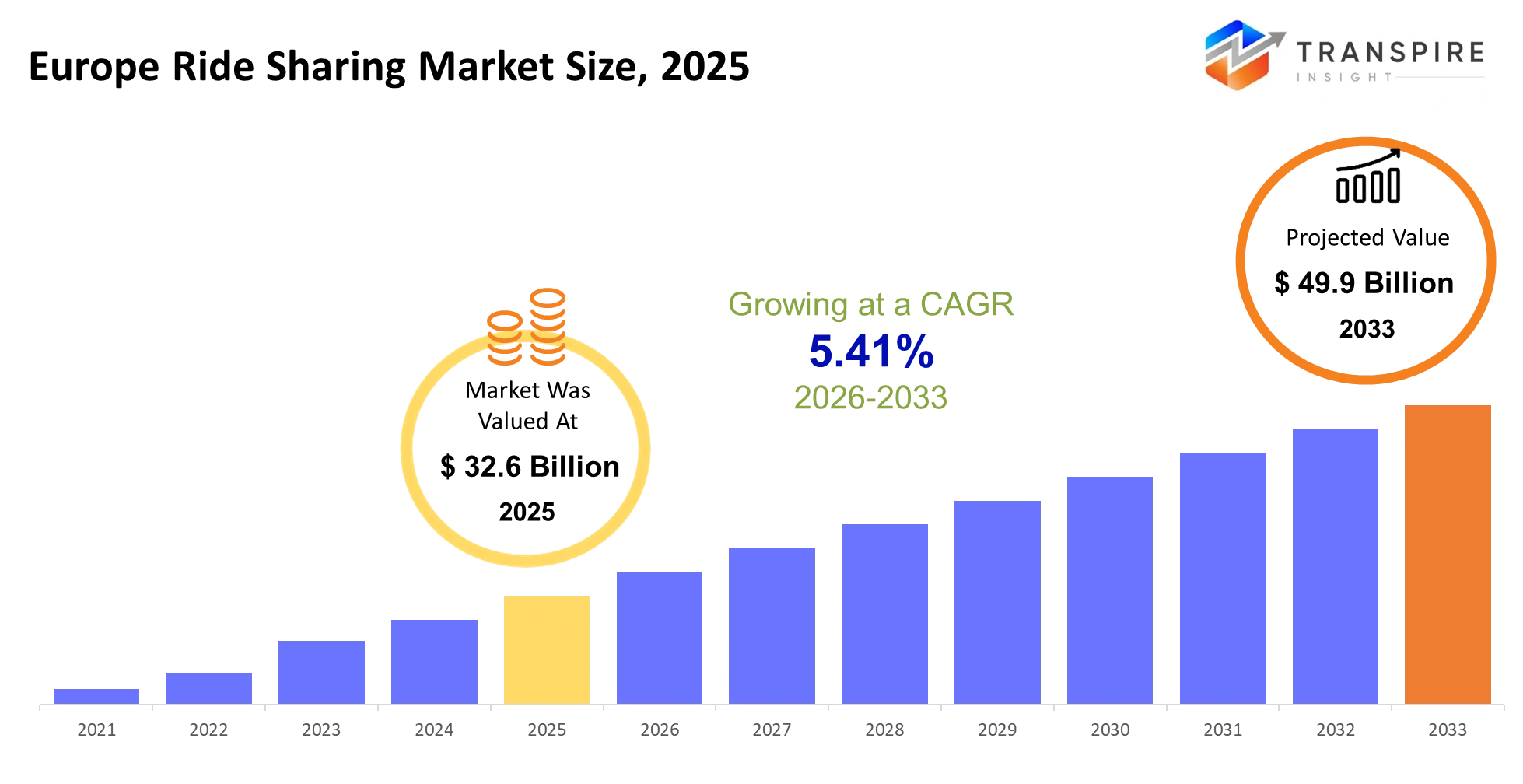
- Europe Ride Sharing Market Size 2025: USD 32.6 Billion
- Europe Ride Sharing Market Size 2033: USD 49.9 Billion
- Europe Ride Sharing Market CAGR: 5.41%
- Europe Ride Sharing Market Segments: By Type (Car Sharing, Bike Sharing, Scooter Sharing, Ride Hailing, Others); By Application (Urban Mobility, Corporate Transport, Airport Transfers, Others); By End-User (Individuals, Businesses, Tourists, Others); By Platform (Mobile Apps, Web Platforms, Others).
To learn more about this report,  Download Free Sample Report
Europe Ride Sharing Market Summary
The Europe Ride Sharing Market was valued at USD 32.6 Billion in 2025. It is forecast to reach USD 49.9 Billion by 2033. That is a CAGR of 5.41% over the period.
The Europe Ride Sharing Market establishes itself as the main solution for urban mobility problems through its provision of operational transportation solutions that enable travelers and tourists and business personnel to move without needing to own a vehicle. App-based mobility platforms help reduce parking pressure, shorten wait times, and improve first-mile and last-mile connectivity across densely populated cities. The market evolved during the past five years when businesses changed their strategy from acquiring new users through electric vehicle fleets and AI-powered route management and multimodal transportation systems to implementing highly profitable operational systems. The introduction of low-emission regulations across cities such as London and Paris and Amsterdam led to a market shift because these rules made vehicle ownership more expensive and operationally restricted drivers.
The COVID-19 recovery period brought about changes in rider behavior because consumers showed a growing preference for digitally managed on-demand transport which operated without the need for crowded transit systems. Subscription-based mobility services became more popular among urban travelers because of the dual impact of fuel price fluctuations and congestion charges. The structural changes led to higher platform usage which resulted in better fleet performance and increased revenue through recurring customer contracts for ride-sharing companies throughout main European transport routes.
Key Market Insights
- Western Europe controlled nearly 48 percent of the European Ride Sharing Market because its cities had high population density and established digital payment systems in 2025.
- Northern Europe became the fastest-expanding regional market between 2026 and 2033 because electric mobility incentives and unified public transportation systems supported its growth.
- Ride hailing held over 46% industry share in 2025 because consumers increasingly preferred flexible app-based transportation over private vehicle ownership.
- Municipalities developed low-emission mobility corridors which enabled scooter sharing to achieve its highest growth rate after 2023.
- Car sharing held the second-largest market share because congestion pricing systems together with increased parking fees became active in Germany France and the Netherlands.
- Daily commuters who use on-demand transportation services contributed to urban mobility applications which generated approximately 52% of market revenue in 2025.
- Airport transfer services experienced substantial growth after 2022 as international tourism recovery brought increased ride-sharing demand to major European airport areas.
- Individual consumers represented more than 60% of total booking activity which showed rapid growth for corporate transport subscriptions at multinational companies after 2023.
- Mobile app platforms controlled about 85% of the market because users preferred systems that provided real-time booking and digital payments combined with AI route optimization.
- Uber Technologies and Bolt Technology and FREE NOW and BlaBlaCar and Cabify enhanced their competitive strength through electric vehicle partnerships and their plans to grow into new geographical markets.
What are the Key Drivers, Restraints, and Opportunities in the Europe Ride Sharing Market?
The European Ride Sharing Market expands because urban transportation policies which prohibit private vehicle access to congested urban areas function as its primary market growth driver. The cities of London, Paris and Milan expanded their congestion pricing areas along with their low-emission zones after 2021, which created higher expenses for daily commuters who wanted to drive their personal vehicles. The new regulations forced consumers to use app-based mobility services, which provided them with instant access to transportation options that charged them based on their needs without requiring them to own anything. The ride-sharing companies began to grow their electric vehicle fleets while creating subscription-based ride packages, which led to more trips and better customer retention throughout urban areas.
The biggest restraint remains the fragmented regulatory environment across European countries and municipalities. The cities establish distinct rules for their licensing process, driver classification methods, insurance requirements and operational limits, which results in increased difficulty for platform providers to manage their operations. The structural barrier requires operators to spend more money on legal compliance while their business growth gets delayed because of the need to develop new pricing systems and labor structures for different jurisdictions. The approval process takes too long because legal problems keep happening, which prevents smaller mobility startups that lack regulatory experience from generating revenue.
Smart city investments will enable multimodal transportation networks to develop through their support of multimodal mobility system integration. German, Dutch and Scandinavian transit authorities develop partnerships with ride-sharing platforms to offer users a complete digital solution for public transportation, bike sharing and ride hailing services.The current shift establishes permanent business opportunities for AI-powered mobility management systems and dynamic price determination methods and complete urban transit subscription services which will remain available until 2033.
What Has the Impact of Artificial Intelligence Been on the Europe Ride Sharing Market?
The combination of artificial intelligence with advanced digital technologies creates new methods to monitor marine emissions through automated systems which use predictive analytics and real-time compliance management. Ship operators increasingly deploy AI-enabled scrubber performance systems that continuously monitor sulfur oxide emissions washwater quality and pressure levels together with exhaust temperatures without needing manual supervision. Integrated control platforms can automatically adjust scrubber flow rates and reagent dosing to maintain compliance with International Maritime Organization sulfur regulations while reducing unnecessary energy consumption. The use of digital optimization software together with exhaust gas cleaning technology enables several vessel operators to achieve fuel savings between 3% and 7% according to their reports.
Machine learning models enable predictive maintenance through their capacity to examine vibration patterns together with corrosion indicators and pump efficiency data which onboard sensors gather. These systems enable crews to detect component failures before they lead to complete breakdowns which results in two benefits: decreased unplanned maintenance downtime and higher vessel operational capacity. AI-driven emissions forecasting tools provide additional assistance to operators by enabling them to choose appropriate fuel sources while planning their routes according to anticipated regional emission control requirements. The process of adopting this technology faces obstacles because maritime routes require expensive integration solutions and their long-distance operations lead to problems with data transmission which reduces system performance during severe operating conditions.
Key Market Trends
- Since 2021 European cities have implemented stricter low-emission transport rules, which required major transport companies to introduce electric ride-sharing services throughout Paris and Amsterdam.
- Uber and Bolt established new electric vehicle partnerships after 2022, while drivers increasingly shifted toward battery-powered vehicles to reduce their operating expenses and keep their costs down during traffic congestion.
- Shared scooter operators began to control their fleet growth after 2020 because they needed to balance their focus on profitability with their parking compliance requirements and their long-term municipal licensing agreements.
- Between 2022 and 2025 corporate mobility subscriptions became more popular because businesses started to cut employee car allowances while they established centralized transportation expense management systems.
- European nations especially Germany and Scandinavian countries developed stronger ties between ride-sharing applications and public transportation systems which resulted in improved services for first-mile and last-mile urban travel.
- The introduction of AI-powered route optimization tools after 2023 allowed operators to achieve better efficiency by reducing downtime between tasks while using their vehicle fleet.
- The demand for airport transfers increased across Southern Europe since 2022, which resulted in the expansion of premium ride categories and multilingual app support.
- European Union regulators established new worker protection requirements, which forced ride-sharing companies to change their driver pay and employment policies.
- After 2023 consumers preferred multimodal mobility packages, which combined ride hailing and bike sharing and public transport into single subscription platforms.
Europe Ride Sharing Market Segmentation
By Type:
Ride hailing holds the largest market share because urban consumers continue to prioritize convenience, real-time booking access, and flexible transportation pricing. The strong smartphone penetration together with widespread digital payment adoption enables European cities to achieve high daily trip volumes. The regulatory approval process for licensed ride-hailing operators in the United Kingdom Germany and France creates stronger pathways for businesses to expand their operations. The continued investment in electric vehicle fleets together with AI-based route optimization will boost operating margins and service efficiency throughout the entire forecast period.
Car sharing maintains its consistent presence in highly populated urban areas because parking shortages and congestion charges prevent people from using their own cars. The business will expand its operations through municipal sustainability initiatives and low-emission transportation regulations which are more important than tourism and temporary transportation needs. Bike sharing and scooter sharing continue expanding through short-distance mobility use cases linked to university districts, commercial centers, and transit hubs. The market expansion will push mobility providers to establish multimodal transportation subscription services while developing better battery management systems for their shared micro-mobility vehicles.

To learn more about this report, Download Free Sample Report
By Application:
The highest revenue stream for urban mobility system results from the strong need for app-based transportation . High fuel prices together with traffic congestion and parking shortages compel people to use shared transportation services which offer them flexible travel options. Municipal governments also support this segment through investments in smart city transportation systems and integrated public transit networks. Urban areas will see increasing demand for low-emission transport which will lead mobility operators to establish partnerships with local transit authorities until 2033.
The corporate transport sector experiences growth because businesses use ride sharing services to decrease their fleet costs while achieving their sustainability targets. The market shows strong demand from technology companies and financial sector organizations and international corporations which operate in major business centers. The airport transfer business is expanding as international tourism and business travel resume in Europe’s aviation industry. Service providers will develop premium ride services and subscription travel products and corporate expense management systems because future applications will provide new market opportunities.
By End-User:
The primary end-user group consists of individual users because personal commuters make the most frequent bookings on urban transportation networks. Young professionals and students who live in markets with high population density show interest in the service because it offers them flexible pricing and immediate vehicle access and mobile app features. The younger generation exhibits a growing preference for on-demand transportation services because they show decreased interest in owning vehicles for extended periods. The electric ride fleet expansion and loyalty-based pricing system will boost customer retention for this market segment in the upcoming years.
The market receives dependable financial support from businesses which use employee transportation contracts and scheduled mobility programs to generate ongoing revenue. Corporations require stable transport services to meet their upcoming transportation needs which makes their demand less affected by seasonal market changes. Tourist demand continues increasing in culturally significant destinations where travelers prefer app-based transport over unfamiliar public transit systems. The business and tourist sector will expand which will lead operators to develop multilingual platform capabilities and digital security features and integrated travel booking partnerships.
By Platform:
Mobile apps exist as the primary platform type because users value their ability to book rides immediately while tracking vehicles in real time and making payments through their mobile devices. The widespread use of mobile internet throughout Europe enables people to use ride-sharing services during their daily travel periods. App-based ecosystems provide operators with the ability to create personalized customer experiences through customized pricing options and route suggestions and loyalty rewards that help maintain customer relationships. The upcoming competition between platforms will focus on three main areas which include artificial intelligence-based trip management systems and predictive analytics for demand forecasting and systems that enable seamless transportation planning across different modes of travel.
Web platforms maintain a smaller but stable presence among corporate clients and pre-scheduled transport services that require centralized booking management. Enterprise users often use desktop systems to manage expenses and coordinate employee transportation and plan their future business travel. The urban market is starting to adopt integrated smart city kiosks and third-party mobility aggregators as new platform channels. Digital mobility ecosystems will expand as platform developers increase their focus on creating secure systems and enabling users to access different platforms while managing their vehicle fleets through cloud technology.
What are the Key Use Cases Driving the Europe Ride Sharing Market?
The primary reason people in Europe use ride sharing services is because they need to travel within urban areas. The app-based mobility services help daily travelers in major cities to save money on both parking and fuel costs and to avoid low-emission zone congestion charges. Public transport systems work better when passengers use short-distance services during peak hours at work.
Business travelers and tourism operators are showing increasing interest in corporate mobility solutions which provide airport transfer services. Organizations are turning to ride sharing services for their employee transportation needs because it helps them minimize vehicle expenses while achieving their environmental sustainability objectives. Intercity travelers now have an increasing demand for transportation services which provide them with flexible options to reach their first and last destinations.
The future of urban transportation will develop through shared electric rides and subscription-based mobility services which connect multiple users. European cities are currently testing integrated mobility platforms which link ride sharing services with autonomous vehicle operations and intelligent traffic control systems.
|
Report Metrics |
Details |
|
Market size value in 2025 |
USD 32.6 Billion |
|
Market size value in 2026 |
USD 34.5 Billion |
|
Revenue forecast in 2033 |
USD 49.9 Billion |
|
Growth rate |
CAGR of 5.41% from 2026 to 2033 |
|
Base year |
2025 |
|
Historical data |
2021 - 2024 |
|
Forecast period |
2026 - 2033 |
|
Report coverage |
Revenue forecast, competitive landscape, growth factors, and trends |
|
Regional scope |
Europe (Germany, United Kingdom, France, Italy, Spain, Rest of Europe) |
|
Key company profiled |
Uber, Lyft, Bolt, BlaBlaCar, Free Now, Ola, Grab, Didi, Gett, Cabify, Via, Yandex Taxi, Careem, Zipcar, Turo. |
|
Customization scope |
Free report customization (country, regional & segment scope). Avail customized purchase options to meet your exact research needs. |
|
Report Segmentation |
By Type (Car Sharing, Bike Sharing, Scooter Sharing, Ride Hailing, Others); By Application (Urban Mobility, Corporate Transport, Airport Transfers, Others); By End-User (Individuals, Businesses, Tourists, Others); By Platform (Mobile Apps, Web Platforms, Others). |
Which Regions are Driving the Europe Ride Sharing Market Growth?
The market functions under European control because regional authorities enforce maritime safety regulations and environmental standards that represent the highest international standards for commercial shipping operations. The North Sea and Baltic Sea coastal countries maintain advanced port facilities which enable operators to conduct large vessel monitoring and equipment retrofitting and regulatory compliance work. The region contains multiple established shipowners and marine equipment suppliers and classification societies and maritime technology companies which continuously develop their operational systems. The European shipping industry benefits from a developed system which allows operators to implement new technologies while achieving high compliance levels for their domestic and international shipping operations.
North America remains a strong contributor to global market revenue, although its position differs from Europe because growth comes more from economic resilience and long-term capital stability than from regulatory intensity alone. The United States and Canadian commercial shipping industry continues to invest in fleet upkeep and digital navigation technology and operational efficiency initiatives during times of freight market fluctuations. The region’s established financial and insurance systems provide support for predictable investment cycles which enable shipowners to modernize vessels and expand their maritime operations. Suppliers and service providers establish reliable revenue streams through contracts that they receive on a recurring basis which includes scheduled technology upgrades.
The Asia-Pacific region will experience its highest growth rate until the year 2033 since governmental bodies are implementing port modernization and fleet expansion initiatives throughout their principal shipping territories. The countries of China, India, Singapore, and Southeast Asian nations have increased their investments for developing smart port systems, environmentally friendly ship technologies, and domestic shipbuilding facilities to improve their ability to compete in international trade markets. The shipping industry has responded to new environmental regulations and increased export activities by replacing their old ships with better-performing vessels that comply with international operating standards. The fast-paced changes in the market create chances for new companies and investors to establish partnerships and provide high-tech maritime solutions while they build their local business presence throughout the period between 2026 and 2033.
Who are the Key Players in the Europe Ride Sharing Market and How Do They Compete?
The European ride sharing industry experiences moderate consolidation because two multinational companies operate most of the market while local companies maintain their regional markets through regulations and unique service offerings. The competition today depends more on platform technology and driver network density and electric and multimodal transport system connections than on price competition. Local mobility applications together with new autonomous mobility partnerships create challenges for existing companies which operate in cities with increasing emissions restrictions and labor law enforcement. Companies need to develop geographic flexibility because Western European operating models require different strategies when entering Central and Eastern European markets.
Through its platform size and dynamic pricing system and autonomous mobility partnerships Uber Technologies competes in the market. The company combines ride hailing and micromobility and premium chauffeur services to create a unique service that competes against traditional urban transport providers. The company has expanded its European footprint through acquisitions and robotaxi partnerships that strengthen long-term technology positioning. Bolt Technology attracts drivers and users who focus on pricing because it operates with a commission structure that is and in Eastern Europe. The company establishes customer loyalty through its food delivery and scooter rental services which help it to expand its business in smaller cities.
FREE NOW distinguishes itself through its complete unification with authorized taxi networks and public transportation systems which it operates throughout major European cities. The company uses this hybrid mobility method to achieve regulatory approval in cities that impose strict urban transportation regulations.BlaBlaCar operates its business model through intercity transport which enables the company to provide lower operational expenses while maintaining its competitive advantage through shared mobility services that operate in longer distances. The company expands its operations through partnerships with multiple transport modes which enable customers to book bus and rail and ride-sharing services from one unified system.
Company List
Recent Development News
“In March 2026, Uber Technologies entered a strategic partnership with Pony.ai and Verne to launch Europe’s first commercial robotaxi service in Zagreb. The partnership marked a significant step toward autonomous ride-sharing commercialization in Europe and established a scalable framework for expansion into additional European cities.
Source: https://investor.uber.com
“In April 2025, Lyft announced the acquisition of FREENOW from BMW and Mercedes-Benz Mobility for approximately $197 million. The acquisition enabled Lyft’s entry into the European ride-sharing market and expanded its operational footprint across more than 150 cities in nine European countries.
Source: https://www.reuters.com
What Strategic Insights Define the Future of the Europe Ride Sharing Market?
The European ride sharing market proceeds toward an urban mobility ecosystem which unites multiple transportation systems through platforms that provide both point-to-point services and multimodal networks which include ride sharing, micro-mobility, public transit, and electric vehicle subscriptions. The transition occurs because emissions regulations become stricter while urban areas experience rising congestion expenses and people select flexible transportation options instead of needing their private vehicles. The European cities face a hidden danger because their separate regulatory systems create different labor classification standards and data-localization rules which will harm platform expansion and profitability despite high demand increases. The Central and Eastern European secondary cities offer an untapped market potential because electric fleet incentives and smart city funding increase throughout the region beyond Western Europe. Market actors need to establish partnerships with municipal transit agencies and electricity distribution companies which will help them meet local regulations while they electrify their vehicle fleets and gain access to city transportation agreements before upcoming regulatory challenges materialize.
Europe Ride Sharing Market Report Segmentation
By Type
- Car Sharing
- Bike Sharing
- Scooter Sharing
- Ride Hailing
- Others
By Application
- Urban Mobility
- Corporate Transport
- Airport Transfers
- Others
By End-User
- Individuals
- Businesses
- Tourists
- Others
By Platform
- Mobile Apps
- Web Platforms
- Others
Frequently Asked Questions
Find quick answers to common questions.
The Europe Ride Sharing Market size is USD 49.9 Billion in 2033.
Key segments for the Europe Ride Sharing Market are By Type (Car Sharing, Bike Sharing, Scooter Sharing, Ride Hailing, Others); By Application (Urban Mobility, Corporate Transport, Airport Transfers, Others); By End-User (Individuals, Businesses, Tourists, Others); By Platform (Mobile Apps, Web Platforms, Others).
Major Europe Ride Sharing Market players are Uber, Lyft, Bolt, BlaBlaCar, Free Now, Ola, Grab, Didi, Gett, Cabify, Via, Yandex Taxi, Careem, Zipcar, Turo.
The Europe Ride Sharing Market size is USD 32.6 Billion in 2025.
The Europe Ride Sharing Market CAGR is 5.41% from 2026 to 2033.
- Uber
- Lyft
- Bolt
- BlaBlaCar
- Free Now
- Ola
- Grab
- Didi
- Gett
- Cabify
- Via
- Yandex Taxi
- Careem
- Zipcar
- Turo
Recently Published Reports
-
Apr 2026
ATV & UTV Market
ATV & UTV Market Size, Share & Analysis Report By Type (ATV, and UTV), By Variants (Less Than 400 CC, 400 CC To 800 CC, and More Than 800 CC), and Geography (North America, Europe, Asia-Pacific, Middle East and Africa, South and Central America), 2021 - 2031
-
Apr 2026
Automotive Central Gateway Module Market
Automotive Central Gateway Module Market Size, Share & Analysis Report By Type (Ethernet Central Gateway Module, CAN Central Gateway Module, LIN Central Gateway Module, and FlexRay), By Application (Powertrain Control, Body Control, Infotainment System, Advanced Driver Assistance Systems (ADAS), and Others), By End User (Passenger Vehicles, and Commercial Vehicles), and Geography (North America, Europe, Asia-Pacific, Middle East and Africa, South and Central America), 2021 - 2031
-
Apr 2026
Automotive Engine Oil Filter Market
Automotive Engine Oil Filter Market Size, Share & Analysis Report By Filter Type (Fuel Filter, Engine Oil Filter, Hydraulic Oil Filter, and Others), By Filter Media (Cellulose, Synthetic, and Micro), By Sales Channel (OEMs, and Aftermarket), By Vehicle Type (Passenger Cars, Light Commercial Vehicles, Heavy Duty Trucks, Buses and Coaches, and Off-road Vehicles), and Geography (North America, Europe, Asia-Pacific, Middle East and Africa, South and Central America), 2021 - 2031
-
Apr 2026
Automotive Parts Aluminium Die Casting Market
Automotive Parts Aluminium Die Casting Market Size, Share & Analysis Report By Production Process (Pressure Die Casting, Vacuum Die Casting, Squeeze Die Casting, Gravity Die Casting), By Application (Body Parts, Engine Parts, Transmission Parts, Battery And Related Components, Other Application Types), and Geography (North America, Europe, Asia-Pacific, Middle East and Africa, South and Central America), 2021 - 2031
Our Clients