

Europe Cream Cheese Market Summary
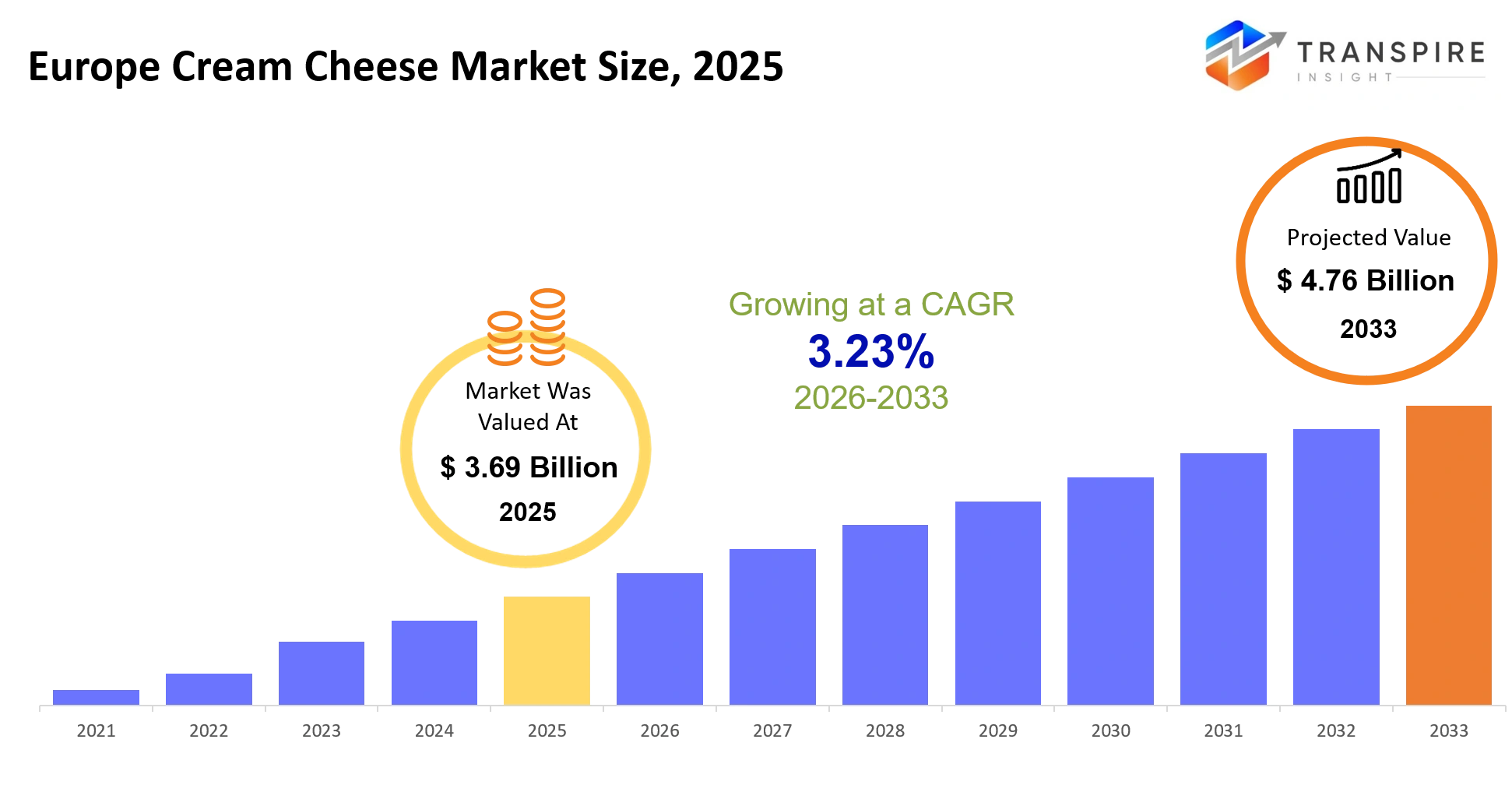
As per Transpire Insight Analysis the Europe Cream Cheese Market size is estimated at USD 3.69 Billion in 2025 and is anticipated to reach USD 4.76 Billion by 2033, growing at a CAGR of 3.23% from 2026 to 2033.
The Europe Cream Cheese Market kind of helps food manufacturers, bakeries, restaurants, and retail brands a lot, because it offers a flexible dairy ingredient that smooths out the texture, boosts the taste, and keeps everything consistent for both sweet bites and more savory meals. In a way it’s like a steady little base that works across lots of menu ideas and product runs. But it’s not only about the usual traditional spreads though, you’ll also see it in ready to eat dishes, desserts, sauces, and even those premium snacking items where you need steady performance while everything is being processed , and then later stored. Over the last three to five years , the market has been kinda leaning more toward clean label recipes, protein enriched formulas , and dairy ingredients that are locally sourced, because retailers and shoppers care more now about ingredient transparency, and what’s actually in there. Then those COVID 19 related supply chain troubles, plus higher dairy input costs, basically pushed companies to rethink sourcing, logistics, and everything that follows through. So yeah regional production became more common, and partnerships with suppliers got tighter, not just on paper but in day to day execution. This whole adjustment also made manufacturers invest more in product innovation and operational efficiency so that premium offerings, the foodservice comeback push, and value-added formulations can improve revenue opportunities across the European dairy scene.
Europe Cream Cheese Market Size & Forecast:
- Europe Cream Cheese Market Size 2025: USD 3.69 Billion
- Expected Market Value 2033: USD 4.76 Billion
- Forecast CAGR: 3.23%
- Leading region in 2025: France
- Fastest Growing region: Poland
- Key Profile: Kraft Heinz (Philadelphia), Arla Foods, Lactalis, Savencia Fromage & Dairy, Bel Group, FrieslandCampina, Fonterra, Danone, Müller Group, Kerry Group, Schreiber Foods, Organic Valley, Daiya Foods, Tofutti Brands, Violife.
Key Market Insights
- Western Europe kinda dominated the Europe Cream Cheese Market about 63% market share in 2025, mostly led by Germany, France and the United Kingdom, through already established dairy processing capacity and yeah pretty clear scale.
- Central and Eastern Europe will stay the fastest-growing regional market during 2025–2033, pushed by retail infrastructure that keeps getting bigger and also premium dairy consumption that looks like it’s rising.
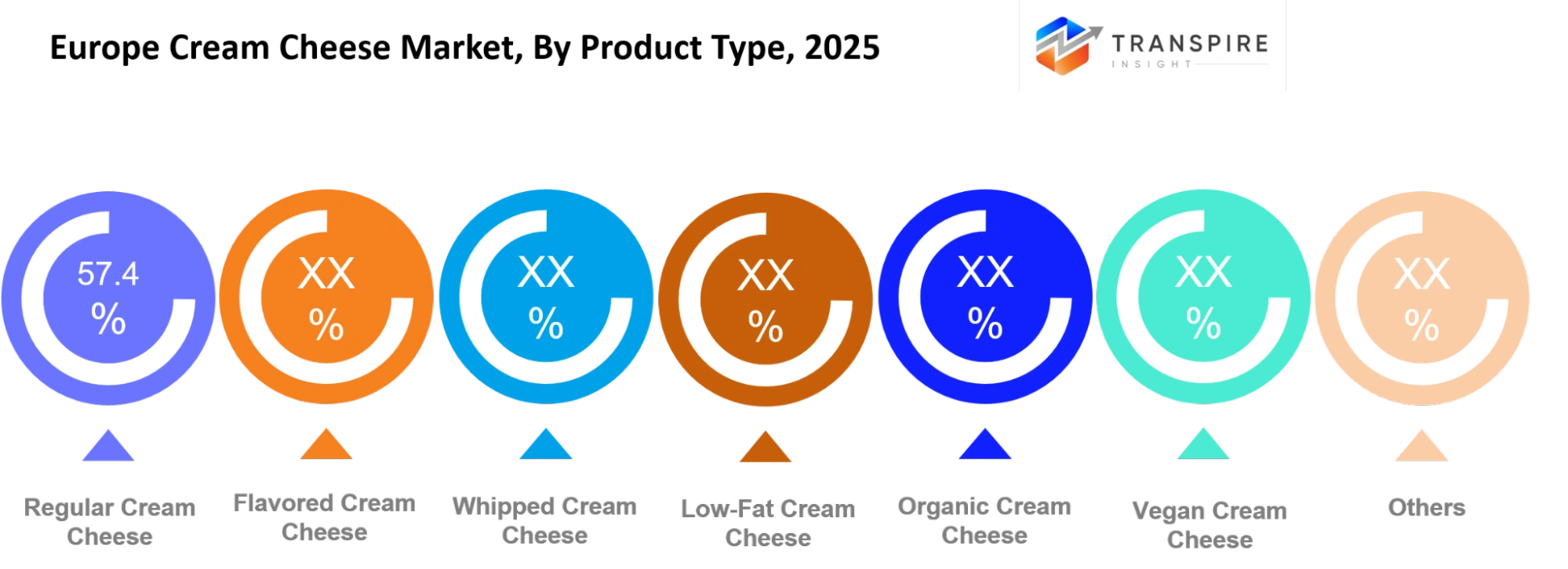
- In the product segment, plain cream cheese was in the lead with almost 56% in 2025, helped by broad bakery uses, foodservice , and household applications too.
- Flavored cream cheese came next as the second-largest segment, and manufacturers rolled out herb, garlic, fruit, plus dessert-inspired varieties across European retail channels.
- Protein-enriched and functional cream cheese will probably be the quickest growing through 2033, driven by product development focused on premium nutrition, and a more differentiated retail positioning.
- For applications, bakery and confectionery actually accounted for around 41% of market share in 2025, supported by steady commercial demand for cheesecakes, pastries, and desserts.
- Meanwhile ready-to-eat meals and convenience foods will grow the fastest across the forecast window , as manufacturers broaden their premium packaged food portfolios.
- By end user, food manufacturers led, with nearly 48% share in 2025, and that comes from large-scale ingredient procurement plus diversified production.
- Foodservice operators look set to be the fastest-growing end-user category through 2033, supported by menu innovation, and those premium café offerings happening across Europe.
What are the Key Drivers, Restraints, and Opportunities in the Europe Cream Cheese Market?
Clean label reformulation , and premium dairy innovation keeps coming up as the most solid growth lever across the European cream cheese scene. Retailers pushed harder on ingredient traceability , plus private-label rules shifted, so producers had to make their recipes feel simpler, sometimes a bit more clean, but also better nutritionally. At the same time they rolled out protein-forward formats and also lower-fat versions , in order to reach the higher margin shoppers. Together this has widened the premium lineup on shelves, improved brand placement, and opened extra revenue chances in retail, in bakery use, and within foodservice too.
Still, the biggest structural drag is the volatility in dairy input costs , since milk supply, energy charges, and haulage expenses can swing across several producing countries. Even if companies add capacity, it cannot instantly fix things, because dairy processing expansions need heavy capital and take a long time to land. Many manufacturers then hold back on new launches , or they reduce promotion intensity, just to defend their margin. According to Transpire Insight , looking over regional procurement announcements and the timing of launches, supply chain concentration is the main execution risk. These pressures dampen the possible revenue lift and they also slow down portfolio diversification , even when demand for new variants appears.
The biggest long-run opportunity is really in functional dairy products, kind of backed by sophisticated processing technology and ongoing premium nutrition investments. You see, protein-enriched formulations, lactose free variants,and also those clean label specialty items, they all push into higher value product groups. Beyond that, Central and Eastern Europe seems to have workable expansion conditions too, mainly because modern retail development is picking up and food manufacturing investments are ramping. All these elements should help wider commercial adoption, and in the end improve long term profitability across regional dairy producers.
What Has the Impact of Artificial Intelligence Been on the Europe Cream Cheese Market?
Artificial intelligence , and digital manufacturing platforms are kind of reshaping dairy production, by boosting quality control, smoothing process consistency, and overall making operations more efficient through cream cheese manufacturing. Computer vision systems automatically check texture , color, and whether packaging is actually in one piece. At the same time AI-enabled monitoring platforms keep watching production parameters all the time, so there is less need for manual inspection and fewer processing deviations. Plus, digital compliance tools help with food safety paperwork, and makes traceability easier across these pretty complex manufacturing operations.
Machine learning models help with demand forecasting too, kind of, they do it by combining retailer sales numbers, seasonal buying rhythms, plus promotional activity and then that mixture helps fine tune production timing and inventory placement. On top of that, predictive analytics can notice equipment wear early, before failures actually show up, so processors can arrange maintenance during scheduled shutdowns rather than getting stuck with sudden stops. Basically, in the end these technologies raise plant utilization, reduce raw material waste, improve production efficiency, and lower operating costs while still supporting more stable product availability across European distribution networks.
Even so, the wider uptake of AI is still kinda constrained, mainly because integration costs are high and a lot of older manufacturing systems are fragmented. Smaller dairy processors often do not have standardized production data that accurate predictive models really need.
And bringing modern analytics into existing processing equipment takes a lot of investment too. As a result, these hurdles keep slowing the digital transformation in parts of the regional dairy processing industry.
Key Market Trends
- Since 2022 , manufacturers have been speeding up clean label reformulations, mainly by taking out artificial stabilizers but still keeping the texture right, using better dairy processing technologies, kind of like a softer swap.
- Protein enriched cream cheese portfolios grew quite a bit in 2023–2025, and that has opened up premium pricing chances, across supermarkets, and also in specialty retail spaces .
- Between 2022 and 2025, European retailers gave a bit more shelf room to lactose free and reduced fat dairy products so, in return they nudged a wider variety of items even when the category was already crowded kind of , yeah.
- Food manufacturers also started leaning harder toward cream cheese for premium ready meals and chilled snacking, because convenience food innovation picked up again after those pandemic supply adjustments. It was delayed, but then a steady rebound came along, little by little.
- From 2023 onward regional dairy processors invested in automation plus digital quality monitoring, which boosted how consistent production felt, and cut down on processing losses.
- Arla Foods and Lactalis then expanded their premium dairy innovation approaches, by putting out more differentiated products, centered on nutrition and also a value added kind of positioning.
- Private label dairy brands gained more shelf presence during 2024, which raised competitive pressure on branded manufacturers through premium quality offerings , but at prices that are still competitive.
- Central and Eastern European processing investments picked up after 2023 , and this strengthened regional manufacturing capacity while shortening distribution lead times , more quickly than before.
- Sustainable packaging rollouts expanded across major dairy companies too, with recyclable materials and lower emission production initiatives becoming a core part of procurement requirements, not just a side note.
Europe Cream Cheese Market Segmentation
By Product Type :
Regular cream cheese ended up taking the largest share, mostly because it shows up everywhere, like in many households, bakeries, restaurants, and also in food manufacturing . The texture stays pretty consistent, the flavor feels nicely balanced, and it really works with both sweet and savory uses. So, because of that, the commercial sales kept looking strong, and bakery manufacturers would usually go for the regular version for cheesecakes, pastries, fillings, and even the frostings.At the same time, foodservice operators leaned on it for dependable results during high volume prep.
Flavored cream cheese then held the second-largest spot, kind of by default, due to better retail availability and those more premium launches , think herbs, fruits, spices, and dessert kinds of blends. Meanwhile vegan, organic, and low-fat options kept growing, since dairy producers put more money into specialty portfolios that matched shifting dietary preferences. Whipped cream cheese also got more attention, not only because it spreads easily, but because the texture feels lighter, and then some other specialty products added extra room for growth across premium retail and foodservice channels too.
By Distribution Channel :
Supermarkets , and hypermarkets showed the top sales pretty consistently, largely due to broad shelf real estate, the refrigerated storage capacity being handled well, and promotional drives that pushed shoppers into more regular buys. Bigger retail chains also kept widening premium dairy ranges, plus they leaned into private label stuff, so customers across Western and Central Europe saw a broader spread of products. On top of that, solid supplier ties and streamlined distribution routes helped keep inventory levels steady all year , without too much empty stock drama.
Foodservice meanwhile stayed around the second biggest distribution route since restaurants , cafés and bakeries started using cream cheese more often in desserts, on breakfast menus, and even in prepared meal formats. Online retail grew at the quickest pace because digital grocery apps made the products easier to reach and home delivery felt more convenient. Specialty stores then had fairly stable demand, mostly by carrying premium, organic, and artisanal dairy products, which basically attracted the more quality minded buyers in a rather direct way.
By Application :
Bakery applications took the largest share, because cream cheese kept being a key ingredient in cheesecakes, pastries, muffins and a range of premium baked things. Commercial bakeries really liked the consistent texture part, stable baking performance, and dependable flavor even when they had huge production volumes to manage. On top of that, innovation in bakery fillings and frostings, like new blends and smoother mouthfeel, kept the long-term demand pretty steady for big scale use.
Desserts then came in second, supported by premium refrigerated items and restaurant menus that feature cream based recipes. Dips and spreads grew pretty fast too, since retailers rolled out flavored, convenient packaging formats for daily eating. Cooking uses and snack applications also expanded, through ready to eat meals and premium convenience food development, and that basically opened more commercial opportunities overall.
By End User :
Food manufacturers were basically the leading end user segment since bigger production facilities brought up sizable ingredient volumes for packaged foods, desserts, sauces and ready meals. There were long term procurement arrangements , plus steady manufacturing timetables, so regional dairy processors stayed pretty consistent with purchases. Also product novelty in premium convenience foods helped push commercial ingredient demand even further.
Bakeries and restaurants stayed as key clients, mainly because they use cream cheese in desserts, breakfast items, sandwiches, and special menu dishes. At the household level, retail sales stayed robust from everyday cooking routines and quick snacking habits , nothing too fancy. On top of that, other commercial customers added more income by handling niche food preparation and catering needs .
By Packaging Type :
Tubs sort of dominated the packaging demand , because convenient storage it really does help, resealable designs, and that extended freshness matched up well with both retail and foodservice needs . Manufacturers kept investing in lighter tub designs that are recyclable too, in order to boost logistics efficiency and still hit those sustainability targets . Even premium product lines seemed to gain a lot, mostly from eye-catching shelf presentation, plus practical consumer handling, you know, the day to day stuff.
Blocks were the second-largest packaging format , mainly because commercial bakeries and food manufacturers liked bulk handling and processing efficiency . Cups also picked up momentum across single-serve and on-the-go categories, while sachets supported portion-controlled foodservice applications . A few other formats handled specialized commercial requirements , and helped with premium positioning across certain retail channels .
What are the Key Use Cases Driving the Europe Cream Cheese Market?
Bakery production still looks like the biggest use case really, because commercial bakeries rely on cream cheese for cheesecakes, pastries, fillings, and frostings that need a steady texture and dependable processing performance. Large food manufacturers , and also bakery chains, buy it in big quantities so they can keep product quality pretty much the same across several production locations
Prepared desserts plus refrigerated convenience foods are still growing too. This is happening as food manufacturers roll out premium ready-to-eat items with more differentiated flavors, and nicer shelf appeal. You also see restaurant chains, and café operators, add cream cheese into breakfast menus , sandwiches, and their own signature dishes, mostly to broaden variety and boost perceived customer value
On the other side, newer opportunities are showing up in protein-boosted dairy products and in plant-based cream cheese alternatives aimed at specialty retail and health-driven food manufacturers. Clean label product development is part of it, and recyclable packaging efforts as well, since retailers are pressing harder on ingredient transparency and sustainability obligations across European food supply chains
|
Report Metrics |
Details |
|
Market size value in 2025 |
USD 3.69 Billion |
|
Market size value in 2026 |
USD 3.81 Billion |
|
Revenue forecast in 2033 |
USD 4.76 Billion |
|
Growth rate |
CAGR of 3.23% from 2026 to 2033 |
|
Base year |
2025 |
|
Historical data |
2021 - 2024 |
|
Forecast period |
2026 - 2033 |
|
Report coverage |
Revenue forecast, competitive landscape, growth factors, and trends |
|
Country scope |
Europe (Germany, United Kingdom, France, Italy, Spain and Rest of Europe) |
|
Key company profiled |
Kraft Heinz (Philadelphia), Arla Foods, Lactalis, Savencia Fromage & Dairy, Bel Group, FrieslandCampina, Fonterra, Danone, Müller Group, Kerry Group, Schreiber Foods, Organic Valley, Daiya Foods, Tofutti Brands, Violife. |
|
Customization scope |
Free report customization (country, regional & segment scope). Avail customized purchase options to meet your exact research needs. |
|
Report Segmentation |
By Product Type (Regular Cream Cheese, Flavored Cream Cheese, Whipped Cream Cheese, Low-Fat Cream Cheese, Organic Cream Cheese, Vegan Cream Cheese, Others); By Distribution Channel (Supermarkets & Hypermarkets, Convenience Stores, Online Retail, Specialty Stores, Foodservice, Others); By Application (Bakery, Desserts, Dips & Spreads, Cooking, Snacks, Others); By End User (Households, Restaurants, Bakeries, Food Manufacturers, Others); By Packaging Type (Tubs, Blocks, Sachets, Cups, Others). |
Which Regions are Driving the Europe Cream Cheese Market Growth?
Western Europe manages about 63% of the regional revenue, so it becomes the biggest area, basically for cream cheese production and also for what people buy and eat there. The thing is, strong food safety rules, really solid dairy processing requirements, and an efficient cold-chain setup kinda help keep product quality steady in most of the major markets. In Germany, France, and the United Kingdom, there are already strong dairy processors, plus supplier links that are pretty integrated, and they keep putting money into manufacturing capacity, and product innovation as well. With retail demand staying stable, premium product ideas, and distribution that works, the region should keep its lead during the entire forecast window.
Southern Europe comes next as the second largest regional contributor, mainly because the culinary traditions are strong, so consumption stays consistent in both retail and foodservice. Italy and Spain, for example , get a lot from tourism that doesn’t really wobble much, and from hospitality that stays dependable, which then creates purchase behavior that is kind of reliable across the year. Regulatory compliance stays on track too, and investment in modern food processing facilities continues, which supports long term production strength. In the end, balanced domestic use plus commercial food manufacturing should keep bringing dependable revenue through the forecast period.
Central and Eastern Europe will probably see the fastest expansion during 2026–2033, since food manufacturing investment and modern retail development are accelerating across Poland, Romania, the Czech Republic and Hungary. In other words, expanded cold storage infrastructure, improved dairy processing facilities and extra focus on premium packaged foods have, in the last few years, reinforced regional production capability. Also, private investment is higher, while supermarket penetration is becoming broader so that commercial opportunities for premium dairy products are getting stronger. Overall these moves should open attractive expansion angles for manufacturers , distributors, and investors looking for higher-growth European markets, even if things feel a bit uneven market to market.
Who are the Key Players in the Europe Cream Cheese Market and How Do They Compete?
Competition across the Europe Cream Cheese Market still looks sort of moderately consolidated, mainly because only a handful of multinational dairy firms account for a big chunk of the output, and then regional manufacturers kind of chase their own corners within local markets. What really keeps the competition going are things like product quality manufacturing efficiency, distribution reach, and also premium product innovation, not just one thing. The older dairy players keep trying to defend their share by doing portfolio expansion, while the smaller regional specialists push harder by targeting premium, organic, and functional dairy categories, in a way that feels a bit more niche.
Arla Foods handles its lineup with protein-focused dairy innovation, plus ongoing investment in sustainable production, so it can get deeper penetration across both retail and foodservice routes. Lactalis, meanwhile, improves its positioning by expanding its premium cheese offering, and it leans on a very wide European manufacturing network, which helps with supply reliability. FrieslandCampina tends to emphasize advanced dairy processing technology along with operational efficiency, supporting stable product quality while also optimizing costs across several markets.
Savencia Fromage & Dairy is really all about specialty cheese development, and premium product differentiation too, which helps them get a stronger stand in value-added dairy categories, you know. Bel Group keeps expanding with fresh product launches that try to match changing customer preferences, while at the same time reinforcing distribution across various European retail chains. Meanwhile, DMK Group carries on investing in regional production capacity and manufacturing modernization, making supply more flexible and it also backs commercial partnerships with food manufacturers as well as private-label retailers.
Company List
- Kraft Heinz (Philadelphia)
- Arla Foods
- Lactalis
- Savencia Fromage & Dairy
- Bel Group
- FrieslandCampina
- Fonterra
- Danone
- Müller Group
- Kerry Group
- Schreiber Foods
- Organic Valley
- Daiya Foods
- Tofutti Brands
- Violife
Recent Development News
In June 2025, Arla Foods confirmed a strategic production investment focused on expanding cream cheese manufacturing in Denmark. The additional processing capacity is intended to strengthen supply resilience and support future growth across European and export markets.
Source: https://webinar.arlafoodsingredients.com/
In June 2025, Arla Foods announced a €59.4 million investment to expand cream cheese production capacity at its Holstebro dairy in Denmark. The expansion will add approximately 16,000 tonnes of annual capacity, strengthening European supply for both retail and foodservice markets.
Source: https://fei-online.com/
What Strategic Insights Define the Future of the Europe Cream Cheese Market?
The Europe Cream Cheese Market is likely to drift, uh, toward higher value product baskets instead of pure volume chasing for the next five to seven years. Basically, product differentiation via functional nutrition, clean label formulations and more advanced dairy processing will become the main driver in how revenue grows over the long run as retailers and food manufacturers push premium options, with stronger profit margins. There is also a quieter risk, kind of less in your face, tied to how concentrated the milk supply and dairy processing already are, where lingering disruptions, or even stricter environmental rules, could push up production costs and then limit pricing flexibility across the whole value chain. Meanwhile precision fermentation and upgraded dairy ingredient technologies are opening a newer window for hybrid and specialty cream cheese styles that better fit changing requirements in food manufacturing. Firms that show up early with regional processing capacity, digital production systems, and premium formulation skills, while also diversifying their supplier base will probably be in a better spot to improve resilience and catch those long term commercial chances across European markets.
Europe Cream Cheese Market Report Segmentation
By Product Type
- Regular Cream Cheese
- Flavored Cream Cheese
- Whipped Cream Cheese
- Low-Fat Cream Cheese
- Organic Cream Cheese
- Vegan Cream Cheese
By Distribution Channel
- Supermarkets & Hypermarkets
- Convenience Stores
- Online Retail
- Specialty Stores
- Foodservice
By Application
- Bakery
- Desserts
- Dips & Spreads
- Cooking
- Snacks
By End User
- Households
- Restaurants
- Bakeries
- Food Manufacturers
By Packaging Type
- Tubs
- Blocks
- Sachets
- Cups
Frequently Asked Questions
Find quick answers to common questions.
The expected Europe Cream Cheese Market size for the market will be USD 4.76 Billion in 2033.
Key segments for the Europe Cream Cheese Market are By Product Type (Regular Cream Cheese, Flavored Cream Cheese, Whipped Cream Cheese, Low-Fat Cream Cheese, Organic Cream Cheese, Vegan Cream Cheese, Others); By Distribution Channel (Supermarkets & Hypermarkets, Convenience Stores, Online Retail, Specialty Stores, Foodservice, Others); By Application (Bakery, Desserts, Dips & Spreads, Cooking, Snacks, Others); By End User (Households, Restaurants, Bakeries, Food Manufacturers, Others); By Packaging Type (Tubs, Blocks, Sachets, Cups, Others).
Major Europe Cream Cheese Market players are Kraft Heinz (Philadelphia), Arla Foods, Lactalis, Savencia Fromage & Dairy, Bel Group, FrieslandCampina, Fonterra, Danone, Müller Group, Kerry Group, Schreiber Foods, Organic Valley, Daiya Foods, Tofutti Brands, Violife.
The Europe Cream Cheese Market size is USD 3.69 Billion in 2025
The Europe Cream Cheese Market CAGR is 3.23% from 2026 to 2033.
- Kraft Heinz (Philadelphia)
- Arla Foods
- Lactalis
- Savencia Fromage & Dairy
- Bel Group
- FrieslandCampina
- Fonterra
- Danone
- Müller Group
- Kerry Group
- Schreiber Foods
- Organic Valley
- Daiya Foods
- Tofutti Brands
- Violife
About the Authors

Chetan Dhatrak
I’m Chetan Dhatrak, a Senior Research Analyst at Transpire Insight, specializing in the Consumer Goods, Foods and Beverages industry. I focus on analyzing market trends, consumer behavior, competitive landscapes, and industry developments to deliver accurate, data-driven insights. My research at Transpire Insight is built on credible sources and in-depth analysis, helping businesses and readers better understand market dynamics, emerging opportunities, and evolving consumer preferences. I’m committed to creating reliable, well-researched content that supports informed decision-making and reflects the latest developments in the consumer goods and food & beverage sectors.

Chakradhar Khansole
Chakradhar serves as the Research Director at Transpire Insight, bringing over 8 years of experience in technology, innovation, and strategic market intelligence. He specializes in transforming complex market data into actionable business insights that enable organizations to make informed, growth-oriented decisions. Recognized for his strategic vision and analytical expertise, Chakradhar leads high-impact research initiatives, delivering comprehensive market assessments, competitive intelligence, and forward-looking industry analysis.
Recently Published Reports
-
Apr 2026
Baby Infant Formula Market
Baby Infant Formula Market Size, Share & Analysis Report By ype (Infant Milk, Follow On Milk, Specialty Baby Milk, Growing-Up Milk), By Ingredient (Carbohydrate, Fat, Protein, Minerals, Vitamins, and Others), By Product Form (Powder, Liquid, and Ready-to-feed), By Distribution Channels (Supermarket/Hypermarket, Specialty Store, Pharmacies, Online Retail, and Others), and Geography (North America, Europe, Asia-Pacific, Middle East and Africa, South and Central America), 2021 - 2031
-
Apr 2026
Edible Insects for Animal Feed Market
Edible Insects for Animal Feed Market Size, Share & Analysis Report By Type (Insect Powder, Insect Meal, Insect Bar, Insect Paste, Insect Oil, and Others), By Insect Type (Beetles, Cricket, Caterpillar, Hymenoptera, Orthoptera, Tree Bugs, and Others), By Application (Livestock, Pet Food, and Aquaculture), By Livestock Type (Poultry, Swine, and Others), and Geography (North America, Europe, Asia-Pacific, Middle East and Africa, South and Central America), 2021 - 2031
-
Apr 2026
Food Industry Disinfection and Bacterial Control Market
Food Industry Disinfection and Bacterial Control Market Size, Share & Analysis Report By Type (Chemical Disinfectants, Physical Disinfectants, and Biocides and Antimicrobials), By Application (Food Processing Equipment Surface Disinfection, Food Preparation Areas Surface Disinfection, Storage Areas Surface Disinfection, Anti-microbial Coatings Food Preservation, and Preservative Solutions Food Preservation), By End User (Meat and Poultry Processing, Dairy Processing, Seafood Processing, Bakery and Confectionery, Restaurants and Commercial Kitchens, and Food Service Providers), By Sales Channel (Online, Offline), and Geography (North America, Europe, Asia-Pacific, Middle East and Africa, South and Central America), 2021 - 2031
-
May 2026
Freeze Dried Food Market
Freeze Dried Food Market Size, Share & Analysis Report By Product Type (Fruits, Vegetables, Freeze-Dried Dairy Products, Freeze-Dried Meat and Seafood, Freeze-Dried Pet Food, and Prepared Meal), By Nature (Organic, and Conventional), By Form (Powdered, Granules, and Diced), By End Use (Breakfast Cereals, Dairy Products, Bakery & Confectionery, Nutritional Bars & Supplements, Powdered Beverages, Snacks, and Retail (Household)), and Geography (North America, Europe, Asia-Pacific, Middle East and Africa, South and Central America), 2021 - 2031