
Asia Pacific Supply Chain Management Market Summary
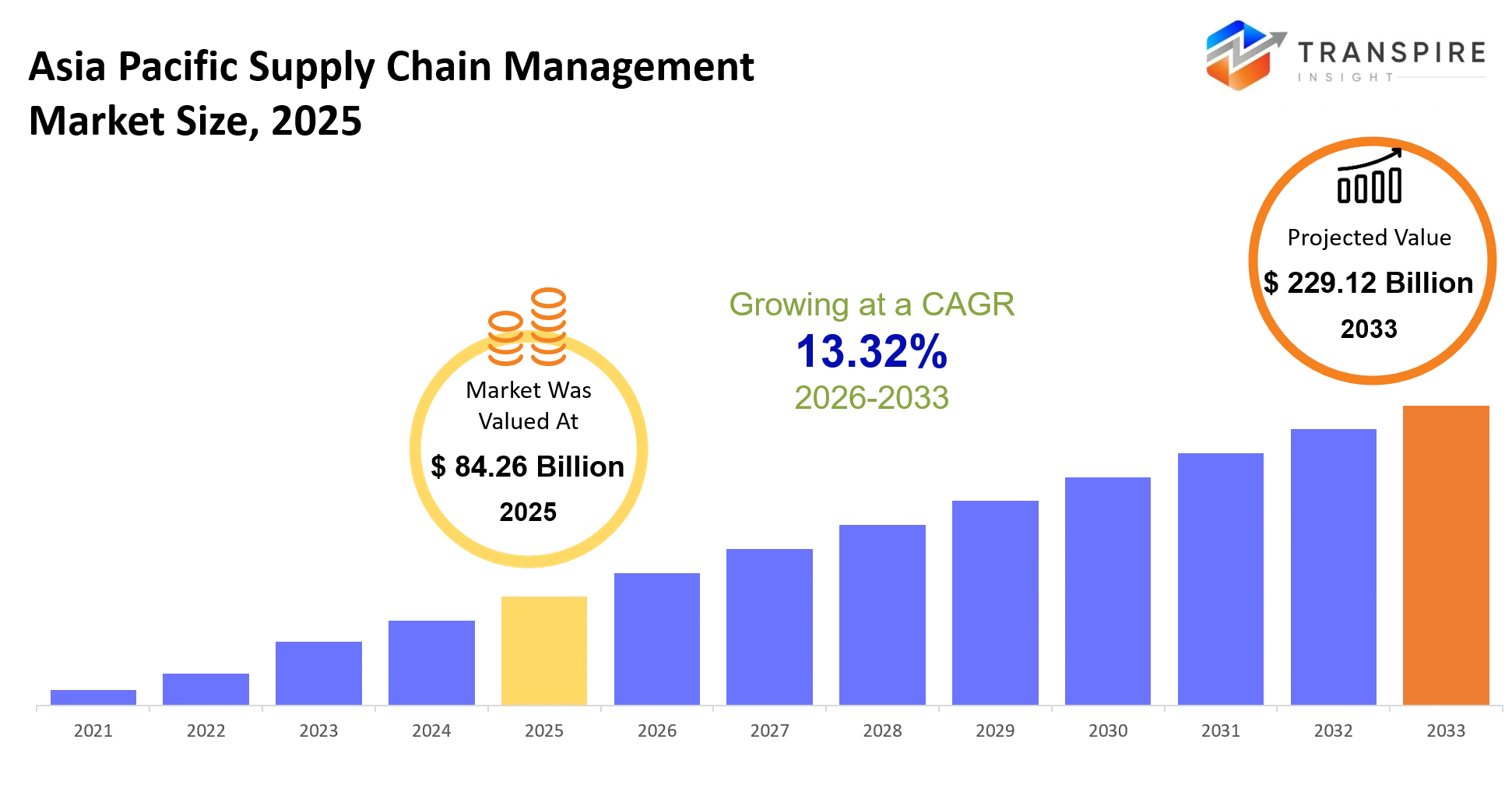
As per Transpire Insight Analysis the Asia Pacific Supply Chain Management Market size is estimated at USD 84.26 Billion in 2025 and is anticipated to reach USD 229.12 Billion by 2033, growing at a CAGR of 13.32% from 2026 to 2033.
The Asia Pacific Supply Chain Management Market sort of helps manufacturers, retailers, logistics providers, and distributors line up sourcing, production, inventory, shipment moving, and order delivery across those tricky regional plus worldwide networks. When solutions connect suppliers, storage hubs, carriers, and end customers through digital platforms, then supply chain management services can cut down operational delays, make inventory more precise, and also back quicker business decisions. In the last five years, the market kinda moved away from just cost centered planning, and it has leaned more toward resilient, data driven supply chain orchestration. This shift is often powered by cloud platforms, artificial intelligence, and real-time analytics, so everything feels more connected in practice.
During the COVID-19 pandemic, the weaknesses showed up fast in cross border sourcing and inventory control, so many organizations began to rework their supply networks, while also trying to strengthen operational visibility , overall. And now as firms diversify production sites, extend regional trade routes, and take up predictive planning tools, investment keeps drifting toward more integrated supply chain platforms. That change generally allows a quicker reaction to disruptions, boosts how well resources are used, and creates tangible operational value, which then pushes more enterprise adoption. As a result, the sustained revenue growth keeps looking more likely .
Asia Pacific Supply Chain Management Market Size & Forecast:
- Asia Pacific Supply Chain Management Market Size 2025: USD 84.26 Billion
- Expected Market Value 2033: USD 229.12 Billion
- Forecast CAGR: 13.32%
- Leading region in 2025: China
- Fastest Growing region: India
- Key Profile: SAP, Oracle, Blue Yonder, Manhattan Associates, Infor, Kinaxis, IBM, Microsoft, Oracle NetSuite, Epicor, Körber, Descartes Systems, E2open, Logility, Coupa Software
Key Market Insights
- China kind of dominated the Asia Pacific Supply Chain Management Market , with an estimated 38% market share in 2025, and it looks like this was backed by deep manufacturing activity plus logistics digitization .
- India should show the quickest rise across 2025–2033 , mainly due to industrial expansion , new digital infrastructure spending, and a push for supply chain modernization too.
- In the product mix, software solutions led with roughly 67% market share in 2025, since many organizations preferred a unified planning approach, transportation oversight, and warehouse control platforms all together.
- For services, it stayed the second biggest segment, supported by roll-out work, consulting , managed services, and those longer enterprise transformation initiatives.
- Cloud based supply chain platforms are forecast to grow the fastest through 2033, helped by scalable deployment options, along with reduced infrastructure expenses .
- In applications, transportation and logistics management took the lead, holding about 32% of revenue in 2025, which pretty clearly mirrors the need for end-to-end shipment visibility.
- Demand planning plus predictive analytics is expected to be the fastest-growing application by 2033, driven by AI forecasting capabilities and real-time data joining.
- Manufacturing accounted for around 34% market share in 2025, because factories kept investing in connected production and supplier collaboration tools .
- Finally, retail and e-commerce is projected to become the fastest-growing end user category through 2033, supported by omnichannel fulfillment and inventory optimization programs.
What are the Key Drivers, Restraints, and Opportunities in the Asia Pacific Supply Chain Management Market?
The main growth driver is kinda the fast shift toward digital transformation in manufacturing, and logistics activities across Asia Pacific, right. Cloud adoption along with AI-enabled planning, and even broader regional supply chain diversification, picked up pace after the pandemic disruptions basically showed where operations were kinda weak. In that time, governments backed digital infrastructure and smart manufacturing initiatives too. Overall those moves helped with inventory visibility, shortened the planning cycles, and reduced logistics inefficiencies. When operational performance got better, enterprises then tended to swap out separated old systems for integrated supply chain platforms, which in turn strengthened software plus service revenues across the region.
Still, the biggest structural restraint is that digital infrastructure can be fragmented, and tech maturity is uneven across suppliers. A lot of small and medium-sized businesses keep using manual processes, and that limits interoperability with the larger enterprise platforms. Integration projects often demand substantial investment, specialized staff, and a bunch of system tailoring. From a Transpire Insight review of regional procurement announcements and release schedules, supply chain concentration stays the key execution risk. These issues slow down end-to-end deployments, push implementation timelines further out, and end up lowering near-term software adoption across those complicated regional supply networks.
The most powerful future opportunity seems to sit in AI-enabled supply chain orchestration mixed with digital twin models, plus real time analytics, and you know it’s kind of a big deal. In a way, India and Southeast Asia are becoming surprisingly attractive for investment, because manufacturers keep diversifying production away from only the usual traditional hubs. Things like advanced analytics, IoT based asset monitoring, and even autonomous planning systems, will allow organizations to optimize sourcing transportation and inventory all at once, rather than in small separate steps. Firms that connect predictive intelligence to cloud native platforms should gain stronger long term customer retention and that kind of recurring subscription income that keeps showing up again and again.
What Has the Impact of Artificial Intelligence Been on the Asia Pacific Supply Chain Management Market?
Artificial intelligence is slowly but steadily changing supply chain management across Asia Pacific, mostly by automating planning, warehouse operations, procurement workflows and even transportation monitoring, sort of. AI-powered control towers keep scanning inventory levels, supplier results , shipment progress, and logistics bottlenecks, so companies can react to disruptions before they end up messing up production, or customer deliveries. Machine learning models also help a lot with demand forecasting; they do this by mixing past sales data with weather conditions, seasonal patterns, and other market signals, in order to make procurement choices and inventory decisions more precise. Predictive analytics furthermore assists with maintenance timing for warehouse automation tools and transport assets, which cuts down surprise downtime and supports smoother operational continuity. With these functions, warehouse output can rise, inventory holding expenses often drop, order fulfillment becomes more reliable, and delivery cycles get faster across tricky regional supply networks.
Digital twins, meanwhile, let organizations try out sourcing strategies and weigh operational risks before anything is actually rolled out. Even with all of that, AI adoption still hits practical limits. Implementation can be expensive, data quality ends up inconsistent, legacy systems stay fragmented, and interoperability between suppliers is still limited, which keeps slowing the process. Companies also have to set up dependable data governance, since advanced AI models can’t reliably produce correct operational recommendations unless the data is managed well. This gets extra important in multinational supply chains, where technology environments vary quite a lot.
Key Market Trends
- Since 2022, enterprises have started moving away from reactive logistics management towards predictive , AI driven supply chain orchestration across regional manufacturing ecosystems, which is kind of a bigger deal than it sounds at first.
- Cloud native supply chain platforms have replaced quite a few on-premise deployments, cutting down implementation complexity and letting enterprises scale sooner through 2030.
- After 2020, multi country sourcing strategies really took off, and manufacturers began diversifying production across India, Vietnam, Thailand, and Indonesia.
- During 2023 to 2025, real time supply chain visibility platforms saw wider adoption , so shipment tracking got better and supplier collaboration improved across international trade networks.
- Warehouse automation investments also picked up speed, because autonomous mobile robots and AI assisted fulfillment helped raise labor productivity, and order accuracy.
- SAP, Oracle, and Blue Yonder expanded AI powered planning capabilities, to strengthen predictive forecasting as well as inventory optimization across Asia Pacific.
- Starting in 2024, sustainability reporting requirements nudged organizations to use digital platforms that can monitor emissions, transportation efficiency, and supplier compliance.
- Digital twin technology is slowly showing up as a more strategic planning approach, allowing firms to model disruptions and refine sourcing choices before anything is executed.
- Generative AI is increasingly helping procurement teams by handling supplier analysis, supporting contract reviews, and producing operational reporting across enterprise supply chain functions, basically without as much manual effort.
Asia Pacific Supply Chain Management Market Segmentation
By Component :
Software holds the biggest part of the market share, because digital platforms let companies handle purchasing procurement, inventory, shipping logistics, and warehouse operations in one place from a single system. Cloud applications , plus analytics capabilities and automation utilities help managers improve forecast quality while also cutting down on the usual manual tasks across the whole supply chain. With continuous upgrades and subscription based delivery models, many enterprises end up making longer term investments, even if they are smaller or mid size.
Services make up a meaningful slice of the market revenue, since organizations need rollout help, tailored configuration, advisory support and ongoing technical assistance. In practice, system integration links older enterprise tools with newer supply chain platforms, so data can move calmly between departments without friction. Managed services, along with support agreements, keep growing too, because a lot of firms prefer specific know-how to protect performance and security, but also to lower day to day operational complexity.
By Deployment :
Cloud based deployment is leading the market, thanks to flexible infrastructure, less upfront investment, and a quicker setup rhythm that backs digital transformation across industries. With remote access and automatic software refreshes, organizations can boost day to day productivity without having to pour a lot into new infrastructure costs. On top of that, scalability helps growth, so the business can spread across more sites, even when there is no wish to redo major systems.
Hybrid deployment is still catching on with big enterprises that want cloud agility but also need to keep existing on premise infrastructure, you know, because it’s already there. Private cloud solutions still matter a lot for firms that manage sensitive operational data and customer information, especially when compliance rules are strict and can’t be bent. And SaaS keeps expanding too, since subscription models make rollout simpler, while also trimming the ongoing upkeep workload that internal technology teams used to carry.
By Application :
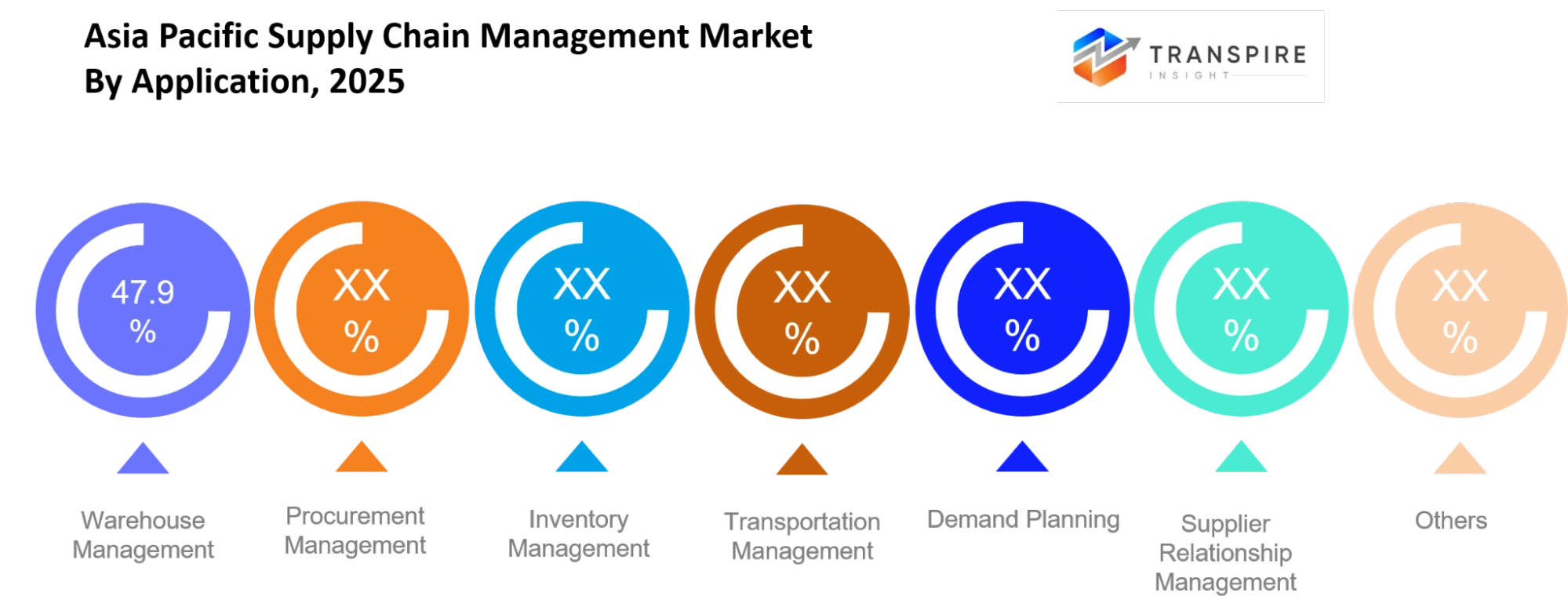
Transportation management is still the leading application, mainly because smooth movement of goods kind of directly affects delivery results, those operating costs and how satisfied customers end up feeling. Digital routing, shipment tracking and freight optimization, together boost clarity across regional logistics networks. When suppliers, warehouses and distribution centers align a bit better, overall operations seem to run in a stronger way.
Demand planning should show the most rapid expansion, since predictive analytics plus artificial intelligence make forecasting more accurate. Inventory management along with warehouse management gets hefty investment too, because companies want quicker order fulfillment and also lower inventory carrying fees. Supplier relationship management platforms help with collaboration in a practical sense by making communication clearer, performance easier to monitor, and procurement planning more consistent across complicated supplier ecosystems.
By End User :
Manufacturing takes the biggest market share because production sites need exact planning, supplier coordination,and clear inventory visibility during the whole production cycle . Digital supply chain platforms let manufacturers cut down operational slow downs while still boosting material availability and refining production scheduling. Also, more factory automation tends to support wider software adoption across industrial work, kind of across the board.
Retail along with logistics keeps growing fast, since e-commerce keeps expanding and makes fulfillment feel more intricate and customer delivery expectations higher . Healthcare orgs meanwhile are pushing harder for supply chain visibility, so they can keep inventory ready for essential medical products. Automotive and food & beverage companies are in that mix too, investing in advanced planning tools, aiming for better operational efficiency , and fewer supply disruptions overall.
By Enterprise Size :
Large enterprises remain the leading users, because extensive supplier networks and rather complex distribution operations need integrated supply chain platforms, so everything stays coordinated. Enterprise wide visibility, predictive planning, and centralized operational control help business performance improve across multiple countries and production facilities. Also, solid technology budgets keep backing continuous investment in advanced digital solutions, even when priorities shift.
Medium enterprises and SMEs are expected to register faster adoption, because cloud based platforms reduce implementation costs and make deployment simpler, it feels more immediate. Subscription pricing lets smaller businesses tap into advanced planning and logistics capabilities without a huge capital outlay, so they can move sooner. Digital transformation initiatives across regional industries will keep supporting broader participation, from companies of different sizes, not just the biggest ones.
What are the Key Use Cases Driving the Asia Pacific Supply Chain Management Market?
Manufacturing is still basically the biggest use case area, since production companies depend on integrated supply chain platforms to keep things coordinated—procurement, inventory, production schedules, and outbound logistics all together. A lot of large manufacturers buy these solutions to cut down production interruptions, boost supplier collaboration, and keep operations steady across several facilities.
Retail and logistics organizations are also leaning into these platforms more and more, mainly to tune warehouse operations, strengthen last-mile delivery, and speed up order fulfillment. Healthcare providers are following suit, using supply chain platforms to raise inventory availability for pharmaceuticals and medical equipment, while also handling strict regulatory rules and quality requirements.
Some newer use cases are starting to show up too, for example AI enabled supply chain control towers, along with digital twin technology for scenario planning and risk assessment. Electronics manufacturers, and automotive suppliers in particular, are beginning to invest in these capabilities to check sourcing alternatives, spot disruptions earlier, and improve long run operational resilience before supply chain problems start affecting production.
|
Report Metrics |
Details |
|
Market size value in 2025 |
USD 84.26 Billion |
|
Market size value in 2026 |
USD 95.48 Billion |
|
Revenue forecast in 2033 |
USD 229.12 Billion |
|
Growth rate |
CAGR of 13.32% from 2026 to 2033 |
|
Base year |
2025 |
|
Historical data |
2021 - 2024 |
|
Forecast period |
2026 - 2033 |
|
Report coverage |
Revenue forecast, competitive landscape, growth factors, and trends |
|
Regional scope |
Asia Pacific (India, China, Japan, Australia, South Korea, Rest of Asia Pacific) |
|
Key company profiled |
SAP, Oracle, Blue Yonder, Manhattan Associates, Infor, Kinaxis, IBM, Microsoft, Oracle NetSuite, Epicor, Körber, Descartes Systems, E2open, Logility, Coupa Software . |
|
Customization scope |
Free report customization (country, regional & segment scope). Avail customized purchase options to meet your exact research needs. |
|
Report Segmentation |
By Component (Software, Services, Consulting, System Integration, Support & Maintenance, Managed Services, Others); By Deployment (Cloud-Based, On-Premise, Hybrid, SaaS, Private Cloud, Others); By Application (Procurement Management, Inventory Management, Warehouse Management, Transportation Management, Demand Planning, Supplier Relationship Management, Others); By End User (Manufacturing, Retail, Healthcare, Automotive, Food & Beverage, Logistics, Others); By Enterprise Size (Large Enterprises, Medium Enterprises, Small Enterprises, SMEs, Others) |
Which Regions are Driving the Asia Pacific Supply Chain Management Market Growth?
China makes up around 38% of the regional revenue, so it is still the main country within the Asia Pacific Supply Chain Management Market. National smart manufacturing efforts, improved logistics infrastructure, and digital transformation policies have basically pushed big adoption of integrated supply chain platforms across multiple industrial sectors. Lots of involvement from manufacturing firms, technology vendors, cloud providers, and logistics operators builds a sort of connected business ecosystem that helps teams keep doing continuous software rollout. Also, ongoing funding into automation, artificial intelligence, and warehouse modernization will keep this position strong during the whole forecast horizon.
Japan is the second biggest regional market, mainly because companies often prefer operational stability, better quality oversight, and sustained technology funding rather than very fast deployment cycles. Stable regulatory expectations, well-developed digital infrastructure, plus tough industrial output all help keep enterprise budgets steady for supply chain modernization. In automotive, electronics, and industrial manufacturing, organizations keep upgrading planning, purchasing, and logistics workflows, to boost day to day efficiency. Because of this, Japan tends to stay a reliable place for repeat income from software licensing, implementation projects, and managed services, not just one time deals.
India is expected to hit the quickest growth in the 2026–2033 window, as industrial expansion, investments in digital infrastructure, and a broader push in manufacturing help speed up technology adoption. There are government moves that support digital manufacturing, logistics modernization, and infrastructure buildout ,and these efforts have encouraged companies to swap out manual routines with more connected supply chain platforms. Meanwhile the pace of growth in e-commerce, third party logistics, plus domestic manufacturing has really boosted demand for cloud based planning and warehouse management solutions . All this momentum then turns into a pretty solid pull for technology vendors, implementation partners, and investors, especially those looking for long-term expansion across emerging enterprise markets.
Who are the Key Players in the Asia Pacific Supply Chain Management Market and How Do They Compete?
Competition in the Asia Pacific Supply Chain Management Market is sort of moderately consolidated, with global enterprise software players running side by side with specialized supply chain technology companies. A big part of what matters is technology innovation, cloud readiness, artificial intelligence, and those industry themed service offerings, which honestly become the main competitive levers. Most established vendors keep expanding their platform, but the smaller specialists still manage to push back with quicker rollouts , sharper analytics and cloud deployment that feels more flexible.
SAP stands out using an integrated enterprise approach that links supply chain operations with finance, manufacturing, and procurement. Ongoing investment in AI-enabled planning plus business network capabilities, helps multinational organizations make decisions with less guesswork. Oracle meanwhile leans hard on cloud-native applications, aiming to make deployment easier and to support scalable operations across regional manufacturing and logistics networks. They also keep improving automation and predictive analytics so customers gain better operational visibility and planning precision.
Blue Yonder competes with advanced demand forecasting, warehouse optimization, and AI based supply chain planning, so predictive intelligence is basically their main differentiator. Kinaxis focuses on concurrent planning technology, allowing firms to react quickly when disruptions happen through real-time scenario analysis. Manhattan Associates continues expanding via intelligent warehouse and transportation management solutions, and they try to boost customer outcomes using automation, omnichannel fulfillment features , and strategic partnerships across Asia Pacific distribution networks.
Company List
- SAP
- Oracle
- Blue Yonder
- Manhattan Associates
- Infor
- Kinaxis
- IBM
- Microsoft
- Oracle NetSuite
- Epicor
- Körber
- Descartes Systems
- E2open
- Logility
- Coupa Software
Recent Development News
In May 2025, Blue Yonder acquired Pledge Earth Technologies. The acquisition added accredited carbon emissions reporting capabilities to Blue Yonder's supply chain platform, strengthening sustainability management for logistics and enterprise customers.
Source https://www.businesswireindia.com/
In June 2026, SAP introduced new AI-driven supply chain orchestration capabilities centered on agentic AI and enhanced SAP Supply Chain Management solutions. The launch strengthened enterprise-wide coordination across procurement, manufacturing, logistics, and planning, supporting faster decision-making and greater operational resilience.
Source https://news.sap.com/
What Strategic Insights Define the Future of the Asia Pacific Supply Chain Management Market?
Over the next five to seven years, the Asia Pacific Supply Chain Management Market will head toward smarter, connected, and more autonomous decision-making, instead of mostly standalone process automation. This shift is pushed by enterprises adopting artificial intelligence, digital twins, and unified cloud platforms that link procurement, manufacturing, logistics, and distribution using live information flows. There is also a quieter danger, namely, market concentration around a small set of cloud infrastructure providers and enterprise software ecosystems, that may raise switching costs, and limit how freely customers can adjust deployments.
At the same time there is an emerging chance that’s easy to overlook: AI-powered supply chain control towers for mid-sized manufacturers across India and Southeast Asia. There, industrial growth, plus investments in digital infrastructure, keeps getting faster. Firms that jump into this space with modular, industry-specific platforms, and solid local implementation partnerships, should end up more ready to win durable recurring income, and still react quickly when customer needs change, or when regional compliance expectations move.
Asia Pacific Supply Chain Management Market Report Segmentation
By Component
- Software
- Services
- Consulting
- System Integration
- Support & Maintenance
- Managed Services
By Deployment
- Cloud-Based
- On-Premise
- Hybrid
- SaaS
- Private Cloud
By Application
- Procurement Management
- Inventory Management
- Warehouse Management
- Transportation Management
- Demand Planning
- Supplier Relationship Management
By End User
- Manufacturing
- Retail
- Healthcare
- Automotive
- Food & Beverage
- Logistics
By Enterprise Size
- Large Enterprises
- Medium Enterprises
- Small Enterprises
- SMEs
Frequently Asked Questions
Find quick answers to common questions.
The expected Asia Pacific Supply Chain Management Market size for the market will be USD 229.12 Billion in 2033.
Key segments for the Asia Pacific Supply Chain Management Market are By Component (Software, Services, Consulting, System Integration, Support & Maintenance, Managed Services, Others); By Deployment (Cloud-Based, On-Premise, Hybrid, SaaS, Private Cloud, Others); By Application (Procurement Management, Inventory Management, Warehouse Management, Transportation Management, Demand Planning, Supplier Relationship Management, Others); By End User (Manufacturing, Retail, Healthcare, Automotive, Food & Beverage, Logistics, Others); By Enterprise Size (Large Enterprises, Medium Enterprises, Small Enterprises, SMEs, Others).
Major Asia Pacific Supply Chain Management Market players are SAP, Oracle, Blue Yonder, Manhattan Associates, Infor, Kinaxis, IBM, Microsoft, Oracle NetSuite, Epicor, Körber, Descartes Systems, E2open, Logility, Coupa Software.
The Asia Pacific Supply Chain Management Market size is USD 84.26 Billion in 2025.
The Asia Pacific Supply Chain Management Market CAGR is 13.32% from 2026 to 2033.
- SAP
- Oracle
- Blue Yonder
- Manhattan Associates
- Infor
- Kinaxis
- IBM
- Microsoft
- Oracle NetSuite
- Epicor
- Körber
- Descartes Systems
- E2open
- Logility
- Coupa Software
About the Authors

Mayur Shinde
I am Mayur Shinde, a Senior Research Analyst at Transpire Insight, specializing in the Automotive & Transportation and Information & Communication Technology (ICT) Industry. My work focuses on analyzing emerging market trends, technological advancements, competitive landscapes, and industry developments to deliver accurate, data-driven insights. I am passionate about transforming complex market information into clear, actionable content that helps businesses, professionals, and decision-makers stay informed and make confident strategic decisions.

Chakradhar Khansole
Chakradhar serves as the Research Director at Transpire Insight, bringing over 8 years of experience in technology, innovation, and strategic market intelligence. He specializes in transforming complex market data into actionable business insights that enable organizations to make informed, growth-oriented decisions. Recognized for his strategic vision and analytical expertise, Chakradhar leads high-impact research initiatives, delivering comprehensive market assessments, competitive intelligence, and forward-looking industry analysis.
Recently Published Reports
-
Apr 2026
3D Optical Profiler Market
3D Optical Profiler Market Size, Share & Analysis Report By Type (Desktop 3D Optical Profiler, and Portable 3D Optical Profiler), By Technology (Confocal Technology, and White Light Interference), By End-Use Industry (Manufacturing, Research Institutions, Automotive, Aerospace and Defense, Medical Devices, and Other), and Geography (North America, Europe, Asia-Pacific, Middle East and Africa, South and Central America), 2021 - 2031
-
Apr 2026
Depth Sensor Market
Depth Sensor Market Size, Share & Analysis Report By Type (Infrared Depth Sensors, Time-of-Flight (ToF) Sensors, Stereo Vision Sensors, Structured Light Sensors, Ultrasonic Depth Sensors), By Application (Automotive, Robotics, Gaming, Consumer Electronics, Industrial Automation, Healthcare, Security & Surveillance, Others), By End Users (Automotive Manufacturers, Consumer Electronics Companies, Healthcare Providers, Industrial Companies, Security Agencies, Gaming Companies, Robotics Companies, Others), and Geography (North America, Europe, Asia-Pacific, Middle East and Africa, South and Central America), 2021 – 2031
-
Apr 2026
Digital Manufacturing Market
Digital Manufacturing Market Size, Share & Analysis Report By Component (Hardware, Software, and Services), By Technology (Robotics, 3D Printing, Internet of Things (IoT), and Others), By Application (Automotive and Transportation, Aerospace and Defense, Consumer Electronics, Industrial Machinery, and Others), By Process Type (Computer-Based Designing, Computer-Based Simulation, Computer 3D Visualization, Analytics, and Others), and Geography (North America, Europe, Asia-Pacific, Middle East and Africa, South and Central America), 2021 – 2031
-
Apr 2026
Digital Visa Services Market
Digital Visa Services Market Size, Share & Analysis Report By Type (Individual Travelers, Group Travelers), By Application (Tourism, Business Travel, Others), and Geography (North America, Europe, Asia-Pacific, Middle East and Africa, South and Central America), 2021 – 2031