

CRISPR-Integrated Gene Editing Delivery Devices Market Summary:
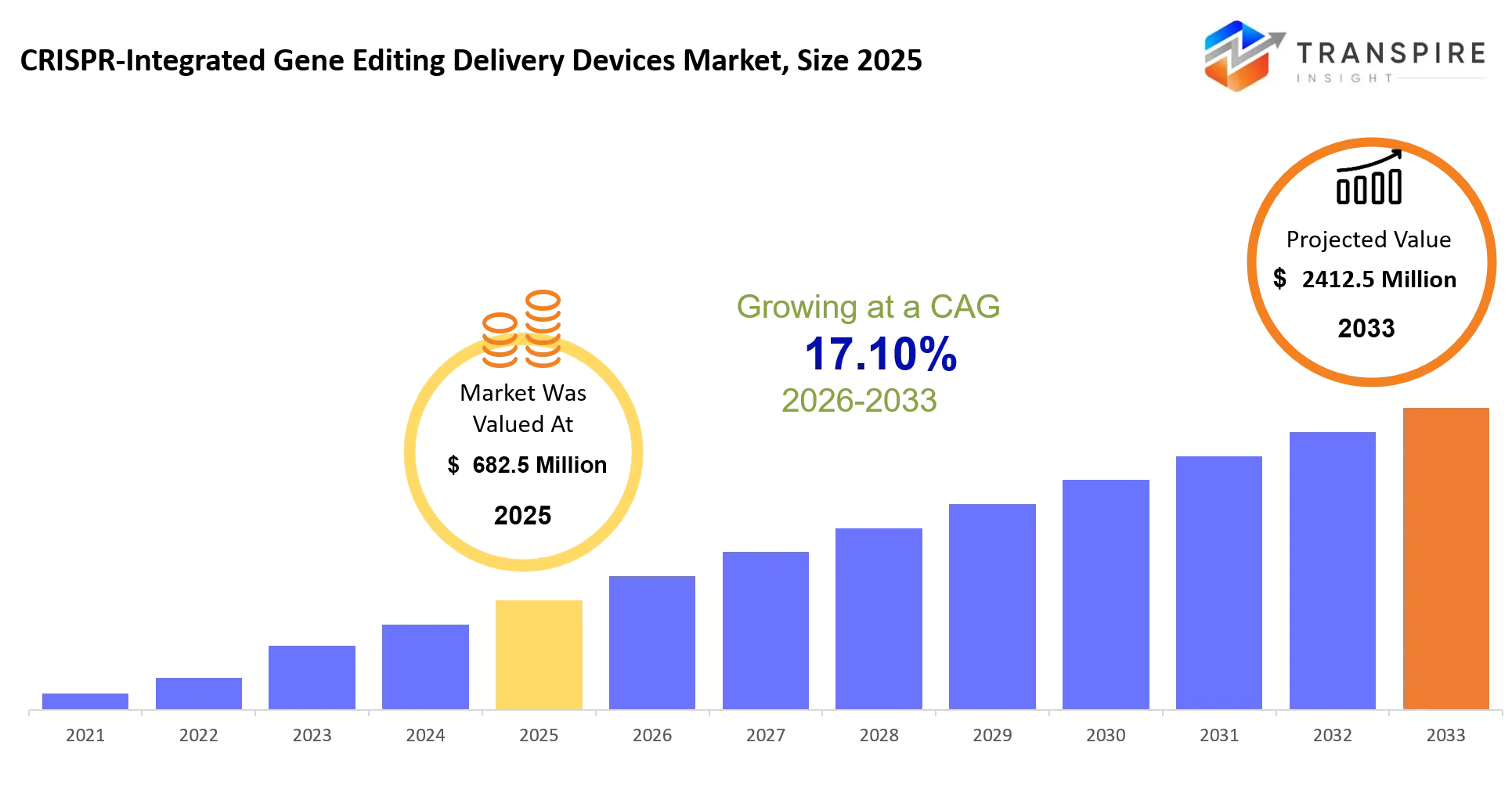
As per the Transpire Insight Analysis, the CRISPR-Integrated Gene Editing Delivery Devices Market size is estimated at USD 682.5 million in 2025 and is anticipated to reach USD 2412.5 million by 2033, growing at a CAGR of 17.10% from 2026 to 2033.
The market offers tools that deliver CRISPR agents, guide RNA, Cas enzymes, or edited cells into target cells with dose control and viability. It translates laboratory editing into programmable workflows for therapy manufacturing, discovery and agriculture. In the last three to five years, demand migrated from research-only transfection to closed, automated, clinical-grade delivery, while lipid nanoparticles rose in strategic importance as developers experimented with alternatives to viral vectors. The structural change was from standalone equipment to integrated platforms with delivery, reagents, analytics, and quality modules. One real-world catalyst was the December 2023 FDA approval of Casgevy, the first clinical CRISPR/Cas9 therapy, which committed delivery efficiency to a commercial manufacturing process. As clinical pipelines mature, manufacturers must assemble large numbers of patient-matched batches with excellent reproducibility; that drive procurement of electroporation systems, non-viral formulations, sensors and digital controls, while regulators reward traceability and reproducibility. It also increases demand for well-validated consumables and ongoing maintenance revenue.
CRISPR-Integrated Gene Editing Delivery Devices Market Size & Forecast:
- Global Market Size 2025: USD 682.5 Million
- Expected Market Value (2033): USD 2412.5 Million
- Forecast CAGR (2026–2033): 17.10%
- Leading Region in 2025: North America
- Fastest Growing Region: Asia Pacific
- Key Company Profiles: Thermo Fisher Scientific, Bio-Rad Laboratories, Lonza, Synthego, GenScript, Integrated DNA Technologies, CRISPR Therapeutics, Editas Medicine, Beam Therapeutics, Intellia Therapeutics, Danaher, Merck KGaA, Sartorius, Takara Bio, MaxCyte
Key CRISPR-Integrated Gene Editing Delivery Devices Market Insights:
The market is heading towards integrated, data-rich delivery platforms; commercial value lies in reproducibility, consumables and validated workflows. The strategic battle is shifting from editing power to whole process performance: targeting, viability, traceability, scale-up and regulatory evidence.
- Vendors are selling closed, sensorized processing, although the 36% share for electroporation is driven by its best fit for ex-vivo cell therapy.
- While viral delivery is now at 24% and is leveling off in challenging-to-transfect applications, payload and immunogenicity concerns are driving innovation toward non-viral delivery.
- LNP systems account for 15% of the market and are gaining formulation partnerships as companies seek to target tissues and can repeat dose and edit in vivo.
- Microinjection retains its 10% share, but is increasingly automated, which means that less reliance is placed on operators for embryo and single-cell work.
- 9% of automated CRISPR platforms are software-linked and traceable, indicating that buyers prefer software-based, linked workflows over standalone platforms.
- Others and Gene Gun systems, both 3%, serve niche and regional applications, which make for specialised delivery opportunities.
- CDMOs are increasingly influencing purchasing decisions, with sponsors increasingly outsourcing cell processing, with a preference for portable protocols and serviceable devices.
- AI-powered design is shifting from guide selection to predictive pulse, dose and formulation optimisation, but validation is still the buy gate.
What are the Key Drivers, Restraints, and Opportunities in the CRISPR-Integrated Gene Editing Delivery Devices Market?
Driver:
Clinically validating delivery is retooling as a billable manufacturing facility the delivery of gene editing services as a billable manufacturing facility, which was previously an expensive experimental step. The successful approval of Casgevy proved to the industry that CRISPR-edited cells are capable of reaching patients, thereby attracting investment in dedicated electroporation systems, consumables and analytics. Better batch-to-batch consistency gives adoption momentum as failed editing, poor cell viability and manual handling can delay expensive therapy campaigns and impact manufacturing robustness throughout clinical production processes.
Restraint:
Delivery continues to be both biologically and commercially challenging. Viral systems are limited in payload, immunogenicity and manufacturing capabilities. Non-viral systems can falter in primary or hard-to-transfect cell lines. This continues to be the case because each tissue, each cell type and every editor demands unique particle chemistry, electric parameters and release testing, making validation a lengthy, capital- and talent-intensive process. Fragmented workflows additionally delay procurement.
Opportunity:
The automated in vivo delivery and smarter ex vivo control. AI-created lipid NPs, compact editors and enclosed robotic platforms could scale editing beyond accessible cells and lower batch-to-batch variation. Funding to hepatic LNP production and Asia-Pacific cell-therapy infrastructure may generate regional need for integrated devices, formulation modules and software, while the FDA's 2026 individualized-therapy framework may facilitate paths to ultra-rare genetic treatments. This relaxes recurrent consumables, validation services and software income across research and commercial manufacture clients, enhancing supplier economics and enabling more sustainable platform contracts.
What Has the Impact of Artificial Intelligence Been on the CRISPR-Integrated Gene Editing Delivery Devices Market?
AI is shifting the industry from trial-and-error delivery to data-driven process control. Guides with models rank guide RNAs by activity and off-target risk while algorithms pre-screen lipid compositions and cargo ratios before trial. In electroporation processes, AI can relate voltage, pulse duration, cell condition, and editor dose to viability and editing yield, then predict parameters to use in the next batch. This introduces predictive features: manufacturers can identify a high likelihood of low-yield runs, predict reagent or cell quality failures, and predict if a construct will work across donors. Computer vision automates cell counts, morphology assessment, alert to contamination, enabling higher throughput and better records. The operative outcome is fewer failures, shorter process development timelines, and more reliable clinical manufacturing, boosting the value of integrated device & software. AI-supported guide design is already recognized as a way to accelerate the development speed of CRISPR processes. The problem is just algorithm accuracy. Good, consistent data sets are limited for cell types, instruments and labs, so models based on one workflow may not be transferable. Merging with validated hardware, cyber-security measures and GMP change-management also pushes the cost, so wider usage is likely to be first in bigger biopharmaceuticals.
In April 2026, Profluent entered into a partnership with Eli Lilly valued at up to $2.25 billion. This collaboration uses Profluent's artificial intelligence models to design precise, site-specific gene-editing tools for therapeutic applications. The partnership aims to overcome traditional trial-and-error design limitations and accelerate the development of next-generation genetic medicines.
Key CRISPR-Integrated Gene Editing Delivery Devices Market Trends:
The delivery market is evolving from a niche for lab equipment to a market for manufacturing control; clinical validation is driving up the importance of reproducibility, and non-viral and automated systems are expanding the addressable workflow. The strategic competition is moving from editing power to performance, viability, traceability, scale-up, and regulatory evidence-focused whole-process editing.
- With payload flexibility and repeat dosing being important, viral-vector bottlenecks have pushed the adoption of electroporation and LNP workflows.
- Since the approval of Casgevy, there has been a shift from prototype instruments to closed and validated systems that can be used for patient-specific commercial batches.
- LNP development has evolved from vaccine formulations to particles that are targeted to tissues for in vivo editing and organ-specific delivery.
- Electroporation has matured from manual cuvette to flow-through, sensor-rich platforms minimising operator variability.
- The need for delivery systems that can bring larger or more complex cargoes without compromising cell viability is growing due to base and prime editing.
- AI is transforming procurement: Developers are looking for more devices with software and predictive analytics.
- As sponsors turn to CDMOs for cell processing, the CDMOs are emerging as important buyers, driving the need for standardized and transferable delivery protocols.
- Regulatory expectations are shifting to more robust off-target, identity and chain of custody evidence, which favours integration of monitoring and digital records.
CRISPR-Integrated Gene Editing Delivery Devices Market Segmentation
By Product Type:
Electroporation Systems top 36% because of high efficiency ex-vivo immune and stem-cell workflows with optimal controllability. Viral Delivery Systems make up 24% and continue to be used where tissue tropism and established protocols outweigh manufacturing burden. Lipid Nanoparticle Delivery Systems are 15% and are the fastest observed growth 20.4% CAGR as in vivo editing and repeat-dose concepts develop. Microinjection Systems are 10% and continue to be valued for specialist use in embryos and single-cell work. Automated CRISPR Delivery Platforms are 9% and are of increasing value through clean, closed, reproducible processing. Gene Gun Systems are 3% and Others 3%, both on niche use, but potentially for plant delivery.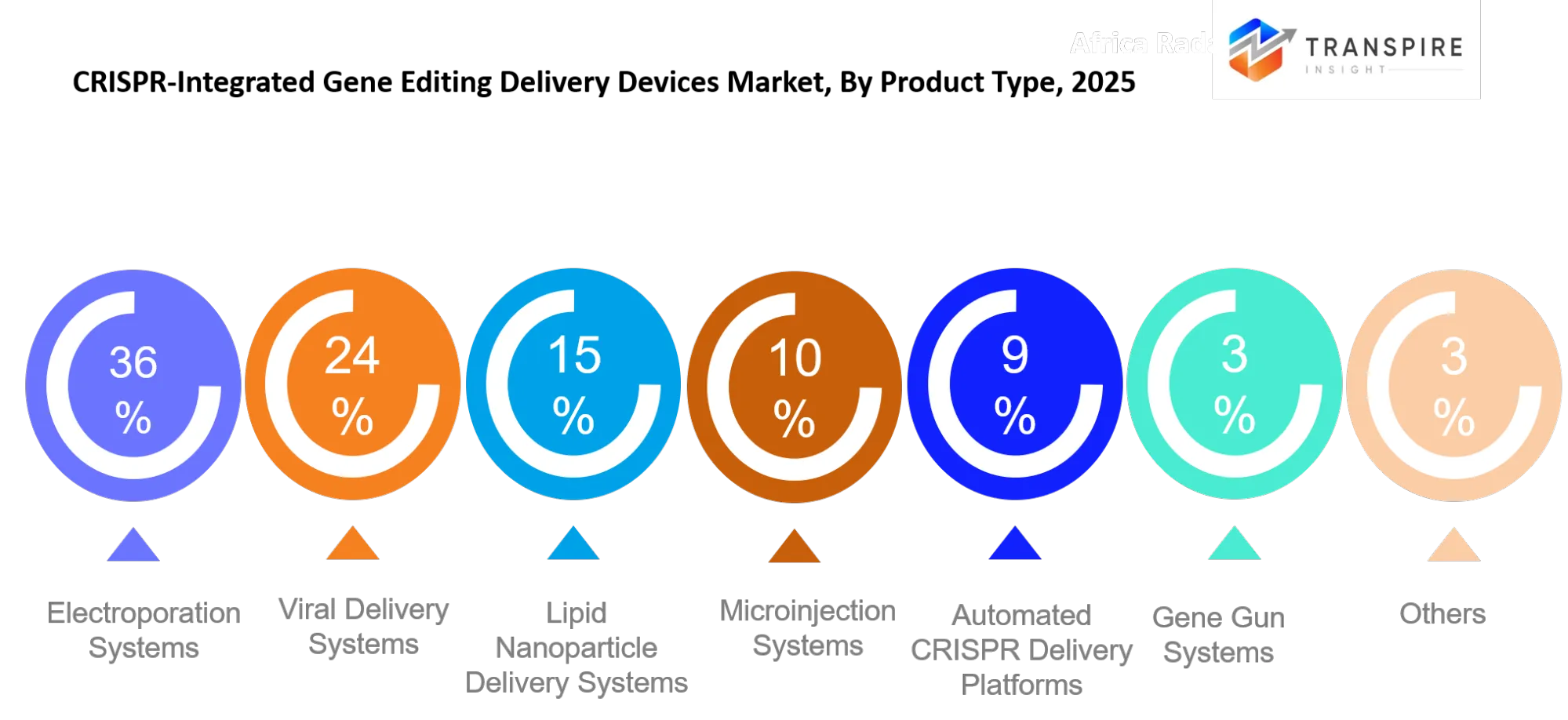
By Application:
Cell Therapy and Gene Therapy are the largest markets, as the single delivery step directly determines the number of edits, viability, and release quality; Drug Discovery and Functional Genomics complement by enabling recurring instrument usage through screening and target validation. Agricultural Biotechnology, Academic Research, and Clinical Research generate the demand, and the growth is proportional to the scalability of the plant transformation and translational workflow.
By End User:
Main users are Biopharmaceutical Companies and Contract Research Organizations, as they are the main users, while Research Institutes and Academic Laboratories provide the means for the method development. Hospitals and Biotechnology Startups will increase demand as treatment sites, and venture-backed pipelines expand internal or partner-driven capacity for broad clinical and research use, driven by growing demand for validated platforms worldwide.
By Technology:
CRISPR-Cas9 continues to be the workhorse for editing, alongside Cas12 enabling broader targeting and multiplexing capabilities. Base editing and Prime editing avenues will deliver significantly increased precision through minimal double-strand breaks, combined with AI-enhanced gene editing platforms offering predictive design and process optimisation, with the additional requirements for delivery cargo protection, titration and scalable process control.
By Distribution Channel:
The majority of validated installations are at Direct Sales and OEM Suppliers because sophisticated systems require application support, validation and servicing. Scientific Equipment Distributors mainly supply research buyers who need efficient sourcing and support, whereas Online B2B Platforms are now more relevant for standardized accessories and consumables. They all promote combined buying, recording, compliance, and life-cycle support.
What are the Key Use Cases Driving the CRISPR-Integrated Gene Editing Delivery Devices Market?
Electroporation-inspired ex vivo cell engineering is the main case, where developers engineer T cells, hematopoietic stem cells and other therapeutic cells before reinfusion. The 36% product share shows that controlled delivery, viability and documented release are required for cell-therapy production.
However, gene therapy development pulls demand to in vivo delivery, where LNP systems deliver the CRISPR cargo to the liver and other target tissues. Drug discovery, functional genomics, and clinical research applications use delivery devices to validate targets, create disease models, and screen edited cell populations, leading to repeat purchases.
Emerging use cases are AI-guided parameters, prime- or base- editing delivery for precision correction, and self-automated platforms for individual ultra-rare disease batches. Agriculture-biotech could adopt gene guns and microinjection for climate-hardy crops, with diversified demand.
|
Report Metrics |
Details |
|
Market size value in 2025 |
USD 682.5 Million |
|
Market size value in 2026 |
USD 799.2 Million |
|
Revenue forecast in 2033 |
USD 2412.5 Million |
|
Growth rate |
CAGR of 17.10% from 2026 to 2033 |
|
Base year |
2025 |
|
Historical data |
2021 - 2024 |
|
Forecast period |
2026 - 2033 |
|
Report coverage |
Revenue forecast, competitive landscape, growth factors, and trends |
|
Regional scope |
United States; Canada; Mexico; United Kingdom; Germany; France; Italy; Spain; Denmark; Sweden; Norway; China; Japan; India; Australia; South Korea; Thailand; Brazil; Argentina; South Africa; Saudi Arabia; United Arab Emirates |
|
Key companies profiled |
Thermo Fisher Scientific, Bio-Rad Laboratories, Lonza, Synthego, GenScript, Integrated DNA Technologies, CRISPR Therapeutics, Editas Medicine, Beam Therapeutics, Intellia Therapeutics, Danaher, Merck KGaA, Sartorius, Takara Bio, MaxCyte |
|
Customization scope |
Free report customisation (country, regional & segment scope). Avail customised purchase options to meet your exact research needs. |
|
Report Segmentation |
By Product Type (Electroporation Systems, Viral Delivery Systems, Lipid Nanoparticle Delivery Systems, Microinjection Systems, Gene Gun Systems, Nanocarrier Delivery Devices, Automated CRISPR Delivery Platforms, Others); By Application (Cell Therapy, Gene Therapy, Drug Discovery, Agricultural Biotechnology, Functional Genomics, Academic Research, Clinical Research, Others); By End User (Biopharmaceutical Companies, Research Institutes, Academic Laboratories, Contract Research Organizations, Hospitals, Biotechnology Startups, Others); By Technology (CRISPR-Cas9 Delivery, CRISPR-Cas12 Delivery, Base Editing Systems, Prime Editing Systems, AI-assisted Gene Editing Platforms, Others); By Distribution Channel (Direct Sales, Scientific Equipment Distributors, Online B2B Platforms, OEM Suppliers, Others) |
Which Regions are Driving the CRISPR-Integrated Gene Editing Delivery Devices Market Growth?
North America accounts for 46%, driven by this region's deepest combined pipeline of therapy, venture funding and installed cell-processing capacity. The US also capitalizes on its FDA experience, CDMOs and proximity of developers, hospitals and suppliers. Cash approval increased orders for closed delivery systems and release analytics. Suppliers can profit from instruments, consumables, and service contracts. These factors support high margins and repeat sales of validated systems worldwide. This regional focus is in line with overall CRISPR delivery-system evaluations identifying North America as the leading market.
In July 2026,Vertex Pharmaceuticalssecured FDA approval for an expanded CASGEVY indication. This decision extended eligibility to children down to age two, driving immediate orders for specialized delivery workflows.
Europe accounts for 28% of the market, enabled by collaborative research, dedicated hospitals and formal regulation. Its basis is translational networks, public investment and established quality systems. Cell and gene therapy centres demand validated, fully traceable processes, and European buyers thus prefer compliant supplied solutions with extensive documentation and years of technical support during regulated manufacturing in any part of the world. In July 2026,Sail Biomedicines partnered with Johnson & Johnson in a deal worth up to $925 million to advance in vivo CAR-T cell therapies.
Asia Pacific represented 21% and is the fastest-growing region with a stated 19.8% CAGR. China, Japan, South Korea and India have recently expanded genomics funding, biomanufacturing capacity and CRO activity, shifting the region from research consumption to local development and outsourcing. Asia Pacific's opportunity is low-cost, standardised platforms for clinical trials and agricultural biotechnology. Partnership with local CDMO's could speed adoption and scale faster than equipment sales by themselves. In June 2026, Avance Clinical expanded its operations into Singapore and Malaysia. This operational footprint enhancement increased regional trial capacity and streamlined multi-country biotech development across the Asia-Pacific region.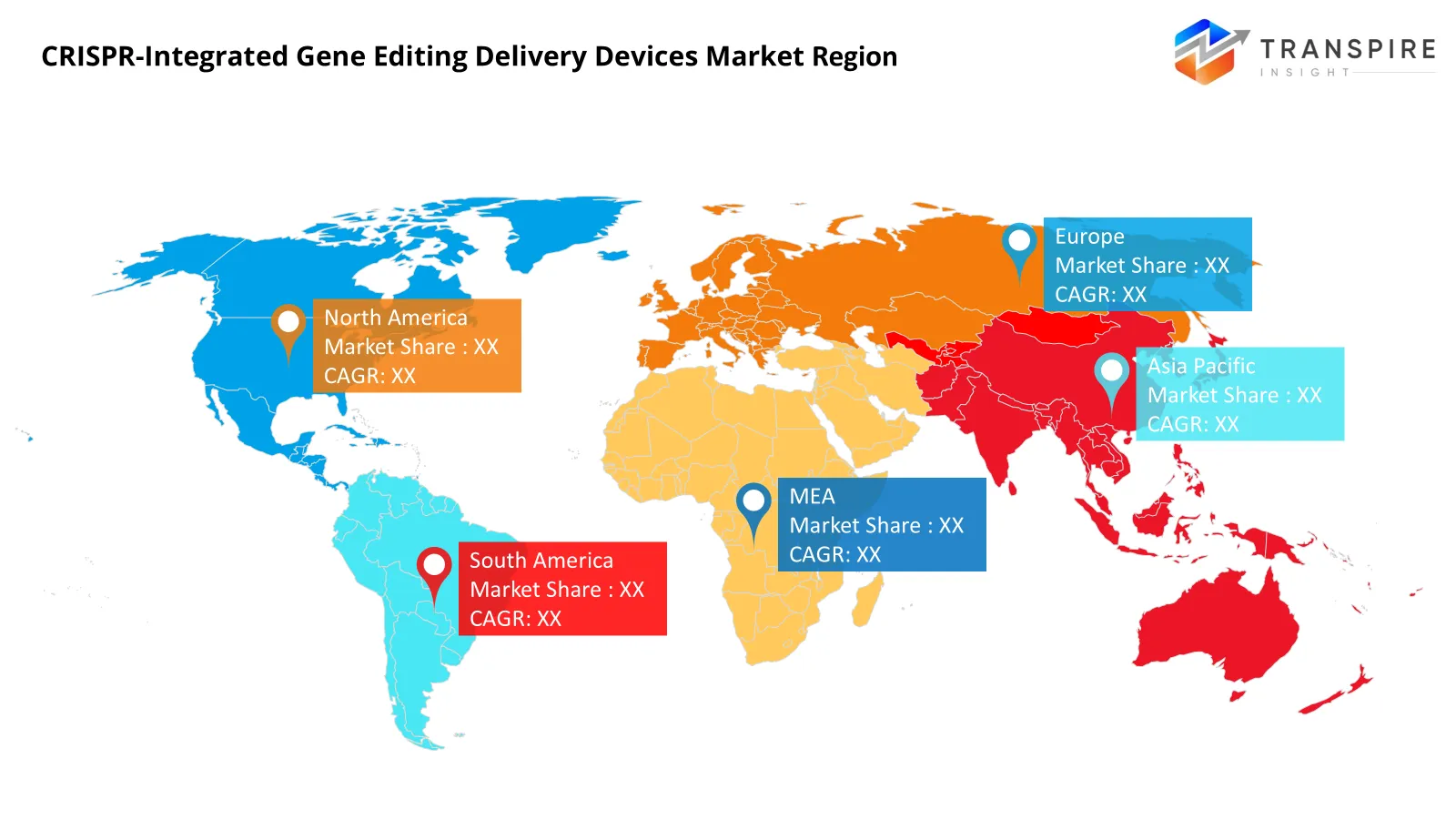
Who are the Key Players in the CRISPR-Integrated Gene Editing Delivery Devices Market, and how do they Compete?
The competitive space is primarily divided between a small handful of global life sciences suppliers, specialized delivery pioneers, and therapeutics manufacturers with in-house workflows. Buyers tend to consider instrument, cell viability, consumable costs, and the software & protocol translation, along with transferring it over from an existing setup to something that qualifies for GMP work.
Thermo Fisher Scientific, Bio-Rad Laboratories, Danaher, Merck KGaA and Sartorius compete on portfolios, distribution and workflow integration. Their point of separation lies in bundled instruments, reagents, analytics and support; add-on is gained via biopharma accounts, CDMOs and regional manufacturing hubs. Lonza, MaxCyte and Takara Bio build out scalable cell-processing or transfection niches, incorporating validated platforms and channel partnerships to accelerate clinical adoption. MaxCyte, with its Flow Electroporation platform, exemplifies this strategy for scalable, high-viability CRISPR delivery. Synthego, GenScript and Integrated DNA Technologies focus on faster, specialised design workflows by guide synthesis, engineering services and consumables. CRISPR Therapeutics, Editas Medicine, Beam Therapeutics and Intellia Therapeutics operate differently: in-house therapeutic development provides delivery expertise and attracts partnerships, licensing and in-house manufacturing. The strategic north/south split lies between low-cost workflow standardisation and premium platforms that de-risk development, with growth increasingly driven by CDMO partnerships rather than hardware deployed in key markets.
Key Players are:
- Thermo Fisher Scientific
- Bio-Rad Laboratories
- Lonza, Synthego
- GenScript
- Integrated DNA Technologies
- CRISPR Therapeutics
- Editas Medicine
- Beam Therapeutics
- Intellia Therapeutics
- Danaher
- Merck KgaA
- Sartorius
- Takara Bio
- MaxCyte
Recent Development News
- In April 2026, Intellia Therapeutics completed an underwritten public offering of its common stock to secure approximately $195 million in net proceeds. The influx of capital extended the company's operational runway into 2028, systematically funding late-stage development and manufacturing operations for its systemic, lipid nanoparticle-mediated in vivo CRISPR delivery pipelines.
- In April 2026, theNational Institutes of Healthengineered an ultra-compact CRISPR enzyme delivery framework utilizing a naturally occurring Al3Cas12f nuclease that directly scales inside adeno-associated virus vectors. The development dramatically optimized internal structural constraints, moving complex in vivo editing workflows directly into standard clinical delivery hardware for the targeted treatment of internal organs.
- In January 2026, CRISPR Therapeutics presented clinical data for its in vivo therapeutic candidate CTX310, which leverages a proprietary lipid nanoparticle (LNP) delivery system. The delivery platform demonstrated deep and durable reductions in triglycerides and low-density lipoprotein following a single-course intravenous infusion, driving the advancement of the candidate into Phase 1b clinical trials.
What Strategic Insights Define the Future of the CRISPR-Integrated Gene Editing Delivery Devices Market?
The market is evolving toward integrated delivery operating systems; hardware lock-in, formulation intelligence, automated quality control, and digital batch records will become more important than just transfection rate. The underlying threat is platform fragmentation; a device proven for one cell type, editor, or donor may not be transferable, leading to expensive revalidation and technology lock-in, even at narrow workflows. The emerging opportunity is targeted non-viral in vivo delivery coupled with AI-designed nanoparticles and mini-editors, using Asia-Pacific contract manufacturing to drive scale at low cost. Suppliers need to focus on modular designs, open interfaces, and application-specific consumables over closed-door hardware. They need to develop regulatory evidence early, focusing on comparability, off-target monitoring, and chain-of-custody control. A dual strategy of pricing premium clinical systems and economical researcher systems will defend margins while growing the installed base. The approach of partnering with CDMOs, hospitals, and regional biotech clusters will enable more rapid learning than "product-in-a-box" approaches.
Key Segmentations are:
By Product Type
- Electroporation Systems
- Viral Delivery Systems
- Lipid Nanoparticle Delivery Systems
- Microinjection Systems
- Gene Gun Systems
- Nanocarrier Delivery Devices
- Automated CRISPR Delivery Platforms
- Others
By Application
- Cell Therapy
- Gene Therapy
- Drug Discovery
- Agricultural Biotechnology
- Functional Genomics
- Academic Research
- Clinical Research
- Others
By End User
- Biopharmaceutical Companies
- Research Institutes
- Academic Laboratories
- Contract Research Organizations
- Hospitals
- Biotechnology Startups
- Others
By Technology
- CRISPR-Cas9 Delivery
- CRISPR-Cas12 Delivery
- Base Editing Systems
- Prime Editing Systems
- AI-assisted Gene Editing Platforms
- Others
By Distribution Channel
- Direct Sales
- Scientific Equipment Distributors
- Online B2B Platforms
- OEM Suppliers
- Others
Regional Outlook
North America
- United States
- Canada
- Mexico
Europe
- Germany
- United Kingdom
- France
- Spain
- Italy
- Rest of Europe
Asia Pacific
- Japan
- China
- Australia & New Zealand
- South Korea
- India
- Rest of Asia Pacific
South America
- Brazil
- Argentina
- Rest of South America
Middle East & Africa
- Saudi Arabia
- United Arab Emirates
- South Africa
- Rest of the Middle East & Africa
Frequently Asked Questions
Find quick answers to common questions.
The CRISPR-Integrated Gene Editing Delivery Devices Market size was valued at USD 682.5 million in 2025 and is poised to reach USD 2412.5 million by 2033, expanding at a 17.10% CAGR.
Key segments for the CRISPR-Integrated Gene Editing Delivery Devices Market are By Product Type (Electroporation Systems, Viral Delivery Systems, Lipid Nanoparticle Delivery Systems, Microinjection Systems, Gene Gun Systems, Nanocarrier Delivery Devices, Automated CRISPR Delivery Platforms, Others); By Application (Cell Therapy, Gene Therapy, Drug Discovery, Agricultural Biotechnology, Functional Genomics, Academic Research, Clinical Research, Others); By End User (Biopharmaceutical Companies, Research Institutes, Academic Laboratories, Contract Research Organizations, Hospitals, Biotechnology Startups, Others); By Technology (CRISPR-Cas9 Delivery, CRISPR-Cas12 Delivery, Base Editing Systems, Prime Editing Systems, AI-assisted Gene Editing Platforms, Others); By Distribution Channel (Direct Sales, Scientific Equipment Distributors, Online B2B Platforms, OEM Suppliers, Others).
Growth is primarily driven by clinical validation of CRISPR therapies, the shift from viral to scalable non-viral delivery, rising demand for automated closed-system manufacturing, increased biopharma investment, and expanding applications in cell therapy, drug discovery, and agricultural biotechnology.
The CRISPR-Integrated Gene Editing Delivery Devices Market is led by major manufacturers including Thermo Fisher Scientific, Bio-Rad Laboratories, Lonza, Synthego, GenScript, Integrated DNA Technologies, CRISPR Therapeutics, Editas Medicine, Beam Therapeutics, Intellia Therapeutics, Danaher, Merck KGaA, Sartorius, Takara Bio, MaxCyte.
North America holds a 46% share, dominates through advanced biopharmaceutical infrastructure, strong venture funding, FDA-supported clinical translation, specialised CDMOs, leading research institutions, and early commercial adoption of gene-editing therapies.
Commercial opportunities include AI-optimised delivery platforms, targeted LNP systems, closed electroporation equipment, clinical-grade consumables, CDMO partnerships, automated quality-control software and lower-cost manufacturing platforms for Asia-Pacific Markets.
- Thermo Fisher Scientific
- Bio-Rad Laboratories
- Lonza, Synthego
- GenScript
- Integrated DNA Technologies
- CRISPR Therapeutics
- Editas Medicine
- Beam Therapeutics
- Intellia Therapeutics
- Danaher
- Merck KgaA
- Sartorius
- Takara Bio
- MaxCyte
About the Authors

Pankaj Ghogare Patil
I am Pankaj Ghogare Patil, a Senior Research Analyst at Transpire Insight, specializing in the Pharmaceutical, Chemicals & Materials, Healthcare IT, and Biotechnology industry. My expertise lies in conducting comprehensive market research, analyzing industry trends, evaluating competitive landscapes, and translating complex data into actionable insights. At Transpire Insight, I closely follow emerging technologies, regulatory developments, and market innovations to create accurate, well-researched, and informative content that helps businesses and professionals make informed decisions. I am committed to producing credible, evidence-based articles that reflect industry best practices while making technical topics accessible and valuable for a broad audience.

Chakradhar Khansole
Chakradhar serves as the Research Director at Transpire Insight, bringing over 8 years of experience in technology, innovation, and strategic market intelligence. He specializes in transforming complex market data into actionable business insights that enable organizations to make informed, growth-oriented decisions. Recognized for his strategic vision and analytical expertise, Chakradhar leads high-impact research initiatives, delivering comprehensive market assessments, competitive intelligence, and forward-looking industry analysis.
Recently Published Reports
-
Jul 2026
Alopecia Treatment Market
Alopecia Treatment Market Size, Share & Analysis Report By Disease Type (Alopecia Areata, Cicatricial Alopecia, Traction Alopecia, Alopecia Totalis, Androgenetic Alopecia, Alopecia Universalis, and Other Disease Types), By Treatment Type (Topical Treatments, Oral Medications, Injectable Therapies, and Hair Transplantation), By Gender (Male, and Female), By Distribution Channel (Hospitals and Clinics, Retail Pharmacies, and Online Retailers), and Geography (North America, Europe, Asia-Pacific, Middle East and Africa, South and Central America), 2021 - 2031
-
Jul 2026
Medical Ultrasound Probe Market
Medical Ultrasound Probe Market Size, Share & Analysis Report By Type (Linear Type, Convex Type, Endocavitary Probe, Phased Array/Cardiac Probe, Transesophageal (TEE) Probe, and Others), By Application (Ophthalmology, Cardiology, Musculoskeletal, Oncology, Obstetrics & Gynecology, General Imaging, and Others), By End User (Hospitals & Clinics, Diagnostic Centers, Ambulatory Surgical Centers, and Others), and Geography (North America, Europe, Asia-Pacific, Middle East and Africa, South and Central America), 2021 – 2031
-
May 2026
Biosimilars Market
Biosimilars Market By Product Type (Monoclonal Antibodies, Recombinant Hormones, Erythropoietin, G-CSF, Others), By Indication (Oncology, Autoimmune Diseases, Blood Disorders, Diabetes, Others), By Manufacturing Type (In-House Manufacturing, Contract Manufacturing), By Distribution Channel (Hospital Pharmacies, Retail Pharmacies, Online Pharmacies), By Industry Analysis, Size, Share, Growth, Trends, and Forecasts 2021-2033
-
Apr 2026
Gastrointestinal Endoscopy Market
Gastrointestinal Endoscopy Market By Type (Rigid Gastrointestinal Endoscope, Flexible Gastrointestinal Endoscopes, Disposable Gastrointestinal Endoscope), By Procedure Type (Colonoscopy, Gastroscopy, Duodenoscopy, Enteroscopy, Flexible Sigmoidoscopy, Others), By Application (Diagnosis, Treatment), By End-Users (Hospitals, Ambulatory Surgical Centers, Specialty Clinics, Laboratories, Others), By Industry Analysis, Size, Share, Growth, Trends, and Forecasts 2021-2033