

United States Gene Editing Market Size & Forecast:
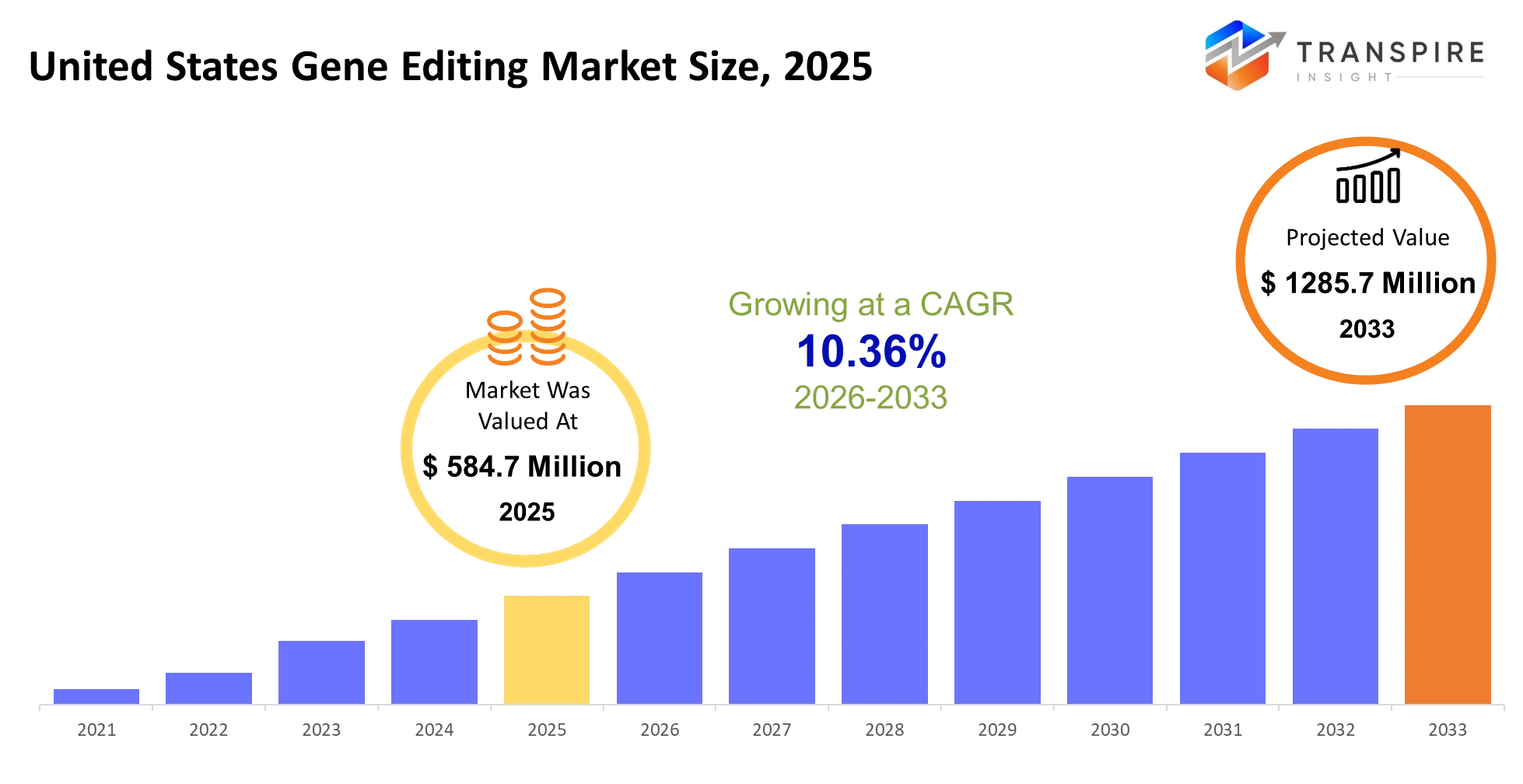
- United States Gene Editing Market Size 2025: USD 584.7 Million
- United States Gene Editing Market Size 2033: USD 1285.7 Million
- United States Gene Editing Market CAGR: 10.36%
- United States Gene Editing Market Segments: By Technology (CRISPR, TALEN, ZFN, Antisense Technology, Meganucleases, Base Editing, Others), By Application (Cell Line Engineering, Genetic Engineering, Drug Discovery, Diagnostics, Agricultural Biotechnology, Others), By End User (Biotechnology Companies, Pharmaceutical Companies, Academic Institutes, Research Organizations, CROs, Others), By Delivery Method (Viral Delivery, Non-viral Delivery, Electroporation, Lipid Nanoparticles, Microinjection, Others).
To learn more about this report,  Download Free Sample Report
United States Gene Editing Market Summary:
The United States Gene Editing Market size is estimated at USD 584.7 Million in 2025 and is anticipated to reach USD 1285.7 Million by 2033, growing at a CAGR of 10.36% from 2026 to 2033. The United States Gene Editing Market sort of moved from experimental research, into more real applied therapeutic and industrial use, which in turn helps pharmaceutical companies , biotechnology firms , and agricultural developers tweak genetic material with much higher precision than old fashioned drug discovery or traditional breeding style methods. And in practice it addresses a big efficiency problem by making it possible to do targeted correction of disease driving mutations , to build engineered cell therapies, and also to speed up the creation of crop traits that are more resilient in the field.
In the past three to five years, the whole market structure has shifted away from small lab CRISPR experiments toward platforms that are clinically validated , plus commercial manufacturing ability. There’s also been more regulatory openness toward gene-edited therapies, and that , joined with improvements in delivery systems, and AI assisted genomic analysis kind of shortens development timelines. It also makes investment confidence feel steadier. One major trigger was the post pandemic biotech funding surge, which ramped up spending on genomic infrastructure and expanded collaborations between big pharmaceutical players and gene editing startups. Now, as additional therapies push into late stage trials, revenue growth is becoming more connected to scalable manufacturing, licensing arrangements , and adoption of high value precision medicine rather than only research activity.
Key Market Insights
- Northeast United States kinda dominated the United States Gene Editing Market, with almost 38% share in 2025 , mainly because of dense biotech and pharmaceutical clusters.
- California still looks like the fastest-growing regional hub all the way through 2032 , helped by venture capital inflows, genomic startups, and those university-led innovation ecosystems that keep compounding momentum.
- Boston and San Francisco keep pulling in a lot of market share , via strategic expansion of cell and gene therapy manufacturing facilities. (Notably they are not slowing down.)
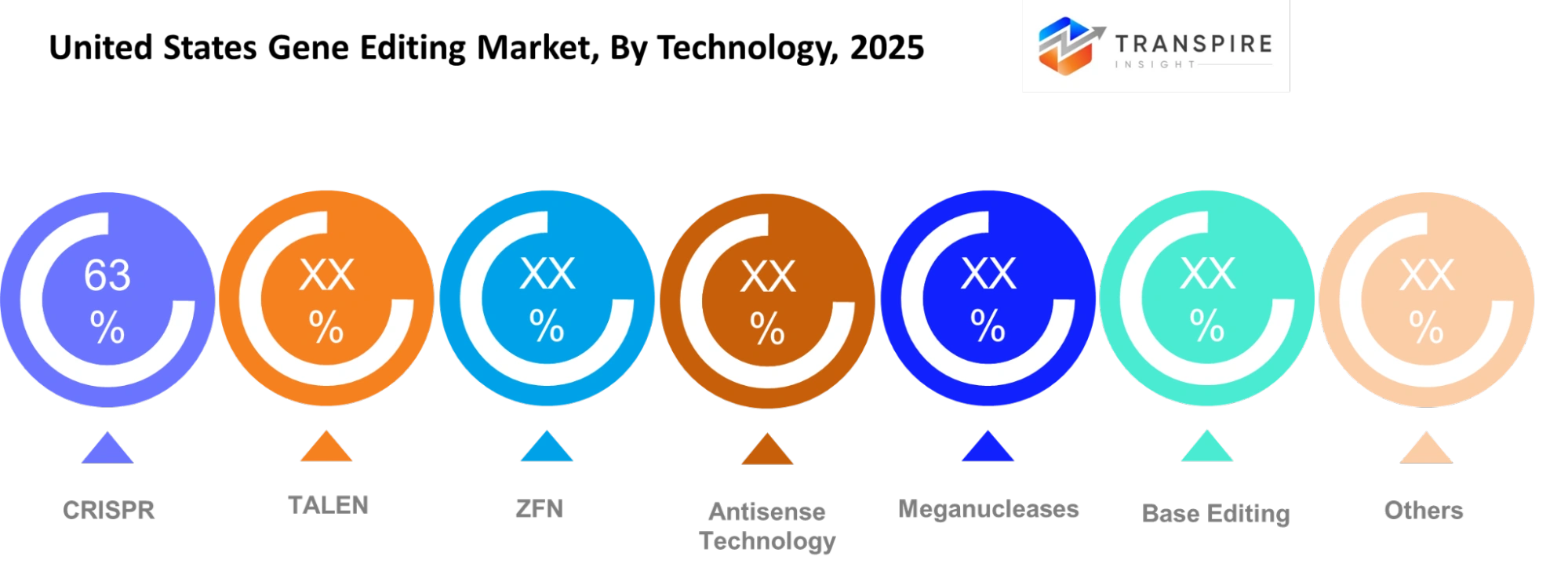
- CRISPR technology actually led the United States Gene Editing Market with more than 45% revenue share in 2025 , because it offers better precision and tends to bring lower editing costs.
- Then TALEN along with Zinc Finger Nuclease platforms took the second-largest industry size share , largely because they already have solid research footprints and therapeutic use cases.
- Meanwhile base editing and prime editing are the fastest-growing technology segments through 2032 , supported by improved safety and fewer off-target mutations , overall.
- Gene editing software and bioinformatics tools are seeing emerging demand too, as AI-driven genomic analysis gets better and makes therapy development more efficient.
- On the application side, therapeutic applications accounted for nearly 52% market share in 2025, pushed by oncology , rare disease, and inherited disorder treatment pipelines.
- Agricultural genome engineering is moving the quickest as an application segment, due to climate-resilient crop development plus food security initiatives.
- Also cell and gene therapy manufacturing demand really picked up after 2021 , when clinical-stage programs started entering late-phase trials.
- And pharmaceutical and biotechnology companies stayed out front with roughly 48% share in 2025 , mostly tied to big investment in genomic medicine platforms.
What are the Key Drivers, Restraints, and Opportunities in the United States Gene Editing Market?
The most powerful force pushing the United States Gene Editing Market forward is kinda the move of CRISPR-based therapies from early experimental work into proper regulated clinical commercialization. That shift started to really gain steam after a series of positive human trial results in rare blood disorders ,and also in oncology settings, showing that the treatments can actually deliver measurable benefits. At the same time, regulatory agencies laid out clearer routes for gene edited products which, in turn, cut down the uncertainty for investors in biotech and for pharmaceutical manufacturers. So, as a ripple effect, major drug companies increased their licensing deals ,their manufacturing spend, and even their acquisition moves. Revenue is now widening beyond just research tools ,into high value therapeutic pipelines, where a single approved treatment can still set premium pricing levels and lock in long term reimbursement contracts.
The market’s toughest structural snag stays the complexity and expense tied to safely delivering the gene editing payload. To change genetic material inside living cells you generally need advanced viral vectors or nanoparticle platforms ,and these are not exactly easy to manufacture in a steady way once you scale up commercially. This issue can’t be fixed overnight, because it rests on years of clinical proof, extra regulatory checks, and building biomanufacturing infrastructure from the ground up. And that leads to slower product launches, higher overall treatment costs, plus reduced patient access, especially for smaller biotechnology companies that have less capital to absorb the upfront risks.
A big opening is sitting in vivo gene editing platforms which can tweak genes right inside the patient’s body, not with all that complicated cell extraction stuff. Backing lipid nanoparticle delivery technologies, especially around California and Massachusetts biotech hubs, is basically setting the stage for wider therapeutic scaling. Businesses working on the next delivery systems could lower manufacturing costs quite a bit, and also broaden who can get treatments across the cardiovascular, neurological and metabolic disease areas.
What Has the Impact of Artificial Intelligence Been on the United States Gene Editing Market?
Artificial intelligence and advanced digital technologies are kind of reshaping the United States Gene Editing Market, by trimming down the time and cost it takes to design validate, and then commercialize genomic therapies. In practice, biotechnology companies are increasingly leaning on AI-driven genomic analysis platforms to automate guide RNA design, spot plausible gene targets, and scan millions of genetic sequences with way more speed than the old manual laboratory workflows. This sort of automation has bumped operational efficiency up in CRISPR-based research, and it also pushes preclinical development forward at a faster pace, even when teams are smaller.
Meanwhile, machine learning models are getting better at predictive accuracy for off-target mutation analysis, which is still one of the most touchy safety concerns in gene editing. AI systems can examine complicated genomic datasets to anticipate editing results, tune delivery vectors, and estimate therapy response rates before clinical trials even begin. Some pharmaceutical developers now add digital twin modeling, plus cloud-based bioinformatics systems, into their therapeutic discovery routines. As a result, they reduce the number of failed experiments and bring down early-stage development expenses. The same tools are also supporting faster regulatory submissions, better lab output, and shorter drug discovery cycles overall.
Still, AI adoption hits a big wall due to fragmented genomic datasets and uneven clinical data quality. A lot of machine learning approaches don’t generalize cleanly across diverse patient groups, so the predictive reliability stays limited, and it slows the wider commercialization of AI-assisted gene editing platforms.
Key Market Trends
- Starting in 2020, CRISPR- based therapies kinda drifted away from only early stage trials, and more toward commercial readiness, especially once the sickle cell disease results looked consistent enough to scale.
- Between 2021 and 2025, big pharmaceutical firms bumped up licensing deals with gene editing startups by over 30% , largely to shore up their precision medicine pipeline plans, you could say.
- AI powered genomic analysis platforms then started swapping out the older manual sequence screening routines, so in several biotechnology laboratories the whole target-finding timeline shrank , from months to just weeks.
- Base editing and prime editing tools picked up steam after 2022, because teams wanted less chance of off target mutations compared to the first generation CRISPR approaches , which were seen as more unpredictable.
- On the manufacturing side, companies leaned more heavily into in house GMP production facilities after supply chain disruptions showed how risky it was to lean on outsourced viral vector manufacturing partners.
- After 2021, regulatory agencies also rolled out more defined clinical evaluation pathways, and that pushed faster investment decisions in oncology plus rare disease gene therapy programs.
- Firms like CRISPR Therapeutics and Intellia Therapeutics widened their partnerships with large pharmaceutical manufacturers , aiming to strengthen commercialization readiness and to speed up late stage trial execution.
- Lipid nanoparticle delivery systems got a lot of attention after the mRNA vaccine success, because it highlighted scalable nucleic acid delivery infrastructure across a bunch of biotechnology markets.
- Meanwhile, academic research institutions worked more often with contract research organizations after 2023 , mainly to cut clinical development costs and help speed up patient recruitment windows.
- Investors also changed what they funded, with more money flowing toward in vivo gene editing platforms , since direct patient treatment models seem to promise better long-term scalability and less operational hassle.
United States Gene Editing Market Segmentation
By Technology
CRISPR technology kinda holds the top spot in the technology segment, largely due to lower editing costs, quicker guide RNA design and a wider therapeutic match compared to the older editing platforms. TALEN and Zinc Finger Nuclease still show up in very specific use cases, where editing precision is a must and where established intellectual property frameworks keep mattering. Meanwhile antisense tech stays relevant for targeted RNA modulation, especially in neurology and for rare genetic disorders. Base editing and prime editing are picking up speed too, because biotecnology developers are looking for safer alternatives with less off-target activity.
Meganucleases, and a few other niche options, take up smaller portions overall, mainly because scalability is limited and the engineering side can be complicated. Strong investment is also reshaping competitive dynamics across the biotechnology and pharmaceutical pipelines, especially around the high-precision editing systems. Going forward, growth will probably lean toward approaches that can support large-scale clinical manufacturing, stay consistent with regulation, and pair well with AI-assisted genomic analysis, so platform developers that can improve editing accuracy while reducing treatment complexity get more opportunities.
To learn more about this report, Download Free Sample Report
By Application
Drug discovery stays as the dominant application segment because pharmaceutical firms keep leaning on gene editing tools, to speed up target validation and cut down those failed clinical development efforts. Cell line engineering also holds a strong position , mostly because biologics manufacturing is expanding, along with engineered cell therapy production. Genetic engineering applications keep climbing across industrial biotechnology and functional genomics research, while diagnostics got more attention after precision medicine initiatives widened the genomic testing infrastructure .
Agricultural biotechnology is one of the quickest-growing areas too, as seed developers chase drought-resistant and disease-tolerant crop characteristics, using targeted editing approaches . Demand looks pretty different between healthcare users and agricultural users, since therapeutic work tends to emphasize safety validation , whereas agricultural teams care more about scalability and regulatory flexibility. In the years ahead, application growth will hinge largely on commercial reimbursement models, regulatory approvals , and whether companies can move smoothly from lab-scale trials to real industrial production capacity across both medical and agricultural markets.
By End-User
Biotechnology companies grab the biggest end user slice,mostly because the early phase innovation and platform building still sit in the hands of specialized genomic firms, yes somewhat concentrated. Pharmaceutical companies are next in line, in part because the big manufacturers keep extending partnerships plus licensing deals to shore up their precision medicine catalog. Academic institutes and research organizations keep feeding meaningful demand via federally supported genomic research programs and translational medicine activities. Contract research organizations are growing fast too, since biotech developers increasingly push off preclinical work, toxicology readouts, and trial coordination to save on operating spend and squeeze commercialization schedules.
Smaller emerging firms often rely on CRO capacity due to the high capital load linked to genomic manufacturing and regulatory compliance. Even the collaboration habits are changing, because universities and commercial teams now seek shared intellectual property agreements, and co-development strategies that feel more synergistic. Going forward, market positioning will likely tip toward end users that combine research, manufacturing, and data analysis capabilities, so therapy validation happens faster and clinical scaling is less bumpy.
By Delivery Method
Viral delivery methods kinda dominate the whole delivery segment, because viral vectors give strong gene transfer efficiency and good fit with complicated therapeutic use cases. Adeno-associated viruses, along with lentiviral systems, are still quite commonly used across oncology and rare disease programs even when the production costs are high and the manufacturing side hits bottlenecks. At the same time non-viral delivery approaches are getting more strategic importance, especially now that biotech developers are looking for safer, more scalable alternatives for in vivo editing kind of work. Lipid nanoparticles also picked up speed after mRNA vaccine commercialization sort of proved that large-scale nucleic acid delivery is possible, and that the manufacturing infrastructure can really support it.
Electroporation keeps a solid role in ex vivo cell therapy workflows, where direct cellular modification helps enable engineered immune therapies. Microinjection and other specialized techniques still show up in research-heavy applications, but scalability gets tricky in commercial production settings, you know. Looking ahead, future investment is being funneled more and more toward non-viral and nanoparticle-based delivery technologies, since lower immunogenicity, less production complexity, and better repeat dosing potential could meaningfully widen access to treatments and improve manufacturing efficiency too.
What are the Key Use Cases Driving the United States Gene Editing Market?
Gene editing adoption is mostly pushed along by therapeutic development , especially in oncology and for rare genetic disorders, plus inherited blood diseases. It’s usually the pharmaceutical and biotechnology companies that create the most demand, mostly because targeted editing platforms can shave off drug discovery timelines and let them sell premium-priced precision therapies.
On another front , agricultural biotechnology and industrial cell line engineering are moving fast , both for research groups and for commercial seed developers. Gene-edited crops— like drought resistance and better yield potential— are getting more interest as climate variability rises and keeps squeezing agricultural productivity and food supply stability.
Newer use cases show up too, including in vivo cardiovascular gene therapies, and engineered immune cell treatments aimed at autoimmune disorders. Early-stage work also looks at gene editing for organ re generation and correction of neurological disease , and this often uses AI assisted genomic targeting along with more refined lipid nanoparticle delivery systems.
|
Report Metrics |
Details |
|
Market size value in 2025 |
USD 584.7 Million |
|
Market size value in 2026 |
USD 644.9 Million |
|
Revenue forecast in 2033 |
USD 1285.7 Million |
|
Growth rate |
CAGR of 10.36% from 2026 to 2033 |
|
Base year |
2025 |
|
Historical data |
2021 - 2024 |
|
Forecast period |
2026 - 2033 |
|
Report coverage |
Revenue forecast, competitive landscape, growth factors, and trends |
|
Geographic scope |
United States of America |
|
Key company profiled |
CRISPR Therapeutics, Editas Medicine, Intellia Therapeutics, Beam Therapeutics, Thermo Fisher Scientific, Horizon Discovery, Sangamo Therapeutics, Precision BioSciences, Caribou Biosciences, Merck KGaA, GenScript, Agilent Technologies, Bio-Rad Laboratories, Danaher Corporation, Synthego. |
|
Customization scope |
Free report customization (country, regional & segment scope). Avail customized purchase options to meet your exact research needs. |
|
Report Segmentation |
By Technology (CRISPR, TALEN, ZFN, Antisense Technology, Meganucleases, Base Editing, Others), By Application (Cell Line Engineering, Genetic Engineering, Drug Discovery, Diagnostics, Agricultural Biotechnology, Others), By End User (Biotechnology Companies, Pharmaceutical Companies, Academic Institutes, Research Organizations, CROs, Others), By Delivery Method (Viral Delivery, Non-viral Delivery, Electroporation, Lipid Nanoparticles, Microinjection, Others). |
Which Regions are Driving the United States Gene Editing Market Growth?
The Northeast region kind of leads the United States gene editing market because it has this dense concentration of biotechnology firms, academic medical centers , and genomic research funding programs that just keep going. Massachusetts and the nearby innovation corridors do well too, mainly from strong venture capital activity , supportive clinical research infrastructure, and a direct sort of collaboration between universities and pharmaceutical manufacturers. On top of that, federal grants and translational medicine networks keep accelerating commercialization for CRISPR based therapies as well as cell engineering platforms. There’s also a mature ecosystem made of contract research organizations, specialized manufacturing facilities, and regulatory know how, which keeps the regional advantage sustained for a long time and supports a lot of clinical trial activity.
The West Coast region stays a steady contributor, mostly through strong technology integration and consistent private sector investment, not only because of research density.California especially benefits from a highly developed startup ecosystem, where biotechnology companies kind of fold in artificial intelligence, cloud genomics, and advanced bioinformatics into therapeutic discovery pipelines. Large pharmaceutical partnerships and pretty steady capital availability create resilience, even when broader biotechnology funding feels a bit volatile . Compared with the Northeast, this region leans more on platform innovation , digital genomic analysis, and scalable delivery technologies, and that helps maintain long run commercial expansion.
The Southern United States seems like it is coming up as the fastest-growing regional market, sort of speaking, because of expanding biomanufacturing infrastructure and lower day to day operational costs for mass therapeutic production. States such as Texas and North Carolina lately pulled in major investments into gene therapy manufacturing sites, clinical research campuses, and life sciences workforce development efforts. In addition, stronger state-level incentives , plus modernization of infrastructure, has led biotechnology developers to spread manufacturing beyond the older coastal hubs. All of this momentum is opening fresh chances for investors, contract manufacturers, and mid-sized biotechnology firms that want scalable production capacity sometime between 2026 and 2033.
Who are the Key Players in the United States Gene Editing Market and How Do They Compete?
The United States gene editing market is still pretty moderately fragmented, and the competition is mostly about how strong the intellectual property is, how well the delivery platform actually performs, and whether a company can manage clinical development, not really about pricing. Older biotechnology players keep pushing to hold market share with patent portfolios and a bunch of strategic pharmaceutical alliances, while newer companies tend to aim at specific niche editing approaches and AI based genomic analysis tools. Lately, it feels like the fight is more about therapeutic precision, how scalable the manufacturing really is , and how effectively they can lower off target editing risks. Firms that can cover research, delivery, and commercialization all together tend to sit in a better position since clinical validation timelines and regulatory approval expenses stay as high barriers for smaller developers, or smaller teams.
CRISPR Therapeutics kind of differentiates itself with its more advanced CRISPR Cas9 therapeutic pipelines aimed at blood disorders, plus oncology related uses. The company has also worked on its commercialization momentum via manufacturing partnerships, and co development agreements, which help improve late stage clinical scalability. Intellia Therapeutics leans much more into in vivo gene editing, and it uses lipid nanoparticle delivery systems so it can reduce the need for complicated cell extraction steps. This method makes it easier for a wider set of patients to access these therapies, and it also places the company in a strong spot for cardiovascular and liver disease applications.
Beam Therapeutics operates with a base editing approach, built to reduce the risk of unwanted DNA breaks while also boosting editing exactness in sensitive therapeutic contexts. They keep moving forward with additional research collaborations, geared toward safer next generation editing systems, especially for hematology and rare disease programs. Editas Medicine still holds a real competitive edge thanks to multiple editing platforms and also solid ties with academic groups , which in turn bolster their ophthalmology and oncology pipeline efforts. Meanwhile Caribou Biosciences focuses on engineered immune cell therapies and their own CRISPR hybrid RNA-DNA method , aiming to sharpen targeting precision, and to reinforce differentiation during cell therapy manufacturing markets.
Company List
- CRISPR Therapeutics
- Editas Medicine
- Intellia Therapeutics
- Beam Therapeutics
- Thermo Fisher Scientific
- Horizon Discovery
- Sangamo Therapeutics
- Precision BioSciences
- Caribou Biosciences
- Merck KGaA
- GenScript
- Agilent Technologies
- Bio-Rad Laboratories
- Danaher Corporation
- Synthego
Recent Development News
In April 2026, Intellia Therapeutics Achieves Late-Stage CRISPR Trial Success: Intellia Therapeutics reported strong Phase 3 results for its in vivo CRISPR gene-editing therapy targeting hereditary angioedema. The single-dose treatment significantly reduced swelling attacks and moved closer to FDA approval, marking a major step for systemic gene editing in the U.S. market.
Source: https://www.bloomberg.com
In April 2026, Intellia Therapeutics Files FDA Submission for First In Vivo CRISPR Therapy: Following successful clinical data, Intellia filed a regulatory submission to the U.S. FDA for its CRISPR-based therapy. If approved, it would become the first in vivo gene-editing treatment cleared in the United States, strengthening commercial momentum in the gene editing sector.
Source: https://medcitynews.com
What Strategic Insights Define the Future of the United States Gene Editing Market?
The United States gene editing market is kind of, sort of moving in a structural way toward integrated therapeutic ecosystems where genomic editing, AI- driven bioinformatics, and scalable delivery platforms act like one unified commercial system, not really like separate technologies. The next phase of growth will probably come from in vivo editing systems and non-viral delivery approaches that cut down manufacturing complexity while also making it easier for patients to access treatment. Big pharmaceutical companies are also likely to raise acquisition activity as clinical validation gets stronger and some smaller biotechnology developers keep hitting commercialization costs.
There is also a hidden risk that’s easy to miss: manufacturing concentration across viral vector and lipid nanoparticle supply chains. If only a handful of specialized production facilities end up doing most of the work, then capacity bottlenecks can happen, pricing pressure can rise, and therapy launches might get delayed when late-stage clinical programs expand at the same time. Another challenge, that’s starting to show up, is reimbursement resistance if ultra-premium therapies do not end up proving durable long term outcomes.
On the opportunity side, something meaningful is taking shape in the Southern United States, where lower-cost biomanufacturing infrastructure and state-backed life sciences investments are pulling in advanced therapy developers. Market players should put emphasis on partnerships that blend delivery technology, AI enabled genomic analysis, and scalable GMP manufacturing. The goal is basically to strengthen long-run competitive positioning, not just win a single deal.
United States Gene Editing Market Report Segmentation
By Technology
- CRISPR
- TALEN
- ZFN
- Antisense Technology
- Meganucleases
- Base Editing
- Others
By Application
- Cell Line Engineering
- Genetic Engineering
- Drug Discovery
- Diagnostics
- Agricultural Biotechnology
- Others
By End User
- Biotechnology Companies
- Pharmaceutical Companies
- Academic Institutes
- Research Organizations
- CROs
- Others
By Delivery Method
- Viral Delivery
- Non-viral Delivery
- Electroporation
- Lipid Nanoparticles
- Microinjection
- Others
Frequently Asked Questions
Find quick answers to common questions.
The approximate United States Gene Editing Market size for the market will be USD 1285.7 Million in 2033.
The key segments of the United States Gene Editing Market are By Technology (CRISPR, TALEN, ZFN, Antisense Technology, Meganucleases, Base Editing, Others), By Application (Cell Line Engineering, Genetic Engineering, Drug Discovery, Diagnostics, Agricultural Biotechnology, Others), By End User (Biotechnology Companies, Pharmaceutical Companies, Academic Institutes, Research Organizations, CROs, Others), By Delivery Method (Viral Delivery, Non-viral Delivery, Electroporation, Lipid Nanoparticles, Microinjection, Others).
Major players in the United States Gene Editing Market are CRISPR Therapeutics, Editas Medicine, Intellia Therapeutics, Beam Therapeutics, Thermo Fisher Scientific, Horizon Discovery, Sangamo Therapeutics, Precision BioSciences, Caribou Biosciences, Merck KGaA, GenScript, Agilent Technologies, Bio-Rad Laboratories, Danaher Corporation, Synthego.
The current market size of the United States Gene Editing Market is USD 584.7 Million in 2025.
The United States Gene Editing Market CAGR is 10.36%.
- CRISPR Therapeutics
- Editas Medicine
- Intellia Therapeutics
- Beam Therapeutics
- Thermo Fisher Scientific
- Horizon Discovery
- Sangamo Therapeutics
- Precision BioSciences
- Caribou Biosciences
- Merck KGaA
- GenScript
- Agilent Technologies
- Bio-Rad Laboratories
- Danaher Corporation
- Synthego
Recently Published Reports
-
Apr 2026
Cord Blood Banking Services Market
Cord Blood Banking Services Market Size, Share & Analysis Report By Type of Service (Collection, Processing, Storage), By Bank Type (Private Banks, Public Banks, and Hybrid Banks), By Component (Cord Blood, and Cord Tissue), By End User (Hospitals, Research Institutions, Biotechnology Companies, and Others) and Geography (North America, Europe, Asia-Pacific, Middle East and Africa, South and Central America), 2021 - 2031
-
Apr 2026
ELISA Processors Market
ELISA Processors Market Size, Share & Analysis Report By Type (Optical Filter ELISA Analyzer, and Optical Grating ELISA Analyzers), By Mode (Automated ELISA Analyzers, and Semi-Automated ELISA Analyzers), By Applications (Immunology, Vaccine development, Drug Monitoring, and Others), By End Users (Biotechnology Companies, Pharmaceutical Companies, Contract Research Organization, and Diagnostic Laboratories) and Geography (North America, Europe, Asia-Pacific, Middle East and Africa, South and Central America), 2021 - 2031
-
May 2026
Microscope Slide Scanner Market
Microscope Slide Scanner Market Size, Share & Analysis Report By Type (Portable Microscope Slide Scanner, and Desktop Microscope Slide Scanner), By Application (Biological Research, Medicine, Veterinary, and Other) and Geography (North America, Europe, Asia-Pacific, Middle East and Africa, South and Central America), 2021 - 2031
-
Apr 2026
Microwave Cookware Market
Microwave Cookware Market Size, Share & Analysis Report By Material Type (Plastic, Glass, Ceramic, Silicone, and Metal), By Application (Cooking, Reheating, and Defrosting), By End User (Household, Commercial (Restaurants, Hotels, and Cafes), and Food Service Industry), By Sales Channel (Online Retail, Offline Retail (Supermarkets, Hypermarkets, Specialty Stores), and Direct Sales (Company Outlets)) and Geography (North America, Europe, Asia-Pacific, Middle East and Africa, South and Central America), 2021 - 2031