Market Summary
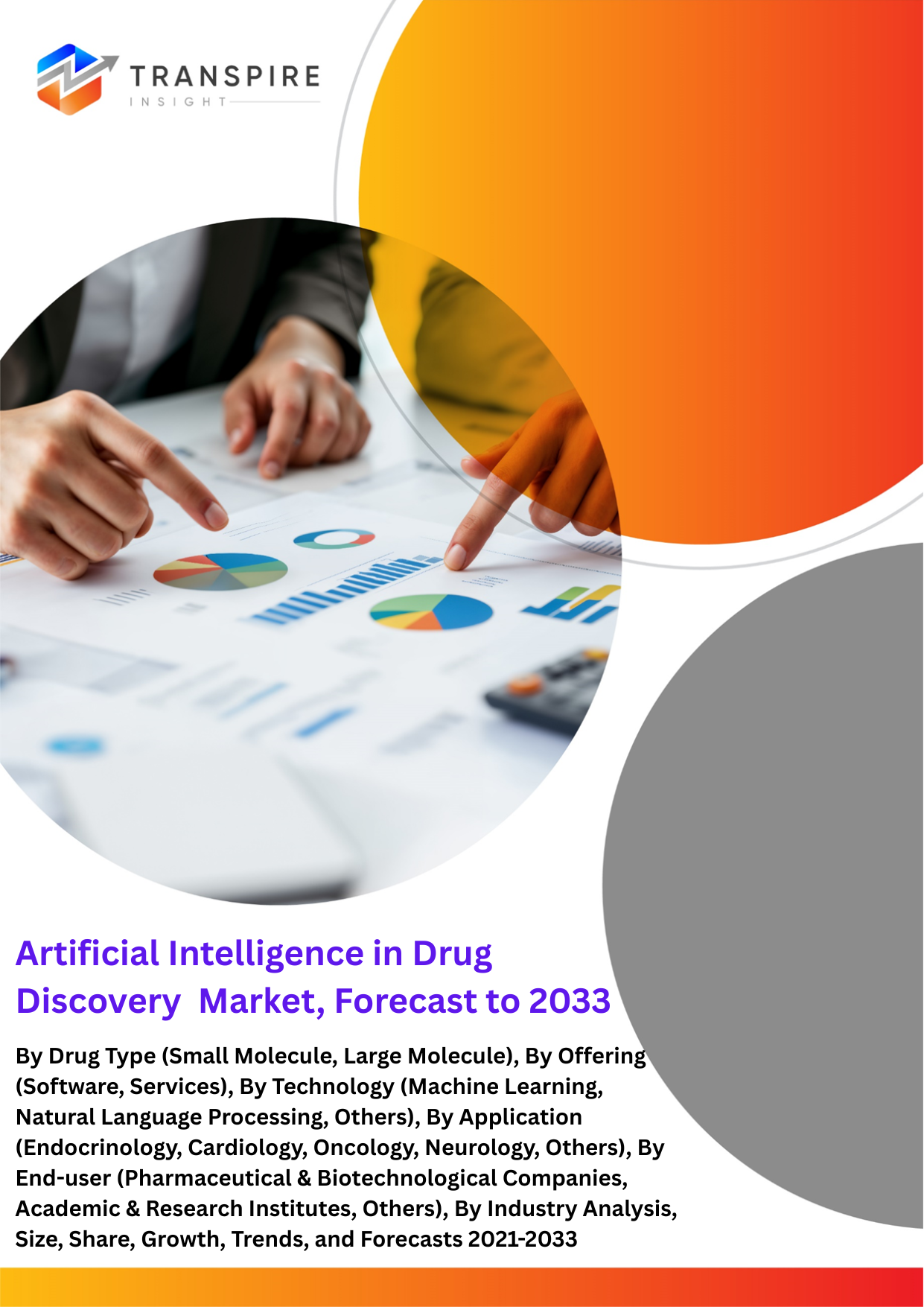
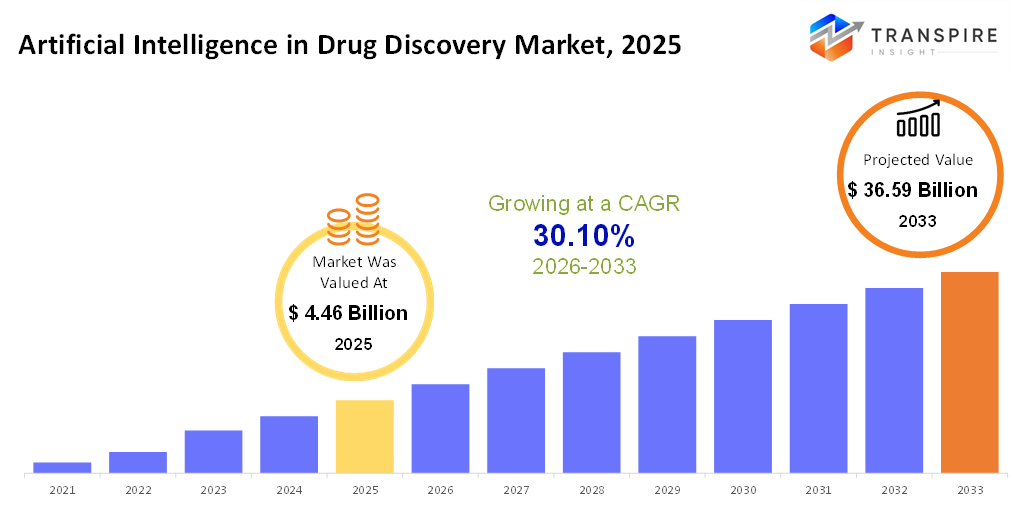
The global Artificial Intelligence in Drug Discovery market size was valued at USD 4.46 billion in 2025 and is projected to reach USD 36.59 billion by 2033, growing at a CAGR of 30.10% from 2026 to 2033. The Artificial Intelligence technology is being used at every stage of drug discovery. This is because the AI technology can help us understand biological information. The Artificial Intelligence technology can also help us find the lead compounds with the highest accuracy. The Artificial Intelligence, in Drug Discovery market is using the Artificial Intelligence technology to make things better. The fully advancements in machine learning algorithms, analytics, and computer capacity are contributing to rising efficiency and success growth rates of drug discoveries, thus making it an attractive opportunity for a significant number of investors. The increasing prevalence of complex diseases and significant R&D spending are creating and launching huge opportunities for growth in the Artificial Intelligence in Drug Discovery market.
Market Size & Forecast
- 2025 Market Size: USD 4.46 Billion
- 2033 Projected Market Size: USD 36.59 Billion
- CAGR (2026-2033): 30.10%
- North America: Largest Market in 2026
- Asia Pacific: Fastest Growing Market
To learn more about this report,  Download Free Sample Report
Key Market Trends Analysis
- North America is doing well in the global AI in Drug Discovery market right now. This is because North America has a strong pharmaceutical sector. North America also spends a lot of money on research and development. It uses digital technologies a lot. The North America region is home to big pharmaceutical companies AI startups and research institutions that help create new ideas in AI in Drug Discovery. These companies and institutions in North America are a part of why North America is a leader in AI, in Drug Discovery.
- The United States oversees this region because the pharmaceutical sector has made a lot of investments in research and development. They are also using intelligence and machine learning a lot. Additionally, technology companies are working closely with the life sciences sector. The government is helping the sector with its policies and there is a lot of biomedical data available which is helping to speed up the development of artificial intelligence for discovering new drugs. The pharmaceutical sector is really benefiting from this. The United States is leading the way, in this region because of the pharmaceutical sector.
- The Asia Pacific is seeing a lot of growth because of pharmaceutical research government help for Artificial Intelligence and digital healthcare and new biotechnology in China, Japan, South Korea and India. The Asia Pacific also has research that people can afford and companies are working with big pharmaceutical companies, around the world which is helping the Asia Pacific market to grow more.
- The market for drug discovery in molecules is really big because it uses Artificial Intelligence technology a lot. This Artificial Intelligence technology is used for things like screening and molecular modeling and lead optimization. The reason Artificial Intelligence technology works well in the drug discovery in small molecules market is that there is a lot of old data and the steps to develop new drugs are very clear. This makes the Artificial Intelligence technology very good, at helping with drug discovery in molecules.
- Machine learning technology is the technology used in all systems that make drugs using Artificial Intelligence. Machine learning technology can look at a lot of information guess how things will behave and reduce the number of tries it takes to get something. This is why Machine learning technology is used the most in the market that uses Artificial Intelligence to make drugs. Machine learning technology is good, at helping us make drugs.
So, the Artificial Intelligence in Drug Discovery market is really taking off. This is because people want to make drugs faster and they also want to save money on research.
The Artificial Intelligence in Drug Discovery market is expected to do well in North America. The United States will probably lead the way in the Artificial Intelligence in Drug Discovery market. This is because the United States has a lot of money to spend on research and development. The United States also started using Artificial Intelligence technologies on. Additionally, tech companies and life science companies in the United States work together.
The Asia Pacific region is expected to grow the fastest in the Artificial Intelligence in Drug Discovery market. This is because the governments in the Asia Pacific region are helping out. The biotech industry in the Asia Pacific region is also getting bigger. The Asia Pacific region has research capabilities and it does not cost too much to do research there. The Artificial Intelligence, in Drug Discovery market will probably do well in the Asia Pacific region. It is expected that Small-molecule drug discovery will attain the largest share due to AI's robust use for virtual screening and lead optimization. Still, machine learning remains the dominant technology powering most platforms. Oncology leads in application adoption as there are high unmet medical needs and strong investment in cancer research-a fact positioning AI as a key driver for innovation in modern drug discovery.
Artificial Intelligence in Drug Discovery Market Segmentation
By Drug Type
- Small Molecules
AI algorithms have widespread applications in small molecules to rapidly screen millions of compounds for their potency and safety. This enables researchers to identify successful compounds quickly and without a significant budget.
- Large Molecule
In large molecule drug development, such as biologics and proteins, AI helps to analyze complicated shapes and interactions. AI assists in improving the design and development of targeted but complicated therapies.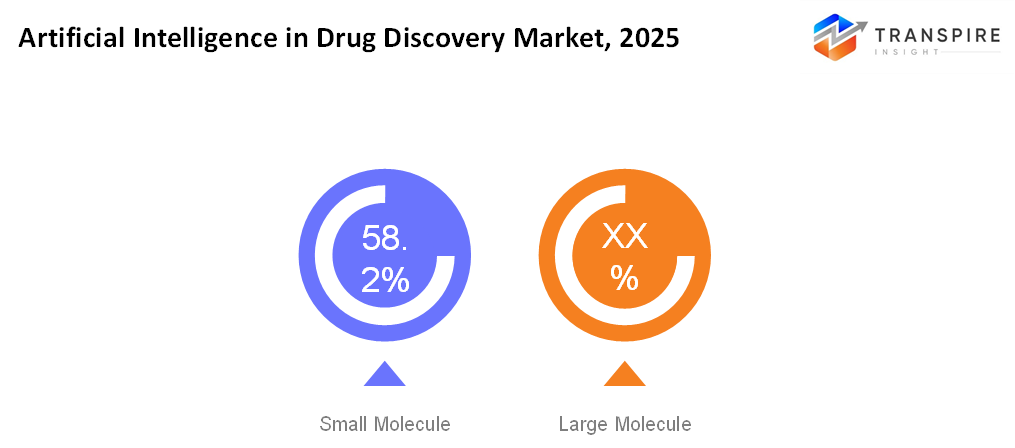
To learn more about this report, Download Free Sample Report
By Offering
- Software
AI software platforms assist researchers to analyze huge biological data, simulate the behavior of drugs, and consequently come up with potential drug candidates more rapidly. These tools make such complex research to highly easier by turning huge datasets into clear, actionable insights.
- Services
AI services include consulting, model development, data integration, and ongoing support, provided by experts in technology and research. These services enable companies to tailor AI solutions and effectively integrate them into their drug discovery workflows.
By Technology
- Machine Learning
Among AI applications, machine learning has seen tremendous adoption in the field of research and development in drugs. This technology assists scientists in understanding molecular behavior and helps them pick the right drugs.
- Natural Language Processing (NLP)
NLP assists scientists to rapidly read and comprehend very large amounts of scientific literature, clinical trials, and medical literature. This enables researchers to discover deep insights and remain up-to-date without needing to scan thousands of articles.
- Others
This category comprises technology areas like deep learning, computer vision, and expert systems. These enable functions like analyzing images related to healthcare, simulating complex biological systems, and improving decision-making in drug discovery.
By Application
- Endocrinology
The technology assists in better understanding of hormone-related illnesses, such as diabetes, through analysis of large amounts of data to highlight new drug targets. This is a process that increases discoveries of effective drug treatments.
- Cardiology
In drug development related to the heart, AI models predict how new drugs would affect the heart and blood vessels. It assists in preventing early trials from failing by finding new, more effective, and safer drug solutions.
- Oncology
Oncology is the biggest application domain and is where AI is heavily utilized for researching new cancer medications. It applies genetic and clinical information to identify specific targets and develop drugs accordingly for various types of cancer.
- Neurology
AI assists in finding drugs to treat complex neurological conditions of the brain. This is due to its ability to process large amounts of neurological as well as imaging information.
- Others
This category will include topics like infectious diseases and rare conditions. AI enables the exploration of small amounts of data quickly. This leads to efficient drug discovery even for smaller disease segments.
By End-user
- Pharmaceutical & Biotechnological companies
Mainly use it due to high demands to accelerate research, cut costs, and enhance success rates of drugs under development. AI assists in identifying targets of drugs more rapidly, designs superior molecules, and shortens timelines for development.
- Academic & Research Institutes
With AI, universities and research centers can also analyze complex biological data, investigate new pathways of diseases, and help in early-stage research into new drugs. AI provides the researchers with the tools to rapidly test ideas and allow academic researchers to work more effectively with their industry counterparts.
- Others
This category includes CROs, AI startups, and healthcare technology firms. They use AI platforms to offer specialized drug discovery services to support pharma companies and drive innovation across the drug development ecosystem.
Regional Insights
The Artificial Intelligence in Drug Discovery market exhibits variable regional progress depending upon R&D investments, digital readiness, and healthcare infrastructure. North America leads in the market due to favorable conditions for pharmaceutical and biotech development, significant levels of R&D, and significant levels of adoption of Artificial Intelligence, with the United States being at the lead. Europe is next with steady progress due to beneficial regulations, high-quality public healthcare infrastructure, and growing interest in digital and personalized healthcare approaches, particularly in Western European regions. The Asia Pacific market exhibits fast progress due to government support for Artificial Intelligence and biotech research and development, and favorable pharmaceutical production infrastructure and R&D costs, particularly in emerging nations such as China, Japan, South Korea, and India. The South America market exhibits emerging trends with pronounced efforts from Brazil and Argentina with respect to improved research infrastructure and international cooperation, and the Middle East and Africa market still being at a nascent stage with initial adoption primarily from nations with growing interest and infrastructure for digital healthcare and Artificial Intelligence-powered healthcare transformation.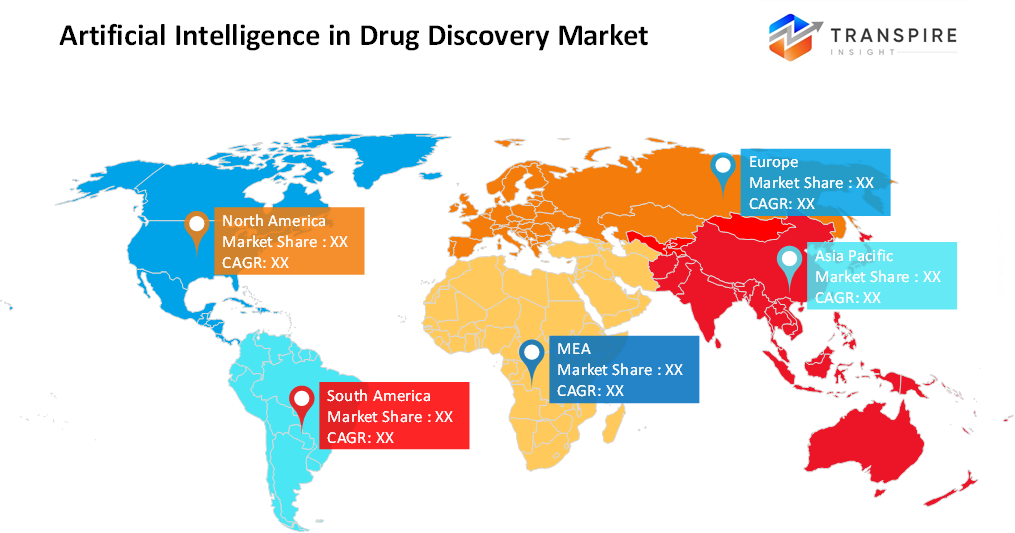
To learn more about this report, Download Free Sample Report
Recent Development News
- In July 2024, Exscientia announced an expanded collaboration with Amazon Web Services (AWS) to utilize AWS's AI and machine learning (ML) services to enhance its end-to-end drug discovery and automation platform.
- In May 2024, Google DeepMind released the third version of its AlphaFold AI-based model, aimed at advancing drug design and disease targeting. This latest iteration allows researchers at DeepMind and Isomorphic Labs to map the behavior of all molecules, including human DNA.
- In April 2024, Xaira Therapeutics, an AI-powered drug discovery and development company, raised over USD 1 Million in a joint funding round with ARCH Venture Partners and Foresite Labs. The company uses machine learning, data generation models, and therapeutic product development to target traditionally challenging drug targets
|
Report Metrics |
Details |
|
Market size value in 2025 |
USD 4.46 Billion |
|
Market size value in 2026 |
USD 5.80 Billion |
|
Revenue forecast in 2033 |
USD 36.59 Billion |
|
Growth rate |
CAGR of 30.10% from 2026 to 2033 |
|
Base year |
2025 |
|
Historical data |
2021 – 2024 |
|
Forecast period |
2026 – 2033 |
|
Report coverage |
Revenue forecast, competitive landscape, growth factors, and trends |
|
Regional scope |
North America; Europe; Asia Pacific; Latin America; Middle East & Africa |
|
Country scope |
United States; Canada; Mexico; United Kingdom; Germany; France; Italy; Spain; Denmark; Sweden; Norway; China; Japan; India; Australia; South Korea; Thailand; Brazil; Argentina; South Africa; Saudi Arabia; United Arab Emirates |
|
Key company profiled |
Microsoft, Schrödinger, Inc., Cresset, IBM, Atomwise Inc., Insilico Medicine, Exscientia, BenevolentAI, Aria Pharmaceuticals, Inc., Integral BioSciences, and Alphabet Inc. |
|
Customization scope |
Free report customization (country, regional & segment scope). Avail customized purchase options to meet your exact research needs. |
|
Report Segmentation |
By Drug Type (Small Molecule, Large Molecule), By Offering (Software, Services), By Technology (Machine Learning, Natural Language Processing, Others), By Application (Endocrinology, Cardiology, Oncology, Neurology, Others), By End-user (Pharmaceutical & Biotechnological Companies, Academic & Research Institutes, Others) |
Key Artificial Intelligence in Drug Discovery Company Insights
With its broad portfolio-including IoT-enabled precision equipment, autonomous machinery, and data analytics platforms-Deere & Company is a clear market leader. Its global presence and significant investment in research and development allow the company to continue to innovate, providing scalable solutions for farmers that help improve operational efficiency and sustainability. Deere's ability to integrate hardware and software ecosystems provides a competitive advantage, which fosters wide diffusion across large commercial farms worldwide.
Key Artificial Intelligence in Drug Discovery Companies:
- Microsoft
- Schrödinger, Inc.
- Cresset
- IBM
- Atomwise Inc.
- Insilico Medicine
- Exscientia
- BenevolentAI
- Aria Pharmaceuticals, Inc.
- Integral BioSciences
- Alphabet Inc.
Global Artificial Intelligence in Drug Discovery Market Report Segmentation
By Drug Type
- Small Molecule
- Large Molecule
By Offering
- Software
- Services
By Technology
- Machine Learning
- Natural Language Processing
- Others
By Application
- Endocrinology
- Cardiology
- Oncology
- Neurology
- Others
By End-user
- Pharmaceutical & Biotechnological Companies
- Academic & Research Institutes
- Others
Regional Outlook
- North America
- United States
- Canada
- Mexico
- Europe
- Germany
- United Kingdom
- France
- Spain
- Italy
- Rest of Europe
- Asia Pacific
- Japan
- China
- Australia & New Zealand
- South Korea
- India
- Rest of Asia Pacific
- South America
- Brazil
- Argentina
- Rest of South America
- Middle East & Africa
- Saudi Arabia
- United Arab Emirates
- South Africa
- Rest of the Middle East & Africa
Frequently Asked Questions
Find quick answers to common questions.
The approximate Artificial Intelligence in Drug Discovery Market size for the market will be USD 36.59 billion in 2033.
Key segments for the Artificial Intelligence in Drug Discovery Market are By Drug Type (Small Molecule, Large Molecule), By Offering (Software, Services), By Technology (Machine Learning, Natural Language Processing, Others), By Application (Endocrinology, Cardiology, Oncology, Neurology, Others), By End-user (Pharmaceutical & Biotechnological Companies, Academic & Research Institutes, Others).
Major Artificial Intelligence in Drug Discovery Market players are Microsoft, Schrödinger, Inc., Cresset, IBM, Atomwise Inc., Insilico Medicine, Exscientia, BenevolentAI, Aria Pharmaceuticals, Inc., Integral BioSciences, and Alphabet Inc.
The North America region is leading the Artificial Intelligence in Drug Discovery Market.
The CAGR of the Artificial Intelligence in Drug Discovery Market is 30.10%.
- Microsoft
- Schrödinger, Inc.
- Cresset
- IBM
- Atomwise Inc.
- Insilico Medicine
- Exscientia
- BenevolentAI
- Aria Pharmaceuticals, Inc.
- Integral BioSciences
- Alphabet Inc.
Recently Published Reports
-
Apr 2026
AI in Diabetic Retinopathy Market
AI in Diabetic Retinopathy Market Size, Share & Analysis Report By Type (Screening AI Systems, Diagnostic AI Systems, and Predictive AI Models), By Application Segment (Hospitals, Ophthalmology Clinics, Diagnostic Centers, and Research and Development), and Geography (North America, Europe, Asia-Pacific, Middle East and Africa, South and Central America), 2021 - 2031
-
Apr 2026
Psychometric Tests Market
Psychometric Tests Market Size, Share & Analysis Report By Type (Personality Tests, Ability/Aptitude Tests, Skill/Knowledge Tests, and Others), By Application (Talent Acquisition and Talent Management), and Geography (North America, Europe, Asia-Pacific, Middle East and Africa, South and Central America), 2021 – 2031
-
Apr 2026
Rare Biological Sample Collection Market
Rare Biological Sample Collection Market Size, Share & Analysis Report By Type (Isolation Kits & Reagent, Blood Collection Tubes, and Others), By Application (Oncology, Transcriptomics, Pharmacogenomics, and Others), and Geography (North America, Europe, Asia-Pacific, Middle East and Africa, South and Central America), 2021 – 2031
-
May 2026
Patient Lift Pendant Market
Patient Lift Pendant Market By Product Type (Wired Pendants, Wireless, Programmable), By Operation Type(Manual, Electric), By End-Users (Healthcare Professionals, Patients), By Application (Hospitals, Homecare, Rehabilitation Centers, Others), By Industry Analysis, Size, Share, Growth, Trends, and Forecasts 2021-2033
Our Clients
.jpg)