
North America Tissue Nanotransfection Market Size & Forecast:
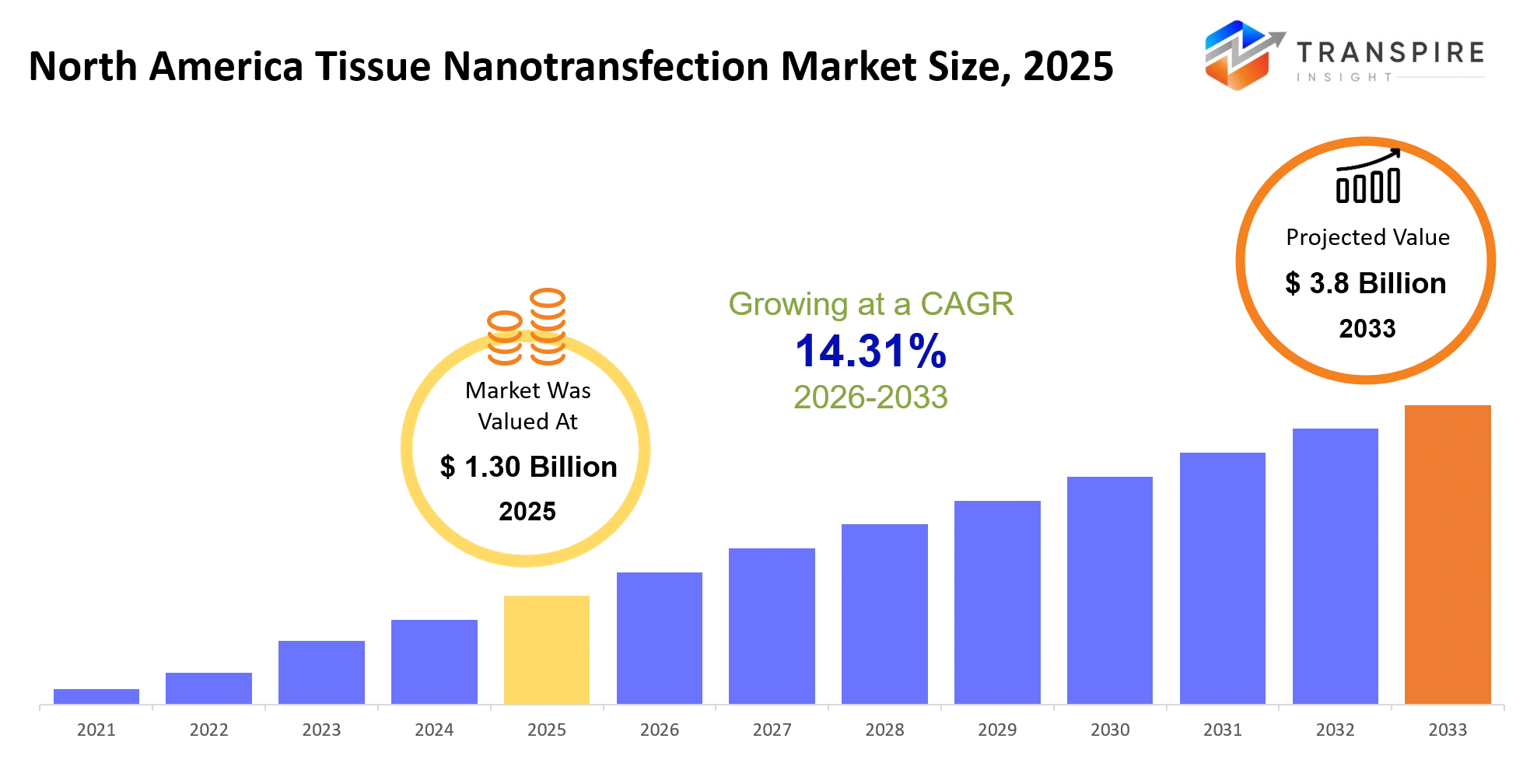
- North America Tissue Nanotransfection Market Size 2025: USD 1.30 Billion
- North America Tissue Nanotransfection Market Size 2033: USD 3.8 Billion
- North America Tissue Nanotransfection Market CAGR: 14.31%
- North America Tissue Nanotransfection Market Segments: By Product Type (Nanotransfection Devices, Nanochips, Reagents, Software Platforms, Others); By Application (Regenerative Medicine, Gene Therapy, Wound Healing, Tissue Engineering, Others); By End User (Research Institutes, Biotechnology Companies, Hospitals, Others); By Technology (Electroporation-based Systems, Nanofluidic Systems, AI-enabled Platforms, Others).
To learn more about this report,  Download Free Sample Report
North America Tissue Nanotransfection Market Summary
The North America Tissue Nanotransfection Market was valued at USD 1.30 Billion in 2025. It is forecast to reach USD 3.8 Billion by 2033. That is a CAGR of 14.31% over the period.
North America Tissue Nanotransfection market is mostly about approaches that send genetic or therapeutic cargo straight into skin and deeper cell layers, so you can do localized cell “switching” for wound repair, vascular rebuilding and maybe even neurological recovery, all without invasive surgery. In real-world use, it sort of reduces the need for lab-grown cell therapies, because instead of waiting on external cell products, it turns the patient’s own tissue into an in-situ treatment stage.
Over the past 3 to 5 years the whole market has shifted in a more structural way, moving away from viral vector driven gene delivery toward non-viral, device based reprogramming platforms that are often bundled with microelectronic patches. One big trigger was COVID-19, it really put stress on viral vector production capacity. That situation showed scalability boundaries in a pretty clear way, and then investors plus regulators started leaning toward alternative delivery methods. So now many North American biotech developers are putting emphasis on faster to deploy solutions, with lower immunogenicity, so they can go from preclinical work into translational trials with less friction. This trend has boosted collaborations and early clinical exploration too, which in turn helps commercialization routes and gives better revenue visibility, even if timelines can still wobble.
Key Market Insights
- North America kind of dominates the North America Tissue Nanotransfection Market, with roughly 48% share in 2025, mostly because of solid biotech R and D infrastructure.
- The United States basically holds about 70% of the regional slice, thanks to early clinical trials, plus a more mature gene delivery research ecosystem.
- Canada, on the other hand is the quickest moving sub-region from 2026–2030, backed by regenerative medicine financing and those usual academic-industry tie ups.
- Device-based nanotransfection platforms seem to lead the North America Tissue Nanotransfection Market, landing near 52% share in 2025. Non-viral gene delivery approaches stay in the second spot, and they’re pushed forward by immunogenicity reduction and also scalability type benefits.
- Patch-based bioelectronic transfection systems are the fastest-growing track through 2030, because minimally invasive clinical adoption keeps getting easier.
- For applications, wound healing and tissue regeneration take the lead at around 44% share, linked to chronic injury trends and diabetic ulcer cases that keep rising.
- Neurological regeneration comes up as the fastest-growing use-case, supported by early stage success in nerve repair studies, and clinical trials that are starting to look promising.
- Hospitals and specialty clinics bring in nearly 49% share, mainly due to how concentrated clinical trial activity tends to be.
- Meanwhile, research institutes and biotech labs are growing the fastest, powered by translational medicine budgets and government grants, which of course matters a lot.
What are the Key Drivers, Restraints, and Opportunities in the North America Tissue Nanotransfection Market?
Driver:
North America Tissue Nanotransfection market growth gets a push because companies are shifting away from viral vectors toward bioelectronic non viral delivery systems, sort of because the scalability limits got painfully exposed during COVID-19. That actually sped up uptake in regenerative medicine clinics,and also in research hospitals. As a result translational funding starts moving quicker and early stage trial activity ramps up. The direct effect feels like faster commercialization pathways, more device based revenue streams, and expanded collaboration between biotech firms and medical device companies around the US innovation hubs.
Restraint:
The restraint comes from long clinical validation cycles and intense regulatory scrutiny for gene reprogramming devices, which ends up stretching approval timelines. On top of that manufacturing is complicated when you’re dealing with nanoscale bioelectronic patches,so production costs rise and scalability gets limited. Because of this structural bottleneck, hospital integration is delayed, near term revenue conversion is suppressed, and adoption stays concentrated in research settings instead of becoming mainstream clinical use. It also intensifies funding competition among startups trying to secure scalable clinical validation routes across North American research ecosystems networks,and this pressure echoes beyond the region too.
Opportunity:
The opportunity is tied to AI integrated tissue regeneration platforms and federally funded neural repair programs in the United States. New collaborations keep forming between device manufacturers and biotech startups, enabling precision gene activation for nerve repair and skin regeneration. As pilot studies broaden in academic hospitals, commercialization potential improves too. So the North America Tissue Nanotransfection market could see quicker clinical scaling and stronger higher value therapies, basically moving from concept to practice sooner.
What Has the Impact of Artificial Intelligence Been on the North America Tissue Nanotransfection Market?
Artificial intelligence is getting more and more dropped into the North America Tissue Nanotransfection Market, where it kinda helps with designing, tracking, and fine tuning bioelectronic gene delivery systems used in regenerative medicine. In the device development flow, AI based simulation tools tune electric field settings, and they mess with microelectrode configurations too. That ends up improving transfection efficiency, while also cutting down on how many experiments labs have to run in preclinical stages, not just once, but repeatedly. So development cycles get shorter, and R&D costs feel lower for companies pushing in-situ cell reprogramming platforms.
At the same time, predictive analytics shows up for forecasting tissue response and gene expression outcomes, usually using patient specific variables. Machine learning systems—trained with imaging alongside omics datasets—help scientists anticipate therapeutic performance, and then adjust delivery protocols before anything hits clinical deployment. In manufacturing settings, AI driven quality inspection supports more consistent nanoscale patch fabrication, which boosts yield rates and reduces the money lost to defect related issues.
Operationally, early adopters say they’re seeing more directional wins like quicker prototype validation cycles and less variability in gene delivery outcomes. That adds up to stronger clinical trial reliability, and it can speed up regulatory submissions across the broader North America Tissue Nanotransfection Market ecosystem.
Still, adoption is held back by limited high-quality biological training data, plus headaches with standardizing real-world clinical datasets. This can create accuracy gaps when models move from tidy controlled lab conditions into messy human tissue variability, so full-scale AI integration slows down, even with all the investment momentum.
Key Market Trends
- From 2021 to 2025, researchers kind of moved away from viral gene vectors toward non-viral nanotransfection devices, mainly because scalability issues and safety concerns became more frequent, which felt necessary.
- In 2023, U.S. NIH-funded programs increased their funding allocations for in situ tissue reprogramming, and this actually accelerated early clinical validation, rather a lot.
- By 2025, hospitals had progressed from experimental uptake in 2020 into more structured clinical trial integration. That shift improved translational research throughput rates too, not just the paperwork side.
- After 2022, device manufacturers started folding in microelectronic patch systems more frequently, and these often replaced older polymer-based delivery prototypes, in regenerative medicine pipeline discussions that kept changing.
- Also, partnerships between biotech startups and companies like Boston Scientific grew after 2023, helping commercialization pathways become a bit more solid for regenerative therapies.
- In 2024, regulatory agencies tightened gene editing device scrutiny, so approvals slowed down but safety standardization across clinical trial frameworks got better, which might feel frustrating at first.
- AI assisted simulation tools were adopted after 2022, and they reduced how many preclinical testing loops were needed, improving efficiency in tissue response modeling workflows overall.
- Between 2023 and 2025, manufacturing supply chains leaned more toward precision nanoscale fabrication hubs in the U.S. Midwest, aiming to reduce production variability.
- Post 2024, research institutions increasingly prioritized neurological regeneration applications, moving beyond wound healing into higher value therapeutic use cases, because the returns looked stronger, at least in their internal planning.
North America Tissue Nanotransfection Market Segmentation
By Product Type
Nanotransfection devices kind of hold the lead in the North America Tissue Nanotransfection Market, grabbing the biggest revenue share because of strong pickup in clinical research and regenerative medicine trials. These systems seem to enjoy early commercialization momentum, plus direct use in in situ gene delivery work, so there is less need for lab based viral vectors. Their overall dominance also shows up in the fact that device pricing is usually higher than consumables, and that kind of boosts revenue concentration in this group.
Nanochips and nanofluidic delivery components are seeing quicker growth too, since more researchers are moving toward precision controlled payload delivery right at the cellular level. This change is pushed by the need for better targeting accuracy, and also for less tissue harm during gene transfer procedures. Software platforms are still a smaller slice, but they are slowly growing, mainly as AI integration gets better at system calibration and real time monitoring.
Over the forecast period, device miniaturization and pairing with digital control systems will likely make adoption stronger for hybrid platforms that mix hardware and software “brainpower”. In practice this evolution should favor manufacturers using scalable fabrication methods and AI enabled control layers, while the demand for standalone consumables may soften a bit.
By Application
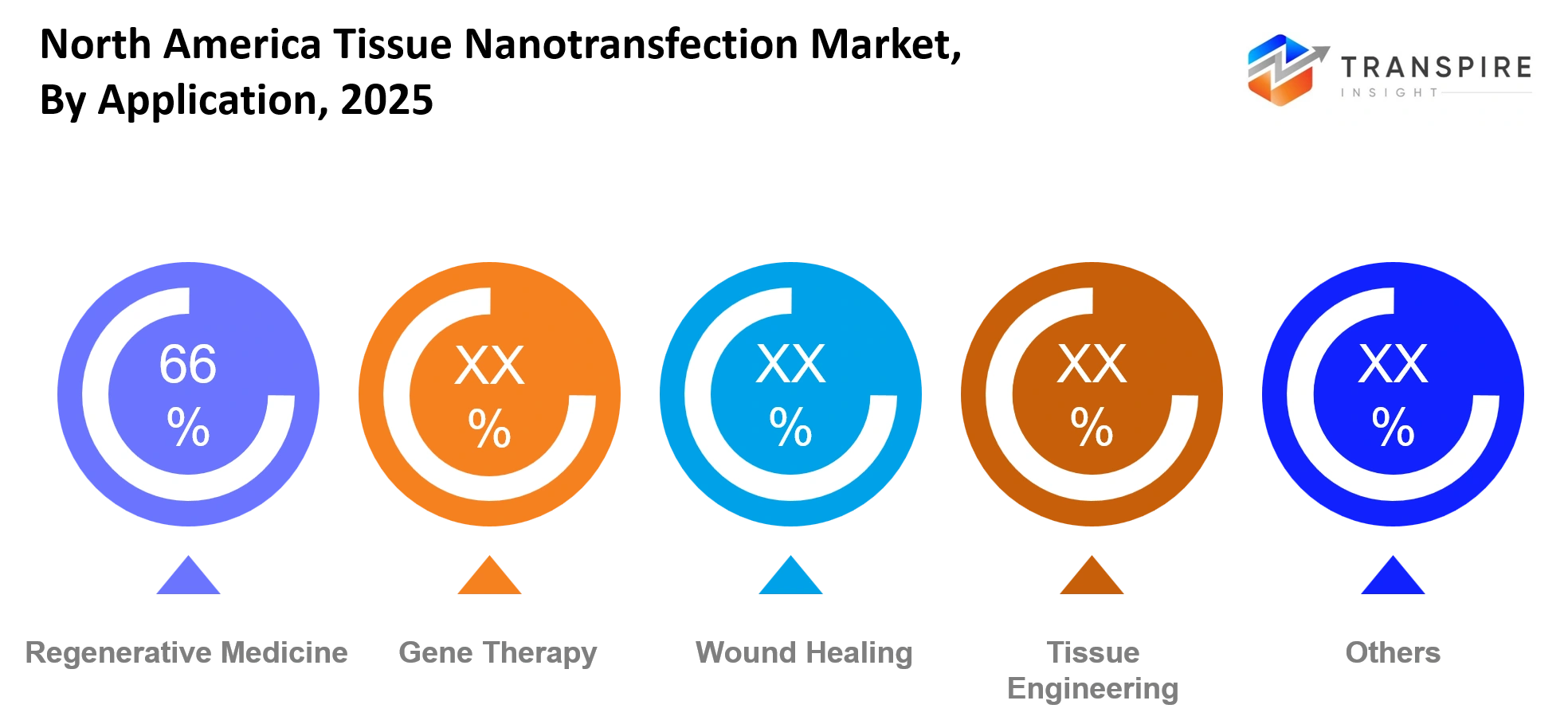
Regenerative medicine leads application demand in the North America Tissue Nanotransfection Market, mostly because it is used widely in skin repair, vascular regeneration, and preclinical organ repair studies. On top of that, steady funding from U.S. biomedical research programs has sped up early adoption in controlled clinical settings. This segment keeps its edge because it lines up with unmet clinical needs in chronic wound scenarios and broader tissue damage cases.
Gene therapy is seen as a kind of structurally widening application zone, because non-viral delivery seems to bring down immune response risks that come with the more traditional viral vectors. Wound healing stays a pretty commercially active slice, also because diabetic ulcer prevalence is climbing and hospitals are getting more comfortable with treatment adoption. Tissue engineering is picking up speed too, especially with those academic-industry collaborations that focus on organ regeneration prototypes, even when the timelines feel a bit stretched.
What comes next, the future growth, is likely to lean more into neurological and cardiac regeneration use cases as the trial pipelines mature. That change will probably push the demand toward super precise transfection systems that can handle multi-tissue targeting, and that creates room for advanced device makers, plus biotech partnerships that want a cleaner path to differentiation.
To learn more about this report, Download Free Sample Report
By End User
Research institutes basically hold the leading spot in the North America Tissue Nanotransfection Market, mainly due to early-stage experimentation, and a heavy reliance on government and grant funding. They end up running most of the preclinical validation work and, in practice, they act as primary testing ground for emerging bioelectronic delivery technologies. Their dominance also mirrors the experimental nature of the field, and the need for controlled research environments, more or less all the time.
Biotechnology companies are growing the quickest among end users, since commercialization efforts keep accelerating and partnerships with device manufacturers keep showing up more often. Hospitals still keep a moderate but rising share because clinical trials are expanding into translational medicine programs. Other end users, like contract research organizations, also contribute, they provide specialized testing and validation services, where needed.
Over time, hospitals will gain a larger share as regulatory approvals keep increasing, and as clinical protocols end up standardizing, across North America. This change will lower dependence on academic settings, and it will help enable wider therapeutic rollout, leading to better revenue stability for device developers, overall.
By Technology
Electroporation-based systems currently dominate the North America Tissue Nanotransfection market, mostly because they’ve been used for a while in cellular membrane permeabilization, and gene transfer performance. They also ride on already established lab use and relatively mature engineering norms, compared with newer ideas. In short, their leadership shows up as reliability in more controlled experimental environments.
Nanofluidic systems are starting to look like a high-growth technology group, because they allow careful low-damage delivery of molecular payloads at single-cell resolution. Meanwhile, AI-enabled platforms are picking up traction by adjusting voltage parameters, delivery timing, and even forecasting tissue response patterns. A few other approaches, though related, are still stuck in experimental stages, with limited real commercial adoption.
Looking ahead, development will likely swing toward hybrid systems—electroporation hardware plus an AI-driven optimization layer. That blend should boost efficiency, reduce the usual trial-and-error grind, and help speed up clinical translation for regenerative medicine use cases.
What are the Key Use Cases Driving the North America Tissue Nanotransfection Market?
Regenerative wound repair kind of drives the main use case in the North America Tissue Nanotransfection Market, most notably for chronic diabetic ulcers and trauma related tissue loss that ends up in hospitals. The reason looks straightforward enough, clinicians lean on localized gene delivery to push healing forward where regular grafting, or even routine drug therapies just don’t cut it. Also the patient volume in specialty care centers makes the whole thing stick, so adoption stays fairly consistent across hospital networks in North America.
Beyond that, gene therapy support applications along with vascular regeneration keep expanding, especially inside biotechnology companies and research institutes running translational work. These groups tie nanotransfection platforms into their workflows to raise non-viral delivery efficiency and keep immune response risk lower during early stage trials. On a parallel track, tissue engineering for organ scaffold work is getting more momentum too, particularly in academic medical centers that collaborate with device developers and they share know how back and forth.
There are new use cases showing up as well, like neurological repair for spinal cord injuries, and cardiac tissue regeneration after ischemic events. For now, these are still mainly preclinical, and early clinical stages, but progress is picking up because nanochip precision keeps improving, plus regulatory support for advanced regenerative medicine trials is getting more visible.
|
Report Metrics |
Details |
|
Market size value in 2025 |
USD 1.30 Billion |
|
Market size value in 2026 |
USD 1.49 Billion |
|
Revenue forecast in 2033 |
USD 3.8 Billion |
|
Growth rate |
CAGR of 14.31% from 2026 to 2033 |
|
Base year |
2025 |
|
Historical data |
2021 - 2024 |
|
Forecast period |
2026 - 2033 |
|
Report coverage |
Revenue forecast, competitive landscape, growth factors, and trends |
|
Regional scope |
North America (Canada, The United States, and Mexico) |
|
Key company profiled |
Thermo Fisher Scientific, Bio-Rad Laboratories, Lonza Group, Harvard Bioscience, MaxCyte, NanoCellect Biomedical, Takara Bio, Merck KGaA, Danaher Corporation, Agilent Technologies, Bio-Techne, Cytiva, STEMCELL Technologies, NanoString Technologies, Fujifilm Cellular Dynamics. |
|
Customization scope |
Free report customization (country, regional & segment scope). Avail customized purchase options to meet your exact research needs. |
|
Report Segmentation |
By Product Type (Nanotransfection Devices, Nanochips, Reagents, Software Platforms, Others); By Application (Regenerative Medicine, Gene Therapy, Wound Healing, Tissue Engineering, Others); By End User (Research Institutes, Biotechnology Companies, Hospitals, Others); By Technology (Electroporation-based Systems, Nanofluidic Systems, AI-enabled Platforms, Others). |
Which Regions are Driving the North America Tissue Nanotransfection Market Growth?
North America keeps the leading spot in the global Tissue Nanotransfection Market, mainly because of a pretty solid biomedical research setup and early regulatory backing for advanced regenerative therapies. The United States is the biggest player in this region, largely due to concentrated funding from federal agencies plus a network of hospital research groups that actually show up in clinical trials. There’s also this dense circle of biotechnology companies, academic medical centers, and device makers that makes translational work move faster, sort of from lab proof to human testing. Even with strict requirements, the regulatory routes are still innovation-friendly—agencies like the FDA, help keep commercialization of nanotransfection technologies more structured and predictable.
Canada lands as the second important regional contributor, with growth that feels steadier and policy-supported, not so much a sudden surge in technological acceleration. Compared with the U.S., Canada’s strength comes from stable public health spending and ongoing budget support for university-led regenerative medicine programs. On top of that, provincial research initiatives and collaborations that cross the border with U.S. biotech firms improve technology access, without pushing Canada to build massive domestic manufacturing capacity. So you end up with a dependable demand base, which supports the incremental rollout of nanotransfection platforms, especially within academic labs and hospital-linked research teams.
Asia Pacific is growing the quickest, propelled by fast expansion of biomedical infrastructure and government-backed precision medicine programs across places like China, Japan, and South Korea. New investments in advanced hospital networks and gene therapy research hubs have improved clinical trial capability, and also boosted how quickly technologies get absorbed. Regulatory streamlining for regenerative medicine approvals has further accelerated adoption. This growth signals strong entry opportunities for global device developers and investors targeting scalable manufacturing partnerships and early-stage clinical collaborations through 2026–2033.
Who are the Key Players in the North America Tissue Nanotransfection Market and How Do They Compete?
The North America Tissue Nanotransfection Market has a kind of moderately concentrated but still innovation driven competitive setup, where a handful of big medical technology firms along with some specialized biotech players quietly steer the overall direction, while smaller startups keep throwing in disruptive device ideas. What really gets attention here is the tech differentiation not so much pricing, because winning depends on delivery precision, biocompatibility, and meeting regulatory requirements for clinical grade gene transfer systems. The established players tend to protect their advantage via intellectual property in nanoelectrode design and the whole clinical validation pathway… while newer entrants often push by promising faster prototyping cycles and AI assisted optimization platforms, which can shrink preclinical testing timelines.
Johnson & Johnson leans into a broad tech integration approach, basically by weaving regenerative medicine capabilities into its more advanced surgery portfolio. They differentiate using their long standing clinical trial infrastructure, this is what lets them validate emerging tissue repair applications quicker. Growth usually follows partnerships with academic hospitals across the United States, which helps with early access to regenerative therapy pipelines, and also makes device to clinic conversion rates better.
Medtronic is more about device engineering specialization, drawing on its strengths in bioelectronic systems and surgical technologies to refine precision delivery platforms. Their edge shows up through strong regulatory compliance know how, plus global hospital relationships that back up quicker clinical rollout. Boston Scientific highlights minimally invasive innovation, they work on compact delivery systems, meant for outpatient and ambulatory care environments. The firm expands by pursuing selected collaborations with biotech startups working on similar regenerative or transfection focused solutions on nano-scale electroporation technologies, accelerating entry into regenerative therapy applications across North America.
Company List
- Thermo Fisher Scientific
- Bio-Rad Laboratories
- Lonza Group
- Harvard Bioscience
- MaxCyte
- NanoCellect Biomedical
- Takara Bio
- Merck KGaA
- Danaher Corporation
- Agilent Technologies
- Bio-Techn
- Cytiva
- STEMCELL Technologies
- NanoString Technologies
- Fujifilm Cellular Dynamics
Recent Development News
“In April 2026, Thermo Fisher Scientific announced the sale of its microbiology business to Astorg for approximately $1.08 billion. The transaction reflected Thermo Fisher’s strategy to streamline its life sciences portfolio and redirect capital toward higher-growth research and advanced biotechnology segments relevant to cellular engineering and tissue-based technologies.
Source: https://www.reuters.com
“In May 2026, MaxCyte expanded commercialization efforts for its ExPERT DTx platform and continued integration of SeQure Dx following prior strategic investments. The development strengthened cell-engineering and gene-editing workflow capabilities, supporting broader adoption across advanced therapeutic research and tissue engineering applications.
Source: https://investors.maxcyte.com
What Strategic Insights Define the Future of the North America Tissue Nanotransfection Market?
The North America Tissue Nanotransfection Market is moving, kind of toward tightly integrated bioelectronic and AI-optimized gene delivery systems, pushed by a wider shift from lab-based regenerative work to therapies that can be actually deployed in the clinic. Over the next 5 to 7 years, growth should cluster around platforms that fuse precision nano-delivery with real-time computational control. Basically, healthcare systems are trying to get faster translational results, and also dial down procedural complexity. In that structure, the advantage goes to firms that can blend hardware engineering with data-led biological modeling.
There’s also a less visible kind of risk, related to how much the field depends on highly specialized fabrication inputs for nanoelectrode and patch production. So if supply chains get disrupted, or if material standardization takes longer than expected, clinical scaling could get slowed down even when demand signals stay strong. Another constraint shows up from regulatory divergence across North America. That part can stretch approval timelines for cross-border clinical adoption, and it may narrow the space for a single, unified commercialization plan.
On the opportunity side, one key emerging angle is AI-guided personalized regeneration protocols, especially in neurological and cardiovascular repair trials that are expanding across U.S. academic hospitals. Market participants should likely focus on building integrated ecosystems that pair device platforms with predictive biology software, because that could help with faster regulatory validation and provide more clinical separation during competitive bidding.
North America Tissue Nanotransfection Market Report Segmentation
By Product Type
- Nanotransfection Devices
- Nanochips
- Reagents
- Software Platforms
- Others
By Application
- Regenerative Medicine
- Gene Therapy
- Wound Healing
- Tissue Engineering
- Others
By End User
- Research Institutes
- Biotechnology Companies
- Hospitals
- Others
By Technology
- Electroporation-based Systems
- Nanofluidic Systems
- AI-enabled Platforms
- Others
Frequently Asked Questions
Find quick answers to common questions.
The expected North America Tissue Nanotransfection Market size is USD 3.8 Billion in 2033.
Key segments for the North America Tissue Nanotransfection Market are By Product Type (Nanotransfection Devices, Nanochips, Reagents, Software Platforms, Others); By Application (Regenerative Medicine, Gene Therapy, Wound Healing, Tissue Engineering, Others); By End User (Research Institutes, Biotechnology Companies, Hospitals, Others); By Technology (Electroporation-based Systems, Nanofluidic Systems, AI-enabled Platforms, Others).
Major North America Tissue Nanotransfection Market players are Thermo Fisher Scientific, Bio-Rad Laboratories, Lonza Group, Harvard Bioscience, MaxCyte, NanoCellect Biomedical, Takara Bio, Merck KGaA, Danaher Corporation, Agilent Technologies, Bio-Techne, Cytiva, STEMCELL Technologies, NanoString Technologies, Fujifilm Cellular Dynamics.
The North America Tissue Nanotransfection Market size is USD 1.30 Billion in 2025.
The North America Tissue Nanotransfection Market CAGR is 14.31% from 2026 to 2033.
- Thermo Fisher Scientific
- Bio-Rad Laboratories
- Lonza Group
- Harvard Bioscience
- MaxCyte
- NanoCellect Biomedical
- Takara Bio
- Merck KGaA
- Danaher Corporation
- Agilent Technologies
- Bio-Techn
- Cytiva
- STEMCELL Technologies
- NanoString Technologies
- Fujifilm Cellular Dynamics
About the Authors

Pankaj Ghogare Patil
I am Pankaj Ghogare Patil, a Senior Research Analyst at Transpire Insight, specializing in the Pharmaceutical, Chemicals & Materials, Healthcare IT, and Biotechnology industry. My expertise lies in conducting comprehensive market research, analyzing industry trends, evaluating competitive landscapes, and translating complex data into actionable insights. At Transpire Insight, I closely follow emerging technologies, regulatory developments, and market innovations to create accurate, well-researched, and informative content that helps businesses and professionals make informed decisions. I am committed to producing credible, evidence-based articles that reflect industry best practices while making technical topics accessible and valuable for a broad audience.

Chakradhar Khansole
Chakradhar serves as the Research Director at Transpire Insight, bringing over 8 years of experience in technology, innovation, and strategic market intelligence. He specializes in transforming complex market data into actionable business insights that enable organizations to make informed, growth-oriented decisions. Recognized for his strategic vision and analytical expertise, Chakradhar leads high-impact research initiatives, delivering comprehensive market assessments, competitive intelligence, and forward-looking industry analysis.
Recently Published Reports
-
Apr 2026
Cord Blood Banking Services Market
Cord Blood Banking Services Market Size, Share & Analysis Report By Type of Service (Collection, Processing, Storage), By Bank Type (Private Banks, Public Banks, and Hybrid Banks), By Component (Cord Blood, and Cord Tissue), By End User (Hospitals, Research Institutions, Biotechnology Companies, and Others) and Geography (North America, Europe, Asia-Pacific, Middle East and Africa, South and Central America), 2021 - 2031
-
Apr 2026
ELISA Processors Market
ELISA Processors Market Size, Share & Analysis Report By Type (Optical Filter ELISA Analyzer, and Optical Grating ELISA Analyzers), By Mode (Automated ELISA Analyzers, and Semi-Automated ELISA Analyzers), By Applications (Immunology, Vaccine development, Drug Monitoring, and Others), By End Users (Biotechnology Companies, Pharmaceutical Companies, Contract Research Organization, and Diagnostic Laboratories) and Geography (North America, Europe, Asia-Pacific, Middle East and Africa, South and Central America), 2021 - 2031
-
May 2026
Microscope Slide Scanner Market
Microscope Slide Scanner Market Size, Share & Analysis Report By Type (Portable Microscope Slide Scanner, and Desktop Microscope Slide Scanner), By Application (Biological Research, Medicine, Veterinary, and Other) and Geography (North America, Europe, Asia-Pacific, Middle East and Africa, South and Central America), 2021 - 2031
-
Apr 2026
Microwave Cookware Market
Microwave Cookware Market Size, Share & Analysis Report By Material Type (Plastic, Glass, Ceramic, Silicone, and Metal), By Application (Cooking, Reheating, and Defrosting), By End User (Household, Commercial (Restaurants, Hotels, and Cafes), and Food Service Industry), By Sales Channel (Online Retail, Offline Retail (Supermarkets, Hypermarkets, Specialty Stores), and Direct Sales (Company Outlets)) and Geography (North America, Europe, Asia-Pacific, Middle East and Africa, South and Central America), 2021 - 2031