

North America Extremity Tissue Expanders Market Size & Forecast:
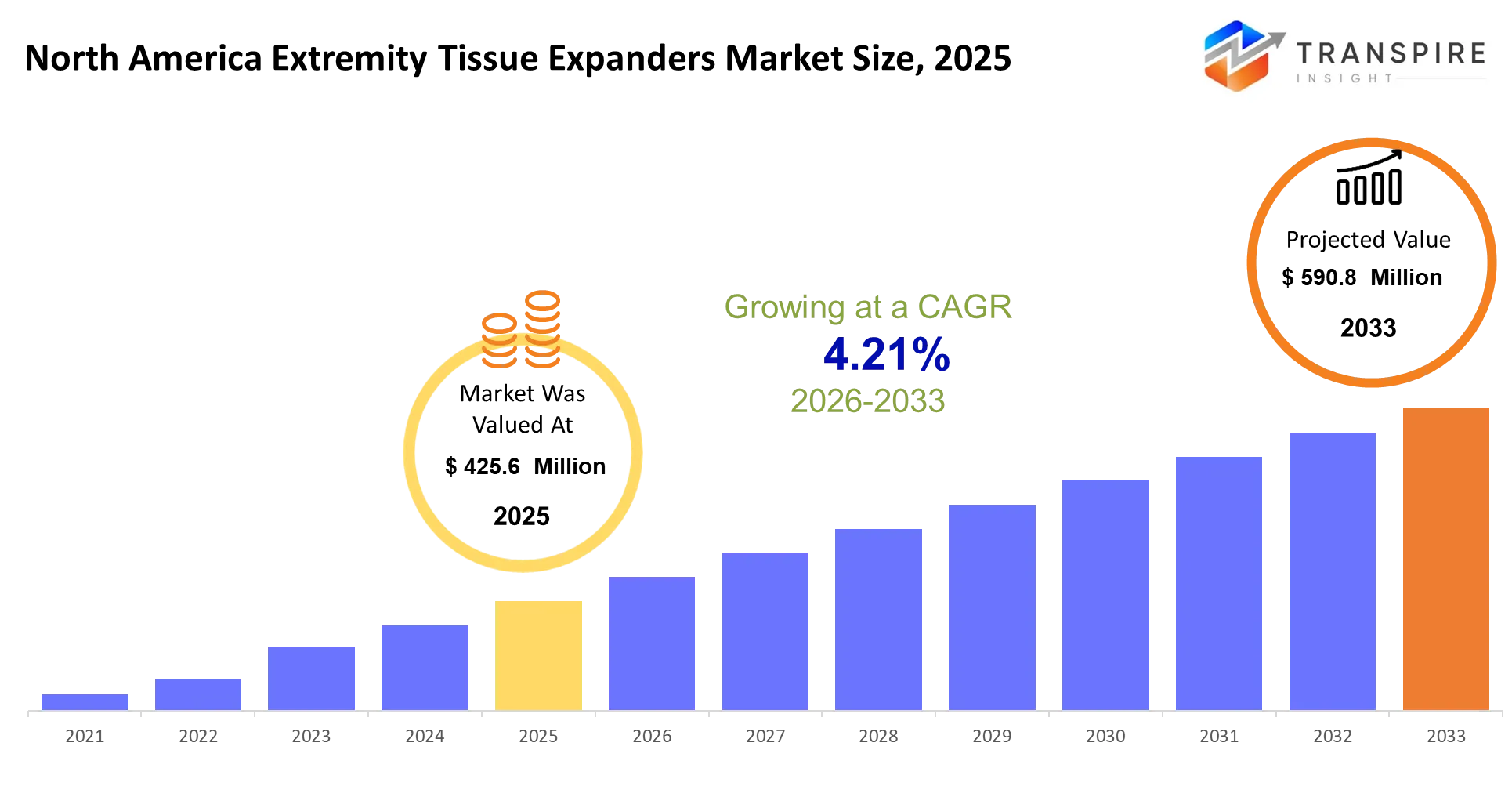
- North America Extremity Tissue Expanders Market Size 2025: USD 425.6 Million
- North America Extremity Tissue Expanders Market Size 2033: USD 590.8 Million
- North America Extremity Tissue Expanders Market CAGR: 4.21%
- North America Extremity Tissue Expanders Market Segments: By Type (Silicone Expanders, Saline Expanders, Others), By Application (Reconstructive Surgery, Cosmetic Surgery, Trauma Repair, Others), By End-User (Hospitals, Clinics, Surgical Centers, Others), By Shape (Round, Anatomical, Custom, Others).
To learn more about this report,  Download Free Sample Report
North America Extremity Tissue Expanders Market Summary:
The North America Extremity Tissue Expanders Market size is estimated at USD 425.6 Million in 2025 and is anticipated to reach USD 590.8 Million by 2033, growing at a CAGR of 4.21% from 2026 to 2033. The North America Extremity Tissue Expanders Market kind of plays a practical role in reconstructive care, by helping surgeons slowly stretch skin plus soft tissue around the arms , legs, hands, and feet before the final reconstruction part. These devices are increasingly used after trauma injuries, burn treatment, tumor excision, and complicated orthopedic procedures where direct wound closure is not possible. In general, their value shows up as less dependence on grafts and better functional , and cosmetic results, especially in limb preservation surgeries.
Over the last five years, the market has moved away from broad, generic reconstruction toward procedure specific expanders made for extremity anatomy, along with faster expansion schedules. This change has been pushed forward by improvements in biomaterials and outpatient reconstructive pathways that can shorten hospital days. One big trigger came from the backlog of postponed elective and reconstructive surgeries after the COVID-19 disruption, which kinda made hospitals focus on efficient staged reconstruction solutions. As trauma centers and ambulatory surgical networks added capacity, tissue expanders became more embedded into treatment planning, and that translated into more procedures , with continuing recurring demand across specialized reconstructive practices.
Key Market Insight
- The United States kind of dominated the North America Extremity Tissue Expanders Market with almost 82% market share in 2025, because advanced reconstructive surgery networks keep pushing things forward
- Canada is still showing up as the fastest-growing regional market through 2032, backed by expanding trauma care investments and the buildout of outpatient surgical infrastructure, in general
- Across North America strong reimbursement frameworks keep on supporting industry scale and also help raise procedural adoption in reconstructive healthcare facilities
- High-volume trauma centers and burn treatment programs are getting a lot faster at driving regional momentum, and this is boosting the appetite for extremity reconstruction technologies
- Silicone-based extremity tissue expanders took more than 58% market share in 2025, largely due to better flexibility and fewer complication rates
- Anatomical tissue expanders stayed the second-largest segment since limb salvage plus post-oncology reconstruction procedures are being used more often
- Customized expanders are projected to grow the quickest during the forecast period, as surgeons start prioritizing patient specific reconstruction outcomes, not just standard shapes
- Self-inflating tissue expanders are also gaining traction, since they reduce clinical intervention needs and make outpatient procedures run more efficiently
- For applications, trauma and burn reconstruction led the North America Extremity Tissue Expanders Market with around 46% revenue share in 2025
- Post-tumor excision reconstruction emerged as the fastest-growing application segment, because limb preservation surgical procedures are increasing across North America
- Orthopedic soft tissue reconstruction applications are expanding quickly too, along with higher sports injury treatment volumes and accident related surgical interventions
What are the Key Drivers, Restraints, and Opportunities in the North America Extremity Tissue Expanders Market?
The most powerful driver pushing the North America Extremity Tissue Expanders Market is basically the move toward limb preservation and staged reconstructive operations in trauma and oncology settings. Lots of hospitals are choosing tissue expansion because it cuts back on heavy grafting workflows ,and it can help with better functional recovery, that kind of thing. This momentum really gathered steam after healthcare systems broadened outpatient reconstruction options following the COVID-19 surgical backlog. Also, improvements in silicone engineering plus self inflating expander technology have lowered the chances of issues , and they tend to speed up the whole treatment cycle. So, more reconstructive centers are pulling extremity tissue expanders into earlier planning stages, which increases procedural volumes and keeps generating steady, almost repeat purchase like revenue streams for device manufacturers.
Still, the market’s main structural sticking point is the relatively small number of highly trained reconstructive surgeons who understand advanced extremity tissue expansion techniques. This isn’t like typical aesthetic use, extremity repair needs coordination across orthopedic plastic, and trauma specialties. Unfortunately, training pathways move slowly, and smaller hospitals often don’t have a dedicated reconstructive department, or the staffing to support it. Because of that, adoption stays weak in secondary care facilities, and the scaling of procedures gets pushed out , especially beyond big metropolitan healthcare systems. Ultimately you end up with uneven penetration, and the commercialization of these advanced expander technologies happens at a slower pace.
A big growth lane seems to be patient specific expanders that are backed by 3D imaging and surgical planning software, kind of like a guided path from imaging to the OR. In North American academic medical centers, more and more teams are putting money into customized reconstruction workflows , which are said to improve fit precision and help cut down revision procedures. And as hospital systems keep building precision surgery programs, the makers that can weave digital planning tools together with tailored expander designs, they might unlock the next phase of premium market momentum.
What Has the Impact of Artificial Intelligence Been on the North America Extremity Tissue Expanders Market?
Artificial intelligence and advanced digital technologies are slowly starting to reshape the North America Extremity Tissue Expanders Market, like by improving surgical planning, procedural accuracy , and post-operative checkups. Hospitals and reconstructive centers are increasingly weaving AI-assisted imaging platforms together with 3D modeling software, so they can automate tissue expansion planning for those more complicated extremity reconstruction situations. These platforms basically look at skin elasticity, wound layout and the expansion potential, to support surgeons in getting better expander placement and to reduce the chance of needing procedural revisions later.
At the same time, machine learning models are helping forecast surgical outcomes by flagging complication likelihoods, including tissue necrosis, infection probability , and delayed healing tendencies. They do this using patient-specific clinical details, then they give reconstructive teams something practical to act on. With that kind of foresight, teams can adjust treatment sequencing and potentially shorten recovery times. In multiple advanced reconstructive programs, digital surgical planning tools have cut down operating room preparation time and boosted procedural flow, mainly by simplifying implant sizing and tightening the expansion schedule.
There are also remote patient monitoring platforms linked to smart wearable devices, which are gradually raising follow-up adherence and catching early issues faster. That tends to reduce unnecessary hospital visits and can lower overall post-surgical management expenses. Still, broad AI uptake is somewhat held back by expensive integration work, plus fragmented clinical datasets. Many healthcare systems don’t yet have standardized reconstructive data infrastructure, so algorithm performance can drop across different trauma and oncology patient groups.
Key Market Trends
- Since 2021, hospitals have, expanded outpatient reconstruction programs, in a way that sort of pushes adoption of self-inflating tissue expanders which lowers the need for repeat clinical interventions .
- After the post-pandemic surgical backlogs piled up , trauma centers across the United States started leaning more toward limb preservation protocols and staged reconstruction pathways, like, more often than before.
- Between 2020 and 2025 , manufacturers rolled out anatomically contoured expanders , these helped with better fit precision for hand, foot, and lower extremity reconstruction surgeries.
- Companies such as Mentor Worldwide LLC and Sientra, Inc. put more money into silicone durability plus antimicrobial surface technologies , largely after complication reduction became a kind of buying priority for purchasers.
- Reconstructive surgeons increasingly used 3D imaging platforms , once studies suggested that digitally planned expansion procedures can reduce revision surgeries and also cut operating room prep time.
- Canadian healthcare systems accelerated procurement of advanced reconstructive devices after provincial funding expanded specialized burn and trauma treatment infrastructure starting in 2022, and that momentum kept going.
- Ambulatory surgical centers gained more procedural share , as insurers encouraged cost-efficient reconstruction routes that shortened inpatient recovery periods , and in turn reduced how much hospital resources were used .
- Supply chain disruptions during 2020 and 2021 , led manufacturers to regionalize medical-grade silicone sourcing and also strengthen North American production, pretty noticeably.
- Pediatric reconstruction programs began adopting smaller, customized expanders more frequently , as congenital deformity correction procedures became more centralized inside specialized academic hospitals .
North America Extremity Tissue Expanders Market Segmentation
By Type
Silicone expanders still seem to take the lead in the type segment, more or less because reconstructive surgeons like flexible materials with a smaller rupture risk and better tissue compatibility, or at least that’s what most reports suggest. Saline expanders keep getting chosen in cost sensitive healthcare settings since filling is easier to control and the initial price is lower, even if worries about complications keep many teams from using them more widely. Then there are other material categories, like hybrid biomaterial designs, they stay relatively smaller but they’re quietly drawing research dollars as manufacturers look for ways to stand out across their product catalog.
Demand has been leaning toward long-duration expanders, basically devices meant for staged extremity reconstruction after trauma or tumor resection. Hospitals are also pushing harder for options that reduce infection rates and can shorten the recovery window, which gives premium silicone systems stronger pricing power. What comes next in this type segment, competition wise, will likely focus on antimicrobial coatings, self inflating mechanisms, and expansion control tools that are more customized. Companies that can mix material durability with digital surgical planning compatibility should be able to build stickier relationships with reconstructive centers and specialty surgical networks over the long run.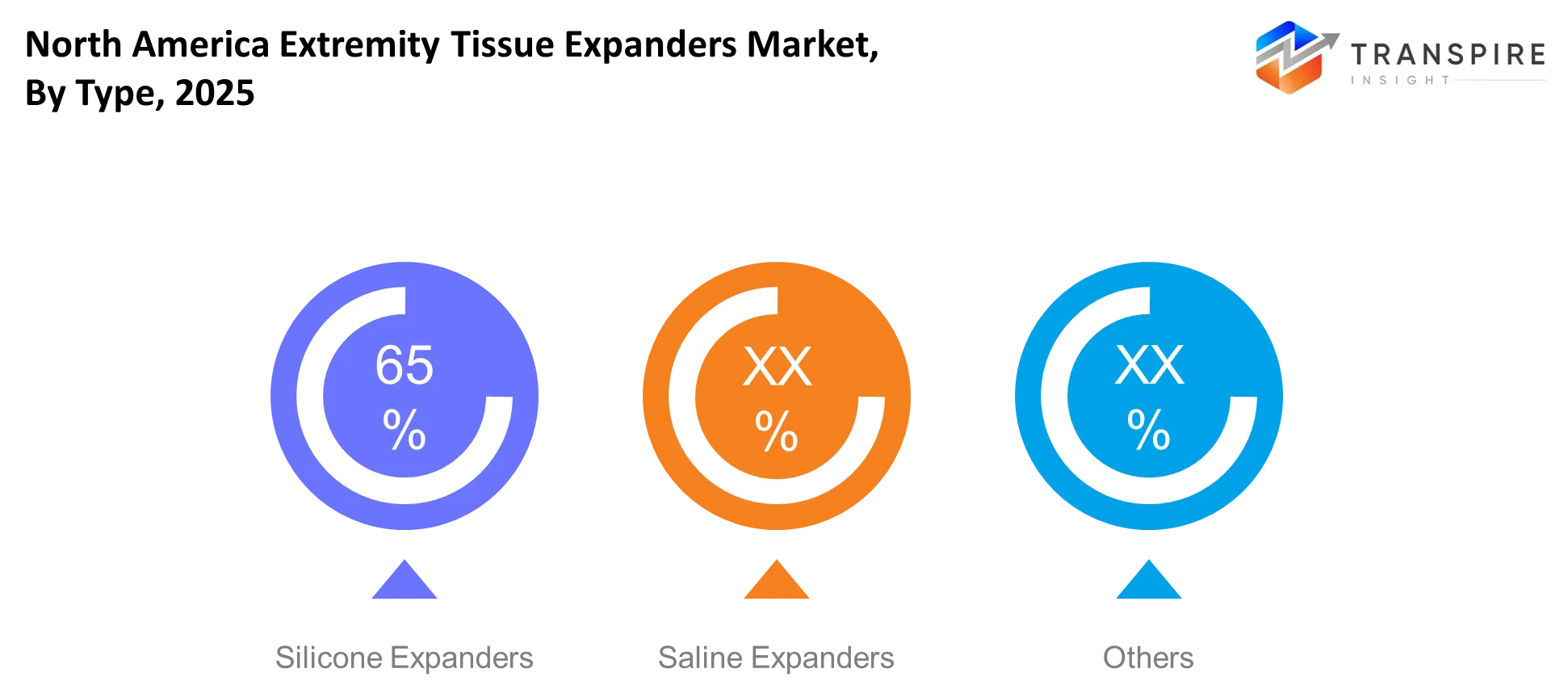
To learn more about this report, Download Free Sample Report
By Application
Reconstructive surgery kind of ends up being the leading application segment, mainly because extremity tissue expanders are used a lot during trauma recovery, limb preservation, burn treatment, and then later post-oncology reconstruction, like it’s pretty common there. Cosmetic surgery stays more as a secondary contributor, and it is backed by elective soft tissue correction procedures, though reimbursement limits make the bigger procedural growth kind of slow, or at least uneven. Trauma repair use has picked up more momentum lately as healthcare systems started putting extra emphasis on functional recovery and staged wound closure, especially after serious orthopedic injuries. There are also other uses, for example congenital deformity correction, and those keep growing inside pediatric reconstruction programs at academic medical centers.
The growth logic in this space is also tied to rising procedural complexity, and surgeon preference tends to lean toward keeping natural tissue rather than leaning entirely on grafting methods. Looking ahead, the application trends point to steadier demand for patient-specific reconstruction pathways, supported by imaging software and customized expander designs. Investors and manufacturers are also aiming more at specialized trauma and oncology care networks, because procedural volumes are usually higher there, and reimbursement stability tends to be comparatively stronger.
By End-User
Hospitals keep dominating the end user segment because big reconstructive procedures need a sort of multidisciplinary surgical set up, advanced imaging gear, and nonstop post operative oversight. Specialty clinics come next, mainly because seasoned reconstructive surgeons are pushing more outpatient options for the less involved tissue expansion steps. Surgical centers are also seeing quicker growth, largely due to healthcare payers pushing to cut inpatient expenses and get patients back on their feet sooner , which kinda reshapes where procedures go. Other end user groups, like academic institutions and military healthcare facilities , still add fairly stable procedural demand through structured trauma reconstruction programs.
Overall demand is shifting toward places that can fold in digital surgical planning, remote patient monitoring, and well coordinated rehabilitation services right into the reconstructive routine. At smaller regional hospitals though, constraints stay real and they limit uptake of more advanced expansion systems, since specialized staffing and training needs are still pretty demanding. Looking ahead, the market seems headed toward stronger consolidation around high volume reconstructive centers that can actually run precision surgery programs and keep handling long term follow up for difficult extremity reconstruction cases.
By Shape
Anatomical expanders kind of dominate the shape segment, because surgeons usually need contour specific designs that match uneven body parts like hands, feet, and lower limbs— at least in practice. Round expanders still see steady use in more routine reconstruction cases, where plain procedure, and lower manufacturing costs, matter a lot for providers. Then custom shaped expanders look like the fastest growing group, partly because 3D imaging is more common now, plus digital surgical mapping and patient specific planning. Other kinds of shapes still get limited traction, but they do help with niche work, for example pediatric deformities or very complicated trauma reconstruction.
Overall demand is trending toward devices that boost tissue distribution accuracy and reduce the odds of extra procedural revisions during staged reconstruction. Manufacturers are responding too, with more ergonomic designs, better pressure control, and more dependable expansion behavior. Looking ahead, shape segment growth will likely hinge on cooperation between device firms, imaging software vendors, and reconstructive surgeons who want more exact surgical outcomes. If healthcare systems keep pushing personalized reconstruction pathways, then customized design options may end up being a key competitive advantage.
What are the Key Use Cases Driving the North America Extremity Tissue Expanders Market?
Trauma, and reconstructive surgery are still kinda the main reasons people adopt extremity tissue expanders across North American hospitals. Basically, high volume trauma centers lean on staged tissue expansion so they can support limb salvage work after burns, accidents, and tumor resections, especially when direct wound closure is hard to pull off in the moment.
At the same time, specialty surgical clinics are picking up tissue expanders for congenital deformity fixes and also for post orthopedic reconstruction procedures. Pediatric reconstructive programs and outpatient surgical centers are going further too, using them for scar revision and soft tissue restoration, because shorter recovery windows help patient flow, and that tends to cut down inpatient load a bit.
More recent, and still emerging, uses involve patient specific expansion systems that tie into 3D surgical planning tools, plus remote monitoring tech. Academic medical centers are also looking into customized expanders for complicated oncology reconstruction, and even military trauma rehabilitation programs, where careful tissue management can make the long term functional recovery outcomes look better.
|
Report Metrics |
Details |
|
Market size value in 2025 |
USD 425.6 Million |
|
Market size value in 2026 |
USD 442.7 Million |
|
Revenue forecast in 2033 |
USD 590.8 Million |
|
Growth rate |
CAGR of 4.21% from 2026 to 2033 |
|
Base year |
2025 |
|
Historical data |
2021 - 2024 |
|
Forecast period |
2026 - 2033 |
|
Report coverage |
Revenue forecast, competitive landscape, growth factors, and trends |
|
Country scope |
North America (Canada, The United States, and Mexico) |
|
Key company profiled |
Mentor Worldwide, Allergan, Sientra, GC Aesthetics, Polytech, HansBiomed, Establishment Labs, Koken, Laboratoires Arion, Eurosilicone, Sebbin, Nagor, Silimed, Ideal Implant, Implantech |
|
Customization scope |
Free report customization (country, regional & segment scope). Avail customized purchase options to meet your exact research needs. |
|
Report Segmentation |
By Type (Silicone Expanders, Saline Expanders, Others), By Application (Reconstructive Surgery, Cosmetic Surgery, Trauma Repair, Others), By End-User (Hospitals, Clinics, Surgical Centers, Others), By Shape (Round, Anatomical, Custom, Others) |
Which Regions are Driving the North America Extremity Tissue Expanders Market Growth?
The United States is basically at the front of the North America Extremity Tissue Expanders Market, since big hospital groups and specialized reconstructive clinics keep a strong procedural tempo for trauma, burn, and oncology care. Strong reimbursement frameworks and wide access to advanced surgical technologies help drive quicker adoption of premium expansion systems across the main urban healthcare networks. Academic medical institutions still keep a sort of top position too, through ongoing clinical research , and surgeon training initiatives that focus on limb preservation approaches. Major manufacturers also hold direct partnerships with hospitals and trauma centers, so it makes a steady little ecosystem for product improvement, procurement, and long-term procedural embedding.
Canada sits as the second-largest regional contributor, even if the market behavior looks a bit different than in the United States. That is due to a more centralized healthcare funding model and generally slower procurement timelines. Growth is still comparatively steady because provincial healthcare systems continue funding reconstructive surgery infrastructure, plus targeted burn treatment programs. Canadian providers tend to favor more cost-effective expansion systems that have proven long-term outcomes , and this keeps procedural demand consistent rather than pushing for fast product turnover. With continuing public healthcare investment and lower reimbursement swings, Canada stays a dependable revenue area for manufacturers aiming for stable multi-year purchasing commitments.
Mexico is kind of emerging as the fastest-growing regional market , mostly because private healthcare investment is increasing, and people are getting better access to advanced reconstructive surgery services in big metro medical hubs. Over the last few years , private hospital groups upped their spend on trauma reconstruction capabilities and outpatient surgical infrastructure, which is basically creating a fresh push for extremity tissue expanders. At the same time, medical tourism growth is moving faster, so adoption of advanced reconstructive procedures is accelerating too, especially in orthopedic areas and in post-trauma recovery services. All that momentum, together, gives device manufacturers and investors a pretty favorable entry point between 2026 and 2033 , mainly for firms that can deliver cost-competitive and adaptable expansion technologies, and that are tailored to mid-tier healthcare providers.
Who are the Key Players in the North America Extremity Tissue Expanders Market and How Do They Compete?
The competitive landscape of the North America Extremity Tissue Expanders Market stays fairly consolidated , like only a few specialized medical device manufacturers end up holding a big portion of the reconstructive surgery supply chains. Instead of almost all pressure being on pricing, the competition now leans toward material engineering, anatomical tuning, and how well these devices plug into digital surgical planning systems, even if some buyers say cost still matters. The older, established players keep defending share via surgeon relationships, hospital contracting pacts, and procedural training assistance. Meanwhile, the newer smaller entrants tend to push customized expansion approaches, especially for complicated trauma cases and oncology rebuilding work. In the end, product dependability plus complication minimization are still the main reasons hospitals buy , because many facilities care more about longer-term clinical results than immediate, short term device cost relief.
Mentor Worldwide LLC shows up with advanced silicone engineering and wide hospital integration across reconstructive surgery programs across the United States. Their strong manufacturing scale, plus the fact that many surgeons already know the line well, gives them momentum in large trauma and oncology centers, where they want process consistency. Sientra, Inc., on the other hand, differentiates with higher-end implant technologies and service models built around physicians, aimed at supporting customized reconstruction workflows. Expansion is also shifting toward collaborations with specialty surgical clinics, as well as funding efforts for digital planning compatibility so patient-specific reconstruction procedures can be scheduled more smoothly.
PMT Corporation keeps its edge mostly by niche specialization in tissue expansion systems that are built for tricky reconstructive uses, especially in pediatric situations and trauma related cases. They also have flexible manufacturing options so customization happens quicker for those irregular extremity reconstructions, which sort of becomes a clear advantage in specialized surgical settings. Meanwhile, GC Aesthetics is growing its regional footprint via distributor partnerships, and by widening its reconstructive lineup toward mid-sized healthcare systems that want cost efficient yet premium devices. Establishment Labs keeps putting money into biomaterial studies along with ergonomic implant design , so they can stand out more in precision reconstruction and in the next generation tissue expansion technologies.
Company List
- Mentor Worldwide
- Allergan
- Sientra
- GC Aesthetics
- Polytech
- HansBiomed
- Establishment Labs
- Koken
- Laboratoires Arion
- Eurosilicone
- Sebbin
- Nagor
- Silimed
- Ideal Implant
- Implantech
Recent Development News
In May 2026, Shoulder Innovations Raises 2026 Outlook After Strong Q1 Revenue Growth: Shoulder Innovations reported a 65% year-over-year revenue increase for Q1 2026, driven by rising implant system sales and expanded customer adoption. The company also increased investment in product development and robotic-platform partnerships, signaling continued momentum in North America’s reconstructive and orthopedic surgery ecosystem connected to extremity reconstruction procedures.
Source: https://www.prnewswire.com
In May 2026, Johnson & Johnson Continued Expansion of MENTOR Reconstruction Portfolio in North America: Johnson & Johnson’s MENTOR division continued expanding its breast reconstruction portfolio across North America following recent FDA-backed commercialization efforts for advanced reconstruction implants and tissue expansion systems. The development supports hospitals and reconstructive surgeons using tissue expander technologies in post-mastectomy and extremity-related reconstruction procedures.
Source: https://www.jnj.com
What Strategic Insights Define the Future of the North America Extremity Tissue Expanders Market?
The North America Extremity Tissue Expanders Market is shifting, in a more precision led direction, toward reconstructive care that’s centered on tailored implants, outpatient surgical routes, and digitally connected planning. Over the next five to seven years, real competitive edge will depend more and more on how well manufacturers blend biomaterial upgrades with imaging software, predictive surgical analytics, and patient specific device making. The main engine is the healthcare system's pressure to lower revision work, speed up return to normal, and raise functional results especially in complicated trauma cases and oncology reconstruction.
There’s also a less visible risk, like supply concentration tied to medical-grade silicone and other specialized production inputs. If sourcing gets stuck for a long period, or if regulators tighten the watch around implant safety, you could see pricing swings and slower product approvals across whole reconstruction lineups. At the same time, there’s an opportunity that’s starting to look more real: AI assisted reconstructive planning tools that connect to 3D-printed custom expanders, especially within high complexity pediatric and military trauma programs. Players in the market should push for collaborations with academic medical centers and digital surgery providers, so they lock in long-term procedural adoption instead of racing only on device cost, like it’s just about price.
North America Extremity Tissue Expanders Market Report Segmentation
By Type
- Silicone Expanders
- Saline Expanders
- Others
By Application
- Reconstructive Surgery
- Cosmetic Surgery
- Trauma Repair
- Others
By End-User
- Hospitals
- Clinics
- Surgical Centers
- Others
By Shape
- Round
- Anatomical
- Custom
- Others
Frequently Asked Questions
Find quick answers to common questions.
The Approximate North America Extremity Tissue Expanders Market size for the Market will be USD 590.8 Million in 2033.
The key segments of the North America Extremity Tissue Expanders Market are By Type (Silicone Expanders, Saline Expanders, Others), By Application (Reconstructive Surgery, Cosmetic Surgery, Trauma Repair, Others), By End-User (Hospitals, Clinics, Surgical Centers, Others), By Shape (Round, Anatomical, Custom, Others).
Major Players in the North America Extremity Tissue Expanders Market are Mentor Worldwide, Allergan, Sientra, GC Aesthetics, Polytech, HansBiomed, Establishment Labs, Koken, Laboratoires Arion, Eurosilicone, Sebbin, Nagor, Silimed, Ideal Implant, Implantech.
The Current Market size of the North America Extremity Tissue Expanders Market is USD 425.6 Million in 2025.
The North America Extremity Tissue Expanders Market CAGR is 4.21%.
- Mentor Worldwide
- Allergan
- Sientra
- GC Aesthetics
- Polytech
- HansBiomed
- Establishment Labs
- Koken
- Laboratoires Arion
- Eurosilicone
- Sebbin
- Nagor
- Silimed
- Ideal Implant
- Implantech
Recently Published Reports
-
May 2026
Biosimilars Market
Biosimilars Market By Product Type (Monoclonal Antibodies, Recombinant Hormones, Erythropoietin, G-CSF, Others), By Indication (Oncology, Autoimmune Diseases, Blood Disorders, Diabetes, Others), By Manufacturing Type (In-House Manufacturing, Contract Manufacturing), By Distribution Channel (Hospital Pharmacies, Retail Pharmacies, Online Pharmacies), By Industry Analysis, Size, Share, Growth, Trends, and Forecasts 2021-2033
-
Apr 2026
Gastrointestinal Endoscopy Market
Gastrointestinal Endoscopy Market By Type (Rigid Gastrointestinal Endoscope, Flexible Gastrointestinal Endoscopes, Disposable Gastrointestinal Endoscope), By Procedure Type (Colonoscopy, Gastroscopy, Duodenoscopy, Enteroscopy, Flexible Sigmoidoscopy, Others), By Application (Diagnosis, Treatment), By End-Users (Hospitals, Ambulatory Surgical Centers, Specialty Clinics, Laboratories, Others), By Industry Analysis, Size, Share, Growth, Trends, and Forecasts 2021-2033
-
Apr 2026
Rare Inherited Metabolic Disorder Drug Market
Rare Inherited Metabolic Disorder Drug Market By Drug Class (Enzyme Replacement Drugs, Gene Therapy Drugs, Substrate Reduction Drugs, Small Module Drugs, Protein Drugs), By Route of Administration(Parenteral, Oral, Intrathecal), By Clinical Development (Marketed Drugs, Late Stage Clinical Phase III, Early Stage Clinical Phase I-II, Preclinical Candidates), By Indication (Lysosomal Storage Disorders, Urea Cycle Disorders, Amino Acid Metabolic Disorders, organic Acidemias, Peroximal Disorders), By Industry Analysis, Size, Share, Growth, Trends, and Forecasts 2021-2033
-
Jan 2026
Pharmaceutical Cleanroom Technology Market
Pharmaceutical Cleanroom Technology Market By Product (Equipment, Consumables, Services); By Cleanroom Type (Standard Cleanrooms, Modular Cleanrooms); By End Use (Pharmaceutical Companies, Biotechnology Companies), By Industry Analysis, Size, Share, Growth, Trends, and Forecasts 2021-2033