
Market Summary
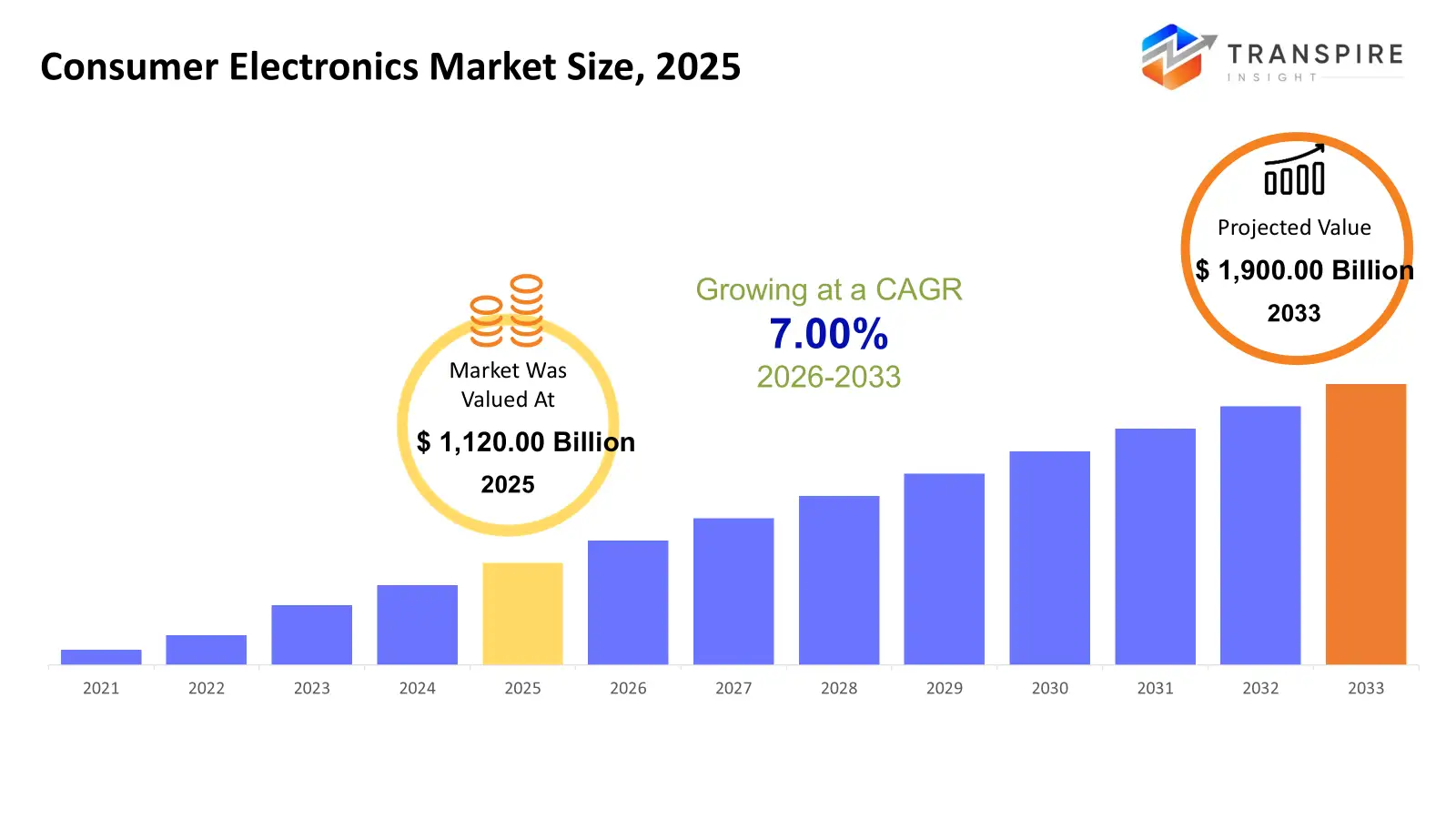
The global Consumer Electronics market size was valued at USD 1,120.00 billion in 2025 and is projected to reach USD 1,900.00 billion by 2033, growing at a CAGR of 7.00% from 2026 to 2033. The consumer electronics segment is growing firmly, with steady CAGR results being driven by rapid technological advancements, high rates of innovation in terms of integrating AI, and further developments in smart devices ecosystems. Higher disposable income levels and lower product replacement cycles ensure steady customer expenditure on such products.
Market Size & Forecast
- 2025 Market Size: USD 1,120.00 Billion
- 2033 Projected Market Size: USD 1,900.00 Billion
- CAGR (2026-2033): 7.00%
- North America: Largest Market in 2026
- Asia Pacific: Fastest Growing Market
To learn more about this report,  Download Free Sample Report
Key Market Trends Analysis
- The increasing preference for connected and 'smart' devices among consumers in North America is consistently contributing to robust market appetite for premium electronics, while high technology penetration and early adoption of AI-based devices is driving market innovation in the regional consumer electronics landscape.
- Similar trends in replacement demand and technology upgrades, coupled with higher disposable income and strong ecosystem integration, have made the United States an important market for general consumer electronics products with high demand levels.
- Asia Pacific indicates rapid market development with high consumer numbers, increasing numbers of middle-class consumers, and robust manufacturing abilities, contributing to increasing smartphone penetration and digital connectivity, thereby boosting and sustaining consumer electronics product requirements.
- Smartphones dominate the product category because of repeated technology updates, growing dependency on mobile connectivity, and innovation in terms of processing technology, camera capabilities, and application packages, thereby sustaining frequent purchases from consumers of both developing and advanced countries.
- Smart devices take first place in the adoption of technology, as more and more customers are willing to purchase and try interconnected ecosystems that bring the convenience of automated devices and remote accessibility, which maximizes the engagement of smart home systems.
- Online retailing is on the increase as the consumer benefits from competitive pricing, product comparison, and higher availability, while manufacturers shift to direct-to-consumer business strategies that improve accessibility and increase reach in urban as well as semi-urban markets.
- In addition to this, the residential end users will continue to drive the ever-increasing demand as the lifestyle and steady progression of home entertainment trends will propel more investment in consumer electronics.
So, The consumer electronics market includes electronic devices designed for personal use, household use, and commercial purposes. Among these are smartphones, televisions, computing devices, audio systems, and smart appliances. The nature of the market is filled with rapid innovation cycles accompanied by very strong competition, partly driven by continuous technological advancement and partly by changing consumer preferences. Demand growth is influenced on the whole by increasing digital connectivity, an expansion of smart home ecosystems, and the rise in the importance of electronic devices for daily communication, entertainment, and productivity. Continuous upgrading of products and integration of artificial intelligence and IoT technologies reshape the functionality of products and the expectations of customers. The market also benefits from the extension of online distribution channels and the improvement of international supply chains, allowing manufacturers to reach broader consumer bases. Growing adoption of connected devices and increasing focus on energy-efficient and multi-featured products are continuously influencing the dynamics and competitive positioning of the market in the long run.
Consumer Electronics Market Segmentation
By Product Type
- Smartphones
Smartphones constitute the segment that generates the largest revenue due to extensive technological improvements, increased internet penetration using mobile devices, and the rising level of dependency by consumers on devices that offer various capabilities.
- Televisions
Demand for television sets comes from higher penetration rates of smart TVs, larger screen sizes, and improved display technologies such as OLED and QLED panels. This is backed up by higher consumption rates of streaming services and improved home entertainment experiences.
- Laptops & Computers
The segment enjoys the trend of hybrid work, digital learning, and digitalization of enterprises. The demand is stable, and consumers and enterprises will be keen on performance, portability, and connectivity, especially in emerging countries because of rising digital infrastructure development.
- Tablets
The tablet holds its own market with its educational apps, consumption of content, and enterprise mobility scenarios. It’s positioned well between the smartphone and laptop markets to stay relevant, mainly for remote learning and lightweight productivity purposes.
- Audio & Video Devices
The segment is supported by increasing consumption of digital media and gaming that consequently surge the demand for wireless headphones, soundbars, and home audio systems. Major upgrade cycles in wireless connectivity and immersive audio technologies further enhance product adoption in residential users.
- Cameras & Imaging Devices
As smartphone cameras substitute entry-level devices, demand is increasingly concentrated in professional and enthusiast segments. Growth is supported by trends in content creation, the influence of social media, and professional photography and videography needs.
- Wearable Electronics
Wearables are growing rapidly owing to health monitoring, fitness tracking capabilities, and much better connectivity with smartphones. Advancing technologies in sensors and power consumption further solidify adoption with health- and technology-conscious consumers.
- Gaming Consoles
Increasing participation in gaming on a global scale and the expanding digital gaming ecosystems are stimulating factors for gaming consoles. Strong demand is supported by high-performance hardware, exclusive content offerings, and integration with online gaming platforms.
- Home Appliances
Smart appliances are gaining popularity since they offer efficiency, automation, and connectivity. The increasing use of smart homes and the need for convenience-driven products are driving the smart appliances market in both developing and developed countries.
- Others
The range of products that exist within this category includes emerging and niche consumer electronics. The factors that affect the market growth include technological convergence and increasing integration of connected ecosystems within a variety of device categories.
By Technology
- Smart Devices
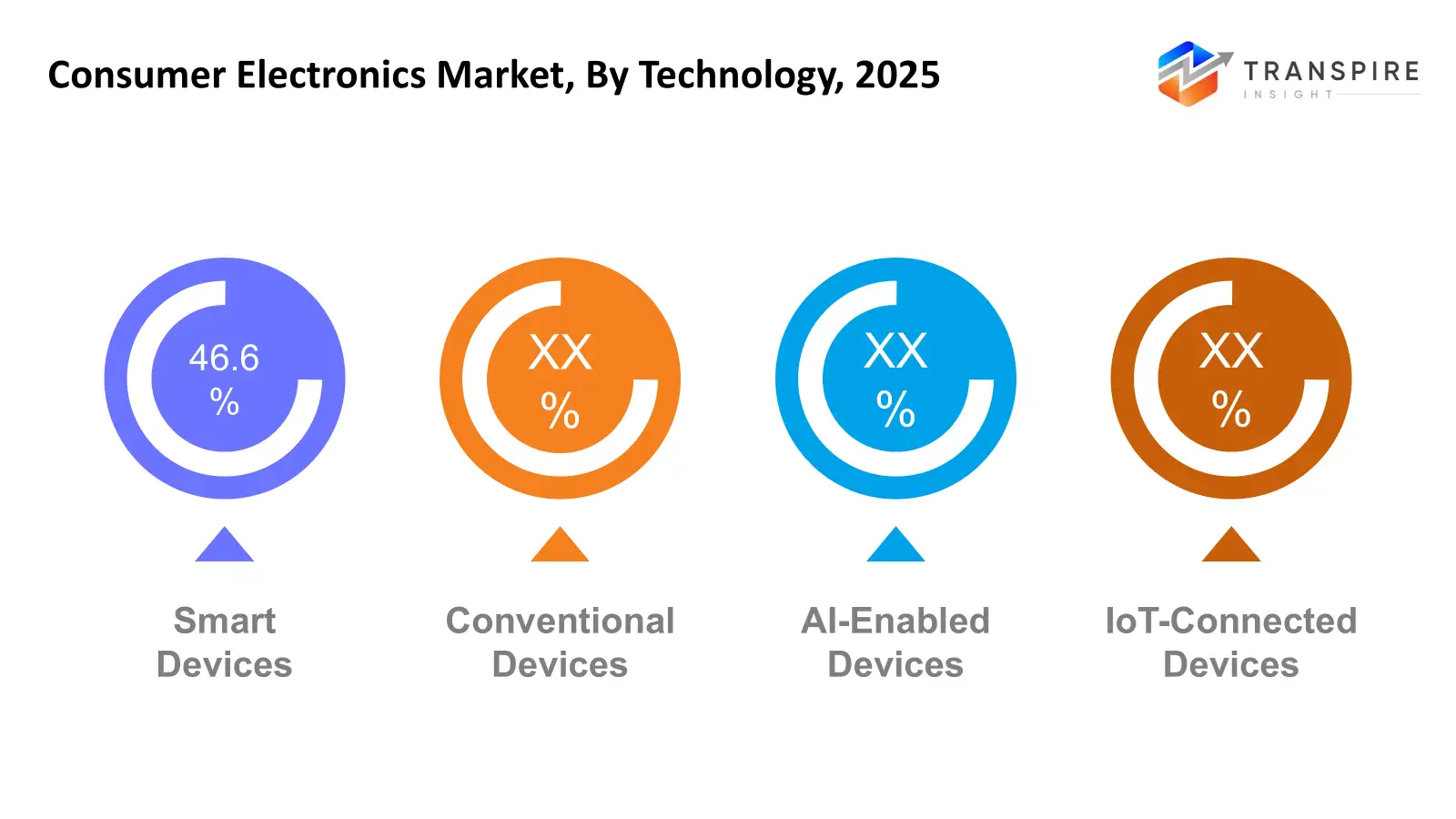
Smart devices lead the market share because of rising connectivity, automation tasks, and integration with the digital world. Consumers seem to be preferring smart devices that allow device control from anywhere and integration with smart homes.
- Conventional Devices
Tradition devices provide a consistent demand for markets where price is a significant factor. They cater to the needs of customers who prefer a price-efficient product, regardless of its connective capabilities.
- AI-Enabled Devices
Devices empowered with AI are gaining momentum in voice assistant, predictive analysis, and personalization. The infusion of artificial intelligence helps create premium products in terms of device performance, automation, and optimization in power consumption.
- IoT-connected devices
IoT devices equipped for connection to the internet are rising exponentially as interconnected ecosystems play a critical role in current consumer electronics. Increased demand for connected environments will enhance long-term growth prospects across several categories.
To learn more about this report, Download Free Sample Report
By Distribution Channel
- Online Retail
The online retail business is growing significantly due to prices, the range of products, and their ease of home delivery. There is a rise in digital payments, growth of e-commerce, and a strategy of selling directly to consumers. All these factors are contributing to the growth of online retail.
- Offline Retail
Offline retail also holds importance due to various reasons, as consumers demonstrate an interest towards product demos. Specialty stores remain an important retail format, as well as outlets, in driving premium product-related sales.
By End User
- Residential
The segment of residential makes up the majority of demand fueled by rising disposable income, smart home systems, and entertainment consumption. Ongoing product upgrading and lifestyle-based purchasing behavior shape long-term growth.
- Commercial
Commercial demands include corporate offices, hospitality, and retail sectors utilizing consumer electronics to improve operational efficiency. These demands have been fueled by digital transformation and increased dependence on technology for business needs.
Regional Insights
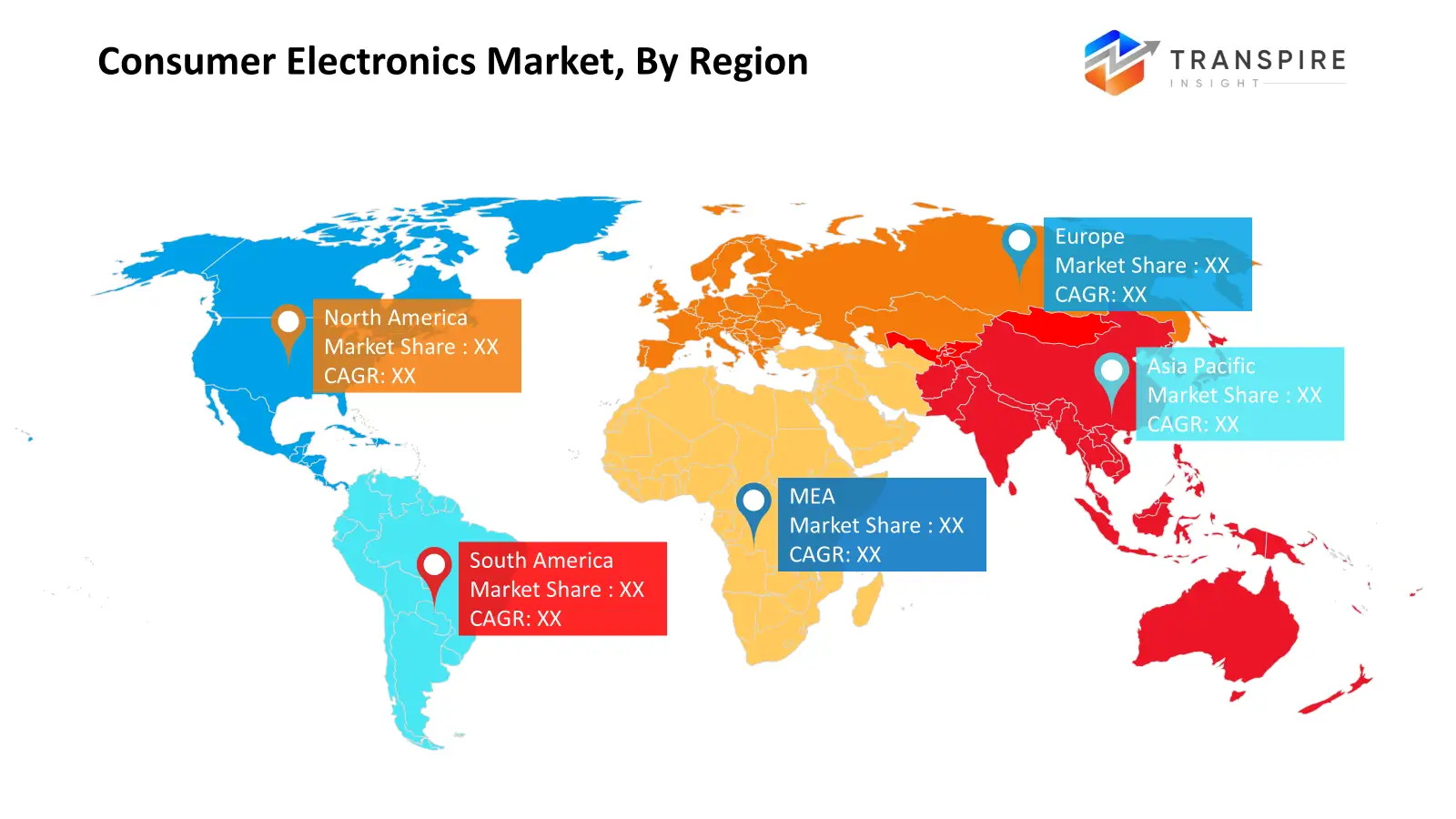
North America, which includes the United States, Canada, and Mexico, defines a highly advanced market from a technology perspective, driven by high levels of purchasing power. In the North American region, the U.S. dominates, while growth can be seen in Canada and Mexico as smart device and retail sales continue. Europe, including Germany, the United Kingdom, France, Spain, Italy, and the rest of Europe, indicates a stable market due to the increase in energy efficiency regulations and the desire of consumers to have high-quality and environmentally friendly electronics. The western countries drive the demand more than the eastern countries.
Asia Pacific, with markets like Japan, China, Australia & New Zealand, South Korea, India, and the others included in Asia Pacific, comprises the largest and fastest-growing market. While China & Japan dominate as global leaders in manufacturing and innovative technology, India & Asia Pacific markets attribute strong growth due to high potential in terms of new consumers and technology penetration. South America, which includes Brazil, Argentina, and the remaining South American countries, exhibits moderate growth trends driven by urbanization and improving access to digital technologies. Brazil is the major market, while Argentina and other South American countries display growth trends driven by improving retail infrastructure. The Middle East & Africa, comprising Saudi Arabia, United Arab Emirates, South Africa, and the rest of the Middle East & Africa, is witnessing an increasing trend in the usage and sales of consumer electronics due to urbanization, higher disposable income, and improving fields of internet connectivity.
To learn more about this report, Download Free Sample Report
Recent Development News
- September 2025, Apple has announced the launch of iPhone 16e under its new line of iPhone 16 devices, focusing on better performance, battery efficiency, and the inclusion of Apple Intelligence features with its newest A18 chip. The new line of iPhone devices is a continuation of the value and premium nature of the industry within the consumer electronics market, as well as its innovation.
- In May 2025, Samsung has announced that its Galaxy S25 has been awarded the Design for Recycling Award, acknowledging the company's progress in using recycled content with circular battery supplier networks in consumer devices. This marks a significant step towards an industry that is increasingly focused on sustainability, using circular design concepts in manufacturing, as well as an environmentally friendly product design, which is a major force for competition in terms of innovation.
(Source:https://news.samsung.com/in/samsung-galaxy-s25-receives-2025-rema-design-for-recycling-award)
|
Report Metrics |
Details |
|
Market size value in 2025 |
USD 1,120.00 Billion |
|
Market size value in 2026 |
USD 1,180.00 Billion |
|
Revenue forecast in 2033 |
USD 1,900.00 Billion |
|
Growth rate |
CAGR of 7.00% from 2026 to 2033 |
|
Base year |
2025 |
|
Historical data |
2021 – 2024 |
|
Forecast period |
2026 – 2033 |
|
Report coverage |
Revenue forecast, competitive landscape, growth factors, and trends |
|
Regional scope |
North America; Europe; Asia Pacific; Latin America; Middle East & Africa |
|
Country scope |
United States; Canada; Mexico; United Kingdom; Germany; France; Italy; Spain; Denmark; Sweden; Norway; China; Japan; India; Australia; South Korea; Thailand; Brazil; Argentina; South Africa; Saudi Arabia; United Arab Emirates |
|
Key company profiled |
Samsung Electronics Co., Ltd., Apple Inc., Sony Group Corporation, LG Electronics Inc., Panasonic Holdings Corporation, Xiaomi Corporation, Huawei Technologies Co., Ltd., Lenovo Group Limited, HP Inc., Dell Technologies Inc., Haier Smart Home Co., Ltd., TCL Technology Group Corporation, Hisense Group Co., Ltd., ASUSTeK Computer Inc., and Microsoft Corporation |
|
Customization scope |
Free report customization (country, regional & segment scope). Avail customized purchase options to meet your exact research needs. |
|
Report Segmentation |
By Product Type (Smartphones, Televisions, Laptops & Computers, Tablets, Audio & Video Devices, Cameras & Imaging Devices, Wearable Electronics, Gaming Consoles, Home Appliances, Others), By Technology (Smart Devices, Conventional Devices, AI-Enabled Devices, IoT-Connected Devices), By Distribution Channel (Online Retail, Offline Retail) and By End User (Residential, Commercial) |
Key Consumer Electronics Company Insights
Apple Inc. enjoys a strong competitive advantage in the electronics industry due to its strategic approach to an ecosystem business model, where software and services complement its devices. Apple has historically positioned itself as an innovator in the electronics market with premium pricing and has achieved exceptional success in customer loyalty, which has maintained its profit margins. Apple's range of devices, including smartphones, computers, tablets and wearables, enjoy the advantage of interoperability and timely software updates. Apple has also achieved excellent retail and distribution footprint in the global electronics market, particularly in developed countries. Apple has made strategic investments in semiconductor technology and user experience to keep itself technologically differentiated in the market.
Key Consumer Electronics Companies:
- Samsung Electronics Co., Ltd.
- Apple Inc.
- Sony Group Corporation
- LG Electronics Inc.
- Panasonic Holdings Corporation
- Xiaomi Corporation
- Huawei Technologies Co., Ltd.
- Lenovo Group Limited
- HP Inc.
- Dell Technologies Inc.
- Haier Smart Home Co., Ltd.
- TCL Technology Group Corporation
- Hisense Group Co., Ltd.
- ASUSTeK Computer Inc.
- Microsoft Corporation
Global Consumer Electronics Market Report Segmentation
By Product Type
- Smartphones
- Televisions
- Laptops & Computers
- Tablets
- Audio & Video Devices
- Cameras & Imaging Devices
- Wearable Electronics
- Gaming Consoles
- Home Appliances
- Others
By Technology
- Smart Devices
- Conventional Devices
- AI-Enabled Devices
- IoT-Connected Devices
By Distribution Channel
- Online Retail
- Offline Retail
By End User
- Residential
- Commercial
Regional Outlook
- North America
- United States
- Canada
- Mexico
- Europe
- Germany
- United Kingdom
- France
- Spain
- Italy
- Rest of Europe
- Asia Pacific
- Japan
- China
- Australia & New Zealand
- South Korea
- India
- Rest of Asia Pacific
- South America
- Brazil
- Argentina
- Rest of South America
- Middle East & Africa
- Saudi Arabia
- United Arab Emirates
- South Africa
- Rest of the Middle East & Africa
Frequently Asked Questions
Find quick answers to common questions.
The approximate Consumer Electronics Market size for the market will be USD 1,900.00 billion in 2033.
Key segments for the Consumer Electronics Market By Product Type (Smartphones, Televisions, Laptops & Computers, Tablets, Audio & Video Devices, Cameras & Imaging Devices, Wearable Electronics, Gaming Consoles, Home Appliances, Others), By Technology (Smart Devices, Conventional Devices, AI-Enabled Devices, IoT-Connected Devices), By Distribution Channel (Online Retail, Offline Retail) and By End User (Residential, Commercial).
Major Consumer Electronics Market players are Samsung Electronics Co., Ltd., Apple Inc.,Sony Group Corporation, LG Electronics Inc.
The North America region is leading the Consumer Electronics Market.
The CAGR of the Consumer Electronics Market is 7.00%.
- Samsung Electronics Co., Ltd.
- Apple Inc.
- Sony Group Corporation
- LG Electronics Inc.
- Panasonic Holdings Corporation
- Xiaomi Corporation
- Huawei Technologies Co., Ltd.
- Lenovo Group Limited
- HP Inc.
- Dell Technologies Inc.
- Haier Smart Home Co., Ltd.
- TCL Technology Group Corporation
- Hisense Group Co., Ltd.
- ASUSTeK Computer Inc.
- Microsoft Corporation
Recently Published Reports
-
Apr 2026
Fiber Optic Faceplates Market
Fiber Optic Faceplates Market Size, Share & Analysis Report By Type (< 300 mm2, 300-350 mm2, and > 350 mm2, By Application (Night Vision, Holographic Imaging, Medical, and Others), and Geography (North America, Europe, Asia-Pacific, Middle East and Africa, South and Central America), 2021 - 2031
-
Apr 2026
High Temperature Superconductors Market
High Temperature Superconductors Market Size, Share & Analysis Report By Type (1G HTS, and 2G HTS), By Application (Power Cable, Fault Current Limiter, and Transformer), and Geography (North America, Europe, Asia-Pacific, Middle East and Africa, South and Central America), 2021 - 2031
-
Apr 2026
Industrial Plugs and Socket Market
Industrial Plugs and Socket Market Size, Share & Analysis Report By Type (Industrial Plugs, Industrial Sockets), By Current (Up to 32 A, 32 to 125 A, Above 125 A), By Protection (Dustproof and Splash Proof, Waterproof, Explosion Proof), By End User (Heavy Industries, Oil and Gas, Chemicals and Pharmaceuticals, Power Generation, Others), and Geography (North America, Europe, Asia-Pacific, Middle East and Africa, South and Central America), 2021 - 2031
-
Apr 2026
InGaAs Avalanche Photodiodes Market
InGaAs Avalanche Photodiodes Market Size, Share & Analysis Report By Type (1100 - 1700 nm, and 1000 - 1600 nm), By Application (Missile Warning System, Muzzle Flash Detection, Wafer Defect Inspection, Laser Rangefinders, and Others), and Geography (North America, Europe, Asia-Pacific, Middle East and Africa, South and Central America), 2021 - 2031