

Automotive Aftermarket Spare Parts Market Summary:
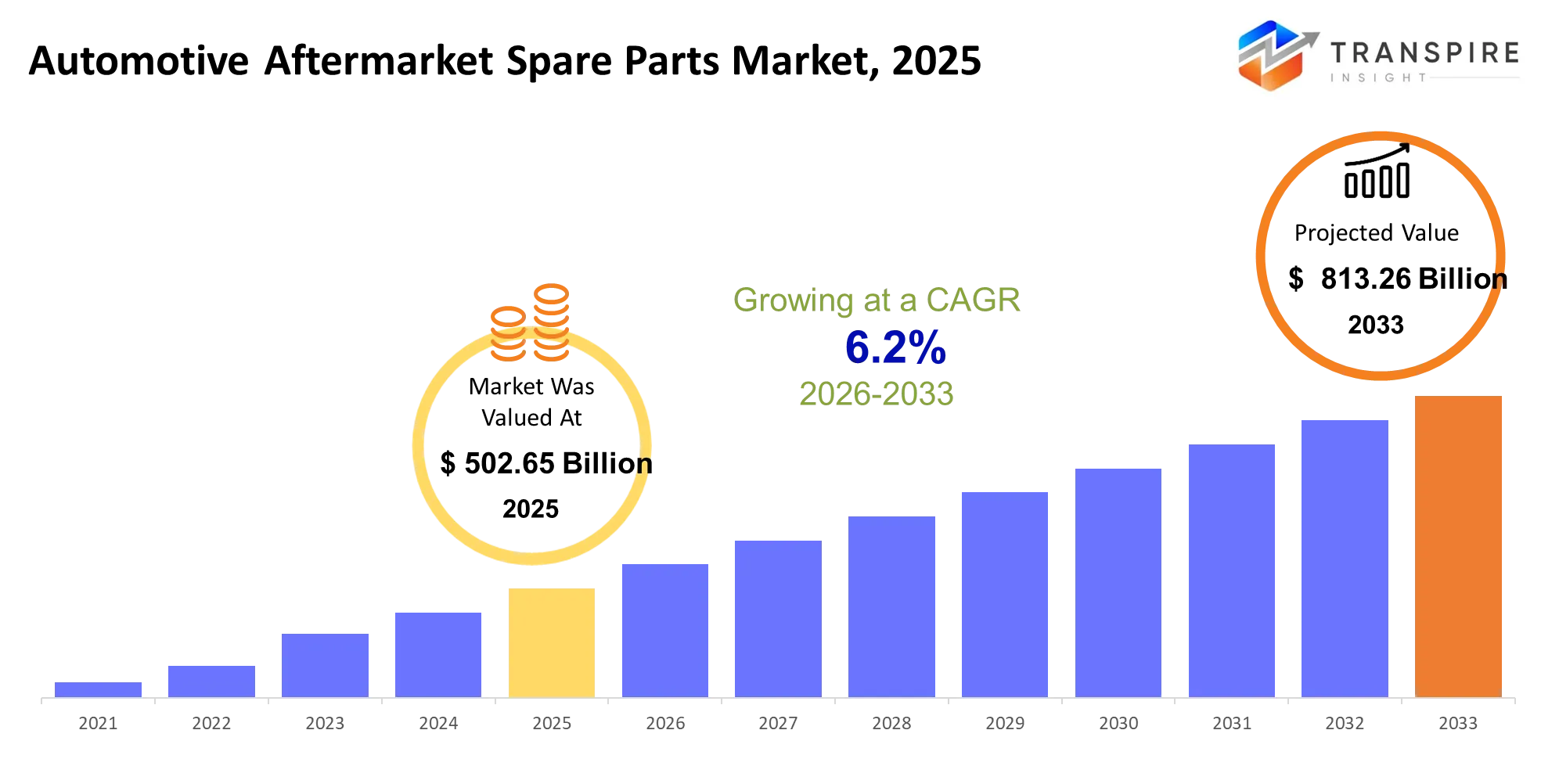
As per Transpire Insight Analysis, the Automotive Aftermarket Spare Parts Market size is estimated at USD 502.65 billion in 2025 and is anticipated to reach USD 813.26 billion by 2033, growing at a CAGR of 6.2% from 2026 to 2033.
The aftermarket spare parts market supports keeping vehicles running by providing replacement parts through workshops, service centres, retailers, distributors and online stores. In the past three to five years, the market has moved away from old-style mechanical repairs and shifted toward digital tools, more electronic parts and support for electric vehicles. A big change is how vehicle diagnostics and connected data are being used. These tools help workshops find problems faster and match the parts more precisely. One reason for this shift is that in many markets, the number of older vehicles is rising. People are keeping their cars longer. Choosing to repair them instead of buying new ones. New technologies in vehicles are also changing what parts are needed. There’s demand for electrical components, sensors, braking systems, chassis parts and parts made for electric vehicles. Growth in the market is driven by complicated repairs, longer ownership of vehicles, wider needs for replacements and easier access to parts, to better organised and digital supply chains.
Automotive Aftermarket Spare Parts Market Size & Forecast:
- Market Size 2025: USD 502.65 Billion
- Expected Market Value (2033): USD 813.26 Billion
- Forecast CAGR (2026-2033): 6.2%
- Leading Region in 2025: North America
- Fastest Growing Region: Asia Pacific
- Key Company Profiles: Bosch, Denso, Continental, ZF, Valeo, Magna International, Tenneco, Aisin, Lear, BorgWarner, KYB, Mahle, Mann+Hummel, Gates Corporation, Brembo
Key Market Insights:
The market is increasingly shifting towards technology-backed maintenance, although traditional replaceable components still create considerable continuous demand. There is a widening of product ranges by suppliers, along with enhanced diagnostic abilities, distribution and vehicle coverage.
- The engine & powertrain parts have a share of 27.80%, as suppliers are extending their replacement offerings due to older vehicles that need regular mechanical servicing.
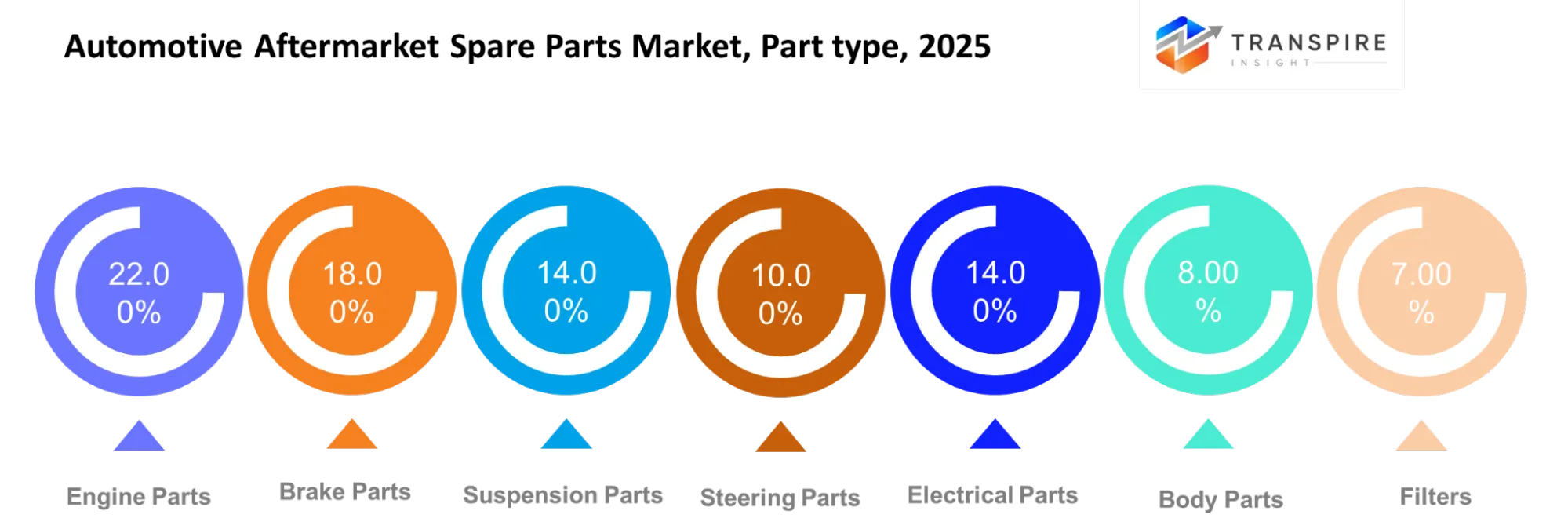
- Engine parts have a share constuitue of 22.00%, and diagnostic systems are aiding workshops in pinpointing issues and choosing replacement parts.
- The brake parts hold 18.00%, and manufacturers are encouraged to bolster their safety-oriented product lines and provide better fitment information to technicians.
- The suspension parts constitute 14.00%, and manufacturers such as ZF are augmenting their chassis lines to cater to more vehicles and workshops.
- Electrical parts amount to 14.00%, given the rising electrification of vehicles and growing reliance on diagnostics in workshops.
- The EV replacement parts are expected to record a CAGR of 13.60%, thus prompting suppliers to develop electric drivetrain, inverter, sensors, and repair solutions.
What are the Key Drivers, Restraints, and Opportunities in the Automotive Aftermarket Spare Parts Market?
Drivers
Increased longevity of car ownership will continue to create demand for replacement components since ageing cars will need more frequent maintenance and repairs. Growth is also created by the increased use of electronic control systems, which results in the need for electrical components, sensors, diagnostics, and special repair parts. Increased availability of aftermarket products through online channels provides increased opportunities for comparing and purchasing parts. This creates opportunities for revenue generation for the automotive aftermarket industry.
Restraints
Due to its fragmented structure, it is difficult to identify parts properly and manage their inventory and distribution processes. For instance, workshops and retailers do not always operate using the same catalogues and software solutions, whereas a great variety of vehicle models and specifications leads to incompatibility problems. This fragmentation still brings about inaccuracies, excess inventory, and higher expenses.
Opportunities
There is potential in providing specialised parts for replacement in EVs, as well as digital diagnostics and preventive maintenance services for electric and connected cars. It is important for suppliers to invest in AI-based catalogues, regional distribution facilities, EV repair training programs, and remanufactured parts to gain competitive advantages.
What Has the Impact of Artificial Intelligence Been on the Automotive Aftermarket Spare Parts Market?
The use of artificial intelligence as an aid in the automobile industry is being considered more often now as a viable practice in diagnostics, inventory management, forecasting, and parts identification. It is possible to analyse such factors as codes of faults, repair history, sensors' information, and repair history of the car to predict future faults before changing the part. AI can save time on diagnosing and help to diagnose correctly. For distributors, demand models are based on historical sales, vehicle fleets, seasonality, patterns, and local factors, which allow estimating the demand for parts. Accurate forecasting will lead to less overstocking and availability of high-turnover products. Catalogues can be digitised and use machine learning algorithms to find better ways of vehicle-to-part matching, as similar names of vehicle models and numerous variants of parts can cause mistakes. It is also used in customer service for automated searches, recommendations, and workshop assistance. But there is some complexity in using the system, as AI needs clear vehicle, product, and transaction data, and integration with old workshop software will increase costs.
Instance
In August 2026, Klipboard expanded the use of AI to its automotive aftermarket software suite, such as AI-based parts identification using its AutoCat platform. The technology assists aftermarket businesses in identifying the right parts quickly, while further AI functions in its workshop management software assist in decision-making and customer interactions.https://www.klipboard.com/news/klipboard-accelerates-practical-ai-across-the-automotive-aftermarket
Key Market Trends:
Market trends are shifting from the sale of parts to connected diagnostics, extended product coverage, online purchase processes, and lifecycle management. Part manufacturers have been increasingly bundling their products with technical information, training, remanufacturing, and digital tools.
- Mechanical repair work is progressively being complemented by electrical diagnostics as cars become increasingly dependent on technology.
- Suppliers are expanding their portfolios from engines and brake parts to sensors, chassis, steering, and other EV parts for replacement.
- The online purchase of parts has become more common as buyers look for easy ways to locate products, compare prices, find product availability, and have easy deliveries.
- Diagnostic tools and services in the independent workshop have seen more investment as modern cars are more advanced and need specialised repair expertise.
- Remanufacturing is acquiring strategic importance as suppliers search for alternatives to get more cost-effective components along with better material efficiency and better supply chain management.
- Data-driven maintenance services for fleets are gaining prominence as fleet managers give increased importance to preventive maintenance of cars.
Automotive Aftermarket Spare Parts Market Segmentation
By Part Type
Engine parts occupy an important place in the market, constituting 22.00% of the market, while the wider category of engines and powertrains constitutes 27.80%. Brake parts come third, occupying 18.00%, due to the need for safety and maintenance. Suspension and electrical parts each constitute 14.00%, while steering parts constitute 10.00%. Body parts constitute 8.00%, while filters and tires & wheels each constitute 7.00%. Future growth will be increasingly biased towards parts related to electronics and vehicle electrification.
By Product Category
Passenger car parts are an important demand base owing to the large number of passenger cars and their maintenance needs. SUV parts are significant because of the growing population of SUVs worldwide and their need for replacement parts. Light commercial and heavy commercial vehicle parts make for ongoing sales opportunities since the vehicle uptime directly impacts business activities. There are also two-wheeler sales opportunities in developing nations and a new category of replacement products that includes EVs and hybrid vehicles.
By Sales Channel
The independent workshops will be significant because they cater to all kinds of age groups and brands. The authorised service centres will also be significant because they cater to customers looking for OEM services and genuine parts. Auto parts stores, dealers, and distributors will cater to the physical distribution network, while online sales channels can help sell to a wider customer base. Even direct sales channels may have a role to play. The future sales channels will be highly integrated in nature, with digital ordering capabilities, inventory, technical information, and fast delivery capabilities.
by Type
Wear and tear replacement parts are an ongoing aftermarket need due to their natural replacement in braking, filtering, suspensions, steering and other systems of vehicles. Demand for collision parts comes after accidents happen, while maintenance replacement is needed during servicing. Performance parts satisfy the needs of special users, while the increasing role of electrical systems results in growing demand for their replacements. Engine and accessories replacement are further income sources for the automotive industry. The growing popularity of electric vehicles is expected to lead to increased demand in special electrical and drivetrain replacement parts rather than mechanical ones.
by Material
Steel is used in structural and mechanical parts due to its strength and existing infrastructure. Aluminium becomes increasingly relevant in cases where lightweight and better thermal properties are needed. Plastics and rubber materials find application in body, sealing, filtration and vibration control, while copper is still widely used in electrical parts of cars. Composites and glass are used in more specific applications.
By Customer Type
Individual vehicle owners make up a large base of customers, although the repair shops continue to be crucial for the installation and sales of the product. The role of fleet operators will also be important because regular preventive maintenance may decrease vehicle breakdowns and operating losses. It is also important to note that the fleet operators and dealerships depend on a constant supply of good parts to keep their vehicles in use, and rental firms need speedy repairs. Again, government fleets can form an important source of demand due to maintenance programs run by the government.
What are the Key Use Cases Driving the Automotive Aftermarket Spare Parts Market?
Use cases include vehicle repairs and maintenance, including engine parts and engine and powertrain parts in the market. Workshops make use of these parts to ensure that the performance of vehicles is maintained, as well as to prevent wear and tear. Applications are growing to include brake parts, suspension, steering, electrical, filters, body, tyres, and wheels through workshops, service centres, dealerships, and online stores. The importance of fleets is growing due to the need for preventive maintenance and quick replacement of parts. New use cases are being developed for electric and hybrid cars, including drivetrain, power electronics, thermal management, and sensors.
|
Report Metrics |
Details |
|
Market size value in 2025 |
USD 502.65 Billion |
|
Market size value in 2026 |
USD 533.80 Billion |
|
Revenue forecast in 2033 |
USD 813.26 Billion |
|
Growth rate |
CAGR of 6.2% from 2026 to 2033 |
|
Base year |
2025 |
|
Historical data |
2021 - 2024 |
|
Forecast period |
2026 - 2033 |
|
Report coverage |
Revenue forecast, competitive landscape, growth factors, and trends |
|
Regional scope |
United States; Canada; Mexico; United Kingdom; Germany; France; Italy; Spain; Denmark; Sweden; Norway; China; Japan; India; Australia; South Korea; Thailand; Brazil; Argentina; South Africa; Saudi Arabia; United Arab Emirates |
|
Key company profiled |
Bosch, Denso, Continental, ZF, Valeo, Magna International, Tenneco, Aisin, Lear, BorgWarner, KYB, Mahle, Mann+Hummel, Gates Corporation, Brembo |
|
Customization scope |
Free report customization (country, regional & segment scope). Avail customized purchase options to meet your exact research needs. |
|
Report Segmentation |
part Type (Engine Parts, Brake Parts, Suspension Parts, Steering Parts, Electrical Parts, Body Parts, Filters, Tires & Wheels); Vehicle Type (Passenger Cars, SUVs, Light Commercial Vehicles, Heavy Commercial Vehicles, Two-Wheelers, Electric Vehicles, Hybrid Vehicles); Sales Channel (Independent Workshops, Authorized Service Centers, Auto Parts Stores, Online Retail, Dealers, Distributors, Direct Sales); Replacement Type (Wear & Tear Parts, Collision Parts, Maintenance Parts, Performance Parts, Electrical Replacement, Engine Replacement, Accessories); Material (Steel, Aluminum, Plastic, Rubber, Copper, Composites, Glass); Customer Type (Individual Vehicle Owners, Repair Shops, Fleet Operators, Dealerships, Rental Companies, Commercial Operators, Government Fleets) |
Which Regions are Driving the Automotive Aftermarket Spare Parts Market Growth?
North America
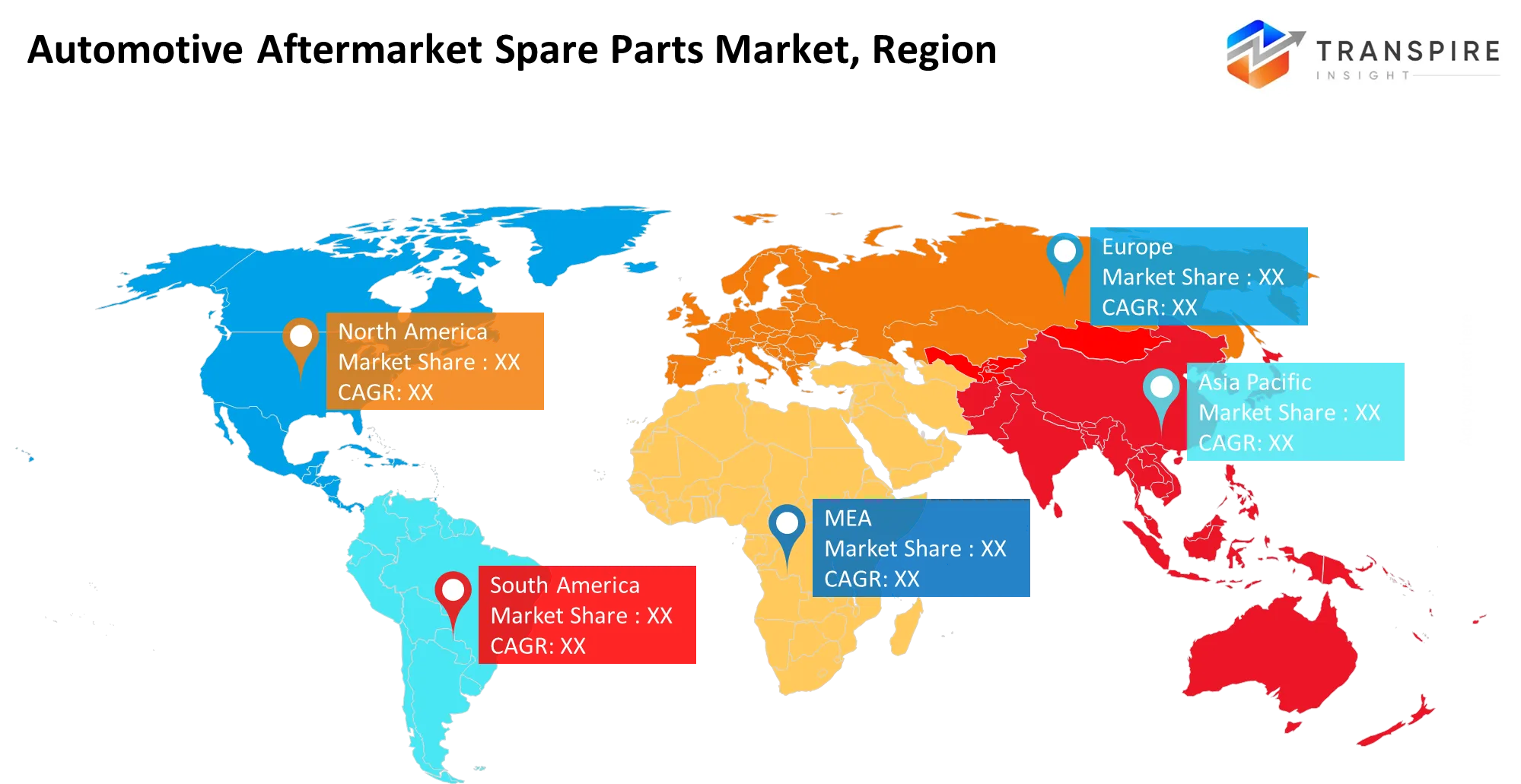
The North American region takes the leading position in the world spare parts market in the automotive aftermarket sector with a 37.60% market share due to its vast installed base of vehicles and repair infrastructure. The wide coverage of independent repair shops and the well-developed distribution system enable vehicle owners to replace parts in a timely manner. In addition, extended vehicle ownership periods provide regular maintenance and repair expenditures in all vehicle age ranges.
In June 2026, Mighty Distributing System of America acquired PREMA Canada,The acquisition extends the distribution channels of Mighty to Canada, giving it a stronghold in the North American automotive aftermarket. PREMA Canada also has a customer base and supplier network in the Canadian aftermarkethttps://www.mightyautoparts.com/about-mighty-auto-parts/press-releases/
Europe
Europe accounts for a 28.00% market share due to its well-developed automotive industry, service structure, and regulations related to safety and vehicle emissions. In addition, the growing popularity of high-quality replacement parts and the use of digital workshop equipment enable more sales. The presence of a well-developed independent repair industry ensures wide accessibility of aftermarket parts. Changes in vehicle technologies prompt suppliers to develop new ranges of products.
In June 2026, AUTODOC made a major restructuring of its B2B business through the digitalisation of AUTODOC PRO. The company claims that the step was taken to enhance scalability and offer workshops competitive prices, a wide range of spare parts, and flexible delivery options. AUTODOC is one of the largest online retailers of spare parts and accessories in Europe.https://autodoc.group/en/news-room/press-releases/autodoc-introduces-all-digital-strategy-for-its-workshop-business/
Asia-Pacific
The Asia-Pacific region has a market share of 25.00% and is the fastest-growing region at 8.90% CAGR. An increasing number of car owners, development of workshops, investments in manufacturing, and availability of parts online are making the aftermarket more accessible. The region is also highly promising in terms of future growth, with electric and connected cars driving the need for specific replacement parts.
In September 2026, Schaeffler undertook a major revamp of its aftermarket brands under a single Schaeffler brand name. The plan is to roll out the revamp in phases starting from The revamp is expected to make Schaeffler’s aftermarket portfolio easy to access for workshops and distributors https://www.schaeffler.co.in/en/news-media/press_releases/press_releases_detail.jsp
Who are the Key Players in the Automotive Aftermarket Spare Parts Market and how do they compete?
The competition in the market is shifting towards product coverage, technical performance, distribution capabilities, diagnostic services, and ability to serve evolving vehicle technologies. The companies are moving beyond the individual replacement parts by integrating them with digital catalogues, diagnostics, training, warranties, and workshop support services. In this way, the suppliers can develop longer-term relationships with the repair shops instead of competing only on product prices. Bosch adopts a technology-oriented strategy that combines the aftermarket components with the diagnostic tools, technical information and workshop support. The company's differentiation is provided by vehicle coverage and diagnostics integration capabilities, while the established distribution network ensures the expansion into multiple markets.ZF Aftermarket adopts a portfolio and innovation strategy by using brands such as ZF, TRW, SACHS, LEMFÖRDER, and WABCO. The expansion is carried out in chassis, braking, steering, commercial vehicle products, remanufacturing, EV repair solutions, and digital workshops.
Automotive Aftermarket Spare Parts Market companies
- Bosch
- Denso
- Continental
- ZF
- Valeo
- Magna International
- Tenneco
- Aisin
- Lear
- BorgWarner
- KYB
- Mahle
- Mann+Hummel
- Gates Corporation
- Brembo
Recent Development News
In October 2025, Continental launched more than 1,000 new wheel bearings, chassis and steering components for the European aftermarket range. This helps increase the scope of coverage for the vehicles and helps Continental achieve the objective of creating a larger one-stop shop aftermarket offering.https://www.continental.com/en/press/press-releases/251028-portfolio/
In April 2026, ZF extended its CorExpedia solution to enable digital core returns in its ZF, TRW, SACHS and WABCO remanufactured brands. This helps improve the reverse logistics process for workshops, distributors and fleets and also helps ZF reinforce its circular aftermarket approach.https://press.zf.com/press/en/releases/release_102147.html
What Strategic Insights Define the Future of the Automotive Aftermarket Spare Parts Market?
The automotive aftermarket spare parts market is evolving from one that is based strictly on replacement components to one that relies on more technological support and integration. Suppliers that offer part availability along with diagnostics, digital catalogues, training, and preventive maintenance will be able to build better relationships with repair workshops and fleets. One of the hidden risks in this scenario lies in the increasing complexity of vehicles, leading to higher repair costs and technician shortages due to a lack of electronic and software skills. On the other hand, the shift towards electric and hybrid vehicles presents opportunities for companies that specialise in replacement parts, diagnostic tools, repair kits, and remanufactured parts. It is necessary to identify potential for capacity growth, better distribution, and workshop network extension.
Part Type
- Engine Parts
- Brake Parts
- Suspension Parts
- Steering Parts
- Electrical Parts
- Body Parts
- Filters
- Tires & Wheels
Vehicle Type
- Passenger Cars
- SUVs
- Light Commercial Vehicles
- Heavy Commercial Vehicles
- Two-Wheelers
- Electric Vehicles
- Hybrid Vehicles
Sales Channel
- Independent Workshops
- Authorized Service Centers
- Auto Parts Stores
- Online Retail
- Dealers
- Distributors
- Direct Sales
Replacement Type
- Wear & Tear Parts
- Collision Parts
- Maintenance Parts
- Performance Parts
- Electrical Replacement
- Engine Replacement
- Accessories
Material
- Steel
- Aluminum
- Plastic
- Rubber
- Copper
- Composites
- Glass
Customer Type
- Individual Vehicle Owners
- Repair Shops
- Fleet Operators
- Dealerships
- Rental Companies
- Commercial Operators
- Government Fleets
By Regional Analysis
North America
- US
- Canada
- Mexico
Europe
- Germany
- UK
- France
- Italy
- Spain
- Russia
- Rest of Europe
Asia Pacific
- China
- Japan
- India
- South Korea
- Australia
- Rest of Asia Pacific
South America
- Brazil
- Argentina
- Rest of South America
Middle East & Africa
- UAE
- Saudi Arabia
- Qatar
- South Africa
- Rest of the Middle East & Africa
Frequently Asked Questions
Find quick answers to common questions.
The automotive aftermarket spare parts market size was valued at USD 502.65 billion in 2025 and is poised to reach USD 813.26 billion by 2033, expanding at a 6.2% CAGR
Key segments for the automotive aftermarket spare parts market are Part Type (Engine Parts, Brake Parts, Suspension Parts, Steering Parts, Electrical Parts, Body Parts, Filters, Tires & Wheels); Vehicle Type (Passenger Cars, SUVs, Light Commercial Vehicles, Heavy Commercial Vehicles, Two-Wheelers, Electric Vehicles, Hybrid Vehicles); Sales Channel (Independent Workshops, Authorized Service Centers, Auto Parts Stores, Online Retail, Dealers, Distributors, Direct Sales); Replacement Type (Wear & Tear Parts, Collision Parts, Maintenance Parts, Performance Parts, Electrical Replacement, Engine Replacement, Accessories); Material (Steel, Aluminum, Plastic, Rubber, Copper, Composites, Glass); Customer Type (Individual Vehicle Owners, Repair Shops, Fleet Operators, Dealerships, Rental Companies, Commercial Operators, Government Fleets
Growth is primarily driven by increasing average age of the vehicle, increase in demand for replacement and maintenance parts, high use of the vehicle, increased number of independent repair shops, and online selling of auto parts.
The market is led by major manufacturers including Bosch, Denso, Continental, ZF, Valeo, Magna International, Tenneco, Aisin, Lear, BorgWarner, KYB, Mahle, Mann+Hummel, Gates Corporation, Brembo
North America accounts for 37.60% of the worldwide market share of spare parts in the automotive aftermarket, attributed to its large number of vehicles, vehicle ownership, demand for replacement parts, highly developed automotive services, and strong aftermarket distribution networks.
The business opportunities in the worldwide automotive spare parts aftermarket industry are the increasing demand for electric and hybrid parts; online sales of auto parts; independent garages' growth; increased demand for high-performance auto parts; and business opportunities in developing nations where vehicle ownership is increasing.
- Bosch
- Denso
- Continental
- ZF
- Valeo
- Magna International
- Tenneco
- Aisin
- Lear
- BorgWarner
- KYB
- Mahle
- Mann+Hummel
- Gates Corporation
- Brembo
About the Authors

Mayur Shinde
I am Mayur Shinde, a Senior Research Analyst at Transpire Insight, specializing in the Automotive & Transportation and Information & Communication Technology (ICT) Industry. My work focuses on analyzing emerging market trends, technological advancements, competitive landscapes, and industry developments to deliver accurate, data-driven insights. I am passionate about transforming complex market information into clear, actionable content that helps businesses, professionals, and decision-makers stay informed and make confident strategic decisions.

Chakradhar Khansole
Chakradhar serves as the Research Director at Transpire Insight, bringing over 8 years of experience in technology, innovation, and strategic market intelligence. He specializes in transforming complex market data into actionable business insights that enable organizations to make informed, growth-oriented decisions. Recognized for his strategic vision and analytical expertise, Chakradhar leads high-impact research initiatives, delivering comprehensive market assessments, competitive intelligence, and forward-looking industry analysis.
Recently Published Reports
-
Apr 2026
ATV & UTV Market
ATV & UTV Market Size, Share & Analysis Report By Type (ATV, and UTV), By Variants (Less Than 400 CC, 400 CC To 800 CC, and More Than 800 CC), and Geography (North America, Europe, Asia-Pacific, Middle East and Africa, South and Central America), 2021 - 2031
-
Apr 2026
Automotive Central Gateway Module Market
Automotive Central Gateway Module Market Size, Share & Analysis Report By Type (Ethernet Central Gateway Module, CAN Central Gateway Module, LIN Central Gateway Module, and FlexRay), By Application (Powertrain Control, Body Control, Infotainment System, Advanced Driver Assistance Systems (ADAS), and Others), By End User (Passenger Vehicles, and Commercial Vehicles), and Geography (North America, Europe, Asia-Pacific, Middle East and Africa, South and Central America), 2021 - 2031
-
Apr 2026
Automotive Engine Oil Filter Market
Automotive Engine Oil Filter Market Size, Share & Analysis Report By Filter Type (Fuel Filter, Engine Oil Filter, Hydraulic Oil Filter, and Others), By Filter Media (Cellulose, Synthetic, and Micro), By Sales Channel (OEMs, and Aftermarket), By Vehicle Type (Passenger Cars, Light Commercial Vehicles, Heavy Duty Trucks, Buses and Coaches, and Off-road Vehicles), and Geography (North America, Europe, Asia-Pacific, Middle East and Africa, South and Central America), 2021 - 2031
-
Apr 2026
Automotive Parts Aluminium Die Casting Market
Automotive Parts Aluminium Die Casting Market Size, Share & Analysis Report By Production Process (Pressure Die Casting, Vacuum Die Casting, Squeeze Die Casting, Gravity Die Casting), By Application (Body Parts, Engine Parts, Transmission Parts, Battery And Related Components, Other Application Types), and Geography (North America, Europe, Asia-Pacific, Middle East and Africa, South and Central America), 2021 - 2031
Our Clients



