

Vehicle Roadside Assistance Market Summary:
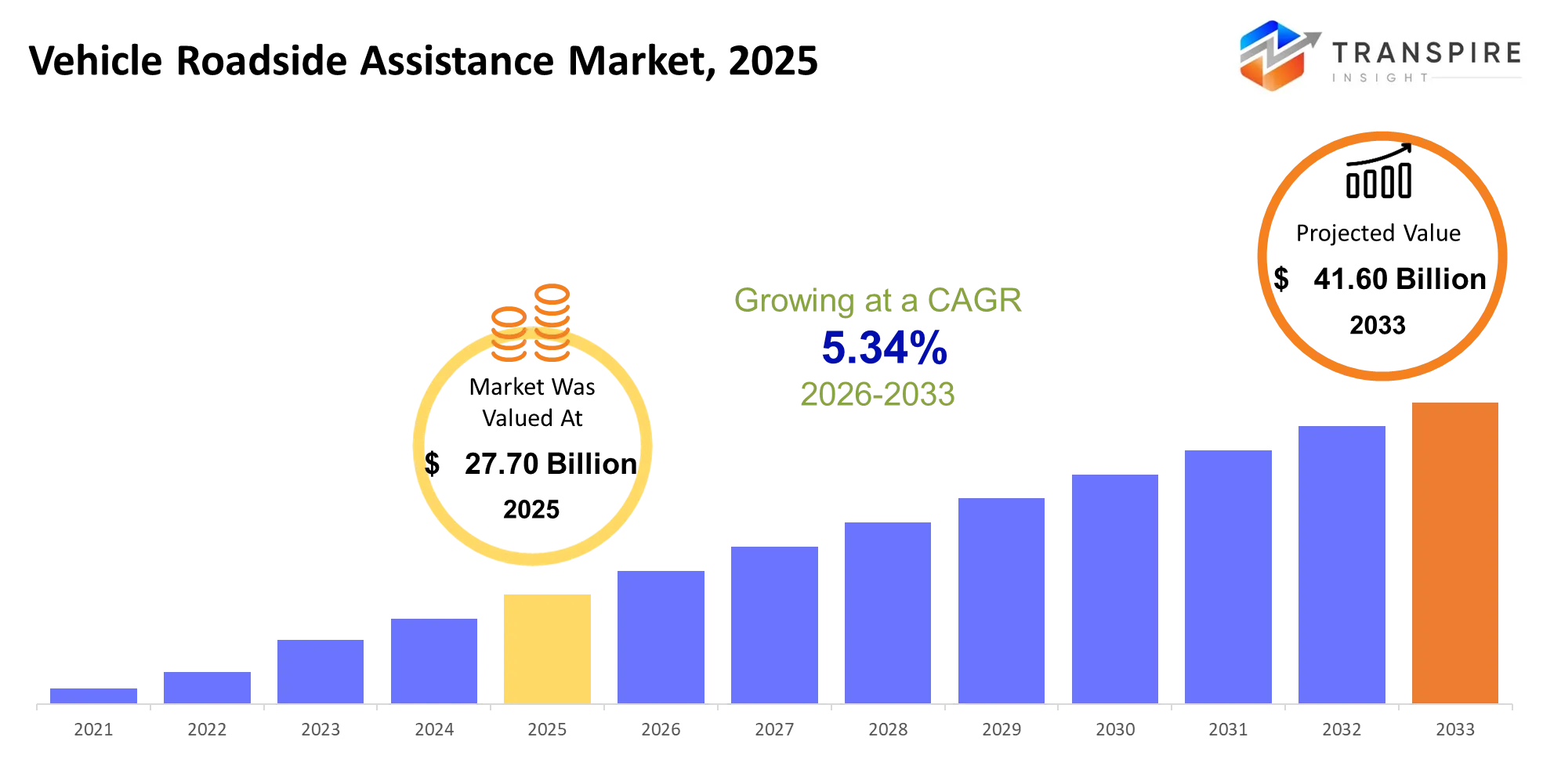
As per Transpire Insight Analysis, the Vehicle Roadside Assistance Market size is estimated at USD 27.70 billion in 2025 and is anticipated to reach USD 41.60 billion by 2033, growing at a CAGR of 5.34% from 2026 to 2033.
The worldwide market of car roadside assistance services assists drivers in case of mechanical breakdown of their vehicles, traffic collisions, flat tyres, dead batteries, or when they get locked out of their vehicles. In the past three to five years, how the service works has changed. It used to be based on phone calls to report problems. Now most requests come through apps. Drivers can send their location in real time, track the service team and get updates digitally. Many services now connect directly to the vehicle’s systems for help. A big change has been the use of vehicle data and digital platforms to find and send help faster. These tools match the incident with the available service provider. This shift is happening because modern vehicles, such as electric cars, are more complicated. They often need tools, charging or technical knowledge to fix. That means the old way of helping no longer works for every problem. Because of this, companies are putting money into better networks, quicker response times and smart communication tools. They’re building partnerships with repair shops, towing companies and even car manufacturers. The goal is to make roadside help faster, more reliable, and easier to use. These improvements help drivers get back on the road sooner and reduce the stress of being stranded. As a result, the roadside assistance market is. The service is becoming smarter, more connected and more efficient.
Vehicle Roadside Assistance Market Size & Forecast:
- Market Size 2025: USD 27.70 Billion
- Expected Market Value (2033): USD 41.60 Billion
- Forecast CAGR (2026–2033): 5.34%
- Leading Region in 2025: North America
- Fastest Growing Region: Asia Pacific
- Key Company Profiles: Allianz Partners, Agero, ARC Europe, Better World Club, Urgently, HONK, Good Sam Enterprises, AAA, RAC, AA, Green Flag, Falck, Allianz Roadside Assistance, Viking Assistance Group, Fixter
Key Market Insights:
The world roadside assistance market is moving towards digital services, but towing remains the biggest segment within it. The growth in the connected car space and electric vehicles opens up new opportunities in this area.
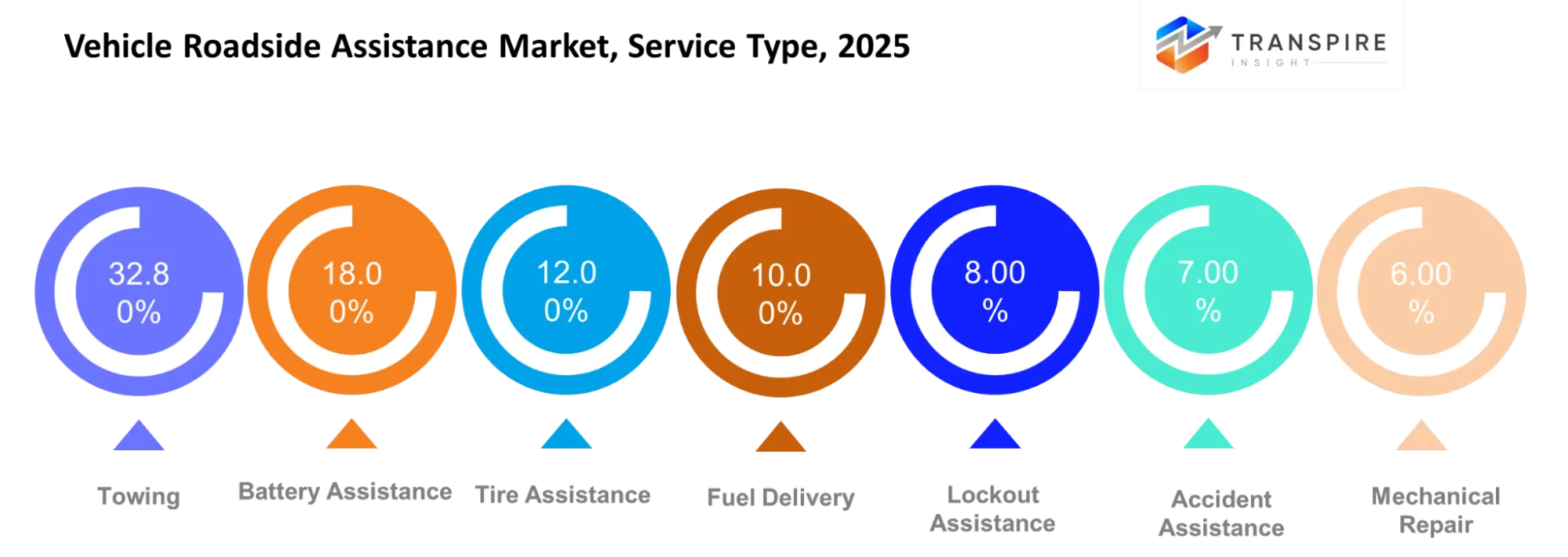
- Towing Services is still leading with its 32.80% market share, with roadside providers leveraging technologies for dispatching and location tracking.
- Battery Assistance holds 18.00% of the market, with roadside providers offering mobile battery testing and jump starts as well as faster dispatches for technicians.
- Tire Assistance accounts for 12.00% of the market, with roadside providers increasingly relying on mobile apps and digital request handling of flat tyres by drivers.
- Lockout Assistance comprises 8.00% of the market, with mobile requests and customer notifications making it easier for providers to handle lockouts.
- Accident Assistance accounts for 7.00% of the market, with roadside companies automating their workflows and location information for accident recovery.
- Mechanical Repair is a 6.00% market share product, with providers working on their relationships with repair networks to follow up on roadside services.
What are the Key Drivers, Restraints, and Opportunities in the Vehicle Roadside Assistance Market?
Drivers
The use of digital dispatch, vehicle connectivity and a broader roadside network helps to make assistance more readily accessible and available. The use of mobile applications to make requests and track status, and the ability to share location information, removes many of the barriers between the driver, the dispatch centre, and the service provider and helps encourage the use of roadside services programs. The growth in EVs is generating need for specialist recovery and battery services, offering an additional source of service revenue.
Restraints
The operation of a reliable roadside network continues to be challenging due to the need for service providers to manage local resources in terms of technician availability, towing capability, traffic, geography, as well as operating costs such as fuel, labour, technology and equipment expenses.
Opportunities
The opportunity is in terms of predictive and connected roadside assistance. Telematics will be able to detect early warning signals, share the vehicle’s location, and provide diagnostic information prior to the explanation of what is going on by the customer. Roadside assistance providers may use such information together with automated dispatch and electric vehicle-specific services to minimise their reaction time. Cooperation with automobile manufacturers, insurance companies, and fleet managers will broaden the coverage; digital subscriptions and embedded services will provide recurring income streams.
What Has the Impact of artificial intelligence on the Vehicle Roadside Assistance Market?
Artificial intelligence is revolutionising roadside assistance services as it will help the providers understand what needs to be done, where to send the vehicles, and how to handle the situation. An AI-based dispatch system would help to assess location, type of service required, provider availability, traffic, and other factors to optimise provider selection and routing. Agero, for instance, has a Swoop system that includes algorithms and machine learning in selecting providers, monitoring events, and handling escalations. Such an AI system will automate communications, update estimates of arrival time, and assist the operation team in identifying incidents that might require some further assistance. It is also capable of creating connections between the vehicle/service information and breakdowns through predictive capabilities. AI requires proper data as well as the integration of the dispatch and service networks. There is also a possibility of inaccuracy in the case of incomplete data about the incident.
Instance
In June 2026, Roadzen extended the scope of application of its AI-driven StrandD roadside orchestration platform within the U.S. by signing a new contract with National Automobile Club (NAC). This technology makes use of artificial intelligence agents for incident reporting, matching service providers, GPS tracking, ETA management and job completion, thus making it possible for roadside assistance services to be provided directly from a customer’s mobile app.https://investors.roadzen.ai/news-releases/news-release-details/roadzen-expands-us-footprint-12-million-embedded-roadside
Key Market Trends:
The trend is moving away from responding to breakdowns and towards connected services that are managed digitally. Service providers are now integrating their recovery networks with technology and mobile platforms.
- App-based services are gradually replacing phone-based requests for services, providing drivers with rapid access to information about their service status.
- Real-time geolocation is gaining importance since companies have started to try to send the right technician to the precise location where there is a breakdown.
- The growth in the number of EVs has led to the need for emergency charging services as well as EV-friendly towing and technicians with specific expertise.
- Connected-vehicle data creates new possibilities in identifying the problems and preparing the needed equipment ahead of time.
- Assistance is becoming an embedded part of other packages that insurers and automakers provide owners of vehicles with.
- The pay-as-you-go models are growing along with the membership programs, enabling occasional customers to receive assistance even without a membership.
Vehicle Roadside Assistance Market Segmentation
By Service Type
The dominant service is Towing, which holds 32.80% of the total market share. It is crucial in breakdown recovery and accidents, and other services follow Towing, including Battery Assistance, holding 18.00% of the market share; Tire Assistance, with 12.00%; Fuel Delivery, with 10.00%; Lockout Assistance, with 8.00%; Accident Assistance, with 7.00%; Mechanical Repair, with 6.00%; and Winching, with 6.20%. The total market share of all these services constitutes the major problems of a vehicle that make it impossible to continue its normal operation.
By vehicle type
Passenger cars and SUVs become significant demand segments since they make up the largest part of everyday road activity and require assistance. Light and Heavy Commercial Vehicles add an extra demand segment since vehicle breakdowns may disrupt delivery and logistics activities, and fast recovery will be beneficial. Motorbikes and luxury vehicles require special assistance handling for certain situations. Electric vehicles are an emerging demand segment that will benefit from the provided 18.60% CAGR of EV Roadside Assistance services, and future services will comprise emergency charging, EV-friendly towing, and qualified specialists.
By provider type
Automotive clubs and insurance companies become important distribution channels since they can integrate roadside assistance into membership and car insurance packages. Vehicle manufacturers become important actors on the market since they offer roadside assistance as a part of warranty and vehicle ownership packages. Independent service providers offer local towing and repair services. Fleets can provide assistance to their vehicles directly, and online platforms allow for the integration of providers and dispatch of services via digital means. Government agencies may also utilise assistance networks for public transport fleets and transport.
By coverage
Pay-Per-Use provides coverage to those people who need help occasionally without being a member, whereas Membership offers an ongoing relationship to those customers who use the assistance regularly. The Insurance-Based help links the assistance with the motor insurance plans, and the OEM Warranty includes the assistance in the vehicle ownership plan. Fleet Contract is possible through which the operators can have assistance centrally, whereas Subscription offers access to assistance on an ongoing basis. Premium Assistance provides extended features such as recovery, travel or other speciality services to the providers for segmentation.
By distribution
Mobile Apps will become an essential channel for requesting assistance as they can collect the location and vehicle information in addition to service information quickly. The website will remain another channel through which assistance will be sought by the customers themselves. Call centres will continue to remain essential for the complex cases and for those who require guidance and advice on the matter. Dealerships and Insurance Agents can provide assistance in the purchase of a vehicle, its servicing, and insurance plans.
By customer type
individual drivers will have repeat business needs due to daily breakdowns, whereas fleet operators will have higher needs for faster service coordination since their vehicle downtime can affect profits and schedules. Corporate clients and rental companies will also have high demand for effective coverage as this would allow their vehicles to remain functional for commercial purposes. Insurance clients form a highly embedded channel since assistance could be part of their insurance policy benefits, and OEM clients would have assistance covered via warranty or manufacturer programs.
What are the Key Use Cases Driving the Vehicle Roadside Assistance Market?
Towing is the use case for roadside services that matches the prevailing Towing category. It is required in cases where vehicles cannot be safely driven due to mechanical failures, accidents, tyre issues, and battery failures. The towing service network brings motorists and service recovery and maintenance points together. The use cases for roadside services include battery jump starts, tyre services, fueling and lockout assistance services to address roadside issues. Mobile apps, call centres, and membership programs facilitate requests for such services. Fleets and vehicle rental companies utilise roadside services to reduce downtime. The emerging use cases include electric vehicle and connected car services. Electric Vehicle Roadside Assistance is the fastest-growing use case segment in the supplied data.
|
Report Metrics |
Details |
|
Market size value in 2025 |
USD 27.70 Billion |
|
Market size value in 2026 |
USD 28.90 Billion |
|
Revenue forecast in 2033 |
USD 41.60 Billion |
|
Growth rate |
CAGR of 5.34% from 2026 to 2033 |
|
Base year |
2025 |
|
Historical data |
2021 - 2024 |
|
Forecast period |
2026 - 2033 |
|
Report coverage |
Revenue forecast, competitive landscape, growth factors, and trends |
|
Regional scope |
United States; Canada; Mexico; United Kingdom; Germany; France; Italy; Spain; Denmark; Sweden; Norway; China; Japan; India; Australia; South Korea; Thailand; Brazil; Argentina; South Africa; Saudi Arabia; United Arab Emirates |
|
Key company profiled |
Allianz Partners, Agero, ARC Europe, Better World Club, Urgently, HONK, Good Sam Enterprises, AAA, RAC, AA, Green Flag, Falck, Allianz Roadside Assistance, Viking Assistance Group, Fixter |
|
Customization scope |
Free report customization (country, regional & segment scope). Avail customized purchase options to meet your exact research needs. |
|
Report Segmentation |
Service Type (Towing, Battery Jump Start, Flat Tire Assistance, Fuel Delivery, Lockout Assistance, Accident Assistance, Mechanical Repair, Winching); Vehicle Type (Passenger Cars, SUVs, Light Commercial Vehicles, Heavy Commercial Vehicles, Motorcycles, Electric Vehicles, Luxury Vehicles); Provider Type (Automotive Clubs, Insurance Companies, Vehicle Manufacturers, Independent Service Providers, Fleet Operators, Online Platforms, Government Agencies); Coverage (Pay-Per-Use, Membership, Insurance-Based, OEM Warranty, Fleet Contract, Subscription, Premium Assistance); Distribution (Mobile App, Website, Call Center, Dealerships, Insurance Agents, Automotive Clubs, Direct Sales); Customer Type (Individual Drivers, Fleet Operators, Corporate Customers, Rental Companies, Insurance Customers, OEM Customers, Government Fleets) |
Which Regions are Driving the Vehicle Roadside Assistance Market Growth?
North America
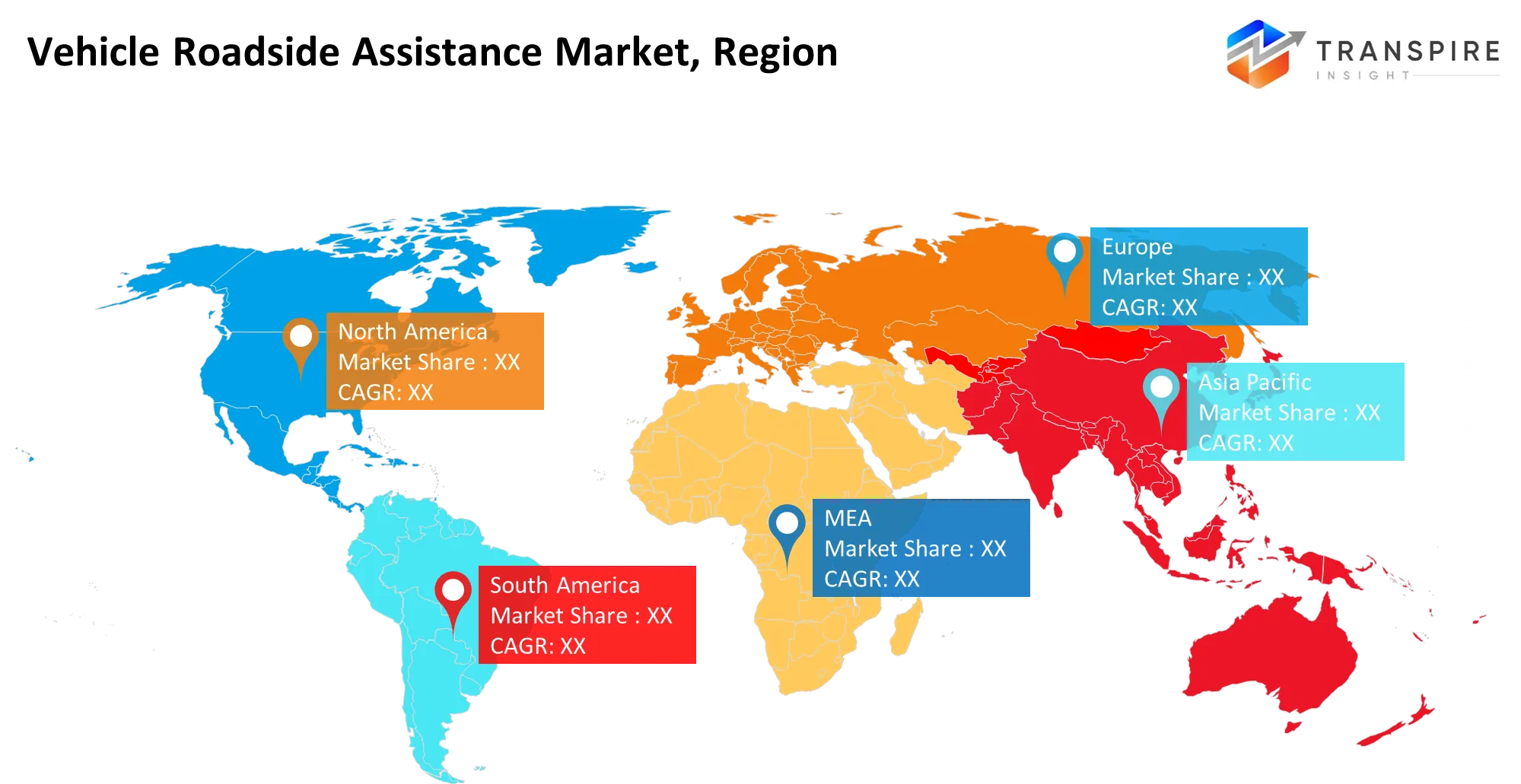
North America is the leading region with 40.20% of the total market share due to its presence of automotive clubs, insurance-backed services, extensive towing services, and vehicle usage. It has a sophisticated ecosystem in terms of providing services such as towing, battery charging, lockout services, among others. Moreover, the presence of high levels of digitisation is helping in coordinating and requesting such services through apps.
In August 2026, Mazda North American Operations, AAA, and HAAS Alert joined hands to launch digital alerts if one of the Mazda customers stops by the roadside and asks for help. This is done through the combination of AAA’s Roadside Assistance services along with HAAS Alert’s Safety Cloud technology.https://news.mazdausa.com/2026-08-27-Mazda-Partners-with-AAA-and-HAAS-Alert-to-Extend-Real-Time-Safety-Beyond-the-Vehicle
Europe
Europe accounts for 30.00% of the total market. Europe has a sophisticated roadside assistance structure which is spread across the automotive manufacturers, motor clubs, insurance companies and standalone providers. As compared to North America, Europe has a strong cross-border aspect of its service as drivers usually move from one country to another. Moreover, connected cars are assisting in improved coordination and communication among the users and providers.
In September 2026, OMODA&JAECOO UK partnered with RAC, expanding the range of roadside and repair assistance. According to this partnership, the company offered a dedicated Vehicle Off Road service, while RAC provided 24/7 breakdown assistance and expanded coverage to the whole of mainland Europe with recovery, hire car, and vehicle repatriation services.https://www.rac.co.uk/drive/news/rac-news/OMODA-JAECOO-expands-RAC-partnership/
Asia Pacific
The Asia Pacific constitutes 21.00% of the market and is the region that is witnessing the highest growth at an 11.80% CAGR. There is an increase in car ownership and urban mobility, as well as the adoption of digital services, which is driving the ways in which motorists will seek roadside assistance. The mobile platform may offer opportunities to reach markets where roadside services are developing.
In June 2026, Hyundai Motor India conducted Hyundai Smart Care Clinic across the country. Through the program, the company offered its customers roadside assistance discounts up to 30% on qualifiedhttps://www.hyundai.com/in/en/hyundai-story/media-center/press-release/smart-care-clinic-for-enhanced-ownership-experience
Who are the Key Players in the Vehicle Roadside Assistance Market and how do they Compete?
The competition in the roadside assistance services has increasingly been about networks, technological advancements, visibility and integration capabilities within the insurance industry and automobile manufacturers. Firms have moved away from just towing services to digital management, prediction and customisation of B2B plans. Allstate offers both membership-based and pay-per-use services with national service provider networks and mobility services. The firm differentiates itself using real-time arrival information, digitised requests and data-informed roadside assistance solutions, and it operates a B2B plan for automakers, insurers, fleets and car rental firms. Agero offers technology-driven dispatch services using its Swoop brand, using algorithms, machine learning and real-time information and configurable workflows for coordinating independent service providers. The company’s strategy lies in building scalable digital systems and white-labeled roadside services.
Vehicle Roadside Assistance Market companies
- Allianz Partners
- Agero
- ARC Europe
- Better World Club
- Urgently
- HONK
- Good Sam Enterprises
- AAA
- RAC
- AA
- Green Flag
- Falck
- Allianz Roadside Assistance
- Viking Assistance Group
- Fixter
Recent Development News
In May 2026, RAC chose to work together with CHERY as its roadside partner in the UK. The collaboration will offer comprehensive roadside assistance to customers purchasing their first CHERY vehicle, and it could even be extended after servicing at an authorised dealer centre.https://media.rac.co.uk/chery-selects-rac-as-its-uk-roadside-assistance-partner
In November 2025, the AA collaborated with Zapmap to improve EV charging assistance using the AA App. The partnership allows AA members to have access to information about charge point availability via the app.https://www.theaa.com/about-us/newsroom/the-aa-and-zapmap-join-forces
What Strategic Insights Define the Future of the Vehicle Roadside Assistance Market?
The industry is evolving towards connected, embedded roadside assistance where drivers can contact roadside assistance through the vehicle's system or applications/insurance providers. Companies able to incorporate live dispatch, diagnosis, positioning and flexible coverage would enhance customer satisfaction and would also be able to use their resources better. There is one implicit threat: uneven service quality because even the best software would not make up for a lack of qualified personnel, necessary equipment or geographical coverage when there is high demand. The other promising opportunity lies in specialized roadside assistance for EVs The supplied for EV Roadside Assistance clearly indicates the promising area of growth, and cooperation with automakers and insurance providers could help to reach out to customers in the process of buying vehicles/purchasing policies. From a strategic point of view, the company should consider investments in digital interoperability, regional network development and EV specialisation along with traditional towing services.
Service Type
- Towing
- Battery Jump Start
- Flat Tire Assistance
- Fuel Delivery
- Lockout Assistance
- Accident Assistance
- Mechanical Repair
- Winching
Vehicle Type
- Passenger Cars
- SUVs
- Light Commercial Vehicles
- Heavy Commercial Vehicles
- Motorcycles
- Electric Vehicles
- Luxury Vehicles
Provider Type
- Automotive Clubs
- Insurance Companies
- Vehicle Manufacturers
- Independent Service Providers
- Fleet Operators
- Online Platforms
- Government Agencies
Coverage
- Pay-Per-Use
- Membership
- Insurance-Based
- OEM Warranty
- Fleet Contract
- Subscription
- Premium Assistance
Distribution
- Mobile App
- Website
- Call Center
- Dealerships
- Insurance Agents
- Automotive Clubs
- Direct Sales
Customer Type
- Individual Drivers
- Fleet Operators
- Corporate Customers
- Rental Companies
- Insurance Customers
- OEM Customers
- Government Fleets
By Regional Analysis
North America
- US
- Canada
- Mexico
Europe
- Germany
- UK
- France
- Italy
- Spain
- Russia
- Rest of Europe
Asia Pacific
- China
- Japan
- India
- South Korea
- Australia
- Rest of Asia Pacific
South America
- Brazil
- Argentina
- Rest of South America
Middle East & Africa
- UAE
- Saudi Arabia
- Qatar
- South Africa
- Rest of the Middle East & Africa
Frequently Asked Questions
Find quick answers to common questions.
The vehicle roadside assistance market size was valued at USD 27.70 Billion in 2025 and is poised to reach USD 41.60 Billion by 2033, expanding at a 5.34% CAGR.
Key segments for the vehicle roadside assistance market are Service Type (Towing, Battery Jump Start, Flat Tire Assistance, Fuel Delivery, Lockout Assistance, Accident Assistance, Mechanical Repair, Winching); Vehicle Type (Passenger Cars, SUVs, Light Commercial Vehicles, Heavy Commercial Vehicles, Motorcycles, Electric Vehicles, Luxury Vehicles); Provider Type (Automotive Clubs, Insurance Companies, Vehicle Manufacturers, Independent Service Providers, Fleet Operators, Online Platforms, Government Agencies); Coverage (Pay-Per-Use, Membership, Insurance-Based, OEM Warranty, Fleet Contract, Subscription, Premium Assistance); Distribution (Mobile App, Website, Call Center, Dealerships, Insurance Agents, Automotive Clubs, Direct Sales); Customer Type (Individual Drivers, Fleet Operators, Corporate Customers, Rental Companies, Insurance Customers, OEM Customers, Government Fleets)
Growth is primarily driven by increasing usage of roads, need for prompt emergency services, expansion in insurance-based roadside services, and use of digital roadside assistance services.
The market is led by major manufacturers including Allianz Partners, Agero, ARC Europe, Better World Club, Urgently, HONK, Good Sam Enterprises, AAA, RAC, AA, Green Flag, Falck, Allianz Roadside Assistance, Viking Assistance Group, Fixter
North America accounts for 40.20% of the market for vehicle roadside assistance owing to its high vehicle penetration, advanced road network, extensive insurance coverage, and increasing need for rapid roadside assistance services.
Business opportunities include the development of digital roadside assistance platforms, the increasing need for EV roadside assistance, collaboration with insurance firms and automobile manufacturers, and the increasing use of subscription and on-demand assistance.
- Allianz Partners
- Agero
- ARC Europe
- Better World Club
- Urgently
- HONK
- Good Sam Enterprises
- AAA
- RAC
- AA
- Green Flag
- Falck
- Allianz Roadside Assistance
- Viking Assistance Group
- Fixter
About the Authors

Mayur Shinde
I am Mayur Shinde, a Senior Research Analyst at Transpire Insight, specializing in the Automotive & Transportation and Information & Communication Technology (ICT) Industry. My work focuses on analyzing emerging market trends, technological advancements, competitive landscapes, and industry developments to deliver accurate, data-driven insights. I am passionate about transforming complex market information into clear, actionable content that helps businesses, professionals, and decision-makers stay informed and make confident strategic decisions.

Chakradhar Khansole
Chakradhar serves as the Research Director at Transpire Insight, bringing over 8 years of experience in technology, innovation, and strategic market intelligence. He specializes in transforming complex market data into actionable business insights that enable organizations to make informed, growth-oriented decisions. Recognized for his strategic vision and analytical expertise, Chakradhar leads high-impact research initiatives, delivering comprehensive market assessments, competitive intelligence, and forward-looking industry analysis.
Recently Published Reports
-
Apr 2026
ATV & UTV Market
ATV & UTV Market Size, Share & Analysis Report By Type (ATV, and UTV), By Variants (Less Than 400 CC, 400 CC To 800 CC, and More Than 800 CC), and Geography (North America, Europe, Asia-Pacific, Middle East and Africa, South and Central America), 2021 - 2031
-
Apr 2026
Automotive Central Gateway Module Market
Automotive Central Gateway Module Market Size, Share & Analysis Report By Type (Ethernet Central Gateway Module, CAN Central Gateway Module, LIN Central Gateway Module, and FlexRay), By Application (Powertrain Control, Body Control, Infotainment System, Advanced Driver Assistance Systems (ADAS), and Others), By End User (Passenger Vehicles, and Commercial Vehicles), and Geography (North America, Europe, Asia-Pacific, Middle East and Africa, South and Central America), 2021 - 2031
-
Apr 2026
Automotive Engine Oil Filter Market
Automotive Engine Oil Filter Market Size, Share & Analysis Report By Filter Type (Fuel Filter, Engine Oil Filter, Hydraulic Oil Filter, and Others), By Filter Media (Cellulose, Synthetic, and Micro), By Sales Channel (OEMs, and Aftermarket), By Vehicle Type (Passenger Cars, Light Commercial Vehicles, Heavy Duty Trucks, Buses and Coaches, and Off-road Vehicles), and Geography (North America, Europe, Asia-Pacific, Middle East and Africa, South and Central America), 2021 - 2031
-
Apr 2026
Automotive Parts Aluminium Die Casting Market
Automotive Parts Aluminium Die Casting Market Size, Share & Analysis Report By Production Process (Pressure Die Casting, Vacuum Die Casting, Squeeze Die Casting, Gravity Die Casting), By Application (Body Parts, Engine Parts, Transmission Parts, Battery And Related Components, Other Application Types), and Geography (North America, Europe, Asia-Pacific, Middle East and Africa, South and Central America), 2021 - 2031
Our Clients



