
Automotive Display Panel Market Summary:
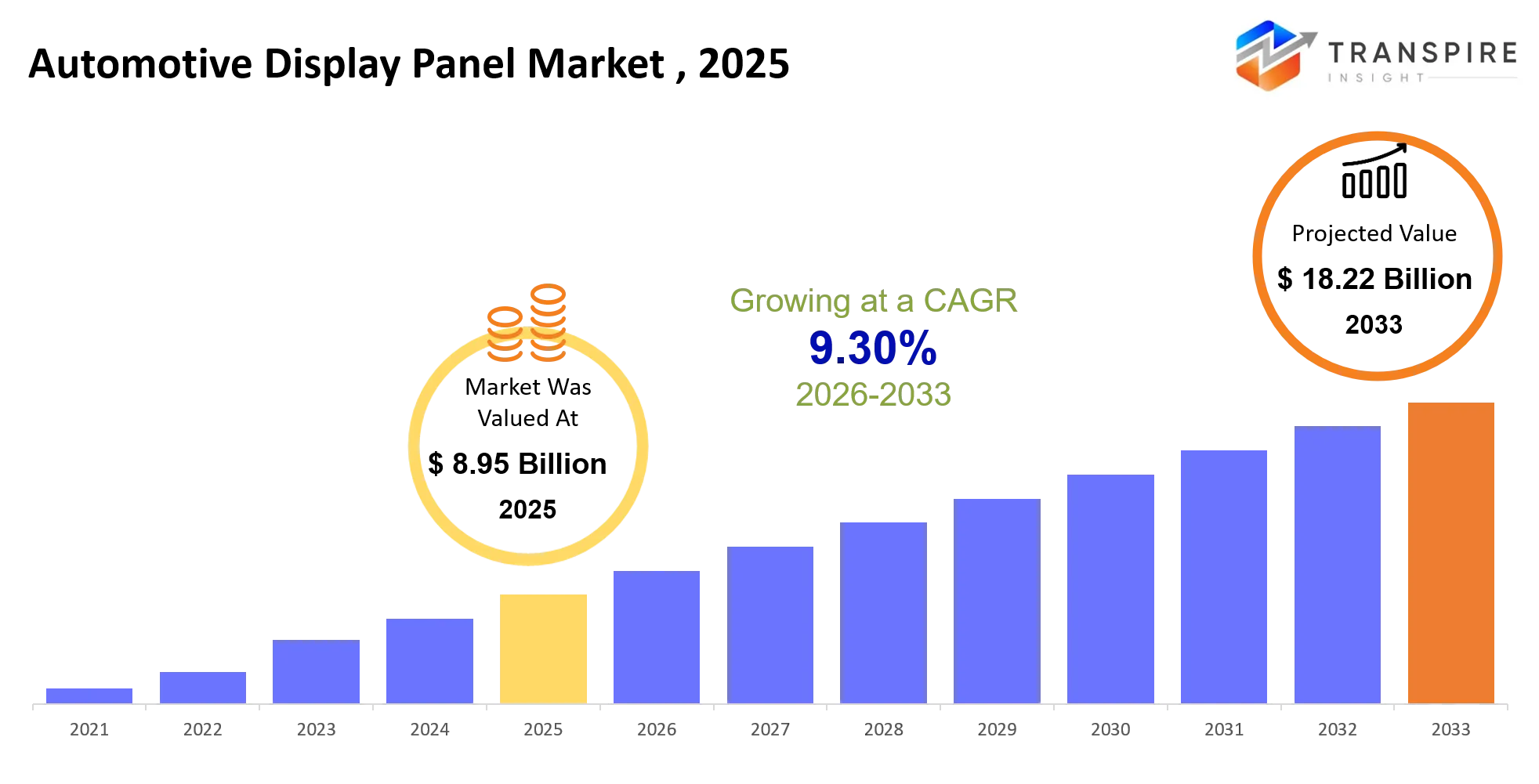
As per the Transpire Insight Analysis, The Automotive Display Panel Market size is estimated at USD 8.95 billion in 2025 and is anticipated to reach USD 18.22 billion by 2033, growing at a CAGR of 9.30% from 2026 to 2033.
The automotive display panel market is moving from the traditional concept of instrumentation to an integrated panel including navigation, vehicle controls, driver assistance, and entertainment. In the last three to five years, automotive manufacturers have preferred larger in-car touch screens, digital instrument clusters, head-up displays, and connected cockpit solutions for electric and premium vehicles. A structural change led to a move away from individual screens in favour of a software-defined cockpit architecture based around the main display, which allows automakers to add or remove functionality without costly dashboard redesigns. The rise of electric vehicles and development of driver assistance systems has further driven adoption of clearer, often configurable visual information. Conversely, the developments in large-format OLED displays and pillar-to-pillar concepts are influencing perceptions of cabin design, also helping to drive market growth through improved usability, differentiated vehicle features, additional premium prices, and new opportunities for software upgrades.
Automotive Display Panel Market Size & Forecast:
- Market Size 2025: USD 8.95 Billion
- Expected Market Value (2033): USD 18.22 Billion
- Forecast CAGR (2026–2033): 9.30%
- Leading Region in 2025: Asia Pacific
- Fastest Growing Region: Middle East & Africa
- Key Company Profiles: LG Display Co.; Samsung Display; BOE Technology Group; Japan Display Inc.; Tianma Microelectronics; AUO Corporation; Innolux Corporation; Continental AG; Visteon Corporation; Denso Corporation; Robert Bosch GmbH; Hyundai Mobis; Marelli; Valeo SE; Panasonic Automotive Systems.
Key Automotive Display Panel Market Insights:
The automotive display industry is transitioning from stand-alone infotainment devices to software-driven safety-critical cockpit infrastructure. Value creation is shifting from simple screen shipments to display area, optical performance, integration depth, and interface intelligence.
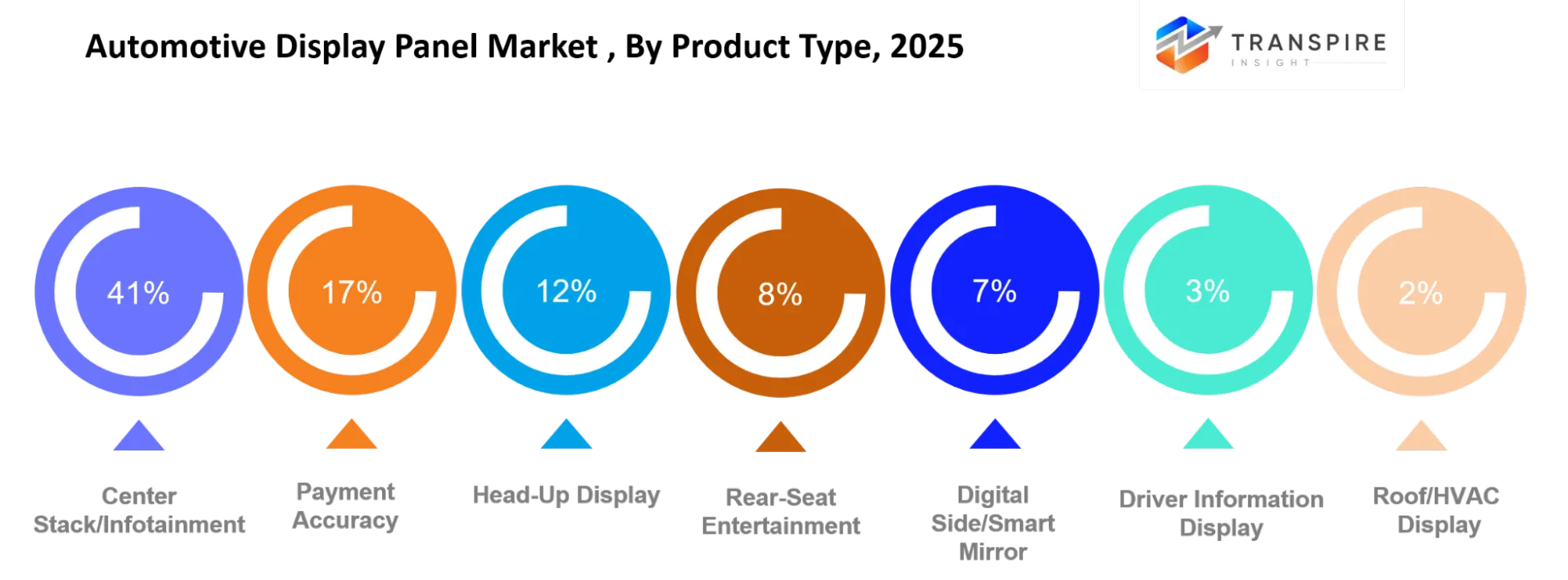
- There has been a shift toward a touch-and-voice control environment, with centre stack/infotainment accounting for 41.08%.
- The instrument clusters market segment is 25.00%, while Continental, Visteon and Denso are gaining ground with reconfigurable ADAS and EV-data interfaces.
- Head-up displays account for 12.00%, and Valeo and Bosch are working on augmented-reality projections that maintain navigation cues closer to the road view.
- Rear-seat entertainment accounts for 8.00% of the total, and premium OEMs are introducing streaming, conferencing, and even passenger-specific controls to enhance cabin comfort.
- The digital side/smart mirrors segment, which is supported by camera-display systems from Hyundai Mobis and Tier-1 suppliers, is expected to grow at 9.31%, accounting for 7.00% of the market.
- The driver information displays are 3.00%, with a growing focus on charging, route energy prediction, and fleet operating alerts.
- Roof/HVAC displays account for 2.00%, indicating a trend toward ambient-control surfaces, rather than mechanical switches.
- Other applications include 1.92%, including niche mobility, commercial and speciality cockpit interfaces for Panasonic Automotive and Marelli.
- The 40-inch pillar-to-pillar OLED commercialisation and the 57-inch concept are the first steps to panoramic cockpit panels by LG Display.
What are the Key Drivers, Restraints, and Opportunities in the Automotive Display Panel Market?
Driver:
The shift toward software-defined vehicles is making display systems central to vehicle differentiation. Larger infotainment screens, digital clusters, and connected cockpit interfaces allow automakers to combine navigation, climate settings, vehicle diagnostics, and smartphone connectivity. The commercial trigger is the expansion of electric vehicles and feature-rich models, where digital interfaces help communicate battery status, charging information and energy consumption. This creates opportunities to increase panel value per vehicle through larger formats, higher resolutions and integrated touch functionality.
Restraint:
High qualification costs and demanding automotive reliability standards limit rapid adoption of advanced panels. Displays must withstand temperature extremes, vibration, sunlight exposure, and prolonged operation without unacceptable degradation. OLED and emerging MicroLED technologies also face cost, yield, and manufacturing-scale challenges. Because vehicle platforms undergo lengthy validation cycles, suppliers cannot quickly replace established LCD designs even when newer technologies offer better contrast or design flexibility.
Opportunity:
The transition toward integrated cockpits creates opportunities for flexible OLED, Mini-LED, and large-format displays. Manufacturers can develop curved, pillar-to-pillar and privacy-enabled screens that support differentiated interiors without adding separate physical modules. China’s advanced electric-vehicle ecosystem offers a practical deployment opportunity, while partnerships between panel makers, Tier 1 suppliers and cockpit-computing providers can improve integration and reduce development duplication. Suppliers that combine optical performance, automotive-grade durability and scalable production are positioned to capture higher-value contracts.
What Has the Impact of Artificial Intelligence Been on the Automotive Display Panel Market?
AI turns screens into contextual displays. The automotive cockpit could use AI-enabled software to prioritize information based on factors like the vehicle speed, road conditions, whether the driver is distracted or paying attention, visual navigation events, or ADAS driver warnings. During challenging driving conditions, the system could hide non-essential infotainment information and make lane guidance, collision warnings, or battery-range information more prominent.
AI will also play a key role in optimising content behind the screen, using driver-monitoring computer-vision systems to track where the driver's eyes are pointed and whether they are drowsy or distracted, then adjusting warning placement, screen brightness, or warning volume accordingly. Predictive algorithms could estimate when it will be time to recharge, how range is changing due to traffic, or when to anticipate navigation prompts, before the driver has to go hunting for them through an infotainment menu. AI can also improve manufacturing quality, with machine-vision panel inspection catching pixel defects, alignment errors, or surface blemishes earlier in the process. Reliable AI depends on validated sensor feeds, resilient embedded computing, cybersecurity measures, and human-factors testing; poor attention detection or warning timing will lead to distraction, while cost can be hard to justify on entry-level vehicles.
In January 2026, Smart Eye launched its AI ONE self-contained driver monitoring system. This product launch integrates a camera, image sensor, embedded processor, and computer-vision software into a single unit operating under two watts.
Key Automotive Display Panel Market Trends:
Automotive displays are moving away from standalone information screens, and software flexibility is as critical as panel quality. But cost constraints and driver safety concerns are prompting manufacturers to pare back the screen size to make the hardware more efficient and controls more user-friendly.
- Centre stacks and integrated clusters are replacing separate gauges to combine driving, media, climate, and charging controls.
- While LCD is still the volume technology, OLED use is growing in high-end cockpits where thinness and high contrast are most important.
- While not as complicated as OLED, mini-LED is becoming the cost-performance bridge that enhances LCD contrast and sunlight readability.
- The curved and pillar-to-pillar displays are changing the layout of dashboard design from component-based to screen-based cockpit architecture.
- Simplified in-motion interfaces, haptic feedback, adaptive brightness, and anti-glare coatings are all emerging as solutions to screen usability concerns and safety issues.
- The driver-monitoring systems are pairing cameras with displays to provide gaze-aware warnings and distraction-management features.
- EVs are driving up the demand for battery, charging, energy-flow, and route-planning visualisation in central displays.
- Rear-seat displays are becoming more than simple entertainment systems; they're becoming more passenger productivity-, streaming-, and vehicle-control oriented.
- To mitigate technology risk and safeguard future cockpit supply, automakers are dual-sourcing OLED and MicroLED roadmaps.
Automotive Display Panel Market Segmentation
Display Technology:
a-Si LCD retains the broadest market position because it is proven, cost-efficient, and deeply embedded in mass-market vehicle platforms. Oxide LCD and LTPS LCD gain share where OEMs require higher resolution, lower power consumption, narrower bezels, or faster response times. OLED is expanding in premium clusters and curved centre displays because of its contrast, thin profile, and design flexibility, although temperature management and lifetime requirements constrain broad deployment. Mini-LED creates a commercially attractive path for high-brightness displays, while MicroLED remains a future premium technology for demanding clusters and head-up-display applications. E-paper and other low-power technologies serve selective information-display use cases.
Screen Size:
8.1–12-inch and 12.1–15-inch panels serve mainstream infotainment systems and digital instrument clusters, balancing readability, dashboard space, and cost. Displays measuring 15.1–20 inches and 20.1–25 inches support integrated cockpit layouts, particularly in electric and premium vehicles. Above-25-inch and flexible large-format panels enable pillar-to-pillar designs, creating opportunities for differentiated interiors. However, manufacturers must balance visual appeal with power consumption, manufacturing complexity, thermal performance, and driver visibility requirements when selecting larger display formats for future vehicle platforms.
Vehicle Type:
Passenger cars provide the largest installed base because digital infotainment and instrument clusters are increasingly standard across vehicle categories. Electric vehicles accelerate display adoption by presenting battery status, charging availability, driving range, energy consumption and navigation information through connected interfaces. Luxury vehicles support higher-value OLED and large-format displays, while light commercial vehicles, heavy commercial vehicles, buses and trucks prioritise durability and clear driver information. Commercial fleets also adopt displays for route guidance, vehicle diagnostics and operational monitoring, creating opportunities for suppliers serving both passenger mobility and professional transportation applications.
Application:
Centre stack/infotainment dominates the Automotive Display Panel Market with a 41.08% share, driven by its role in navigation, connectivity, media, and vehicle controls. Instrument clusters account for 25.00%, followed by head-up displays at 12.00% and rear-seat entertainment at 8.00%. Digital side/smart mirrors represent 7.00%, while driver-information displays hold 3.00%, roof/HVAC displays 2.00%, and other applications 1.92%. Digital side/smart mirrors are projected to grow at a 9.31% CAGR, supported by camera-based visibility systems, improved display integration and aerodynamic vehicle designs that encourage alternatives to conventional mirrors.
Integration Level:
Stand-alone displays remain relevant for entry-level vehicles because they simplify system design and help control component costs. However, integrated cockpits and multi-display systems are gaining traction as manufacturers consolidate infotainment, instrument clusters and vehicle controls into coordinated interfaces. Centralised display architectures can reduce hardware duplication and support software updates across vehicle functions. Curved, flexible and pillar-to-pillar displays create premium interior differentiation, although they require more complex mechanical integration, optical bonding and thermal management. Suppliers that combine modular hardware with scalable software compatibility can serve multiple vehicle platforms efficiently.
Touch/Control:
Capacitive touch remains widely used because it supports responsive interaction, multi-touch gestures and modern infotainment interfaces. However, concerns about driver distraction are encouraging automakers to reconsider touchscreen-only designs. Haptic feedback can provide confirmation without requiring continuous visual attention, while voice controls allow drivers to operate navigation, media, and climate functions more conveniently. Gesture recognition offers additional interaction options, although accuracy may vary with lighting and movement. Physical controls remain important for frequently used functions, while multimodal systems combine touch, voice and tactile feedback to balance convenience, accessibility and road safety.
Sales Channel:
OEM-fitted displays dominate because panels must meet vehicle-specific requirements for durability, electrical compatibility, software integration and safety validation before production. Direct OEM programmes also provide suppliers with longer-term contracts and predictable production volumes. Dealer installation and aftermarket retrofit channels serve owners seeking upgraded infotainment, navigation or replacement displays after purchase. Fleet and commercial channels prioritise operational reliability, compatibility and manageable maintenance costs, while luxury customers value premium materials and advanced visual performance. Replacement and speciality channels provide additional revenue as ageing displays fail, vehicle ownership periods extend, and older models require compatible components.
What are the Key Use Cases Driving the Automotive Display Panel Market?
Centre-stack infotainment is the largest app type, 41.08% of the mix, providing navigation, media, smartphone link, climate controls, and vehicle functions, keeping drivers from needing separate interfaces. In electric vehicles, the need to display charging availability, battery charge state, and energy flow visualisation brings even more significance to connected displays.
Additional app types can include digital instrument clusters to report speed, warning lights, navigation instructions, and driver-assistance indicators; digital mirrors to reflect vehicle-based rearward view where the vehicle design prevents a physical mirror; and more-advanced AI-supported cockpit GUIs, flexible dashboard displays, and passenger entertainment screens.
Commercial vehicles may include displays for driver assistance and vehicle diagnostics, and connected software for interface updates and new in-vehicle services.
|
Report Metrics |
Details |
|
Market size value in 2025 |
USD 8.95 Billion |
|
Market size value in 2026 |
USD 9.78 Billion |
|
Revenue forecast in 2033 |
USD 18.22 Billion |
|
Growth rate |
CAGR of 9.30% from 2026 to 2033 |
|
Base year |
2025 |
|
Historical data |
2021 - 2024 |
|
Forecast period |
2026 - 2033 |
|
Report coverage |
Revenue forecast, competitive landscape, growth factors, and trends |
|
Regional scope |
United States; Canada; Mexico; United Kingdom; Germany; France; Italy; Spain; Denmark; Sweden; Norway; China; Japan; India; Australia; South Korea; Thailand; Brazil; Argentina; South Africa; Saudi Arabia; United Arab Emirates |
|
Key companies profiled |
LG Display Co.; Samsung Display; BOE Technology Group; Japan Display Inc.; Tianma Microelectronics; AUO Corporation; Innolux Corporation; Continental AG; Visteon Corporation; Denso Corporation; Robert Bosch GmbH; Hyundai Mobis; Marelli; Valeo SE; Panasonic Automotive Systems |
|
Customization scope |
Free report customization (country, regional & segment scope). Available customised purchase options to meet your exact research needs. |
|
Report Segmentation |
Display Technology (a-Si LCD, Oxide LCD, LTPS LCD, OLED, MicroLED, Mini-LED, E-Paper, Others); Screen Size (Up to 5 Inch, 5.1–8 Inch, 8.1–12 Inch, 12.1–15 Inch, 15.1–20 Inch, 20.1–25 Inch, Above 25 Inch, Flexible/Large Format); Vehicle Type (Passenger Cars, Light Commercial Vehicles, Heavy Commercial Vehicles, Buses, Trucks, Luxury Vehicles, Electric Vehicles, Commercial Fleets); Application (Instrument Cluster, Center Stack/Infotainment, Head-Up Display, Rear-Seat Entertainment, Digital Side/Smart Mirror, Driver Information Display, Roof/HVAC Display, Others); Integration Level (Stand-Alone, Integrated Cockpit, Pillar-to-Pillar, Curved Display, Flexible Display, Multi-Display, Centralized Display, Modular Display); Touch/Control (Capacitive, Resistive, Haptic, Gesture, Voice, Physical Controls, Display-Only, Multi-Modal); Sales Channel (OEM-Fitted, Aftermarket Retrofit, Dealer Installation, Fleet, Luxury/Premium, Commercial, Replacement, Specialty). |
Which Regions are Driving the Automotive Display Panel Market Growth?
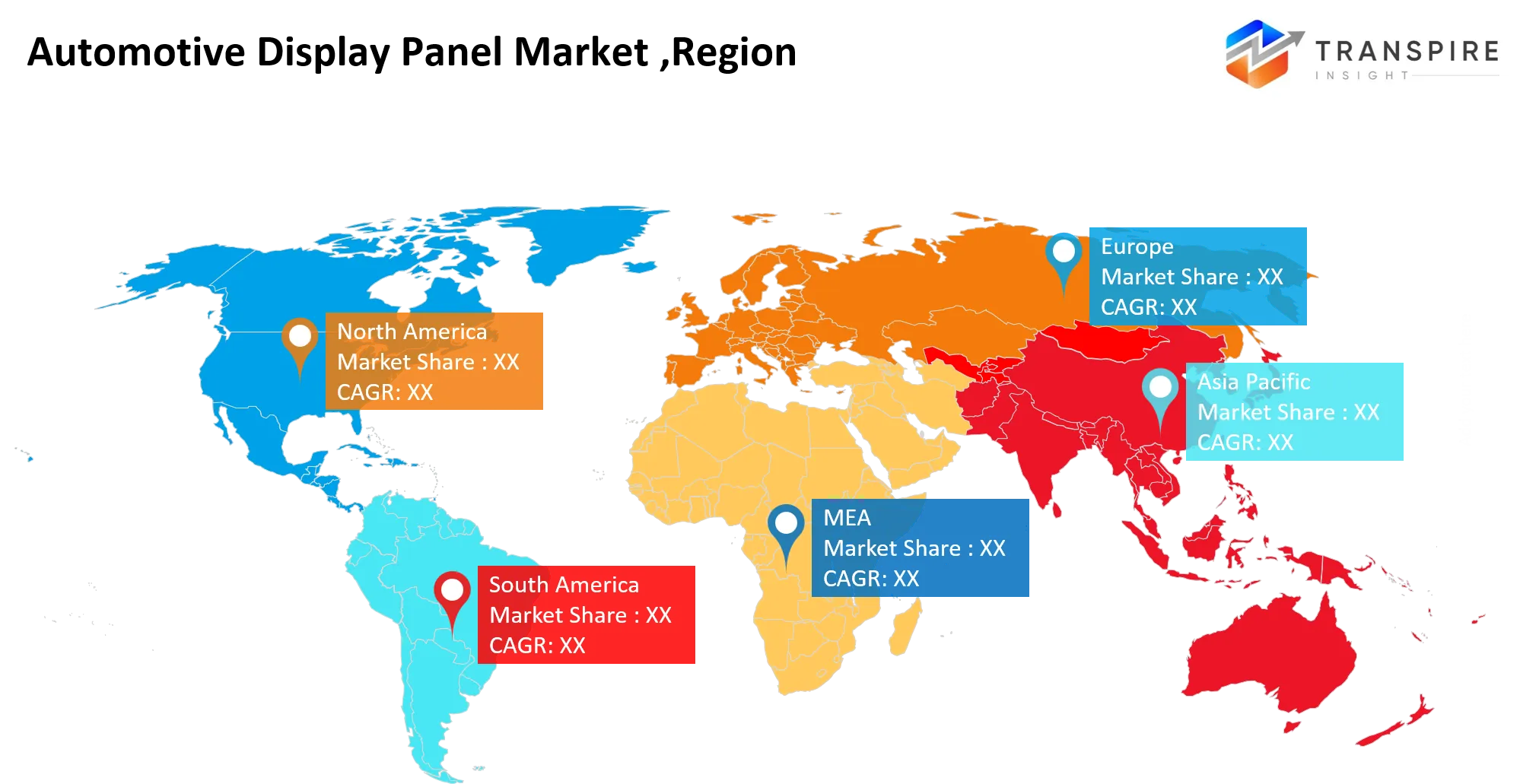
Asia-Pacific held the largest market share at 48.12% on account of vertical-specific ecosystems for panel manufacturers, vehicle assemblers, battery providers, and electronics manufacturers in China, South Korea, Japan, and Taiwan. Growing e-vehicle assembly rates in China, and associated demands for wide centre displays, digital clusters, and battery-management systems are among the factors augmenting demand for component suppliers in the region. Cost and scale benefits due to localised supply chain and assembly, local government incentives to manufacture e-vehicles, smart mobility, and semiconductor-display manufacturing capacity are adding to the advantage of Asia-Pacific manufacturers.
In February 2026, Contemporary Amperex Technology Co. Limited to construct a new lithium battery manufacturing facility in the Dianzhong New Area.
Europe is at 22.00%, but the growth drivers are unlike the manufacturing-heavy model in the APAC region. North America benefits from high adoption rates of connected vehicles, large-screen EV cabins, subscription-based software, and high-end pickup and SUV platforms. Europe remains supported by luxury vehicle builds, heightened safety standards, cybersecurity mandates, and high integration potential at supply chain companies, such as Continental, Bosch, Valeo, and Forvia. Despite a generally slower volume growth outlook, these regions deliver somewhat more stable margins for qualified automotive-grade panels.
In September 2026, FORVIA HELLA formed a strategic development partnership with Finnish startup Distance Technologies. This collaboration aims to develop a mirrorless 3D Augmented Reality (AR) Head-Up Display (HUD) for advanced automotive applications.
https://www.hella.com/en/Newsroom/Press-Releases/2026-09-09-Strategic-Development-Partnership-9768/
Middle East & Africa at 3.88% of current demand is the fastest-growing regional market at a CAGR of 8.17%, as premium electric-vehicle imports, smart-city investments, connected-fleet launches, and in-car digital services spending rise in Gulf economies. In contrast to panel manufacturing-based Asia-Pacific, growth in this region comes from vehicle imports, dealer-installed upgrades, luxury demand, and fleet-digitisation investments. The major opportunities in the coming years will be in designing high-brightness, heat-resistant displays for use in extreme sunlight and high-temperature operating conditions. Latin America at 4.00% is a relatively small, emerging volume market that will benefit from local vehicle production and aftermarket replacement demand.
In July 2026, General Motors rolled out Google's Gemini AI assistant via over-the-air software updates to tens of thousands of connected vehicles across the Middle East. This deployment directly accelerates the regional surge in premium digital services by upgrading the in-car infotainment display experience with an advanced, natural-language conversational assistant.
Who are the Key Players in the Automotive Display Panel Market, and how do they compete?
Competition involves panel makers, cockpit-system integrators, and automotive Tier-1s, so qualifications and display technology are both factors in wins. Among panel makers, LG Display differentiates with the presence of automotive OLED and pillar-to-pillar format offerings, including the commercialised 40-inch panel, while Samsung Display focuses on resilient OLED architecture and its DRIVE automotive OLED approach. BOE Technology Group, Tianma Microelectronics, AUO, Innolux, and Japan Display compete on lower-cost LCD capability, automotive-grade specific reliability, local OEM relationships, and selective investments in Mini-LED, OLED, and MicroLED concepts.
Among the suppliers competing at the higher-value system tier are: Continental, Visteon, Denso, Robert Bosch, Hyundai Mobis, Marelli, Valeo, and Panasonic Automotive Systems. Their approach involves integrating displays with cockpit domain controllers, ADAS data, software platforms, cameras, haptics, and cybersecurity. Visteon and Continental are focusing on digital cockpit architecture; Bosch and Valeo connect display output to sensing and driver assistance; Hyundai Mobis and Marelli are leveraging partnerships with OEM platforms. Innolux and AUO have partnered to develop high-brightness, energy-efficient MicroLEDs and share the development risk for next-gen automotive applications.
Key Players are:
- LG Display Co.
- Samsung Display
- BOE Technology Group
- Japan Display Inc.
- Tianma Microelectronics
- AUO Corporation
- Innolux Corporation
- Continental AG
- Visteon Corporation
- Denso Corporation
- Robert Bosch GmbH
- Hyundai Mobis
- Marelli
- Valeo SE
- Panasonic Automotive Systems
Recent Development News
In February 2026, Hyundai Mobis formed a alliance with ZEISS, Tesa and Saint-Gobain Sekurit to develop holographic windshield display technology. The collaboration combines optical, film, glass, and system-integration capabilities to transform the windshield into a large display surface, with mass production targeted from 2029 and potential applications spanning driver information and passenger infotainment.
In September 2026, Microchip Technology and Marelli introduced a new open-standard display connectivity solution for software-defined vehicles. The solution streams graphics and video from centralized vehicle computing systems directly to automotive displays through ASA Motion Link, supporting simplified display architectures, secure high-speed transmission, and greater sourcing flexibility.
What Strategic Insights Define the Future of the Automotive Display Panel Market?
The industry is moving towards more centralised, panoramic, and software-defined cockpit designs, with display manufacturers transitioning from supplying just a panel towards providing qualified interface solutions. There is also an unavoidable risk that the adoption of larger touch-enabled interfaces might introduce driver distraction, thermal issues, durability, or cybersecurity problems, which could increase validation costs and platform approval timeframes. This becomes even more relevant as connected display subsystems need to meet rising vehicle cybersecurity and software update specifications. A new opportunity also exists in adaptive, high-brightness Mini-LED and OLED displays with driver-monitoring, augmented-reality guidance, and AI-driven context management. Suppliers should focus on modular display platforms that will allow OEMs to scale screen size, touch performance, and visuals without an entire cockpit redesign. For growth, suppliers need to focus on optical bonding, low-reflection coatings, functional-safety software, and regional manufacturing presence within APAC, while leaving high-end OLEDs and MicroLEDs to premium EV and luxury segment platforms.
Key Players are:
Display Technology
- a-Si LCD
- Oxide LCD
- LTPS LCD
- OLED
- MicroLED
- Mini-LED
- E-Paper
- Others
Screen Size
- Up to 5 inches
- 5.1–8 Inch
- 8.1–12 Inch
- 12.1–15 Inch
- 15.1–20 Inch
- 20.1–25 Inch
- Above 25 Inch
- Flexible/Large Format
Vehicle Type
- Passenger Cars
- Light Commercial Vehicles
- Heavy Commercial Vehicles
- Buses
- Trucks
- Luxury Vehicles
- Electric Vehicles
- Commercial Fleets
Application
- Instrument Cluster
- Centre Stack/Infotainment
- Head-Up Display
- Rear-Seat Entertainment
- Digital Side/Smart Mirror
- Driver Information Display
- Roof/HVAC Display
- Others
Integration Level
- Stand-Alone
- Integrated Cockpit
- Pillar-to-Pillar
- Curved Display
- Flexible Display
- Multi-Display
- Centralised Display
- Modular Display
Touch/Control
- Capacitive
- Resistive
- Haptic
- Gesture
- Voice
- Physical Controls
- Display-Only
- Multi-Modal
Sales Channel
- OEM-Fitted
- Aftermarket Retrofit
- Dealer Installation
- Fleet
- Luxury/Premium
- Commercial
- Replacement
- Speciality
Frequently Asked Questions
Find quick answers to common questions.
The automotive display panel market size was valued at USD 8.95 billion in 2025 and is poised to reach USD 18.22 billion by 2033, expanding at a 9.30% CAGR.
Key segments for the automotive display panel market are Display Technology (a-Si LCD, Oxide LCD, LTPS LCD, OLED, MicroLED, Mini-LED, E-Paper, Others); Screen Size (Up to 5 Inch, 5.1–8 Inch, 8.1–12 Inch, 12.1–15 Inch, 15.1–20 Inch, 20.1–25 Inch, Above 25 Inch, Flexible/Large Format); Vehicle Type (Passenger Cars, Light Commercial Vehicles, Heavy Commercial Vehicles, Buses, Trucks, Luxury Vehicles, Electric Vehicles, Commercial Fleets); Application (Instrument Cluster, Center Stack/Infotainment, Head-Up Display, Rear-Seat Entertainment, Digital Side/Smart Mirror, Driver Information Display, Roof/HVAC Display, Others); Integration Level (Stand-Alone, Integrated Cockpit, Pillar-to-Pillar, Curved Display, Flexible Display, Multi-Display, Centralized Display, Modular Display); Touch/Control (Capacitive, Resistive, Haptic, Gesture, Voice, Physical Controls, Display-Only, Multi-Modal); Sales Channel (OEM-Fitted, Aftermarket Retrofit, Dealer Installation, Fleet, Luxury/Premium, Commercial, Replacement, Specialty)
Growth is primarily driven by the adoption of electric vehicles, software-defined cockpits, larger infotainment screens, advanced driver-assistance systems, digital instrument clusters, and demand for connected, personalised in-vehicle experiences.
The automotive display panel market is led by major manufacturers including LG Display Co.; Samsung Display; BOE Technology Group; Japan Display Inc.; Tianma Microelectronics; AUO Corporation; Innolux Corporation; Continental AG; Visteon Corporation; Denso Corporation; Robert Bosch GmbH; Hyundai Mobis; Marelli; Valeo SE; Panasonic Automotive Systems.
Asia-Pacific holds a 48.12% market share, supported by strong automotive production, established display manufacturing capabilities, electric vehicle adoption, and a concentrated electronics supply chain across China, South Korea, and Japan.
Opportunities include flexible OLED and Mini-LED displays, integrated digital cockpits, AI-enabled interfaces, digital smart mirrors, and large-format displays for electric and premium vehicles.
- LG Display Co.
- Samsung Display
- BOE Technology Group
- Japan Display Inc.
- Tianma Microelectronics
- AUO Corporation
- Innolux Corporation
- Continental AG
- Visteon Corporation
- Denso Corporation
- Robert Bosch GmbH
- Hyundai Mobis
- Marelli
- Valeo SE
- Panasonic Automotive Systems
About the Authors

Mayur Shinde
I am Mayur Shinde, a Senior Research Analyst at Transpire Insight, specializing in the Automotive & Transportation and Information & Communication Technology (ICT) Industry. My work focuses on analyzing emerging market trends, technological advancements, competitive landscapes, and industry developments to deliver accurate, data-driven insights. I am passionate about transforming complex market information into clear, actionable content that helps businesses, professionals, and decision-makers stay informed and make confident strategic decisions.

Chakradhar Khansole
Chakradhar serves as the Research Director at Transpire Insight, bringing over 8 years of experience in technology, innovation, and strategic market intelligence. He specializes in transforming complex market data into actionable business insights that enable organizations to make informed, growth-oriented decisions. Recognized for his strategic vision and analytical expertise, Chakradhar leads high-impact research initiatives, delivering comprehensive market assessments, competitive intelligence, and forward-looking industry analysis.
Recently Published Reports
-
Apr 2026
ATV & UTV Market
ATV & UTV Market Size, Share & Analysis Report By Type (ATV, and UTV), By Variants (Less Than 400 CC, 400 CC To 800 CC, and More Than 800 CC), and Geography (North America, Europe, Asia-Pacific, Middle East and Africa, South and Central America), 2021 - 2031
-
Apr 2026
Automotive Central Gateway Module Market
Automotive Central Gateway Module Market Size, Share & Analysis Report By Type (Ethernet Central Gateway Module, CAN Central Gateway Module, LIN Central Gateway Module, and FlexRay), By Application (Powertrain Control, Body Control, Infotainment System, Advanced Driver Assistance Systems (ADAS), and Others), By End User (Passenger Vehicles, and Commercial Vehicles), and Geography (North America, Europe, Asia-Pacific, Middle East and Africa, South and Central America), 2021 - 2031
-
Apr 2026
Automotive Engine Oil Filter Market
Automotive Engine Oil Filter Market Size, Share & Analysis Report By Filter Type (Fuel Filter, Engine Oil Filter, Hydraulic Oil Filter, and Others), By Filter Media (Cellulose, Synthetic, and Micro), By Sales Channel (OEMs, and Aftermarket), By Vehicle Type (Passenger Cars, Light Commercial Vehicles, Heavy Duty Trucks, Buses and Coaches, and Off-road Vehicles), and Geography (North America, Europe, Asia-Pacific, Middle East and Africa, South and Central America), 2021 - 2031
-
Apr 2026
Automotive Parts Aluminium Die Casting Market
Automotive Parts Aluminium Die Casting Market Size, Share & Analysis Report By Production Process (Pressure Die Casting, Vacuum Die Casting, Squeeze Die Casting, Gravity Die Casting), By Application (Body Parts, Engine Parts, Transmission Parts, Battery And Related Components, Other Application Types), and Geography (North America, Europe, Asia-Pacific, Middle East and Africa, South and Central America), 2021 - 2031
Our Clients