
Europe Electric Vehicle Range Extender Market Summary
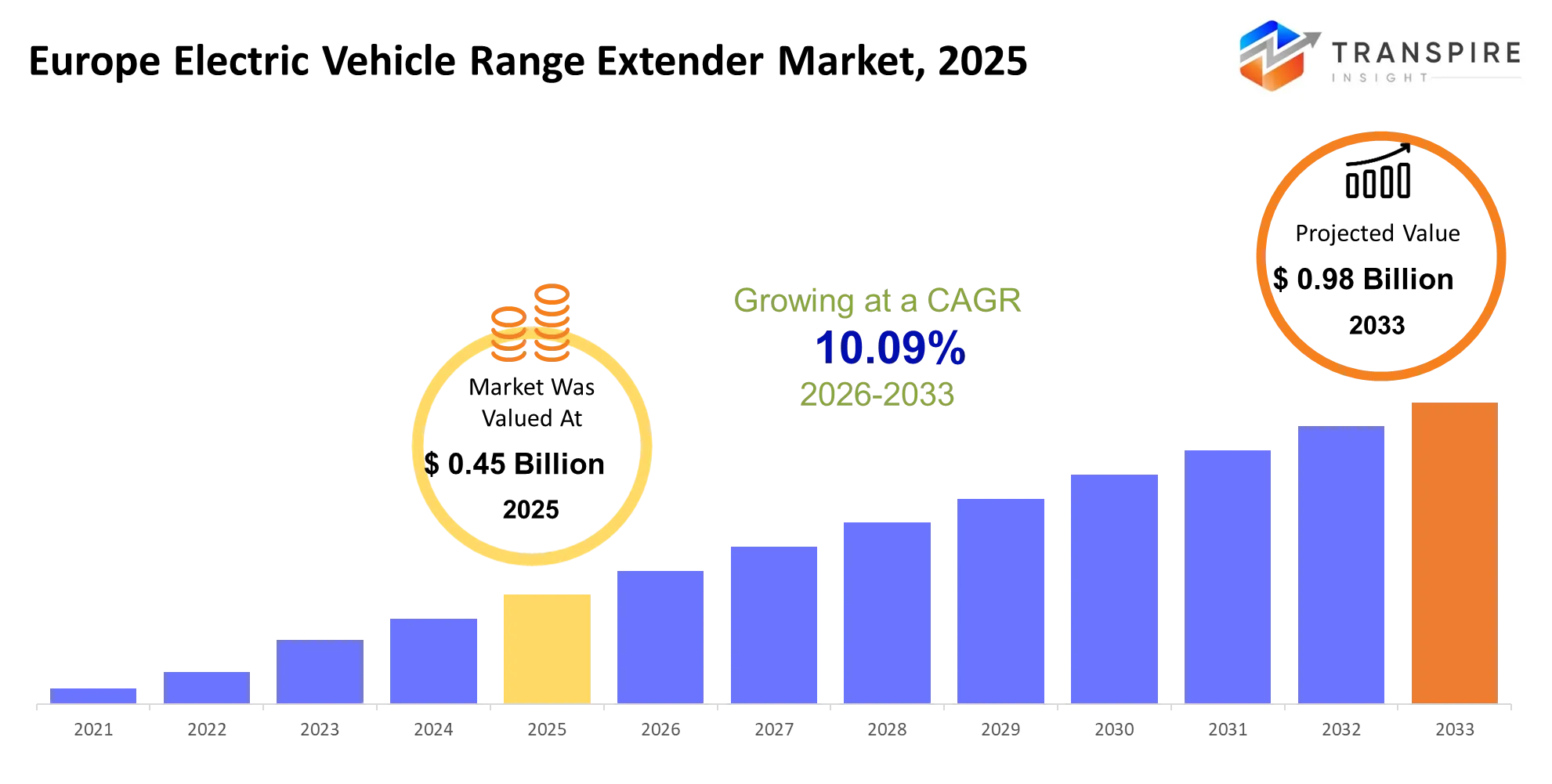
As per Transpire Insight Analysis the Europe Electric Vehicle Range Extender Market size is estimated at USD 0.45 Billion in 2025 and is anticipated to reach USD 0.98 Billion by 2033, growing at a CAGR of 10.09% from 2026 to 2033.
In Europe, the electric vehicle range extender market helps when battery-only driving is not enough for cars, trucks, or other specialized vehicles. These systems add extra power using an engine, a fuel cell, a generator, or another energy option. With that added power, makers can use smaller battery packs and still keep vehicles on the road for longer distances.
In the last few years, the focus has moved away from older combustion-based add-on units. More designs now mix fuel cells with hydrogen, batteries with extra boost, and more tightly linked hybrid setups. Tight EU rules on vehicle emissions push companies to cut pollution. At the same time, fleets still need day to day driving range. That pressure keeps demand steady for systems that extend range without making the car impractical.
The 2022 energy crisis and later supply problems also highlighted issues with big battery packs. Cost and supply risk became a bigger concern. That led to more interest in setups that can add distance while avoiding a one-to-one rise in battery size.
Revenue across Europe is expected to gain support from OEM spending. Work on better power electronics also matters, as do smaller generator units and hydrogen-related technology. Transpire Insight puts the market at USD 0.45 billion in 2025. It is expected to rise to USD 0.98 billion by 2033.
Europe Electric Vehicle Range Extender Market Size & Forecast:
- Europe Electric Vehicle Range Extender Market Size 2025: USD 0.45 Billion
- Expected Market Value 2033: USD 0.98 Billion
- Forecast CAGR: 10.09%
- Leading region in 2025: Western Europe,
- Fastest Growing region: Central and Eastern Europe
- Key Profile: BMW, Nissan, Mazda, Mahle, AVL, FEV Group, Ricardo, Cummins, Ballard Power Systems, Plug Power, Toyota, Bosch, Denso, ZF Friedrichshafen, Magna International
Key Market Insights
- Firms are shifting away from the usual engine and generator format. A lot of builders are now weighing fuel-cell units. They are also looking harder at hydrogen. Some are mixing these ideas in hybrid layouts. The main point is to reduce total life-cycle emissions.
- In 2025, Western Europe was a major driver for electrified cars. Germany helped lead the change. It has a deep auto manufacturing base. In many towns, charging points were already in place too.
- Central and Eastern Europe may be next to surge. Car makers are expanding output at both newer and older sites. At the same time, suppliers are moving in and starting local work on powertrains.
- The market is expected to grow in value. It is projected to rise from USD 0.45 billion in 2025 to USD 0.98 billion in 2033. Part of that path matches the growing use of range extenders in real products.
- Passenger cars still lead deployments. Even so, commercial fleets are getting more attention. Fleet routes are often known well before vehicles are ordered. This makes it easier to plan where range extenders will fit.
- Fuel-cell and hydrogen systems are also pulling in more funds. Many makers want an option that does not rely on combustion-based range extension.
- Some groups are testing smaller battery packs. They then add extra generator units alongside them. The aim is to use less battery material. It may also bring down vehicle cost, at least for early versions.
- Teams are placing more weight on how major parts work together. Power electronics, cooling, and heat control are being treated as one connected set. The battery interface is included in that view as well. This approach can improve energy transfer and make fitment easier inside the car.
- BMW, Mazda, Toyota, MAHLE, Bosch, and ZF are working to keep their position strong. They are doing this with ongoing powertrain work. They are also improving how components fit. Alternative-fuel development remains part of their plan.
- From 2026 to 2033, the forecast growth rate is 10.09 percent. That suggests steady interest in practical electrification. It also hints that charging access is not the same across all regions.
What are the Key Drivers, Restraints, and Opportunities in the Europe Electric Vehicle Range Extender Market?
European car makers are under tighter emissions rules. At the same time, drivers and fleet managers still want cars that can travel far without stress. Because of this, electrified drivetrains now need a setup that can use a battery but also add extra power when needed.
One option is a range extender. It can cut the need for huge battery packs. It also helps the vehicle work well on longer trips. With a smaller battery, the car can weigh less. It can also mean less demand for materials and less pressure on fast charging. This supports a business case in a few passenger and commercial uses.
As electrified platforms grow, OEMs are likely to spend more on smaller generators, fuel cells, power electronics, and thermal parts. Those investments can help drive sales for individual components.
Still, there is a major drawback. Putting a range extender into a vehicle is not cheap. It adds more hardware, extra control work, more cooling needs, and more space planning. It also calls for energy management software in addition to the main battery system. All of that adds complexity in the factory and pushes up build cost. That can weaken the cost edge versus a plain battery electric design, especially as battery energy density keeps improving.
There are also rules to consider. How regulators treat the vehicle can change with the powertrain layout and the fuel type. That adds extra engineering steps and extra testing and certification work. Those delays can slow down wide rollout. Adoption may stay mainly in uses where the extra operating distance clearly pays off.
A path forward is hydrogen fuel cell range extenders. They can fit well for heavy commercial vehicles and other specialty trucks that must run for long stretches.
What Has the Impact of Artificial Intelligence Been on the Europe Electric Vehicle Range Extender Market?
AI is now helping manage energy in electric cars. This is most common when a battery is paired with a generator, a fuel cell, or another add-on that extends range.
Learning models can watch a lot of inputs. They track speed, hills or flat roads, traffic, battery state of charge, and battery temperature. They also use past energy use to guess how much power the car will need. After that, the control logic can decide when extra power should kick in. The goal is to keep the battery charge in a good working range, not too high and not too low.
Control software can also set how hard the generator runs. It can coordinate the battery with power electronics. It can also link this with the cooling system. When this is done well, the generator does not have to run as much when it does not need to. Energy use can be more efficient. The result is a range that feels steadier even when trips change a lot.
AI is also used for predictive upkeep. This applies to engines, fuel cell stacks, cooling parts, pumps, and compressors. It can also cover high-voltage sections. Data from sensors can flag odd trends early. Examples include temperature swings, vibration changes, pressure shifts, voltage drift, or loss of efficiency. Fleet teams can plan service earlier, instead of waiting for fixed time or mileage rules.
Some teams use digital twins and simulations too. These tools let makers test how the powertrain behaves under different loads. That happens before real-world checks. Still, a big problem is data quality. Real operating data is not always available for every climate, every vehicle design, or every type of driving duty. On top of that, older vehicle control systems must be tested carefully. Strong software checks and cyber safety steps are needed. This slows rollout, even if the benefits are clear.
Key Market Trends
- Since 2021, more car companies have been talking about fuel cells and hydrogen. They talk about it in addition to the older idea of using a combustion style range extender.
- In 2022, a major energy disruption made automakers rethink battery size. It also put more focus on overall energy safety. They also paid more attention to efficiency and to how much they rely on energy from other countries.
- Battery link and control work has improved too. Some makers now use smaller battery packs, then add extra power generation for certain long trips.
- Starting in 2023, energy software in cars has mattered more. Cars are made to coordinate the battery, a generator, cooling and heating, and regen braking as one system.
- Commercial fleet teams are also taking range extenders more seriously. With fixed routes, it is easier to plan fuel use, schedule service, and keep energy control methods consistent.
- In Europe, suppliers are building wider ties in hydrogen, fuel cells, power electronics, and thermal control. Their goal is to back new electrified vehicle platforms.
- Investment in manufacturing across Central and Eastern Europe has grown. That has made local supplier networks for electric powertrain parts more important for planning.
- Predictive upkeep is moving forward as well. AI-based monitoring is shifting from trial projects to real checks for batteries, fuel cells, engines, and thermal parts.
- Vehicle builders are starting to judge the full system cost, not only battery size, when they pick tech for long-distance electrified travel.
- At the same time, emission rules keep tightening. This is steering research funding toward methods that extend range without causing new problems for fleet emission goals.
Europe Electric Vehicle Range Extender Market Segmentation
By Range Extender Type:
Range extenders can be built in different ways so the vehicle can keep going when the main battery drops. One type uses an internal combustion engine tied to a generator. It runs only when extra electricity is needed. Another type relies on fuel cells. These make power from an electrochemical process, usually with hydrogen. They fit uses where people want more miles and cleaner exhaust.Some range extenders are battery based. They add a separate pack to help with energy. Others use a turbine. A small turbine generator can turn fast and deliver strong power in a compact unit. There are also systems that work with hydrogen. They can use hydrogen fuel cell setups so driving distance improves without depending only on the vehicle’s main battery.
Biofuel range extenders run on renewable fuels like biodiesel or ethanol blends. Generator based designs use an engine and generator together, sending electricity to the traction battery or the electric drive. Hybrid range extenders mix two or more approaches. For example, they may pair an internal combustion engine with a battery or a fuel cell. The goal is to trade off range, efficiency, cost, and pollution in a practical way.In Europe, makers are testing and judging these options. They look at vehicle size and local rules. They also check how far the vehicle is driven, where charging is available, and the full cost of ownership.
By Vehicle Type:
Passenger cars are a big use case. A range extender can ease range worries. It also lets a maker fit a smaller battery. SUVs need more energy. They are heavier and take more power to move. Because of that, a range extender can help on longer trips. Light commercial vehicles can also use this tech. Delivery and service routes often run far from fast charging. A range extender can keep the drive feel more electric for longer. Heavy commercial vehicles push the limits more. They carry bigger loads and face tough work cycles. They need a stronger, higher output system. Buses may benefit on long routes. Charging options can be few and far apart. Trucks can use range extenders for long freight runs too.
Pickup trucks often need systems that can take heavy hauling. They also face towing demands and changing road conditions. Special purpose vehicles include emergency, construction, mining, utility, military, and other customized models. For these, dependable running matters more than easy charging access. Across these uses, there is room for range-extender designs. They can add flexibility in daily work. They do not always require very large battery packs.
By Fuel Type:
Gasoline still shows up in range extenders for a simple reason. A gasoline engine can be small and light, so it can power a backup electrical system without adding too much weight.Diesel fits better when the job needs more pull and long life. It is often chosen for steady work in commercial trucks and other heavy vehicles. Diesel also tends to handle continuous running well.Hydrogen is a different path. In a fuel cell setup, it can help a range extender make electricity. If the system runs from hydrogen through a fuel cell, there are no tailpipe carbon emissions.
Biofuels can cut the tie to regular fossil fuels. They can let some combustion based range extenders run on a renewable fuel. The exact fit depends on the engine design.Natural gas can also work for auxiliary generators when the local fuel setup exists. If fueling is available, it can be a practical option.Synthetic fuels are another choice for combustion based range extenders. Some of these fuels may lower life cycle emissions if they are made using low carbon energy. Methanol is used in some fuel cell designs. It can also be turned into hydrogen for making electricity. There are also newer low carbon fuels for special range extender uses.In the end, fuel choice is about more than the fuel itself. It depends on what is available, how the vehicle is driven, what the rules say, what infrastructure exists, how well the system converts energy, and what the whole range extender costs.
By Power Output:
Units below 10 kW are good for small cars. They also work in cases where the range extender adds only a bit more energy.
When you step up to 10 to 25 kW, you can power compact passenger cars. It can also cover smaller work vans. Some jobs fall here, too, as long as they do not need a lot of power.
For the 25 to 50 kW band, the fit gets better. This level suits passenger cars and SUVs. Light commercial vehicles also land in this range.
A system in the 50 to 75 kW range is a solid match for larger passenger cars. It is also a good choice for business use. You get steadier output when you need it for longer.
Between 75 and 100 kW, these setups can handle bigger vehicles. They also help on longer trips. They can be useful when the energy demand is higher. From 100 to 150 kW, you see more use in large commercial vehicles. This often comes up with a tough duty cycle.
At 150 to 250 kW, the systems are aimed at heavy-duty fleets. You can think of trucks and buses. It also fits work that stays at high loads for a long time.
By Component:
A generator takes mechanical energy made by an engine or turbine and turns it into electricity. In range extender setups that use generators, it is a key part. In one layout, the engine spins a shaft to make mechanical power. In a fuel cell setup, electricity is made right from an electrochemical reaction. After that, power electronics handle the change from one electrical form to another. They also control and route power so it goes between the range extender, the battery, and the motor. The battery interface ties the extra power source to the main battery pack. It controls how energy moves into and out of the pack. All of these parts have to work well and still fit in the vehicle. They also must meet heat limits.
A cooling system limits heat that builds up during running. This heat can come from engines, generators, fuel cells, batteries, and power electronics. A control unit links the range extender actions with the battery manager and with the vehicle drive system. It decides when extra power should be made. The fuel system holds fuel and sends it to the unit that produces power. That fuel can be gasoline, diesel, hydrogen, biofuel, or other options. Better compact packaging can help space use. Good thermal handling can keep parts within limits. Advances in power electronics, control software, and part efficiency can cut the overall size of the system and improve how well range-extended electric cars perform.
By Application:
Urban mobility apps cover cars used inside cities, taxis, shared cars, buses, and vehicles used for deliveries. A range extender can help when charging spots are scarce. It can also help when a vehicle must stay on the road for a long time. Another use is long trips. Drivers can keep going after the main battery drops to a lower charge. In business transport, the use shows up in vans, trucks, and other freight vehicles. These vehicles often need steady running over longer routes. Fleets may also gain. Less time spent waiting to charge can mean fewer service delays. It can also help keep schedules more stable.
Range extenders can matter in off-road work too. They can be useful in distant areas where there are few charging options. Emergency services may also use them. Ambulances and rescue units may need extra power during long calls. Response teams can face the same limits. Recreational vehicles are another case. They can be used for long drives and trips far from charging access. Specialty work includes construction gear and utility vehicles. It can also include industrial vehicles and defense platforms. Some setups are built to fit the job.
What drives demand across these cases is not one thing. Distance matters. So does whether charging is easy to find. Payload needs play a role. Reliability matters, as does fuel access. Emissions rules can affect choices. The price of installing a bigger battery system also changes the decision.
What are the Key Use Cases Driving the Europe Electric Vehicle Range Extender Market?
Passenger cars and SUVs still matter. Long trips can show the limits of driving on battery power alone. This gets worse when you cross areas with patchy charging access. Range-extender setups add extra electricity. They do not force a bigger battery at the same rate. That makes highway trips more doable and cuts how much you must rely on chargers. Some high-end or niche passenger models may also fit the idea. Their design choices can justify the extra cost if the powertrain adds real value in range, space, and driving feel.
Commercial fleets are also a key path. Fleet teams track uptime and route success. They also watch fuel use and time lost to charging. For light trucks, buses, and vehicles that run set routes, energy planning can be more consistent. It also helps when refueling sites are placed in the right spots. Range-extender systems can fit workdays when charging time is tight. Fleet systems that send data back can then help steer energy use and plan service work.
New areas may appear in emergency response, off-road rigs, recreation vehicles, and special-purpose transport. These types often travel beyond busy charging networks. They need steady power for longer missions. Hydrogen fuel-cell systems and strong hybrid designs may pick up support by 2030 to 2033. This timing lines up with growth in hydrogen supply in Europe and with falling powertrain costs. Industrial and utility fleets might be early adopters too. In those cases, keeping vehicles running can matter more than buying them at the lowest possible price.
|
Report Metrics |
Details |
|
Market size value in 2025 |
USD 0.45 Billion |
|
Market size value in 2026 |
USD 0.50 Billion |
|
Revenue forecast in 2033 |
USD 0.98 Billion |
|
Growth rate |
CAGR of 10.09% from 2026 to 2033 |
|
Base year |
2025 |
|
Historical data |
2021 - 2024 |
|
Forecast period |
2026 - 2033 |
|
Report coverage |
Revenue forecast, competitive landscape, growth factors, and trends |
|
Regional scope |
Europe |
|
Key company profiled |
BMW, Nissan, Mazda, Mahle, AVL, FEV Group, Ricardo, Cummins, Ballard Power Systems, Plug Power, Toyota, Bosch, Denso, ZF Friedrichshafen, Magna International |
|
Customization scope |
Free report customization (country, regional & segment scope). Avail customized purchase options to meet your exact research needs. |
|
Report Segmentation |
By Range Extender Type (Internal Combustion Engine Range Extenders, Fuel Cell Range Extenders, Battery-Based Range Extenders, Turbine Range Extenders, Hydrogen Range Extenders, Biofuel Range Extenders, Generator-Based Systems, Hybrid Range Extenders); By Vehicle Type (Passenger Cars, SUVs, Light Commercial Vehicles, Heavy Commercial Vehicles, Buses, Trucks, Pickup Trucks, Specialty Vehicles); By Fuel Type (Gasoline, Diesel, Hydrogen, Biofuels, Natural Gas, Synthetic Fuels, Methanol, Other Alternative Fuels); By Power Output (Below 10 kW, 10–25 kW, 25–50 kW, 50–75 kW, 75–100 kW, 100–150 kW, 150–250 kW, Above 250 kW); By Component (Generator, Engine, Fuel Cell, Power Electronics, Battery Interface, Cooling System, Control Unit, Fuel System); By Application (Urban Mobility, Long-Distance Travel, Commercial Transport, Fleet Operations, Off-Road Vehicles, Emergency Vehicles, Recreational Vehicles, Specialty Applications) |
Which Regions are Driving the Europe Electric Vehicle Range Extender Market Growth?
Germany and parts of Western Europe look like the best place to start with range extenders. One reason is the scale of auto production there. Germany also has strong EV output and a deep base of suppliers. In 2025, Germany made 1.67 million electric passenger cars. That is up 23% from the year before. German makers also took in about half of all new electric car registrations across Europe. Because of that, there are many OEM teams, component makers, test sites, and powertrain experts in one area. That mix helps a range extender move from concept to products.
France and other big Western markets follow a different path. Their growth is driven more by charging access. By the end of 2025, France had about 1.5 million battery electric passenger cars. It also had 185,500 public charging points. With that kind of setup, range extenders can fit longer trips and also work for business use. Rules are being rolled out, fleets are adding more EVs, and charging is still getting money. So suppliers may see steadier demand, even while automakers compare different drive system designs.In Central and Eastern Europe, the outlook is more about quick expansion. Auto output and battery work are spreading further into the region. Hungary, Poland, Czechia, Slovakia, and Romania all pull in major e-mobility investment. In the regional study being cited, Hungary alone made up 11% of EU e-mobility investment. As EV assembly and battery production rise, and as parts makers set up local plants, new chances open for range extender parts. Engineering firms can also benefit between 2026 and 2033, especially if they team up with growing vehicle producers.
Who are the Key Players in the Europe Electric Vehicle Range Extender Market and How Do They Compete?
Competition is moving away from just shipping parts. It is turning into modular powertrain design work. In Europe, suppliers are trying to stand out with tight packaging, better energy use, and clean high-voltage integration. They also need to be ready for production. Another key point is how fast they can fit range extender setups into different BEV designs. At the same time, Asian automakers are bringing REEV models into Europe. That adds stress on European teams. They now have to cut development time and keep system costs in check.
ZF Friedrichshafen is trying to separate itself with a modular electric range extender base. It plans to start series work in 2026. The eRE+ setup can also use the motor for an extra axle drive. This is meant to be better than setups that only add a generator. ZF official range-extender announcement
MAHLE is aiming for systems that fit well and are built to be produced. The goal is to reduce how much battery capacity a vehicle needs. For 2025, its range extender work is tied to up to 1,350 km on WLTP. It uses an 85 kW continuous system. It also includes an 800 V design. MAHLE says this helps its role in high-efficiency powertrain pairing. MAHLE official technology announcement
Toyota is working to push its fuel cell track further. It signed a deal in March 2026 with Daimler Truck, Volvo Group, and cellcentric. Toyota will hold a stake as part of the plan. The idea is to blend Toyota fuel cell know-how with well known European commercial vehicle platforms. This is meant to support hydrogen based range extension and heavy-duty needs. Toyota official announcement
Company List
- BMW
- Nissan
- Mazda
- MAHLE
- AVL
- FEV Group
- Ricardo
- Cummins
- Ballard Power Systems
- Plug Power
- Toyota
- Bosch
- Denso
- ZF Friedrichshafen
- Magna International
Recent Development News
"In January 2025, Leapmotor launched the C10 Range Extender Electric Vehicle (REEV) at the Brussels Motor Show. The C10 REEV offers a total range of more than 950 km and marked the company’s expansion of range-extender technology into the European passenger-vehicle market.https://www.media.stellantis.com/em-en/leapmotor/press/leapmotor-at-the-2025-brussels-motor-show-launch-of-the-range-extender-on-c10 (Stellantis Media)."
"In April 2025, ZF further developed its electric Range Extender systems and announced volume production from 2026. The modular technology is designed to increase EV driving range while supporting different vehicle architectures, strengthening ZF’s position in next-generation range-extender systems.https://press.zf.com/press/en/releases/release_85376.html (ZF Group)."
"In March 2026, Toyota Motor Corporation entered a strategic agreement with Daimler Truck, Volvo Group, and cellcentric to collaborate on fuel-cell technology and announced plans to become an equal shareholder in cellcentric. The partnership will strengthen fuel-cell systems for heavy-duty commercial vehicles and support the development of fuel-cell-based electric mobility solutions in Europe.https://global.toyota/en/newsroom/corporate/44152536.html (Toyota Motor Corporation).
What Strategic Insights Define the Future of the Europe Electric Vehicle Range Extender Market?
Car makers are shifting their focus. They want smaller battery packs, and they plan to pair them with very efficient power systems. This is different from relying on battery size alone for trips that need long range.
Several pressures drive this change. Companies must juggle vehicle cost and total weight. They also have to meet rules on charging time and emissions. Driving range still matters, especially for commercial fleets.
There is also a quieter risk. New battery advances could undercut some current designs. If charging gets faster and energy density rises, and if battery prices keep dropping, then range extenders in passenger cars may look less cost effective. This could happen before vendors fully recoup their development spending.
At the same time, hydrogen fuel cells may fit some segments well. In heavy trucks and other vehicles that run a lot each day, big batteries can become a burden. Weight limits and charging limits can make hydrogen a more practical choice there.
Because of this, it is safer to avoid only one plan. Firms should build modular platforms. These platforms should support different setups, including fuel from combustion, hydrogen systems, and fuel cell options. They should also secure OEM ties early, so production plans are set through 2030 to 2033.
Europe Electric Vehicle Range Extender Market Report Segmentation
By Range Extender Type
- Internal Combustion Engine Range Extenders
- Fuel Cell Range Extenders
- Battery-Based Range Extenders
- Turbine Range Extenders
- Hydrogen Range Extenders
- Biofuel Range Extenders
- Generator-Based Systems
- Hybrid Range Extenders
By Vehicle Type
- Passenger Cars
- SUVs
- Light Commercial Vehicles
- Heavy Commercial Vehicles
- Buses
- Trucks
- Pickup Trucks
- Specialty Vehicles
By Fuel Type
- Gasoline
- Diesel
- Hydrogen
- Biofuels
- Natural Gas
- Synthetic Fuels
- Methanol
- Other Alternative Fuels
By Power Output
- Below 10 kW
- 10–25 kW
- 25–50 kW
- 50–75 kW
- 75–100 kW
- 100–150 kW
- 150–250 kW
- Above 250 kW
By Component
- Generator
- Engine
- Fuel Cell
- Power Electronics
- Battery Interface
- Cooling System
- Control Unit
- Fuel System
By Application
- Urban Mobility
- Long-Distance Travel
- Commercial Transport
- Fleet Operations
- Off-Road Vehicles
- Emergency Vehicles
- Recreational Vehicles
- Specialty Applications
Frequently Asked Questions
Find quick answers to common questions.
The expected Europe Electric Vehicle Range Extender Market size for the market will be USD 0.98 Billion in 2033.
Key segments for the Europe Electric Vehicle Range Extender Market are By Range Extender Type (Internal Combustion Engine Range Extenders, Fuel Cell Range Extenders, Battery-Based Range Extenders, Turbine Range Extenders, Hydrogen Range Extenders, Biofuel Range Extenders, Generator-Based Systems, Hybrid Range Extenders); By Vehicle Type (Passenger Cars, SUVs, Light Commercial Vehicles, Heavy Commercial Vehicles, Buses, Trucks, Pickup Trucks, Specialty Vehicles); By Fuel Type (Gasoline, Diesel, Hydrogen, Biofuels, Natural Gas, Synthetic Fuels, Methanol, Other Alternative Fuels); By Power Output (Below 10 kW, 10–25 kW, 25–50 kW, 50–75 kW, 75–100 kW, 100–150 kW, 150–250 kW, Above 250 kW); By Component (Generator, Engine, Fuel Cell, Power Electronics, Battery Interface, Cooling System, Control Unit, Fuel System); By Application (Urban Mobility, Long-Distance Travel, Commercial Transport, Fleet Operations, Off-Road Vehicles, Emergency Vehicles, Recreational Vehicles, Specialty Applications).
Major Europe Electric Vehicle Range Extender Market players are BMW, Nissan, Mazda, Mahle, AVL, FEV Group, Ricardo, Cummins, Ballard Power Systems, Plug Power, Toyota, Bosch, Denso, ZF Friedrichshafen, Magna International.
The Europe Electric Vehicle Range Extender Market size is USD 0.45 Billion in 2025.
The Europe Electric Vehicle Range Extender Market CAGR is 10.09% from 2026 to 2033.
- BMW
- Nissan
- Mazda
- MAHLE
- AVL
- FEV Group
- Ricardo
- Cummins
- Ballard Power Systems
- Plug Power
- Toyota
- Bosch
- Denso
- ZF Friedrichshafen
- Magna International
About the Authors

Avinash Kumar
I’m Avinash Kumar, a Senior Research Analyst at Transpire Insight, with expertise in the Electronics and Semiconductor and Energy & Power industry. My work focuses on analyzing emerging technologies, market trends, industry developments, and innovation across these sectors. I specialize in transforming complex technical and market insights into clear, research-backed content that helps professionals, businesses, and decision-makers stay informed. Through continuous industry research and data-driven analysis, I strive to deliver accurate, reliable, and practical perspectives on the latest advancements shaping the semiconductor and energy landscape.

Chakradhar Khansole
Chakradhar serves as the Research Director at Transpire Insight, bringing over 8 years of experience in technology, innovation, and strategic market intelligence. He specializes in transforming complex market data into actionable business insights that enable organizations to make informed, growth-oriented decisions. Recognized for his strategic vision and analytical expertise, Chakradhar leads high-impact research initiatives, delivering comprehensive market assessments, competitive intelligence, and forward-looking industry analysis.
Recently Published Reports
-
Apr 2026
Fiber Optic Faceplates Market
Fiber Optic Faceplates Market Size, Share & Analysis Report By Type (< 300 mm2, 300-350 mm2, and > 350 mm2, By Application (Night Vision, Holographic Imaging, Medical, and Others), and Geography (North America, Europe, Asia-Pacific, Middle East and Africa, South and Central America), 2021 - 2031
-
Apr 2026
High Temperature Superconductors Market
High Temperature Superconductors Market Size, Share & Analysis Report By Type (1G HTS, and 2G HTS), By Application (Power Cable, Fault Current Limiter, and Transformer), and Geography (North America, Europe, Asia-Pacific, Middle East and Africa, South and Central America), 2021 - 2031
-
Apr 2026
Industrial Plugs and Socket Market
Industrial Plugs and Socket Market Size, Share & Analysis Report By Type (Industrial Plugs, Industrial Sockets), By Current (Up to 32 A, 32 to 125 A, Above 125 A), By Protection (Dustproof and Splash Proof, Waterproof, Explosion Proof), By End User (Heavy Industries, Oil and Gas, Chemicals and Pharmaceuticals, Power Generation, Others), and Geography (North America, Europe, Asia-Pacific, Middle East and Africa, South and Central America), 2021 - 2031
-
Apr 2026
InGaAs Avalanche Photodiodes Market
InGaAs Avalanche Photodiodes Market Size, Share & Analysis Report By Type (1100 - 1700 nm, and 1000 - 1600 nm), By Application (Missile Warning System, Muzzle Flash Detection, Wafer Defect Inspection, Laser Rangefinders, and Others), and Geography (North America, Europe, Asia-Pacific, Middle East and Africa, South and Central America), 2021 - 2031