

Asia Pacific Automotive Instrument Cluster Market Size & Forecast:
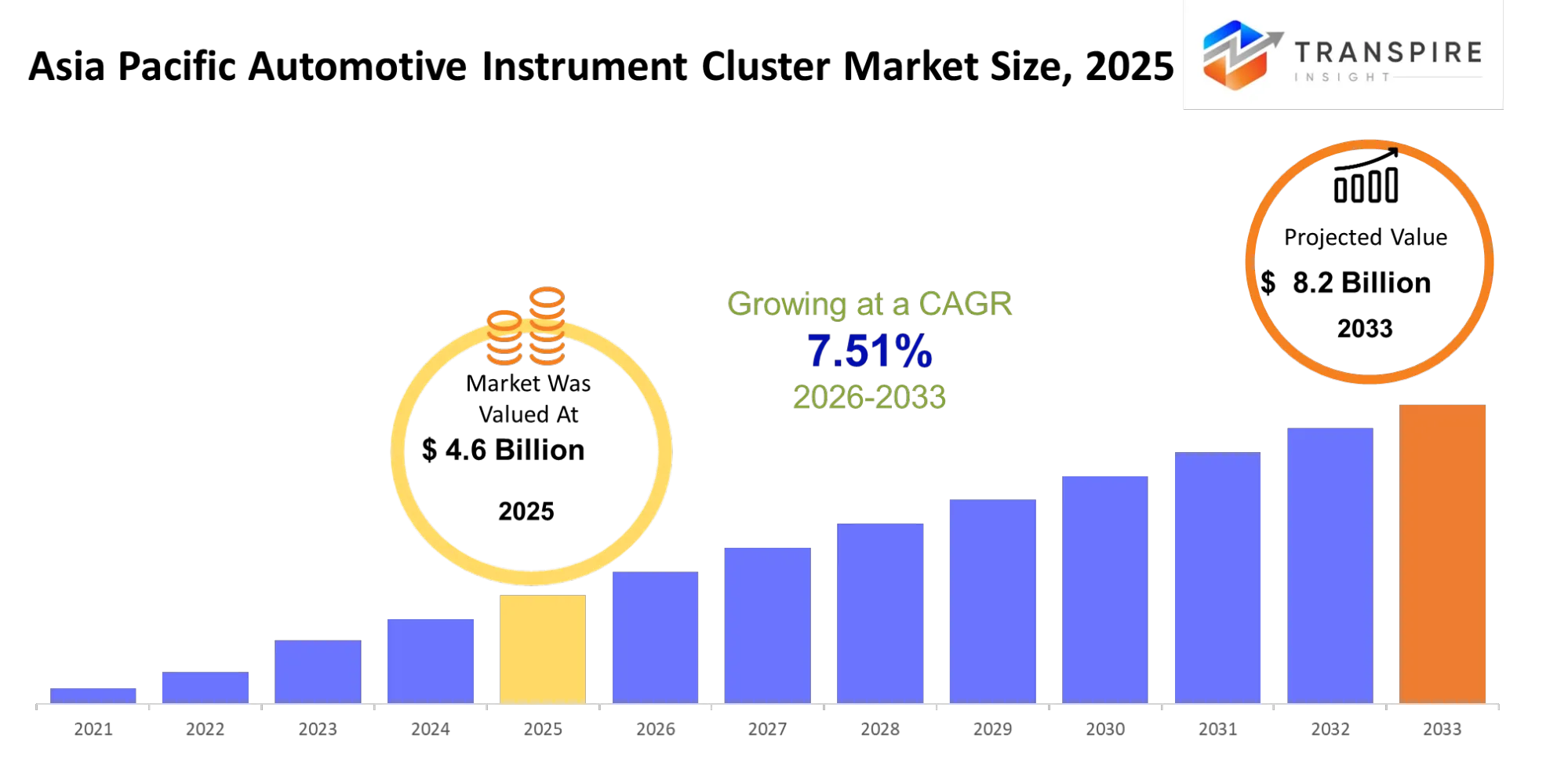
- Asia Pacific Automotive Instrument Cluster Market Size 2025: USD 4.6 Billion
- Asia Pacific Automotive Instrument Cluster Market Size 2033: USD 8.2 Billion
- Asia Pacific Automotive Instrument Cluster Market CAGR: 7.51%
- Asia Pacific Automotive Instrument Cluster Market Segments: By Type (Analog Cluster, Digital Cluster, Hybrid Cluster, Others); By Application (Passenger Vehicles, Commercial Vehicles, Electric Vehicles, Luxury Vehicles, Others); By End-User (Automakers, Tier 1 Suppliers, Electronics Firms, Others); By Technology (LCD, TFT, OLED, Others)
To learn more about this report,  Download Free Sample Report
Asia Pacific Automotive Instrument Cluster Market Summary
The Asia Pacific Automotive Instrument Cluster Market was valued at USD 4.6 Billion in 2025. It is forecast to reach USD 8.2 Billion by 2033. That is a CAGR of 7.51% over the period.
The Asia Pacific automotive instrument cluster market serves as the primary interface through which vehicles provide essential data to their drivers. This system converts vital operational information about vehicles which includes speed and battery level and navigation directions and safety notifications into understandable visual representations which drivers can use to make decisions.
The market has switched from traditional analog clusters to digital and hybrid display systems which combine advanced driver assistance with digital displays during the last three to five years. The transition accelerated after semiconductor supply shortages disrupted operations during the post-pandemic recovery period which compelled automakers to develop more adaptable electronic systems that could operate with multiple software programs. The implementation of warning systems and connected vehicle interfaces through advanced clusters gained momentum as China, Japan and South Korea enforced more stringent vehicle safety regulations. Modern vehicle manufacturers focus their competition on cabin technology and user experience because instrument clusters have transformed into essential elements which generate revenue through premium vehicle offerings and digital cockpit systems.
Key Market Insights
- China holds the top position in the Asia Pacific Automotive Instrument Cluster Market because it will achieve a 42% market share during 2025 through its extensive electric vehicle production capabilities.
- The Indian market shows the highest growth rate among all regions until 2032 because of its increasing production of passenger vehicles and its rising adoption of digital cockpit technology.
- The automotive electronics manufacturing systems of Japan and South Korea enable both countries to maintain substantial market shares through their robust original equipment manufacturer research and development activities.
- The automotive market will reach its highest point in 2025 when digital instrument clusters achieve their 48% market share because automakers are shifting towards software-defined vehicle systems.
- Hybrid clusters operate as the second largest market segment because they provide affordable installation options for mid-range vehicle platforms.
- The period between 2026 and 2032 will experience the most rapid growth of fully configurable TFT-based clusters which manufacturers design to meet premiumization demands and implement electric vehicle dashboard improvements.
- Passenger vehicles currently account for approximately 72% of total market demand because digital display technology has become more common in sedans and SUVs and electric vehicles.
- Fleet operators show an increasing preference for telematics-enabled driver information systems which drive rapid commercial vehicle adoption.
- The factory-fitted clusters represent the primary source of revenue in the Asia Pacific Automotive Instrument Cluster Market because OEM installations control more than 81% of market share.
- The aftermarket retrofitting sector has become the fastest-expanding market segment which drives growth in vehicle customization throughout Southeast Asia.
What are the Key Drivers, Restraints, and Opportunities in the Asia Pacific Automotive Instrument Cluster Market?
The primary element which drives growth in the Asia Pacific automotive instrument cluster market operates through the fast evolution of vehicles which utilize software-controlled systems and electric propulsion. The shift began when China, Japan and South Korea implemented their new vehicle safety regulations which included requirements for digital cockpit systems during the previous five years. The decreasing prices of both TFT-LCD technology and OLED display technology enabled manufacturers to develop advanced digital clusters that could be used in mid-tier vehicle products. Automakers now use bigger multifunctional clusters which enable them to analyze battery data and display driver support notifications and track vehicle routes through their navigation systems. Digital clusters generate higher supplier revenue because they sell for much higher prices compared to standard analog systems.
The most significant barrier remains semiconductor dependency and the region’s fragmented electronic component supply chain. Automotive-grade chips used in display controllers, graphics processors, and cluster communication modules require long validation cycles and highly specialized fabrication capacity. Local semiconductor production systems require multiple billion dollar investments plus several years needed to establish operational production. The result leads to postponed vehicle manufacturing schedules and delayed instrument panel redesign initiatives and missing revenue chances which impact both OEMs and tier-one suppliers.
The next growth phase lies in India and Southeast Asia as domestic EV production expands and cockpit digitization becomes more affordable. Global suppliers who invest in local electronic manufacturing facilities for digital cluster systems will enable more compact and mid-priced vehicles to adopt this technology.
What Has the Impact of Artificial Intelligence Been on the Asia Pacific Automotive Instrument Cluster Market?
The introduction of artificial intelligence and advanced digital technologies has transformed vehicle display systems throughout the Asia Pacific region by changing instrument clusters into interactive platforms through which drivers can interact. The automotive industry now implements AI-powered human-machine interface systems which adjust display settings automatically according to various driving factors including driving conditions and battery levels and navigation patterns and driver actions. The adaptive systems of this system create screen layouts which change their design dynamically to decrease driver distraction while making vital alerts and vehicle diagnostic information more accessible.
Digital cockpit ecosystems implement machine learning models to deliver predictive capabilities. Connected instrument clusters process sensor data to forecast battery degradation and component wear and system faults that will occur before actual failure happens. The predictive analytics system in electric vehicle cluster software enables drivers to forecast battery range with 10% to 15% accuracy, which helps them decide when to charge their vehicles. The solution leads to increased vehicle availability while decreasing unplanned maintenance expenses.
The integration of instrument clusters with ADAS platforms and cloud-based telematics systems produces operational advantages for organizations. The systems enhance diagnostic response efficiency while enabling software updates through over-the-air methods and minimizing service costs for original equipment manufacturers and fleet management companies.
The system suffers from a major problem because it operates with excessive complexity during its integration process. To build AI-powered clusters developers need specialized semiconductor designs together with thorough software testing and complete real-world driving information. The automotive industry in Southeast Asia faces training dataset availability problems which prevent many local manufacturers from developing effective systems due to high costs and restricted access to necessary training data.
Key Market Trends
- Chinese automakers introduced 55 percent of their electric vehicle models after 2021 which used digital clusters instead of analog systems which operated through software-based display systems.
- Continental AG and Visteon Corporation increased regional R&D investment after 2022 to accelerate cockpit domain controller integration across Asia Pacific production programs.
- The semiconductor shortages during the 2021 to 2023 period forced OEMs to redesign their cluster systems which now use fewer chips while delivering improved software capabilities, which led to enduring changes in supplier engineering priorities.
- Between 2022 and 2025, Japan's premium vehicle manufacturers established new in-cabin display standards, which replaced their previous dual-screen dashboard systems with panoramic cockpit display technology.
- India's passenger vehicle manufacturers have implemented digital cluster systems in approximately 28 percent of their vehicles since 2023 because they needed to compete against rivals who offered advanced features in their mid-range compact SUVs.
- The ADAS warning visualization system now requires standard installation in China and South Korea after 2022 because regulatory updates demanded improved system integration.
- Automakers must now provide driver-profile-based dashboards which users can customize because buyers increasingly want personalized interface solutions.
- The introduction of OLED and curved TFT displays began in 2024 after panel manufacturing costs dropped, which enabled manufacturers to create high-end display products that reached markets beyond luxury vehicle segments.
- Since 2023, regional suppliers have increased their partnerships with semiconductor companies to establish local production capabilities which help them decrease their reliance on international display controller supply shortages.
- Software-over-the-air update capability emerged as a competitive differentiator after 2022, enabling automakers to continuously enhance cluster functionality post-sale.
Asia Pacific Automotive Instrument Cluster Market Segmentation
By Type :
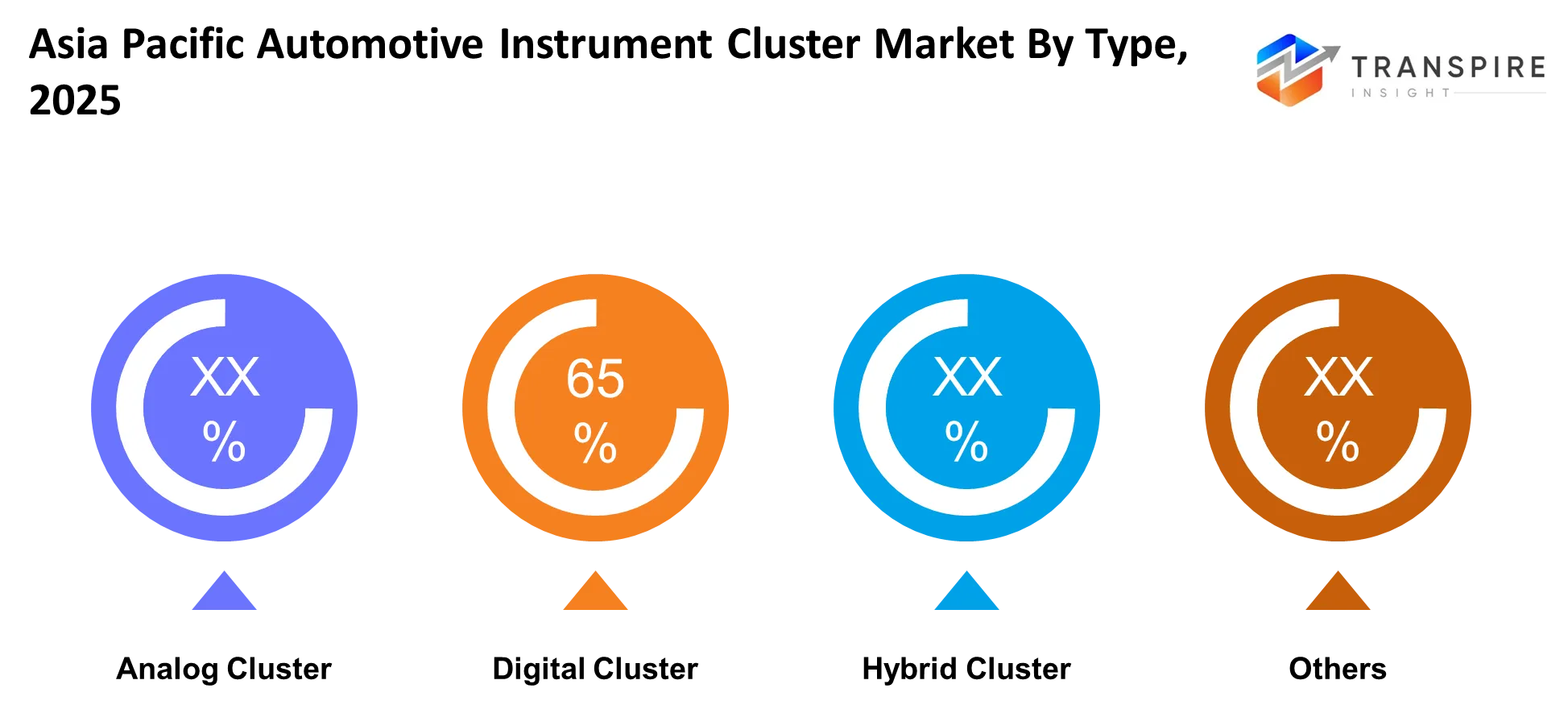
The entry-level and mid-range vehicles which operate throughout Asia Pacific continue to use analog cluster systems because of their cost efficiency and familiar design and maintenance ease. The mass-market vehicles which require low-cost solutions continue to use analog displays because manufacturers prefer this technology. The systems provide reliable performance which enables users to read them easily throughout their daily activities in multiple developing automotive markets.
Digital clusters are seeing faster adoption as connected vehicle technology becomes more common. Digital clusters have become popular in premium and electric vehicles because they provide high-resolution displays and customizable layouts and integrated navigation or safety alerts. Hybrid clusters enable users to experience traditional design elements together with modern technological functions through their combination of analog dials and digital screens. Other cluster types include experimental designs focused on augmented displays and simplified interface concepts built for future mobility solutions.
To learn more about this report, Download Free Sample Report
By Application :
The increasing private vehicle ownership throughout Asia Pacific nations drives demand for instrument clusters in passenger vehicles. Consumers increasingly expect better dashboard displays that provide real-time information, entertainment access, and driver assistance notifications. Manufacturers respond to this requirement by developing better cluster systems, which they will implement across all vehicle types starting from mid-range models.
Commercial vehicles require clusters designed for durability, operational clarity, and fleet efficiency. Electric vehicles require advanced clusters to show their drivers battery range information together with charging status and energy flow data. Luxury vehicles focus on highly interactive displays that enhance driving comfort and style. The other applications of this system include specialized mobility solutions which require intelligent dashboard interfaces that enable users to operate shared transport systems and compact urban mobility platforms.
By End-User :
Automakers maintain their status as primary end-users because they use instrument clusters to enhance both vehicle performance and brand identity. Dashboard technology has become a visible feature influencing purchase decisions because manufacturers establish partnerships with technology companies to develop advanced display systems that meet evolving consumer demands. The design and development of cluster systems according to manufacturer requirements is the main responsibility of Tier 1 suppliers.
Display technology now depends on software and connectivity therefore electronics companies have increased their participation in this industry. The company developed its expertise through work with semiconductors display panels and interface design. Mobility technology developers and aftermarket solution providers use cluster upgrades to customize vehicles for their end-user needs.
By Technology :
The industry continues to use LCD technology because it delivers effective performance at lower costs and manufacturers can produce it in large quantities. LCD-based clusters serve most standard vehicle models because these systems deliver dependable display performance and manufacturers can produce them at low costs. Customers prefer TFT displays because they provide better display quality and their visual response times and color accuracy surpass other display technologies which operate at mid-to-high-end price points.
People are now interested in OLED technology because it delivers better contrast, flexible design options, and contemporary visual design. The technology enables the development of display systems which use lightweight materials and curved shapes to create next-generation dashboard designs. Premium vehicle segments continue to adopt the technology because its production expenses remain high. The Asia Pacific automotive industry will soon produce more accessible micro-LED and transparent display systems which will develop into future instrument cluster technologies.
What are the Key Use Cases Driving the Asia Pacific Automotive Instrument Cluster Market?
Automotive instrument clusters across Asia Pacific mainly support passenger vehicles but especially serve mid-range and premium vehicles which use digital dashboards as their primary driver interface technology. The automotive industry demands advanced display systems because car manufacturers require these systems to show multiple functions which include navigation, ADAS alerts, battery performance data, and connected infotainment system functions through a unified display.
The development of electric commercial vehicles and shared mobility fleets is creating new operational requirements. Advanced cluster systems enable logistics operators to monitor batteries in real time while tracking route efficiency and offering predictive maintenance notifications. Ride-hailing operators use configurable displays to enhance their operational monitoring capabilities while they manage their entire fleet through connected systems.
New use cases have developed which include augmented reality clusters and AI-based interfaces that adapt to the needs of fully autonomous and partially autonomous vehicles. Connected vehicle testing programs are currently accelerating their development in regulatory environments which include China and South Korea. Vehicle-to-everything communication system integration will create fresh possibilities for next-generation cockpit display systems throughout the forecast duration.
|
Report Metrics |
Details |
|
Market size value in 2025 |
USD 4.6 Billion |
|
Market size value in 2026 |
USD 4.94 Billion |
|
Revenue forecast in 2033 |
USD 8.2 Billion |
|
Growth rate |
CAGR of 7.51% from 2026 to 2033 |
|
Base year |
2025 |
|
Historical data |
2021 - 2024 |
|
Forecast period |
2026 - 2033 |
|
Report coverage |
Revenue forecast, competitive landscape, growth factors, and trends |
|
Regional scope |
Asia Pacific (India, China, Japan, Australia,South Korea, Rest of Asia Pacific) |
|
Key company profiled |
Bosch, Continental, Denso, Visteon, Magneti Marelli, Nippon Seiki, Panasonic, Yazaki, Aptiv, Valeo, Nvidia, Qualcomm, Renesas, NXP, Hyundai Mobis |
|
Customization scope |
Free report customization (country, regional & segment scope). Avail customized purchase options to meet your exact research needs. |
|
Report Segmentation |
By Type (Analog Cluster, Digital Cluster, Hybrid Cluster, Others); By Application (Passenger Vehicles, Commercial Vehicles, Electric Vehicles, Luxury Vehicles, Others); By End-User (Automakers, Tier 1 Suppliers, Electronics Firms, Others); By Technology (LCD, TFT, OLED, Others) |
Which Regions are Driving the Asia Pacific Automotive Instrument Cluster Market Growth?
China continues to maintain its status as the primary regional market because of its superior production capacity for automobiles and its strong commitment to electric vehicle development. The combination of government incentives for new energy vehicles and the requirement for intelligent cockpit systems in multiple domestic electric vehicle platforms has led to faster digital cluster implementation. The country possesses a complete electronics production network which enables the manufacturing of display panels and semiconductors and the development of software. Automakers can use this extensive supply chain network to develop their products more efficiently while they test and bring their advanced cockpit systems to market.
Japan stands as the second largest contributor because its engineering efficiency enables production but it does not exceed other countries in output capacity. Japanese electric vehicle markets develop through established original equipment manufacturers who invest for the long term while they develop reliable vehicles with advanced safety features and high-quality display systems. Domestic automakers maintain steady procurement relationships with tier-one electronics suppliers which creates predictable revenue streams for cluster manufacturers. Japan serves as a reliable market for digital cockpit technologies because its innovation process remains stable.
Vehicle manufacturers in India are implementing high-speed local production of advanced electronics which makes India their fastest-growing regional market. The adoption of digital dashboards in compact and mid-range vehicles has increased due to the recent production-linked incentive programs and the growing establishment of EV assembly facilities. The automotive industry uses connected display systems as their main tool to win over customers in the high-volume consumer segments. The existing business momentum creates strong market opportunities for new companies and investors which will last until 2033 especially for digital cluster solutions that companies design to operate at low costs in mass-market environments.
Who are the Key Players in the Asia Pacific Automotive Instrument Cluster Market and How Do They Compete?
The Asia Pacific automotive instrument cluster market shows moderate competition because global tier-one automotive electronics suppliers hold critical OEM contracts while regional companies compete through their ability to provide affordable products and engineering services that meet local needs. The main competitive factors now include software integration abilities, display technology advancements and software-defined vehicle platform compatibility instead of manufacturing capacity. Incumbents use digital cockpit development projects to maintain their market position but new electronics companies create market disruptions through their ability to provide electric vehicle manufacturers with quicker product modifications. Suppliers who possess domain controller knowledge experience a distinct benefit because automotive manufacturers now prefer integrated cockpit systems instead of separate display components.
Continental AG uses digital clusters that work together with driver assistance systems and cockpit controllers to create a unique market position. The company develops a strategy that uses high-performance software architecture to enable automakers to connect their display systems and infotainment systems and safety systems. Denso Corporation uses reliability-based engineering methods to establish strong ties with domestic OEMs which enables the company to obtain long-term production agreements through its partnerships with Japanese car manufacturers.
Visteon Corporation develops its competitive advantage through quick product development of complete digital display systems which include curved display clusters designed for electric vehicle applications. The company expands its operations more efficiently through partnerships with Chinese electric vehicle manufacturers which enable it to complete product development work at a faster pace. LG Electronics establishes market presence through its OLED display technologies and its joint development efforts with semiconductor partners while Yazaki Corporation enhances its market position through affordable cluster solutions which target high-volume passenger vehicle production in India and Southeast Asia.
Company List
- Bosch
- Continental
- Denso
- Visteon
- Magneti Marelli
- Nippon Seiki
- Panasonic
- Yazaki
- Aptiv
- Valeo
- Nvidia
- Qualcomm
- Renesas
- NXP
- Hyundai Mobis
Recent Development News
In January 2026, DENSO Corporation entered a partnership with AUTOSAR. The company became a Core Partner to advance global standardization of automotive software platforms, strengthening the shift toward software-defined digital instrument clusters and scalable cockpit architectures across Asia Pacific. Source https://www.denso.com/
In September 2025, Continental AG entered a strategic partnership with a leading Chinese EV manufacturer to supply advanced digital instrument clusters. This collaboration expands Continental’s presence in Asia Pacific and supports the rapid adoption of fully digital cockpit displays in electric vehicles. Source https://www.continental.com/
What Strategic Insights Define the Future of the Asia Pacific Automotive Instrument Cluster Market?
The Asia Pacific automotive instrument cluster market will develop during the next five to seven years into fully software-defined cockpit ecosystems which use display systems as dynamic computing interfaces instead of fixed hardware components. The electrification and autonomous driving development as well as consumer demand for digital vehicle experiences are driving this transformation. Suppliers that combine display hardware with flexible software architecture will generate the highest value for their businesses.
A less visible risk lies in platform concentration among a small group of dominant EV manufacturers, particularly in China. The increasing standardization of cockpit architectures and vertical software development integration by these automakers will reduce independent cluster suppliers' design authority and profitability.
India and Southeast Asia provide a new opportunity through the creation of AI-based display systems which will personalize user experience in electric vehicles.As regional electric vehicle adoption grows digital cockpit solutions which are designed for budget-conscious customers will become more important.
The most effective strategic move for market participants is to invest now in modular, software-upgradable cluster platforms. The approach enables suppliers to react swiftly to changing regional vehicle regulations and user interface expectations while reducing redesign costs and shortening OEM integration timelines.
Asia Pacific Automotive Instrument Cluster Market Report Segmentation
By Type
- Analog Cluster
- Digital Cluster
- Hybrid Cluster
By Application
- Passenger Vehicles
- Commercial Vehicles
- Electric Vehicles
- Luxury Vehicles
By End-User
- Automakers
- Tier 1 Suppliers
- Electronics Firms
By Technology
- LCD
- TFT
- OLED
Frequently Asked Questions
Find quick answers to common questions.
The Asia Pacific Automotive Instrument Cluster Market size is USD 8.2 Billion in 2033.
Key segments for the Asia Pacific Automotive Instrument Cluster Market are By Type (Analog Cluster, Digital Cluster, Hybrid Cluster, Others); By Application (Passenger Vehicles, Commercial Vehicles, Electric Vehicles, Luxury Vehicles, Others); By End-User (Automakers, Tier 1 Suppliers, Electronics Firms, Others); By Technology (LCD, TFT, OLED, Others).
Major Asia Pacific Automotive Instrument Cluster Market players are Bosch, Continental, Denso, Visteon, Magneti Marelli, Nippon Seiki, Panasonic, Yazaki, Aptiv, Valeo, Nvidia, Qualcomm, Renesas, NXP, Hyundai Mobis.
The Asia Pacific Automotive Instrument Cluster Market size is USD 4.6 Billion in 2025.
The Asia Pacific Automotive Instrument Cluster Market CAGR is 7.51% from 2026 to 2033.
- Bosch
- Continental
- Denso
- Visteon
- Magneti Marelli
- Nippon Seiki
- Panasonic
- Yazaki
- Aptiv
- Valeo
- Nvidia
- Qualcomm
- Renesas
- NXP
- Hyundai Mobis
Recently Published Reports
-
Apr 2026
Fiber Optic Faceplates Market
Fiber Optic Faceplates Market Size, Share & Analysis Report By Type (< 300 mm2, 300-350 mm2, and > 350 mm2, By Application (Night Vision, Holographic Imaging, Medical, and Others), and Geography (North America, Europe, Asia-Pacific, Middle East and Africa, South and Central America), 2021 - 2031
-
Apr 2026
High Temperature Superconductors Market
High Temperature Superconductors Market Size, Share & Analysis Report By Type (1G HTS, and 2G HTS), By Application (Power Cable, Fault Current Limiter, and Transformer), and Geography (North America, Europe, Asia-Pacific, Middle East and Africa, South and Central America), 2021 - 2031
-
Apr 2026
Industrial Plugs and Socket Market
Industrial Plugs and Socket Market Size, Share & Analysis Report By Type (Industrial Plugs, Industrial Sockets), By Current (Up to 32 A, 32 to 125 A, Above 125 A), By Protection (Dustproof and Splash Proof, Waterproof, Explosion Proof), By End User (Heavy Industries, Oil and Gas, Chemicals and Pharmaceuticals, Power Generation, Others), and Geography (North America, Europe, Asia-Pacific, Middle East and Africa, South and Central America), 2021 - 2031
-
Apr 2026
InGaAs Avalanche Photodiodes Market
InGaAs Avalanche Photodiodes Market Size, Share & Analysis Report By Type (1100 - 1700 nm, and 1000 - 1600 nm), By Application (Missile Warning System, Muzzle Flash Detection, Wafer Defect Inspection, Laser Rangefinders, and Others), and Geography (North America, Europe, Asia-Pacific, Middle East and Africa, South and Central America), 2021 - 2031