

Asia Pacific Spare Parts Management Market Size & Forecast:
- Asia Pacific Spare Parts Management Market Size 2025: USD 180.4 Million
- Asia Pacific Spare Parts Management Market Size 2033: USD 458.4 Million
- Asia Pacific Spare Parts Management Market CAGR: 12.29%
- Asia Pacific Spare Parts Management Market Segments: By Component (Inventory Management Software, Asset Tracking Systems, Procurement Solutions, Analytics Platforms, Warehouse Management Tools, Forecasting Tools, Cloud Platforms, Others); By Deployment (Cloud, On-Premise, Hybrid, SaaS Platforms, Private Cloud, Multi-Cloud, Edge Systems, Others); By Application (Inventory Control, Demand Forecasting, Procurement Management, Warehouse Optimization, Asset Maintenance, Logistics Management, Supplier Management, Others); By End User (Manufacturing, Automotive, Aerospace, Energy, Healthcare, Logistics, Retail, Others)
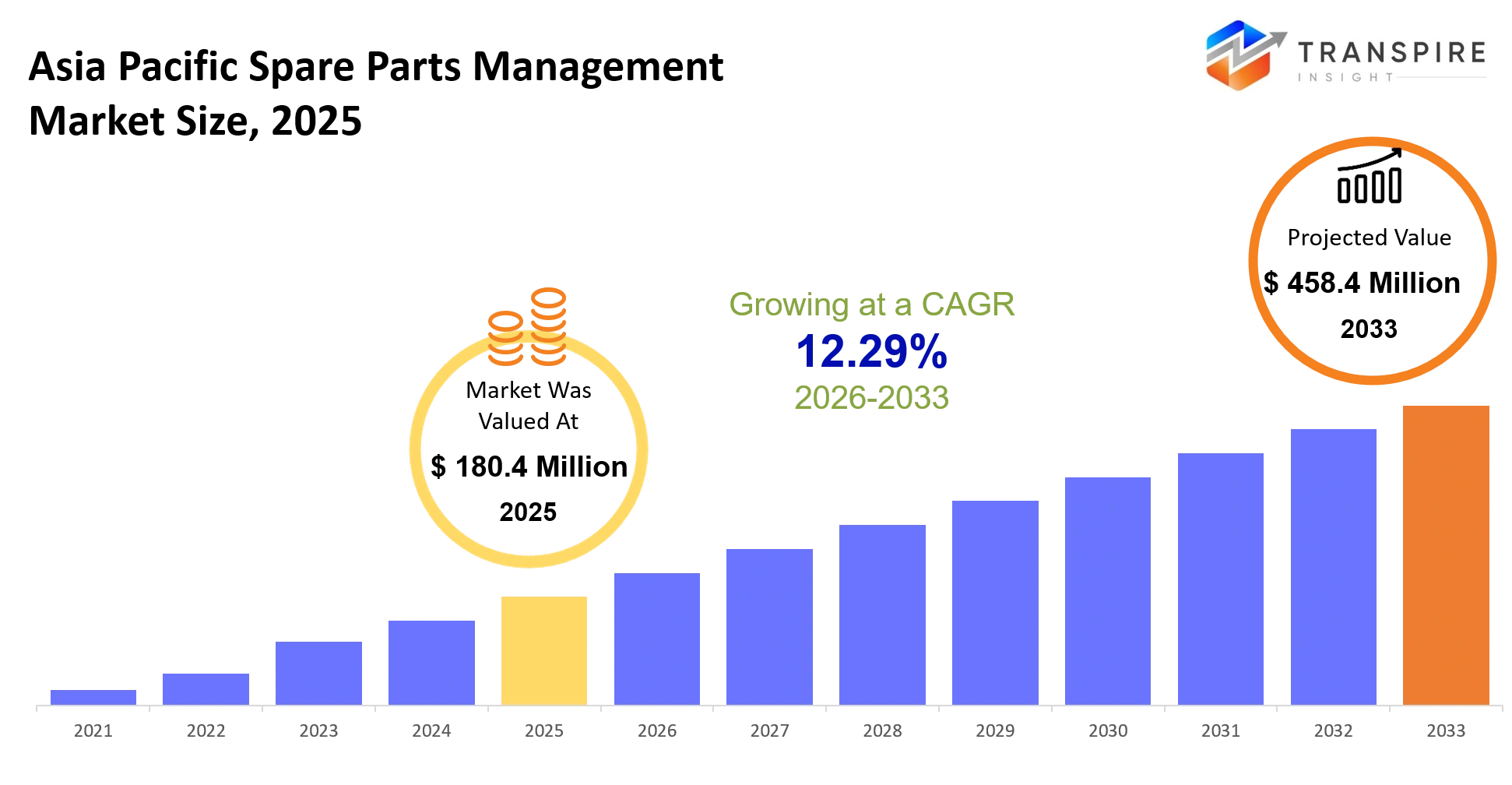
Asia Pacific Spare Parts Management Market Summary
The Asia Pacific Spare Parts Management Market was valued at USD 180.4 Million in 2025. It is forecast to reach USD 9.0 billion by 2033. That is a CAGR of 12.29% over the period.
The Asia Pacific Spare Parts Management Market helps keep equipment running smoothly by making sure the right parts are available for maintenance, repairs and unexpected breakdowns in factories, logistics systems and heavy machinery fleets.In reality it reduces production downtime by making inventory planning, supplier coordination and replacement scheduling easier in sectors where equipment failure leads to big losses. The Asia Pacific Spare Parts Management Market achieves this by ensuring parts are readily available.Over the 3–5 years the Asia Pacific Spare Parts Management Market has changed significantly. It has moved away from inventory tracking in warehouses to digital spare parts systems that use predictive analytics and connected supply chains. This change happened faster because of supply chain problems that showed how delayed component availability could be.
As a result companies are spending more on tools that provide real-time inventory visibility and demand forecasting. These tools improve reliability and reduce emergency procurement costs. The Asia Pacific Spare Parts Management Market benefits from these improvements.This change has led to companies using automated spare parts platforms. This growth in adoption increases revenue opportunities for suppliers that offer logistics, predictive replenishment and cloud-based asset management solutions, across Asia Pacific’s industrial base. The Asia Pacific Spare Parts Management Market continues to evolve with these developments.
Key Market Insights
- The Asia Pacific Spare Parts Management Market is mostly driven by the manufacturing sector, which will have 38 percent of the market in 2025. This is because the manufacturing sector really needs a lot of equipment to work.
- From 2026 to 2032 logistics and transportation will be the area that grows the fastest. This is happening because more and more companies are using technology to manage their vehicles and make sure they are always working.
- Many companies are using cloud-based spare parts management platforms. This is because these platforms are better than the manual systems that companies used to use to keep track of their inventory.
- Predictive maintenance solutions are becoming very popular. This is because they use intelligence to predict when equipment might fail.
- Inventory optimization applications are popular in the Asia Pacific Spare Parts Management Market. This is because they help companies save money and make sure they do not run out of the parts they need.
- Maintenance planning applications are also becoming very popular. This is because companies are starting to use condition-based servicing models, which means they only fix equipment when it needs to be fixed.
- Big companies are the ones that use spare parts management the most. They will have more than 55 percent of the market. This is because they have a lot of equipment and assets in different places.
- medium-sized businesses are starting to use spare parts management more and more. This is because they can use software as a service, which's cheaper and easier to implement.
- Some of the companies in the Asia Pacific Spare Parts Management Market are SAP, Oracle, IBM, Siemens, Honeywell, ABB, Microsoft and PTC.
- These companies are investing in technology, such as artificial intelligence and the internet of things to improve their spare parts management systems.
- They are also working with companies that make equipment and provide logistics services. This helps them to have control over their spare parts from start, to finish.
- Many companies are moving to cloud-based supply chain platforms, which helps them to manage their inventory in time and make their procurement processes more efficient.
- To be competitive companies need to have predictive analytics capabilities and be able to control their entire enterprise ecosystem. The Asia Pacific Spare Parts Management Market is very competitive. Companies need to have these capabilities to succeed in the Asia Pacific Spare Parts Management Market.
What are the Key Drivers, Restraints, and Opportunities in the Asia Pacific Spare Parts Management Market?
Drivers
The main reason the Asia Pacific Spare Parts Management Market is growing fast is that people are using the Internet of Things and artificial intelligence to predict when equipment will break down. This is happening because when machines stop working it can cost a lot of money. So companies are buying systems to manage their spare parts. These systems connect the inventory to how the machines are working, which helps get the right parts faster. This also means that the companies selling these systems can make money from software and services.
Restraints
One big problem is that it is hard to see what is going on in the supply chain. This is because there are vendors and they do not all work well together. A lot of companies are still using systems that do not work well with their suppliers. This means that they cannot automatically order parts when they need them so people have to do it by hand. This takes a lot of time and costs more money.
Opportunity
There is a chance for growth in Southeast Asia especially in Vietnam, Thailand and Indonesia. This is because companies are starting to use cloud-based systems to manage their parts. These systems use twins, which are like virtual copies of the machines. This helps companies plan better and make sure they have the parts when they need them. Many companies are investing in factory technology, which is driving the demand for systems that can help them manage their spare parts. The Asia Pacific Spare Parts Management Market is going to keep growing because of this.
What Has the Impact of Artificial Intelligence Been on the Asia Pacific Spare Parts Management Market?
The Asia Pacific Spare Parts Management Market is changing because of intelligence and new digital tools. These tools are helping to control inventory, predict demand and make procurement easier for companies that make things and move goods around. Computer systems that use intelligence can now watch how equipment is working in real time and automatically order more spare parts when they think something might break. This means people do not have to get involved much and it helps the maintenance teams and suppliers work together better especially in big factories and places with a lot of vehicles.Companies are using machine learning to predict when maintenance will be needed. They look at what happened in the past and data from sensors to figure out when parts might wear out in things like turbines, production lines and transport equipment. This helps them plan better for when they will need parts and reduces the time that machines are not working. If companies use these systems they can fix problems earlier. This means their machines are working more often and they do not have to pay as much for emergency parts.
Some companies are not using these new tools because it is expensive to connect them to their old computer systems. This is especially true for sized companies. Another problem is that companies have trouble getting all the information from their suppliers to be the same which makes it harder for the computer models to work correctly and slows down how fast these new tools can be used in the Asia Pacific Spare Parts Management Market.
Key Market Trends
- The use of maintenance became really popular after 2023. This is because it replaced the way of fixing things when they break. Now people use maintenance across manufacturing and logistics operations.
- From 2024 cloud-based platforms for parts started to grow really fast. These platforms help people see what spare parts are available in time. This is useful for companies that have sites.
- In 2025 inventory systems that work with ERP systems became more popular. This helps reduce delays when buying things. It does this by connecting maintenance data with suppliers.
- Predicting what spare parts will be needed became more accurate with the help of intelligence. This reduced the number of times companies had to buy parts in an emergency. This is especially helpful for industries that use a lot of equipment.
- After 2024 companies started to use the internet of things to track their equipment. This allows them to constantly check the health of their equipment across all their production facilities.
- People stopped using inventory management a lot. This is because companies started to use automated systems that can refill stock on their own. These systems use tools to analyze data.
- Big companies started to use these systems earlier than smaller companies.. Smaller companies started to catch up after 2025. They used platforms that are available online.
- Digitizing the supply chain helped companies work together better. This is especially true for the people who make equipment and the people who distribute it. Now spare parts are more available across networks.
- Companies like SAP, Oracle, Siemens and IBM made cloud-based solutions for managing equipment. These solutions help with maintenance. They became really popular.
Asia Pacific Spare Parts Management Market Segmentation
By Component:
The Asia Pacific Spare Parts Management Market has Inventory Management Software that helps track spare parts movement in time across industrial facilities. This is really useful because it helps people see what is happening with the parts. Asset Tracking Systems also help people see how equipment is being used and when it needs to be maintained. Procurement Solutions make it easier to buy the parts that are needed and reduce delays. Analytics Platforms help people make decisions by looking at data and predicting what will happen. Warehouse Management Tools help store things in a way that makes sense and reduce the time it takes to get what is needed. Forecasting Tools help predict when spare parts will be needed based on how machines are performing. Cloud Platforms make it possible for people to access inventory data from anywhere.More and more companies are using integrated component systems because they want to automate their maintenance planning and reduce downtime. This will help companies respond quickly to changes in the market and make sure they have the spare parts. The Asia Pacific Spare Parts Management Market is getting better at managing parts and this will make things more efficient.
By Deployment:
Most companies in the Asia Pacific Spare Parts Management Market are using Cloud deployment because it is scalable and allows for real-time data access. Some big companies are still using On-Premise systems because they want to control their data and keep it secure. Hybrid models are also being used because they allow companies to integrate new systems. SaaS Platforms are popular among medium-sized companies because they are cheaper and easier to implement. Private Cloud deployment is used in industries that have regulations and need to control their data. Multi-Cloud strategies are also being used because they give companies flexibility and reduce their dependence on one vendor. Edge Systems are being used more and more for real-time data processing in manufacturing.The Asia Pacific Spare Parts Management Market is moving towards cloud- deployment and this is helping companies transform their supply chains digitally. This is a change and it is happening quickly.
By Application:
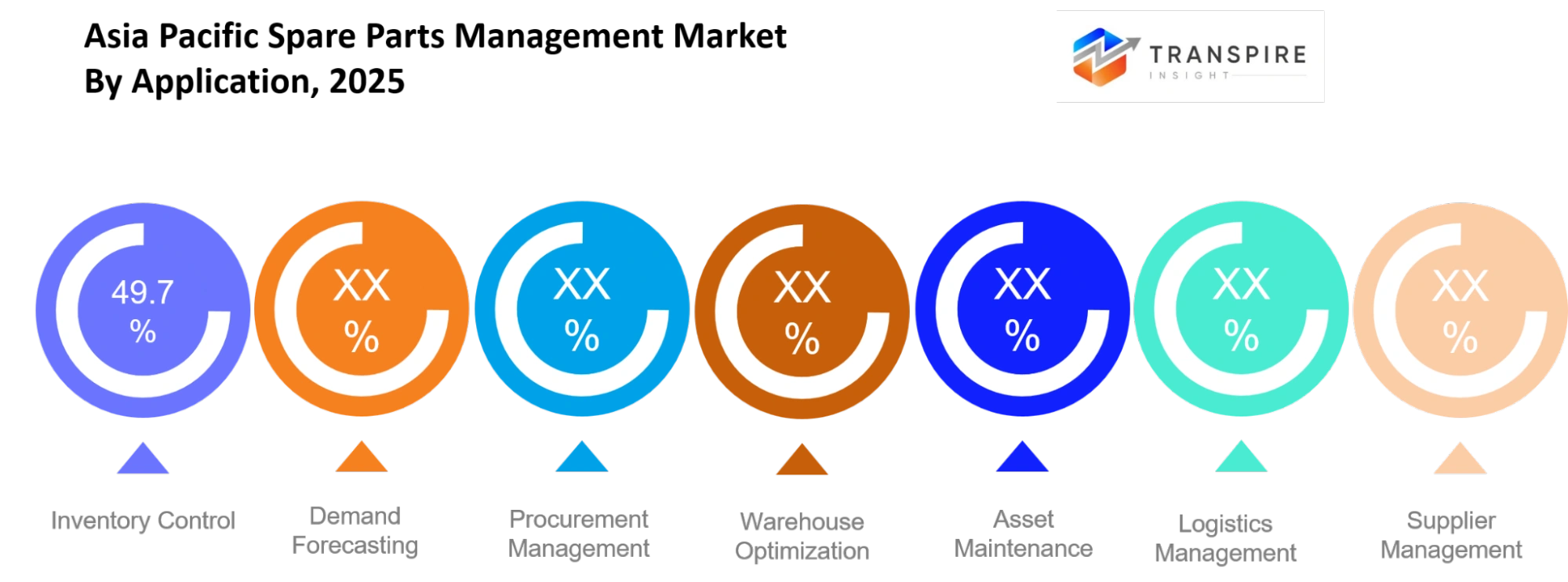
The main use of the Asia Pacific Spare Parts Management Market is Inventory Control because companies need to have spare parts available all the time. Demand Forecasting is also important because it helps companies plan ahead by looking at equipment performance and usage trends. Procurement Management helps companies buy what they need and reduces delays. Warehouse Optimization helps companies store things in a way that makes sense and reduces bottlenecks. Asset Maintenance applications help companies predict when equipment needs to be maintained and reduce downtime. Logistics Management helps companies get things from one place to another quickly and efficiently. Supplier Management helps companies work with their suppliers and get what they need.The Asia Pacific Spare Parts Management Market is using applications to improve how things are done and reduce the risk of not having the right spare parts. This is making things more efficient and reducing downtime.
By End User:
The Asia Pacific Spare Parts Management Market is led by Manufacturing because companies in this industry rely heavily on machinery and need to produce things all the time. The Automotive sector is also using spare parts systems more and more because they are producing vehicles and have complex supply chains. The Aerospace industry uses spare parts systems to make sure they are safe and comply with regulations. The Energy sector relies on spare parts management to keep producing power. The Healthcare industry is also using spare parts systems more and more because they need to keep their equipment running all the time. The Logistics sector is using tracking systems to improve how they maintain their fleets. The Retail sector is using spare parts platforms to manage their infrastructure and equipment.The Asia Pacific Spare Parts Management Market is expanding its use of maintenance systems and this will help companies be more reliable and reduce the risk of downtime. This is a change and it will make things more efficient.
What are the Key Use Cases Driving the Asia Pacific Spare Parts Management Market?
Core adoption in the Asia Pacific Spare Parts Management Market is driven by inventory control in manufacturing plants. You see these plants need to keep production going without any interruptions. That's where spare parts systems come in. They help reduce downtime by making sure critical components are stocked and replenished based on how the equipment is used.This use case is actually the one that generates the demand.The reason is that production losses are really high when machinery fails unexpectedly.Spare parts management is also being used in areas.For example -Automotive assembly lines are using maintenance.Energy and power facilities are using it for asset maintenance.Automotive manufacturers are using these systems to manage inventories of many different parts.On the hand energy operators rely on them to keep turbines and generators running reliably.These sectors are shifting towards maintenance models that are based on the condition of the equipment.New use cases are also emerging.
Some of these include
- Integrating twins to simulate the lifecycle of equipment
- Using AI for autonomous procurement systems.
Logistics companies and big industrial operators are starting to test systems.These systems automatically order parts when there's a predictive signal that a failure might happen.As industries in Asia Pacific become more digital these applications are expected to grow.
|
Report Metrics |
Details |
|
Market size value in 2025 |
USD 180.4 Million |
|
Market size value in 2026 |
USD 203.7 Million |
|
Revenue forecast in 2033 |
USD 458.4 Million |
|
Growth rate |
CAGR of 12.29% from 2026 to 2033 |
|
Base year |
2025 |
|
Historical data |
2021 - 2024 |
|
Forecast period |
2026 - 2033 |
|
Report coverage |
Revenue forecast, competitive landscape, growth factors, and trends |
|
Regional scope |
Asia Pacific |
|
Key company profiled |
SAP, Oracle, IBM, Infor, Siemens, ABB, Honeywell, PTC, Epicor, Microsoft, IFS, Blue Yonder, Manhattan Associates, E2open, Syncron |
|
Customization scope |
Free report customization (country, regional & segment scope). Avail customized purchase options to meet your exact research needs. |
|
Report Segmentation |
By Component (Inventory Management Software, Asset Tracking Systems, Procurement Solutions, Analytics Platforms, Warehouse Management Tools, Forecasting Tools, Cloud Platforms, Others); By Deployment (Cloud, On-Premise, Hybrid, SaaS Platforms, Private Cloud, Multi-Cloud, Edge Systems, Others); By Application (Inventory Control, Demand Forecasting, Procurement Management, Warehouse Optimization, Asset Maintenance, Logistics Management, Supplier Management, Others); By End User (Manufacturing, Automotive, Aerospace, Energy, Healthcare, Logistics, Retail, Others) |
Which Regions are Driving the Asia Pacific Spare Parts Management Market Growth?
North America leads the Asia Pacific Spare Parts Management Market ecosystem influence due to its advanced industrial automation infrastructure and early adoption of predictive maintenance technologies. Strong integration of ERP systems across manufacturing and logistics sectors supports real-time spare parts visibility and automated procurement workflows. The region benefits from a mature supplier ecosystem, high digital penetration in industrial operations, and strong investment in AI-driven supply chain optimization tools. This established digital foundation enables efficient coordination between OEMs, distributors, and end users, reinforcing consistent demand for advanced spare parts management solutions.
Europe remains a stable and structured contributor, driven by strong regulatory frameworks and disciplined industrial maintenance practices. Unlike North America’s technology-led ecosystem, Europe emphasizes compliance, sustainability, and long-term asset reliability in industrial operations. Manufacturing and automotive sectors maintain steady investment cycles supported by strict operational safety standards and energy efficiency requirements. This creates predictable demand for spare parts planning systems, particularly in regulated industries where downtime and equipment failure carry high compliance risks.
Asia Pacific demonstrates the fastest growth momentum due to rapid industrial expansion and accelerating digital transformation across manufacturing hubs. A major shift occurred with increased investment in smart factories and cloud-based supply chain systems across countries such as India, Vietnam, and Indonesia. Rising production scale and expanding logistics networks have intensified demand for real-time spare parts visibility and predictive maintenance tools. For investors and market entrants, this growth signals strong long-term opportunities in scalable SaaS platforms and AI-driven inventory optimization solutions through 2026–2033.
Who are the Key Players in the Asia Pacific Spare Parts Management Market and How Do They Compete?
The Asia Pacific Spare Parts Management Market shows a moderately consolidated competitive structure where global enterprise software providers dominate large-scale deployments while regional and niche vendors compete in mid-market and industry-specific solutions. Competition is primarily driven by technology integration capabilities, especially in AI-based forecasting, ERP connectivity, and real-time inventory visibility. Incumbents are defending their position by embedding spare parts modules within broader enterprise ecosystems, while new entrants focus on cloud-native platforms that offer faster deployment and lower implementation costs for SMEs and mid-sized manufacturers.
SAP strengthens its position by integrating spare parts management directly into its ERP ecosystem, enabling seamless linkage between asset performance, procurement, and inventory control. Its advantage lies in deep enterprise integration, which reduces data fragmentation across global manufacturing networks. Oracle competes through cloud-based supply chain solutions that emphasize automation and real-time analytics, helping enterprises optimize spare parts availability across distributed operations.
Siemens focuses on industrial IoT-enabled spare parts optimization within smart factory environments, using digital twin technology to improve predictive maintenance accuracy. IBM differentiates through AI-driven asset intelligence platforms that enhance demand forecasting and lifecycle planning for industrial equipment. Microsoft expands through Azure-based supply chain solutions that integrate analytics and cloud scalability, while PTC leverages industrial connectivity platforms to connect machine data with spare parts demand signals. These firms expand through cloud migration partnerships, industrial automation collaborations, and expansion into emerging manufacturing hubs across Asia Pacific.
Company List
- SAP
- Oracle
- IBM
- Infor
- Siemens
- ABB
- Honeywell
- PTC
- Epicor
- Microsoft
- IFS
- Blue Yonder
- Manhattan Associates
- E2open
- Syncron
Recent Development News
In December 2025, SAP announced expansion of its SAP Business Network and logistics ecosystem to strengthen real-time spare parts and inventory coordination across industrial supply chains. The update integrates AI-driven automation into warehouse and procurement workflows, enabling enterprises to reduce manual inventory handling and improve spare parts visibility across distributed operations. The development strengthens SAP’s position in connected maintenance and asset management solutions across manufacturing and logistics sectors.https://news.sap.com
In November 2025, NTT DATA expanded its strategic partnership with ServiceNow to accelerate AI-led enterprise transformation, including supply chain and asset management workflows. The collaboration focuses on integrating intelligent automation capabilities into enterprise systems, improving predictive maintenance coordination and digital service delivery. This strengthens end-to-end visibility across IT and industrial operations, supporting spare parts optimization use cases.https://www.servicenow.com
In March 2026, IBM enhanced its AI-powered supply chain and asset intelligence offerings through expanded automation features within its enterprise solutions portfolio. The upgrade improves predictive analytics for maintenance planning and spare parts demand forecasting across industrial clients. It enables enterprises to reduce downtime and improve inventory efficiency through real-time decision support systems.https://www.ibm.com
What Strategic Insights Define the Future of the Asia Pacific Spare Parts Management Market?
Over the next 5–7 years, the Asia Pacific Spare Parts Management Market will structurally shift toward fully integrated, AI-orchestrated supply chain ecosystems where inventory planning, procurement, and asset monitoring operate on a unified digital layer. This direction is driven by rising industrial automation and the need to minimize downtime costs in manufacturing and logistics networks, where real-time part availability directly impacts productivity and revenue continuity. A less visible risk is growing dependence on a small group of global ERP and cloud platform providers, which could concentrate system control and reduce flexibility for industrial buyers, especially during pricing or service disruptions.
A key emerging opportunity lies in the convergence of digital twin technology with spare parts forecasting systems in smart manufacturing hubs across Southeast Asia and India. This integration will enable predictive simulation of equipment failure and automated replenishment planning at scale. To capitalize on this shift, market participants should invest in interoperable AI-driven platforms that connect OEM data, supplier networks, and enterprise ERP systems. Building early partnerships with industrial automation providers will help secure long-term platform positioning and recurring service revenues.
Asia Pacific Spare Parts Management Market Report Segmentation
-
By Component
- Inventory Management Software
- Asset Tracking Systems
- Procurement Solutions
- Analytics Platforms
- Warehouse Management Tools
- Forecasting Tools
- Cloud Platforms
- Others
-
By Deployment
- Cloud
- On-Premise
- Hybrid
- SaaS Platforms
- Private Cloud
- Multi-Cloud
- Edge Systems
- Others
-
By Application
- Inventory Control
- Demand Forecasting
- Procurement Management
- Warehouse Optimization
- Asset Maintenance
- Logistics Management
- Supplier Management
- Others
-
By End User
- Manufacturing
- Automotive
- Aerospace
- Energy
- Healthcare
- Logistics
- Retail
- Others
Frequently Asked Questions
Find quick answers to common questions.
The expected Asia Pacific Spare Parts Management Market size for the market will be USD 458.4 Million in 2033.
Key segments for the Asia Pacific Spare Parts Management Market are By Component (Inventory Management Software, Asset Tracking Systems, Procurement Solutions, Analytics Platforms, Warehouse Management Tools, Forecasting Tools, Cloud Platforms, Others); By Deployment (Cloud, On-Premise, Hybrid, SaaS Platforms, Private Cloud, Multi-Cloud, Edge Systems, Others); By Application (Inventory Control, Demand Forecasting, Procurement Management, Warehouse Optimization, Asset Maintenance, Logistics Management, Supplier Management, Others); By End User (Manufacturing, Automotive, Aerospace, Energy, Healthcare, Logistics, Retail, Others).
Major Asia Pacific Spare Parts Management Market players are SAP, Oracle, IBM, Infor, Siemens, ABB, Honeywell, PTC, Epicor, Microsoft, IFS, Blue Yonder, Manhattan Associates, E2open, Syncron.
The Asia Pacific Spare Parts Management Market size is USD 180.4 Million in 2025.
The Asia Pacific Spare Parts Management Market CAGR is 12.29% from 2026 to 2033.
- SAP
- Oracle
- IBM
- Infor
- Siemens
- ABB
- Honeywell
- PTC
- Epicor
- Microsoft
- IFS
- Blue Yonder
- Manhattan Associates
- E2open
- Syncron
About the Authors

Kartik bhong
I am Kartik Bhong, a Senior Research Analyst at Transpire Insight, specializing in the Packaging, Manufacturing, and Construction industry. My work focuses on analyzing market trends, emerging technologies, industry regulations, and competitive landscapes to deliver accurate, data-driven insights. I am passionate about transforming complex industry information into clear, practical content that helps businesses, professionals, and decision-makers stay informed and make confident strategic decisions. Through continuous research and a strong commitment to accuracy, I strive to create reliable, well-researched content that reflects the latest developments across these dynamic industries and supports the vision of Transpire Insight in delivering valuable market intelligence.

Chakradhar Khansole
Chakradhar serves as the Research Director at Transpire Insight, bringing over 8 years of experience in technology, innovation, and strategic market intelligence. He specializes in transforming complex market data into actionable business insights that enable organizations to make informed, growth-oriented decisions. Recognized for his strategic vision and analytical expertise, Chakradhar leads high-impact research initiatives, delivering comprehensive market assessments, competitive intelligence, and forward-looking industry analysis.
Recently Published Reports
-
Apr 2026
Handling and Lifting Equipment Market
Handling and Lifting Equipment Market Size, Share & Analysis Report By Product (Cranes and Hoists, Forklifts, Conveyor Systems, Aerial Work Platforms, Others), By Application (E-Commerce, Automotive and Railway, Food and Beverages, Aviation, Others), and Geography (North America, Europe, Asia-Pacific, Middle East and Africa, South and Central America), 2021 - 2031
-
Apr 2026
HVAC Equipment Market
HVAC Equipment Market Size, Share & Analysis Report By Heating Equipment Type (Boilers and Furnaces, Heat Pumps, and Unitary Heaters), By Ventilation Equipment (Air Handling Units, Humidifiers and Dehumidifiers, Air Filters, and Fan Coiling Units), By Air Conditioning Equipment (Unitary Air Conditioners, Room Air Conditioners, Packaged Terminal Air Conditioners, and Chillers), By End User (Commercial, Residential, Industrial, and others), and Geography (North America, Europe, Asia-Pacific, Middle East and Africa, South and Central America), 2021 – 2031
-
Apr 2026
Refrigeration Valves Market
Refrigeration Valves Market Size, Share & Analysis Report By Type (Solenoid Valves, Expansion Valves, Check Valves, Service Valves, Others), By Application (Commercial Refrigeration, Industrial Refrigeration, Transport Refrigeration, Residential Refrigeration, Air Conditioning Systems), By End User (Food and Beverage Industry, Pharmaceutical Industry, HVAC Industry, Chemical Industry, Others), and Geography (North America, Europe, Asia-Pacific, Middle East and Africa, South and Central America), 2021 – 2031
-
Apr 2026
E-Commerce Packaging Materials Market
E-Commerce Packaging Materials Market By Material Type (Corrugated Boxes, Paper & Paperboard, Foam & Cushioning Materials, Plastic Packaging, Flexible Packaging, Protective Packaging, Others), By Product(Primary Packaging, Secondary Packaging, Tertiary Packaging), By Packaging Function (Protective Packaging, Branding & Presentation Packaging, Transit & Logistic Packaging, Sustainable Packaging, Tamper Evidence Packaging), By End-User (Retail & Consumer Goods, Electronic Appliances, Food & Beverages, Healthcare & Pharmaceutical, Fashion & Apparel, Home & Furnishing, Others); By Industry Analysis, Size, Share, Growth, Trends, and Forecasts 2021-2033