
Global Back Testing Software Market Size & Forecast:
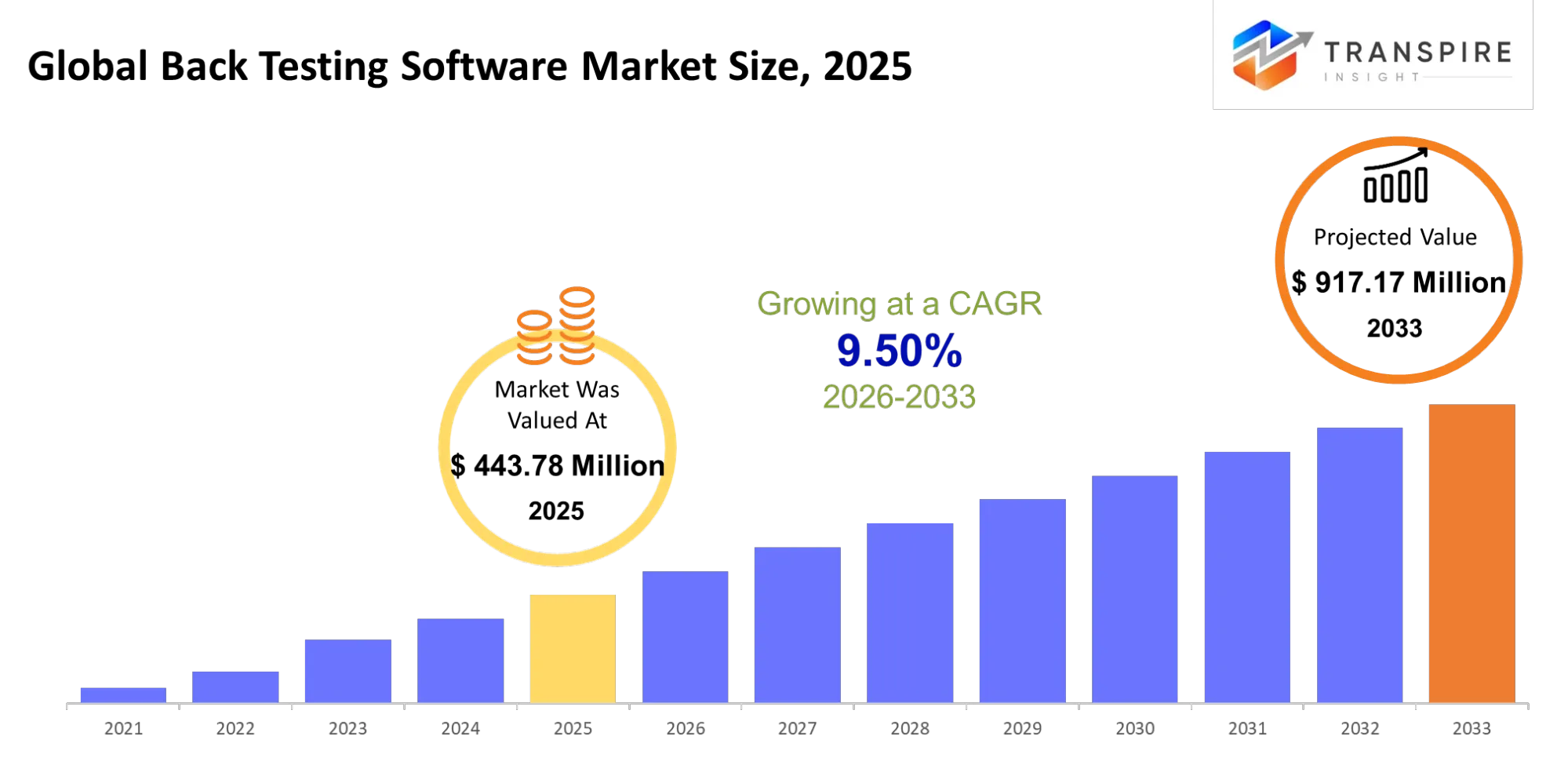
- Global Back Testing Software Market Size 2025: USD 443.78 Million
- Global Back Testing Software Market Size 2033: USD 917.17 Million
- Global Back Testing Software Market CAGR: 9.50%
- Global Back Testing Software Market Segments: By Type (Algorithmic Trading Global Back Testing Software, Quantitative Analysis Platforms, Cloud-based Back Testing Tools, AI-driven Trading Simulators, Portfolio Back Testing Platforms, Real-time Strategy Testers, Others); By Application (Stock Market Analysis, Forex Trading, Cryptocurrency Trading, Commodity Trading, Risk Assessment, Others); By End-User (Financial Institutions, Hedge Funds, Retail Traders, Investment Firms, Others); By Deployment (Cloud-based Platforms, On-premise Platforms, Hybrid Platforms, API-integrated Platforms, Others).
To learn more about this report,  Download Free Sample Report
Global Back Testing Software Market Summary:
The Global Back Testing Software market size is estimated at USD 443.78 million in 2025 and is anticipated to reach USD 917.17 million by 2033, growing at a CAGR of 9.50% from 2026 to 2033. Backtesting Software is a virtual flight simulator for traders and fund managers. Rather than putting their own funds into potentially untested concepts, users enter their own trading rules into the software to observe their performance over years of real market data and potentially discover weaknesses before putting any money at stake.
In the past few years, the market has gone from the "heavy" desktop-based solution with coding requirements to agile "cloud-native" solutions. A significant paradigm change took place when non-technical retail traders began to wish for platforms that were not dependent on coding. Software vendors had to create visual drag-and-drop strategy builders.
This has led to the market growing, with greater retail participation directly resulting in greater algorithmic and high-frequency trading. Consequently, software companies are expanding their cloud-based infrastructure to enable fast, complicated simulations to a large user population of non-expert users.
Key Market Insights:
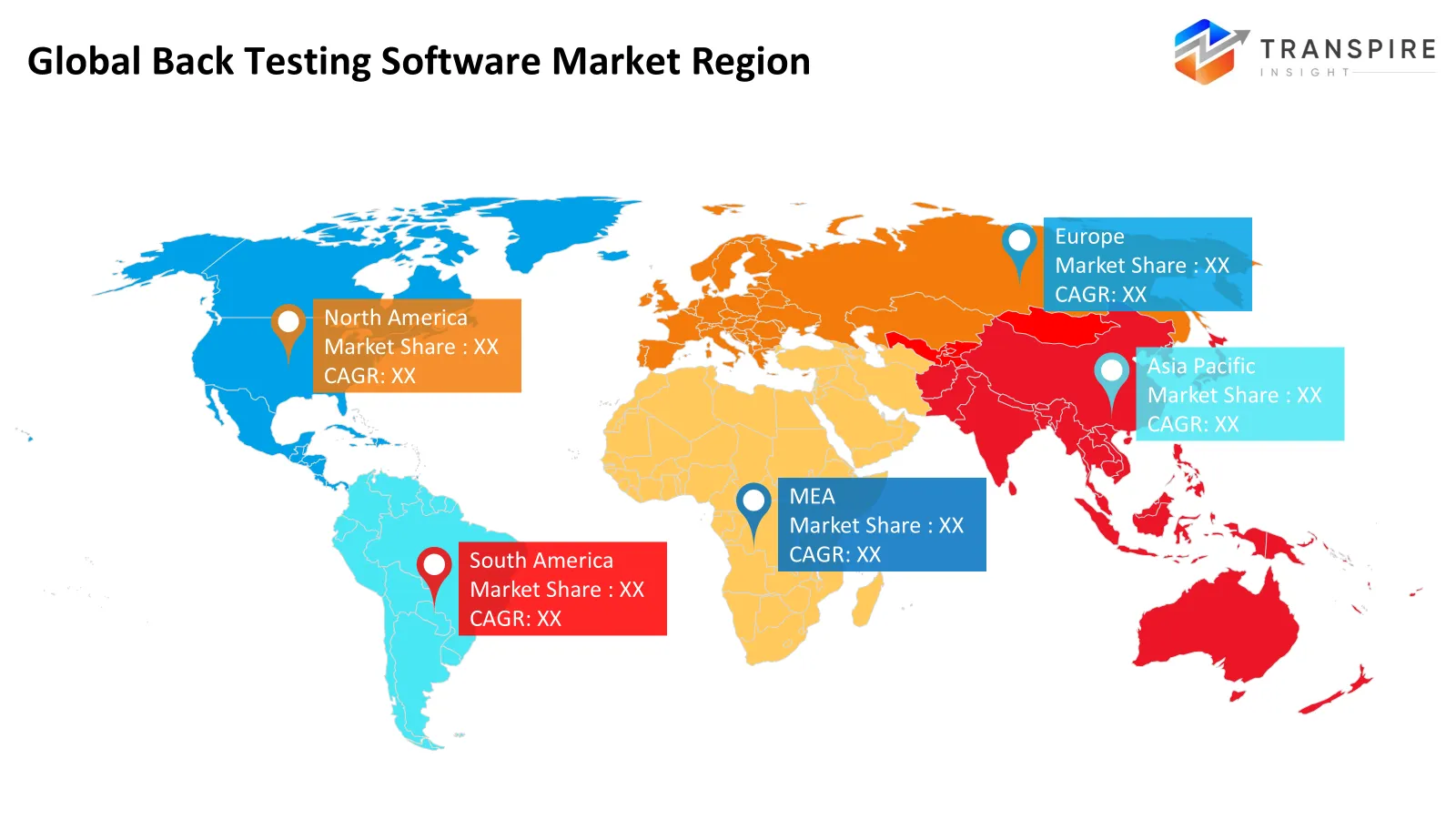
- North America is the dominant region with 39% of the market share.
- Asia Pacific is the fastest-growing region with a CAGR of 13.1%.
- Algorithmic trading Global Back Testing Software is the dominating segment with a market share of 52% in the Global Back Testing Software market.
- AI-driven trading simulators are the fastest-growing segment in the Global Back Testing Software market with a CAGR of 12.4%.
- Asia Pacific has 24% market share.
- Europe is the second region with a market share of 29%.
- ROW consists of 8% of the Global Back Testing Software market share.
What are the Key Drivers, Restraints, and Opportunities in the Global Back Testing Software Market?
Drivers
AI and low-code democratization of the retail trading explosion are the primary drivers of the back test software market growth. The primary driver of the back test software market growth is the explosion of retail algorithmic trading due to the democratization of AI and low code. With the ease of access, non-technical traders can easily implement automated trading strategies. Recently, DdbuShen announced a strategy-driven platform for automated trading in the crypto and stock markets, powered by artificial intelligence. The platform features AI-powered quantitative trading tools, automated strategy execution, and risk management solutions, driving a growing need for sophisticated backtesting software to test trading strategies before implementation.
- In May 2026, DdbuShen launched a strategy-driven AI-powered automated trading platform for cryptocurrency and equity markets. The platform helps in AI-based quantitative trading capabilities, automated strategy execution, and risk management tools, increasing demand for advanced backtesting software to validate trading models before deployment.
Restraints
The market of the back test software is restricted by the high implementation cost and data quality problems. The high cost of software licenses and employee training can be a challenge for small businesses. In addition, incorrect or incomplete past market information results in “garbage in, garbage out” situations that hinder broader market adoption and erode user trust.
Opportunities
By incorporating the synthetic data generation, traders will be able to simulate extreme and unprecedented financial crises, leading to immense growth in the Global Back Testing Software market. Moreover, APAC's emerging markets provide an additional source of retail investors, and creating new tools for decentralized finance (DeFi) protocols is a whole new niche of digital asset classes.
What Has the Impact of Artificial Intelligence Been on the Global Back Testing Software Market?
Artificial Intelligence has empowered backtesting to become a predictive, future-focused optimization tool instead of a passive review tool. Instead of human operators optimizing parameters through experimentation and trial and error to achieve a desired result, machine learning algorithms can perform thousands of tests of strategy permutations at once automatically. AI can automate the data cleaning process, reducing the time and manpower required to identify and fix issues or inconsistencies in historical tick data.
Additionally, AI improves predictive abilities by taking care of rigid historical replay. Advanced models create fictional market data to test a strategy in a chaotic environment of “black swan” financial crises that have not occurred in real life. Recently, the QuantPilot launch has been done. It is an AI platform designed specifically for Crypto strategy and development, as well as back testing. This is one of the factors that is contributing to the growth of the Global Back Testing Software market. The platform allows users to develop, test, and fine-tune trading strategies using natural language, which boosts the need for AI-powered backtesting software and automated quantitative trading solutions.
Key Market Trends:
The evolution of backtesting software is progressing from historical strategy testing to real-time, AI-powered decision support tools. Users are looking to have automated cloud-based solutions that incorporate back testing, optimization, and live trading functions in one place.
- Strategies are increasingly being automated by AI tools, with the processes of creation, testing, and optimization.
- Many traders are moving from manual testing to backtesting platforms through algorithms.
- Cloud-based deployment is taking the place of the traditional backtesting software that has been installed on the desktops of its users.
- Real-time data integration is becoming commonplace now across platforms.
- Retailers are now increasingly using backtesting tools that are professional-grade.
- Platforms are making an increasing effort to merge backtesting, paper trading, and live execution.
- The traditional trading strategies are being tested alongside machine learning models.
- There is a trend towards multi-asset backtesting, including stocks, forex, and cryptocurrencies.
- Low-code and no-code interfaces are making strategy testing easier for non-programmers.
- Beyond just the bottom line, risk analytics are growing in significance.
Global Back Testing Software Market Segmentation
By Type
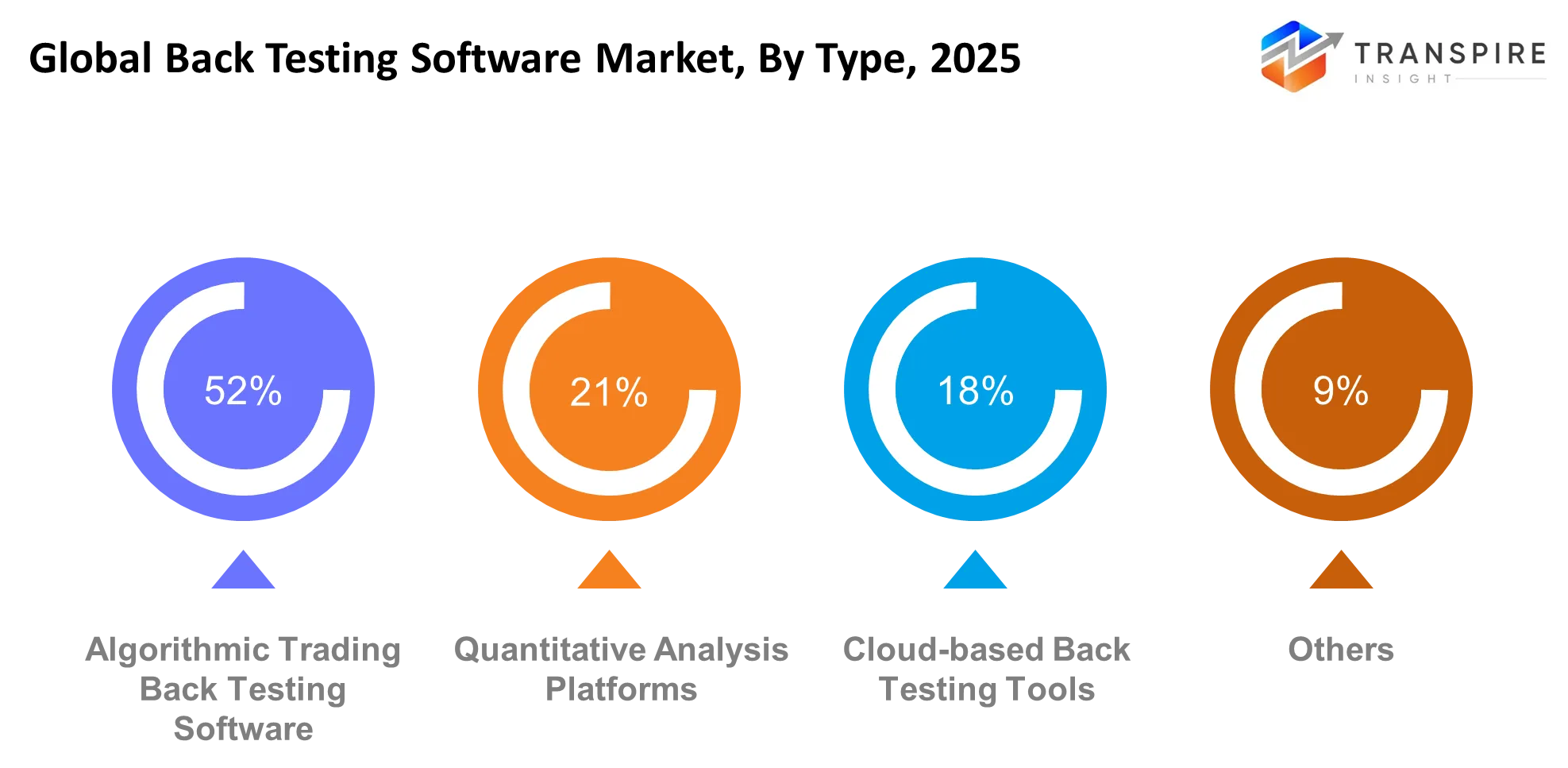
The algorithmic trading backtesting software market size is dominated by the algorithmic trading Global Back Testing Software sub-segment, with 52% market share. It is a special growth logic, driven by the extensive institutional dependence on automated execution systems, where code-based validation is an inherent requirement to deployment.
The AI-driven trading simulators sub-segment is the quickest emerging market pocket, increasing at a CAGR of 12.4%. The AI-driven market regime and stress testing it creates on the other hand, is fueled by the inability of traditional historical data to portray volatile and unexpected market conditions, as patterns from the past cannot predict the future.
The other market segments are Quantitative Analysis Platforms (21%), Cloud-based Backtesting Tools (18%), and Others (9%). This growth logic is based on accessibility and diversification; multi-asset managers need the widest statistical toolkits, and retail trading platforms are keen to test their platforms on web browsers without footprints.
To learn more about this report, Download Free Sample Report
By End-User
In this market segment, hedge funds and institutional investors are the power players, using industrial-grade risk management given the enormous amounts of capital they allocate. Their growth logic, which is what makes them so dominant, is that they have a fiduciary duty to their investors, regulatory supervision, and without auditable and statistically significant backtests, no institutional player can put money into quantitative strategies.
Retail Traders are the fastest-growing end-user category with a high rate of adoption, as the trading technology becomes more accessible. The ability to trade in a fairly simple fashion, investing in individual stocks, has given way to a more systematic approach that follows rules, and that is where a lot of the unique growth logic comes into play: the explosion of modern brokerage APIs and online communities.
The rest of the market is made up of Investment Firms, Proprietary Trading Desks, and Commercial Banks. They focus on growth through diversification and cross-asset risk hedging in globalised markets. The growing nature of their needs implies that the workstations of the future will need to have a single, enterprise backtesting suite that can test equities, fixed income, and volatile digital assets all in one.
By Application
Stock market analysis takes the leading position in the market, being the core to a successful system trading strategy for the stock market. The special growth logic is quite easy. The equity market has the longest, cleanest, and best historical data sets of any market, and is thus the natural sandbox for strategy development.
Cryptocurrency Trading is the fastest-growing application segment in the market. This distinctive growth model stems from the 24/7 trading environment of digital asset markets and the volatility of these markets, making it impractical to trade manually and profitable to trade automatically using algorithms. Since the crypto market never sleeps, the future impact on backtesting software is a definite need for continuous and real-time data feed and specialized simulations. It can support extremely dispersed liquidity throughout the global decentralized exchanges.
The rest of the application share is taken up by Forex Trading, Commodity Markets, and Enterprise Risk Assessment. The growth logic for these areas has become global macro trends, supply chain pressures, and currency fluctuations. The implication for the future will be a growing need for macro-economic overlay features in back-testing tools that enable users to learn how physical supply problems or central bank interest rate increases play out in their portfolios.
By Deployment
Cloud-based platforms are firmly taking the lead, as they have revolutionized the way financial simulations are carried out. The distinct growth logic of cloud dominance is scalability. Running complex backtests over decades of tick-by-tick data would demand huge computational bursts - ones that are too costly to keep on local hardware.
API-integrated platforms are becoming the top deployment model. Their special growth logic is built on the trend of modern trading software designs that favor modular architectures, with developers having the option to connect a specialized back testing calculation engine directly to their custom trading interface through a simple web hook.
The remaining part of the deployment matrix comprises On-premise and Hybrid Platforms. The growth logic that propels these models is solely based on tier-one banks and ultra-low latency funds, with the need for absolute data privacy, strict sovereignty, and zero cloud latency. The implication for the future is that though these configurations may lose share to enterprise offerings, they will be more expensive and become isolated, niche parts of the industry's most security-sensitive institutions.
What are the Key Use Cases Driving the Global Back Testing Software Market?
The main applications that are going to be fueling this market are algorithmic strategy validation in the equity market. These tools are used by institutional funds to test their automated high-frequency trading strategies with decades of stock market history, giving them the confidence to execute the strategy before committing significant capital to it.
Traditional equities are not the only investment classes being used, but Forex and Crypto ones are also growing in number. The software is used by traders, both retail and institutional, to optimize their cross-border currency hedging and to test 24/7 automated currency market-making algorithms across the disorganized digital exchanges around the world.
New use cases focus on AI simulation and risk compliance for crises. Machine learning engines are also employed by risk managers to create synthetic macroeconomic scenarios to help ensure that portfolios can handle dramatic financial anomalies that haven't been seen before, as required by increasingly stringent global regulatory guidelines.
Report Metrics
|
Report Metrics |
Details |
|
Market size value in 2025 |
USD 443.78 Million |
|
Market size value in 2026 |
USD 485.56 Million |
|
Revenue forecast in 2033 |
USD 917.17 Million |
|
Growth rate |
CAGR of 9.50% from 2026 to 2033 |
|
Base year |
2025 |
|
Historical data |
2021 - 2024 |
|
Forecast period |
2026 - 2033 |
|
Report coverage |
Revenue forecast, competitive landscape, growth factors, and trends |
|
Regional scope |
United States; Canada; Mexico; United Kingdom; Germany; France; Italy; Spain; Denmark; Sweden; Norway; China; Japan; India; Australia; South Korea; Thailand; Brazil; Argentina; South Africa; Saudi Arabia; United Arab Emirates |
|
Key company profiled |
MetaQuotes, QuantConnect, NinjaTrader, TradeStation, AmiBroker, MultiCharts, TradingView, MATLAB, AlgoTrader, Quantopian, Backtrader, Wealth-Lab, Tickblaze, Portfolio123, Alpaca. |
|
Customization scope |
Free report customization (country, regional & segment scope). Avail customized purchase options to meet your exact research needs. |
|
Report Segmentation |
By Type (Algorithmic Trading Global Back Testing Software, Quantitative Analysis Platforms, Cloud-based Back Testing Tools, AI-driven Trading Simulators, Portfolio Back Testing Platforms, Real-time Strategy Testers, Others); By Application (Stock Market Analysis, Forex Trading, Cryptocurrency Trading, Commodity Trading, Risk Assessment, Others); By End-User (Financial Institutions, Hedge Funds, Retail Traders, Investment Firms, Others); By Deployment (Cloud-based Platforms, On-premise Platforms, Hybrid Platforms, API-integrated Platforms, Others). |
Which Regions are Driving the Global Back Testing Software Market Growth?
North America is the dominant market with 39% of the global market share of Global Back Testing Software. This dominance is largely due to the unique concentration of tier-one hedge funds, proprietary trading desks, and institutional asset managers in Wall Street's financial ecosystem. Backtesting infrastructure that works with the browser is present. The cloud-based module will enable traders to create, test, and backtest rule-based trading strategies without the need to install any software on their computers, supporting the expanding need for more sophisticated back testing tools in the retail and quantitative trading community across North America. In March 2026, TakeProfit launched a browser-native strategy backtesting infrastructure. The cloud-based module allows traders to design, simulate, and evaluate rule-based trading strategies directly through a web browser, increasing demand for advanced backtesting software across North America’s retail and quantitative trading ecosystem.
Europe is the second largest market, accounting for 29% of the market share. Highly standardized and strict financial regulations in Europe, such as MiFID II, which provide strict governance over algorithmic testing and risk reporting, make for a very stable market in Europe. The robust institutional compliance culture provides a very predictable, regular income stream to software vendors serving European banks and asset managers. The futures trading platform was introduced, marking NinjaTrader's growth.
Asia-Pacific is the fastest-growing market pocket with an explosive CAGR of 13.1%. This fast-forward is driven by enormous digital transformation (DX) in the recent past and an unprecedented boom in retail trading on smartphones in emerging economies such as India, China, and Southeast Asian economies. Local brokerages are busy adding feature-rich backtest APIs to their retail apps to meet a new wave of tech-savvy investors. In the future, the massive untapped retail segment and the continued evolution of regional digital asset exchanges will offer the most promising opportunity for growth for global backtesting platforms. Moomoo API Skills is introduced by Moomoo in markets in Asia-Pacific such as Singapore, Malaysia, Australia, New Zealand, Japan, and Hong Kong.
To learn more about this report, Download Free Sample Report
Who are the Key Players in the Global Back Testing Software Market and how do they Compete?
The Global Back Testing Software Market is highly competitive among the vendors, and the ability to innovate their platforms, integrate cloud and artificial intelligence capabilities, provide asset-class coverage, and offer flexible pricing are the key factors that vendors will compete and differentiate from one another in the market. Participants are working on enhancing strategy testing accuracy, access to real-time data, automation features, and the user experience to appeal to retail and institutional traders alike. As algorithmic trading and quantitative investing become increasingly prevalent, the competition is rising.
Undoubtedly, innovation is the game plan for many successful companies. MetaQuotes' primary emphasis is on sophisticated algorithmic trading solutions within its MetaTrader platform. QuantConnect values quantitative research in the cloud and scalable backtesting. The competition between NinjaTrader and TradeStation lies in their built-in trading and analytical features. The collaborative charting, social trading capabilities, and pricing make TradingView stand out. AlgoTrader is specifically designed to meet the needs of institutional users, offering multi-asset automation and advanced execution tools.
Multiple companies have a specialization in a certain niche and solutions that are cost-efficient. AmiBroker and MultiCharts are designed with a keen eye for high-performance back testing for active traders. MATLAB takes advantage of quantitative modeling and analytics expertise. The competition is based on the main criteria of ease of use, customization, and developer ecosystems: that is, ease of use, customization, and developer ecosystems, in that order. While it's no longer in operation, Quantopian was a piece of innovation that still rings true in today's market.
Global Back Testing Software Market Companies
- MetaQuotes
- QuantConnect
- NinjaTrader
- TradeStation
- AmiBroker
- MultiCharts
- TradingView
- MATLAB
- AlgoTrader
- Quantopian
- Backtrader
- Wealth-Lab
- Tickblaze
- Portfolio123
- Alpaca
Recent Development News
In May 2026, xBratAI launched its trading signals platform in the Asia-Pacific region, expanding access to algorithmic trading tools for retail investors. The platform processes over 100,000 signal combinations and supports quantitative trading workflows, increasing the need for reliable backtesting software to validate trading strategies before execution.
(Source- https://itbrief.asia)
What Strategic Insights Define the Future of the Global Back Testing Software Market?
The Global Back Testing Software market is transitioning towards AI-powered cloud-based and real-time simulation platforms, supporting quicker strategy validation across various asset classes such as equities, cryptocurrencies, forex, and multi-asset portfolios. With the steady increase in the usage of algorithmic trading by retail and institutional traders, the demand for scalable and automated backtesting is also projected to grow.
One of the new trends that is gaining traction is the use of generative AI and machine learning in backtesting platforms to automate strategy development, tweak parameters, and enhance predictions.
Relevant and explainable AI, effective risk-testing processes, and cloud-native designs offer the market participants great hope for more reliable, more compliant, more trustworthy turnkey solutions that promise more long-term growth opportunities.
Global Back Testing Software Market Segmentation
By Type
- Algorithmic Trading Global Back Testing Software
- Quantitative Analysis Platforms
- Cloud-based Back Testing Tools
- AI-driven Trading Simulators
- Portfolio Back Testing Platforms
- Real-time Strategy Testers
- Others
By Application
- Stock Market Analysis
- Forex Trading
- Cryptocurrency Trading
- Commodity Trading
- Risk Assessment
- Others
By End-User
- Financial Institutions
- Hedge Funds
- Retail Traders
- Investment Firms
- Others
By Deployment
- Cloud-based Platforms
- On-premise Platforms
- Hybrid Platforms
- API-integrated Platforms
- Others
Regional Outlook
North America
- United States
- Canada
- Mexico
Europe
- Germany
- United Kingdom
- France
- Spain
- Italy
- Rest of Europe
Asia Pacific
- Japan
- China
- Australia & New Zealand
- South Korea
- India
- Rest of Asia Pacific
South America
- Brazil
- Argentina
- Rest of South America
Middle East & Africa
- Saudi Arabia
- United Arab Emirates
- South Africa
- Rest of the Middle East & Africa
Frequently Asked Questions
Find quick answers to common questions.
The global Back Testing Software market size was valued at USD 443.78 Million in 2025 and is poised to reach USD 917.17 Million by 2033, expanding at a 9.50% CAGR.
Key segments for the Global Back Testing Software market are By Type (Algorithmic Trading Global Back Testing Software, Quantitative Analysis Platforms, Cloud-based Back Testing Tools, AI-driven Trading Simulators, Portfolio Back Testing Platforms, Real-time Strategy Testers, Others); By Application (Stock Market Analysis, Forex Trading, Cryptocurrency Trading, Commodity Trading, Risk Assessment, Others); By End-User (Financial Institutions, Hedge Funds, Retail Traders, Investment Firms, Others); By Deployment (Cloud-based Platforms, On-premise Platforms, Hybrid Platforms, API-integrated Platforms, Others).
The Global Back Testing Software market growth is primarily driven by the increasing adoption of algorithmic trading, AI-powered investment strategies, and automated trading platforms. These tools require robust backtesting solutions to test and optimize trading strategies before live deployment.
The Global Back Testing Software market is led by major manufacturers, such as MetaQuotes, QuantConnect, NinjaTrader, TradeStation, AmiBroker, MultiCharts, TradingView, MATLAB, AlgoTrader, Quantopian, Backtrader, Wealth-Lab, Tickblaze, Portfolio123, and Alpaca.
North America holds 39% of the Global Back Testing Software market, making it the leading regional market. Its dominance is driven by the strong presence of fintech firms, hedge funds, and algorithmic trading platforms, along with high adoption of AI-driven trading technologies, cloud-based analytics solutions, and advanced financial infrastructure.
- MetaQuotes
- QuantConnect
- NinjaTrader
- TradeStation
- AmiBroker
- MultiCharts
- TradingView
- MATLAB
- AlgoTrader
- Quantopian
- Backtrader
- Wealth-Lab
- Tickblaze
- Portfolio123
- Alpaca
About the Authors

Mayur Shinde
I am Mayur Shinde, a Senior Research Analyst at Transpire Insight, specializing in the Automotive & Transportation and Information & Communication Technology (ICT) Industry. My work focuses on analyzing emerging market trends, technological advancements, competitive landscapes, and industry developments to deliver accurate, data-driven insights. I am passionate about transforming complex market information into clear, actionable content that helps businesses, professionals, and decision-makers stay informed and make confident strategic decisions.

Chakradhar Khansole
Chakradhar serves as the Research Director at Transpire Insight, bringing over 8 years of experience in technology, innovation, and strategic market intelligence. He specializes in transforming complex market data into actionable business insights that enable organizations to make informed, growth-oriented decisions. Recognized for his strategic vision and analytical expertise, Chakradhar leads high-impact research initiatives, delivering comprehensive market assessments, competitive intelligence, and forward-looking industry analysis.
Recently Published Reports
-
Apr 2026
3D Optical Profiler Market
3D Optical Profiler Market Size, Share & Analysis Report By Type (Desktop 3D Optical Profiler, and Portable 3D Optical Profiler), By Technology (Confocal Technology, and White Light Interference), By End-Use Industry (Manufacturing, Research Institutions, Automotive, Aerospace and Defense, Medical Devices, and Other), and Geography (North America, Europe, Asia-Pacific, Middle East and Africa, South and Central America), 2021 - 2031
-
Apr 2026
Depth Sensor Market
Depth Sensor Market Size, Share & Analysis Report By Type (Infrared Depth Sensors, Time-of-Flight (ToF) Sensors, Stereo Vision Sensors, Structured Light Sensors, Ultrasonic Depth Sensors), By Application (Automotive, Robotics, Gaming, Consumer Electronics, Industrial Automation, Healthcare, Security & Surveillance, Others), By End Users (Automotive Manufacturers, Consumer Electronics Companies, Healthcare Providers, Industrial Companies, Security Agencies, Gaming Companies, Robotics Companies, Others), and Geography (North America, Europe, Asia-Pacific, Middle East and Africa, South and Central America), 2021 – 2031
-
Apr 2026
Digital Manufacturing Market
Digital Manufacturing Market Size, Share & Analysis Report By Component (Hardware, Software, and Services), By Technology (Robotics, 3D Printing, Internet of Things (IoT), and Others), By Application (Automotive and Transportation, Aerospace and Defense, Consumer Electronics, Industrial Machinery, and Others), By Process Type (Computer-Based Designing, Computer-Based Simulation, Computer 3D Visualization, Analytics, and Others), and Geography (North America, Europe, Asia-Pacific, Middle East and Africa, South and Central America), 2021 – 2031
-
Apr 2026
Digital Visa Services Market
Digital Visa Services Market Size, Share & Analysis Report By Type (Individual Travelers, Group Travelers), By Application (Tourism, Business Travel, Others), and Geography (North America, Europe, Asia-Pacific, Middle East and Africa, South and Central America), 2021 – 2031