

Market Summary
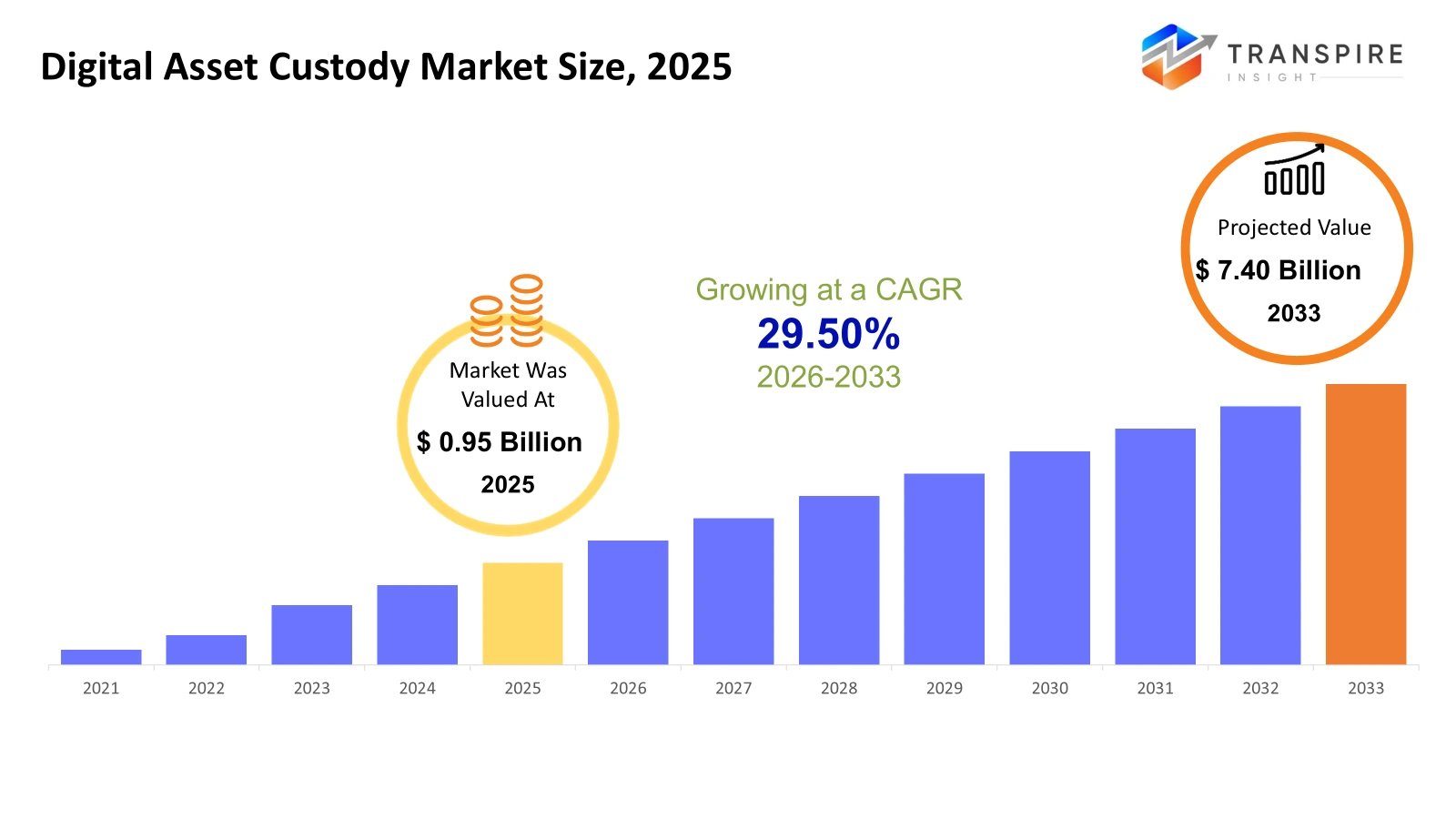
The global Digital Asset Custody market size was valued at USD 0.95 billion in 2025 and is projected to reach USD 7.40 billion by 2033, growing at a CAGR of 29.50% from 2026 to 2033. Increased institutional allocation to cryptocurrencies and tokenized assets is driving the demand for secure and compliant custody solutions. Regulatory clarity in developed markets is lowering the barriers to entry for participants, and banks and asset managers are increasing their custody offerings to drive CAGR growth in the market.
Market Size & Forecast
- 2025 Market Size: USD 0.95 Billion
- 2033 Projected Market Size: USD 7.40 Billion
- CAGR (2026-2033): 29.50%
- North America: Largest Market in 2026
- Asia Pacific: Fastest Growing Market
To learn more about this report,  Download Free Sample Report
Key Market Trends Analysis
- North America is the most advanced digital asset custody market, fueled by regulatory evolution, ETF product launches, and institutional capital inflows. The presence of established banking engagement and insured custody solutions enhances investor trust and further cements large-scale infrastructure investments.
- The United States is at the forefront of innovation, fueled by regulatory participation, growing institutional trading desks, and increasing allocations from asset managers and pension funds. The integration of custody solutions with traditional financial service infrastructure platforms propels mainstream adoption and capital investment.
- The Asia Pacific region is witnessing swift adoption, fueled by fintech growth, retail adoption, and evolving regulatory environments in Japan and South Korea. Emerging institutional adoption in India and Australia further fuels regional infrastructure investments and global digital asset integration.
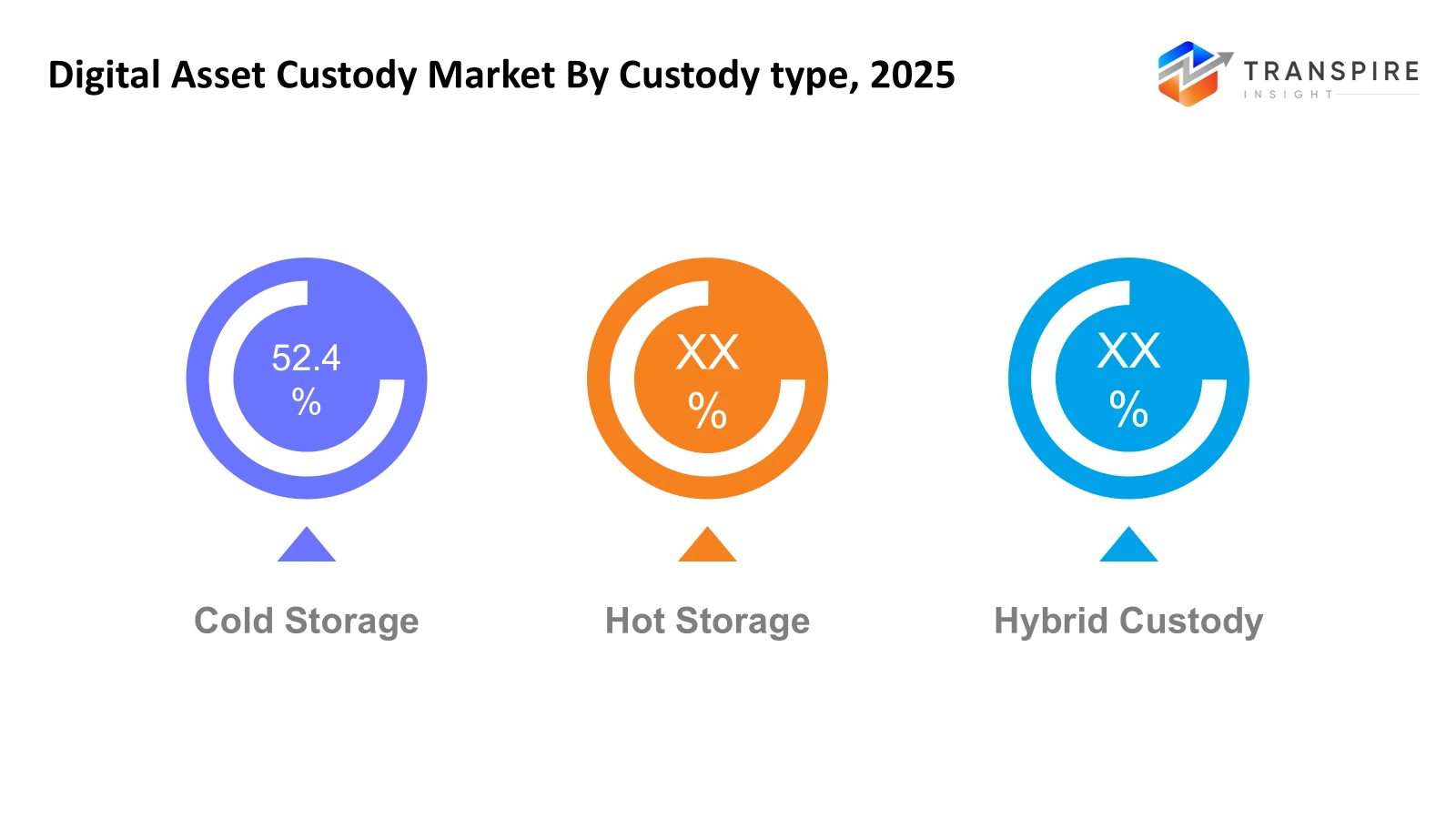
- Cold storage solutions lead the custody solution market due to their superior offline security design, which caters to institutional risk management needs. Increasing regulatory focus and fiduciary responsibilities further cements the preference for air-gapped solutions among banks, hedge funds, and asset managers managing large-value portfolios.
- Banks are the most prominent type of custodians because they capitalize on the benefits of regulatory compliance, capital, and trust to attract institutional business. Collaborations with blockchain technology companies accelerate the digitalization process and improve the overall custody services offered.
- Cryptocurrencies continue to be the most prominent segment of asset type because of the continued institutional exposure to Bitcoin and Ethereum. Methods of diversifying portfolios and the volatility of prices continue to fuel trading activities that require professional custody services for asset protection and transparency.
- The custody services are the central service segment, which includes asset protection, settlement, and compliance. The institutional need for insured and audit-ready platforms with multi-asset capabilities continues to support their prominent share of revenue generation.
So, The Digital Asset Custody Market is defined as the provision of institutional and enterprise-grade solutions for the secure storage, management, and protection of private cryptographic keys for digital assets. The provision of these services is essential for the protection of assets, validation of transactions, and regulatory compliance for cryptocurrencies and other tokenized assets. The service of custody is an integral part of facilitating institutional involvement in financial ecosystems based on blockchain technology.The Digital Asset Custody Market has progressed from simple wallet storage solutions to comprehensive platforms that provide insurance protection, compliance services, and portfolio analysis. As digital assets become increasingly accepted in traditional financial systems, custodians are increasingly working with banks, exchanges, and asset managers to provide scalable and regulated solutions. Advances in technology, such as multi-party computation and cold storage infrastructure, improve the resilience of operations.
The increasing tokenization of securities, stablecoins, and alternative assets is broadening the focus of the custody market. Institutional investors demand transparent governance, asset segregation, and risk management solutions, which are increasing the need for enterprise-grade solutions. The intersection of regulatory development and financial system digitization continues to place the Digital Asset Custody Market as a key enabler of modern capital markets.
Digital Asset Custody Market Segmentation
By Custody Type
- Cold Storage
Cold storage services lead the way in institutional-grade custody, thanks to their offline model that reduces the threat of cyber-attacks and risks of private key exposure. They are very popular with institutional investors who oversee massive crypto holdings. Increasing regulatory pressures will further fuel the demand for secure, air-gapped storage solutions.
- Hot Storage
Hot storage solutions facilitate real-time transactions and liquidity management, making them a critical component of trading platforms. Although they are more vulnerable to cyber threats than cold storage solutions, recent breakthroughs in multi-signature authentication and encryption techniques are enhancing their reliability. Increasing demand is expected in the context of decentralized finance and high-frequency trading.
- Hybrid Custody
Hybrid custody solutions provide a balanced risk-liquidity profile, thanks to their offline and online features. They are becoming increasingly popular with institutions that seek to optimize operational efficiency while ensuring regulatory compliance. The hybrid solution is ideal for diversified portfolio management and dynamic asset allocation strategies.
To learn more about this report, Download Free Sample Report
By Custodian Type
- Banks
Conventional banks are venturing into digital asset custody to benefit from institutional trust and regulatory certainty. Their presence in the market improves overall adoption by providing insured and regulatory-compliant custody solutions. Banks’ strong capital bases and governance frameworks make them stable custodial anchors in the long run.
- Cryptocurrency Exchanges
Cryptocurrency exchanges utilize comprehensive trading and custody infrastructure to provide seamless asset management. They benefit from large trading volumes and existing crypto-native communities. However, risks of counterparty exposure and regulatory pressures are forcing a change in operational models.
- Independent Custodians
Independent custodians concentrate solely on secure asset storage and regulatory compliance, appealing to hedge funds and asset managers. Their non-biased stance eliminates potential conflict-of-interest issues inherent in exchanges. Sophisticated cryptographic security and insured storage solutions make them more relevant in the market.
- Technology Providers
Technology-based custodians provide white-label custody solutions and blockchain infrastructure services. They enable financial institutions to enter the market with API connectivity and cloud deployment. Technological advancements in multi-party computation and hardware security modules improve competitive differentiation.
- Asset Management Firms
Asset managers offer digital asset investment solutions that include custody. Integrated custody solutions simplify portfolio reporting, valuation, and compliance. Increasing demand for crypto ETFs and tokenized funds drives this category’s adoption.
By Asset Type
- Cryptocurrencies
Cryptocurrencies represent the biggest market for custody services, led by institutional investment in Bitcoin and Ethereum. The price volatility of cryptocurrencies fuels the need for secure asset protection and risk management solutions. Regulatory frameworks in mature markets also fuel institutional investment.
- Stablecoins
The demand for custody services for stablecoins is growing, driven by their use in cross-border payments and decentralized finance. Stablecoins are less volatile than other cryptocurrencies and are therefore well-suited for treasury and liquidity management. Monitoring regulatory requirements is also important for stablecoins.
- Security Tokens
Security tokens need to be stored in regulated custody facilities that are consistent with securities regulations and investor protection requirements. The use of security tokens is growing, with tokenized equity and debt securities becoming popular. Institutional investors need transparent reporting and auditing capabilities for these assets.
- Non-Fungible Tokens
NFT custody services help in intellectual property rights and the verification of ownership of digital assets. Institutional investment in digital art, gaming, and metaverse assets is slowly increasing. Managing keys securely and tracing provenance is a major operational focus.
- Tokenized Assets
Tokenized real-world assets are bringing about a paradigm shift in the capital markets industry. Custody services need to be compatible with existing asset laws and blockchain interoperability. Institutional investment is increasing as a result of tokenization, which optimizes settlement times.
By Service Type
- Custody Solutions
Basic custody solutions encompass secure storage, transaction verification, and segregation of assets. Insured and compliant custody solutions are preferred by institutions to reduce operational and fiduciary risks. Demand is driven by the growing allocation to digital assets in diversified investment portfolios.
- Wallet Management Solutions
Wallet management solutions facilitate transaction authorization, access management, and asset monitoring on various blockchain networks. Improved user interface design and multi-factor authentication enhance operational efficiency. Institutional investors require scalable solutions with audit trails.
- Key Management Solutions
Private key management continues to be a critical component of digital asset security and operational risk management. Multi-party computation and hardware encryption technologies minimize the risk of single-point failures. Regulatory focus on protecting client assets boosts demand for sound private key management practices.
- Insurance & Risk Management
Hacking, fraud, and operational risk are mitigated by insurance-backed custody solutions. Risk management solutions combine cybersecurity and regulatory compliance monitoring. Insured custody solutions are now a prerequisite for institutional investors before capital deployment.
- Compliance & Reporting
Compliance solutions help institutional investors with anti-money laundering, know-your-customer, and transaction monitoring. Automated reporting solutions improve transparency for auditors and regulators. As global regulatory environments evolve, compliance-driven custody solutions are now a differentiator.
Regional Insights
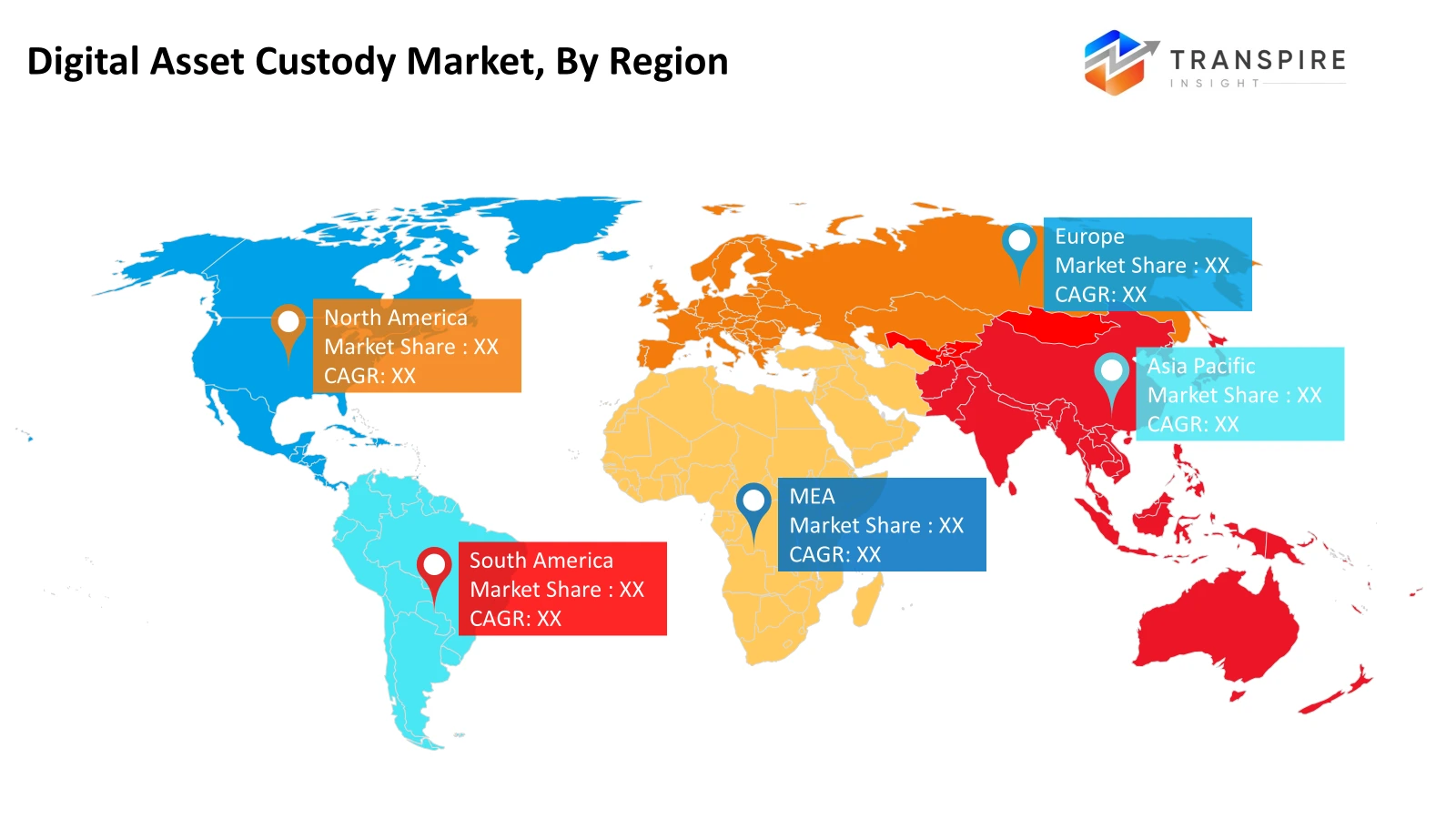
The North America market continues to be the most prominent, with the United States being a Tier 1 hub because of ETF approvals, regulatory engagement, and institutional involvement. Canada and Mexico are Tier 2 markets, showing sustainable growth in the fintech sector and an evolving regulatory structure. The European market is organized and regulation-friendly, with Germany, the United Kingdom, and France being Tier 1 markets because of their progressive licensing structures and institutional involvement. Spain, Italy, and the Rest of Europe are Tier 2 markets, with harmonized regulatory efforts and growing blockchain investments. The Asia Pacific is a fast-growing region, with Japan and South Korea being Tier 1 markets because of their mature exchange environments and well-structured regulatory frameworks. China, Australia & New Zealand, and India are Tier 2 markets with increasing institutional participation. South America, fueled by Brazil as a Tier 1 market and Argentina as a Tier 2 market, is growing in a volatile macroeconomic environment. In the Middle East & Africa, the United Arab Emirates and Saudi Arabia are Tier 1 innovation hubs, with South Africa and the Rest of the Middle East & Africa being Tier 2 adoption markets.
To learn more about this report, Download Free Sample Report
Recent Development News
- January 2026, BitGo Holdings, Inc., the digital asset infrastructure company, announced today that it has become the first publicly traded, federally chartered digital asset infrastructure company, following its initial public offering and listing on the New York Stock Exchange on January 22, 2026, and the receipt of final approval from the Office of the Comptroller of the Currency (OCC) to operate as a national trust bank.
- In January 2026, BitGo Holdings Inc., a digital asset infrastructure company, announced today that it facilitated the execution and custody of the digital asset treasury transactions of iPower Inc. iPower made purchases of Bitcoin (BTC) and Ethereum (ETH) through an account held at BitGo Bank & Trust, National Association.
|
Report Metrics |
Details |
|
Market size value in 2025 |
USD 0.95 Billion |
|
Market size value in 2026 |
USD 1.20 Billion |
|
Revenue forecast in 2033 |
USD 7.40 Billion |
|
Growth rate |
CAGR of 29.50% from 2026 to 2033 |
|
Base year |
2025 |
|
Historical data |
2021 – 2024 |
|
Forecast period |
2026 – 2033 |
|
Report coverage |
Revenue forecast, competitive landscape, growth factors, and trends |
|
Regional scope |
North America; Europe; Asia Pacific; Latin America; Middle East & Africa |
|
Country scope |
United States; Canada; Mexico; United Kingdom; Germany; France; Italy; Spain; Denmark; Sweden; Norway; China; Japan; India; Australia; South Korea; Thailand; Brazil; Argentina; South Africa; Saudi Arabia; United Arab Emirates |
|
Key company profiled |
Coinbase Custody, BitGo, Fidelity Digital Assets, Anchorage Digital, Gemini Custody, BNY Mellon Digital Asset Custody, Fireblocks, Ledger Enterprise, Metaco, Hex Trust, Standard Chartered Zodia Custody, Copper.co, Komainu, NYDIG, and Prime Trust |
|
Customization scope |
Free report customization (country, regional & segment scope). Avail customized purchase options to meet your exact research needs. |
|
Report Segmentation |
By Custody Type (Cold Storage, Hot Storage, Hybrid Custody), By Custodian Type (Banks, Cryptocurrency Exchanges, Independent Custodians, Technology Providers, Asset Management Firms), By Asset Type (Cryptocurrencies, Stablecoins, Security Tokens, Non-Fungible Tokens, Tokenized Assets) and By Service Type (Custody Solutions, Wallet Management, Key Management, Insurance & Risk Management, Compliance & Reporting) |
Key Digital Asset Custody Company Insights
Coinbase Custody is the most prominent institutional custody solution, with a substantial market share due to its comprehensive security infrastructure, global cold storage facilities, and extensive regulatory support. It caters to institutional customers worldwide, supporting a wide variety of digital assets, with segregated accounts and high insurance levels, which bolsters fiduciary support. Its tight integration with the overall trading and asset management infrastructure of Coinbase provides streamlined workflows for institutional asset managers and hedge funds. With growing regulatory support, the fact that Coinbase Custody is SOC 1 and SOC 2 compliant and has an impeccable reputation makes it the custodian of choice for institutions seeking scalable, secure, and compliant digital asset custody solutions.
Key Digital Asset Custody Companies:
- Coinbase Custody
- BitGo
- Fidelity Digital Assets
- Anchorage Digital
- Gemini Custody
- BNY Mellon Digital Asset Custody
- Fireblocks
- Ledger Enterprise
- Metaco
- Hex Trust
- Standard Chartered Zodia Custody
- co
- Komainu
- NYDIG
- Prime Trust
Global Digital Asset Custody Market Report Segmentation
By Custody Type
- Cold Storage
- Hot Storage
- Hybrid Custody
By Custodian Type
- Banks
- Cryptocurrency Exchanges
- Independent Custodians
- Technology Providers
- Asset Management Firms
By Asset Type
- Cryptocurrencies
- Stablecoins
- Security Tokens
- Non-Fungible Tokens
- Tokenized Assets
By Service Type
- Custody Solutions
- Wallet Management
- Key Management
- Insurance & Risk Management
- Compliance & Reporting
Regional Outlook
- North America
- United States
- Canada
- Mexico
- Europe
- Germany
- United Kingdom
- France
- Spain
- Italy
- Rest of Europe
- Asia Pacific
- Japan
- China
- Australia & New Zealand
- South Korea
- India
- Rest of Asia Pacific
- South America
- Brazil
- Argentina
- Rest of South America
- Middle East & Africa
- Saudi Arabia
- United Arab Emirates
- South Africa
- Rest of the Middle East & Africa
Frequently Asked Questions
Find quick answers to common questions.
The approximate Digital Asset Custody Market size for the market will be USD 7.40 billion in 2033.
Key segments for the Digital Asset Custody Market By Custody Type (Cold Storage, Hot Storage, Hybrid Custody), By Custodian Type (Banks, Cryptocurrency Exchanges, Independent Custodians, Technology Providers, Asset Management Firms), By Asset Type (Cryptocurrencies, Stablecoins, Security Tokens, Non-Fungible Tokens, Tokenized Assets) and By Service Type (Custody Solutions, Wallet Management, Key Management, Insurance & Risk Management, Compliance & Reporting).
Major Digital Asset Custody Market players are Coinbase Custody, BitGo, Fidelity Digital Assets, Anchorage Digital, Gemini Custody.
The North America region is leading the Digital Asset Custody Market.
The CAGR of the Digital Asset Custody Market is 29.50%.
- Coinbase Custody
- BitGo
- Fidelity Digital Assets
- Anchorage Digital
- Gemini Custody
- BNY Mellon Digital Asset Custody
- Fireblocks
- Ledger Enterprise
- Metaco
- Hex Trust
- Standard Chartered Zodia Custody
- co
- Komainu
- NYDIG
- Prime Trust
Recently Published Reports
-
Apr 2026
3D Optical Profiler Market
3D Optical Profiler Market Size, Share & Analysis Report By Type (Desktop 3D Optical Profiler, and Portable 3D Optical Profiler), By Technology (Confocal Technology, and White Light Interference), By End-Use Industry (Manufacturing, Research Institutions, Automotive, Aerospace and Defense, Medical Devices, and Other), and Geography (North America, Europe, Asia-Pacific, Middle East and Africa, South and Central America), 2021 - 2031
-
Apr 2026
Depth Sensor Market
Depth Sensor Market Size, Share & Analysis Report By Type (Infrared Depth Sensors, Time-of-Flight (ToF) Sensors, Stereo Vision Sensors, Structured Light Sensors, Ultrasonic Depth Sensors), By Application (Automotive, Robotics, Gaming, Consumer Electronics, Industrial Automation, Healthcare, Security & Surveillance, Others), By End Users (Automotive Manufacturers, Consumer Electronics Companies, Healthcare Providers, Industrial Companies, Security Agencies, Gaming Companies, Robotics Companies, Others), and Geography (North America, Europe, Asia-Pacific, Middle East and Africa, South and Central America), 2021 – 2031
-
Apr 2026
Digital Manufacturing Market
Digital Manufacturing Market Size, Share & Analysis Report By Component (Hardware, Software, and Services), By Technology (Robotics, 3D Printing, Internet of Things (IoT), and Others), By Application (Automotive and Transportation, Aerospace and Defense, Consumer Electronics, Industrial Machinery, and Others), By Process Type (Computer-Based Designing, Computer-Based Simulation, Computer 3D Visualization, Analytics, and Others), and Geography (North America, Europe, Asia-Pacific, Middle East and Africa, South and Central America), 2021 – 2031
-
Apr 2026
Digital Visa Services Market
Digital Visa Services Market Size, Share & Analysis Report By Type (Individual Travelers, Group Travelers), By Application (Tourism, Business Travel, Others), and Geography (North America, Europe, Asia-Pacific, Middle East and Africa, South and Central America), 2021 – 2031