
Asia Pacific Wood Preservative Chemical and Coating Active Ingredient Market Size & Forecast:
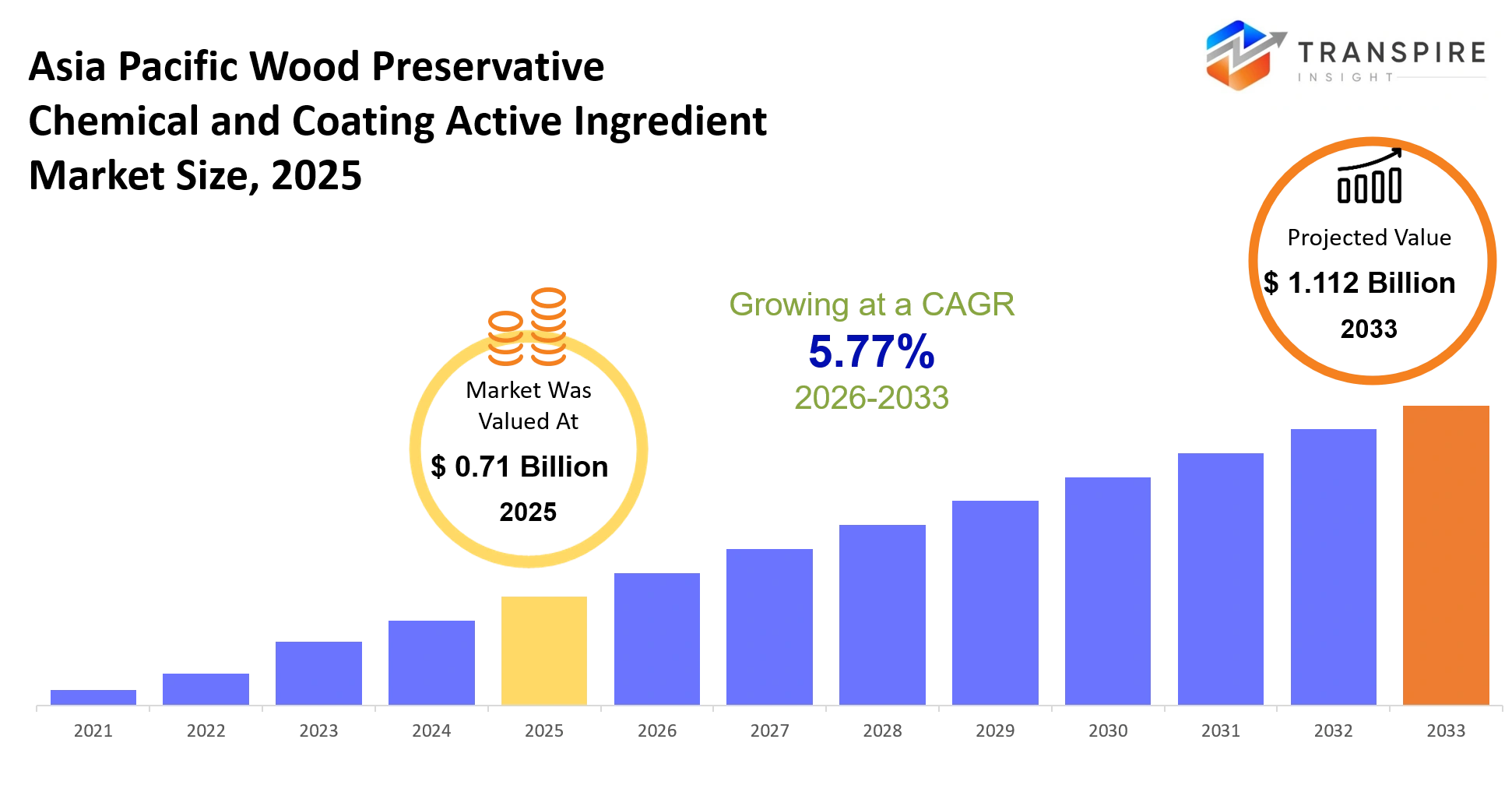
- Asia Pacific Wood Preservative Chemical and Coating Active Ingredient Market Size 2025: USD 0.71 Billion
- Asia Pacific Wood Preservative Chemical and Coating Active Ingredient Market Size 2033: USD 1.112 Billion
- Asia Pacific Wood Preservative Chemical and Coating Active Ingredient Market CAGR: 5.77%
- Asia Pacific Wood Preservative Chemical and Coating Active Ingredient Market Segments: By Product Type (Copper-based Preservatives, Borate Preservatives, Creosote Preservatives, Water-based Coatings, Oil-based Coatings, Others); By Application (Residential Construction, Commercial Construction, Marine Applications, Utility Poles, Furniture Protection, Others); By End User (Construction Industry, Furniture Industry, Utility Sector, Others)
To learn more about this report,  Download Free Sample Report
Asia Pacific Wood Preservative Chemical and Coating Active Ingredient Market Summary
The Asia Pacific Wood Preservative Chemical and Coating Active Ingredient Market was valued at USD 0.71 Billion in 2025. It is forecast to reach USD 1.112 Billion by 2033. That is a CAGR of 5.77% over the period.
Across the Asia Pacific, wood preservative chemicals and coating active substances are used to make timber last longer in ports, near-coastal infrastructure, industrial flooring, and even construction frameworks that get hit by humidity, saltwater, and biological decay. In real life, these formulations tend to stop fungal attack, marine borers, and weather-driven breakdown. So, the replacement cycles get pushed out farther longer even in those high stress environments where everything feels more extreme and less forgiving.
Over the past 5 years, the market moved away from traditional chromium and arsenic based treatments toward low VOC, copper based, and waterborne bio efficient systems, mainly as sustainability expectations tightened across building and marine requirements. A big trigger was the post pandemic supply chain wobble, plus stricter environmental compliance rules in several major APAC economies, and that combo basically forced manufacturers to reformulate and also localize how active ingredient sourcing is done.
All of that has boosted uptake in big port upgrade programs and coastal protection projects, where longer asset life and regulatory alignment now shape procurement choices, along with lifecycle costs, in a pretty direct way.
Key Market Insights
- The Asia Pacific Wood Preservative Chemical and Coating Active Ingredient Market is basically led by China, holding around 35–40% market share because of huge scale construction plus port infrastructure needs, so it is not really surprising.
- India looks like the quickest riser from 2024–2030, fueled by coastal development initiatives, smart city programs, and also railway modernization, all kind of moving at the same time.
- Southeast Asia is seeing greater uptake too, mainly because of marine exposure risks,and the faster industrial push in places like Vietnam, Indonesia and Thailand.
- In terms of type, copper based preservatives take the lead across the Asia Pacific Wood Preservative Chemical and Coating Active Ingredient Market, capturing a notable share due to durability and broader regulatory acceptance.
- Waterborne coating active ingredients sit in second place, backed by VOC compliance requirements and safer formulation mandates that keep getting tighter.
- For growth, bio based and low toxicity preservatives are the fastest growing segment through 2030, largely driven by sustainability rules and related pressure.
- Marine and coastal infrastructure applications make up roughly 38% share,and they dominate because saltwater exposure is intense plus biological degradation is constant.
- On the application side, industrial flooring and heavy duty timber structures are expanding fast in logistics and manufacturing hubs, with more projects each year.
- The construction sector stays the top end user, holding more than 40% share in the Asia Pacific Wood Preservative Chemical and Coating Active Ingredient Market.
- Port authorities together with marine engineering contractors are the fastest growing end user group, driven by climate resilience spending and the push to upgrade assets.
What are the Key Drivers, Restraints, and Opportunities in the Asia Pacific Wood Preservative Chemical and Coating Active Ingredient Market?
The main growth driver is this accelerated enforcement of environmental and building safety rules across China , Japan, South Korea, and India, and it basically pushed manufacturers away from their older toxic type formulations toward copper based and waterborne active ingredients. You can trace this shift to tighter VOC emission limits , plus coastal infrastructure resilience mandates , after the region kept seeing climate linked damage to infrastructure over and over. So now procurement cycles are more and more leaning toward compliant, long life preservative systems, and that directly gives formulation suppliers clearer revenue visibility across the Asia Pacific Wood Preservative Chemical and Coating Active Ingredient Market.
The biggest constraint is a high dependency on specialized chemical precursors and formulation grade copper compounds, which still are vulnerable to global supply swings and also concentrated upstream production. And this kind of structural dependency is not something you can fix quickly, since substitution chemistry needs long certification cycles in marine and construction use cases. That’s why adoption delays keep happening , especially in cost sensitive markets like Southeast Asia, where project approvals often drag because input pricing feels unpredictable and compliance validation timelines are hard to forecast.
One real forward-looking opportunity shows up with bio based hybrid preservatives and nano enabled coating systems, especially in Japan and South Korea where the advanced materials R&D ecosystems are getting more mature. Early pilot deployments tied to coastal smart port projects, for example automated logistics hubs in Busan and Yokohama, suggest commercialization might be coming sooner than expected, and it could end up redefining performance benchmarks in the Asia Pacific Wood Preservative Chemical and Coating Active Ingredient Mark
What Has the Impact of Artificial Intelligence Been on the Asia Pacific Wood Preservative Chemical and Coating Active Ingredient Market?
Artificial intelligence and advanced digital technologies are starting to nudge operational choices more and more inside the Asia Pacific Wood Preservative Chemical and Coating Active Ingredient Market, especially when they get tightly linked with industrial coating performance systems and marine infrastructure upkeep schedules. In factories and production spaces, AI driven process control setups are now used to keep formulation steadier—particularly for waterborne and copper based preservatives by tweaking temperature, mixing ratios and curing settings, in real time. It helps cut down batch to batch wobble, and makes coating performance more dependable under the high humidity and sea exposure situations that a lot of Asia Pacific ports deal with every day.
At the same time, predictive analytics tools are being rolled out to anticipate how materials degrade and when maintenance will actually be needed in coastal infrastructure and treated timber holdings. Machine learning is basically chewing through exposure signals like salinity, humidity, and load stress, and then supporting longer service intervals plus fewer surprise replacement rounds. That ends up improving lifecycle cost efficiency for operators, since they can plan in a calmer way. In certain industrial situations, these approaches have been linked with around 10–15% fewer maintenance downtime events and better inventory scheduling for the coating active ingredient stream.
Still, take-up isn’t fully smooth because there just aren’t enough strong training datasets that are specific to the region, and especially not for tropical marine conditions. A lot of AI models can have trouble when climates get mixed across zones, they may not properly forecast corrosion patterns, nor biological decay behavior. So they default to overly cautious maintenance guidance, and that kind of strictness pulls back the total optimization capacity of these digital tools across the Asia Pacific Wood Preservative Chemical and Coating Active Ingredient Market.
Key Market Trends
- China and India tightened VOC plus biocide rules after 2021, kinda pushing the shift from chromium based treatments toward copper based preservatives across most industrial uses, faster than before.
- In Japan and South Korea, manufacturers started expanding waterborne coating systems after 2022, swapping out the solvent heavy stuff so it fits the marine infrastructure compliance requirements better.
- When supply chains got messy in 2020 to 2022, APAC producers had to localize copper compound sourcing, so they leaned less on European specialty chemical imports, overall.
- Singapore and Vietnam are rolling out port upgrades where long-life preservative coatings are getting specified more and more, meaning procurement decisions move from pure cost thinking to lifecycle based evaluation, almost.
- After 2023, AkzoNobel and Nippon Paint Holdings sped up research into bio based additive options, aiming for low toxicity wood protection for coastal infrastructure projects, specifically.
- Then after 2024, AI enabled formulation systems came in and helped improve batch consistency for preservative chemicals, which lowers variability in those humid tropical manufacturing settings.
- Marine corrosion monitoring systems now also fold in predictive analytics, letting asset owners stretch maintenance intervals across coastal infrastructure networks, in practice.
- And in parts of Southeast Asia, like Indonesia and Thailand, emerging markets are accelerating adoption too, due to the growth of shipbuilding as well as offshore construction activity, right now.
Asia Pacific Wood Preservative Chemical and Coating Active Ingredient Market Segmentation
By Product Type :
Product type segmentation in Asia Pacific Wood Preservative Chemical and Coating Active Ingredient Market looks at chemical formulation kinds used to guard timber and industrial materials from rot, fungi, and moisture issues. In general, copper-based preservatives along with borate systems keep being widely adopted, not only because of long service life but also for that solid performance when conditions get harsh.
Copper based systems tend to lead adoption because of longer endurance when exposed to marine settings and construction related stress, while borate preservatives are often chosen for indoor use and controlled spaces where lower toxicity requirements matter more. At the same time, water-based coatings are moving up steadily, mostly as regulatory pressure rises across Asia Pacific. These are gradually swapping out solvent heavy oil-based alternatives for infrastructure, utility poles, and big scale industrial protection use.
By Application :
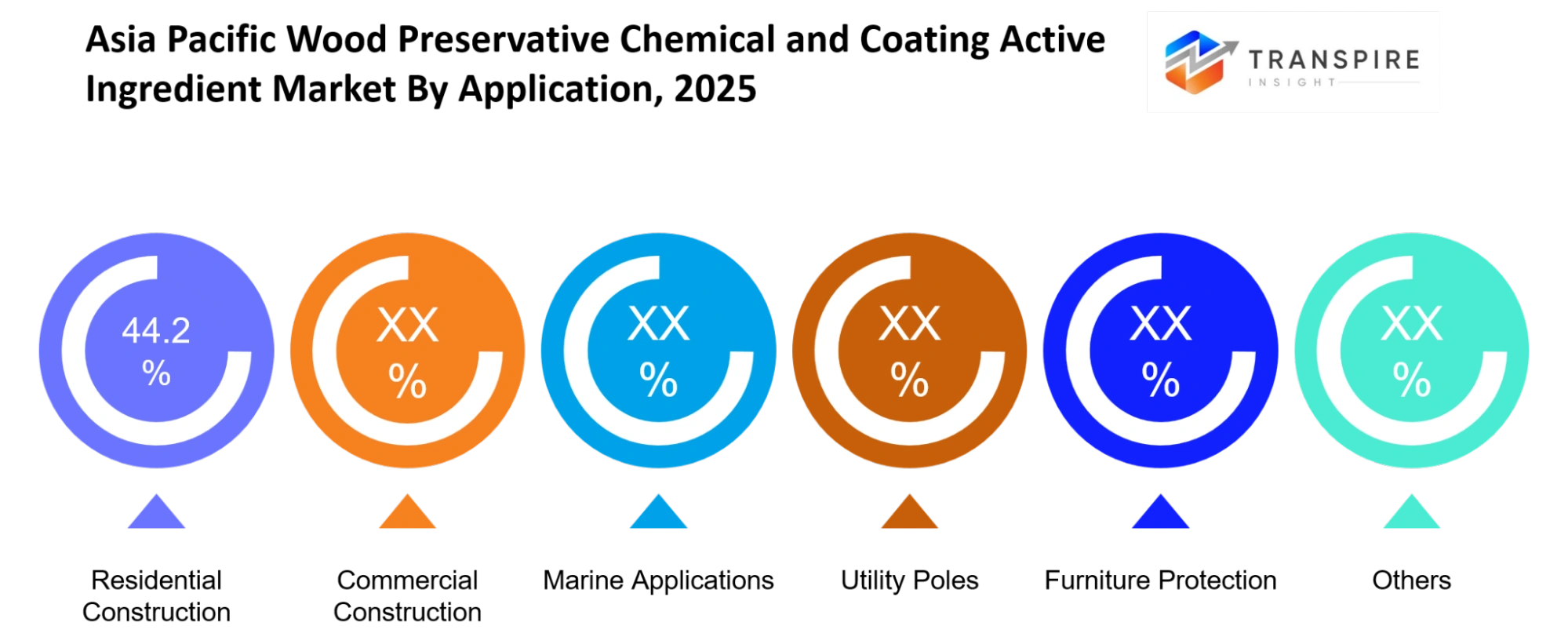
Application segmentation covers end use environments where treated wood and coated materials get different kinds of exposure, including wetness, load strain, and biological assault. Residential and commercial construction stay as core demand drivers, while marine applications and utility poles push the market toward higher-grade preservation chemistry, mainly because they live with constant humidity, salt exposure, and temperature swings all the time.
Demand patterns across Asia Pacific Wood Preservative Chemical and Coating Active Ingredient Market suggest that buyers are asking more often for long-life coating specs in ports, industrial warehouses, and infrastructure corridors. Marine and utility segments are also shifting toward predictive maintenance approaches, so there is more reliance on advanced chemical formulations. That helps extend replacement cycles, and it also cuts down structural degradation costs, for owners and operators.
To learn more about this report, Download Free Sample Report
By End User :
End user segmentation kind of maps out which industries are using wood preservative chemicals and coating active ingredients for structural protection, and also lifecycle extension. In the construction field you typically see the biggest pull, mainly because of large scale infrastructure build outs. Meanwhile the furniture industry leans more toward aesthetic durability and indoor shielding. The utility sector instead is often depending on treated materials so the structures hold up longer, especially when they’re out in the outdoor exposure conditions.
Growth in the Asia Pacific Wood Preservative Chemical and Coating Active Ingredient Market is also being pushed by a wider end user base, with modernization of utilities and an expansion of more sustainable construction practices. Industrial customers are moving toward advanced coatings to shrink maintenance cycles, while furniture producers are blending safer preservatives that match indoor air quality needs and regulatory compliance.
What are the Key Use Cases Driving the Asia Pacific Wood Preservative Chemical and Coating Active Ingredient Market?
Construction activity still seems like the main thing in the Asia Pacific Wood Preservative Chemical and Coating Active Ingredient Market, mostly because there is big residential and commercial building happening across China , India and a good chunk of Southeast Asia. The demand looks strongest in areas where timber structures, and even hybrid materials, keep getting hit by humidity plus biological breakdown. In those situations, you need long run safeguards so the upkeep doesn’t pile up and the lifecycle expenses stay lower, especially as urban infrastructure grows fast.
On top of that , marine infrastructure and utility pole work are also picking up steam. That’s happening because many governments are putting money into port modernization, coastal shielding, and grid build outs. Contractors and utility companies are leaning more toward copper based formulations and waterborne approaches, mainly to boost wear resistance when things get rough with saltwater and severe weather. Furniture protection is growing too, but more steadily, particularly inside manufacturing clusters that target export quality, plus indoor air quality expectations.
More “new” use cases are starting to show up as well, like coating solutions for smart infrastructure that are bundled with monitoring setups to observe material deterioration in real time. Offshore renewable energy projects, along with modular coastal housing developments, are beginning to test advanced preservative systems, trying to stretch the service life when environmental pressure is pretty intense.
|
Report Metrics |
Details |
|
Market size value in 2025 |
USD 0.71 Billion |
|
Market size value in 2026 |
USD 0.751 Billion |
|
Revenue forecast in 2033 |
USD 1.112 Billion |
|
Growth rate |
CAGR of 5.77% from 2026 to 2033 |
|
Base year |
2025 |
|
Historical data |
2021 - 2024 |
|
Forecast period |
2026 - 2033 |
|
Report coverage |
Revenue forecast, competitive landscape, growth factors, and trends |
|
Regional scope |
Asia Pacific (India, China, Japan, Australia,South Korea, Rest of Asia Pacific) |
|
Key company profiled |
BASF, Koppers, Lonza, Lanxess, Viance, Arxada, Troy Corporation, Borax, Akzo Nobel, Nippon Paint, Sherwin-Williams, PPG Industries, Jotun, Asian Paints, RPM International |
|
Customization scope |
Free report customization (country, regional & segment scope). Avail customized purchase options to meet your exact research needs. |
|
Report Segmentation |
By Product Type (Copper-based Preservatives, Borate Preservatives, Creosote Preservatives, Water-based Coatings, Oil-based Coatings, Others); By Application (Residential Construction, Commercial Construction, Marine Applications, Utility Poles, Furniture Protection, Others); By End User (Construction Industry, Furniture Industry, Utility Sector, Others) |
Which Regions are Driving the Asia Pacific Wood Preservative Chemical and Coating Active Ingredient Market Growth?
Asia, in practice, leads the Asia Pacific wood preservative chemical and coating active ingredient market, and it seems largely because China keeps pushing big scale infrastructure projects along with an extensive coastal industrial base. Where it gets noticeable is enforcement on construction durability and environmental safety, that kind of rule tightening has basically driven broader uptake of more modern wood protection systems in ports, bridges, and industrial plants. Japan and South Korea then help hold that pace, by backing leadership with high precision material specs and coating know-how that’s used in marine, coastal engineering. On top of that, China has a fairly mature chemical manufacturing ecosystem so copper based and waterborne formulations keep flowing, which, if we’re being exact, makes the regional position even stronger.
Meanwhile South Asia, especially India, acts like a sort of stabilizing force, with demand that stays consistent thanks to infrastructure growth and utility modernization efforts. It’s a little different from the wider Asia export-led industrial pattern, since India’s usage is more tied to domestic construction cycles, railway electrification programs, and also housing development pushes. The regulatory environment is slowly getting stricter, but adoption is still quite cost sensitive, so it rolls out in phases. That means demand stays predictable, just steady, not rushed. Also, the region has long term government infrastructure investment pipelines, which in turn helps reduce the usual procurement volatility across public sector projects, even when timing changes.
Southeast Asia is sort of the fastest growing region, in part because ports keep getting expanded, shipbuilding is staying busy ,and offshore energy development keeps rolling along in Vietnam, Indonesia, and Thailand. In the last while, money has flowed into maritime logistics corridors and climate-resilient coastal infrastructure, and that has sped up the specification of long-life wood preservative solutions. At the same time, governments have started adjusting building standards so they match international marine safety rules , plus broader environmental compliance expectations. All of that together means there are strong entry opportunities for global suppliers from 2026 to 2033, especially across marine coatings and high-performance active ingredient technologies.
Who are the Key Players in the Asia Pacific Wood Preservative Chemical and Coating Active Ingredient Market and How Do They Compete?
The Asia Pacific Wood Preservative Chemical and Coating Active Ingredient Market looks kind of moderately consolidated at the top, driven by big global chemical majors but then the regional players keep solid footholds in those more localized use cases. In practice, the rivalry is not only about price, it’s more about how good the formulation performs , plus regulatory compliance, and also the long-term staying power especially in marine settings and construction environments. On top of that, companies try to compete via supply reliability, because infrastructure projects are asking for dependable delivery of certified low-VOC and bio-compliant solutions across a bunch of different climatic zones, not just one.
AkzoNobel leans into advanced waterborne and marine protective coatings for high humidity and coastal needs, and it’s reinforcing its stance by building localized manufacturing hubs across Asia Pacific. Nippon Paint Holdings relies on strong distribution reach in Japan and Southeast Asia, while also teaming up with shipyards and infrastructure contractors so their coatings get included in long term maintenance agreements. BASF pushes differentiation through chemical innovation in copper-based preservatives, along with regulatory compliant formulation systems, and this is backed by bigger scale R and D spending.
Dow Inc keeps pushing ahead with newer binder technologies and industrial coating systems kinda woven into big construction project pipelines, while also expanding by partnering via joint ventures with nearby manufacturers in different regions. Arxada AG leans hard into niche biocide and wood protection chemistries, basically building its edge using sustainability certifications and also careful targeted alliances for premium marine and utility uses, where performance matters. Sherwin-Williams, meanwhile, keeps stretching across Asia through acquisitions, plus distribution scaling, and it concentrates on industrial protective coatings that support refurbishment of infrastructure and those heavy-duty maintenance sectors , more often than not.
Company List
- BASF
- Koppers
- Lonza
- Lanxess
- Viance
- Arxada
- Troy Corporation
- Borax
- Akzo Nobel
- Nippon Paint
- Sherwin-Williams
- PPG Industries
- Jotun
- Asian Paints
- RPM International
Recent Development News
In March 2025, Sarex Overseas entered a strategic distribution partnership with Caldic for its triazine-based UV absorbers and light stabilizers across Asia-Pacific. The agreement gives Caldic distribution rights in key Asia-Pacific markets and expands the availability of specialty coating additives that improve durability, color retention, and weather resistance in industrial coatings. Source https://www.caldic.com/
In February 2025, Arxada launched Polyboost™, a multifunctional additive for the paint and coatings industry. The new additive improves pH and viscosity stability while supporting lower preservative use rates, helping coatings manufacturers meet tightening regulatory and performance requirements relevant to wood-protection and industrial coating formulations.
Source https://www.coatingsworld.com/
What Strategic Insights Define the Future of the Asia Pacific Wood Preservative Chemical and Coating Active Ingredient Market?
The Asia Pacific Wood Preservative Chemical and Coating Active Ingredient Market is kind of structurally moving toward high-performance low-toxicity, and digitally tuned preservation systems over the next 5–7 years. I mean this shift is mostly pushed by stricter environmental enforcement around coastal infrastructure projects, plus the rising cost of premature material failure in humid , high-salinity environments. So buyers will start putting more weight on lifecycle performance than the initial ticket price, and that should strengthen demand for advanced copper hybrid and waterborne approaches.
There’s also a risk that isn’t always that obvious. It’s more about raw material concentration, especially copper and specialty biocide intermediates, where dependence on a few limited global sources can trigger price shocks and mess with formulation stability. And honestly this risk is often underplayed, because when demand growth looks good, it can hide the real upstream volatility in chemical availability.
At the same time, there’s an opportunity that’s starting to show up. Think about smart coating systems that are embedded with degradation sensing capabilities, particularly across Southeast Asian port modernization work. These solutions are moving from pilot trials into early procurement frameworks now. So companies that line up early with maritime digital infrastructure programs and also localize production in India or Vietnam may secure a structural edge, as procurement standards slowly move toward monitored asset performance, rather than “set-and-forget” static protection.
Asia Pacific Wood Preservative Chemical and Coating Active Ingredient Market Report Segmentation
By Product Type
- Copper-based Preservatives
- Borate Preservatives
- Creosote Preservatives
- Water-based Coatings
- Oil-based Coatings
By Application
- Residential Construction
- Commercial Construction
- Marine Applications
- Utility Poles
- Furniture Protection
By End User
- Construction Industry
- Furniture Industry
- Utility Sector
Frequently Asked Questions
Find quick answers to common questions.
The Asia Pacific Wood Preservative Chemical and Coating Active Ingredient Market size is USD 1.112 Billion in 2033.
Key segments for the Asia Pacific Wood Preservative Chemical and Coating Active Ingredient Market are By Product Type (Copper-based Preservatives, Borate Preservatives, Creosote Preservatives, Water-based Coatings, Oil-based Coatings, Others); By Application (Residential Construction, Commercial Construction, Marine Applications, Utility Poles, Furniture Protection, Others); By End User (Construction Industry, Furniture Industry, Utility Sector, Others).
Major Asia Pacific Wood Preservative Chemical and Coating Active Ingredient Market players are BASF, Koppers, Lonza, Lanxess, Viance, Arxada, Troy Corporation, Borax, Akzo Nobel, Nippon Paint, Sherwin-Williams, PPG Industries, Jotun, Asian Paints, RPM International.
The Asia Pacific Wood Preservative Chemical and Coating Active Ingredient Market size is USD 0.71 Billion in 2025.
The Asia Pacific Wood Preservative Chemical and Coating Active Ingredient Market CAGR is 5.77% from 2026 to 2033.
- BASF
- Koppers
- Lonza
- Lanxess
- Viance
- Arxada
- Troy Corporation
- Borax
- Akzo Nobel
- Nippon Paint
- Sherwin-Williams
- PPG Industries
- Jotun
- Asian Paints
- RPM International
About the Authors

Pankaj Ghogare Patil
I am Pankaj Ghogare Patil, a Senior Research Analyst at Transpire Insight, specializing in the Pharmaceutical, Chemicals & Materials, Healthcare IT, and Biotechnology industry. My expertise lies in conducting comprehensive market research, analyzing industry trends, evaluating competitive landscapes, and translating complex data into actionable insights. At Transpire Insight, I closely follow emerging technologies, regulatory developments, and market innovations to create accurate, well-researched, and informative content that helps businesses and professionals make informed decisions. I am committed to producing credible, evidence-based articles that reflect industry best practices while making technical topics accessible and valuable for a broad audience.

Chakradhar Khansole
Chakradhar serves as the Research Director at Transpire Insight, bringing over 8 years of experience in technology, innovation, and strategic market intelligence. He specializes in transforming complex market data into actionable business insights that enable organizations to make informed, growth-oriented decisions. Recognized for his strategic vision and analytical expertise, Chakradhar leads high-impact research initiatives, delivering comprehensive market assessments, competitive intelligence, and forward-looking industry analysis.
Recently Published Reports
-
May 2026
Healthcare Polymer Packaging Market
Healthcare Polymer Packaging Market Size, Share & Analysis Report By Packaging Type (Syringes, IV Bottles and Pouches, Clamshells, Blisters, Bottles & Jars, Containers, Tubes, IV Parental Packaging, Others), By Type (Regulated, Non-regulated), By Polymer Type (LDPE (Low-Density Polyethylene), HDPE (High-Density Polyethylene), Homo-polymer (Homo), Random Copolymer (Random), Block Copolymer (Block), PET, Polystyrene, Polyvinyl Chloride, Polyamide/EVOH, Others), and Geography (North America, Europe, Asia-Pacific, Middle East and Africa, South and Central America), 2021 - 2031
-
Apr 2026
Hydrophilic Tape (Waterstop) Market
Hydrophilic Tape (Waterstop) Market Size, Share & Analysis Report By Type (Bentonite-Based Hydrophilic Tape, Rubber-Based Hydrophilic Tape), By Application (Residential Buildings, Commercial Buildings, Infrastructure Projects), and Geography (North America, Europe, Asia-Pacific, Middle East and Africa, South and Central America), 2021 - 2031
-
Apr 2026
Metalens Market
Metalens Market Size, Share & Analysis Report By Type (Visible Light Metalens, and Infrared Metalens), By Application (Consumer Electronics, Automotive Electronics, Industrial, Medical, and Others), and Geography (North America, Europe, Asia-Pacific, Middle East and Africa, South and Central America), 2021 - 2031
-
Apr 2026
PBT Resin Market
PBT Resin Market Size, Share & Analysis Report By Type (Reinforced PBT Resin, Unreinforced PBT Resin), By Processing Method (Injection Molding, Extrusion, Blow Molding, Others), By End-User (Automotive, Electrical & Electronics, Consumer Appliances, Industrial Machinery, Medical Devices, Packaging, Others), and Geography (North America, Europe, Asia-Pacific, Middle East and Africa, South and Central America), 2021 - 2031