

Asia Pacific Coated Groundwood Paper Market Size & Forecast:
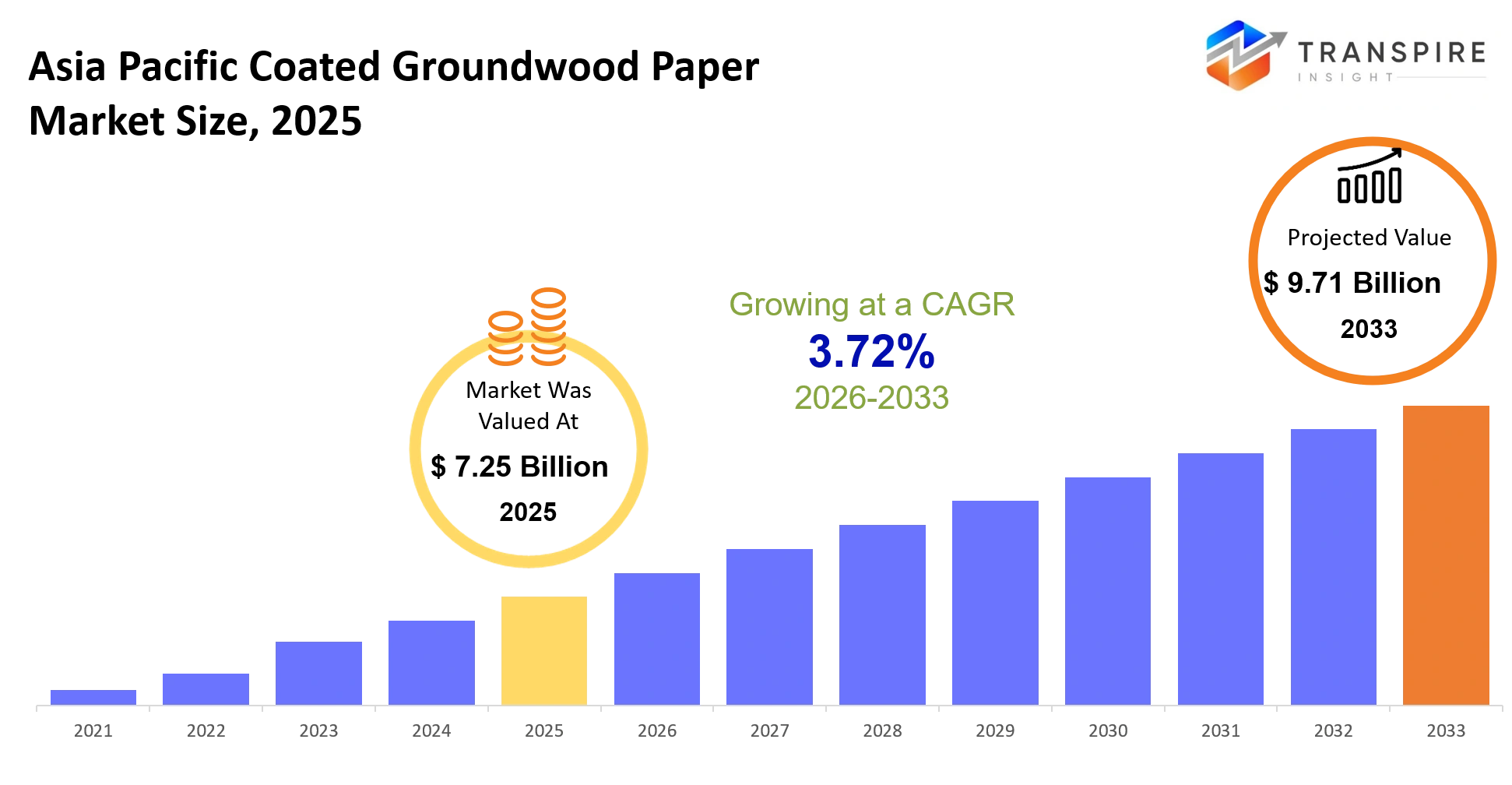
- Asia Pacific Coated Groundwood Paper Market Size 2025: USD 7.25 Billion
- Asia Pacific Coated Groundwood Paper Market Size 2033: USD 9.71 Billion
- Asia Pacific Coated Groundwood Paper Market CAGR: 3.72%
- Asia Pacific Coated Groundwood Paper Market Segments: By Product Type (Gloss Coated Paper, Matte Coated Paper, Lightweight Coated Paper, Others); By Application (Magazine Printing, Catalog Printing, Advertising Materials, Packaging, Others); By End User (Publishing Industry, Packaging Industry, Advertising Agencies, Others)
To learn more about this report,  Download Free Sample Report
Asia Pacific Coated Groundwood Paper Market Summary
The Asia Pacific Coated Groundwood Paper Market was valued at USD 7.25 Billion in 2025. It is forecast to reach USD 9.71 Billion by 2033. That is a CAGR of 3.72% over the period.
Coated groundwood paper kind of plays a big role in the publishing, advertising, retail, and commercial printing industries, as it gives a cost effective way to print magazines, catalogs, brochures, newspaper inserts,and promotional materials where high-quality image reproduction is really needed. The coated surface helps boost print clarity, makes colors look more vibrant and keeps readability higher, while production costs stay lower than the more premium woodfree paper grades. That mix of strong visual impact and affordability ends up making it a go to option for high volume printing needs across Asia Pacific.
Over the last five years, the market kind of moved in a structural way, because paper manufacturers started optimizing their production portfolios toward value-added grades and they also adopted more efficient coating technologies. At the same time, supply chain disruptions, and the volatile pulp and energy prices after the post pandemic recovery period… kinda changed the way companies approached procurement across the region. With those kinds of shifts happening, publishers and commercial printers leaned toward longer term supply arrangements and they also put more weight on operational efficiency, in general. Then as advertising, retail marketing, educational publishing and regional print media activity started to stabilize, coated groundwood paper producers seemed to benefit as well, mainly via better capacity utilization and tighter pricing discipline. In the end, this supported continued revenue growth in several key Asia Pacific markets.
Key Market Insights
- In the Asia Pacific Coated Groundwood Paper market,it’s still kind of the biggest global consumption hub, backed by China, Japan,India, and the printing scenes across Southeast Asia.
- China is responsible for close to 45% of the regional market share in 2025, mostly because of huge publishing and commercial printing capacity that keeps expanding,you know.
- India shows up as the quickest moving national market through 2033, driven by educational publishing growing at a steady pace and also by more retail advertising activity.
- Gloss-coated paper makes up around 38% of the market share, staying on top mainly for magazine and catalog printing needs.
- Matte-coated grades take nearly 30% of industry revenue, and they benefit from higher-end marketing materials as well as corporate communication items.
- Lightweight coated paper is expected to post the fastest growth rate through 2033, as publishers try to lower distribution and mailing costs, which kind of forces the switch.
- Commercial printing adds more than 40% to total market demand, so it ends up being the leading application segment across Asia Pacific.
- Educational publishing demand increased by an estimated 5–7�tween 2023 and 2025, helping coated paper stay in stable consumption territory.
- Key players such as UPM-Kymmene, Stora Enso, Nippon Paper, Oji Holdings, Sappi, and Nine Dragons Paper keep investing in production efficiency and specialty paper grades, rather than slowing down.
- And on top of that, strategic expansions,fiber optimization technologies,and upgraded coating solutions are helping suppliers improve margins, plus strengthen their foothold in the regional market.
What are the Key Drivers, Restraints, and Opportunities in the Asia Pacific Coated Groundwood Paper Market?
The prime driver for market growth is basically the ongoing requirement for good quality, cost-efficient print media across publishing, retail marketing, and educational sectors. Retail brands keep going back to printed catalogs,promotional inserts, and point-of-sale materials, because these formats give a wide consumer footprint at pretty steady costs. Over time, coating technology improvements have upped the print quality while also dialing down production expenses. So printers and publishers can keep using coated groundwood paper even when budgets feel tight. This whole mix helps directly with higher production volumes and, in turn,revenue generation through the entire value chain.
The most serious restraint is the sort of structural slide of classic print media in a few mature Asia Pacific economies. Digital ad platforms, online publishing channels, and electronic content distribution keep taking away budgets that once went to print. And yeah, this is not just a short-term fluctuation, it’s structural ,meaning it follows long-run shifts in consumer behavior, media habits, and corporate marketing strategies. So paper producers end up with periodic capacity rationalization, less utilization in some markets, and margin squeeze on the operating side.
A big opportunity seems to come from the expansion in educational publishing, regional-language content, and premium commercial printing across newer Asian economies. Places like India, Indonesia, Vietnam, and the Philippines are still investing in educational infrastructure and printed learning resources. Meanwhile advances in lightweight coated paper technology make it possible for publishers to reduce logistics spending, without giving up the print result. That trade-off is pretty important, and it can support stronger adoption.
What Has the Impact of Artificial Intelligence Been on the Asia Pacific Coated Groundwood Paper Market?
Artificial intelligence is starting to change coated groundwood paper manufacturing in a more noticeable way, mostly by boosting production efficiency, raising quality oversight, and making asset use feel less wasteful. Paper mills are increasingly bringing in AI monitoring systems, so they can look at coating evenness, moisture levels, fiber distribution, and machine behavior all at once, in real time. In practice, these setups catch process quirks early, before they end up showing on the final product,which in turn cuts down on scrap and also reduces those expensive moments when the line has to stop.
Machine learning is also backing predictive maintenance efforts across paper facilities. By reading vibration signatures, temperature readings, and the way equipment is currently running, the systems can estimate when maintenance will likely be needed, before an actual breakdown happens. This tends to keep uptime higher, help equipment last longer, and lower the number of surprise shutdowns. A few producers say they’ve seen clear drops in maintenance spending and steadier output after rolling out predictive analytics platforms.
On top of that, newer digital tools are helping optimize how raw materials are used and how much energy is consumed. AI-assisted production planning lets manufacturers juggle coating mixtures, fiber inputs, and the production calendar, in a way that supports cost control as well as sustainability goals. Still, adoption is not evenly spread across the region. Costs for integration can be high, older manufacturing infrastructure is often in the way, and there’s limited access to plant-specific training data. All of that keeps slowing implementation, especially for smaller and mid-sized producers. As a result, the overall speed of digital transformation may stay slower than expected, even if the operational advantages look pretty clear.
Key Market Trends
- Between 2021 and 2025, several paper producers ended up shifting capacity toward higher value coated grades, mainly to boost profitability and keep day to day operations more flexible, you know.
- In 2025 China still held over 45% of regional consumption share, which basically keeps it firmly as the main production and demand hub.
- Lightweight coated paper use climbed by an estimated 6% a year since 2022, largely because publishers tried to trim distribution costs,and that mattered.
- At the same time educational publishing demand picked up across India and Southeast Asia, especially after curriculum modernization steps were rolled out following 2021.
- On the tech side, energy efficient coating technologies brought production costs down by about 5–10% at certain modernized facilities between 2023 and 2025.
- Publishers also moved toward shorter production cycles and on demand printing models, which helps them manage inventory risk, and deal with market swings easier.
- Oji Holdings, Nippon Paper, and Nine Dragons Paper increased spending on value added paper products plus operational efficiency programs.
- And in general regional supply chains became more localized after logistics disruptions during the post pandemic recovery period.
- Sustainability reporting obligations pushed manufacturers to get better at fiber sourcing transparency, and improve resource efficiency across their operations too.
- Commercial printing firms, meanwhile, increasingly leaned toward premium matte and lightweight coated grades, so they could improve marketing impact while still controlling costs.
Asia Pacific Coated Groundwood Paper Market Segmentation
By Product Type
Gloss Coated Paper has a pretty notable share because publishers and commercial printers basically lean on it for bright image reproduction and sharp print quality. The smooth surface traits do help with vibrant color output ,so this paper grade becomes a go-to for magazines, promotional materials and retail publications. Its consistent print performance still plays a part in ongoing use, even within large volume printing operations, you know.
Matte Coated Paper also pulls in steady demand, largely because reduced glare makes pages easier to read while keeping solid image quality. Lightweight Coated Paper keeps getting more acceptance as printing companies try to bring down distribution and transportation costs without giving up that nice visual appeal. There are also other types, like specialty coated grades shaped for specific printing requirements, premium publications, and customized commercial applications. Together they create chances for product diversification across the whole paper industry, in a way.
By Application
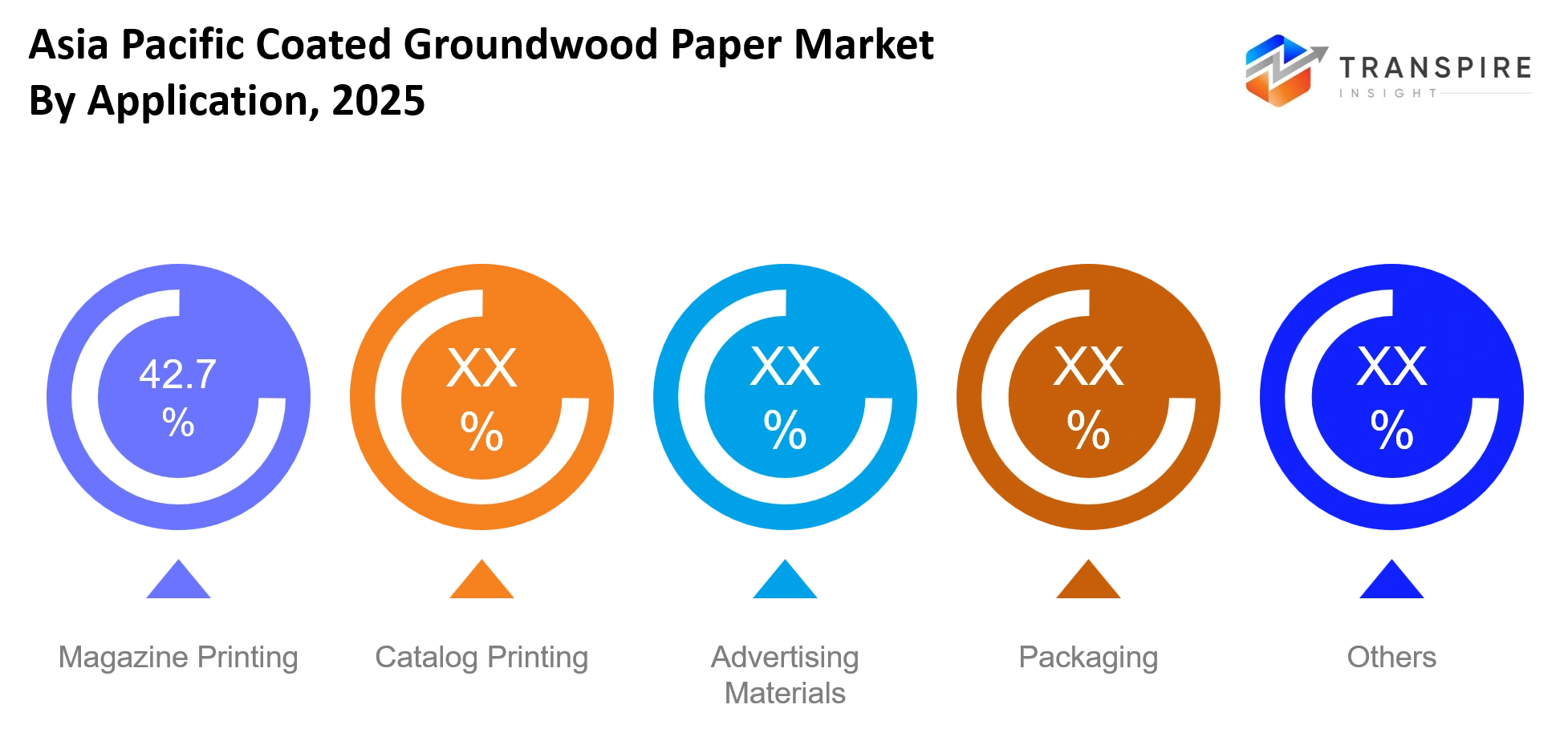
Magazine Printing is, in a sense, one of the biggest application areas because high-quality images, appealing layouts, and a bold visual show still matter a lot for both consumer and business publications. When the print results are consistent, it actually helps support circulation across lifestyle, educational and industry focused magazines, even when teams change or timelines get tight. So, reliable performance, plus cost efficiency keep things steady, and that is what continues to sustain demand in this segment.
Catalog Printing takes up a large share of use mainly because catalogs stay around for retail promotions, product displays, and direct marketing drives. Advertising Materials keep a strong market presence too since companies want effective printed communication tools that boost brand visibility, and get customers to notice, or come back. Packaging also keeps growing, especially as coated paper gets used more often in premium packaging solutions. And Others cover the rest like inserts, brochures, corporate documents and specialized printing applications that really need enhanced print quality, for the small details to look right.
To learn more about this report, Download Free Sample Report
By End User
The Publishing Industry, by accounts for a significant share, mainly because books,magazines,journals,learning materials, and commercial releases all need reliable paper quality, plus printing that stays consistent. Also, the growth you see in local publishing initiatives and the making of educational content keeps feeding demand. On top of that, there are strong expectations around visual appeal and easy readability, which kind of keeps consumption levels steady.
The Packaging Industry is still a major end user, since producers use coated paper for attractive packages and for that branded product look. Advertising Agencies keep opening opportunities too, by leaning heavily on brochures, catalogues, promotional leaflets, and a whole range of marketing items that really depend on high quality printing results. Other groups in the mix include corporate organizations, educational institutions, retail businesses, and commercial service providers,all of which depend on printed communication assets for everyday operations,as well as promotions.
What are the Key Use Cases Driving the Asia Pacific Coated Groundwood Paper Market?
The biggest use case for coated groundwood paper is still kinda magazine work, catalog, and other commercial publication printing. Publishers tend to pick these grades because they give solid image clarity sharp color reproduction, and a nice visual look…all while keeping production costs competitive. That mix is what makes them especially good for high volume print runs, you know, the kind where the schedule is pretty tight.
Also, extra uses keep spreading out into retail promotion and corporate communication efforts. Retailers lean on coated paper for promotional brochures, advertising inserts,and seasonal campaign pieces. Businesses, on their side, rely on it for annual reports, product guides, and branded marketing materials. In general, these uses take advantage of the paper’s ability to upgrade how prints look, without really driving up the printing expenses too much.
New openings are showing up in education publishing and in specialized regional language content creation. More money is being put into school resources, training manuals, and extra learning references, so demand streams are forming there. And there’s also potential in premium short run digital printing, mainly because publishers are starting to want customized, more targeted print solutions rather than one size fits all.
|
Report Metrics |
Details |
|
Market size value in 2025 |
USD 7.25 Billion |
|
Market size value in 2026 |
USD 7.52 Billion |
|
Revenue forecast in 2033 |
USD 9.71 Billion |
|
Growth rate |
CAGR of 3.72% from 2026 to 2033 |
|
Base year |
2025 |
|
Historical data |
2021 - 2024 |
|
Forecast period |
2026 - 2033 |
|
Report coverage |
Revenue forecast, competitive landscape, growth factors, and trends |
|
Regional scope |
Asia Pacific (India, China, Japan, Australia, South Korea, Rest of Asia Pacific) |
|
Key company profiled |
UPM-Kymmene, Stora Enso, Sappi, Nippon Paper, Oji Holdings, Nine Dragons Paper, Asia Pulp & Paper, Norske Skog, Domtar, Resolute Forest Products, Burgo Group, Lecta, Mondi, Catalyst Paper, Daio Paper |
|
Customization scope |
Free report customization (country, regional & segment scope). Avail customized purchase options to meet your exact research needs. |
|
Report Segmentation |
By Product Type (Gloss Coated Paper, Matte Coated Paper, Lightweight Coated Paper, Others); By Application (Magazine Printing, Catalog Printing, Advertising Materials, Packaging, Others); By End User (Publishing Industry, Packaging Industry, Advertising Agencies, Others) |
Which Regions are Driving the Asia Pacific Coated Groundwood Paper Market Growth?
East Asia remains the dominant regional market, really pulled by China, Japan, and South Korea. China seems to gain the most, not only from large scale publishing infrastructure but also from the kinda integrated paper manufacturing capacity, plus the huge commercial printing operations that keep everything moving. Japan adds value through advanced coating technologies and, overall, strong specialty paper know-how. The whole region's supply chain ecosystem feels already established and it keeps backing this leadership role.
Southeast Asia comes next as the second largest contributor and it kind of differs from East Asia because it puts more emphasis on economic diversification, and growth in domestic consumption. Indonesia, Thailand, Malaysia, and Vietnam keep making steady investments in publishing, advertising, and education related materials. Instead of depending mostly on export oriented production, these markets ride on middle class expansion and continuous commercial activity. In practice, that ends up giving a dependable line of long-term market demand.
South Asia is expected to show the quickest growth during the forecast window, mainly because India leads the pack. With newer investments in educational infrastructure, textbook production, and organized retail marketing, coated paper consumption has been increasing. Also the growing commercial printing sector, along with the expanding regional-language publishing industry, keeps lifting demand. For investors and people entering the market, this is basically a cue for localized production models, distribution networks, and specialty coated paper offerings, roughly between 2026 and 2033.
Who are the Key Players in the Asia Pacific Coated Groundwood Paper Market and How Do They Compete?
Competition in the Asia Pacific coated groundwood paper market is, kinda moderately consolidated, but still with a mix of global paper makers and big regional producers. They’re mostly jawing it out on cost efficiency, product quality, production scale,and how far they can reach geographically. Players put a lot of attention on operational optimization, fiber procurement approaches and value added coating technologies, mainly to help defend margins in a pretty tight setting.
UPM-Kymmene stands out with its advanced production efficiency programs and a very visible commitment to sustainable fiber stewardship. The company tends to push high quality printing paper grades while tweaking the manufacturing network map to stay cost competitive. Stora Enso, meanwhile, leans on broad innovation capabilities plus sustainable forestry resources, so it can put together premium coated paper solutions for commercial printing clients who care about steady print outcomes.
Nippon Paper and Oji Holdings keep their edge via strong positions in Japan and also wider across Asia. Both back production modernization, invest in specialty paper development, and run resource-efficiency initiatives that help their profitability and make the products more distinct. Nine Dragons Paper competes with very large scale manufacturing, plus integrated pulp-and-paper production, which gives it real cost advantages. It keeps moving forward by expanding capacity and upgrading facilities, to further lock in its stance across Asian paper markets.
Company List
- UPM-Kymmene
- Stora Enso
- Sappi
- Nippon Paper
- Oji Holdings
- Nine Dragons Paper
- Asia Pulp & Paper
- Norske Skog
- Domtar
- Resolute Forest Products
- Burgo Group
- Lecta
- Mondi
- Catalyst Paper
- Daio Paper
Recent Development News
In May 2026, Oji Holdings launched OJO⁺PC recycled paper yarn technology. The initiative converts used paper cups into value-added paper-based materials, supporting circular economy objectives and expanding advanced fiber utilization opportunities. (Oji Holdings)
Source:https://www.ojiholdings.co.jp
In September 2025, Oji Holdings launched the Renewa recycling brand. The program expands recycling solutions for difficult-to-recycle paper materials and strengthens the company's resource-circulation strategy across Asia. (Oji Holdings)
Source:https://www.ojiholdings.co.jp
In 2025, Nine Dragons Paper commenced operation of major high-end papermaking and pulp expansion projects in Jingzhou and Beihai. The investment increased printing and writing paper capacity while strengthening vertically integrated production capabilities. (Nine Dragons Paper)
Source:https://www.ndpaper.com
What Strategic Insights Define the Future of the Asia Pacific Coated Groundwood Paper Market?
The Asia Pacific coated groundwood paper industry is kind of drifting toward a more specialized, efficiency-driven future. Growth is going to rely more and more on value enhanced applications,lighter coated grades, newer coating technologies, and regional demand from schooling, retail promotion, and business printing rather than the older mass market publishing. Manufacturers that can raise productivity while also making their products feel more distinct are probably going to grab a bigger portion of the next wave of revenue.
A risk that’s not so easy to see right away is the ongoing capacity rationalization across already mature markets. As digital media keeps spreading, producers that don’t properly tune their capacity might run into margin squeeze, even if the total market value stays positive. Another challenge is the volatility in raw material and energy costs, which can flip profitability pretty fast, sometimes in ways management did not plan for.
One more encouraging opportunity is in advanced lightweight coated paper products, made for high end commercial printing and educational materials across South and Southeast Asia. Companies should put attention into production modernization, AI enabled manufacturing setups, and partnerships for regional distribution. Organizations that can blend operational efficiency with specialized product development should end up in a better spot to benefit from the next stage of how the market evolves.
Asia Pacific Coated Groundwood Paper Market Report Segmentation
By Product Type
- Gloss Coated Paper
- Matte Coated Paper
- Lightweight Coated Paper
- Others
By Application
- Magazine Printing
- Catalog Printing
- Advertising Materials
- Packaging
- Others
By End User
- Publishing Industry
- Packaging Industry
- Advertising Agencies
- Others
Frequently Asked Questions
Find quick answers to common questions.
The expected Asia Pacific Coated Groundwood Paper Market size for the market will be USD 9.71 Billion in 2033.
Key segments for the Asia Pacific Coated Groundwood Paper Market are By Product Type (Gloss Coated Paper, Matte Coated Paper, Lightweight Coated Paper, Others); By Application (Magazine Printing, Catalog Printing, Advertising Materials, Packaging, Others); By End User (Publishing Industry, Packaging Industry, Advertising Agencies, Others)
Major Asia Pacific Coated Groundwood Paper Market players are UPM-Kymmene, Stora Enso, Sappi, Nippon Paper, Oji Holdings, Nine Dragons Paper, Asia Pulp & Paper, Norske Skog, Domtar, Resolute Forest Products, Burgo Group, Lecta, Mondi, Catalyst Paper, Daio Paper
The Asia Pacific Coated Groundwood Paper Market size is USD 7.25 Billion in 2025.
The Asia Pacific Coated Groundwood Paper Market CAGR is 3.72% from 2026 to 2033.
- UPM-Kymmene
- Stora Enso
- Sappi
- Nippon Paper
- Oji Holdings
- Nine Dragons Paper
- Asia Pulp & Paper
- Norske Skog
- Domtar
- Resolute Forest Products
- Burgo Group
- Lecta
- Mondi
- Catalyst Paper
- Daio Paper
About the Authors

Pankaj Ghogare Patil
I am Pankaj Ghogare Patil, a Senior Research Analyst at Transpire Insight, specializing in the Pharmaceutical, Chemicals & Materials, Healthcare IT, and Biotechnology industry. My expertise lies in conducting comprehensive market research, analyzing industry trends, evaluating competitive landscapes, and translating complex data into actionable insights. At Transpire Insight, I closely follow emerging technologies, regulatory developments, and market innovations to create accurate, well-researched, and informative content that helps businesses and professionals make informed decisions. I am committed to producing credible, evidence-based articles that reflect industry best practices while making technical topics accessible and valuable for a broad audience.

Chakradhar Khansole
Chakradhar serves as the Research Director at Transpire Insight, bringing over 8 years of experience in technology, innovation, and strategic market intelligence. He specializes in transforming complex market data into actionable business insights that enable organizations to make informed, growth-oriented decisions. Recognized for his strategic vision and analytical expertise, Chakradhar leads high-impact research initiatives, delivering comprehensive market assessments, competitive intelligence, and forward-looking industry analysis.
Recently Published Reports
-
May 2026
Healthcare Polymer Packaging Market
Healthcare Polymer Packaging Market Size, Share & Analysis Report By Packaging Type (Syringes, IV Bottles and Pouches, Clamshells, Blisters, Bottles & Jars, Containers, Tubes, IV Parental Packaging, Others), By Type (Regulated, Non-regulated), By Polymer Type (LDPE (Low-Density Polyethylene), HDPE (High-Density Polyethylene), Homo-polymer (Homo), Random Copolymer (Random), Block Copolymer (Block), PET, Polystyrene, Polyvinyl Chloride, Polyamide/EVOH, Others), and Geography (North America, Europe, Asia-Pacific, Middle East and Africa, South and Central America), 2021 - 2031
-
Apr 2026
Hydrophilic Tape (Waterstop) Market
Hydrophilic Tape (Waterstop) Market Size, Share & Analysis Report By Type (Bentonite-Based Hydrophilic Tape, Rubber-Based Hydrophilic Tape), By Application (Residential Buildings, Commercial Buildings, Infrastructure Projects), and Geography (North America, Europe, Asia-Pacific, Middle East and Africa, South and Central America), 2021 - 2031
-
Apr 2026
Metalens Market
Metalens Market Size, Share & Analysis Report By Type (Visible Light Metalens, and Infrared Metalens), By Application (Consumer Electronics, Automotive Electronics, Industrial, Medical, and Others), and Geography (North America, Europe, Asia-Pacific, Middle East and Africa, South and Central America), 2021 - 2031
-
Apr 2026
PBT Resin Market
PBT Resin Market Size, Share & Analysis Report By Type (Reinforced PBT Resin, Unreinforced PBT Resin), By Processing Method (Injection Molding, Extrusion, Blow Molding, Others), By End-User (Automotive, Electrical & Electronics, Consumer Appliances, Industrial Machinery, Medical Devices, Packaging, Others), and Geography (North America, Europe, Asia-Pacific, Middle East and Africa, South and Central America), 2021 - 2031