
Asia Pacific Smart Shopping Cart Market Size & Forecast:
- Asia Pacific Smart Shopping Cart Market Size 2025: USD 126.3 Million
- Asia Pacific Smart Shopping Cart Market Size 2033: USD 685.2 Million
- Asia Pacific Smart Shopping Cart Market CAGR: 23.35%
- Asia Pacific Smart Shopping Cart Market Segments: By Technology (RFID, Computer Vision, IoT Sensors, AI Analytics, Barcode Scanning, Smart Displays, Cashless Checkout, Others); By Component (Hardware, Software, Services, Displays, Sensors, Connectivity Modules, Analytics Platforms, Others); By Application (Supermarkets, Hypermarkets, Convenience Stores, Specialty Stores, Warehouse Clubs, Grocery Chains, Retail Chains, Others); By End User (Retail Chains, Independent Retailers, E-commerce Retailers, Department Stores, Grocery Stores, Shopping Malls, Wholesale Stores, Others).
Asia Pacific Smart Shopping Cart Market Summary
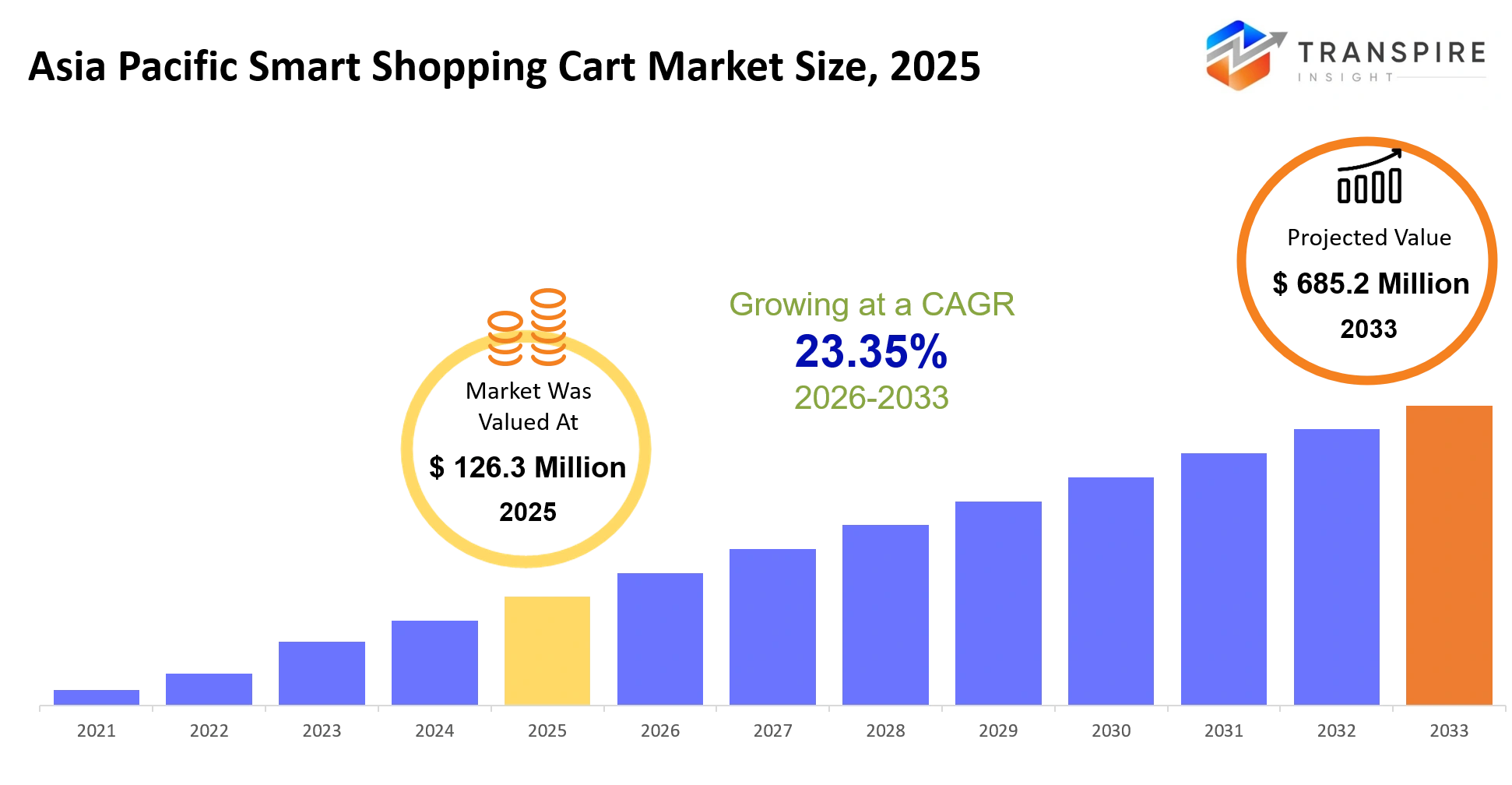
The Asia Pacific Smart Shopping Cart Market was valued at USD 126.3 Million in 2025. It is forecast to reach USD 685.2 Million by 2033. That is a CAGR of 23.35% over the period.
Smart carts have transformed from a retail gimmick to an operational necessity that enables supermarkets to alleviate checkout congestion, gain visibility of their inventory and record shopper behavior as it occurs. Through enabling customers to scan goods, view discounts and pay directly at the cart, they enable retailers to reduce waiting times and staff reliance on cashier-operated checkouts while boosting store throughput. The market has been undergoing a structural change in the past three to five years from pilots to chain-wide deployments underpinned by the enabling technologies of computer vision, sensor fusion and AI-based analytics. However the Covid-19 pandemic significantly accelerated its pace of adoption as consumers and retailers were forced to re-examine store operations and the customer experience of contactless shopping. This has redefined retail investment priorities as retailers begin to see smart carts as a revenue generating tool that increases basket size, enables personalised promotional strategies and tackles theft (shrinkage), developing the business case for chain wide deployments in Asia Pacific.
Key Market Insights
- The Asia Pacific Smart Shopping Cart market is moving from pilot stages to wide-scale commercial implementations across supermarkets, hypermarkets and retail chains across convenience stores.
- China currently leads the Asia Pacific market, representing almost 45% of the regional market share in 2025, primarily driven by mature digital retail ecosystems and extensive adoption of automated store operations.
- AI based smart shopping carts dominate the smart shopping cart market, capturing over 55% of the smart shopping cart industry revenue in 2025 due to its accurate product recognition capabilities.
- The second largest smart shopping cart market is represented by the RFID based smart shopping cart segment which benefits from the ease of implementation and existing stock tracking system across the retailer premises.
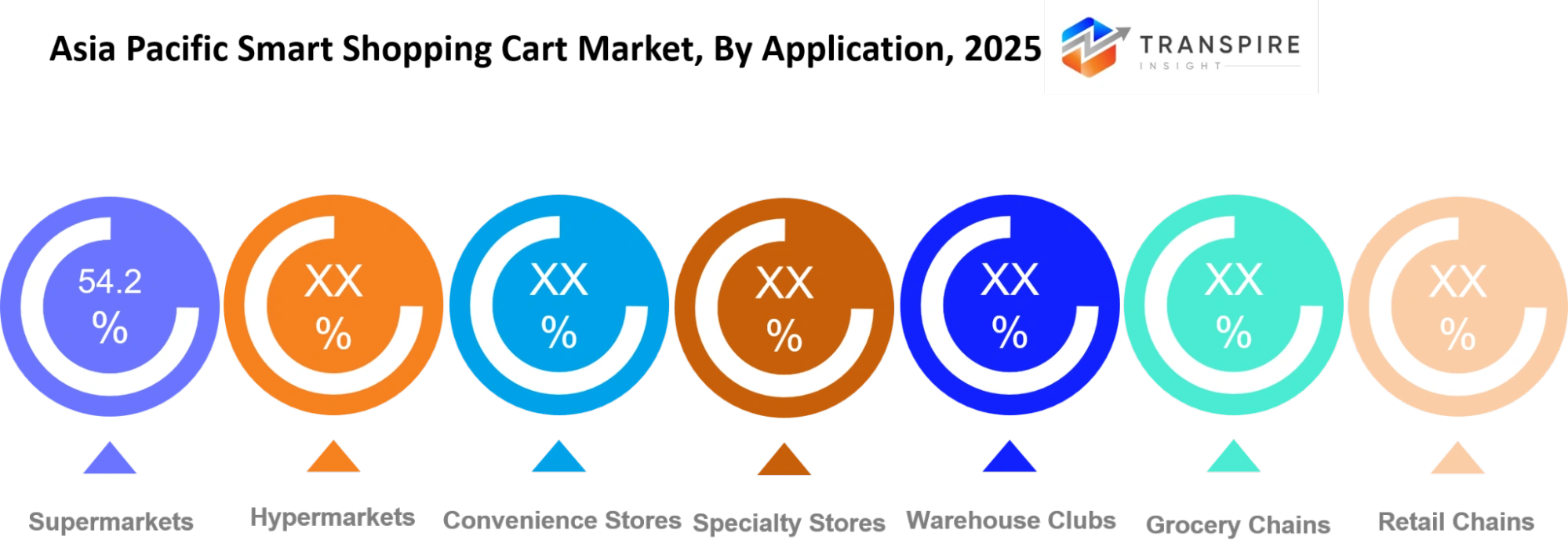
- Supermarkets and hypermarkets represent the largest application in the market with over 60% market share as a result of large customer traffic volumes and increasing basket sizes in the segment.
- Convenience stores represents the fastest growing application segment due to the demand from retailers for space efficient and digitally enabled store formats.
- Large retail chains are considered the leading end user segment in the market with an almost 70% market share due to increased technology investment and scalability of deploying across the retail chain.
- The fastest growing end user segment are the mid-sized retailers with the decreasing cost of hardware and increasing accessibility to cloud-based retail analytic solutions.
- The smart shopping cart market in the Asia Pacific region presents competitive advantages with large players such as Caper AI, Amazon Dash Cart, Veeve, Imagr, Shopic, and Cust2Mate operating in the market.
- Product innovation, dynamic inventory management and personalized advertisement based revenue models have become key revenue drivers for the smart retail ecosystem.
What are the Key Drivers, Restraints, and Opportunities in the Asia Pacific Smart Shopping Cart Market?
The fastest growing market trend is organized retail's swift digital evolution across the Asia Pacific Smart Shopping Cart Market, spurred by retail sector labor shortages and high operational costs coupled with increased demand to improve customer experience within existing retail space. Supermarkets and hypermarkets must invest in AI-powered smart shopping carts equipped with self-checkout capabilities, personalized suggestions and real-time inventory data. The value proposition is immediate-retailers can cut check-out lines, decrease labor costs and raise purchase values with tailored promotion, solidifying the return-on-investment and prompting use of smart carts throughout the store.
The primary hindrance remains the high cost of initial implementation. These systems consist of cameras, sensors, computer vision software, wireless capabilities and data analytics back-ends, requiring substantial upfront capital investment. Many retailers in developing Asia Pacific markets have slim margins, cannot support large upfront capital expenditures and remain on very small operating budgets, which results in very large chains only buying smart carts and slows growth of small stores.
The largest opportunity arises when smart carts are integrated into advertising and media platform sales. Recommendation engines enabled by AI are already beginning to push personalized deals and advertising directly to customers during their shopping trip. This can unlock significant opportunities for new revenue channels beyond mere hardware sale. Retailers in nations like India and throughout Southeast Asia present attractive market potential with a maturing organized retail presence.
What Has the Impact of Artificial Intelligence Been on the Asia Pacific Smart Shopping Cart Market?
AI has transformed smart shopping carts from mere checkout devices into smart retail terminals which not only enable automated store checkout but also customer engagement. With computer vision algorithms which no longer require products to be scanned to recognize it is inside the smart shopping cart, as well as sensors powered by AI to identify customer’s movement and behavior within the store in real time; this in turn drastically decreases checkout times and allows retailers to cut labor costs by eliminating the reliance on check-out counters staffed by human employees.
Machine learning allows for inventory management and allows businesses to predict stocking levels based on shopping habits, seasonality as well as traffic flow. Businesses will be able to minimize stockouts, optimize inventory turns and carry out precise stocking of goods within stores. The analytic engine used in the AI can further offer customers targeted marketing, allowing them to receive product recommendations based on their purchasing patterns, thereby enabling retailers to increase shopping basket size as well as customer loyalty. Many stores which are utilizing AI enabled carts are reporting increased productivity and operational efficiencies, and are claiming a reduction in product loss due to shrinkage.
Nevertheless, AI technology is not without its limitations, due to high implementation costs and training computer vision models to learn the identity of thousands of products in various lighting situations, as well as packaging conditions to perform as accurately as required poses as limitations for implementation within the market. Small and medium businesses within the region particularly may find this a constraint
Key Market Trends
- Between 2020 and 2025, a movement from RFID-enabled trolleys to AI/computer vision based platforms with automatic product identification and a friction-less checkout experience.
- The impact of COVID-19 had permanently altered shopping behaviors, causing retailers to embrace cashless purchases, speeding the proliferation of smart carts across supermarkets and hypermarkets.
- China became the regional innovation center after 2021 with retailers heavily implementing AI-powered stores and integration of smart carts in their digital retail environments.
- Smart cart providers are increasingly collaborating with payment gateways and cloud vendors moving from selling standalone hardware solutions to subscription-based retail technology platforms.
- Retailers use real-time shopping data to generate personalized offers since 2022 focusing more on basket optimization rather than transactions alone.
- The market saw noticeable changes, as players such as Caper AI, Veeve, and Imagr expanded to Asia-Pacific through collaborations with key retailers and customized technology.
- Hardware prices have decreased steadily over the last 5 years allowing mid-size retailers to test smart cart adoption beyond major players.
- The need for integration with existing stock control, loyalty, and mobile payment systems is increasingly forcing suppliers to move towards an open software architecture.
- Edge AI technology application grew since 2023 with retailers adopting faster product identification and reducing dependence on cloud networks, enhancing data privacy within the store.
Asia Pacific Smart Shopping Cart Market Segmentation
By Technology:
RFID uses radio frequency tags and helps identify products in shopping carts and the retailer's ability to manage inventory more effectively. It's adopted by retailers in their stores because it is an effective and affordable option. Computer vision uses cameras and image recognition systems to identify products and automatically reduces manual scanning for a more seamless shopping experience.
IoT sensors gather real-time data about cart movement, product selection and customer activity within a store. AI analytics use information gathered about shopping to offer personalized suggestions or operational benefits. Traditional barcode scanning still continues to provide traditional checkout functions while smart displays and cashless checkout enhance the customer experience. Other technologies included location tracking and voice assistance features, all of which continue to enhance the experience of customers.
By Component:
Hardware, for example, includes all the devices used in the creation of a smart shopping cart: cameras, displays, processors, batteries and wheel mounted sensors. Retailers focus on durable hardware capable of withstanding heavy daily usage, consistent performance over extended periods. Software facilitates the tracking, processing of transactions, management of information and operation of inventory levels.
Service entails Installation, ongoing maintenance and technical support to keep the system functioning. Displays assist in the customers’ interaction, sensors and connectivity modules facilitate flawless communication of data and analytics platforms make data actionable to provide relevant information for the improvement of the store.
By Application:
Supermarkets-Supermarket is a large-scale shopping sector in terms of a wide range of products and high number of customers so there is huge demand for automated shopping. Hypermarkets are a part of supermarkets and use smart carts to shorten checkout times, and increase operational efficiencies while coping with vast stores. Convenience stores are deploying the smart carts to decrease customer waiting times, enhance customer experiences.
Specialty stores leverage the smart carts to offer personalized recommendations and personalized offers. Warehouse clubs, supermarket chains, retail chains also adopt these advanced shopping carts to streamline operational processes, and increase visibility to inventories. Various kinds of mixed retail formats continue to develop around smart retail technologies.
By End User:
Retail chains are one of the dominant sectors adopting smart shopping cart technology as there is a huge number of networks and needs effective inventory management as well as excellent customer experience over the network. The investment in digital retail technologies benefits retailers to increase the operational efficiency of the large networks and gain customers’ loyalty. Independent retailers gradually invest in the smart shopping carts as the cost of the technology is getting lower.
E-commerce retailers will expand to brick-and-mortar retailers and adopt integrated shopping solutions for a united shopping experience over the internet and physical stores. Other end-users such as department stores, grocery stores, shopping malls, and wholesale stores are increasingly invested in the smart shopping carts to elevate customer satisfaction and day-to-day operation management. There are various kinds of other end-users to invest in smart retail technologies.
What are the Key Use Cases Driving the Asia Pacific Smart Shopping Cart Market?
Supermarkets and hypermarkets currently see the greatest uptake of smart shopping carts; this is as a result of large queues at checkout, and an increase in labour shortages being experienced by operators. The primary purposes of smart carts in supermarkets and hypermarkets are automated product scanning, the provision of cashless payment methods, and targeted customer offers in-store.
The smart cart is beneficial for consumers in terms of customer satisfaction, while providing stores with the opportunities to improve basket size and alleviate staffing pressure.
It is predicted that the use of smart shopping carts will be further increased by the application of technology to convenience stores and grocery stores where a quicker service and a greater visibility of inventory are sought.
Increasingly, the major grocery chains are adopting integrated loyalty cards and mobile payment solutions so that the consumer can receive tailored deals and purchase products from smart shopping carts at traditional checkouts. There are new uses for smart shopping carts including those which use computer vision and edge AI to enable fully automated shopping, and cart designs which use targeted advertising to provide offers and gather shopper data. These can provide significant new sources of revenue and could transform retail stores during the forecast period.
|
Report Metrics |
Details |
|
Market size value in 2025 |
USD 126.3 Million |
|
Market size value in 2026 |
USD 157.7 Million |
|
Revenue forecast in 2033 |
USD 685.2 Million |
|
Growth rate |
CAGR of 23.35% from 2026 to 2033 |
|
Base year |
2025 |
|
Historical data |
2021 - 2024 |
|
Forecast period |
2026 - 2033 |
|
Report coverage |
Revenue forecast, competitive landscape, growth factors, and trends |
|
Regional scope |
Asia Pacific (India, China, Japan, Australia, South Korea, Rest of Asia Pacific) |
|
Key company profiled |
Amazon, Instacart Caper, VusionGroup, Toshiba Global Commerce, IBM, Fujitsu, NCR Voyix, Panasonic, Zebra Technologies, Microsoft, Diebold Nixdorf, Trigo, A2Z Smart Technologies, Shopic, Zippin. |
|
Customization scope |
Free report customization (country, regional & segment scope). Avail customized purchase options to meet your exact research needs. |
|
Report Segmentation |
By Technology (RFID, Computer Vision, IoT Sensors, AI Analytics, Barcode Scanning, Smart Displays, Cashless Checkout, Others); By Component (Hardware, Software, Services, Displays, Sensors, Connectivity Modules, Analytics Platforms, Others); By Application (Supermarkets, Hypermarkets, Convenience Stores, Specialty Stores, Warehouse Clubs, Grocery Chains, Retail Chains, Others); By End User (Retail Chains, Independent Retailers, E-commerce Retailers, Department Stores, Grocery Stores, Shopping Malls, Wholesale Stores, Others). |
Which Regions are Driving the Asia Pacific Smart Shopping Cart Market Growth?
Driven by significant investments from large retail chains to automate stores with AI-powered shopping technologies, China dominates the Asia Pacific Smart Shopping Cart Market. Strong adoption of digital payments, a developed retail infrastructure, and support from the government in modernizing retail enable speedy deployment of new shopping cart technologies. Retailers are progressively incorporating smart carts with existing customer reward systems, mobile apps and inventory management to engage customers. The mature ecosystem of technology vendors, software developers and hardware manufacturers continually bolster China's leadership position in the regional market.
Japan is the second largest market in the region, and is expected to grow differently compared to China. Retailers are placing more importance on operational stability, labor efficiency, and long-term investments in technology over fast-track store modernization. The country’s aging workforce and enduring labor shortages are forcing supermarkets and department stores to use automated shopping technologies in a move to decrease dependence on personnel. Supported by robust investments in digital infrastructure and high customer acceptance of cashless payments, Japan remains a steady and significant market in the region.
India is projected to experience a faster market growth as modern retailing advances and technologies become affordable to a large number of users. Significant growth in digital payments and penetration of smartphones combined with rapid expansion of the organized grocery retail sector are boosting demand for smart shopping solutions. Retailers are deploying AI enabled smart shopping carts for customer engagement and differentiated store experience in competitive urban areas, creating strong growth opportunities in the market for technology vendors, software developers, and investors for a period of 2026-2033.
Who are the Key Players in the Asia Pacific Smart Shopping Cart Market and How Do They Compete?
The Asia Pacific Smart Shopping Cart Market is expected to remain moderately fragmented with technology firms, retail automation specialists and software vendors vying for partnerships with large retailers. The primary driver of competition has shifted away from price and more toward technological innovation. In an attempt to secure long-term agreements, vendors are competing on their computer vision performance, payment integrability and data analysis capabilities, alongside service offering expansions. Emerging players are also challenging established players with affordable subscription based payment models and AI driven retail technologies.
Caper AI uses its advanced computer vision and autonomous checkout capabilities, allowing shoppers to bypass individual item scans. Caper AI is able to offer both pre-existing retailer integrated systems and continue expansion with further partnerships with supermarket chains. Veeve offers an AI-powered shopping cart which includes an integrated smart display for advertisements creating added revenue streams from in-store advertisements for retailers.
Imagr offers computer vision for retrofitted carts allowing retailers to upgrade current systems without a need to replace all carts on hand. Shopic offers computer vision hardware that clips onto existing shopping carts, making them connected shopping platforms at a fraction of the deployment cost. Both companies continue to gain traction across the Asia Pacific by partnering with retailers wanting scalable, adaptive automation technology.
Company List
- Amazon
- Instacart Caper
- VusionGroup
- Toshiba Global Commerce
- IBM
- Fujitsu
- NCR Voyix
- Panasonic
- Zebra Technologies
- Microsoft
- Diebold Nixdorf
- Trigo
- A2Z Smart Technologies
- Shopic
- Zippin
Recent Development News
In January 2025, Instacart entered a partnership with point-of-sale providers DUMAC and TRUNO to accelerate deployment of AI-powered Caper Carts. The agreement expanded end-to-end POS integration capabilities for grocers and lowered implementation barriers, helping Instacart scale smart cart adoption across retail networks.
Source: https://www.instacart.com/
In January 2026, Instacart and Allegiance Retail Services expanded a strategic partnership to introduce Caper Carts at select Foodtown stores. The expansion combined smart carts with omnichannel retail capabilities, reinforcing the shift toward connected shopping experiences and creating additional deployment opportunities for AI-enabled retail technologies.
Source: https://investors.instacart.com/
What Strategic Insights Define the Future of the Asia Pacific Smart Shopping Cart Market?
The Asia Pacific Smart Shopping Cart Market will evolve from being solely a "checkout solution" to a full "retail intelligence ecosystem." Over the next five-seven years the market's growth will largely be driven by how well retailers can integrate the smart cart solution with AI analytics, customer loyalty systems, digital payments, and real time inventory management solutions. Factors pushing the market towards this are continued labor shortages, need for increased in-store productivity, and demand from consumers for personalized shopping experiences that retain customers and maximize shopping basket size.
One underappreciated risk in the market is that of market concentration. Only a few providers currently possess and control capabilities critical to smart carts such as computer vision algorithms and AI software, posing supply risks and making it difficult to ensure interoperability between systems. An offsetting development is emerging in Southeast Asia, where the growth of organized retail and adoption of digital payment methods will support scalable solution rollouts, while success will favor retailers offering open, interoperable platforms that are easily integrable with existing store infrastructure and allow for varied business models.
Asia Pacific Smart Shopping Cart Market Report Segmentation
By Technology
- RFID
- Computer Vision
- IoT Sensors
- AI Analytics
- Barcode Scanning
- Smart Displays
- Cashless Checkout
By Component
- Hardware
- Software
- Services
- Displays
- Sensors
- Connectivity Modules
- Analytics Platforms
By Application
- Supermarkets
- Hypermarkets
- Convenience Stores
- Specialty Stores
- Warehouse Clubs
- Grocery Chains
- Retail Chains
By End User
- Retail Chains
- Independent Retailers
- E-commerce Retailers
- Department Stores
- Grocery Stores
- Shopping Malls
- Wholesale Stores
Frequently Asked Questions
Find quick answers to common questions.
The Asia Pacific Smart Shopping Cart Market size is USD 685.2 Million in 2033.
Key segments for the Asia Pacific Smart Shopping Cart Market are By Technology (RFID, Computer Vision, IoT Sensors, AI Analytics, Barcode Scanning, Smart Displays, Cashless Checkout, Others); By Component (Hardware, Software, Services, Displays, Sensors, Connectivity Modules, Analytics Platforms, Others); By Application (Supermarkets, Hypermarkets, Convenience Stores, Specialty Stores, Warehouse Clubs, Grocery Chains, Retail Chains, Others); By End User (Retail Chains, Independent Retailers, E-commerce Retailers, Department Stores, Grocery Stores, Shopping Malls, Wholesale Stores, Others).
Major Asia Pacific Smart Shopping Cart Market players are Amazon, Instacart Caper, VusionGroup, Toshiba Global Commerce, IBM, Fujitsu, NCR Voyix, Panasonic, Zebra Technologies, Microsoft, Diebold Nixdorf, Trigo, A2Z Smart Technologies, Shopic, Zippin.
The Asia Pacific Smart Shopping Cart Market size is USD 126.3 Million in 2025.
The Asia Pacific Smart Shopping Cart Market CAGR is 23.35% from 2026 to 2033.
- Amazon
- Instacart Caper
- VusionGroup
- Toshiba Global Commerce
- IBM
- Fujitsu
- NCR Voyix
- Panasonic
- Zebra Technologies
- Microsoft
- Diebold Nixdorf
- Trigo
- A2Z Smart Technologies
- Shopic
- Zippin
About the Authors

Mayur Shinde
I am Mayur Shinde, a Senior Research Analyst at Transpire Insight, specializing in the Automotive & Transportation and Information & Communication Technology (ICT) Industry. My work focuses on analyzing emerging market trends, technological advancements, competitive landscapes, and industry developments to deliver accurate, data-driven insights. I am passionate about transforming complex market information into clear, actionable content that helps businesses, professionals, and decision-makers stay informed and make confident strategic decisions.

Chakradhar Khansole
Chakradhar serves as the Research Director at Transpire Insight, bringing over 8 years of experience in technology, innovation, and strategic market intelligence. He specializes in transforming complex market data into actionable business insights that enable organizations to make informed, growth-oriented decisions. Recognized for his strategic vision and analytical expertise, Chakradhar leads high-impact research initiatives, delivering comprehensive market assessments, competitive intelligence, and forward-looking industry analysis.
Recently Published Reports
-
Apr 2026
3D Optical Profiler Market
3D Optical Profiler Market Size, Share & Analysis Report By Type (Desktop 3D Optical Profiler, and Portable 3D Optical Profiler), By Technology (Confocal Technology, and White Light Interference), By End-Use Industry (Manufacturing, Research Institutions, Automotive, Aerospace and Defense, Medical Devices, and Other), and Geography (North America, Europe, Asia-Pacific, Middle East and Africa, South and Central America), 2021 - 2031
-
Apr 2026
Depth Sensor Market
Depth Sensor Market Size, Share & Analysis Report By Type (Infrared Depth Sensors, Time-of-Flight (ToF) Sensors, Stereo Vision Sensors, Structured Light Sensors, Ultrasonic Depth Sensors), By Application (Automotive, Robotics, Gaming, Consumer Electronics, Industrial Automation, Healthcare, Security & Surveillance, Others), By End Users (Automotive Manufacturers, Consumer Electronics Companies, Healthcare Providers, Industrial Companies, Security Agencies, Gaming Companies, Robotics Companies, Others), and Geography (North America, Europe, Asia-Pacific, Middle East and Africa, South and Central America), 2021 – 2031
-
Apr 2026
Digital Manufacturing Market
Digital Manufacturing Market Size, Share & Analysis Report By Component (Hardware, Software, and Services), By Technology (Robotics, 3D Printing, Internet of Things (IoT), and Others), By Application (Automotive and Transportation, Aerospace and Defense, Consumer Electronics, Industrial Machinery, and Others), By Process Type (Computer-Based Designing, Computer-Based Simulation, Computer 3D Visualization, Analytics, and Others), and Geography (North America, Europe, Asia-Pacific, Middle East and Africa, South and Central America), 2021 – 2031
-
Apr 2026
Digital Visa Services Market
Digital Visa Services Market Size, Share & Analysis Report By Type (Individual Travelers, Group Travelers), By Application (Tourism, Business Travel, Others), and Geography (North America, Europe, Asia-Pacific, Middle East and Africa, South and Central America), 2021 – 2031