

France Warehouse Management System Market Size & Forecast:
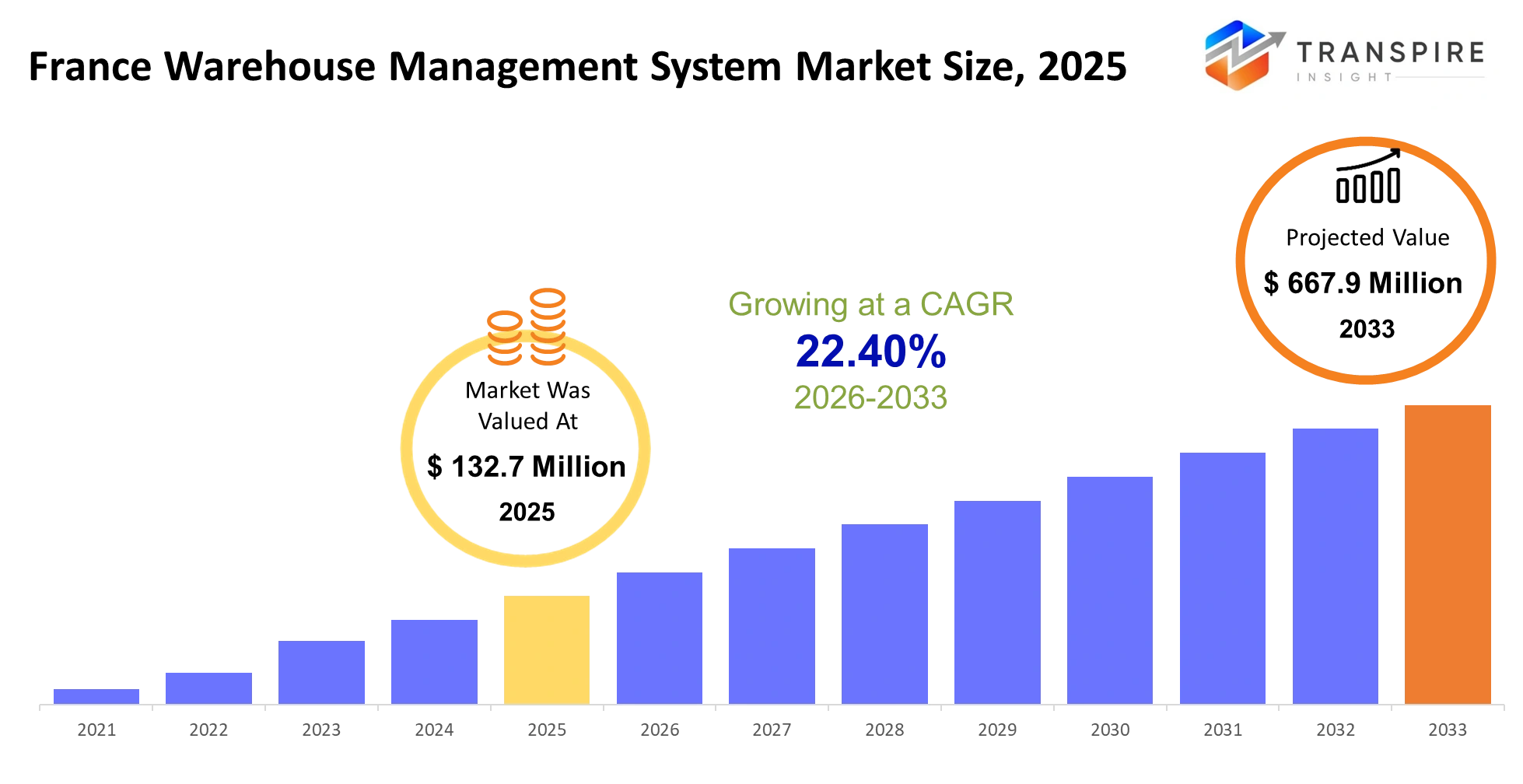
- France Warehouse Management System Market Size 2025: USD 132.7 Million
- France Warehouse Management System Market Size 2033: USD 667.9 Million
- France Warehouse Management System Market CAGR: 22.40%
- France Warehouse Management System Market Segments: By Type (Standalone WMS, Integrated WMS, Cloud-based WMS, Others); By Application (Inventory Management, Order Fulfillment, Labor Management, Yard Management, Others); By End-User (Logistics Companies, Retailers, Manufacturers, E-commerce Companies, Others); By Deployment (Cloud, On-premise, Hybrid, Others).
To learn more about this report,  Download Free Sample Report
France Warehouse Management System Market Summary
The France Warehouse Management System Market was valued at USD 132.7 Million in 2025. It is forecast to reach USD 667.9 Million by 2033. That is a CAGR of 22.40% over the period.
French warehouse operations use warehouse management systems to manage their inventory movements and their storage space and their fulfillment process between retail and manufacturing and e-commerce supply chains. The systems provide better operational efficiency through their ability to track goods between receipt and delivery while they optimize workforce distribution and their automated picking system. The market experienced a complete transformation during the past five years as customers abandoned on-premise software systems in favor of cloud-based AI-powered solutions which enabled them to deploy systems faster and connect with their robotic and IoT-based warehouse systems.
The COVID-19 pandemic created supply chain disruptions which affected free movement across warehouse spaces and forced businesses to create systems that would protect their operations from future digital failures. E-commerce growth led to businesses adopting automated decision systems because customers demanded faster delivery times. The present adoption process occurs because businesses need to maintain their operations at all times while decreasing their operational expenses which results in businesses changing their revenue model to subscription-based software and combined logistics systems.
Key Market Insights
- The France Warehouse Management System Market uses AI-powered inventory tracking and robotic systems for Warehouse Management System functions which enhance logistics operations by delivering precise results and faster order processing times.
- The cloud-based deployment model thrives in 2025 because it has achieved 55 percent market share which businesses prefer for its ability to grow and its cost-efficient infrastructure requirements.
- The SaaS-based WMS platforms which operate as the fastest-growing segment will experience rapid growth until 2033 across SME warehouse operators in France.
- The retail and e-commerce applications lead market demand with their combined market share of nearly 40 percent because they handle numerous orders and experience fulfillment challenges.
- The end-user category for third-party logistics (3PL) providers has become the most rapidly expanding segment because businesses increasingly rely on outsourced supply chain management solutions.
- Companies are forming more strategic alliances with robotics companies to develop automated systems for picking and sorting and managing warehouse vehicle operations.
- The European market now sees companies extending their cloud-native solutions to support increasing demand for international logistics services.
- AI forecasting tools now represent a standard practice which helps businesses achieve precise inventory levels while decreasing their expenses related to storing products in warehouses.
- The operational visibility of large distribution centers now receives enhancement from systems which integrate IoT sensors with real-time analytical capabilities.
What are the Key Drivers, Restraints, and Opportunities in the France Warehouse Management System Market?
The France Warehouse Management System Market experiences its primary growth because e-commerce logistics networks need real-time inventory visibility. Retailers and logistics providers need to shorten delivery times which has led to increased investment in cloud-based warehouse management systems and automation technology. Warehouses that use automated systems for their operations instead of manual methods will experience higher software usage and subscription-based revenue streams.
Warehouse operations face major challenges because existing systems require complex integration with traditional warehouse systems. The majority of mid-sized logistics companies in France continue to use outdated ERP systems and inventory management software which creates compatibility issues with modern cloud-based WMS solutions. The process of switching to new systems involves high initial costs and lengthy implementation periods which create risks of operational interruption that will prevent businesses from completing their digital transformation.
AI-enabled autonomous warehouse ecosystems present a powerful business opportunity. Machine learning technology combines with robotics and IoT sensors to create systems that can predict inventory locations and optimize space usage in real time. Major French industrial zones are starting to use AI-based picking systems which help logistics hubs decrease their need for human workers while increasing their operational capacity. Scalable SaaS-based WMS platforms enable 3PL providers to expand their operations throughout Europe because these platforms allow for quick implementation and standardized operational procedures across different countries.
What Has the Impact of Artificial Intelligence Been on the France Warehouse Management System Market?
AI technology is bringing major changes to warehouse operations in French warehouses through its ability to automate decision processes and execute predictive analytics and optimize logistics operations in real time. The automated warehouse management systems which use artificial intelligence technology now handle inventory distribution and route selection for picking operations and demand estimation processes which leads to decreased need for human work and improved accuracy of order fulfillment. Machine learning models use historical shipment data together with seasonal demand patterns to forecast necessary stock levels which helps to decrease both overstocking and stockouts at distribution centers.
AI implementation has enhanced warehouse operational efficiency by increasing throughput which occurs because task scheduling for personnel and robotic systems has been improved through optimization. Organizations use computer vision technology to track shelf space usage while simultaneously monitoring inventory discrepancies which boosts their operational efficiency. Predictive maintenance algorithms serve to identify upcoming failures which affect conveyor systems and automated storage equipment while they help to decrease operational downtime and boost system dependability.
The main challenge arises from the expensive and difficult process of implementing artificial intelligence solutions into existing warehouse systems which contain disjointed parts. The majority of operators struggle to maintain steady model performance because real-world warehouse conditions vary and supply chain systems provide different levels of data quality.
Key Market Trends
- The implementation of cloud-native warehouse management systems across major French logistics centers began to replace traditional on-premise systems during the year 2025.
- The application of AI-based demand forecasting systems enabled retailers to maintain accurate inventory levels which decreased their excess inventory problems at their large distribution centers.
- E-commerce businesses increased their automated warehouse systems because they needed efficient operations at their high-volume distribution centers located in urban areas.
- The use of robotics technology in major warehouses experienced a growth rate that exceeded 30 percent from 2023 until 2025 which resulted in better picking performance.
- The implementation of Software as a Service based Warehouse Management Systems by third-party logistics companies allowed them to operate their multi-client logistics operations in a more efficient manner.
- Real-time analytics dashboards became standard for monitoring warehouse performance and labor productivity metrics.
- The integration of IoT sensors enabled continuous tracking of goods movement across storage and dispatch systems.
- Software vendors and automation companies established strategic partnerships to create complete digital solutions for warehouse operations.
- The development of sustainability-oriented warehouse optimization systems enables facilities to decrease their energy use while achieving better space management efficiency.
France Warehouse Management System Market Segmentation
By Type
The France Warehouse Management System Market by type is shaped by a gradual shift from traditional standalone solutions toward more connected and scalable architectures. Smaller warehouses and regional distribution centers continue to use standalone WMS platforms because these systems meet their needs for basic inventory control while maintaining cost efficiency. Enterprises now require real-time system visibility and full supply chain system integration, which has reduced the usage of these systems. The increased use of integrated WMS solutions happens because these systems link warehouse operations with ERP and transportation and procurement systems which allow logistics operations to make synchronized decisions.
The market now trends toward cloud-based WMS systems because businesses need systems that enable remote access and fast system setup for their multiple warehouse locations. The model enables e-commerce operations and retail-driven logistics to scale quickly because their operations experience high demand changes. The "others" category contains hybrid and niche systems which specialized environments use to handle cold storage and regulated goods because these environments need customized workflows that standard platforms cannot provide. The market demonstrates a clear shift toward system designs that require extensive integration with existing systems and use cloud-based technology as their primary foundation.
By Application
French companies use warehouse management software to achieve faster and more precise operations throughout their high-volume supply networks. The main focus of inventory management exists because businesses need to track their inventory at all times to maintain smooth operations during retail restocking and industrial supply chain processes. Order fulfillment becomes essential because e-commerce and omnichannel retailing require warehouses to handle increased order volumes through shorter delivery times. The need for labor coordination systems has grown because warehouses now use automated systems which need optimal workforce scheduling and task distribution to achieve their productivity goals.
Yard coordination and related logistics control functions are gaining importance in large distribution hubs and port-linked facilities where inbound and outbound freight movement must be synchronized to avoid congestion and delays. Other applications such as returns processing and compliance tracking are becoming more relevant due to stricter regulatory requirements and rising reverse logistics in retail and electronics. These applications demonstrate the movement toward warehouse ecosystems which require real-time operational coordination between different functional areas to achieve optimal efficiency.

To learn more about this report, Download Free Sample Report
By End-User
User acceptance of the France Warehouse Management System Market depends on two main factors which are supply chain complexity and the size of their business operations. Logistics companies remain the primary users because they manage multiple client warehousing operations which require systems that can efficiently handle various types of inventory movements. Retailers also represent a major adoption base as they transition toward omnichannel distribution models that demand precise inventory synchronization between stores and warehouses. Manufacturers use warehouse systems mainly to align raw material flow with production schedules, which helps them maintain continuous operations while decreasing their downtime.
The increasing order volume and need for fast deliveries and automated fulfillment systems make e-commerce companies the most rapidly growing customer group. Their demand is accelerating investment in advanced warehouse automation and AI-driven optimization tools. Other end-users include healthcare distributors and specialty logistics operators who require high levels of traceability and compliance control, particularly in regulated storage environments. The adoption trend shows all segments of the market have started to implement digitalized data-driven warehouse systems which improve their capacity to respond to customer needs and their ability to operate efficiently.
By Deployment
The France Warehouse Management System Market experiences rapid deployment model changes because organizations need to find the ideal balance between their system requirements and their operational overhead needs while keeping their expenses under control. The main preferred solution for enterprises today is cloud deployment because it enables instant data retrieval and allows unified system management across different storage sites while decreasing initial hardware expenditure. The system receives particular preference from logistics networks and retail supply chains that require rapid growth because it enables expansion without requiring expensive IT development.
Organizations which operate large manufacturing facilities need on-premise systems because they operate in environments where data security needs and regulatory compliance requirements and legacy infrastructure limitations make cloud migration impossible. Hybrid deployment models are increasingly used as a transitional strategy, allowing companies to maintain critical on-site operations while gradually adopting cloud capabilities. The deployment methods used in highly automated warehouses include edge-based systems and distributed systems because these environments require local processing power to support their robotics and IoT systems. The market is moving toward hybrid digital infrastructure systems which enable centralized intelligence operations and localized control systems for their business operations.
What are the Key Use Cases Driving the France Warehouse Management System Market?
The primary driver behind the France Warehouse Management System market exists because enterprises need to track their inventory and manage order delivery through their retail operations and e-commerce distribution centers. The application leads the market because it helps businesses decrease picking mistakes while they increase their ability to monitor inventory and achieve faster delivery times in crowded city distribution networks.
Secondary use cases include cold chain warehouse coordination for pharmaceuticals and food distribution, where temperature-sensitive tracking is essential for compliance and product integrity. The manufacturing industry utilizes warehouse systems to control their production process by connecting storage with component handling operations which supply needed resources.
Autonomous warehouse robotics coordination and AI-driven slotting optimization represent new developments in warehouse operations. These systems find implementation within extensive logistics facilities and automated fulfillment centers, which operators use to decrease their need for workers while improving their operational output.
|
Report Metrics |
Details |
|
Market size value in 2025 |
USD 132.7 Million |
|
Market size value in 2026 |
USD 162.3 Million |
|
Revenue forecast in 2033 |
USD 667.9 Million |
|
Growth rate |
CAGR of 22.40% from 2026 to 2033 |
|
Base year |
2025 |
|
Historical data |
2021 - 2024 |
|
Forecast period |
2026 - 2033 |
|
Report coverage |
Revenue forecast, competitive landscape, growth factors, and trends |
|
Regional scope |
France |
|
Key company profiled |
Manhattan Associates, SAP, Oracle, Blue Yonder, Infor, IBM, Microsoft, HighJump, Tecsys, Fishbowl, Softeon, Epicor, Körber, Logiwa, 3PL Central. |
|
Customization scope |
Free report customization (country, regional & segment scope). Avail customized purchase options to meet your exact research needs. |
|
Report Segmentation |
By Type (Standalone WMS, Integrated WMS, Cloud-based WMS, Others); By Application (Inventory Management, Order Fulfillment, Labor Management, Yard Management, Others); By End-User (Logistics Companies, Retailers, Manufacturers, E-commerce Companies, Others); By Deployment (Cloud, On-premise, Hybrid, Others). |
Which Regions are Driving the France Warehouse Management System Market Growth?
The dense logistics infrastructure of Northern France, which connects major European trade corridors and provides access to Le Havre and Dunkirk ports, makes it the top region in France. Advanced warehouse orchestration systems face continuous demand because strong customs enforcement measures combined with high freight volumes require them. The region benefits from integrated industrial clusters that combine automotive, retail, and manufacturing supply chains. The ecosystem enables organizations to adopt automated warehouse technologies, which help them maintain smooth operations across international borders.
Central France maintains its economic growth through its various industrial sectors, which include aerospace production and agri-logistics and manufacturing distribution centers. The domestic supply chain system and company investments drive regional economic development, which differs from the international transit focus that drives growth in northern regions. Companies in this region choose to implement digital transformation at a slow pace, as they value system dependability more than immediate automation advancements. The established industrial operators create a stable requirement for warehouse management solutions, which they use to oversee their operations.
The southern region of France experiences its fastest growth period because Mediterranean ports like Marseille-Fos undergo modernization and logistics corridors receive more investment to connect with Spain and Italy. The implementation of recent infrastructure improvements together with EU-supported freight digitization initiatives has led to increased warehouse automation deployment. The transition to smart port logistics systems and renewable-energy-powered industrial zones results in heightened market requirements. The period from 2026 to 2033 will show strong growth in this area because of ongoing modernization efforts and increasing trade activities.
Who are the Key Players in the France Warehouse Management System Market and How Do They Compete?
The France Warehouse Management System Market is moderately consolidated, with strong influence from global enterprise software vendors competing against agile cloud-native specialists. Competition exists because organizations want sophisticated technology solutions which can connect to their ERP systems and provide quick implementation results without needing to pay for their services. Established players protect their market share through their extensive enterprise connections which they established with their enterprise relationships, while new market entrants choose to concentrate on creating flexible SaaS solutions which they can implement without needing long deployment times.
SAP establishes its competitive position through its ability to connect ERP systems with warehouse management systems, which allows companies to track their warehouse operations until they reach the finance department, who control their inventory across manufacturing and retail sectors. Oracle develops its competitive advantage through its cloud scalability capabilities and its unified supply chain systems which enable global logistics companies to implement identical operational procedures throughout different geographical areas. Manhattan Associates establishes its market differentiation by providing superior omnichannel fulfillment optimization capabilities which benefit both retail stores and e-commerce businesses through their warehousing operations.
Blue Yonder strengthens its market position in automated distribution centers by using AI-driven forecasting and labor optimization tools which enhance warehouse operational capabilities. Körber competes through end-to-end automation integration, which combines its software products with robotics systems and material handling equipment. Infor expands its business activities by developing dedicated cloud solutions for various industries which it provides to mid-sized logistics companies that need quick implementation and easy system adjustment.
Company List
- Manhattan Associates
- SAP
- Oracle
- Blue Yonder
- Infor
- IBM
- Microsoft
- HighJump
- Tecsys
- Fishbowl
- Softeon
- Epicor
- Körber
- Logiwa
- 3PL Central
Recent Development News
In January 2026, SAP announced expansion of its SAP Digital Supply Chain portfolio with enhanced AI-enabled warehouse orchestration features. The update focuses on improving real-time inventory accuracy and automation in large European distribution centers.https://www.sap.com
In November 2025, Manhattan Associates launched an upgraded cloud-native warehouse management platform with expanded robotics integration capabilities. The release targets high-volume retail and e-commerce logistics operators across Europe.https://www.manh.com
What Strategic Insights Define the Future of the France Warehouse Management System Market?
The France Warehouse Management System Market is structurally shifting toward fully autonomous, cloud-native logistics ecosystems where software, robotics, and predictive intelligence operate as a unified system. The increasing need for faster delivery services together with the growing use of cross-border e-commerce in European supply chains is driving this transition.
High-throughput warehouse operations face hidden risks because organizations depend on complex cloud ecosystems which create major disruptions during system outages and vendor lock-in situations in time-sensitive retail logistics.
An emerging opportunity is the integration of AI-driven autonomous micro-fulfillment centers in urban zones, which will decrease the need for large centralized warehouses. This trend is gaining traction as real estate costs rise in metropolitan logistics hubs.
Market participants need to adopt modular WMS systems which can integrate with robotics and third-party logistics platforms and grow without requiring complete system upgrades.
France Warehouse Management System Market Report Segmentation
By Type
- Standalone WMS
- Integrated WMS
- Cloud-based WMS
- Others
By Application
- Inventory Management
- Order Fulfillment
- Labor Management
- Yard Management
- Others
By End-User
- Logistics Companies
- Retailers
- Manufacturers
- E-commerce Companies
- Others
By Deployment
- Cloud
- On-premise
- Hybrid
- Others
Frequently Asked Questions
Find quick answers to common questions.
The estimated 2033 market size figure in USD 667.9 Million.
Key segments for the France Warehouse Management System Market are By Type (Standalone WMS, Integrated WMS, Cloud-based WMS, Others); By Application (Inventory Management, Order Fulfillment, Labor Management, Yard Management, Others); By End-User (Logistics Companies, Retailers, Manufacturers, E-commerce Companies, Others); By Deployment (Cloud, On-premise, Hybrid, Others).
Major France Warehouse Management System Market players are Manhattan Associates, SAP, Oracle, Blue Yonder, Infor, IBM, Microsoft, HighJump, Tecsys, Fishbowl, Softeon, Epicor, Körber, Logiwa, 3PL Central.
The France Warehouse Management System Market size is USD 132.7 Million in 2025.
The France Warehouse Management System Market CAGR is 22.40% from 2026 to 2033.
- Manhattan Associates
- SAP
- Oracle
- Blue Yonder
- Infor
- IBM
- Microsoft
- HighJump
- Tecsys
- Fishbowl
- Softeon
- Epicor
- Körber
- Logiwa
- 3PL Central
Recently Published Reports
-
Apr 2026
3D Optical Profiler Market
3D Optical Profiler Market Size, Share & Analysis Report By Type (Desktop 3D Optical Profiler, and Portable 3D Optical Profiler), By Technology (Confocal Technology, and White Light Interference), By End-Use Industry (Manufacturing, Research Institutions, Automotive, Aerospace and Defense, Medical Devices, and Other), and Geography (North America, Europe, Asia-Pacific, Middle East and Africa, South and Central America), 2021 - 2031
-
Apr 2026
Depth Sensor Market
Depth Sensor Market Size, Share & Analysis Report By Type (Infrared Depth Sensors, Time-of-Flight (ToF) Sensors, Stereo Vision Sensors, Structured Light Sensors, Ultrasonic Depth Sensors), By Application (Automotive, Robotics, Gaming, Consumer Electronics, Industrial Automation, Healthcare, Security & Surveillance, Others), By End Users (Automotive Manufacturers, Consumer Electronics Companies, Healthcare Providers, Industrial Companies, Security Agencies, Gaming Companies, Robotics Companies, Others), and Geography (North America, Europe, Asia-Pacific, Middle East and Africa, South and Central America), 2021 – 2031
-
Apr 2026
Digital Manufacturing Market
Digital Manufacturing Market Size, Share & Analysis Report By Component (Hardware, Software, and Services), By Technology (Robotics, 3D Printing, Internet of Things (IoT), and Others), By Application (Automotive and Transportation, Aerospace and Defense, Consumer Electronics, Industrial Machinery, and Others), By Process Type (Computer-Based Designing, Computer-Based Simulation, Computer 3D Visualization, Analytics, and Others), and Geography (North America, Europe, Asia-Pacific, Middle East and Africa, South and Central America), 2021 – 2031
-
Apr 2026
Digital Visa Services Market
Digital Visa Services Market Size, Share & Analysis Report By Type (Individual Travelers, Group Travelers), By Application (Tourism, Business Travel, Others), and Geography (North America, Europe, Asia-Pacific, Middle East and Africa, South and Central America), 2021 – 2031