
Global Acoustic Sensors Market Size & Forecast:
- Global Acoustic Sensors Market Size 2025: USD 1.77 Billion
- Global Acoustic Sensors Market Size 2033: USD 3.445 Billion
- Global Acoustic Sensors Market CAGR: 8.7%
- Global Acoustic Sensors Market Segments: By Type (Piezoelectric Acoustic Sensors, MEMS Acoustic Sensors, Fiber Optic Acoustic Sensors, Ultrasonic Acoustic Sensors, Surface Acoustic Wave Sensors, Underwater Acoustic Sensors, Others); By Application (Industrial Monitoring, Automotive Safety, Consumer Electronics, Defense & Surveillance, Healthcare Diagnostics, Others); By End-User (Industrial Manufacturers, Automotive OEMs, Defense Organizations, Healthcare Providers, Others); By Connectivity (Wired Sensors, Wireless Sensors, IoT-integrated Sensors, Smart Sensors, Others)

To learn more about this report,  Download Free Sample Report
Global Acoustic Sensors Market Summary:
Acoustic Sensor Market Size Forecast Analysis shows that in 2025, it is expected to be around USD 1.77 billion, and by 2033, it is projected to be around USD 3.445 billion with a CAGR of 8.7%.
These acoustic sensors use very high-frequency sound waves on surfaces to detect changes in real-world parameters such as pressure, temperature, and chemical composition in their vicinity. It is worth noting that this component, over the past three to five years, has evolved from a mere tool used in industry to an essential part of mainstream connected gadgets.
This is mainly driven by the need to create an infrastructure that integrates physical spaces into the network. A major driving force behind this trend is the quest for new solutions for healthcare needs. This calls for components that can be embedded within devices, hence the increased preference for Surface Acoustic Wave technology.
Key Market Insights:
The Global Acoustic Sensors Market trends lean towards small size, high-sensitivity models that can be integrated into IoT platforms to give immediate results. As a result of increased interest in environmental sensing and precise factory automation, companies are distancing themselves from standalone tools in favour of real-time monitoring systems used in the healthcare industry, biotech, and food safety applications.
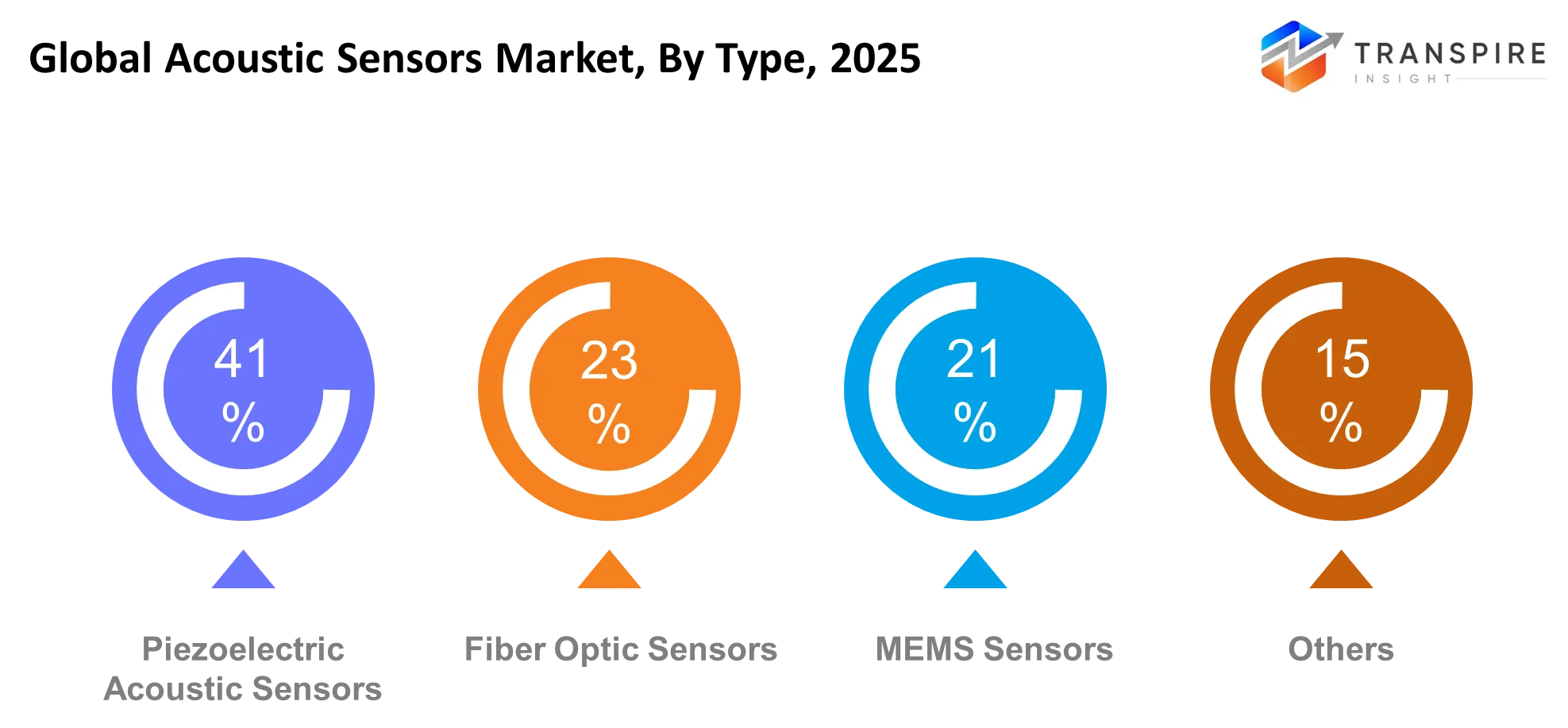
- The component manufacturers are making enhancements in crystalline substrates for Piezoelectric Acoustic Sensors to gain a 41% market segment and prevent heating effects while monitoring machines.
- Silicon factories are integrating micromachining and electronics to accelerate the development of MEMS Acoustic Sensors at a CAGR of 13.5%, the fastest-growing sub-segment for electronic gadgets.
- The engineering firms are incorporating Fibre Optic Sensors into 23% of the total market to protect the accurate acoustic signals from significant electrical disturbances.
- The chip designers are developing multiple-axis configurations for MEMS Sensors to achieve a 21% market presence by integrating bulk wave structures on small boards.
- The research facilities are designing alternate surface acoustic wave structures for the remaining 15% market segment known as Others, due to stringent environmental regulations
- The hardware designers are reducing the size of the whole device to fit it within the restricted healthcare and biology testing equipment.
- The connected-hardware suppliers are connecting the surface and bulk acoustic wave systems in wireless networks to convert their separate signals into constant feeds.
What are the Key Drivers, Restraints, and Opportunities in the Global Acoustic Sensors Market?
Drivers
Industrial players and automobile manufacturing firms have started adopting automation in addition to constant monitoring of assets to avoid any breakdown of equipment. Introduction of wireless industrial systems and connected machines that can only function with field devices that can work independently in remote locations. As the sensors work autonomously, they do not require constant electricity to collect information and also do not require batteries at all. This saves a lot of money on electricity maintenance and directly boosts rapid deployment and increased orders.
Restraints
Increased manufacturing cost and complex procedures are involved while integrating sensors with existing infrastructure. Fabrication of both Surface Acoustic Wave (SAW) and Body Acoustic Wave (BAW) components requires cleanroom conditions along with precision of materials used.
Opportunity
The enforcement of stricter international environmental laws, together with increasing demand from businesses for rapid medical testing at the point-of-care. By incorporating such highly advanced sensors into wearable medical diagnostic belts or municipal air quality monitors, there emerges a completely new source of potential commercial income beyond the boundaries of traditional factories. Such advanced technology would allow urban municipalities and medical experts to receive real-time information about particular biomarkers or chemicals without sending out any samples to laboratories.
What Has the Impact of Artificial Intelligence Been on the Global Acoustic Sensors Market?
Computer software enables these acoustic sensors to function as intelligent diagnostic devices. Since analysis takes place directly within the processors of sensors themselves, automation is made possible. Sound detection and categorization into specific events, such as pipeline cracks and urban noises, is automatically performed. Optimization allows for filtering out noise from the outset.
Factory settings can benefit greatly from the predictive powers that such sensors provide to the constant monitoring of sound. Software keeps track of high-frequency sounds to detect any potential machine malfunction or leakages before they happen. This enhances productivity while saving on maintenance expenditure.
An using acoustic sensors in factories is the high setup costs involved. Connecting these new technology-enabled sensors to existing factory equipment involves considerable complexity. Ensuring that older equipment will be able to accept, interpret, and display sensor input data requires a great deal of custom coding. In February 2026, A complete global market analysis revealed that the implementation of artificial intelligence and machine learning techniques within acoustic sensors is the main growth driver for the industry, enabling its projected value to reach $3.56 billion.
Key Market Trends:
- The operators at factories are opting for acoustic systems without batteries instead of battery-operated nodes to reduce maintenance costs.
- Product designers have been incorporating Surface Acoustic Wave technology to achieve greater accuracy of signals at reduced costs of production.
- Telecommunications experts have started using Bulk Acoustic Wave elements in their products due to their ability to work at high frequencies.
- Military, automotive, and industry personnel are opting for rugged acoustic sensors as opposed to delicate gauges that cannot withstand extreme temperatures
- Consumer electronics firms are increasingly embracing micro-components to incorporate sensor functionalities in their slim electronics product
- Manufacturing facilities are substituting manual machine examinations with automatic data flows that directly enter the factory networks.
- Maintenance personnel in the field have opted for monitoring passive data flows rather than carrying out emergency repairs.
Global Acoustic Sensors Market Segmentation
By Type
Piezoelectric acoustic sensors have taken up the first place in terms of global market segment-wise revenue share by grabbing an impressive 41% share of the market, whereas the second position in terms of infrastructure block goes to the fibre optic sensors, having a revenue share of 23%, followed by MEMS sensors taking up an estimated market segment of 21%. In this regard, the remaining 15% goes to the other infrastructure block that includes ultrasonic acoustic sensors, surface acoustic wave sensors, and underwater acoustic sensors. Amongst all these sensor categories, MEMS acoustic sensors emerge as the dominating, fastest-growing sub-segment in the industry with a CAGR of 13.5%.
This is due to the fact that the growth factor for each of the different hardware types is based upon varying material physics along with their application environments. This is because silicon micro-machined architectures and surface wave structures benefit from shrinkage due to decreased manufacturing cost and power consumption and thus make suitable candidates in small electronic devices and miniature circuits. Similarly, lengthy fibre optics and large submarine underwater acoustic sensors benefit from the ability to provide total immunity from strong electromagnetic interferences and withstand high-pressure corrosive ocean water environments.
In terms of future trends, the change in the terrain for this kind of product would be based on rugged materials that can withstand very harsh working conditions. In cases where there is a lot of heavy machinery and factories with transmission systems operating at extremes of temperatures, buyers will move towards high-grade composite material bases and co-fired ceramic casing to ensure accuracy of readings.
To learn more about this report, Download Free Sample Report
By Application
From an application point of view, it is worth highlighting that the field sees a very dispersed geographical presence spanning the following industries. Industrial Monitoring, Automotive Safety, Consumer Electronics, Defence & Surveillance, Healthcare Diagnostics, and others. The diversification among those segments allows sensors a strong financial security due to stable market demand, even during sudden economic drops through safety systems, civic installations, and consumer electronics.
As far as the reasons behind the growth in these sectors, one can note the fundamental shift towards predictive maintenance from the post-failure reactive approach. Rather than collecting data on the general ambient sound, the current setup relies on capturing small structural frequency changes to detect malfunctioning components before they break down in vehicles and plants' chassis, while healthcare facilities adopt the same technology to develop patient monitoring wearable devices, including electronic stethoscopes or biometric skin patches.
On a general long-term scale, what comes out of the above fields' implementation is that localised sound collection capabilities will become an important part of larger smart city grids. Sound nodes will be used in massive traffic and security networks, able to detect congestion zones, sound pollution, as well as urgent events like gunshot or sirens.
By End-User
Institutionally, the key buyers' market has its base dominated by large procurement organisations, including such as Industrial Manufacturers, Automotive OEMs, Defence, and Healthcare institutions, with Others as the secondary buyers. In such a particular business environment, the companies get assured of stable long-term supply agreements and pay much attention to parts that ensure field reliability over long periods.
Buyers' rationale in the above case depends on tightened compliance and worldwide manufacturing requirements. For industrial and defence buyers, establishing listening arrays is required as per law for compliance with international testing regulations, whereas the high-volume purchases coming from automotive OEMs are linked to the introduction of electric cars and driver assistance systems worldwide, with sound elements replacing silence from electric engines and ensuring protection of the battery vault walls.
Going ahead, buyers will face problems related to limited supply lines of raw materials and multilayered calibrations. Corporate purchasers will require complete traceability of the history of every item and its complete tracking, making for a market transition to full-service manufacturers, which would provide total visibility of the parts at their origin as well as in the field.
By Connectivity
The connectivity dimensions involve systematic separation of paths for data transmission into Wired Sensors, Wireless Sensors, IoT-integrated Sensors, and Smart Sensors, with legacy connections that can be regarded as Others. The ratio in such a combination helps to reconcile the need for extreme reliability for data in older legacy plants and the extreme flexibility needed by the contemporary remote monitoring systems.
The expansion rationale of this dimension is completely dependent upon physical installation costs versus data transmission speed. Wireless and IoT-integrated circuits expand very fast due to their complete absence of the costly physical cable installations, which allows firms to quickly rewire existing structures without spending millions of dollars on protective pipelines, whereas the wired systems are used only in situations when a reliable energy supply at a vibration-intensive plant and absolute absence of wireless connections become mandatory.
The future architecture of this data pipeline suggests a huge revamp of the design of the sensor node, replacing the outdated passive devices used in data forwarding with more sophisticated nodes capable of performing data processing at the edge. Filtering background noise and triggering events directly within the chip will eliminate the necessity for external network resources and protect data flow from disruption due to wireless network disconnection issues.
What are the Key Use Cases Driving the Global Acoustic Sensors Market?
As one of the most dominant manufacturing sectors in the industry, this sector uses acoustic sensors to maintain machines. With the ability to detect high-frequency acoustic vibrations generated by equipment such as pumps and turbines, it becomes possible to notice the presence of cracks or other forms of damage that could lead to machinery failure
The rapidly growing automotive and consumer electronics industries employ MEMS microphones to ensure better product performance and customer safety. Acoustic sensors help detect emergency sirens as part of driver assistance systems, multi-zone vehicle voice command systems, and active noise reduction systems for smartphones.
Some applications within the healthcare and infrastructure sectors involve the use of optical fibre DAS technology. The application of fibre optics is used to detect vehicle speeds along highways and pipeline breaks over several miles. Biomedical sensors are also useful for heart rate and respiration detection through non-contact technology.
|
Report Metrics |
Details |
|
Market size value in 2025 |
USD 1.77 Billion |
|
Market size value in 2026 |
USD 1.921 Billion |
|
Revenue forecast in 2033 |
USD 3.445 Billion |
|
Growth rate |
CAGR of 8.7% from 2026 to 2033 |
|
Base year |
2025 |
|
Historical data |
2021 - 2024 |
|
Forecast period |
2026 - 2033 |
|
Report coverage |
Revenue forecast, competitive landscape, growth factors, and trends |
|
Regional scope |
United States; Canada; Mexico; United Kingdom; Germany; France; Italy; Spain; Denmark; Sweden; Norway; China; Japan; India; Australia; South Korea; Thailand; Brazil; Argentina; South Africa; Saudi Arabia; United Arab Emirates |
|
Key company profiled |
Honeywell, Bosch Sensortec, STMicroelectronics, Analog Devices, TE Connectivity, Murata Manufacturing, Siemens, Brüel & Kjær, Knowles Corporation, Infineon Technologies, CTS Corporation, Qualcomm, TDK Corporation, Emerson Electric, OmniVision |
|
Customization scope |
Free report customization (country, regional & segment scope). Avail customized purchase options to meet your exact research needs. |
|
Report Segmentation |
By Type (Piezoelectric Acoustic Sensors, MEMS Acoustic Sensors, Fiber Optic Acoustic Sensors, Ultrasonic Acoustic Sensors, Surface Acoustic Wave Sensors, Underwater Acoustic Sensors, Others); By Application (Industrial Monitoring, Automotive Safety, Consumer Electronics, Defense & Surveillance, Healthcare Diagnostics, Others); By End-User (Industrial Manufacturers, Automotive OEMs, Defense Organizations, Healthcare Providers, Others); By Connectivity (Wired Sensors, Wireless Sensors, IoT-integrated Sensors, Smart Sensors, Others) |
Which Regions are Driving the Global Acoustic Sensors Market Growth?
North America
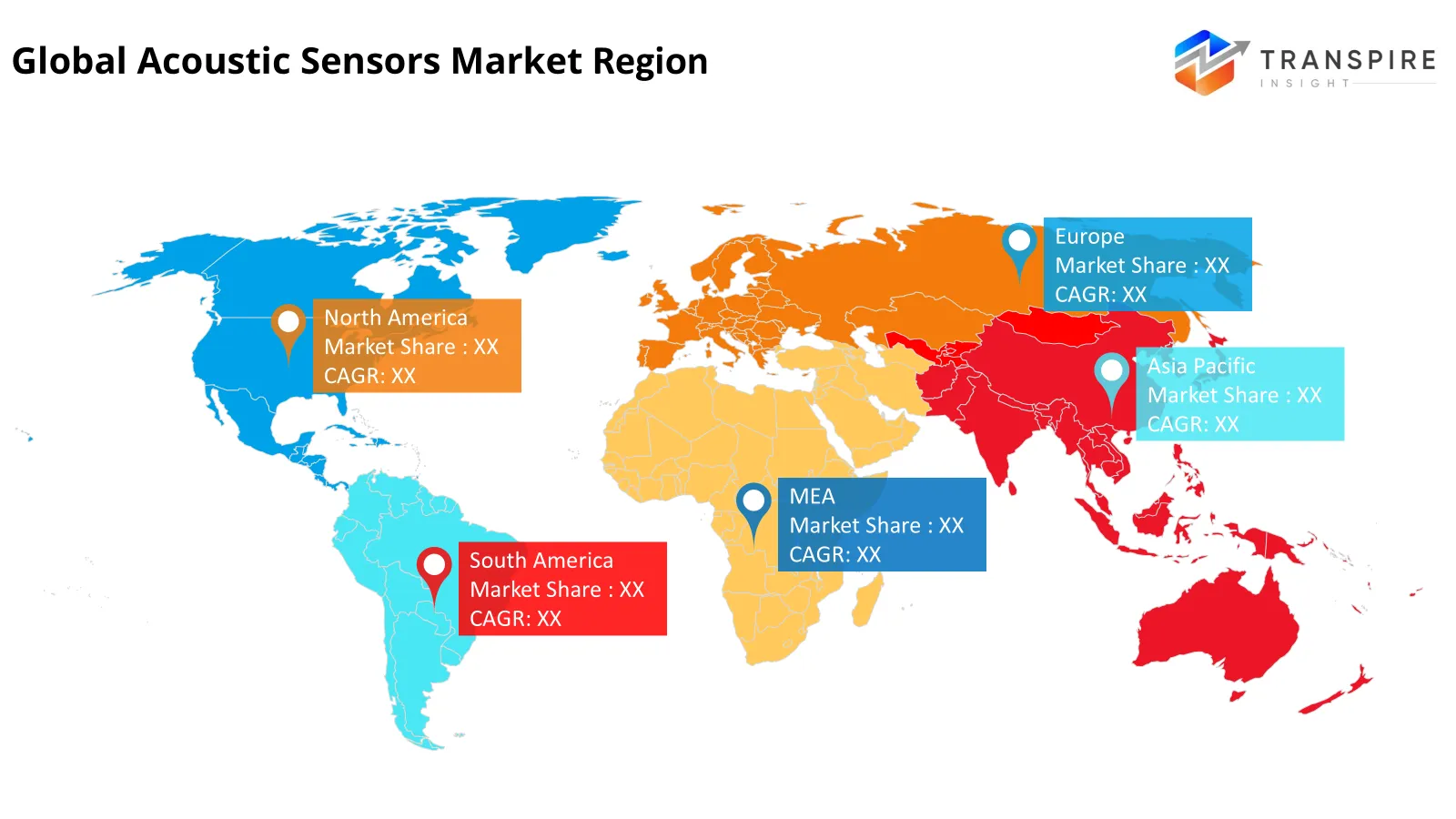
The North American region is growing fastest, with 36% of the market share, and the region grows at a compound annual growth rate (CAGR) of 14.1%. The region stands out due to its growth rate, which is increasing very quickly because of new developments being made rapidly in the technology field in areas such as the internet of things, automobiles, and health care. The rapid growth in this region will continue due to major investments being made in infrastructure, among others. In February 2026, Telecom equipment manufacturers throughout the country increased the installation of BAW filters significantly as a way of addressing issues related to signal filtration in the extended 5G infrastructure network towers.
Europe
Europe is considered the second region in this context, taking up 24% market share in this region. The top Asian market uses the approach of heavy reliance on factory output, whereas Europe mainly focuses on stringent regulations for safety and environmental considerations to retain its position in the industry. Such eco-friendly measures and manufacturing systems ensure that the industry remains stable in the long run. While companies from Europe concentrate on satisfying such strict standards, other countries occupy the remaining 9% market share. In April 2026, European manufacturers of semiconductors, namely STMicroelectronics and Infineon Technologies, introduced MEMS acoustic sensors designed to monitor emissions and provide automotive safety features by expanding their range of industrial sensors.
Asia-Pacific
Asia-Pacific emerges as the leading market force due to its possession of 31% of the world's share. The firm position is enabled through the adoption of advanced factory automation and smart cities. The governments of countries such as China and Japan have been keen to promote such developments through investment in research and technology. In addition, the electronics industry has contributed immensely to the rise of demand within the region. In May 2026, the Japanese components maker Murata Manufacturing unveiled its ultra-thin contact acoustic sensor module that utilises highly sensitive piezoelectric components to detect low-frequency vibrations of equipment for proactive maintenance in factories.
To learn more about this report, Download Free Sample Report
Who are the Key Players in the Global Acoustic Sensors Market, and how do they Compete?
Acoustic sensors represent a somewhat fragmented industry, where the focus of competition has changed from price to technology. In order to mitigate global disruptions in the supply chain, local production facilities are used. Additionally, larger companies employ mergers and acquisitions as a means to increase their market presence.
The innovation strategy pursued by Texas Instruments entails differentiation through fundamental breakthroughs in sensor technology while leveraging expansion through intensive R&D efforts. Qualcomm uses an innovation strategy for differentiation through sensors embedded in smart vehicles. The company drives its growth through partnerships in the automotive industry.
The digital transformation strategy used by Honeywell allows for differentiation due to the high reliability and energy efficiency of the solutions provided. This company drives its expansion through releasing dedicated product lines designed for use in industrial conditions. Finally, the niche innovation strategy employed by STMicroelectronics involves differentiation in the hardware through artificial intelligence and analytical capabilities of devices.
Global Acoustic Sensors Market companies
- Honeywell
- Bosch Sensortec
- STMicroelectronics
- Analog Devices
- TE Connectivity
- Murata Manufacturing
- Siemens
- Brüel & Kjær
- Knowles Corporation
- Infineon Technologies
- CTS Corporation
- Qualcomm
- TDK Corporation
- Emerson Electric
- OmniVision
Recent Development News
In September 2025, the Honeywell 13MM Pressure Sensor, aimed at the ultra-high-purity industry and semiconductor manufacturing, was launched. The development of such products is important because there is a great demand for accurate measurement devices that help avoid contamination and maximise yields.
In July 2025, STMicroelectronics made an acquisition of NXP Semiconductors’ MEMS sensor division, which was meant to boost its technology offerings. The acquisition will enhance STMicroelectronics’ ability to develop new innovations in sensor-based decision-making due to increased resources from the acquisition.
What Strategic Insights Define the Future of the Global Acoustic Sensors Market?
The acoustic sensor industry globally is making the shift from being a pure hardware-based business segment to becoming more sophisticated and software-based. Industry growth drivers include the increasing adoption of networked internet devices, high-speed telecommunication equipment, and advanced automotive safety features. As the industry matures, players have started emphasising incorporating predictive intelligence and high-frequency wave processing capabilities to add value to their solutions.
Network-connected sensors have inherent vulnerability due to the threat posed by cyberattacks. The need to ensure the security of such sensitive endpoints through encryption techniques results in considerable spending, thus driving up the cost of projects for industrial organisations. Distribution of acoustic sensing solutions can be a profitable opportunity in the market. Re-engineering the existing fibre-optics cables into vibration sensors enables companies to perform diagnostics of pipeline and power grid infrastructure without having to install any additional hardware.
Firms have to embrace the "sensing-as-a-service" approach. It involves offering customers bundled software-based services along with their hardware. This ensures that the company derives predictable revenue streams, thereby avoiding commoditization.
Global Acoustic Sensors Market Report Segmentation
By Type
- Piezoelectric Acoustic Sensors
- MEMS Acoustic Sensors
- Fiber Optic Acoustic Sensors
- Ultrasonic Acoustic Sensors
- Surface Acoustic Wave Sensors
- Underwater Acoustic Sensors
By Application
- Industrial Monitoring
- Automotive Safety
- Consumer Electronics
- Defence & Surveillance
- Healthcare Diagnostics
By End-User
- Industrial Manufacturers
- Automotive OEMs
- Defense Organizations
- Healthcare Providers
By Connectivity
- Wired Sensors
- Wireless Sensors
- IoT-integrated Sensors
- Smart Sensors
Regional Outlook
North America
- United States
- Canada
- Mexico
Europe
- Germany
- United Kingdom
- France
- Spain
- Italy
- Rest of Europe
Asia Pacific
- Japan
- China
- Australia & New Zealand
- South Korea
- India
- Rest of Asia Pacific
South America
- Brazil
- Argentina
- Rest of South America
Middle East & Africa
- Saudi Arabia
- United Arab Emirates
- South Africa
- Rest of the Middle East & Africa
Frequently Asked Questions
Find quick answers to common questions.
The approximate Global Acoustic Sensors Market size for the market will be USD 3.445 Billion in 2033.
Key segments for the Global Acoustic Sensors Market are By Type (Piezoelectric Acoustic Sensors, MEMS Acoustic Sensors, Fiber Optic Acoustic Sensors, Ultrasonic Acoustic Sensors, Surface Acoustic Wave Sensors, Underwater Acoustic Sensors, Others); By Application (Industrial Monitoring, Automotive Safety, Consumer Electronics, Defense & Surveillance, Healthcare Diagnostics, Others); By End-User (Industrial Manufacturers, Automotive OEMs, Defense Organizations, Healthcare Providers, Others); By Connectivity (Wired Sensors, Wireless Sensors, IoT-integrated Sensors, Smart Sensors, Others).
Major Global Acoustic Sensors Market players are Honeywell, Bosch Sensortec, STMicroelectronics, Analog Devices, TE Connectivity, Murata Manufacturing, Siemens, Brüel & Kjær, Knowles Corporation, Infineon Technologies, CTS Corporation, Qualcomm, TDK Corporation, Emerson Electric, OmniVision.
The Global Acoustic Sensors Market size is USD 1.77 Billion in 2025.
The Global Acoustic Sensors Market CAGR is 8.7%
- Honeywell
- Bosch Sensortec
- STMicroelectronics
- Analog Devices
- TE Connectivity
- Murata Manufacturing
- Siemens
- Brüel & Kjær
- Knowles Corporation
- Infineon Technologies
- CTS Corporation
- Qualcomm
- TDK Corporation
- Emerson Electric
- OmniVision
About the Authors

Avinash Kumar
I’m Avinash Kumar, a Senior Research Analyst at Transpire Insight, with expertise in the Electronics and Semiconductor and Energy & Power industry. My work focuses on analyzing emerging technologies, market trends, industry developments, and innovation across these sectors. I specialize in transforming complex technical and market insights into clear, research-backed content that helps professionals, businesses, and decision-makers stay informed. Through continuous industry research and data-driven analysis, I strive to deliver accurate, reliable, and practical perspectives on the latest advancements shaping the semiconductor and energy landscape.

Chakradhar Khansole
Chakradhar serves as the Research Director at Transpire Insight, bringing over 8 years of experience in technology, innovation, and strategic market intelligence. He specializes in transforming complex market data into actionable business insights that enable organizations to make informed, growth-oriented decisions. Recognized for his strategic vision and analytical expertise, Chakradhar leads high-impact research initiatives, delivering comprehensive market assessments, competitive intelligence, and forward-looking industry analysis.
Recently Published Reports
-
Apr 2026
Fiber Optic Faceplates Market
Fiber Optic Faceplates Market Size, Share & Analysis Report By Type (< 300 mm2, 300-350 mm2, and > 350 mm2, By Application (Night Vision, Holographic Imaging, Medical, and Others), and Geography (North America, Europe, Asia-Pacific, Middle East and Africa, South and Central America), 2021 - 2031
-
Apr 2026
High Temperature Superconductors Market
High Temperature Superconductors Market Size, Share & Analysis Report By Type (1G HTS, and 2G HTS), By Application (Power Cable, Fault Current Limiter, and Transformer), and Geography (North America, Europe, Asia-Pacific, Middle East and Africa, South and Central America), 2021 - 2031
-
Apr 2026
Industrial Plugs and Socket Market
Industrial Plugs and Socket Market Size, Share & Analysis Report By Type (Industrial Plugs, Industrial Sockets), By Current (Up to 32 A, 32 to 125 A, Above 125 A), By Protection (Dustproof and Splash Proof, Waterproof, Explosion Proof), By End User (Heavy Industries, Oil and Gas, Chemicals and Pharmaceuticals, Power Generation, Others), and Geography (North America, Europe, Asia-Pacific, Middle East and Africa, South and Central America), 2021 - 2031
-
Apr 2026
InGaAs Avalanche Photodiodes Market
InGaAs Avalanche Photodiodes Market Size, Share & Analysis Report By Type (1100 - 1700 nm, and 1000 - 1600 nm), By Application (Missile Warning System, Muzzle Flash Detection, Wafer Defect Inspection, Laser Rangefinders, and Others), and Geography (North America, Europe, Asia-Pacific, Middle East and Africa, South and Central America), 2021 - 2031