

Asia Pacific Smart Greenhouse Market Summary
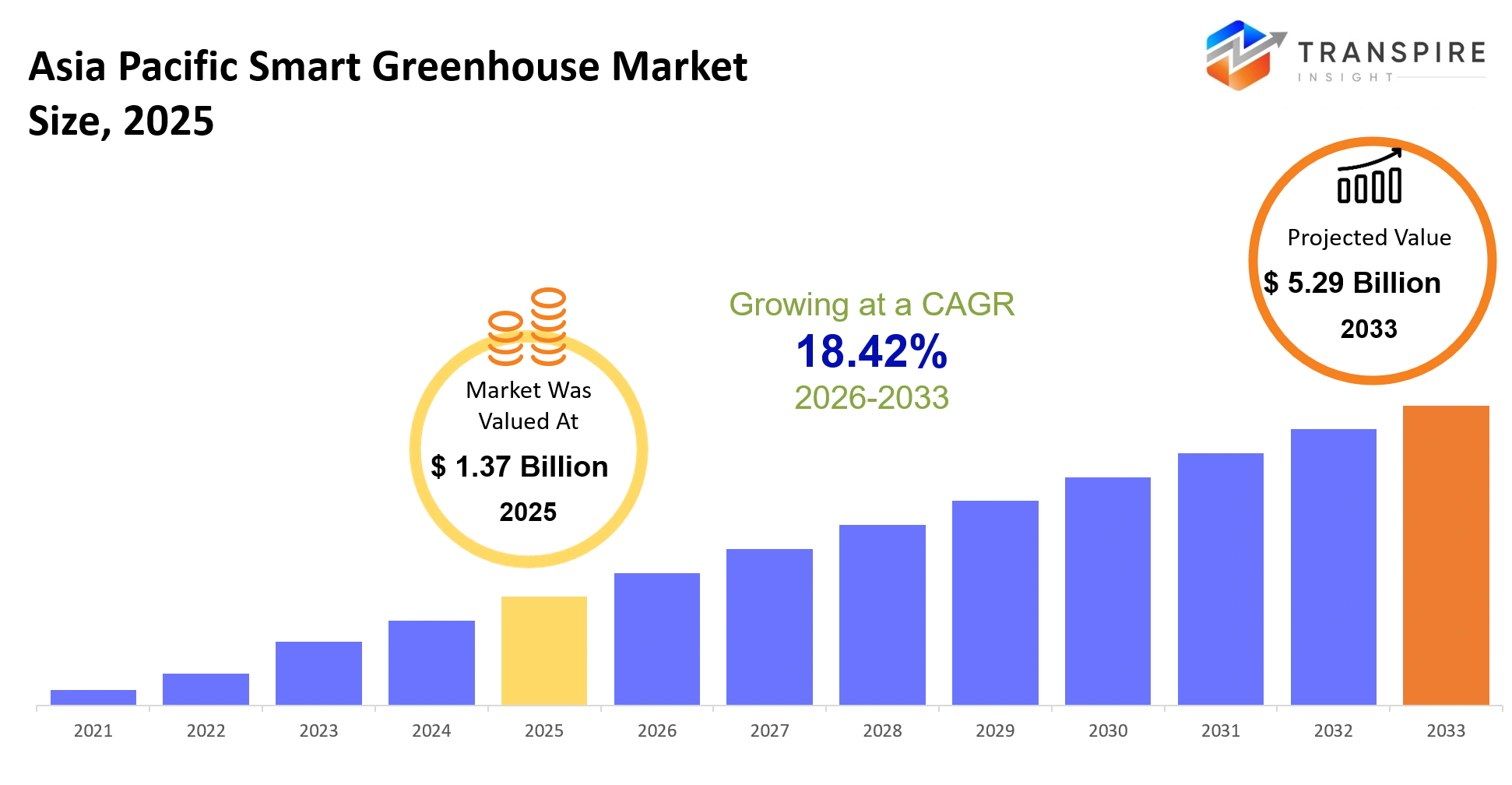
As per Transpire Insight Analysis the Asia Pacific Smart Greenhouse Market size is estimated at USD 1.37 Billion in 2025 and is anticipated to reach USD 5.29 Billion by 2033, growing at a CAGR of 18.42% from 2026 to 2033.
In the Asia Pacific Smart Greenhouse Market , growers can end up producing high-quality crops across the whole year, kinda by blending climate control, irrigation, lighting, and monitoring capabilities into tightly managed cultivation spaces. With these setups they cut down reliance on weather that is hard to predict. At the same time, they boost efficiency of water and other resources, and commercial producers are better able to keep output steadier even when land space is tight and climate swings around. Over the last five years the market kinda moved away from just standalone greenhouse hardware to more integrated digital platforms, that link sensors with automation, plus data analytics. That change really picked up after the COVID-19 pandemic showed weaknesses in regional food supply chains, and it pushed governments to lean harder into domestic production. Now, as growers chase better productivity but with less water , less energy, and less labor required, money has been flowing toward “smart” greenhouse infrastructure. This shift is also opening up repeating revenue for technology providers software developers, and equipment manufacturers while pushing modernization across protected agriculture across Asia Pacific.
Asia Pacific Smart Greenhouse Market Size & Forecast:
- Asia Pacific Smart Greenhouse Market Size 2025: USD 1.37 Billion
- Expected Market Value 2033: USD 5.29 Billion
- Forecast CAGR: 18.42%
- Leading region in 2025:
- Fastest Growing region:
- Key Profile: Netafim, Richel Group, Certhon, Priva, Signify, Heliospectra, Argus Control Systems, Rough Brothers, Jain Irrigation Systems, Hort Americas, Growlink, Autogrow, DENSO, Yanmar, Hoogendoorn Growth Management
Key Market Insights
- China is really dominating the Asia Pacific Smart Greenhouse Market, roughly 39% of the regional revenue by 2025, and that’s backed by big protected farming investments , plus the whole agricultural modernization programs that keep expanding.
- India should show the fastest growth through 2033, mostly because precision irrigation is being adopted more , and the protected cultivation incentives are helping, also commercial horticulture is growing quickly in multiple places.
- When you look at components HVAC systems are leading the pack with close to 24% market share, because tight climate control is still kinda non-negotiable for consistent crop quality and year-round production.
- Monitoring software takes the second spot in the component split, while AI-enabled monitoring solutions are set to grow the quickest during the forecast period.
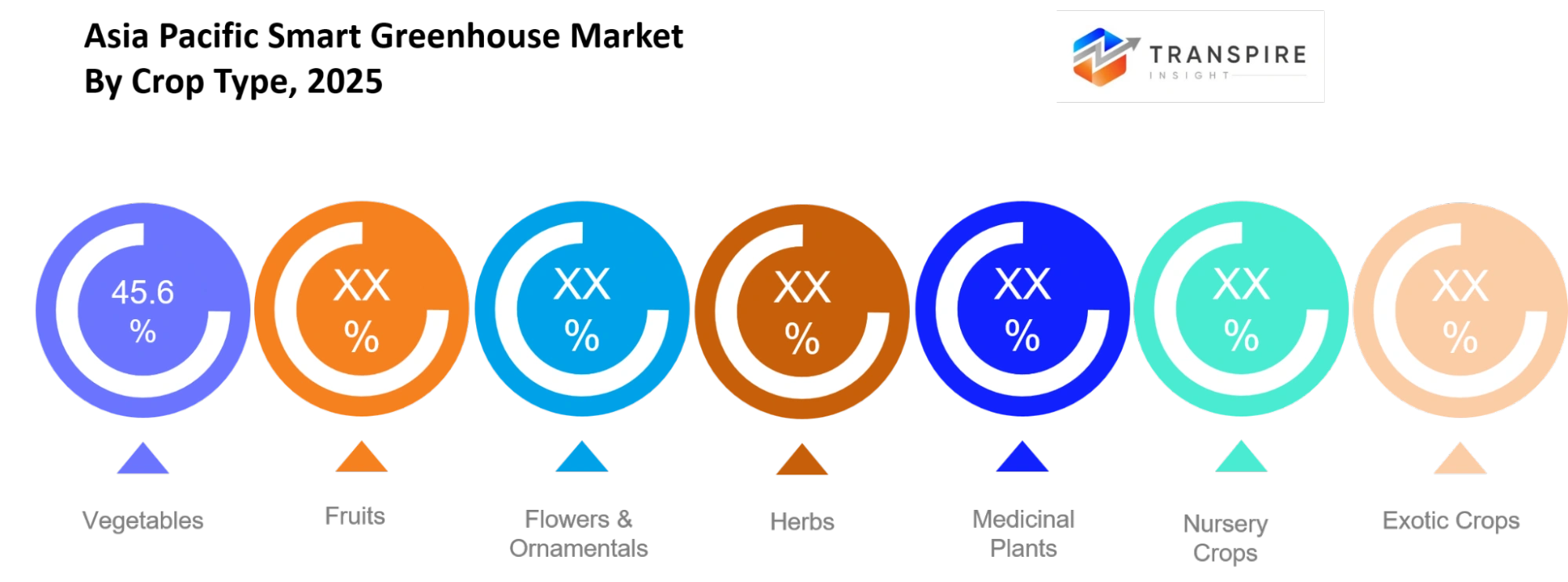
- For greenhouse production, vegetables make up about 46%, which matches the steady appetite for premium tomatoes, cucumbers, leafy greens, and peppers , especially across city markets where demand doesn’t really slow down.
- In terms of end users, commercial growers contribute nearly 58% of industry revenue, while horticulture companies are the fastest-growing group. That growth seems tied to export-focused production strategies that are getting more traction.
- Netafim, Priva, Certhon, Signify, and Hoogendoorn Growth Management keep pushing that competitive edge, by leaning on integrated automation platforms, LED innovations, and smart irrigation technologies , more or less all stitched together.
- On top of that , the strategic partnerships between greenhouse tech suppliers and local agricultural enterprises have helped speed up the rollout of cloud based monitoring, predictive analytics, and remote crop management solutions.
- And in the end , manufacturers are more and more bundling IoT sensors, automated fertigation, plus AI driven climate optimization into one single greenhouse management platform, so day to day operations feel smoother and production variability goes down.
What are the Key Drivers, Restraints, and Opportunities in the Asia Pacific Smart Greenhouse Market?
Driver: The strongest force backing market expansion seems to be that shift toward controlled-environment agriculture , as governments push food security a bit harder and also want more resource-efficient farming. National initiatives around protected cultivation, precision irrigation, and digital agriculture have motivated commercial growers to move away from regular greenhouse setups and into more automated facilities. Meanwhile, the costs for IoT sensors, LED grow lighting, and cloud-based monitoring platforms keep dropping, so greenhouse operators can see better investment returns. In practice, this lets growers boost crop reliability, use less water, and handle production schedules more predictably, which in turn creates a bigger revenue pool for technology suppliers and greenhouse equipment manufacturers.
Restraint: The biggest structural restraint is still high capital expenditure because modern greenhouse infrastructure needs a lot of money up front for climate control hardware, automation systems, lighting, software platforms, and technical integration work . Smaller farms, in particular, run into tight financing channels and they often struggle with unclear payback timelines, especially where agricultural markets are still developing. On top of that, there are skilled workforce shortages, because operating advanced greenhouse technologies is not simple, it takes know-how, training , and maintenance discipline. So implementation drags on, technology adoption stays slower, and revenue potential gets squeezed in price-sensitive regions.
Opportunity: A noteworthy opportunity is starting to show up via AI-enabled greenhouse management and vertical farming projects across India , Southeast Asia, and Australia. Support from investors is building facilities that bring together machine learning, robotics, precision irrigation, and real-time environmental sensing to raise yields even when land availability is limited.
What Has the Impact of Artificial Intelligence Been on the Asia Pacific Smart Greenhouse Market?
Artificial intelligence has been kind of a game changer for greenhouse operations, because it shifts crop management away from fixed routines and toward real time, more data driven decisions , basically. AI platforms keep chewing through information coming from environmental sensors, cameras, weather forecasts, and soil or nutrient check systems, then they handle things like irrigation timing , ventilation flow, lighting control, fertigation dosing, and temperature regulation in a more automated way. In practice, these setups hold near optimal growing conditions with far less hand work, so you end up wasting fewer resources while the crops stay more consistent. And beyond that, commercial greenhouse operators often lean on digital twins plus cloud based control platforms , which lets them watch and manage several facilities from one centralized place. That tends to boost operational clarity, and also helps with labor efficiency, too.
Then you have machine learning models that sharpen the predictive side , by spotting equipment faults before they turn into full failures, predicting pest and disease outbreaks, estimating harvest timing, and tuning energy consumption as the weather changes. On top of that, computer vision systems can catch nutrient deficiencies, leaf discoloration, and signs of plant stress early, which means growers can intervene with corrective actions before the yield impact becomes a real problem. Many greenhouse operators say they see double digit drops in both water and fertilizer use , and at the same time they get measurable gains in crop yield, energy efficiency, and even equipment uptime thanks to AI assisted climate optimization.
Still, it is not all effortless. Big scale deployment runs into challenges that are pretty hard to ignore. Integration costs can be high, older greenhouse infrastructure is often fragmented, and there’s limited access to high quality localized agronomic datasets. Together these issues can shrink prediction accuracy when you move across different crop varieties and climate zones.
Key Market Trends
- China has been expanding its protected cultivation capacity by,like more than 15% since 2020 , and that’s kinda pushed faster adoption of automated climate control and that more “brainy” greenhouse management stuff.
- Meanwhile LED grow lighting keeps moving in and swapping out the conventional options, with reported energy savings that can land around 40–60% for commercial operations, though it depends on crop type , and the facility design details.
- AI-powered monitoring platforms which used to be mostly pilot projects are now showing up in commercial deployment, helping people notice crop stress earlier and making daily operational decisions a bit better, or at least more timely.
- Precision irrigation is also trending, and it can reduce water consumption by roughly 30–50% , so many commercial growers are encouraged to modernize greenhouse infrastructure especially in water-stressed regions where every drop matters.
- Greenhouse operators increasingly stitch together IoT sensors, cloud analytics, and automated fertigation into one unified management platform, rather than going with standalone monitoring gear that’s separate from everything else.
- Netafim, Priva, Signify, Certhon, and Hoogendoorn Growth Management keep broadening their digital agriculture portfolios, mainly through product innovation and regional technology partnerships that help them reach customers quicker.
- Also, government-backed protected cultivation programs across India, China, and parts of Southeast Asia have shifted funding toward higher-value horticulture and greenhouse production that’s driven by technology.
- On top of that, greenhouse developers are leaning more into modular designs , because they make future expansion easier, while also cutting installation time and lifecycle operating costs , sometimes by quite a bit.
- Finally, buyers are now preferring integrated software ecosystems that cover remote monitoring, predictive maintenance, and mobile-based greenhouse control, instead of relying on independent hardware solutions that don’t really talk to each other.
Asia Pacific Smart Greenhouse Market Segmentation
By Component
HVAC Systems kinda hold a leading role, because keeping stable temperature and humidity really, directly affects crop quality and makes year- round production possible. LED Grow Lights also help quite a bit with productivity, since they deliver lighting that matches the crop needs , yet they still cut down on electricity use vs conventional setups. Irrigation Systems improve water efficiency via precision delivery, and Sensors then gather continuous environmental and crop information which supports smarter, informed operational choices. Control Systems basically tie together multiple greenhouse functions into one operating platform , so climate lighting, and irrigation can be managed more accurately.
Monitoring Software turns day to day operational data into useful guidance, using dashboards, alerts, and performance analytics that make timely intervention easier. Automation Equipment reduces the manual workload by managing irrigation, ventilation, nutrient dosing , and other routine greenhouse tasks with steadier results. Other items you might see include communication modules, fertigation units, power management devices, and specialized accessories which together raise overall greenhouse performance.
When all component categories are balanced, integrated, and not treated as separate islands, you get higher productivity, lower operating costs , and more efficient resource use across commercial greenhouse facilities.
By Technology
Hydroponics still seems like the most widely used cultivation tech, mainly because water solutions packed with nutrients help crops grow quicker, and at the same time they reduce land use and water needs. Aeroponics is getting more funding for premium crop production, mostly because it sprays a nutrient mist straight onto the roots, which tends to boost oxygen availability and encourages root development, a bit more directly than other methods. Then there is Aquaponics, where fish farming and plant cultivation basically work together, forming a circular production approach that, in theory, cuts down on nutrient waste. Meanwhile, Soil-Based Cultivation keeps helping growers who want a more gradual modernization, while still sticking to methods that feel familiar to them.
For automation, IoT-Based Automation lets farms keep checking environmental factors and equipment health nonstop, using sensors connected to cloud platforms. AI-Based Monitoring takes it further, it studies greenhouse data to improve choices like irrigation timing, light intensity, nutrient delivery, and even climate settings. Climate Control Systems try to hold steady growing conditions, even when seasonal weather changes around them, so the crop quality stays more consistent over the whole production cycle. Other options are also showing up, like robotics, digital twin platforms, automated fertigation solutions, and advanced imaging systems, these keep pushing the boundaries of controlled-environment agriculture in general.
By Crop Type
Vegetables kind of take the biggest share, because controlled cultivation helps keep production steady for tomatoes, cucumbers, lettuce, peppers, and leafy greens, with the same kind of reliable quality across the whole year. Fruits are pretty important too, since greenhouse cultivation tends to make yield stability better for strawberries, berries, melons, and other premium crops. Flowers & Ornamentals still hold strong commercial weight by satisfying what retail, landscaping, and export markets are asking for. Herbs keep getting more acceptance, because when the conditions are controlled, freshness, aroma, and overall quality are preserved, for both culinary and pharmaceutical use.
Medicinal Plants, in particular, benefit from greenhouse production through precise environmental control, which supports standardized active-ingredient quality. Nursery Crops remain vital for providing healthy seedlings and young plants to commercial farms and horticulture businesses. Exotic Crops attract investment, because protected cultivation makes it possible to grow specialty produce that really needs accurate climate conditions. Others would include experimental crops, high value niche varieties, and specialty horticultural products that should broaden cultivation opportunities in controlled-environment agriculture.
By End User
Commercial Growers end up with the highest adoption, mostly because automation quietly ramps up productivity, crop consistency, and day to day operational efficiency across those large cultivation facilities. Research Institutes tend to look at advanced greenhouse technologies, cultivation routines, and actual crop performance, so the whole thing can back agricultural innovation and not just theory. Agricultural Universities lean on controlled cultivation systems for teaching, scientific study, and hands on practical training, they kind of need a reliable setup. Government Farms push protected agriculture through demonstration projects, technology validation, and sustainable farming initiatives.
Nursery Operators count on greenhouse infrastructure in a practical way, to raise healthy seedlings with more uniform quality and better survival rates. Organic Farmers also adopt controlled cultivation, not only for better resource efficiency, but still to keep production standards in place for certified crops. Horticulture Companies put money into modern greenhouse systems, mainly to boost export competitiveness and maintain year-round supply of premium produce. Others, like private agribusiness firms, cooperatives, technology demonstration centers, and specialized cultivation enterprises, also keep showing up and widening greenhouse adoption across the region.
By Covering Material
Glass Greenhouses are still the go to pick for long term commercial setups, mainly because really good light transmission helps high value crops grow well, and you also get a long operational life, so people tend to stick with them. Polycarbonate Greenhouses, on the other hand, bring strong insulation with durable performance and impact resistance, which means they’re often chosen for installations across very different climate scenarios. Then there are Polyethylene Film Greenhouses, they’re basically a budget friendly option for growers who want protected cultivation but don’t want a big initial investment right away. Shade Net Houses act a bit different, they safeguard delicate crops from too much sunlight, while also helping airflow, and lowering heat stress when the warmer seasons show up.
You’ll also see Fiberglass Structures used when corrosion resistance matters, plus they deliver dependable results in specialized growing environments where a tough building material is required. Tunnel Greenhouses are more about seasonal production, with a flexible setup process and lower operating costs that can work nicely for small to medium farms. Hybrid Structures usually combine several covering materials, so you can tune insulation, light transmission, durability, and cost effectiveness depending on what the production plan needs. And then there are Others, which can mean reinforced plastic materials, customized coverings ,and even newer composite solutions that keep widening greenhouse construction choices across commercial agriculture.
What are the Key Use Cases Driving the Asia Pacific Smart Greenhouse Market?
Commercial vegetable growing is still the main use case, but growers are leaning harder on automated climate management, precise irrigation, and LED lighting , so they can keep crop quality pretty consistent, like all year round. Bigger greenhouse sites making tomatoes, cucumbers, peppers, and leafy greens use these tools to boost yields, cut down on resource use , and keep their supply commitments with supermarkets, food processors, and export buyers.
More and more, the idea is spreading into horticulture firms, nursery operators, and research groups. Premium flowers, decorative plants, herb varieties , and top-tier seedlings do well when the conditions are controlled, because it helps with uniformity and can also shorten the production timetable. Even agricultural universities are adopting smart greenhouse setups to test precision farming methods and newer cultivation approaches, which is kinda useful for real trials.
On top of that, the emerging use cases are medicinal plant cultivation , rare fruit production, and AI-driven vertical farming projects, especially in crowded cities. In those setups, people combine machine vision, predictive climate control , and robotic automation. The goal is to squeeze more output out of limited land, while also supporting pharmaceutical production, specialty food, and other high-value horticulture segments across the forecast horizon.
|
Report Metrics |
Details |
|
Market size value in 2025 |
USD 78.2 Billion |
|
Market size value in 2026 |
USD 1.62 Billion |
|
Revenue forecast in 2033 |
USD 5.29 Billion |
|
Growth rate |
CAGR of 18.42% from 2026 to 2033 |
|
Base year |
2025 |
|
Historical data |
2021 - 2024 |
|
Forecast period |
2026 - 2033 |
|
Report coverage |
Revenue forecast, competitive landscape, growth factors, and trends |
|
Regional scope |
United States; Canada; Mexico; United Kingdom; Germany; France; Italy; Spain; Denmark; Sweden; Norway; China; Japan; India; Australia; South Korea; Thailand; Brazil; Argentina; South Africa; Saudi Arabia; United Arab Emirates |
|
Key company profiled |
Netafim, Richel Group, Certhon, Priva, Signify, Heliospectra, Argus Control Systems, Rough Brothers, Jain Irrigation Systems, Hort Americas, Growlink, Autogrow, DENSO, Yanmar, Hoogendoorn Growth Management |
|
Customization scope |
Free report customization (country, regional & segment scope). Avail customized purchase options to meet your exact research needs. |
|
Report Segmentation |
By Component (HVAC Systems, LED Grow Lights, Irrigation Systems, Sensors, Control Systems, Monitoring Software, Automation Equipment, Others); By Technology (Hydroponics, Aeroponics, Aquaponics, Soil-Based Cultivation, IoT-Based Automation, AI-Based Monitoring, Climate Control Systems, Others); By Crop Type (Vegetables, Fruits, Flowers & Ornamentals, Herbs, Medicinal Plants, Nursery Crops, Exotic Crops, Others); By End User (Commercial Growers, Research Institutes, Agricultural Universities, Government Farms, Nursery Operators, Organic Farmers, Horticulture Companies, Others); By Covering Material (Glass Greenhouses, Polycarbonate Greenhouses, Polyethylene Film Greenhouses, Shade Net Houses, Fiberglass Structures, Tunnel Greenhouses, Hybrid Structures, Others) |
Which Regions are Driving the Asia Pacific Smart Greenhouse Market Growth?
China takes the lead in this regional market, largely because of heavy spending on protected cultivation, a push through national agricultural modernization programs, and, let’s say, real strength in manufacturing for greenhouse hardware plus automation technologies. Big commercial farming operations keep moving toward climate control setups, precision irrigation systems, and AI-enabled monitoring , not just for productivity reasons but also because arable land is limited and the climate can be… unpredictable. On top of that, there’s an almost stacked ecosystem made up of greenhouse manufacturers, technology suppliers, agricultural research institutes, and digital agriculture companies, so innovation keeps moving forward. Government backing for smart farming and food security initiatives just adds more weight, strengthening leadership in the long run.
Japan sits as the second-largest regional contributor, but the growth story looks a bit different. Instead of rapidly widening greenhouse acreage, Japanese growers tend to bet more on operational efficiency, labor-saving automation and premium crops, supported by advanced engineering and robotics. Ongoing investment in precision agriculture, high-value horticulture, and energy-efficient greenhouse solutions creates steady demand for capable control systems and monitoring platforms. This particular focus on technological refinement makes Japan a dependable base for recurring revenue , from solution providers.
India is projected to show the fastest growth from 2026 to 2033, as protected cultivation spreads beyond the older horticultural strongholds. More recently, government support for precision farming, micro-irrigation, and controlled-environment agriculture has helped spark commercial greenhouse investment across several states.
Who are the Key Players in the Asia Pacific Smart Greenhouse Market and How Do They Compete?
Competition is still kind of moderately fragmented, you can see global greenhouse tech providers out there, but also regional irrigation, automation, and agricultural engineering companies, all together in the mix. What really drives the competition now is technology integration not just price, because commercial growers are increasingly asking for a full greenhouse management platform, rather than only standalone equipment. Then companies lean on localized technical support , plus digital services , and yes customized options meant for different climate conditions and crop types.
Priva kind of stands out with integrated climate control, energy management, and cloud based greenhouse automation platforms that link environmental monitoring with operational analytics. Certhon seems to differentiate via turnkey greenhouse projects, by bundling engineering, cultivation know-how, and automation into whole production facilities, so customers can lower the implementation complexity, kinda reduce the “mess” upfront. Signify keeps pushing through advanced LED horticultural lighting systems, those help crop performance while also bringing down electricity consumption, and it’s backed by ongoing lighting innovation and research collaborations.
Netafim pairs precision irrigation with digital farming technologies, so greenhouse operators can optimize water and nutrient delivery, and that creates measurable efficiency gains, especially in water stressed regions. Hoogendoorn Growth Management focuses on intelligent greenhouse climate computers and autonomous growing technologies, improving operational precision through data driven environmental control.
Company List
•Netafim
• Richel Group
• Certhon
• Priva
• Signify
• Heliospectra
• Argus Control Systems
• Rough Brothers
• Jain Irrigation Systems
• Hort Americas
• Growlink
• Autogrow
• DENSO
• Yanmar
• Hoogendoorn Growth Management
Recent Development News
In May 2026, Priva and Grodan announced a partnership to integrate GroSens root zone data into the Priva One platform. The integration enables greenhouse growers to combine root-zone measurements with climate control data, improving cultivation decisions and greenhouse automation.https://www.priva.com
In February 2026, Orbia Netafim announced a collaboration with Amazon India to implement advanced drip irrigation projects. The initiative supports water-efficient agriculture across India and strengthens digital farming adoption, creating additional opportunities for protected cultivation technologies.https://www.netafim.com
In October 2025, Priva entered a partnership with Gardin to integrate real-time plant physiology analytics into the Priva One greenhouse operating platform. The collaboration enhances crop monitoring and precision greenhouse management through real-time plant intelligence.https://www.priva.com
What Strategic Insights Define the Future of the Asia Pacific Smart Greenhouse Market?
The market is kind of shifting toward fully connected greenhouse ecosystems where climate control, irrigation, lighting, AI analytics, and predictive decision support kind of work through one unified digital platform, not separate, independent systems. This change will be pushed by the need to crank up productivity while also cutting down water, labor, and energy use across commercial horticulture. There is also a more subtle risk that is building, like growing dependence on imported electronic components and advanced sensors, which might end up making greenhouse projects vulnerable to supply chain disruptions, and then raise equipment costs, too.
At the same time there’s an emerging opportunity in AI-enabled autonomous greenhouse operations across India and Southeast Asia, since investment in protected cultivation keeps accelerating. So market players really should focus on interoperable software platforms, plus automation solutions that are locally supported, which integrate smoothly with existing greenhouse infrastructure. That way customers can modernize a bit at a time, without accidentally sacrificing their long term technology investments.
Asia Pacific Smart Greenhouse Market Report Segmentation
By Component
• HVAC Systems
• LED Grow Lights
• Irrigation Systems
• Sensors
• Control Systems
• Monitoring Software
• Automation Equipment
• Others
By Technology
• Hydroponics
• Aeroponics
• Aquaponics
• Soil-Based Cultivation
• IoT-Based Automation
• AI-Based Monitoring
• Climate Control Systems
• Others
By Crop Type
• Vegetables
• Fruits
• Flowers & Ornamentals
• Herbs
• Medicinal Plants
• Nursery Crops
• Exotic Crops
• Others
By End User
• Commercial Growers
• Research Institutes
• Agricultural Universities
• Government Farms
• Nursery Operators
• Organic Farmers
• Horticulture Companies
• Others
By Covering Material
• Glass Greenhouses
• Polycarbonate Greenhouses
• Polyethylene Film Greenhouses
• Shade Net Houses
• Fiberglass Structures
• Tunnel Greenhouses
• Hybrid Structures
• Others
Frequently Asked Questions
Find quick answers to common questions.
The expected Asia Pacific Smart Greenhouse Market size for the market will be USD 5.29 Billion in 2033.
Key segments for the Asia Pacific Smart Greenhouse Market are By Component (HVAC Systems, LED Grow Lights, Irrigation Systems, Sensors, Control Systems, Monitoring Software, Automation Equipment, Others); By Technology (Hydroponics, Aeroponics, Aquaponics, Soil-Based Cultivation, IoT-Based Automation, AI-Based Monitoring, Climate Control Systems, Others); By Crop Type (Vegetables, Fruits, Flowers & Ornamentals, Herbs, Medicinal Plants, Nursery Crops, Exotic Crops, Others); By End User (Commercial Growers, Research Institutes, Agricultural Universities, Government Farms, Nursery Operators, Organic Farmers, Horticulture Companies, Others); By Covering Material (Glass Greenhouses, Polycarbonate Greenhouses, Polyethylene Film Greenhouses, Shade Net Houses, Fiberglass Structures, Tunnel Greenhouses, Hybrid Structures, Others).
Major Asia Pacific Smart Greenhouse Market players are Netafim, Richel Group, Certhon, Priva, Signify, Heliospectra, Argus Control Systems, Rough Brothers, Jain Irrigation Systems, Hort Americas, Growlink, Autogrow, DENSO, Yanmar, Hoogendoorn Growth Management.
The Asia Pacific Smart Greenhouse Market size is USD 1.37 Billion in 2025.
The Asia Pacific Smart Greenhouse Market CAGR is 18.42% from 2026 to 2033.
• Netafim
• Richel Group
• Certhon
• Priva
• Signify
• Heliospectra
• Argus Control Systems
• Rough Brothers
• Jain Irrigation Systems
• Hort Americas
• Growlink
• Autogrow
• DENSO
• Yanmar
• Hoogendoorn Growth Management
About the Authors

Mayur Shinde
I am Mayur Shinde, a Senior Research Analyst at Transpire Insight, specializing in the Automotive & Transportation and Information & Communication Technology (ICT) Industry. My work focuses on analyzing emerging market trends, technological advancements, competitive landscapes, and industry developments to deliver accurate, data-driven insights. I am passionate about transforming complex market information into clear, actionable content that helps businesses, professionals, and decision-makers stay informed and make confident strategic decisions.

Chakradhar Khansole
Chakradhar serves as the Research Director at Transpire Insight, bringing over 8 years of experience in technology, innovation, and strategic market intelligence. He specializes in transforming complex market data into actionable business insights that enable organizations to make informed, growth-oriented decisions. Recognized for his strategic vision and analytical expertise, Chakradhar leads high-impact research initiatives, delivering comprehensive market assessments, competitive intelligence, and forward-looking industry analysis.
Recently Published Reports
-
Apr 2026
3D Optical Profiler Market
3D Optical Profiler Market Size, Share & Analysis Report By Type (Desktop 3D Optical Profiler, and Portable 3D Optical Profiler), By Technology (Confocal Technology, and White Light Interference), By End-Use Industry (Manufacturing, Research Institutions, Automotive, Aerospace and Defense, Medical Devices, and Other), and Geography (North America, Europe, Asia-Pacific, Middle East and Africa, South and Central America), 2021 - 2031
-
Apr 2026
Depth Sensor Market
Depth Sensor Market Size, Share & Analysis Report By Type (Infrared Depth Sensors, Time-of-Flight (ToF) Sensors, Stereo Vision Sensors, Structured Light Sensors, Ultrasonic Depth Sensors), By Application (Automotive, Robotics, Gaming, Consumer Electronics, Industrial Automation, Healthcare, Security & Surveillance, Others), By End Users (Automotive Manufacturers, Consumer Electronics Companies, Healthcare Providers, Industrial Companies, Security Agencies, Gaming Companies, Robotics Companies, Others), and Geography (North America, Europe, Asia-Pacific, Middle East and Africa, South and Central America), 2021 – 2031
-
Apr 2026
Digital Manufacturing Market
Digital Manufacturing Market Size, Share & Analysis Report By Component (Hardware, Software, and Services), By Technology (Robotics, 3D Printing, Internet of Things (IoT), and Others), By Application (Automotive and Transportation, Aerospace and Defense, Consumer Electronics, Industrial Machinery, and Others), By Process Type (Computer-Based Designing, Computer-Based Simulation, Computer 3D Visualization, Analytics, and Others), and Geography (North America, Europe, Asia-Pacific, Middle East and Africa, South and Central America), 2021 – 2031
-
Apr 2026
Digital Visa Services Market
Digital Visa Services Market Size, Share & Analysis Report By Type (Individual Travelers, Group Travelers), By Application (Tourism, Business Travel, Others), and Geography (North America, Europe, Asia-Pacific, Middle East and Africa, South and Central America), 2021 – 2031