

Asia Pacific Fruits & Vegetables Market Size & Forecast:
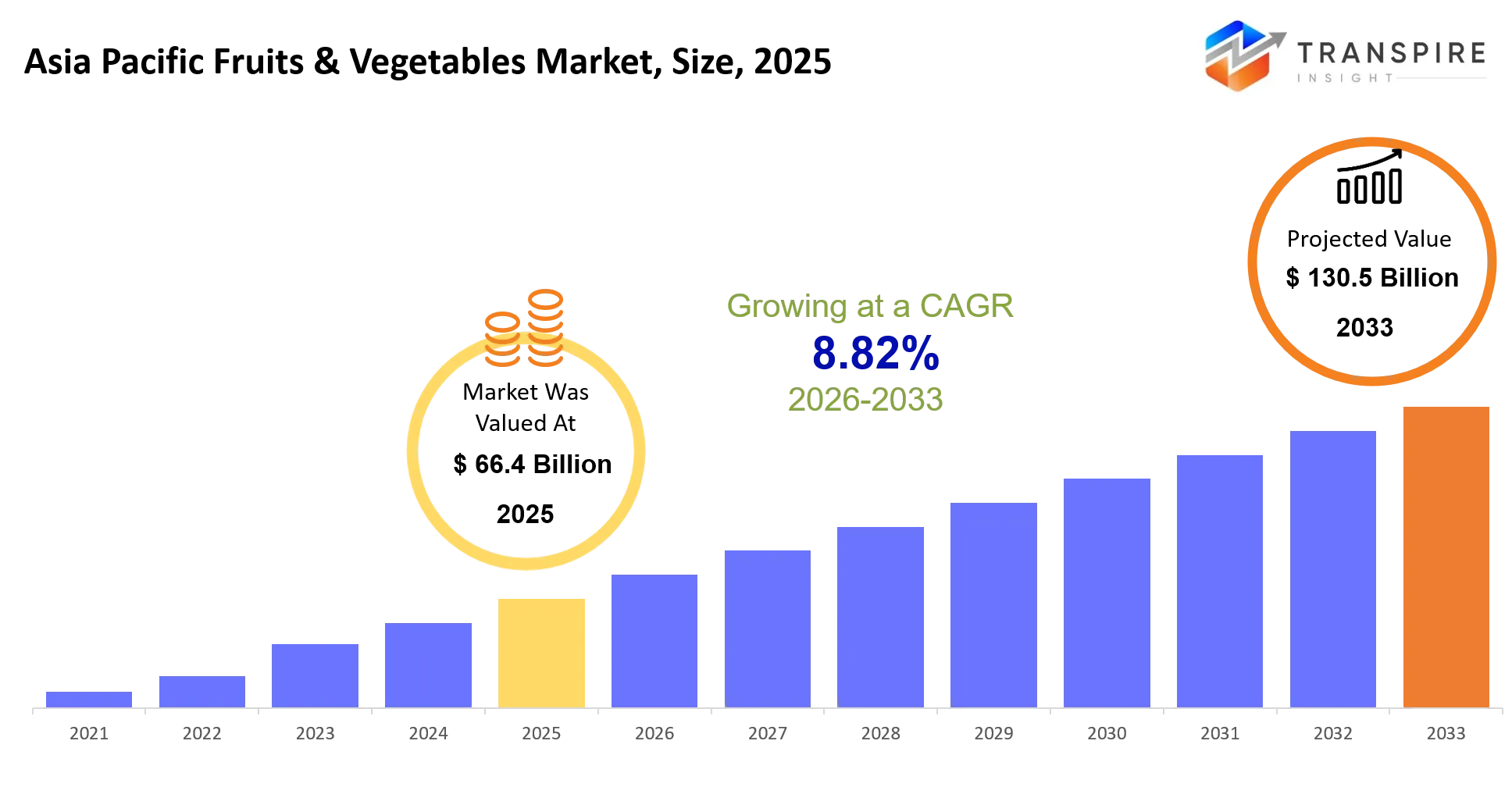
- Asia Pacific Fruits & Vegetables Market Size 2025: USD 66.4 Billion
- Asia Pacific Fruits & Vegetables Market Size 2033: USD 130.5 Billion
- Asia Pacific Fruits & Vegetables Market CAGR: 8.82%
- Asia Pacific Fruits & Vegetables Market Segments: By Product Type (Fresh Fruits, Fresh Vegetables, Organic Produce, Exotic Fruits, Leafy Vegetables, Root Vegetables, Others); By Distribution Channel (Supermarkets, Traditional Markets, Online Retail, Convenience Stores, Others); By Cultivation Type (Conventional, Organic, Greenhouse, Hydroponic, Others); By End User (Households, Foodservice, Food Processing, Hospitality, Others)
Asia Pacific Fruits & Vegetables Market Summary
The Asia Pacific Fruits & Vegetables Market was valued at USD 66.4 Billion in 2025. It is forecast to reach USD 130.5 billion by 2033. That is a CAGR of 8.82% over the period.
The Asia Pacific Fruits & Vegetables Market helps to move fruits and vegetables from farms to stores and restaurants. It also sends these products to countries. The Asia Pacific Fruits & Vegetables Market makes sure that the fruits and vegetables stay fresh by keeping them cool and moving them quickly.This helps to reduce the amount of fruits and vegetables that go bad after they are picked. The Asia Pacific Fruits & Vegetables Market connects farmers with big stores and exporters. This means that people in cities can always buy fruits and vegetables. The Asia Pacific Fruits & Vegetables Market also helps to make sure that there are fruits and vegetables available all year round.
Over the few years the way that fruits and vegetables are bought and sold has changed a lot. More and more people are buying from stores and using online platforms. This is going to traditional markets. One of the reasons for this change is that there have been problems with getting products from one place to another. This has shown that the old way of doing things was not working well. So people have started to invest in ways of keeping products cool and in building new centers for storing and sending products.
As a result the people who grow and sell fruits and vegetables have gotten better at tracking their products and storing and moving them. This has made the process efficient and reduced waste. It has also helped the people who export fruits and vegetables to make money and have a more stable business, in the Asia Pacific Fruits & Vegetables Market.
Key Market Insights
- The Asia Pacific Fruits & Vegetables Market is really growing. This is because more people are buying fruits and vegetables from stores. By 2026 a lot of people will be buying these things from stores.
- The Asia Pacific Fruits & Vegetables Market is really changing. Nowadays people prefer to buy fruits and vegetables that come in packages. The reason for this is that a lot of people are doing their shopping on the internet. For example the Asia Pacific Fruits & Vegetables Market saw a shift in 2025 when twenty two percent of people were purchasing their groceries online from the Asia Pacific Fruits & Vegetables Market.
- If we look at parts of the region East Asia is doing very well. This is because they have ways to move things around and send them to other countries. In 2025 East Asia had 42 percent of the market.
- Southeast Asia is growing very fast. This is because they are sending things to other countries and making more cold storage spaces. This will happen from 2026 to 2030.
- People mostly buy vegetables. These make up 48 percent of what people buy. Fruits are also very popular.
- Now people are buying packaged and precut fruits and vegetables.This is because city dwellers are really busy.They do not have time on their hands.They also prefer eating out a lot.Packaged fruits and vegetables are convenient for them.
- Most of the time fruits and vegetables are used in hotels and restaurants. 46 Percent of the time they are used for this.
- Now people are also buying things online. This is because it is easy to buy things and get them delivered quickly.
- Big stores are the ones that sell most of the fruits and vegetables. They sell them in supermarkets and big stores.
- Some companies like Dole, Del Monte, Chiquita, Zespri and Driscoll’s are doing well. They are making partnerships with companies and making new products. They are also getting things from parts of the region.
What are the Key Drivers, Restraints, and Opportunities in the Asia Pacific Fruits & Vegetables Market?
Drivers
The Asia Pacific Fruits & Vegetables Market is growing fast. This is because of organized retail stores and better cold storage in cities where people buy a lot of food.The reason for this change is that governments and private investors wanted to solve two problems.One was that a lot of food was getting wasted after it was harvested.The other was that the quality of food was often not good.To fix these problems they created systems, for moving and storing food.These systems helped keep food fresh for a time and reduced waste.As a result people who grow, export and distribute Asia Pacific Fruits & Vegetables can make a profit.The Asia Pacific Fruits & Vegetables Market also became more stable because supermarkets and online grocery stores made it easier for people to see what things cost and buy them regularly.
Restraints
However the Asia Pacific Fruits & Vegetables Market still faces some issues. Many farms that grow the food are lack systems, for storing, sorting and moving their products.This causes problems that are hard to solve because these small farms do not have much money to invest in new technology.As a result it is hard to know how much food will be available and when.This means that the prices of Asia Pacific Fruits & Vegetables can fluctuate a lot.It also takes time to get the food ready to export.Because of this people who grow, export and distribute Asia Pacific Fruits & Vegetables are not making much money as they could be.
Opportunities
There is an opportunity for the Asia Pacific Fruits & Vegetables Market to grow in Southeast Asia because of new investments in precision agriculture and controlled-environment farming. Countries, like Vietnam and Thailand are getting money to build greenhouses and use computers to monitor their crops.
What Has the Impact of Artificial Intelligence Been on the Asia Pacific Fruits & Vegetables Market?
The Asia Pacific Fruits & Vegetables Market is changing because of intelligence and advanced digital technologies. Artificial intelligence helps with the coordination of things. It reduces waste. It also helps to predict what people will buy. This is happening at farms and production networks.Automation tools are used at sorting facilities and distribution centers for the Asia Pacific Fruits & Vegetables Market. These tools help to make sure that fruits and vegetables are sorted and packaged properly. They also make sure that fruits and vegetables are inspected properly. This reduces mistakes that people make. It makes things move efficiently for the Asia Pacific Fruits & Vegetables Market.
Digital integration has made chain uptime better by optimizing routes and reducing spoilage rates. Some exporters say they have reduced -harvest losses by a lot and improved fuel efficiency in refrigerated trucks.However there is a problem with using these technologies. Many small farms do not have data. They lack reporting systems, which makes it hard to make accurate predictions.
This makes it slow to use AI systems in the Asia Pacific Fruits & Vegetables Market. It is especially hard in areas where internet connections are not good.The Asia Pacific Fruits & Vegetables Market is seeing a lot of changes with intelligence and advanced digital technologies.Artificial intelligence and advanced digital technologies help the Asia Pacific Fruits & Vegetables Market a lot.The Asia Pacific Fruits & Vegetables Market benefits, from intelligence and advanced digital technologies.
Key Market Trends
- The Asia Pacific Fruits and Vegetables Market changed a lot. The part of the market that is organized grew a lot. It increased by 18 percent from 2022 to 2025. This change affected how people in cities buy fruits and vegetables.
- After 2023 more people started using storage to keep fruits and vegetables fresh. This helped reduce waste and made it easier to export fruits and vegetables that can spoil easily.
- By 2025 people were using the internet to buy and sell fruits and vegetables a lot. This new way of trading became very popular in cities and replaced the old ways of buying and selling.
- In Southeast Asia farmers started growing fruits and vegetables to sell to countries after 2024. This led to more fruits and vegetables being shipped to countries.
- People still liked to buy vegetables.. More people started buying fruits that are packaged. This is because people want an experience when they buy fruits and vegetables.
- Companies that serve food like restaurants worked with suppliers like Dole and Del Monte. This partnership made sure that these businesses had a supply of fruits and vegetables from 2023.
- In 2025 many people started shopping for groceries. This change had an impact on how fruits and vegetables are delivered to people's homes.
- Retail stores began buying fruits and vegetables from suppliers after 2024. This move helped them save money and make sure they had a supply of Asia Pacific Fruits and Vegetables.
- The weather conditions between 2023 and 2025 were unfavorable. In response farmers began growing fruits and vegetables in controlled environments. This approach allowed them to maintain a supply of high-value produce.
- Companies like Chiquita and Zespri implemented tracking systems for their fruits and vegetables after 2024. This measure helped them adhere to the quality standards of countries.
Asia Pacific Fruits & Vegetables Market Segmentation
By Product Type:
Fresh Fruits will stay in demand. More people are moving to cities. I want to eat healthy. Cold storage and transportation are getting better in Asia. This helps apples, bananas and citrus fruits move smoothly through organized supply chains. Companies like Dole and Chiquita will supply more to countries. They are improving their logistics. People want packaged and quality fruits. This helps distributors and retailers make money. Some fruits are only available at times. So imports will continue. This ensures people in cities can buy fruits all year round.Organic Produce will grow fast. More stores are selling products. People want food. Leafy Vegetables and Root Vegetables are important for buyers like hotels and restaurants. Exotic Fruits will become popular in stores. People have money and want to eat differently. This helps the Asia Pacific Fruits & Vegetables Market.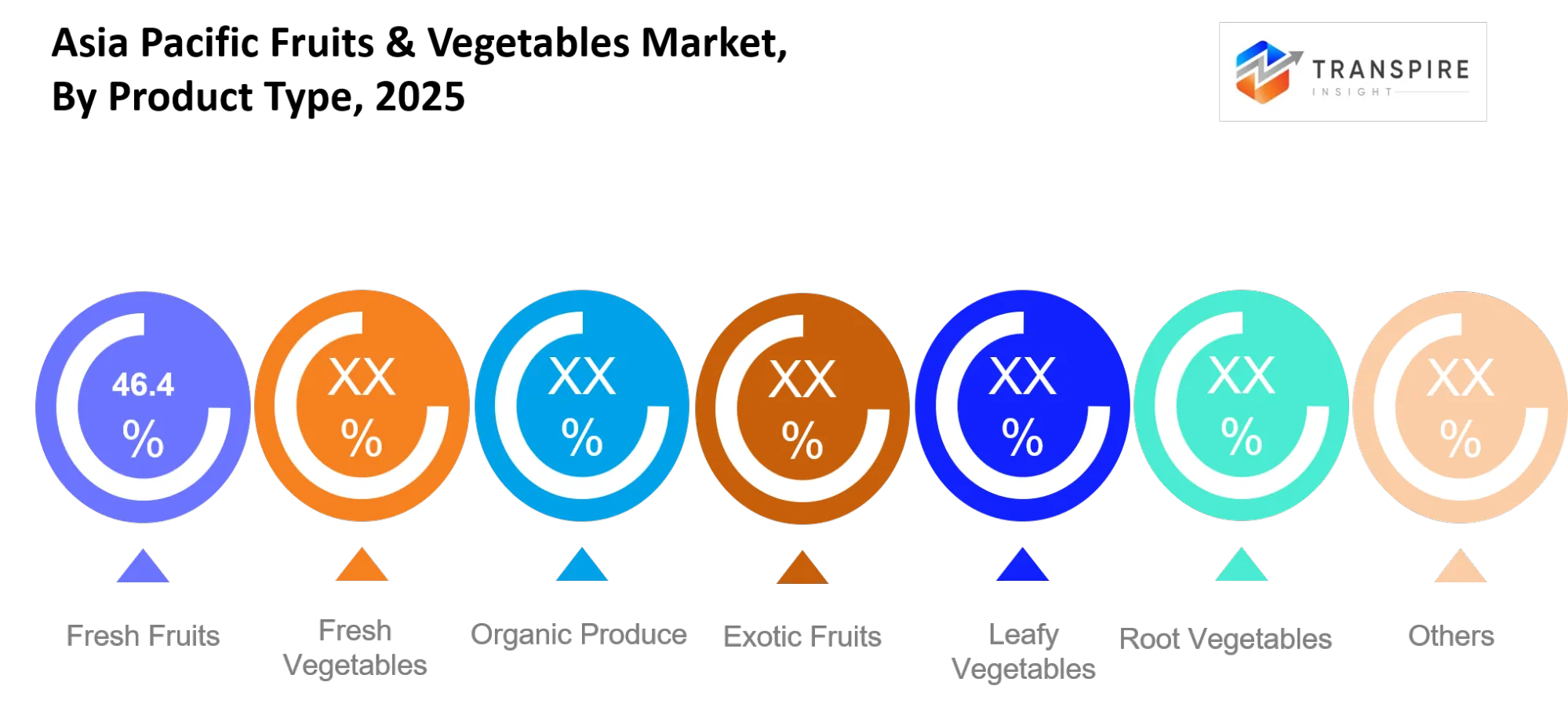
By Distribution Channel:
Supermarkets will still be the way to buy fresh produce. Organized retail stores are opening. They make it easy to buy quality fruits and vegetables. Big retail chains will get better at buying from farmers. They will not depend on markets as much. Traditional Markets will still be good for people who want to save money.. They will lose some customers in cities. Online Retail will grow fast. People can buy groceries online. Get them delivered fresh. Convenience Stores help people buy produce every day in busy cities.
By Cultivation Type:
Most produce will still come from farming. It is the way to produce. Organic farming will grow. Farmers get money for organic products. Greenhouse farming will increase. It helps farmers control the environment. Hydroponic systems will become popular in cities. They use land and produce more. Technology will help farmers make quality produce. They will lose produce after harvesting.
By End User:
People at home will still buy the fruits and vegetables. They eat them every day. Restaurants will buy more. They need a lot of produce. The hospitality sector will grow. More tourists are coming. They want to eat food. Food Processing industries will keep buying fruits and vegetables. They use them to make packaged foods and drinks. Other big buyers will also keep buying. This helps the Asia Pacific Fruits & Vegetables Market.
What are the Key Use Cases Driving the Asia Pacific Fruits & Vegetables Market?
The prices of fruits and vegetables have to be stable.As more people move to cities and supermarkets get bigger they need a system that can get them fruits and vegetables all the time. This system has to work so people can get the fruits and vegetables they need. The Asia Pacific Fruits & Vegetables Market is very important for people who want to eat healthy.
Some other people who buy a lot of fruits and vegetables are those who own restaurants, hotels and big kitchens. These people need a way to get quality fruits and vegetables every time they buy them. Food companies also need a lot of fruits and vegetables to make packaged food, juice and frozen meals. The Asia Pacific Fruits & Vegetables Market is a place for these companies to buy fruits and vegetables because they can get them transported in a way that keeps them fresh.
Now people are also buying fruits and vegetables online. Getting them delivered to their homes. Some farms are even growing produce in controlled environments and sending it straight to stores. People who care about their health are also buying fruits and vegetables from special services that deliver healthy meals. Some people even pay more for produce because they think it is better for them. All these new ways of buying fruits and vegetables are getting popular because people can order online and know where their food is coming from.
|
Report Metrics |
Details |
|
Market size value in 2025 |
USD 66.4 Billion |
|
Market size value in 2026 |
USD 72.2 Billion |
|
Revenue forecast in 2033 |
USD 130.5 Billion |
|
Growth rate |
CAGR of 8.82% from 2026 to 2033 |
|
Base year |
2025 |
|
Historical data |
2021 - 2024 |
|
Forecast period |
2026 - 2033 |
|
Report coverage |
Revenue forecast, competitive landscape, growth factors, and trends |
|
Regional scope |
Asia Pacific |
|
Key company profiled |
Dole, Del Monte, Chiquita, Zespri, Driscoll's, Fresh Del Monte, Costa Group, Joy Wing Mau, Pagoda, IG International, Sumifru, Fyffes, Freshmax, Greenyard, Total Produce |
|
Customization scope |
Free report customization (country, regional & segment scope). Avail customized purchase options to meet your exact research needs. |
|
Report Segmentation |
By Product Type (Fresh Fruits, Fresh Vegetables, Organic Produce, Exotic Fruits, Leafy Vegetables, Root Vegetables, Others); By Distribution Channel (Supermarkets, Traditional Markets, Online Retail, Convenience Stores, Others); By Cultivation Type (Conventional, Organic, Greenhouse, Hydroponic, Others); By End User (Households, Foodservice, Food Processing, Hospitality, Others) |
Which Regions are Driving the Asia Pacific Fruits & Vegetables Market Growth?
The Asia Pacific Fruits & Vegetables Market is led by East Asia because it has a good retail system, strong cold chain logistics and big import-export networks. The countries in this region do well because they have ports and supply chain systems that help move fresh produce around all the time. The government is also helping with food security. Making agriculture better which means they can store more food and do not lose as much after harvesting. Supermarkets and food distributors work well together to make sure people in cities can always buy fruits and vegetables.
Southeast Asia is the biggest contributor to the Asia Pacific Fruits & Vegetables Market. This region does this because it has strong farms and people are buying more food. Unlike East Asia Southeast Asia grows a lot of its food instead of importing it. The people in this region are investing in farms. Making their transportation systems better which helps the market do well. More tourists are also coming to this region and the food industry is growing. There is a steady demand for fresh fruits and vegetables. This means the region can make money without having to import much food.
The Asia Pacific Fruits & Vegetables Market is also growing fast in South Asia. This is because many people are moving to cities where they have money to spend and the retail system is getting better. New storage facilities and logistics systems are helping to get food to people more efficiently. Supermarkets and online grocery shopping are also becoming more popular which is changing the way people buy food. This is a time for new companies to enter the Asia Pacific Fruits & Vegetables Market especially between 2026 and 2033 as the supply chain is getting better and more people are buying fresh fruits and vegetables in cities and towns.
Who are the Key Players in the Asia Pacific Fruits & Vegetables Market and How Do They Compete?
The Asia Pacific Fruits and Vegetables Market is really split up with a lot of companies competing including people who export from around the world, others who distribute in certain regions and local companies that handle the supply chain. The companies that are already established try to keep their customers by signing term contracts with stores and investing in ways to keep their products cold while new companies are trying to make a name for themselves by using digital platforms to find products and selling directly to stores from farms. What really matters to customers is how well companies can get products to them, how fresh the products are, if the prices are stable and if they can always get what they need, not how well known the company is. Companies that have control over the facilities that keep products cold and have a system for getting products to stores have more power to negotiate in both their home country and when they export.
Dole is a company that focuses on making its supply chain really efficient and keeping costs low by working closely with the people who grow their products and having a good system for getting products all around the world. They are really good at getting bananas and other fresh fruits to stores and restaurants because they have a system for moving products around. Chiquita is a company that cares a lot about growing bananas in a way that's good for the environment and can track where all their products come from which helps them follow the rules that stores have and makes them popular with customers who want high quality products. Zespri is a company that only grows kiwis and has a relationship with the people who grow them which helps them make sure their products are always good and that customers trust their brand.
Driscoll’s is a company that makes berries that you cannot find anywhere else and they market them in a way that makes them seem really high end, which helps them sell to stores that cater to customers who want the best. Costa Group is a company that grows products in greenhouses that help keep the quality of their products consistent even when the weather is bad. Joy Wing Mau is a company that has facilities for ripening products and a good system for getting products to stores in big cities, which makes them an important company for bringing products into the country and getting them to stores. These companies are all trying to grow by working with companies in the region making their logistics better and making their supply chains more efficient which helps them reach more customers and be more efficient, in the Asia Pacific Fruits and Vegetables Market.
Company List
- Driscoll’s
- Fresh Del Monte
- Costa Group
- Joy Wing Mau
- Pagoda
- IG International
- Sumifru
- Fyffes
- Freshmax
- Greenyard
- Total Produce
Recent Development News
In [January 2026], ASIA FRUIT LOGISTICA entered into a strategic partnership with IMBERRI as an official fresh produce partner for its 2026 edition. The collaboration strengthened cross-border sourcing networks and improved market access for exporters across Asia Pacific fruits and vegetables trade channels.https://www.asiafruitlogistica.com
In [May 2026], ASIA FRUIT LOGISTICA announced UNITEC as its official technology partner for the 2026 event. The partnership accelerated adoption of advanced sorting and post-harvest technology, improving quality control and supply chain efficiency across fresh produce distribution systems.https://www.asiafruitlogistica.com
In [April 2026], industry research initiatives highlighted new AI-driven supply chain optimization models for fruits and vegetables logistics under IoT-based frameworks. These developments improved shelf-life performance by over 18 percent through better temperature control and real-time monitoring, enhancing operational efficiency across perishable produce distribution networks.https://arxiv.org
What Strategic Insights Define the Future of the Asia Pacific Fruits & Vegetables Market?
The Asia Pacific Fruits & Vegetables Market is structurally moving toward highly integrated, technology-enabled supply chains where cold chain logistics, digital procurement platforms, and controlled-environment agriculture define long-term competitiveness. This shift is driven by rising urban demand consistency requirements and the need to reduce post-harvest losses across fragmented production systems. As distribution becomes more centralized and data-driven, value creation will increasingly shift from production to logistics efficiency and quality assurance.
A hidden risk lies in overdependence on concentrated export hubs and large-scale distributors, which can create vulnerability to climate disruptions and trade bottlenecks. Any disruption in a few key sourcing corridors can quickly impact regional supply stability and pricing structures, limiting revenue predictability for downstream players in the Asia Pacific Fruits & Vegetables Market.
An emerging opportunity is the scaling of AI-enabled precision farming integrated with direct retail supply contracts, particularly in Southeast Asia. This model reduces intermediaries and improves yield forecasting accuracy, enabling premium pricing for consistent quality produce. Market participants that invest in integrated farm-to-retail ecosystems and digital traceability systems will gain stronger control over margins and long-term supply resilience across 2026–2033.
Asia Pacific Fruits & Vegetables Market Report Segmentation
-
By Product Type
Fresh Fruits
Fresh Vegetables
Organic Produce
Exotic Fruits
Leafy Vegetables
Root Vegetables
Others -
By Distribution Channel
Supermarkets
Traditional Markets
Online Retail
Convenience Stores
Others -
By Cultivation Type
Conventional
Organic
Greenhouse
Hydroponic
Others -
By End User
Households
Foodservice
Food Processing
Hospitality
Others
Frequently Asked Questions
Find quick answers to common questions.
The Expected Asia Pacific Fruits & Vegetables Market size for the Market will be USD 130.5 Billion in 2033.
Key Segments for the Asia Pacific Fruits & Vegetables Market are By Product Type (Fresh Fruits, Fresh Vegetables, Organic Produce, Exotic Fruits, Leafy Vegetables, Root Vegetables, Others); By Distribution Channel (Supermarkets, Traditional Markets, Online Retail, Convenience Stores, Others); By Cultivation Type (Conventional, Organic, Greenhouse, Hydroponic, Others); By End User (Households, Foodservice, Food Processing, Hospitality, Others).
Major Asia Pacific Fruits & Vegetables Market Players are Dole, Del Monte, Chiquita, Zespri, Driscoll's, Fresh Del Monte, Costa Group, Joy Wing Mau, Pagoda, IG International, Sumifru, Fyffes, Freshmax, Greenyard, Total Produce.
The Current Asia Pacific Fruits & Vegetables Market size is USD 66.4 Billion in 2025.
The Asia Pacific Fruits & Vegetables Market CAGR is 8.82% from 2026 to 2033.
- Dole
- Del Monte
- Chiquita
- Zespri
- Driscoll’s
- Fresh Del Monte
- Costa Group
- Joy Wing Mau
- Pagoda
- IG International
- Sumifru
- Fyffes
- Freshmax
- Greenyard
- Total Produce
About the Authors

Chetan Dhatrak
I’m Chetan Dhatrak, a Senior Research Analyst at Transpire Insight, specializing in the Consumer Goods, Foods and Beverages industry. I focus on analyzing market trends, consumer behavior, competitive landscapes, and industry developments to deliver accurate, data-driven insights. My research at Transpire Insight is built on credible sources and in-depth analysis, helping businesses and readers better understand market dynamics, emerging opportunities, and evolving consumer preferences. I’m committed to creating reliable, well-researched content that supports informed decision-making and reflects the latest developments in the consumer goods and food & beverage sectors.

Chakradhar Khansole
Chakradhar serves as the Research Director at Transpire Insight, bringing over 8 years of experience in technology, innovation, and strategic market intelligence. He specializes in transforming complex market data into actionable business insights that enable organizations to make informed, growth-oriented decisions. Recognized for his strategic vision and analytical expertise, Chakradhar leads high-impact research initiatives, delivering comprehensive market assessments, competitive intelligence, and forward-looking industry analysis.
Recently Published Reports
-
Apr 2026
Baby Infant Formula Market
Baby Infant Formula Market Size, Share & Analysis Report By ype (Infant Milk, Follow On Milk, Specialty Baby Milk, Growing-Up Milk), By Ingredient (Carbohydrate, Fat, Protein, Minerals, Vitamins, and Others), By Product Form (Powder, Liquid, and Ready-to-feed), By Distribution Channels (Supermarket/Hypermarket, Specialty Store, Pharmacies, Online Retail, and Others), and Geography (North America, Europe, Asia-Pacific, Middle East and Africa, South and Central America), 2021 - 2031
-
Apr 2026
Edible Insects for Animal Feed Market
Edible Insects for Animal Feed Market Size, Share & Analysis Report By Type (Insect Powder, Insect Meal, Insect Bar, Insect Paste, Insect Oil, and Others), By Insect Type (Beetles, Cricket, Caterpillar, Hymenoptera, Orthoptera, Tree Bugs, and Others), By Application (Livestock, Pet Food, and Aquaculture), By Livestock Type (Poultry, Swine, and Others), and Geography (North America, Europe, Asia-Pacific, Middle East and Africa, South and Central America), 2021 - 2031
-
Apr 2026
Food Industry Disinfection and Bacterial Control Market
Food Industry Disinfection and Bacterial Control Market Size, Share & Analysis Report By Type (Chemical Disinfectants, Physical Disinfectants, and Biocides and Antimicrobials), By Application (Food Processing Equipment Surface Disinfection, Food Preparation Areas Surface Disinfection, Storage Areas Surface Disinfection, Anti-microbial Coatings Food Preservation, and Preservative Solutions Food Preservation), By End User (Meat and Poultry Processing, Dairy Processing, Seafood Processing, Bakery and Confectionery, Restaurants and Commercial Kitchens, and Food Service Providers), By Sales Channel (Online, Offline), and Geography (North America, Europe, Asia-Pacific, Middle East and Africa, South and Central America), 2021 - 2031
-
May 2026
Freeze Dried Food Market
Freeze Dried Food Market Size, Share & Analysis Report By Product Type (Fruits, Vegetables, Freeze-Dried Dairy Products, Freeze-Dried Meat and Seafood, Freeze-Dried Pet Food, and Prepared Meal), By Nature (Organic, and Conventional), By Form (Powdered, Granules, and Diced), By End Use (Breakfast Cereals, Dairy Products, Bakery & Confectionery, Nutritional Bars & Supplements, Powdered Beverages, Snacks, and Retail (Household)), and Geography (North America, Europe, Asia-Pacific, Middle East and Africa, South and Central America), 2021 - 2031