

Asia Pacific Dried Fruit Market Size & Forecast:
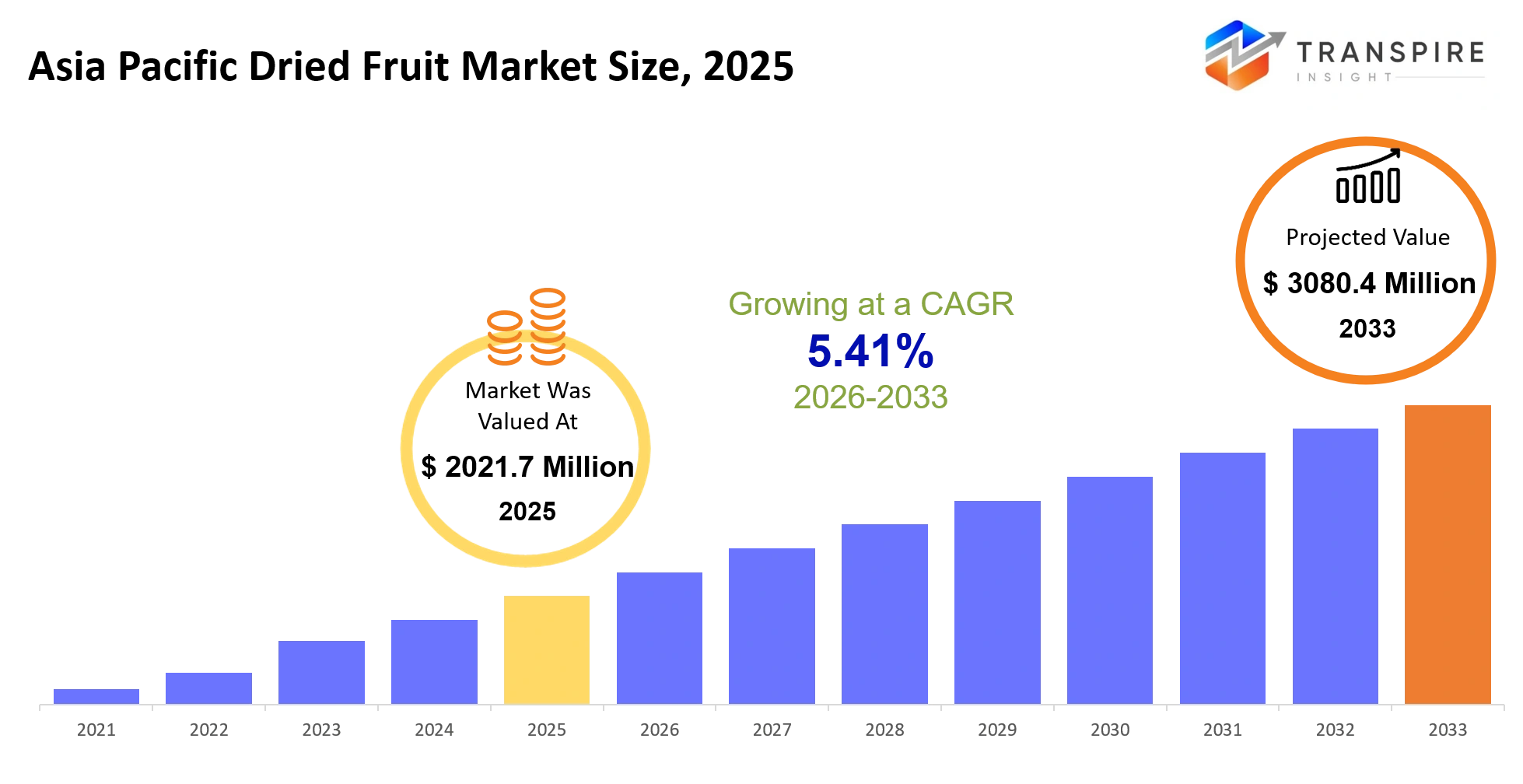
- Asia Pacific Dried Fruit Market Size 2025: USD 2021.7 Million
- Asia Pacific Dried Fruit Market Size 2033: USD 3080.4 Million
- Asia Pacific Dried Fruit Market CAGR: 5.41%
- Asia Pacific Dried Fruit Market Segments: By Product Type (Raisins, Dates, Apricots, Figs, Berries, Mangoes, Mixed Dried Fruits, Others); By Distribution Channel (Supermarkets, Convenience Stores, Online Retail, Specialty Stores, Wholesale, Others); By End User (Households, Food Processors, Bakeries, Confectionery Manufacturers, Foodservice, Others); By Application (Snacks, Bakery Products, Dairy Products, Breakfast Cereals, Confectionery, Others).
To learn more about this report,  Download Free Sample Report
Asia Pacific Dried Fruit Market Summary
The Asia Pacific Dried Fruit Market was valued at USD 2021.7 Million in 2025. It is forecast to reach USD 3080.4 Million by 2033. That is a CAGR of 5.41% over the period.
The Asia Pacific dried fruit market takes this important role in the regional food ecosystem, basically by making fruits last longer, cutting down post harvest waste, and giving manufacturers steadier inputs for snacking, bakery mixes, cereals, dairy based foods, and confectionery use. Dried fruits also help with year round access and easier logistics, so food processors can keep product quality more uniform, and keep supply on track.
Over the last five years things have started drifting away from just simple traditional bulk buying, toward more branded and “extra value” types of goods, and honestly even premium items too, like organic, freeze dried, and no added sugar varieties. The COVID 19 pandemic, plus the later supply chain disruptions, sort of nudged people and businesses to lean harder into shelf stable foods , which then made retailers and food manufacturers rethink how they source things and how they store their inventory. Meanwhile e-commerce kept expanding, and modern retail formats spread faster, improving where and how products are found around urban areas. All of that has boosted revenue growth, because consumers and brands are more willing to pick higher value items, dried fruits are used in more packaged recipes, and there’s deeper penetration in convenience oriented segments. And as food manufacturers keep searching for natural ingredients and longer lasting formulations, dried fruits keep growing in importance across the region’s food processing industry.
Key Market Insights
- The Asia Pacific Dried Fruit Market is set to hit around USD 3,080.4 million by 2033, this is basically showing steady expansion across food processing , plus retail channels.
- China is still the biggest player in the region, holding about 30.4% share, and that’s pushed by big food manufacturing operations and the rise of premium snack cravings.
- India stays as the second-largest contributor, with roughly 22.1% of regional revenue in 2025, even with demand shifting a bit toward higher quality.
- For Southeast Asia, it looks like the fastest growth story through 2033 , mainly due to newer retail growth , and more noticeable changes in eating habits.
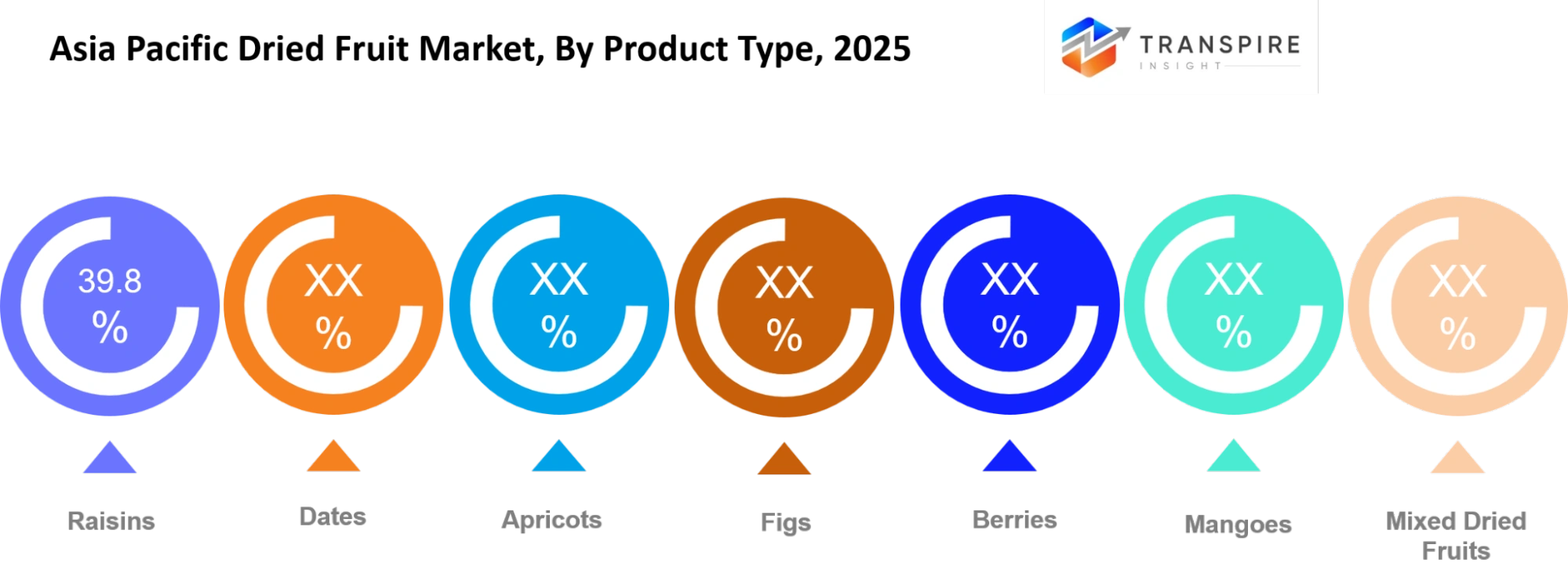
- On the product side, raisins lead demand at about 35.4% market share , largely because they’re affordable and get used everywhere from bakery goods to confectionery lines.
- Berries, and also freeze-dried fruit items are moving up quicker than the rest, they benefit from premium framing and clean-label sensibilities.
- When it comes to applications, bakery products are on top with around 40.3% share, as dried fruits are being folded into breads , cakes, and ready-to-eat snack formats.
- Food processing companies are the leading end-user group, while health driven snack producers are showing the most rapid growth rates.
- Key companies like Sun-Maid, Sunsweet, Olam, Dole, and Traina Foods are putting money into premium assortments and more advanced processing know-how.
- Overall, firms are trying to lock in stronger positions via automation, sustainable sourcing initiatives , fresh product launches, and broader regional distribution.
What are the Key Drivers, Restraints, and Opportunities in the Asia Pacific Dried Fruit Market?
The main reason the market grows is kind of this steady shift in how people eat regionally, moving toward food that’s more convenient, shelf-stable, and packed with useful ingredients. Food makers have been putting dried fruits into cereals, bakery products, nutrition bars, dairy items, and those wrapped snack products more and more. They do this because dried fruit brings natural sweetness, better shelf life, and less storage worry than fresh fruit. Also, the expansion of modern retail setups, plus e-commerce platforms, has made products easier to find. As a result, producers can reach a wider consumer group, and it helps push sales volumes higher.
If you look at the biggest restraint, it’s really the structural reliance on farming output. And fruit production is also very sensitive to climate, so it’s not just one variable. Dried fruit manufacturers are still exposed to weather swings, water limitations, crop diseases, and those day-to-day changes in how much raw material is available. Unfortunately, these issues don’t get fixed fast, because orchards need multiple growing seasons, plus a lot of upfront money. When supply gets a bit shaky, procurement costs can climb, margins get squeezed,and production schedules start slipping. It’s all kind of a domino effect that caps revenue upside through the entire value chain.
Still, there’s a solid opening by broadening premium plus value-added dried fruit assortments, particularly freeze-dried offerings, organic choices, and formats with no added sugar. Many firms are pouring money into more advanced dehydration technologies, and honestly that helps product quality, while also preserving nutrients and flavor. In markets such as India, Indonesia, Vietnam, and the Philippines, conditions are trending in a more favorable direction for premium snack adoption. That momentum is being backed by retail becoming more polished, alongside e-commerce growing fast, so people are more willing to taste the higher-end products.
What Has the Impact of Artificial Intelligence Been on the Asia Pacific Dried Fruit Market?
Artificial intelligence is slowly and kind of quietly reshaping day to day operations across the Asia Pacific dried fruit industry, especially in processing, checking product quality, keeping track of inventory, and planning supply routes. In the newest processing facilities, AI enabled optical sorting systems are being used more and more, they catch defects, detect discoloration, spot size irregularities, and even recognize foreign materials more accurately than people doing manual inspection, which usually means more consistency and less waste. At the same time, labor needs drop, so processors can run smoother, with fewer interruptions.
On the other side, machine learning is being applied to forecast crop yields, fine tune procurement timing, and estimate inventory needs using seasonal demand patterns. When processors review weather conditions, harvest measurements, and past sales signals, sourcing decisions get better and stock imbalances become less of a problem. Plus, analytics platforms with stronger capabilities can help manufacturers set the right drying conditions, decide on packaging approaches, and manage logistics tasks, and that combination tends to raise production efficiency while also lowering operational spend.
A number of companies have taken steps toward automated grading and sorting setups that lift throughput and cut down on quality drift. AI supported solutions can boost yield recovery, reduce processing problems, and help maintain food safety compliance during routine production, from start to finish.
Even so, adoption is still held back by expensive implementation, and there is also a shortage of high quality agricultural datasets. Smaller processors often do not have the infrastructure or technical know-how needed to integrate AI tools into existing workflows. Also crop quality varies across different regions, and that can weaken predictive performance, so some machine learning uses become less effective than expected.
Key Market Trends
- Since 2021, premium dried fruit products have expanded pretty a lot. Manufacturers have rolled out organic freeze-dried stuff and even no-added-sugar options so the whole category looks more diversified now. And after the pandemic , people started buying differently, so e-commerce sales channels picked up speed, they still keep taking a bigger portion of retail sales than before.
- In 2025 China stayed above 30% of the regional market, helped by strong food manufacturing capacity plus solid retail distribution networks. Raisins in particular held around 35.4% share in 2025, largely because they fit well across bakery and confectionery use cases, you know the common ones.
- Bakery applications actually went past 40% of the total market demand. This is when manufacturers started swapping artificial sweeteners for fruit-based ingredients more often than before.
- Since 2024, processing facilities have accelerated investment in automated grading and AI-assisted sorting. Also, major brands like Sun-Maid and Traina Foods brought in tech-driven quality improvements, along with premium product lines, during 2025–2026.
- Meanwhile, regional distributors are partnering more frequently with health-focused food brands, mainly to push deeper market penetration across Southeast Asia. Food manufacturers are also treating dried fruits as multifunctional ingredients— they deliver flavor, texture, and a kind of natural sweetness all at once.
- Finally sustainability initiatives, along with waste reduction strategies, are nudging processors to improve yield recovery and to use raw materials more efficiently.
Asia Pacific Dried Fruit Market Segmentation
By Product Type
The product type segment actually shows a bunch of dried fruit categories that help with consumption in homes, in food manufacturing, and also in commercial food preparation. In practice, product selection tends to rely on taste preferences, nutritional traits, how long it stays shelf stable , and whether it works well for processed food uses. Utilization stays pretty strong across bakery products, snack items, cereals, and even confectionery, and that keeps demand alive for several dried fruit varieties across different regional markets.
Raisins have a major role since they’re used a lot in baked goods and snack products. Dates get attention too, partly because their natural sweetness fits nicely into “healthy snack” formulations and various food processing applications. Apricots and Figs still do well in retail and in specialty categories, mostly because they carry distinctive flavor profiles and solid nutritional value. Berries and Mangoes are also becoming more visible, especially with premium offerings and functional food applications. Mixed Dried Fruits, meanwhile, support the convenience minded buyer by giving variety inside one package. Other options include smaller, niche fruit varieties shaped for regional preferences , specialty products, and more innovative food formulations that keep evolving over time.
To learn more about this report, Download Free Sample Report
By Distribution Channel
The distribution channel segment kind of shows the routes, through which dried fruit goods finally get to commercial buyers as well as retail consumers. In practice, market participants often lean on multiple sales channels so product access is improved , and also to make the regional presence feel stronger. Right now, the widening of structured retail chains and digital commerce platforms keeps shaping how people purchase across a lot of countries.
Supermarkets stick around with a pretty solid role, mainly because you get wide product availability and the shopping routine feels easy , so they pull in big consumer numbers. Convenience stores work for fast buys and they support a wider reach in city areas where there is heavy foot traffic. Online retail keeps growing via digital platforms that bring lots of variety and home delivery options. Specialty stores, on the other hand, draw customers who want a premium angle, imported snacks, or more health-focused dried fruit. Wholesale channels are still crucial too, especially for big scale transactions that involve food processors, retailers, and foodservice operators. And then there are others, like independent retailers and alternative distribution networks that match local market needs.
By End User
The end user segment brings up the different customer groups that buy dried fruits for straight up eating, cooking needs, and also for use in product manufacturing. The way they consume them actually shifts a bit based on the intended use, the quantity purchased, and the business side requirements. Overall utilization stays pretty steady across consumer and industrial areas, which really helps long term market growth.
Households still feel like a big slice here because dried fruits work as an easy snack, plus they become handy for home cooking, and even baking. Food Processors generate a lot of demand by folding dried fruits into packaged foods , cereals , nutrition offerings, and ingredient mixes. Bakeries use dried fruits to lift flavor, improve texture, and help with product differentiation across all sorts of baked goods. Confectionery Manufacturers integrate dried fruits in chocolates, candies and those more premium sweet products. Foodservice operators also buy them for menu prep, desserts, and special type dishes. Then there are the other buyers, meaning institutional purchasers and commercial organizations that have very particular food ingredient needs
By Application
The app segment kinda mirrors the wide use of dried fruits across a lot of food categories, where flavor, texture, shelf stability, and nutritional value stay kind of key. Food manufacturers keep on expanding the dried fruits use, mostly to lift product appeal and also to diversify ingredients. The growth that comes from packaged food industries helps keep the application development moving along through the market, even when it slows in some places.
Snacks are a huge application too, since convenient and portable food products still pull in consumer interest across many age groups. Bakery products get major utilization because dried fruits show up in breads, cakes, cookies, and pastries, pretty often. In dairy products dried fruits are more and more included to make the taste better and to craft what feels like premium product options. Breakfast cereals also lean on dried fruit ingredients, mainly for that more natural sweetness and a bit of extra texture inside packaged formulations. For confectionery, demand gets supported through chocolates, coated fruits, and specialty sweets. Other uses cover emerging food categories and custom formulations made for particular consumer needs and commercial requirements.
What are the Key Use Cases Driving the Asia Pacific Dried Fruit Market?
The biggest use case is incorporation into bakery and confectionery goods, like you know, cakes, biscuits and such. Manufacturers use raisins, dates, dried berries and other fruit ingredients to boost flavor, texture, and shelf life while cutting down dependence on artificial sweeteners. This application creates strong demand, because bakery production runs at huge scale across most Asia Pacific economies, more or less.
Dried fruits are also getting broader uptake in breakfast cereals, snack bars, dairy products, and ready-to-eat food formulations. Food processors and packaged snack producers like dried fruits for their steadiness, easy carry, and because they can help premium product positioning. In a way it also helps with a consistent taste profile, which matters.
Newer applications include functional nutrition products, sports nutrition blends, and premium freeze-dried fruit snack packs. These segments are still relatively small right now, but should widen as manufacturers chase health conscious urban buyers who want convenient, and minimally processed options.
|
Report Metrics |
Details |
|
Market size value in 2025 |
USD 2021.7 Million |
|
Market size value in 2026 |
USD 2130.9 Million |
|
Revenue forecast in 2033 |
USD 3080.4 Million |
|
Growth rate |
CAGR of 5.41% from 2026 to 2033 |
|
Base year |
2025 |
|
Historical data |
2021 - 2024 |
|
Forecast period |
2026 - 2033 |
|
Report coverage |
Revenue forecast, competitive landscape, growth factors, and trends |
|
Regional scope |
Asia Pacific (India, China, Japan, Australia, South Korea, Rest of Asia Pacific) |
|
Key company profiled |
Sun-Maid, National Raisin, Dole, Ocean Spray, Bergin Fruit, Traina Foods, Del Monte, Paradise Fruits, Nutraj, Brothers All Natural, Olam, Arimex, Graceland Fruit, Sunsweet, Kanegrade. |
|
Customization scope |
Free report customization (country, regional & segment scope). Avail customized purchase options to meet your exact research needs. |
|
Report Segmentation |
By Product Type (Raisins, Dates, Apricots, Figs, Berries, Mangoes, Mixed Dried Fruits, Others); By Distribution Channel (Supermarkets, Convenience Stores, Online Retail, Specialty Stores, Wholesale, Others); By End User (Households, Food Processors, Bakeries, Confectionery Manufacturers, Foodservice, Others); By Application (Snacks, Bakery Products, Dairy Products, Breakfast Cereals, Confectionery, Others). |
Which Regions are Driving the Asia Pacific Dried Fruit Market Growth?
China is kind of leading the Asia Pacific dried fruit market, mostly because its food processing industry is big, it has a huge consumer base , and the retail infrastructure is really well developed. Also strong domestic output plus solid import channels keep products available all year long across many kinds of categories. You can still see the packaged food sector steadily pulling in dried fruits, especially into bakery items, snack foods, and breakfast selections. This kind of connected ecosystem, more or less, helps China keep its top spot in regional revenue, year after year, not just for a short moment.
India is next, and it’s second-largest, though it feels different from China in terms of culture and seasonal eating routines. Dried fruits stay embedded in older, traditional dishes, festive moments, and even household purchasing habits. With government backing for food processing infrastructure and agricultural value addition, local production capabilities have gotten stronger. In practice, these drivers make demand look more stable and resilient, so the market can keep expanding in a fairly consistent way.
Southeast Asia, meanwhile, is showing up as the fastest-growing regional cluster. Retail modernization is pushing demand, the middle-class population keeps growing, and packaged food products are getting more common. Indonesia, Vietnam, Thailand and the Philippines are all seeing higher uptake of premium snack products and functional food ingredients. Modern supermarkets, convenience stores, and online grocery platforms are also making distribution faster, so market access is improving. For investors, and for new entrants too , the region could look attractive between 2026 and 2033, largely because market saturation is still relatively low and distribution networks are getting better.
Who are the Key Players in the Asia Pacific Dried Fruit Market and How Do They Compete?
The competitive landscape is sorta moderately fragmented, with competition mostly centered on product quality, sourcing abilities , processing know-how, brand strength, and distribution reach. A lot of established producers keep trying to protect market share via scale perks and long time supplier relationships, while more specialized firms push harder with premium positioning, organic certifications, and ingredient solutions that feel a bit more creative.
Sun-Maid is really focused on branded raisins and those consumer-facing dried fruit products. Its edge comes from recognizable brand presence, big grower networks, and ongoing packaging tweaks that help keep product freshness up and give better shelf appeal. They have also broadened their premium snack portfolio to match changing consumer expectations, sort of staying in step.
Traina Foods differentiates by leaning into ingredient specialization plus tech driven processing. Their bets on AI-enabled sorting systems help boost consistency and cut down defects, which makes them more attractive to food manufacturers who want dependable ingredient quality, not just “good enough”.
Olam leans on wide agricultural sourcing and global supply chain knowledge. They’re doing capacity expansion and automation investments to raise processing efficiency, and at the same time improving export reliability which matters a lot.
Sunsweet competes with category specialization, nutritional emphasis, and solid international distribution. Meanwhile, Dole and Ocean Spray lean on brand equity and product diversification to tap into multiple retail and foodservice channels, kinda covering more angles at once.
Company List
- Sun-Maid
- National Raisin
- Dole
- Ocean Spray
- Bergin Fruit
- Traina Foods
- Del Monte
- Paradise Fruits
- Nutraj
- Brothers All Natural
- Olam
- Arimex
- Graceland Fruit
- Sunsweet
- Kanegrade
Recent Development News
In March 2026, Olam Group expanded its dried fruit processing facility in Africa and increased processing capacity by 18%. The investment improved export efficiency and supply reliability for global dried fruit customers.
Source: https://www.olamgroup.com (Olam Group)
In November 2025, Sun-Maid Growers of California launched a new no-added-sugar dried fruit snack range. The launch strengthened the company's premium product portfolio and improved shelf-life performance through advanced packaging technology.
Source: https://www.sunmaid.com (Sun-Maid)
In July 2025, Traina Foods partnered with a food technology provider to implement AI-driven sorting systems. The initiative reduced processing defects and enhanced product consistency for export markets.
Source: https://www.trainafoods.com (Traina Foods)
What Strategic Insights Define the Future of the Asia Pacific Dried Fruit Market?
The Asia Pacific dried fruit market is headed toward a more tech enabled and kind of value added future, where product differentiation, premium positioning and supply chain efficiency will decide who wins. The growth, it seems, is getting more linked to how well manufacturers can keep delivering steady quality, nutritional value, and just general convenience , while also juggling agricultural supply risks that keep popping up.
One risk that’s maybe not so visible at first is the fact that buyers are getting too depended on a small set of fruit producing regions. When climate swings around, when there’s water stress, or when crops get disrupted , supply bottlenecks can form. That can hit pricing and profitability harder than many of the current growth projections imply.
At the same time, there’s a real opportunity showing up, especially around premium freeze dried fruits and functional nutrition ingredients aimed at people living in cities across Southeast Asia. As modern retail formats and digital commerce keep maturing, these higher margin segments could end up outperforming the more traditional dried fruit items, pretty noticeably.
Market players should probably focus on investments in advanced processing tech, more diversified sourcing plans, and distribution partnerships across regions. Firms that mix operational resilience with premium product innovation will, in all likelihood, be the ones most able to grab long term value and bolster market share through 2033.
Asia Pacific Dried Fruit Market Report Segmentation
By Product Type
- Raisins
- Dates
- Apricots
- Figs
- Berries
- Mangoes
- Mixed Dried Fruits
- Others
By Distribution Channel
- Supermarkets
- Convenience Stores
- Online Retail
- Specialty Stores
- Wholesale
- Others
By End User
- Households
- Food Processors
- Bakeries
- Confectionery Manufacturers
- Foodservice
- Others
By Application
- Snacks
- Bakery Products
- Dairy Products
- Breakfast Cereals
- Confectionery
- Others
Frequently Asked Questions
Find quick answers to common questions.
The expected Asia Pacific Dried Fruit Market size for the market will be USD 3080.4 Million in 2033.
Key segments for the Asia Pacific Dried Fruit Market are By Product Type (Raisins, Dates, Apricots, Figs, Berries, Mangoes, Mixed Dried Fruits, Others); By Distribution Channel (Supermarkets, Convenience Stores, Online Retail, Specialty Stores, Wholesale, Others); By End User (Households, Food Processors, Bakeries, Confectionery Manufacturers, Foodservice, Others); By Application (Snacks, Bakery Products, Dairy Products, Breakfast Cereals, Confectionery, Others).
Major Asia Pacific Dried Fruit Market players are Sun-Maid, National Raisin, Dole, Ocean Spray, Bergin Fruit, Traina Foods, Del Monte, Paradise Fruits, Nutraj, Brothers All Natural, Olam, Arimex, Graceland Fruit, Sunsweet, Kanegrade.
The Asia Pacific Dried Fruit Market size is USD 2021.7 Million in 2025.
The Asia Pacific Dried Fruit Market CAGR is 5.41% from 2026 to 2033.
- Sun-Maid
- National Raisin
- Dole
- Ocean Spray
- Bergin Fruit
- Traina Foods
- Del Monte
- Paradise Fruits
- Nutraj
- Brothers All Natural
- Olam
- Arimex
- Graceland Fruit
- Sunsweet
- Kanegrade
About the Authors

Chetan Dhatrak
I’m Chetan Dhatrak, a Senior Research Analyst at Transpire Insight, specializing in the Consumer Goods, Foods and Beverages industry. I focus on analyzing market trends, consumer behavior, competitive landscapes, and industry developments to deliver accurate, data-driven insights. My research at Transpire Insight is built on credible sources and in-depth analysis, helping businesses and readers better understand market dynamics, emerging opportunities, and evolving consumer preferences. I’m committed to creating reliable, well-researched content that supports informed decision-making and reflects the latest developments in the consumer goods and food & beverage sectors.

Chakradhar Khansole
Chakradhar serves as the Research Director at Transpire Insight, bringing over 8 years of experience in technology, innovation, and strategic market intelligence. He specializes in transforming complex market data into actionable business insights that enable organizations to make informed, growth-oriented decisions. Recognized for his strategic vision and analytical expertise, Chakradhar leads high-impact research initiatives, delivering comprehensive market assessments, competitive intelligence, and forward-looking industry analysis.
Recently Published Reports
-
Apr 2026
Baby Infant Formula Market
Baby Infant Formula Market Size, Share & Analysis Report By ype (Infant Milk, Follow On Milk, Specialty Baby Milk, Growing-Up Milk), By Ingredient (Carbohydrate, Fat, Protein, Minerals, Vitamins, and Others), By Product Form (Powder, Liquid, and Ready-to-feed), By Distribution Channels (Supermarket/Hypermarket, Specialty Store, Pharmacies, Online Retail, and Others), and Geography (North America, Europe, Asia-Pacific, Middle East and Africa, South and Central America), 2021 - 2031
-
Apr 2026
Edible Insects for Animal Feed Market
Edible Insects for Animal Feed Market Size, Share & Analysis Report By Type (Insect Powder, Insect Meal, Insect Bar, Insect Paste, Insect Oil, and Others), By Insect Type (Beetles, Cricket, Caterpillar, Hymenoptera, Orthoptera, Tree Bugs, and Others), By Application (Livestock, Pet Food, and Aquaculture), By Livestock Type (Poultry, Swine, and Others), and Geography (North America, Europe, Asia-Pacific, Middle East and Africa, South and Central America), 2021 - 2031
-
Apr 2026
Food Industry Disinfection and Bacterial Control Market
Food Industry Disinfection and Bacterial Control Market Size, Share & Analysis Report By Type (Chemical Disinfectants, Physical Disinfectants, and Biocides and Antimicrobials), By Application (Food Processing Equipment Surface Disinfection, Food Preparation Areas Surface Disinfection, Storage Areas Surface Disinfection, Anti-microbial Coatings Food Preservation, and Preservative Solutions Food Preservation), By End User (Meat and Poultry Processing, Dairy Processing, Seafood Processing, Bakery and Confectionery, Restaurants and Commercial Kitchens, and Food Service Providers), By Sales Channel (Online, Offline), and Geography (North America, Europe, Asia-Pacific, Middle East and Africa, South and Central America), 2021 - 2031
-
May 2026
Freeze Dried Food Market
Freeze Dried Food Market Size, Share & Analysis Report By Product Type (Fruits, Vegetables, Freeze-Dried Dairy Products, Freeze-Dried Meat and Seafood, Freeze-Dried Pet Food, and Prepared Meal), By Nature (Organic, and Conventional), By Form (Powdered, Granules, and Diced), By End Use (Breakfast Cereals, Dairy Products, Bakery & Confectionery, Nutritional Bars & Supplements, Powdered Beverages, Snacks, and Retail (Household)), and Geography (North America, Europe, Asia-Pacific, Middle East and Africa, South and Central America), 2021 - 2031