

Asia Pacific Scrubber System Market Size & Forecast:
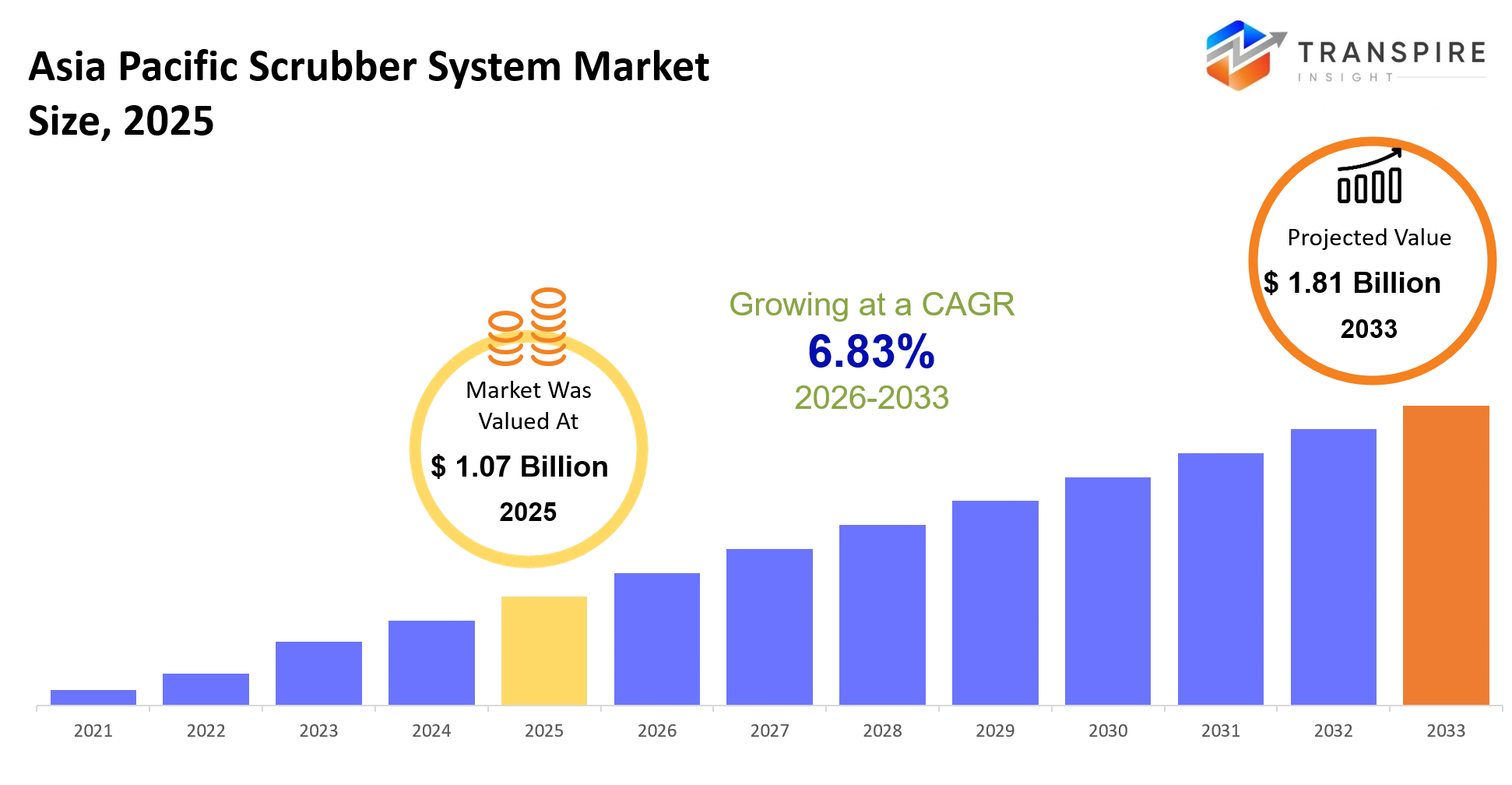
- Asia Pacific Scrubber System Market Size 2025: USD 1.07 Billion
- Asia Pacific Scrubber System Market Size 2033: USD 1.81 Billion
- Asia Pacific Scrubber System Market CAGR: 6.83%
- Asia Pacific Scrubber System Market Segments: By Type (Wet Scrubbers, Dry Scrubbers, Hybrid Scrubbers, Venturi Scrubbers, Packed Bed Scrubbers, Spray Tower Scrubbers, Electrostatic Scrubbers, Others); By Application (Marine Vessels, Power Plants, Chemical Plants, Metal Processing, Cement Plants, Oil & Gas Facilities, Waste Incineration, Others); By Fuel Type (HFO, MGO, LNG, Dual Fuel, Biofuel, Marine Diesel, Alternative Fuels, Others); By End User (Shipping Companies, Utilities, Industrial Facilities, Refineries, Chemical Manufacturers, Marine Operators, Power Producers, Others)
Asia Pacific Scrubber System Market Summary
The Asia Pacific Scrubber System Market was valued at USD 1.07 Billion in 2025. It is forecast to reach USD 1.81 Billion by 2033. That is a CAGR of 6.83% over the period.
In real terms, the adoption of scrubber systems within the Asia Pacific maritime & industrial community helps to remove sulfur & particulate matter from ship’s exhausts allowing them to continue burning standard heavy fuel oil and remain compliant with increasingly stringent environmental limits. Such systems have therefore been adapted into a tool for fleet owners to limit costs and achieve compliance with new port-state restrictions and fluctuating fuel prices.
Structurally, over the past 3-5 years the market has evolved from simple open-loop systems as the initial choice, to hybrid and closed-loop systems as ports in China, Singapore and India brought in restrictions on discharge, coupled by the implementation of the IMO 2020 sulphur cap to force owners' hand in deciding between low-sulphur fuel alternatives and retrofitting ships with scrubbers. The regulatory shockwave therefore fueled large retrofit programming across bulk carriers and tankers and shifted the purchasing trend from discretionary options to life-cycle fuel costs and trade route compliance.
Key Market Insights
- China commands significant influence in the Asia Pacific Scrubber System market with around 38% share in 2025owing to massive shipbuilding and retrofit projects.
- Singapore to witness the fastest growing hub (2025-2030) due to stricter port emissions monitoring coupled with strong dominance in bunker fuel trading.
- Hybrid scrubber systems account for major share in the Asia Pacific Scrubber System market (around 46% share in 2025) owing to increasing preference of operators towards flexibility of systems to be deployed in varied routes and regions.
- Closed-loop systems stand at second position owing to imposition of restrictions by many ports across the globe to discharge washwater in sensitive coastal areas.
- Retrofit applications dominated the market share (around 62%) of Asia Pacific Scrubber System Market in 2025, backed by IMO 2020 compliance backlog.
- Newbuild applications to gain momentum during the forecast period on the back of long-term fleet upgrading cycles.
- Tankers end-use segment accounted for significant market share (around 41%) of Asia Pacific Scrubber System Market in 2025 attributed to long-haul fuel costs and sulfur fuel consumption trend.
- Container shipping end-use segment to grow with highest CAGR during forecast period as growth in international trade will increase fleet utilization.
- Companies expand through hybrid scrubber innovations, digital emissions monitoring tools and partnership in the Asian market for maintenance of scrubbers.
- Integrated exhaust gas cleaning system and predictive maintenance software platform give a competitive edge to companies.
What are the Key Drivers, Restraints, and Opportunities in the Asia Pacific Scrubber System Market?
Driving forces for the Asia Pacific Scrubber System Market have been stringent IMO 2020 sulphur cap regulations, accompanied by continued high price differential of bunker fuel over other fuel options. In an attempt to avoid the high cost of using low-sulphur fuel, ship owners retrofitted scrubbers to gain an immediate increase in voyage level operating profit for Asia-Europe and intra-Asia trade. This factor has also generated consistent orders, especially among tanking and bulker fleets, running on long-distance lanes.
A significant restraining factor has been regulatory inconsistencies among various ports, including widespread ban on open-loop discharge in coastal regions like China and South-East Asia. Asset risk is now becoming more significant and ship owners need to change or reconfigure scrubber system depending on ports they will call at, hence, increasing complexity and cost associated with ship owners' investment decision in retrofit; in result of this, some owners chose to defer installation plans, thereby, dampening short term revenue generation.
Key opportunity within the market is modernization of hybrid scrubbers combined with integration with digital compliance reporting solutions. Ship owners, from Singapore and South Korea in particular, are investing in systems that combine the functionality of scrubbers with software applications for tracking and reporting emission levels in real-time to feed into carbon reporting requirements. The transition of vendors to providing not just the hardware but also to long-term service contracts and revenue models based on performance will play a role.
What Has the Impact of Artificial Intelligence Been on the Asia Pacific Scrubber System Market?
Artificial Intelligence (AI) is being increasingly integrated into scrubber performance systems to enhance emission control and minimize the uncertainty involved in maritime operations. Ship operators are now employing AI based control systems that allow automatic adaptation of washwater flow rates, the balance of fuel combustion and cleaning intensity of exhaust gases, depending on current engine load and thereby enhance the accuracy of compliance in all sea state conditions.
In relation to maintenance, the utilization of machine learning algorithms enables a forecast of the potential fouling risk or a components' deterioration, by processing sensor information relating to pumps, the levels of pH, and differential pressure readings. This enhancement has resulted in increased reliability of up time, while unscheduled maintenance operations, particularly in long-haul ships, and even more importantly, within the Asia Pacific Scrubber System market, have also decreased.
With regard to fuel efficiency and a forecast of emission levels, AI driven analytical platforms offer an improvement through simulating voyage conditions and optimizing the efficiency of scrubbers with varying fuel types. Operational costs are observed to have a directional decrease due to more efficient energy utilization and fewer manual adjustments. However, utilization is tempered by unreliable maritime communications for ship to shore data transmission while at sea. Further reasons are the associated high costs in implementing systems where new infrastructure, and a sensor rich data system for older vessels are required to allow for extensive utilization of AI based technology in exhaust gas cleaning.
Key Market Trends
- The imposition of IMO 2020 transition adoption from optional equipment purchase to capital expenditure and increased investment for scrubber installation among Asian ship operators from 2020.
- Port State Control in China strengthened the inspections at ports from 2023 which has promoted ships operators to choose hybrid scrubber instead of open-loop scrubber due to stricter regulations on discharge.
- Singapore tightened the regulation on emitted pollutants in the bunker fuel from 2024 which would further spur the adoption of the real-time emission monitoring scrubber with integrated digitalized compliance reporting module.
- The replacement trend of retrofitting installation exceeded new buildings from 2022, especially among older Japanese and South Korean fleets for economical upgrade.
- Wärtsilä and Alfa Laval extended the after-sale services in Asia from 2023 to 2025 that led to intense rivalry shift from equipment supply to after-sale long term service contract.
- Switching to scrubber application from fuel switching strategy has gained traction as the price gap of heavy fuel oil and diesel widened from 2021.
- Preference has tilted towards the adoption of the hybrid system since 2022 because operators need more flexible operation across inconsistent rules among the different Southeast Asia ports.
- The adoption of the closed loop system will be on the rise following environmental regulations and crackdown on wash water discharge in coastal industrialized zones from 2023.
- The digital emission management system has become a mandatory standard for new installations from 2024 as the demand for automated compliance reporting has increased.
- The trend of differentiation had shifted from hardware features to an integrated AI empowered monitoring with predictive maintenance functions among leading OEM.
Asia Pacific Scrubber System Market Segmentation
By Type :
Wet scrubbers apply liquid to a process for the removal of acidic gases and remain the most common form as the technology has a proven stable process and is the cheapest to run. Dry scrubbers remove pollutants using dry reagents and will serve as a viable option for those industries that face restrictions on their water usage. Hybrid scrubbers which blend wet and dry systems will become more popular as operators seek more versatility across changing port requirements and fuel situations in the Asia Pacific region.
Venturi scrubbers employ a high-pressure liquid jet to remove fine particles, these will find continued use within industrial emission controls. Packed bed scrubbers employ structured packing to enhance the contact between the gas and liquid for more effective emission control. Spray tower scrubbers utilize a spray of liquid to capture the gas pollutants, large applications that require simple robust emission controls will continue to employ this method. Electrostatic scrubbers are an electrically charged system used to remove particulate matter and will complement stringent requirements for emission controls in niche industrial areas.
By Application :
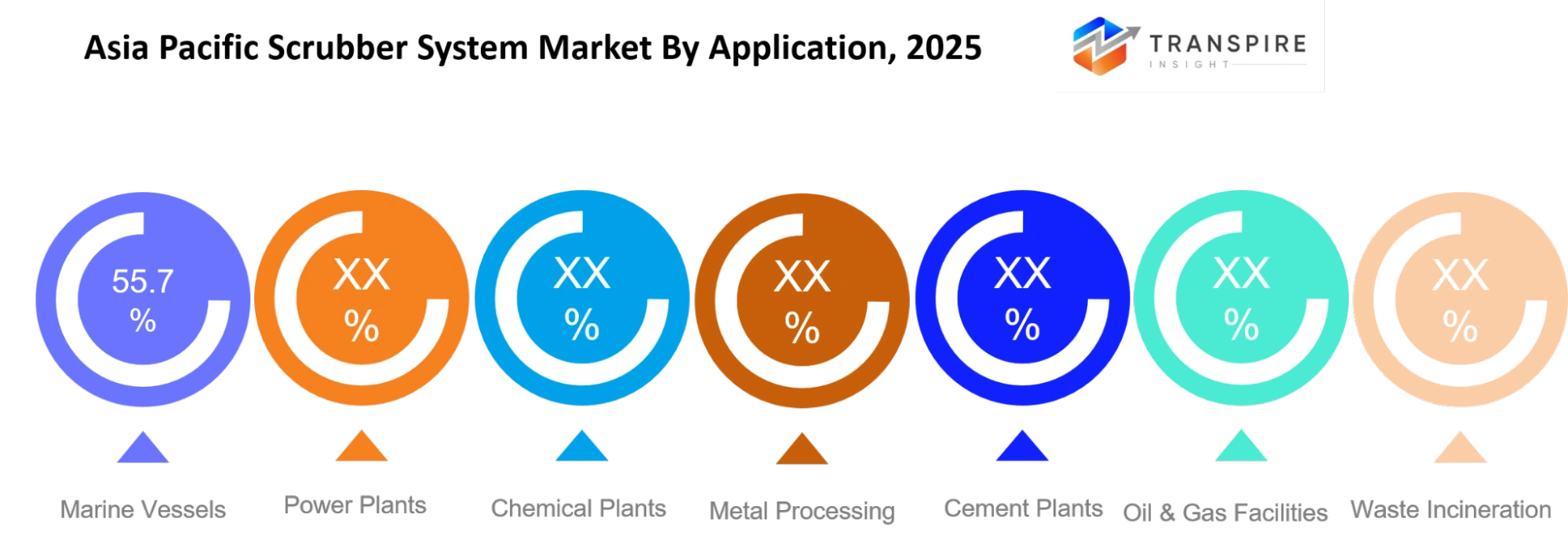
Marine applications will continue to be the biggest use as the sulfur regulations continue to enforce reductions in marine exhaust emissions across international waters. Power plants can and will continue to implement cleaner combustion compliance systems for the control of sulfur dioxide and particulate emissions. Chemical plants rely on scrubber technology for removal of harmful exhaust gases and remain focused on controlling the processes.
Metal production plants utilize scrubbers to control the dust and fumes released during smelting and fabrication process; Cement plants produce large amounts of particulate and will continue to use scrubbers to control dust and maintain air quality. Oil and gas plants implement scrubbers as a part of their gas treatment and refinery processes. Incinerators will implement scrubbing systems as part of their operation to decrease harmful gaseous pollutants released during combustion.
By Fuel Type :
The heavy fuel oil is one of the primary factors affecting scrubber demand, because operators can use it at lower cost, but must meet stringent emission compliance. Marine gas oil promotes clean combustion, however operational cost increases. It is used for some specific compliant routes. The usage of LNG will support low sulfur emission and also continues to influence the scrubber demand in dual compliance situations.
Dual fuel systems can easily switch between fuels, it will remain relevant for operators trying to adapt to the volatile fuel prices and varying regulatory zones. Biogas is more extensively used as clean fuel blends are drawing more attention in emission control strategy. Marine diesel still serves for the regulated operation; and alternatively fuel types will gradually have an impact on scrubber demand as policies in favor of clean energy are being strengthened in the markets of Asia Pacific.
By End User :
Shipping companies are the major end user groups because fleets adopt the technology of scrubbers as they need to consider the dual aspect of saving fuel cost as well as fulfilling the emission compliance standard. Utilities are also adopting scrubbers in order to decrease emissions from power generation and satisfy the environmental standards. Industrial factories also adopted scrubbers for controlling the emissions from manufacturing processes and production activities.
Refineries are implementing scrubbers in order to decrease the sulfur compounds from fuel processing and achieve the compliance standard of emission. Chemical manufacturers adopt the scrubbers for controlling and removing the toxic gases that are handled in the factory, they must strictly follow the emission standard of gases in order to protect the environment and health. Marine operators install scrubbers into their vessels for ensuring compliance while operating in the international shipping routes. Power producers are continuing their efforts to adopt scrubbers in order to achieve their goal in reduction of emission from their fossil fuel-based power plants and also comply with more and more stringent emission standards in the Asia Pacific markets.
What are the Key Use Cases Driving the Asia Pacific Scrubber System Market?
The main application is the control of emissions from marine ships, mainly tankers and bulk carriers, where a high demand is created from stringent sulphur limits. Ship owners fit them into ships in order to still utilize the cheaper heavy fuel oil and still comply with IMO 2020 sulfur requirements, relieving pressure on fuel costs over long haul trips. The application creates the highest demand as it is clearly linked with cost savings due to regulatory compliance.
Secondary applications have begun to include power plants, refineries (controlling SO2 and particulate matter emissions from the combustion of fossil fuels), and chemical manufacturing facilities where these systems treat toxic exhausts and allow firms to comply with stricter controls over industrial regions within China, Japan and India as regulations have become more enforced in these regions.
Nascent applications involve links with digital emissions tracking systems, combined with hybrid energy systems within industrial facilities and also by ports monitoring shore-based scrubber related equipment to ensure regulatory compliance.
|
Report Metrics |
Details |
|
Market size value in 2025 |
USD 1.07 Billion |
|
Market size value in 2026 |
USD 1.14 Billion |
|
Revenue forecast in 2033 |
USD 1.81 Billion |
|
Growth rate |
CAGR of 6.83% from 2026 to 2033 |
|
Base year |
2025 |
|
Historical data |
2021 - 2024 |
|
Forecast period |
2026 - 2033 |
|
Report coverage |
Revenue forecast, competitive landscape, growth factors, and trends |
|
Regional scope |
Asia Pacific (India, China, Japan, Australia, South Korea, Rest of Asia Pacific) |
|
Key company profiled |
Wartsila, Alfa Laval, Andritz, Ducon, CECO Environmental, Fuji Electric, Mitsubishi Heavy Industries, Babcock & Wilcox, Yara Marine, Valmet, Hitachi Zosen, Hamworthy, Thermax, Verantis, PureteQ |
|
Customization scope |
Free report customization (country, regional & segment scope). Avail customized purchase options to meet your exact research needs. |
|
Report Segmentation |
By Type (Wet Scrubbers, Dry Scrubbers, Hybrid Scrubbers, Venturi Scrubbers, Packed Bed Scrubbers, Spray Tower Scrubbers, Electrostatic Scrubbers, Others); By Application (Marine Vessels, Power Plants, Chemical Plants, Metal Processing, Cement Plants, Oil & Gas Facilities, Waste Incineration, Others); By Fuel Type (HFO, MGO, LNG, Dual Fuel, Biofuel, Marine Diesel, Alternative Fuels, Others); By End User (Shipping Companies, Utilities, Industrial Facilities, Refineries, Chemical Manufacturers, Marine Operators, Power Producers, Others) |
Which Regions are Driving the Asia Pacific Scrubber System Market Growth?
China is currently a leading market within the Asia Pacific Scrubber System Market as it maintains a vast shipbuilding industry, rigorous enforcement of coastal emission laws, and considerable scope for vessel retrofit works. Important ports like Shanghai and Ningbo have regular inspections which in turn drives vessel operators towards a compliant system for the cleaning of exhaust. Moreover, a substantial domestic manufacturing base assists in the reduction of equipment installation lead times and minimizes downtime. The stringent regulation combined with China's domestic production capacity enables its leading position in the market.
Japan acts as a sustained growth driver fueled by persistent investment from ship owners and phased long-term ship fleet modernization projects. In addition, as opposed to a primarily regulatory push, market adoption within the country is driven by reliability considerations and stringent engineering standards. Integrated installation into the design phase of new ships, as undertaken by shipbuilders, negates the need for retrofit. This steady trend of adoption from high-quality marine finance structures can contribute to a sustainable income generation from across all global shipping cycles.
Southeast Asia is a rapidly expanding market driven by new stringent environmental regulations being applied to the ports since 2023. The Singapore, Vietnam and Malaysia ports' recent investment in their port infrastructure coupled with strengthened oversight of emissions standards, has stimulated the demand for a compliant system from vessel owners. Newly established bunkering hubs and increased trade activity also play a role in the increasing demand for retrofit services. These growth indicators, therefore suggest significant market opportunities for suppliers and partners up until 2033.
Who are the Key Players in the Asia Pacific Scrubber System Market and How Do They Compete?
Moderate concentration is the dominant trend in the Asia Pacific Scrubber System Market. Major global OEMs control higher-value, newly constructed installs while smaller, regional service companies are competing on retrofit installation. Whereas the larger, established companies focus on engineering reliability and compliance validation, the smaller entities are bidding for low-value retrofit projects based on price and installation speed. The basis of competition has shifted from the price of hardware to the integrated capability, rapid installation and digital monitoring capabilities for emissions compliance.
Alfa Laval has developed highly efficient Marine Exhaust Gas Cleaning systems, which were initially developed to work in conjunction with alternative fuels and are also characterized by extended lifetime. Key aspects forAlfa Lavalis their use of a modular scrubber design which is ideal for installing without incurring significant vessel downtime during port calls.The primary growth mechanism is the development of long-term service contracts with shipping fleets working throughoutAsia Pacific shipping lanes.
Wartsila has invested heavily on incorporating scrubbers into their overall systems. Specifically, the combination of scrubbers and automation systems coupled with vessel energy management offers unique benefits to shipping fleets. It’s their ability to develop tools for analyzing and monitoring real-time vessel performance and emissions that has provided a strategic advantage. The expansion for Wartsila is achieved through strategic relationships with shipyards in South Korea and Japan, where it is more convenient to integrate at the very initial stages of ship development, which will in turn drive early adoption of their technology.
Yara Marine Technologies is developing its presence in the market through its retrofit specialized solutions, and it targets mid-sized shipping fleets, aiming at providing quick and efficient installation of scrubbers. Saacke is concentrating on developing the combustion-link emission controls for marine and industrial environments. Clean Marine is increasing market share through providing customized scrubber systems and targeting retrofit projects for shipping fleets in Southeast Asia.
Company List
- Wartsila
- Alfa Laval
- Andritz
- Ducon
- CECO Environmental
- Fuji Electric
- Mitsubishi Heavy Industries
- Babcock & Wilcox
- Yara Marine
- Valmet
- Hitachi Zosen
- Hamworthy
- Thermax
- Verantis
- PureteQ
Recent Development News
In January 2026, Wärtsilä announced expansion of its exhaust gas cleaning service network across Asia Pacific. The company strengthened after-sales support for hybrid scrubber systems used in retrofit fleets operating under stricter port emission rules.
Source https://www.manifoldtimes.com/
In April 2025, Wärtsilä announced a reduction in its short-term marine scrubber order outlook, citing weaker vessel contracting activity and uncertainty in fuel price spreads. The move highlighted a slowdown in scrubber retrofit momentum across global shipping markets, including Asia Pacific, where owners are reassessing payback periods for exhaust gas cleaning systems. Source https://www.manifoldtimes.com/
What Strategic Insights Define the Future of the Asia Pacific Scrubber System Market?
In terms of market structure, the Asia Pacific Scrubber System Market will gradually evolve from dedicated hybrid exhaust cleaning devices to holistic emissions management platforms. While compliance is still a main driver in the near term, fuel economics of a vessel's lifecycle will more strongly drive adoption in the 5-7 years range, and ship owners' choices will be guided by fuel flexibility versus expanding port requirements throughout key Asian trade lanes, in which context, hybrids, and digitally integrated solutions are more suitable.
A less apparent risk is regulatory fragmentation in the region. Inconsistent rules and enforcement for washwater discharge limit an asset's predictability over its lifespan, stranding assets with open-loop systems, especially when multiple countries introduce new thresholds and there is a lack of a coordinated time-line for each change.
An upcoming opportunity for vendors is in the AI based emission verification platform integrated with port digitisation initiatives being deployed in Singapore and South Korea; this converts scrubbing data into authenticated, compliance records, allowing for new service based revenue streams beyond equipment supply.Vendors should focus on modular, upgradeable scrubbers capable of connecting to a digital system for data logging, analysis and regulatory reporting.
Asia Pacific Scrubber System Market Report Segmentation
By Type
- Wet Scrubbers
- Dry Scrubbers
- Hybrid Scrubbers
- Venturi Scrubbers
- Packed Bed Scrubbers
- Spray Tower Scrubbers
- Electrostatic Scrubbers
By Application
- Marine Vessels
- Power Plants
- Chemical Plants
- Metal Processing
- Cement Plants
- Oil & Gas Facilities
- Waste Incineration
By Fuel Type
- HFO
- MGO
- LNG
- Dual Fuel
- Biofuel
- Marine Diesel
- Alternative Fuels
By End User
- Shipping Companies
- Utilities
- Industrial Facilities
- Refineries
- Chemical Manufacturers
- Marine Operators
- Power Producers
Frequently Asked Questions
Find quick answers to common questions.
The Asia Pacific Scrubber System Market size is USD 1.81 Billion in 2033.
Key segments for the Asia Pacific Scrubber System Market are By Type (Wet Scrubbers, Dry Scrubbers, Hybrid Scrubbers, Venturi Scrubbers, Packed Bed Scrubbers, Spray Tower Scrubbers, Electrostatic Scrubbers, Others); By Application (Marine Vessels, Power Plants, Chemical Plants, Metal Processing, Cement Plants, Oil & Gas Facilities, Waste Incineration, Others); By Fuel Type (HFO, MGO, LNG, Dual Fuel, Biofuel, Marine Diesel, Alternative Fuels, Others); By End User (Shipping Companies, Utilities, Industrial Facilities, Refineries, Chemical Manufacturers, Marine Operators, Power Producers, Others).
Major Asia Pacific Scrubber System Market players are Wartsila, Alfa Laval, Andritz, Ducon, CECO Environmental, Fuji Electric, Mitsubishi Heavy Industries, Babcock & Wilcox, Yara Marine, Valmet, Hitachi Zosen, Hamworthy, Thermax, Verantis, PureteQ.
The Asia Pacific Scrubber System Market size is USD 1.07 Billion in 2025.
The Asia Pacific Scrubber System Market CAGR is 6.83% from 2026 to 2033.
- Wartsila
- Alfa Laval
- Andritz
- Ducon
- CECO Environmental
- Fuji Electric
- Mitsubishi Heavy Industries
- Babcock & Wilcox
- Yara Marine
- Valmet
- Hitachi Zosen
- Hamworthy
- Thermax
- Verantis
- PureteQ
About the Authors

Avinash Kumar
I’m Avinash Kumar, a Senior Research Analyst at Transpire Insight, with expertise in the Electronics and Semiconductor and Energy & Power industry. My work focuses on analyzing emerging technologies, market trends, industry developments, and innovation across these sectors. I specialize in transforming complex technical and market insights into clear, research-backed content that helps professionals, businesses, and decision-makers stay informed. Through continuous industry research and data-driven analysis, I strive to deliver accurate, reliable, and practical perspectives on the latest advancements shaping the semiconductor and energy landscape.

Chakradhar Khansole
Chakradhar serves as the Research Director at Transpire Insight, bringing over 8 years of experience in technology, innovation, and strategic market intelligence. He specializes in transforming complex market data into actionable business insights that enable organizations to make informed, growth-oriented decisions. Recognized for his strategic vision and analytical expertise, Chakradhar leads high-impact research initiatives, delivering comprehensive market assessments, competitive intelligence, and forward-looking industry analysis.
Recently Published Reports
-
Apr 2026
Active Power Filter Market
Active Power Filter Market Size, Share & Analysis Report By Type (Shunt Active Power Filters, Series Active Power Filter, Hybrid Active Power Filter), By Application (Harmonics Mitigation, Reactive Power Compensation, Voltage Regulation, Power Factor Correction), By Phase (Single Phase, Three Phase), By End-User Industry (Manufacturing, Healthcare, Commercial, Automotive, Oil and Gas, Others), and Geography (North America, Europe, Asia-Pacific, Middle East and Africa, South and Central America), 2021 - 2031
-
Apr 2026
Electrical Transformer Market
Electrical Transformer Market Size, Share & Analysis Report By Core (Closed, Shell, and Berry), By Insulation (Gas, Oil, Solid, Air, and Other), By Phase (Single, and Three), By Rating (100 MVA to 500 MVA, 501 MVA to 800 MVA, and 801 MVA to 1200 MVA), and Geography (North America, Europe, Asia-Pacific, Middle East and Africa, South and Central America), 2021 – 2031
-
Apr 2026
Hydraulic Piston Pumps Market
Hydraulic Piston Pumps Market Size, Share & Analysis Report By Type (Axial Piston Pumps, Radial Piston Pumps), By Operating Pressure (Low Pressure, Medium Pressure, High Pressure), By Application (Construction, Mining, Agriculture, Automotive, Oil & Gas, Industrial Machinery, Others), By End-User (OEMs, Aftermarket), and Geography (North America, Europe, Asia-Pacific, Middle East and Africa, South and Central America), 2021 – 2031
-
Apr 2026
Laboratory Gas Generators Market
Laboratory Gas Generators Market Size, Share & Analysis Report By Product (Nitrogen Gas Generator, Hydrogen Gas Generator, Zero Air Gas Generator, Purge Gas Generator, TOC Gas Generators, Others), By Application (Gas Chromatography, Liquid Chromatography-mass Spectrometry (LC-MS), Gas Analyzers, Others), By End-user (Life Science, Chemical & Petrochemical, Food & Beverage, Others), and Geography (North America, Europe, Asia-Pacific, Middle East and Africa, South and Central America), 2021 – 2031