
Europe Chemical Tanker Shipping Market Size & Forecast:
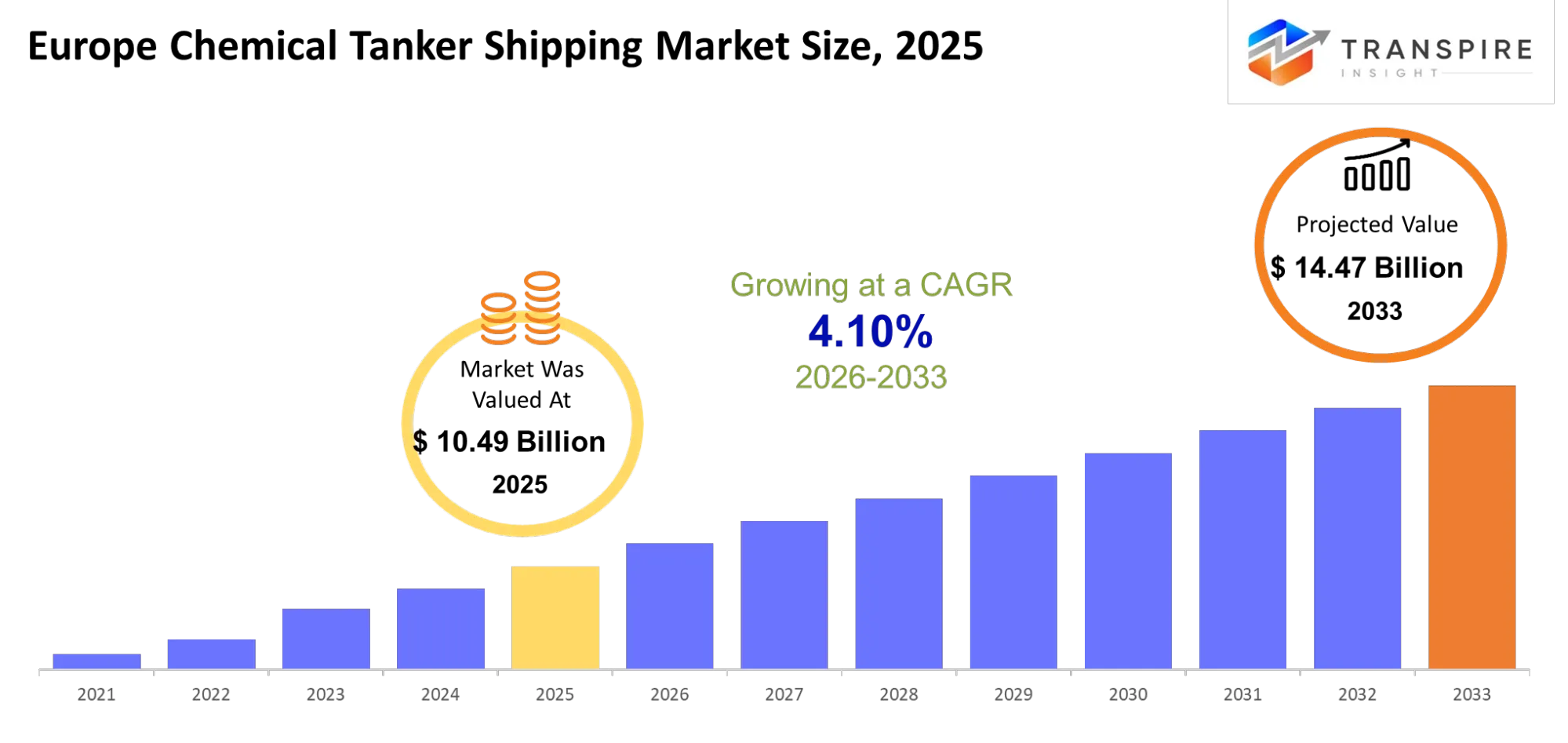
- Europe Chemical Tanker Shipping Market Size 2025: USD 10.49 Billion
- Europe Chemical Tanker Shipping Market Size 2033: USD 14.47 Billion
- Europe Chemical Tanker Shipping Market CAGR: 4.10%
- Europe Chemical Tanker Shipping Market Segments: By Type (Organic Chemicals, Inorganic Chemicals, Vegetable Oils, Specialty Chemicals, Others); By Application (Industrial Transport, Energy, Chemicals, Petrochemicals, Others); By End-User (Chemical Companies, Oil & Gas Firms, Traders, Others); By Vessel Type (IMO Type 1, Type 2, Type 3, Specialized Tankers, Others)
To learn more about this report,  Download Free Sample Report
Europe Chemical Tanker Shipping Market Summary
The Europe Chemical Tanker Shipping Market was valued at USD 10.49 Billion in 2025. It is forecast to reach USD 14.47 Billion by 2033. That is a CAGR of 4.10% over the period.
The European chemical tanker shipping market serves as a transportation network that enables the safe delivery of dangerous materials and high-purity liquids between refineries and petrochemical plants and pharmaceutical manufacturing sites and industrial processing centers. The specialized chemical tankers function as essential elements that enable maritime trade to proceed without interruptions which occur when products like methanol and caustic soda and specialty solvents and food-grade chemicals undergo protected maritime transport. The market has changed during the past five years because European maritime regulations now demand low-emission ships and digital fleet management systems while requiring companies to report their carbon emissions and achieve better fuel efficiency results.
The implementation of stricter European Union decarbonization policies together with the Russia-Ukraine conflict which disrupted regional trade flows created a major turning point for this situation. The shipowners experienced increased pressures to update their fleets because they needed to establish new trade patterns and enhance their operational capabilities through predictive maintenance and voyage optimization technologies. The chemical manufacturers need trustworthy transportation partners who follow transportation regulations therefore companies with energy-saving vessels and sophisticated cargo control systems obtain extended contracts which bring them better revenue predictability for their domestic and global shipping routes.
Key Market Insights
- The Europe Chemical Tanker Shipping Market in 2025 saw Northern Europe maintain its dominant position because its advanced port infrastructure combined with its strict emissions enforcement policies which resulted in more than 40 percent market share.
- The Eastern European market showed its fastest expansion from 2026 to 2033 because terminal renovations and the growth of Baltic chemical trade corridors.
- Southern European ports increased their market share through higher refinery output which boosted chemical shipments that connected Mediterranean Sea and Middle Eastern shipping routes.
- In 2025 organic chemicals became the leading market segment because petrochemical producers continued to require massive shipments of methanol and benzene and aromatics materials.
- The pharmaceutical and food-grade industries required contamination-controlled tanker transportation services which made specialty chemicals the second-largest market segment.
- The fastest-growing market segment after 2024 included bio-based feedstocks and green methanol cargoes because Northern Europe invested in renewable fuel development.
- The total shipping demand of 2025 derived from petrochemical transportation which accounted for 45 percent of all shipping needs because European industrial sectors required ongoing movement of feedstock between their main ports.
- The shipping industry experienced its most rapid forecast growth through chemical transportation which included hydrogen-derived liquids and alternative marine fuels that became part of regional shipping operations.
- Chemical companies controlled more than 50 percent of market demand in 2025 because they used long-term tanker charter agreements and integrated logistics contracts to meet their transportation needs.
- Odfjell SE accelerated strategic expansion in 2026 through its decision to fund wind-assisted chemical tankers which deliver better fuel efficiency and emission control results.
What are the Key Drivers, Restraints, and Opportunities in the Europe Chemical Tanker Shipping Market?
The European Union Emissions Trading System together with FuelEU Maritime regulations now serve as the principal drivers which determine market conditions in the Europe Chemical Tanker Shipping market. The regulations increased operational demands on shipowners to upgrade their fleets through the adoption of fuel-efficient propulsion systems together with advanced emissions monitoring solutions. Chemical manufacturers and industrial exporters increasingly prefer operators with compliant low-emission fleets because regulatory penalties and carbon costs directly affect their transportation contracts and operating margins. The industry now allocates its investments toward stainless-steel tankers and dual-fuel vessels while implementing digital voyage optimization systems which help operators develop new revenue streams through improved environmental performance.
The primary restriction which prevents progress in the industry exists as a result of the substantial capital requirements needed for both fleet upgrades and specialized tanker construction. Chemical tankers require complex cargo segregation systems, corrosion-resistant materials, and advanced safety certifications that significantly increase vessel acquisition and maintenance costs. Small operators face difficulties in replacing their fleets because shipyard resources are limited and delivery periods are extended. The existing structural obstacles prevent companies from entering the market which decreases their ability to expand operations and adopt new technologies across regional shipping networks.
A major future opportunity is emerging around transportation of green methanol, bio-based feedstocks, and hydrogen-derived liquid chemicals. Northern European ports and industrial corridors are attracting investment in alternative fuel infrastructure and renewable chemical production facilities.Operators who establish partnerships with energy producers and industrial exporters during their initial phase will secure permanent rights to high-growth cargo segments which are associated with Europe’s energy transition strategy.
What Has the Impact of Artificial Intelligence Been on the Europe Chemical Tanker Shipping Market?
Chemical tanker operations throughout Europe, which rely on advanced digital systems, will experience their most significant changes through automated compliance management and vessel performance optimization. The shipping industry now uses AI-based scrubber systems that track sulfur oxide emissions and washwater discharge and fuel usage throughout their operational activities. Integrated fleet compliance platforms handle automatic reporting duties which stem from IMO and European Union environmental regulations, thus decreasing the need for manual work and enhancing inspection preparedness. Several tanker operators have connected their onboard sensors to cloud-based analytics systems which monitor cargo temperatures and engine loads and ballast system performance during their journeys.
Machine learning models help organizations predict maintenance needs by detecting unusual vibration patterns and corrosion dangers and engine performance problems which occur before equipment breakdowns happen. The systems enable operators to decrease unexpected maintenance service interruptions while they arrange dry-docking activities, which leads to increased ship availability and reduced maintenance expenses. AI-supported maritime route planning software uses current weather conditions and fuel price information and traffic data to suggest speed changes and route modifications, which results in measurable reductions of fuel usage and carbon emissions. The satellite connectivity problems, which affect onboard data systems, and the high costs of integration create obstacles that prevent organizations from using AI software in actual maritime environments.
Key Market Trends
- Since 2023, European shipowners have accelerated investments in dual-fuel and wind-assisted tankers to comply with FuelEU Maritime emissions targets.
- Odfjell changed its fleet operations in 2026 through its acquisition of stainless-steel wind-assisted tankers which target improved fuel efficiency and reduced carbon emissions.
- Chemical producers increasingly preferred long-term charter agreements after freight rate fluctuations during 2021–2024 disrupted spot market transportation reliability throughout Europe.
- Northern European ports enhanced their digital cargo monitoring systems between 2024 and 2026 to establish better efficiency in handling hazardous chemicals and tracking compliance.
- Stolt-Nielsen and NYK expanded their LNG bunkering partnership in 2026 because low-emission marine fuel infrastructure became essential for tanker operations.
- The specialized vessels known as IMO Type 1 and Type 2 experienced rising demand because pharmaceutical and food-grade chemical exports needed tighter contamination control measures.
- Eastern European ports attracted higher tanker traffic after modernization projects at their terminals enhanced chemical logistics operations between rail and port and improved turnaround times.
- The number of traders participating in short-term chemical cargo contracts increased after 2024, which created more scheduling demands for medium-range tanker operators throughout Europe.
- European regulators established more stringent maritime decarbonization standards which forced smaller tanker operators to choose between fleet consolidation and strategic leasing partnerships by early 2026.
- Bio-based feedstock transportation emerged as a new shipping category after chemical manufacturers increased investment in renewable and circular production processes.
Europe Chemical Tanker Shipping Market Segmentation
By Type:
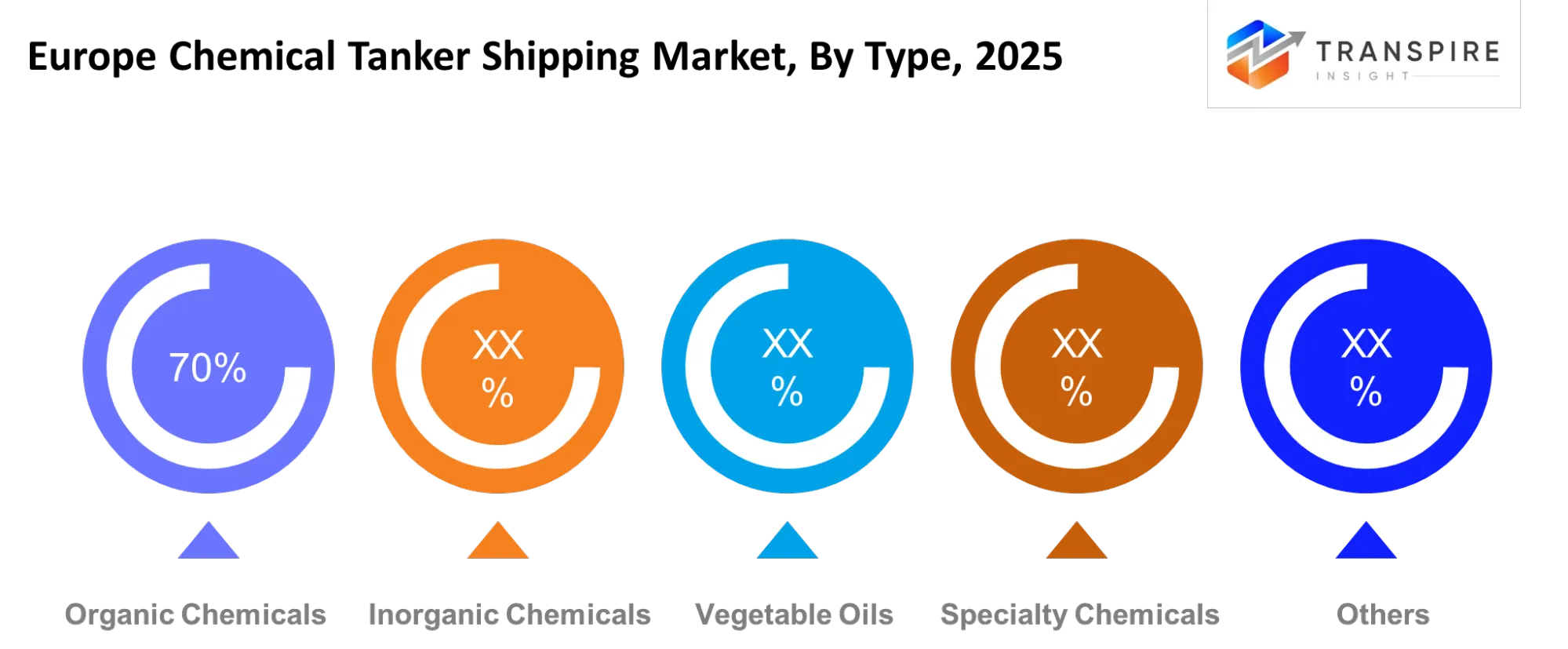
The main reason for organic chemicals to possess their largest market share is the continuous transport of high-volume petrochemical shipments which include methanol and ethanol and benzene and aromatics between European industrial centers and their export terminals. The manufacturing requirements from plastics and coatings and industrial solvents create continuous demand for shipping services which Northern and Western Europe ports provide. Shipping operations benefit from advanced stainless-steel tanker fleets because they need to meet both their long-distance hauling needs and their strict cargo separation requirements.
The future of organic chemical production will rely on two factors which are low-carbon chemical manufacturing processes and the rising demand for bio-based raw materials. Shipping companies are investing in fuel-efficient vessels and digital cargo monitoring systems to improve compliance and reduce operating costs. The pharmaceutical and food-grade and performance material industries require high-purity transportation solutions which deliver exact temperature control and contamination protection making specialty chemicals more popular. The industrial manufacturing sector and agricultural processing activities create constant demand for vegetable oils and inorganic chemicals even though commodity prices fluctuate which leads to shipping rate changes.
To learn more about this report, Download Free Sample Report
By Application:
The chemical and petrochemical transportation industry holds its largest market share because European refining and industrial production networks depend on marine bulk transport. The shipping industry experiences steady demand because feedstocks and intermediates and processed chemicals continuously move between the ports of Rotterdam and Antwerp-Bruges and Hamburg. Dedicated tanker fleets with advanced cargo handling systems remain critical for maintaining supply chain reliability across cross-border industrial operations.
The industrial transport sector keeps growing because industries need to move specialized materials which serve electronic manufacturing and construction and advanced manufacturing purposes. The energy sector experiences expansion through the regional trade of alternative marine fuels and green methanol and hydrogen-derived liquids. Future demand patterns will require operators who can manage multiple cargo types because single-product shipping networks cannot meet market needs. Fleet operators need to achieve environmental transport standards for their fleets to gain competitive advantages which will help them maintain access to the market for extended periods.
By End-User:
Chemical companies represent the dominant end-user segment because large manufacturers maintain long-term shipping contracts to secure stable raw material and product transportation capacity. The integrated chemical producers which operate in Northern Europe need to have safe tanker access for their high-purity and hazardous materials operations throughout the industrial regions of the area. The companies in this segment base their purchasing choices on two main factors which include operational reliability and their need to follow European environmental standards.
The oil and gas industry maintains a strong need for transportation services which support the movement of refined products and petrochemical feedstocks and liquid intermediates used in downstream processing. Trading firms are increasing participation in spot charter markets as commodity trade flows become more dynamic and geographically diversified. The future market expansion will create opportunities for shipowners and industrial buyers to work together through multi-year charter agreements which will support their investments in low-emission vessels. Increasing demand for integrated logistics solutions will occur as end-users strive to achieve better visibility into their supply chains while maintaining cost control.
By Vessel Type:
The market currently favors IMO Type 2 tankers because industrial chemicals which European companies transport, require only moderate containment and safety standards to maintain safe industrial operations. The vessels provide operational flexibility which allows them to transport a wide range of cargo for use in both regional and international chemical trade operations. The petrochemical specialty chemical and industrial liquid transport sectors now utilize their entire fleet through active operations.
IMO Type 1 vessels serve high-risk cargo transportation where strict containment and advanced safety systems remain essential, particularly for hazardous chemical products. The pharmaceutical and food-grade industries need specialized tankers to transport temperature-sensitive and high-purity cargoes which are becoming more important to their operations. The forecast period will see fleet modernization programs which will lead to increased use of specialized vessels which operate with fuel efficiency and digital monitoring systems. Shipowners and investors now focus their interest on flexible vessel designs which enable multiple cargo operations and comply with stricter European emissions regulations.
What are the Key Use Cases Driving the Europe Chemical Tanker Shipping Market?
The primary use case in the Europe Chemical Tanker Shipping Market is the transportation of bulk petrochemicals and industrial chemicals for manufacturing and refining industries. The operation of stainless-steel and coated chemical tankers enables the transportation of methanol and caustic soda and aromatics because these substances create ongoing requirements from industrial centers located throughout Northern and Western Europe.
The specialty chemicals and pharmaceutical supply chains now use secondary applications which require cargo purity and temperature-controlled handling. Agrochemical producers and food-grade chemical suppliers now prefer medium-range chemical tankers because these vessels provide separate cargo systems and maintain compliance with international regulations during border crossings.
The maritime industry now uses bio-based feedstocks and green methanol and hydrogen-derived chemicals to support Europe's energy transition strategy. The demand for low-emission coastal tanker services has increased because these services help distribute goods through short-sea networks which operate under European carbon reduction policies that have become more stringent.
|
Report Metrics |
Details |
|
Market size value in 2025 |
USD 10.49 Billion |
|
Market size value in 2026 |
USD 10.92 Billion |
|
Revenue forecast in 2033 |
USD 14.47 Billion |
|
Growth rate |
CAGR of 4.10% from 2026 to 2033 |
|
Base year |
2025 |
|
Historical data |
2021 - 2024 |
|
Forecast period |
2026 - 2033 |
|
Report coverage |
Revenue forecast, competitive landscape, growth factors, and trends |
|
Regional scope |
Europe (Germany, United Kingdom, France, Italy, Spain, Rest of Europe) |
|
Key company profiled |
Stolt-Nielsen, Odfjell, MOL Chemical Tankers, Navig8, Ardmore Shipping, Hafnia, Team Tankers, Maersk Tankers, Scorpio Tankers, BW Group, Mitsui OSK Lines, NYK Line, Bahri, K Line, Euronav |
|
Customization scope |
Free report customization (country, regional & segment scope). Avail customized purchase options to meet your exact research needs. |
|
Report Segmentation |
By Type (Organic Chemicals, Inorganic Chemicals, Vegetable Oils, Specialty Chemicals, Others); By Application (Industrial Transport, Energy, Chemicals, Petrochemicals, Others); By End-User (Chemical Companies, Oil & Gas Firms, Traders, Others); By Vessel Type (IMO Type 1, Type 2, Type 3, Specialized Tankers, Others) |
Which Regions are Driving the Europe Chemical Tanker Shipping Market Growth?
The Europe Chemical Tanker Shipping Market still operates its main business activities from Northern Europe because this region maintains strict environmental laws and possesses superior maritime facilities. The Netherlands and Germany and Norway operate petroleum chemical facilities which extend their reach to main seaports that include Rotterdam and Hamburg and Antwerp-Bruges for transporting petrochemical products and using specialized tankers to export them. The region leads fleet modernization initiatives because it adopted low-emission vessel technologies before other regions and because it strictly enforces European Union decarbonization regulations. The supporting ecosystem contains storage terminals that work together with digital port systems and marine fuel facilities and industrial shipping contracts to improve operational efficiency while creating market stability.
Southern Europe stands as the second most important regional force because its trade network and strategic location remain its main strengths instead of its regulatory expertise. The ports of Italy and Spain and Greece function as vital transportation centers which connect European chemical manufacturers to markets in the Middle East and North Africa. Shipowners in this region have maintained steady investment in medium-range and deep-sea tanker fleets, allowing operators to preserve capacity even during periods of freight volatility. The region delivers dependable shipping requirements through its various chemical products because it maintains its refineries and distributes trade across different chemical categories.
Eastern Europe is developing into the quickest expanding area because both governmental bodies and private companies are increasing their investments toward port modernization and industrial logistics development. The Baltic and Black Sea corridors now serve as major supply chain hubs because chemical production operations and rail-to-port network expansion have increased their cargo handling capacity. The recent terminal upgrades and fleet renewal initiatives have improved cargo handling capacity while enabling the company to meet international maritime standards. The period from 2026 to 2033 will generate valuable business prospects for tanker operators and leasing companies and infrastructure investors who want to access emerging routes that handle growing industrial traffic.
Who are the Key Players in the Europe Chemical Tanker Shipping Market and How Do They Compete?
The Europe Chemical Tanker Shipping Market presents a situation with moderate consolidation which enables market participants to compete through their different fleet capabilities and environmental standards and their ability to maintain efficient shipping routes instead of using basic freight pricing models. Major shipping companies maintain their market position by signing extended contracts with chemical producers and refineries while smaller shipping companies function in short-distance and regional markets because they need to adapt quickly instead of relying on their large capacity. The market now provides greater benefits to businesses which possess the ability to handle intricate chemical shipments while following strict European safety regulations and emissions control measures.
Technology implementation together with cargo separation capabilities and all-inclusive transportation solutions now determines competitive advantage more than the total number of vessels in operation. Odfjell SE operates its business through specialized operations which focus on building stainless-steel chemical tankers that transport both high-purity products and dangerous materials. The company achieves operating cost reductions through its investment in wind-assisted propulsion systems and fuel-efficient newbuilds which also enable compliance with European decarbonization regulations that keep getting stricter. Stolt-Nielsen Limited establishes its unique market position through an all-in-one service package which merges tanker transportation with terminal warehousing and tank container distribution to provide customers improved command over their supply chains while making freight handling simpler.
MOL Chemical Tankers specializes in deep-sea chemical shipping while using its worldwide fleet to manage trade operations between Europe and Asia. The flexible medium-range fleet of Team Tankers International enables the company to operate throughout Europe because it can quickly adjust its schedule for various intra-European routes which provides a competitive advantage. Bahri Chemicals is growing its operations by using advanced IMO-class tankers which deliver better fuel performance to help the company establish its presence in long-distance European Union routes.
Company List
- Stolt-Nielsen
- Odfjell
- MOL Chemical Tankers
- Navig8
- Ardmore Shipping
- Hafnia
- Team Tankers
- Maersk Tankers
- Scorpio Tankers
- BW Group
- Mitsui OSK Lines
- NYK Line
- Bahri
- K Line
- Euronav
Recent Development News
“In April 2026, Stolt Tankers participated in a shore-to-ship green methanol bunkering trial at Deendayal Port alongside Aegis Vopak, Indian Oil Corporation, and J M Baxi. The initiative validated operational and safety procedures for methanol bunkering and strengthened the commercial pathway for low-emission chemical tanker operations serving European regulatory compliance requirements.https://www.constructionworld.in
“In April 2026, Odfjell SE committed approximately USD 290 million for four new stainless-steel chemical tanker newbuilds equipped with wind-assisted propulsion technology. The investment advances fleet modernization and supports compliance with stricter European decarbonization standards, reinforcing the shift toward energy-efficient chemical tanker operations.https://www.rivieramm.com
What Strategic Insights Define the Future of the Europe Chemical Tanker Shipping Market?
The Europe Chemical Tanker Shipping Market is undergoing a structural transition which will establish specialized operations that require high compliance standards during the next 5 to 7 years because of increasing decarbonization requirements and more complex chemical trade patterns between European countries. Fleet modernization will increasingly favor operators who can use fuel-flexible vessels together with digital cargo management systems which will create a competitive gap between companies with abundant financial resources and smaller regional shipping firms. The market presents an underappreciated danger because it increasingly depends on a small number of shipyards which meet compliance standards and on facilities that provide alternative fuel sources, which will result in longer fleet replacement periods and higher operational expenses, even though demand conditions seem to be positive.
Short-sea chemical transportation which operates between Northern European industrial corridors shows great potential to develop into a specialized market segment that supports green hydrogen derivatives and bio-based feedstock transportation. Market participants should establish long-term charter agreements which connect to their low-emission vessel investments because these agreements provide utilization stability and regulatory resilience until compliance expenses increase to higher levels.
Europe Chemical Tanker Shipping Market Report Segmentation
By Type
- Organic Chemicals
- Inorganic Chemicals
- Vegetable Oils
- Specialty Chemicals
- Others
By Application
- Industrial Transport
- Energy
- Chemicals
- Petrochemicals
- Others
By End-User
- Chemical Companies
- Oil & Gas Firms
- Traders
- Others
By Vessel Type
- IMO Type 1
- Type 2
- Type 3
- Specialized Tankers
- Others
Frequently Asked Questions
Find quick answers to common questions.
The Europe Chemical Tanker Shipping Market size is USD 14.47 Billion in 2033.
Key segments for the Europe Chemical Tanker Shipping Market are By Type (Organic Chemicals, Inorganic Chemicals, Vegetable Oils, Specialty Chemicals, Others); By Application (Industrial Transport, Energy, Chemicals, Petrochemicals, Others); By End-User (Chemical Companies, Oil & Gas Firms, Traders, Others); By Vessel Type (IMO Type 1, Type 2, Type 3, Specialized Tankers, Others).
Major Europe Chemical Tanker Shipping Market players are Stolt-Nielsen, Odfjell, MOL Chemical Tankers, Navig8, Ardmore Shipping, Hafnia, Team Tankers, Maersk Tankers, Scorpio Tankers, BW Group, Mitsui OSK Lines, NYK Line, Bahri, K Line, Euronav.
The Europe Chemical Tanker Shipping Market size is USD 10.49 Billion in 2025.
The Europe Chemical Tanker Shipping Market CAGR is 4.10% from 2026 to 2033.
- Stolt-Nielsen
- Odfjell
- MOL Chemical Tankers
- Navig8
- Ardmore Shipping
- Hafnia
- Team Tankers
- Maersk Tankers
- Scorpio Tankers
- BW Group
- Mitsui OSK Lines
- NYK Line
- Bahri
- K Line
- Euronav
Recently Published Reports
-
Apr 2026
Healthcare Polymer Packaging Market
Healthcare Polymer Packaging Market Size, Share & Analysis Report By Packaging Type (Syringes, IV Bottles and Pouches, Clamshells, Blisters, Bottles & Jars, Containers, Tubes, IV Parental Packaging, Others), By Type (Regulated, Non-regulated), By Polymer Type (LDPE (Low-Density Polyethylene), HDPE (High-Density Polyethylene), Homo-polymer (Homo), Random Copolymer (Random), Block Copolymer (Block), PET, Polystyrene, Polyvinyl Chloride, Polyamide/EVOH, Others), and Geography (North America, Europe, Asia-Pacific, Middle East and Africa, South and Central America), 2021 - 2031
-
Apr 2026
Hydrophilic Tape (Waterstop) Market
Hydrophilic Tape (Waterstop) Market Size, Share & Analysis Report By Type (Bentonite-Based Hydrophilic Tape, Rubber-Based Hydrophilic Tape), By Application (Residential Buildings, Commercial Buildings, Infrastructure Projects), and Geography (North America, Europe, Asia-Pacific, Middle East and Africa, South and Central America), 2021 - 2031
-
Apr 2026
Metalens Market
Metalens Market Size, Share & Analysis Report By Type (Visible Light Metalens, and Infrared Metalens), By Application (Consumer Electronics, Automotive Electronics, Industrial, Medical, and Others), and Geography (North America, Europe, Asia-Pacific, Middle East and Africa, South and Central America), 2021 - 2031
-
Apr 2026
PBT Resin Market
PBT Resin Market Size, Share & Analysis Report By Type (Reinforced PBT Resin, Unreinforced PBT Resin), By Processing Method (Injection Molding, Extrusion, Blow Molding, Others), By End-User (Automotive, Electrical & Electronics, Consumer Appliances, Industrial Machinery, Medical Devices, Packaging, Others), and Geography (North America, Europe, Asia-Pacific, Middle East and Africa, South and Central America), 2021 - 2031