

Global Dry Marine Scrubber Systems Market Size & Forecast
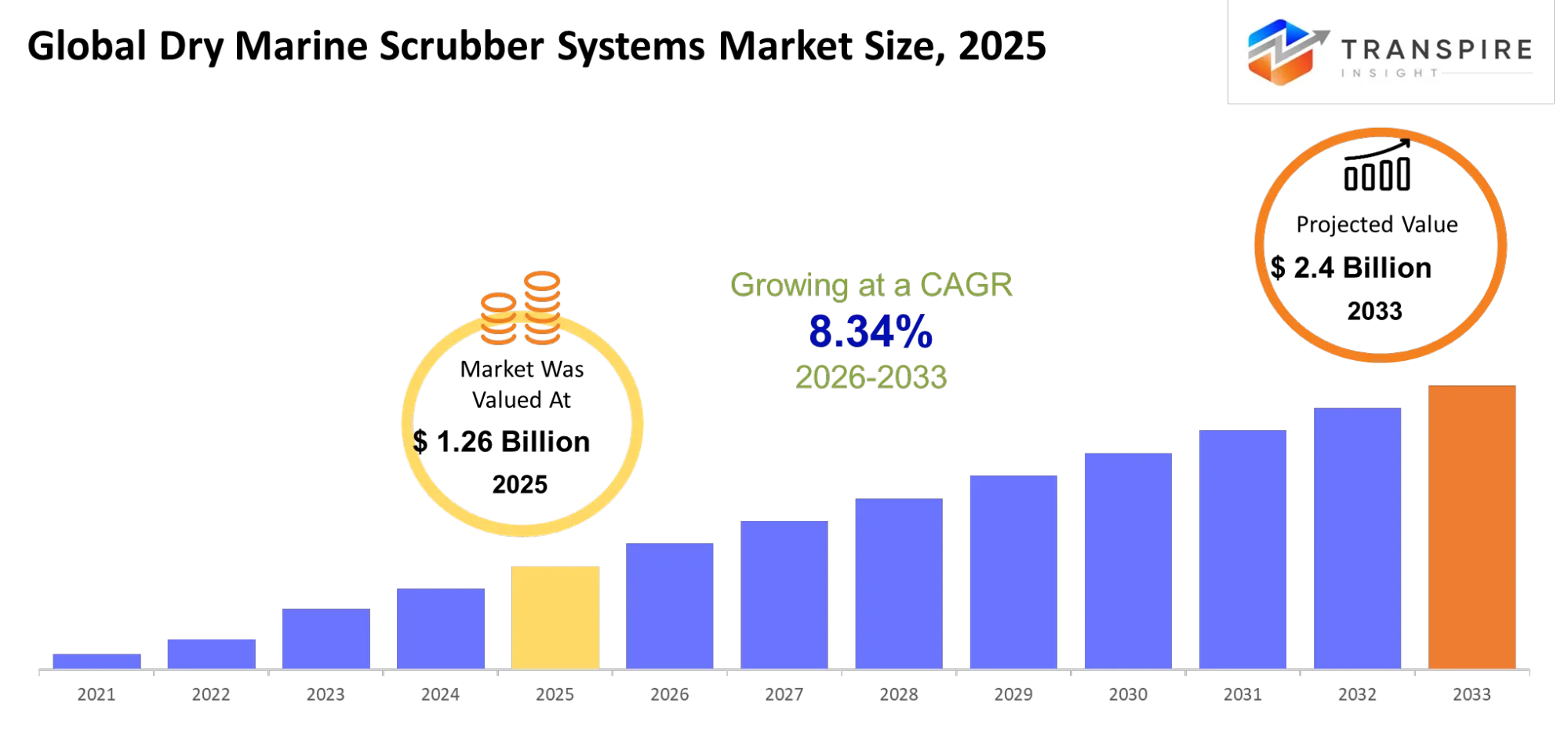
- Global Dry Marine Scrubber Systems Market Size 2025: USD 1.26 Billion
- Global Dry Marine Scrubber Systems Market Size 2033: USD 2.4 Billion
- Global Dry Marine Scrubber Systems Market CAGR: 8.34%
- Global Dry Marine Scrubber Systems Market Segments: By Scrubber Type (Dry Scrubber Systems, Hybrid Scrubber Systems), By Vessel Type (Bulk Carriers, Container Ships, Tankers, Cruise Ships), By Application (Commercial Shipping, Naval Vessels)
To learn more about this report,  Download Free Sample Report
Global Dry Marine Scrubber Systems Market Summary
The global dry marine scrubber systems market was valued at USD 1.26 billion in 2025. It is expected to reach USD 2.4 billion by 2033, growing at a CAGR of 8.34%. Dry marine scrubbers extract sulphur oxides from engine exhaust - before it leaves the stack - offering a mechanical solution to a very serious compliance problem that arose almost overnight when the IMO's global 0. 5 per cent sulphur cap came into force in January 2020. Unlike wet scrubbers, dry systems don't require any seawater intake or discharge water, which makes all the difference when travelling through freshwater zones, shallow-draft ports, and very strict emission-control areas with strict discharge rules.
The major change over the past few years was driven by fuel prices, rather than technology. Russia's invasion of Ukraine really tightened LNG markets - and widened the price gap between heavy fuel oil and lower sulphur alternatives. Very suddenly, the payback period for installing a scrubber retrofit became a much shorter, cleaner conversation for ship owners: pay the fuel surcharge all the time or absorb a one-time capital investment. This has led to a retrofit trend that is now seeping into newbuild designs, particularly among bulk carriers and tankers on very long intercontinental routes.
Key Global Dry Marine Scrubber Systems Market Insights
- North America dominates the dry marine scrubber systems industry with a commanding lead. North America leads the global market with a 34.7% share in 2024, supported by strict emission regulations, advanced port infrastructure, and a strong fleet modernization strategy.
- Europe accounts for 31.2% of the global market in 2024, driven by strict IMO MARPOL Annex VI implementation and EU Emission Control Areas (ECAs).
- Hybrid scrubber systems lead the product landscape in the dry marine scrubber systems market. Hybrid scrubber systems combine features of open-loop and closed-loop systems, offering lower operating costs and reduced environmental impact.
- The wet scrubber segment led the overall marine scrubber market and accounted for the largest revenue share of 86.6% in 2024, with advancements in hybrid systems enhancing operational flexibility.
- The dry scrubber segment valuation stood at USD 0.73 billion in 2024, with an estimated growth rate of 10.3% over 2025 to 2032, favored for its independence from seawater availability.
- Commercial shipping is the dominant application in the global dry marine scrubber systems industry. The commercial shipping segment is expected to account for the largest share of the Dry Marine Scrubber Systems Market, driven by IMO 2020 sulfur cap compliance requirements.
- Recreational vessels represent the fastest-growing application segment, reflecting broader green shipping momentum. The dry marine scrubber systems market from the recreational application segment is set to record over 10% CAGR up to 2032, owing to shifting focus on reducing the environmental footprint of yachts, cruise ships, and pleasure craft.
- The bulk containers segment held the dominant vessel-type position in the market, accounting for the largest revenue share of 32.1% in 2024, driven by ongoing R&D in scrubber technology.
- The marine segment commands the leading end-user position in the broader scrubber systems landscape. By end-users, the marine segment accounted for the largest market share of 33% in 2024, as scrubber technology plays a key role in reducing sulfur oxide (SOx) emissions from ships.
- Alfa Laval AB, holding a 25–30% share, is expected to maintain its leadership in marine scrubber technology in 2025, driven by its PureSOx systems and strategic integration of AI-based scrubber monitoring.
- Chinese container line COSCO increased its usage of scrubber systems in 2024, adding 417,827 TEU capacity in scrubber-fitted tonnage, moving from eighth to fifth place in the ranking of operators of scrubber tonnage by capacity.
What are the Key Drivers, Restraints, and Opportunities in the Global Dry Marine Scrubber Systems Market?
The IMO's 0.5% global sulphur cap really pushed scrubber adoption from an optional thing to a purely financial calculation. Shipowners had to choose between very expensive low-sulphur fuel, the risk of non-compliance, or exhaust gas cleaning systems, and dry scrubbers started to gain more traction, especially among operators running coastal and inland routes where port-state discharge rules made wet systems much less practical. The regulatory deadline created quite a concentrated demand period rather than spreading it out evenly over the years; it all happened between 2019 and 2022, which put a huge strain on supplier capacity and essentially defined the market's first major revenue cycle.
It's a bit tougher to extend that growth into mid-tier fleets much further. Retrofitting a dry scrubber onto a vessel not originally designed for one results in extended dry-dock time, significant structural rerouting of exhaust systems, and per-ship costs typically ranging from $3 million to $6 million. For operators running older bulk carriers on very thin freight margins, the payback period stretches past seven years - long enough that pretty rational operators really put off the decision indefinitely. Even falling component costs don't really solve this. The barrier really lies in the physical reality of retrofitting vessels that were never planned with scrubbers in mind, and the financing infrastructure to bridge that gap just hasn't emerged at scale yet.
The clearest path forward is probably hybrid scrubber architecture systems that can seamlessly switch between dry and wet operation depending on what regulations apply to a specific port, because they really eliminate the binary installation decision that's been holding back adoption across multi-jurisdiction routes. Wärtsilä and Alfa Laval are both developing hybrid configurations with this exact problem right in their sights. At the same time, South Korean and Vietnamese shipyards are emerging as cost-competitive retrofit hubs for Pacific operators, with government incentives in both countries cutting dry-dock costs by about 15-20% compared to European alternatives.
What Has the Impact of Artificial Intelligence Been on the Global Dry Marine Scrubber Systems Market?
Shipowners and fleet operators have gone much further than manual monitoring techniques. AI-driven control platforms currently handle real-time tracking of scrubber performance, automatically adjusting wash water flow rates and alkali dosing due to changes in exhaust gas conditions - something that previously required constant input from the crew. Firms such as Wärtsilä and Alfa Laval have really integrated sensor-to-dashboard automation into their exhaust gas cleaning technology, allowing compliance officials to easily monitor all their fleets from shoreside control rooms rather than relying on reports from individual vessels.
Machine learning adds another layer of value through predictive maintenance. Models are trained on all sorts of historical data - including pressure drops, pH readings, and recirculation pump cycles - that can spot component failure weeks in advance. Really, this has translated into actual uptime improvements: certain operators even report a 15-20% decrease in unplanned drydocking, though figures vary widely depending on the age of your fleet and the quality of your data. Emissions forecasting models also greatly help operators set their scrubbers before arriving in Emission Control Areas, further reducing the risk of non-compliance incidents.
The real limit on AI adoption, however, is connectivity. Vessels often spend long stretches beyond satellite bandwidth that can handle continuous data streaming, so predictive models really operate on batched, time-delayed data rather than actual live feeds. That gap really limits your real-time responsiveness and forces most operators into a hybrid approach, AI-assisted while near shore, manual checks everywhere else.
Key Market Trends
- IMO 2020's sulfur cap created an installation surge between 2019 and 2021; dry scrubber demand peaked during that window and has since normalized.
- Bulk carrier operators became the largest end-user segment by 2022, overtaking tanker owners who had dominated early adoption.
- Chinese port authorities expanded domestic ECA enforcement coverage between 2018 and 2022, accelerating demand from coastal freight operators.
- Wärtsilä and Alfa Laval consolidated their combined market position through service contract bundling, making it harder for smaller OEMs to compete solely on aftersales.
- Classification society requirements for scrubber wash water discharge shifted procurement decisions in 2021, favoring closed-loop dry systems in ecologically sensitive routes.
- By 2023, shipowners began treating scrubber systems as financed assets rather than capital expenditures, extending average payback calculations from 3 years to 5.
- Green shipping corridor initiatives between Rotterdam, Singapore, and Busan, have begun specifying scrubber compatibility in port access frameworks, creating indirect procurement pressure.
- Second-hand vessel scrubber retrofits declined as a share of total installations after 2022, reflecting older fleet economics that no longer justify the capital outlay.
Global Dry Marine Scrubber Systems Market Segmentation
By Scrubber Type
The global dry marine scrubber systems market comprises two primary types: dry and hybrid scrubber systems. Dry scrubber systems use solid sorbent materials to capture sulfur oxides and particulate matter from exhaust gas without producing any liquid washwater discharge. This technology is particularly valuable on vessels operating in freshwater environments, coastal zones, and ports where wet scrubber discharge is restricted. Hybrid scrubber systems combine dry and wet scrubbing modes, allowing operators to switch between configurations based on local regulations and operating conditions. Each type addresses different compliance scenarios, and buyer selection depends on the vessel’s route profile, the regulatory environment along that route, and the capital budget available for installation.
Scrubber type selection has become more commercially significant as regional discharge regulations diverge. In markets where open-loop wet scrubber washwater bans are in force, dry and hybrid systems are the only viable compliance path for vessels running on heavy fuel oil. Dry scrubbers generate a solid waste byproduct that must be offloaded at port, creating logistics requirements but avoiding the sea-discharge issue entirely. Hybrid systems add installation cost but give fleet operators regulatory flexibility across multiple jurisdictions without equipment changes. As more ports and coastal regions introduce discharge restrictions, the case for hybrid and dry configurations strengthens across all vessel categories in the global dry marine scrubber systems market.
By Vessel Type
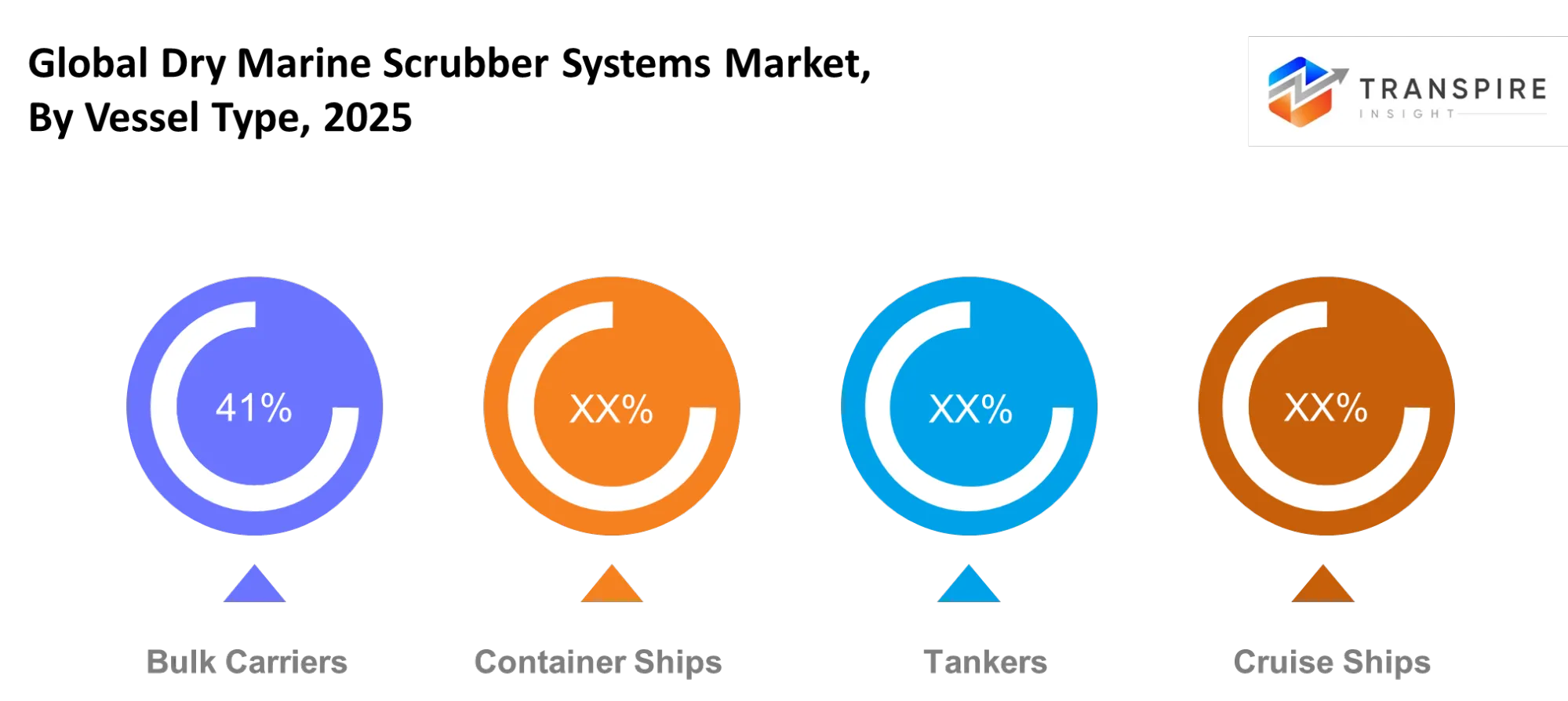
Vessel type is the most commercially important segmentation dimension in the global dry marine scrubber systems market. Bulk carriers hold 41% of the market because they operate on high fuel volumes, long voyages, and tight cost margins where compliance technology economics are most favorable. Container ships are the second-largest segment, with scrubber retrofits driven by the high fuel consumption of large boxships operating on major trade lanes. Tankers require explosion-proof designs and additional safety certifications due to cargo hazard classifications, which adds engineering complexity. Cruise ships represent a distinct buyer profile where passenger perception of environmental compliance matters as much as regulatory compliance, pushing cruise operators toward the cleanest available exhaust treatment options.
Vessel type shapes both the technical specification and the commercial terms of scrubber procurement. Bulk carrier operators typically make scrubber decisions based on fuel cost savings relative to switching to low-sulfur fuels over the remaining vessel life. Container ship operators evaluate scrubbers across large fleets where aggregate fuel savings are substantial. Tanker specifications are shaped heavily by class society requirements and flag state regulations for hazardous cargo vessels. Cruise operators procure scrubber systems as part of broader environmental compliance programs that include wastewater treatment, solid waste management, and emissions reporting. Each vessel type creates a distinct sales and installation cycle in the global dry marine scrubber systems market.
To learn more about this report, Download Free Sample Report
By Application
Commercial shipping accounts for the dominant share of the global dry marine scrubber systems market. This segment covers all cargo-carrying and passenger vessels operating in international trade, including bulk carriers, container ships, tankers, and cruise ships. The commercial shipping segment is driven by economics as much as regulation. Vessels burning heavy fuel oil save significant sums by avoiding the premium cost of low-sulfur fuel when they install scrubbers. For high-utilization vessels on established trade routes through ECAs, the payback period for a scrubber installation can be under three years. This financial logic keeps commercial shipping as the largest and most active procurement category in the global dry marine scrubber systems market.
Naval vessels form the secondary application segment. Navies procuring dry scrubber systems are motivated less by fuel cost savings and more by operational requirements, including the need to operate in restricted discharge zones without revealing vessel position through visible exhaust plume, and the need to comply with environmental regulations in allied ports. Naval vessel scrubber specifications are typically more demanding than commercial equivalents, requiring higher reliability thresholds, military-grade component standards, and extended service intervals without specialist support. Procurement timelines are longer and order volumes are smaller than commercial shipping, but average contract values are higher. European and Asian navies are the most active buyers in this application segment.
What are the Key Use Cases Driving the Global Dry Marine Scrubber Systems Market?
The dominant application is sulfur oxide reduction on large ocean-going vessels such as container ships, bulk carriers, and crude tankers operating on heavy fuel oil across international trade routes. These vessels face the most direct exposure to IMO 2020 compliance costs, and their fuel consumption volumes make the economics of scrubber investment straightforward. A container ship burning 80–100 tonnes of HFO per day generates sufficient fuel cost savings relative to low-sulfur distillate alternatives to recover scrubber installation costs within two to four years on high-utilisation routes. That arithmetic drives the bulk of current demand.
Adjacent demand is building in the cruise and ferry segments, where operators face dual pressure: environmental scrutiny from port authorities in tourism-sensitive waters and passenger-facing sustainability commitments that require documented emissions control. Several European ferry operators have retrofitted exhaust gas cleaning technology on Baltic and North Sea routes, where both ECA enforcement and port community expectations are well established. These vessels often run fixed schedules with predictable fuel grades, which makes scrubber performance modelling more reliable than on tramping bulk carriers.
The emerging applications are in inland waterway vessels and river-sea craft operating under regional regulatory frameworks, particularly in China's Yangtze River basin and the Rhine corridor in Europe. These vessels are smaller than ocean-going ships and have historically been outside the addressable range of the scrubber market, but tightening domestic emissions rules are changing that calculus. Cost-reduced, compact scrubber configurations designed for vessels under 5,000 DWT are still in an early stage, but the regulatory trajectory in both regions suggests this segment will matter more by 2028.
Report Overview Table
|
Report Metrics |
Details |
|
Market size value in 2025 |
USD 1.26 Billion |
|
Market size value in 2026 |
USD 1.37 Billion |
|
Revenue forecast in 2033 |
USD 2.4 Billion |
|
Growth rate |
CAGR of 8.34% from 2026 to 2033 |
|
Base year |
2025 |
|
Historical data |
2021 – 2024 |
|
Forecast period |
2026 – 2033 |
|
Report coverage |
Revenue forecast, competitive landscape, growth factors, and trends |
|
Regional scope |
United States; Canada; Mexico; United Kingdom; Germany; France; Italy; Spain; Denmark; Sweden; Norway; China; Japan; India; Australia; South Korea; Thailand; Brazil; Argentina; South Africa; Saudi Arabia; United Arab Emirates |
|
Key companies profiled |
Wärtsilä Corporation, Alfa Laval AB, Yara Marine Technologies AS, Mitsubishi Heavy Industries Ltd., DuPont Clean Technologies, Valmet Oyj, CR Ocean Engineering LLC, Ecospray Technologies S.r.l., Pacific Green Marine Technologies Inc., Fuji Electric Co. Ltd., Shanghai Bluesoul Environmental Technology Co. Ltd., Clean Marine AS, VDL AEC Maritime B.V., Puyier Environmental Protection Technology Co. Ltd., Saacke GmbH |
|
Customization scope |
Free report customization (country, regional & segment scope). Avail customized purchase options to meet your exact research needs. |
|
Report Segmentation |
By Scrubber Type (Dry Scrubber Systems, Hybrid Scrubber Systems), By Vessel Type (Bulk Carriers, Container Ships, Tankers, Cruise Ships), By Application (Commercial Shipping, Naval Vessels) |
Which Regions are Driving the Global Dry Marine Scrubber Systems Market Growth?
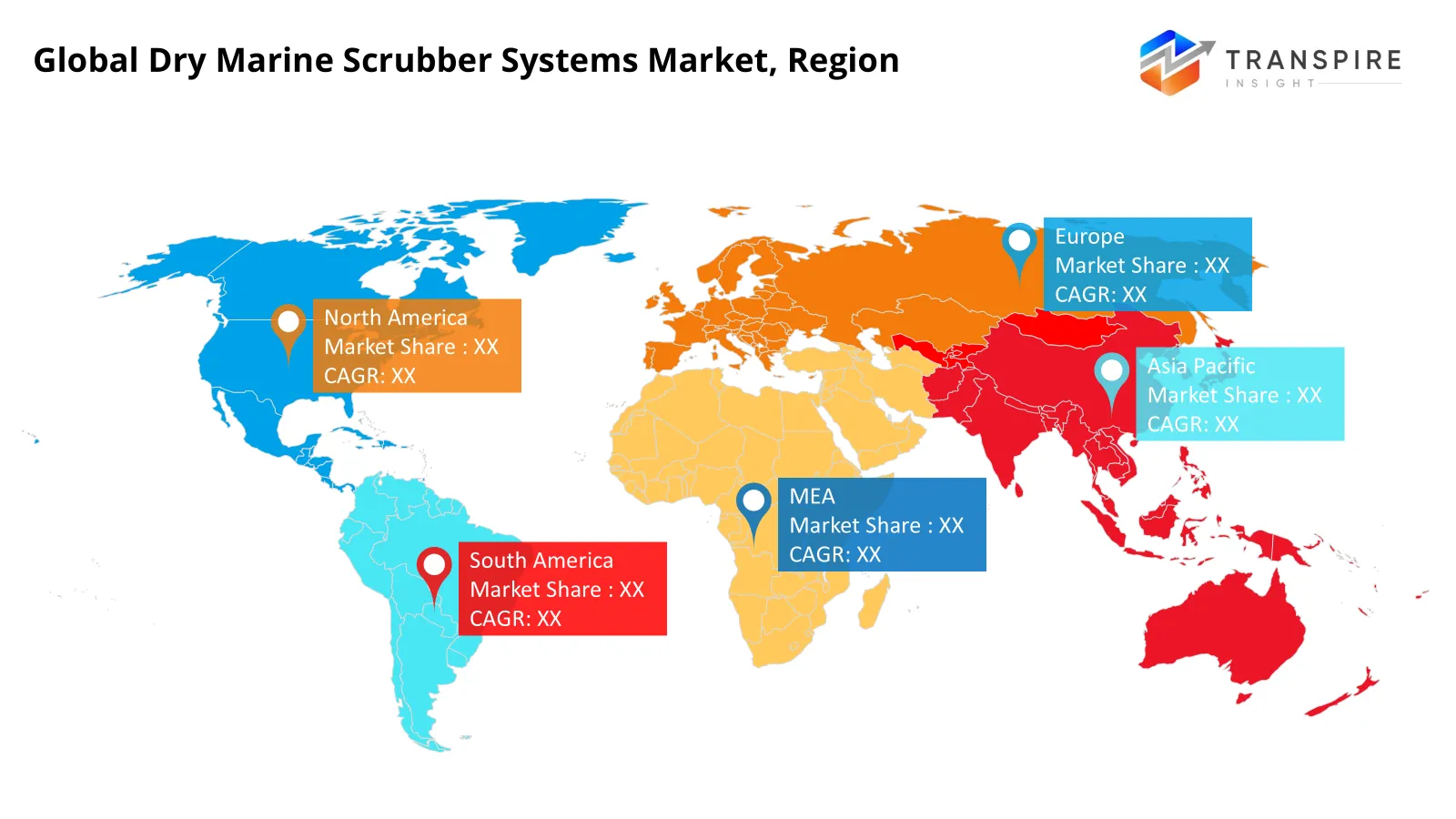
Europe leads the global market, and the reasons are structural rather than coincidental. The combination of the Baltic and North Sea ECAs among the world's most stringently enforced with a dense concentration of ferry operators, short-sea shipping companies, and large cruise lines creates consistent, repeated demand that other regions cannot yet replicate. Port state control enforcement in Hamburg, Rotterdam, and Antwerp operates with inspection rates and penalty frameworks that make non-compliance genuinely costly, which removes the temptation to defer scrubber investment. The European region also benefits from a mature installation and service ecosystem: classification societies, engineering contractors, and scrubber OEM service networks are all well established, which reduces commissioning risk for new buyers.
East Asia, primarily Japan, South Korea, and China, contributes a reliable and growing volume of installations that differs from Europe in one important respect: the primary growth driver is domestic regulation rather than international ECA enforcement. China's domestic ECA expansion and Japan's port authority frameworks have created a parallel compliance environment that operates somewhat independently of IMO timelines.
Southeast Asia is the fastest-growing region, and the shift is recent. Indonesia's domestic shipping reform program and Vietnam's accelerating port infrastructure investment have created a fleet modernization dynamic that did not exist before 2021. Both countries have significant coastal and inter-island freight operations running on ageing tonnage with limited emissions controls. As flag-state requirements tighten and port access frameworks begin to mirror regional ECA discussions, operators face a credible compliance deadline for the first time. For market entrants and investors, Southeast Asia offers the highest installation growth rate of any region through 2033, though service infrastructure remains underdeveloped, which favors OEMs willing to invest in regional aftersales capability alongside hardware sales.
To learn more about this report, Download Free Sample Report
Who are the Key Players in the Global Dry Marine Scrubber Systems Market and How Do They Compete?
The market sits in a middle state between fragmentation and consolidation. A handful of established OEMs, such as Wärtsilä, Alfa Laval, CR Ocean Engineering, Pacific Green Technologies, and Wartsila's sister brands, hold the majority of the installed base, but the field is not locked. Installation backlogs created during the 2019–2021 compliance rush allowed several smaller entrants to take share, and service contract renewal cycles now present a second competitive moment for challengers. The primary basis of competition has shifted from hardware specification toward total cost of ownership arguments, uptime guarantees, remote monitoring integration, and regulatory certification coverage across multiple flag states.
Alfa Laval competes on the breadth of certifications and relationships with classification societies. Its PureSOx system carries approvals across more than a dozen flag states, which matters for operators running vessels under multiple registries. The company expanded its service network in Singapore and South Korea after 2021, directly targeting the dry-docking market in both countries. Wärtsilä differentiates through system integration: its scrubber hardware ships with pre-integrated automation interfaces that connect directly to its broader vessel management software, reducing the integration burden for owners who already run Wärtsilä propulsion systems.
CR Ocean Engineering targets the price-sensitive segment of the market with a leaner product portfolio and faster delivery commitments, and has taken share in the Chinese coastal shipping segment, where procurement decisions are driven more by cost and regulatory timing than by brand preference. Pacific Green Technologies has carved out a position in the retrofit market, specifically focusing on vessels where non-standard hull geometries complicate installation, a niche the larger OEMs treat as high-cost and low-margin.
Recent Developments
In April 2026, Palo Alto Networks announced the acquisition of a France-based zero trust access startup to strengthen its European SASE and ZTNA capabilities. The move aims to expand localized security infrastructure and compliance offerings for French enterprises.https://www.paloaltonetworks.com
In March 2026, Orange Cyberdefense completed the acquisition of a regional identity and access management firm to enhance its Zero Trust Network Access portfolio in France. This acquisition supports the company’s strategy to scale enterprise-grade zero trust solutions across Europe.https://www.orangecyberdefense.com
What Strategic Insights Define the Future of the Global Dry Marine Scrubber Systems Market?
Over the next five to seven years, the dry marine scrubber market will be shaped less by new regulatory mandates and more by enforcement quality. The rules are largely written; what changes is how rigorously port state authorities enforce compliance and what penalties genuinely deter. Markets where enforcement is tightened will generate sustained installation demand; markets where enforcement remains weak will remain structurally underserved regardless of paper regulations.
The risk that headline growth figures obscure is technology substitution, specifically, the accelerating economics of methanol and ammonia dual-fuel engines. If alternative fuel adoption accelerates beyond current forecasts on the container ship and tanker segments, a portion of the scrubber's addressable market disappears rather than defers. This risk is not imminent, but investors pricing in long lifetimes for scrubber infrastructure should build in a substitution scenario for the 2030–2035 window.
The opportunity that is not yet reflected in most market analyses is the inland and river-sea segment in Asia. China's Yangtze basin alone represents a fleet of thousands of vessels that are now facing emissions compliance requirements for the first time. Compact, cost-reduced scrubber configurations for sub-5,000 DWT vessels do not yet exist at scale, but the first OEM to develop a viable product for this segment will face limited direct competition for several years.
The concrete recommendation: incumbents should treat service contract density as a strategic asset, not a revenue line. The operators who signed installation contracts in 2019–2021 will face major service decisions between 2025 and 2028. OEMs that have built remote monitoring relationships with those fleet owners will retain the contract; those that shipped hardware and moved on will not.
Global Dry Marine Scrubber Systems Market Companies
- Wärtsilä Corporation
- Alfa Laval AB
- Yara Marine Technologies AS
- Mitsubishi Heavy Industries Ltd.
- DuPont Clean Technologies
- Valmet Oyj
- CR Ocean Engineering LLC
- Ecospray Technologies S.r.l.
- Pacific Green Marine Technologies Inc.
- Fuji Electric Co. Ltd.
- Shanghai Bluesoul Environmental Technology Co. Ltd.
- Clean Marine AS
- VDL AEC Maritime B.V.
- Puyier Environmental Protection Technology Co. Ltd.
- Saacke GmbH
Global Dry Marine Scrubber Systems Market Report Segmentation
By Scrubber Type
- Dry Scrubber Systems
- Hybrid Scrubber Systems
By Vessel Type
- Bulk Carriers
- Container Ships
- Tankers
- Cruise Ships
By Application
- Commercial Shipping
- Naval Vessels
Frequently Asked Questions
Find quick answers to common questions.
The Global Dry Marine Scrubber Systems Market size is expected to reach USD 2.4 Billion by 2033.
The key segments of the Global Dry Marine Scrubber Systems Market are By Scrubber Type (Dry Scrubber Systems, Hybrid Scrubber Systems), By Vessel Type (Bulk Carriers, Container Ships, Tankers, Cruise Ships), By Application (Commercial Shipping, Naval Vessels).
Major players in the Global Dry Marine Scrubber Systems Market include Wärtsilä Corporation, Alfa Laval AB, Yara Marine Technologies AS, Mitsubishi Heavy Industries Ltd., DuPont Clean Technologies, Valmet Oyj, CR Ocean Engineering LLC, Ecospray Technologies S.r.l., Pacific Green Marine Technologies Inc., Fuji Electric Co. Ltd., Shanghai Bluesoul Environmental Technology Co. Ltd., Clean Marine AS, VDL AEC Maritime B.V., Puyier Environmental Protection Technology Co. Ltd., and Saacke GmbH.
The Global Dry Marine Scrubber Systems Market size is USD 1.26 Billion in 2025.
The Global Dry Marine Scrubber Systems Market CAGR is 8.34% from 2026 to 2033.
- Wärtsilä Corporation
- Alfa Laval AB
- Yara Marine Technologies AS
- Mitsubishi Heavy Industries Ltd.
- DuPont Clean Technologies
- Valmet Oyj
- CR Ocean Engineering LLC
- Ecospray Technologies S.r.l.
- Pacific Green Marine Technologies Inc.
- Fuji Electric Co. Ltd.
- Shanghai Bluesoul Environmental Technology Co. Ltd.
- Clean Marine AS
- VDL AEC Maritime B.V.
- Puyier Environmental Protection Technology Co. Ltd.
- Saacke GmbH
Recently Published Reports
-
Apr 2026
Active Power Filter Market
Active Power Filter Market Size, Share & Analysis Report By Type (Shunt Active Power Filters, Series Active Power Filter, Hybrid Active Power Filter), By Application (Harmonics Mitigation, Reactive Power Compensation, Voltage Regulation, Power Factor Correction), By Phase (Single Phase, Three Phase), By End-User Industry (Manufacturing, Healthcare, Commercial, Automotive, Oil and Gas, Others), and Geography (North America, Europe, Asia-Pacific, Middle East and Africa, South and Central America), 2021 - 2031
-
Apr 2026
Electrical Transformer Market
Electrical Transformer Market Size, Share & Analysis Report By Core (Closed, Shell, and Berry), By Insulation (Gas, Oil, Solid, Air, and Other), By Phase (Single, and Three), By Rating (100 MVA to 500 MVA, 501 MVA to 800 MVA, and 801 MVA to 1200 MVA), and Geography (North America, Europe, Asia-Pacific, Middle East and Africa, South and Central America), 2021 – 2031
-
Apr 2026
Hydraulic Piston Pumps Market
Hydraulic Piston Pumps Market Size, Share & Analysis Report By Type (Axial Piston Pumps, Radial Piston Pumps), By Operating Pressure (Low Pressure, Medium Pressure, High Pressure), By Application (Construction, Mining, Agriculture, Automotive, Oil & Gas, Industrial Machinery, Others), By End-User (OEMs, Aftermarket), and Geography (North America, Europe, Asia-Pacific, Middle East and Africa, South and Central America), 2021 – 2031
-
Apr 2026
Laboratory Gas Generators Market
Laboratory Gas Generators Market Size, Share & Analysis Report By Product (Nitrogen Gas Generator, Hydrogen Gas Generator, Zero Air Gas Generator, Purge Gas Generator, TOC Gas Generators, Others), By Application (Gas Chromatography, Liquid Chromatography-mass Spectrometry (LC-MS), Gas Analyzers, Others), By End-user (Life Science, Chemical & Petrochemical, Food & Beverage, Others), and Geography (North America, Europe, Asia-Pacific, Middle East and Africa, South and Central America), 2021 – 2031