

Asia Pacific Rigid Packaging Market Size & Forecast:
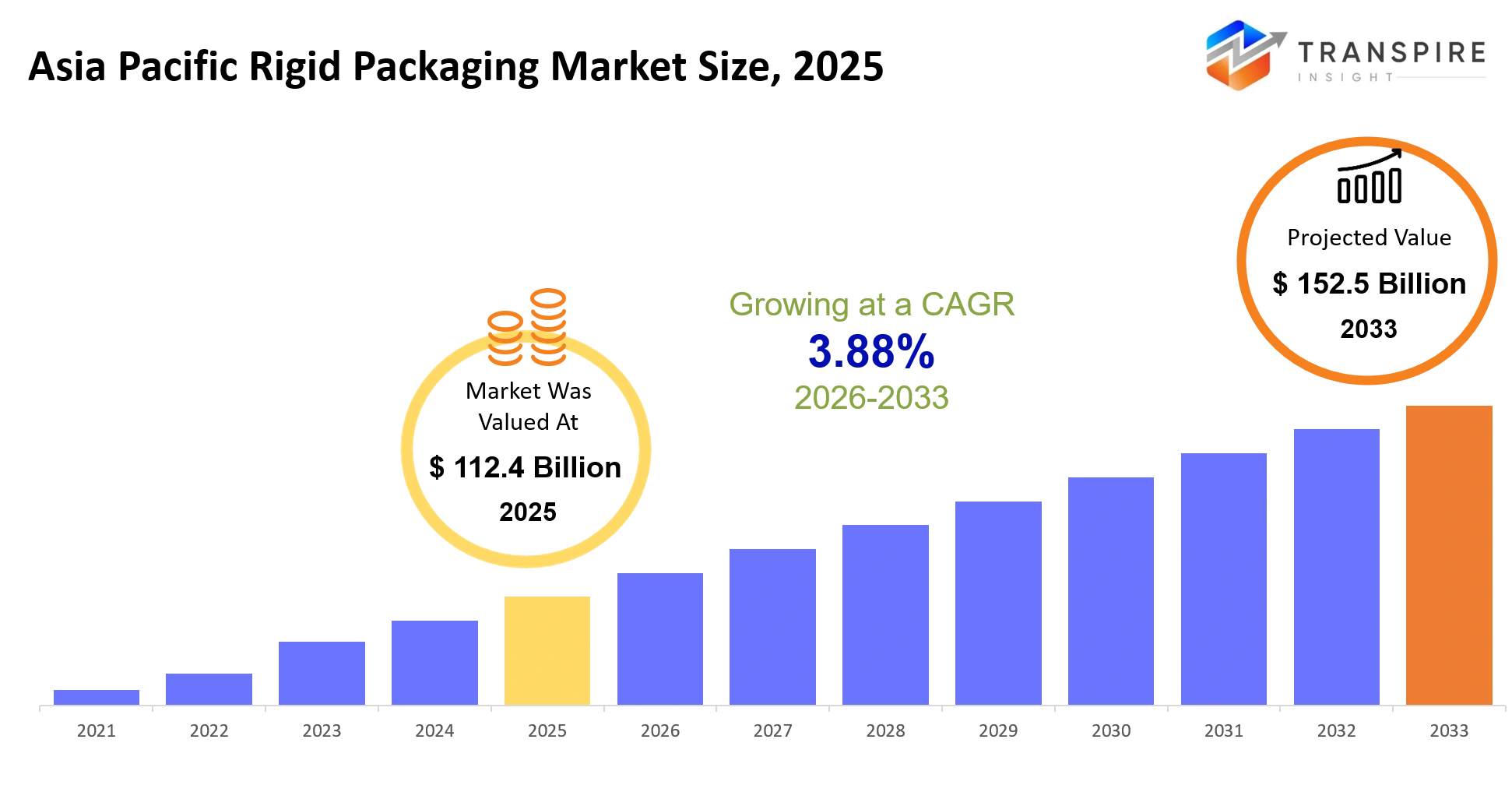
- Asia Pacific Rigid Packaging Market Size 2025: USD 112.4 Billion
- Asia Pacific Rigid Packaging Market Size 2033: USD 152.5 Billion
- Asia Pacific Rigid Packaging Market CAGR: 3.88%
- Asia Pacific Rigid Packaging Market Segments: By Material (Plastic, Metal, Glass, Paperboard, Composite Materials, Aluminum, Steel, Others); By Product Type (Bottles, Containers, Trays, Caps & Closures, Cans, Boxes, Drums, Others); By Application (Food & Beverage, Healthcare, Personal Care, Industrial Products, Household Products, Chemicals, Consumer Goods, Others); By End User (Food Manufacturers, Pharmaceutical Companies, Consumer Goods Companies, Retailers, Beverage Producers, Chemical Companies, E-commerce Firms, Others).
Asia Pacific Rigid Packaging Market Summary
The Asia Pacific Rigid Packaging Market was valued at USD 112.4 Billion in 2025. It is forecast to reach USD 152.5 Billion by 2033. That is a CAGR of 3.88% over the period.
Rigid packaging forms the very foundation of protecting and transporting a range of consumer and industrial goods throughout Asia Pacific. From maintaining food freshness on extended distribution networks to preventing contaminants entering pharmaceutical packaging and facilitating movement of consumer goods, chemicals and industrial products throughout intricate supply chains, rigid packaging is essential. It is a market that has seen a structural shift in the past five years. Brand owners and manufacturers are moving away from material-hungry, single use solutions toward lightweight, recyclable, high-performance packaging options that can balance robustness with environmental requirements. This shift has been propelled forward by pandemic era supply chain shocks and the recognition that relying solely on imported materials and susceptible distribution channels carries substantial risks. Companies are not only looking to extend shelf life and decrease transport costs by changing packaging configurations but are also complying with ever tighter environmental legislation and investing heavily in new materials and local production capabilities. This has resulted in more ubiquitous use across markets and a move away from revenue dependent solely on volume to solutions that add greater value.
Key Market Insights
- The Asia Pacific Rigid Packaging Market is the largest within the global packaging consumption due to the large manufacturing base along with the growing retail and pharmaceutical sector.
- China accounts for over 40% of the regional market in 2025 with robust industrial output coupled with a sophisticated packaging ecosystem.
- India is the fastest growing country market through 2030 with a booming retail organization, e-commerce logistics network and food processing infrastructure.
- The Plastic rigid packaging product is the leader with over 50% of market share driven by the product's high durability, cost-effectiveness and excellent design flexibility.
- Metal packaging is the second largest with increasing demand in the food cans and beverage cans due to extended product shelf-life and excellent recyclability.
- The rigid paperboard packaging product segment is expected to grow with a CAGR during the forecast period driven by brand's adoption of lighter materials along with circular economy initiatives.
- The Food and beverage application segment dominates the market with over 45% of market share driven by packed food consumption and expansion in cold chain infrastructure.
- The healthcare and pharmaceutical product segment is the fast-growing segment through 2030 with increased stringent requirements for product safety along with biologics packaging and transportation.
- The Consumer goods end user segment is the dominant market with higher share of the overall Asia Pacific rigid packaging market share due to increased urban consumption along with launching of premium product line in the consumer goods segment.
- Increased investments in automation, digital printing, smart manufacturing in the Asia Pacific rigid packaging industry
What are the Key Drivers, Restraints, and Opportunities in the Asia Pacific Rigid Packaging Market?
Rising prominence of transformed retail & distribution systems is the driving factor. Over the last decade, a fast acceleration in online retail networks, organised retail chains, and pharmaceutical distribution networks has been observed across China, India, Indonesia and SE Asia. The same has led to an escalation in the demand for such packaging products, which not only ensure safe delivery during long and multiple transit stages, but also maintain product integrity. This development has been met with the investments in lighter plastics, barrier containers with higher life value and higher throughput machines that cater to a growing need for supply chain optimized packaging, fueling increased revenue in the industry and improved uptake in the consumer packaged goods, food & beverages and healthcare sectors.
The highest among the structurally restrictive factors is volatility in prices of raw materials. Prices of plastics resin, aluminum and steel fluctuate due to global energy markets, geopolitical pressures and various trade regimes and government policies. Increased cost due to these volatility is very difficult to pass over to the consumers and is a reason for pressure on profit margins and delayed expansion of capacity. As such constraints in developing alternate supply chain networks and commodity markets cannot be mitigated quickly, they have continued to put a restraint on the revenues for this market segment.
New frontier for growth: Smart & Sustainable Packaging. Trends toward recyclable mono-material structures, high resolution digital printing and connected packaging technologies are growing rapidly especially across India and China. Firms who combine material traceability, lightweight design and a circular material flow are poised to explore new revenue streams and reinforce their sustainable positions over the longer term.
What Has the Impact of Artificial Intelligence Been on the Asia Pacific Rigid Packaging Market?
AI has started impacting the market by enabling improved manufacturing performance, better quality and increased operational transparency. AI vision systems are implemented at a growing number of plants by packaging manufacturers for real-time inspection of bottles, containers and caps which will help them to quickly identify and reject defects that manual inspection is unable to detect on a reliable and regular basis. In molding applications, AI machine learning algorithms are used to analyze manufacturing data, helping them to increase product quality and optimize parameters such as molding temperatures, cycle times and material consumption reducing overall waste.
Predictive maintenance applications are becoming an integral part of plant operations. AI algorithms monitor vibrations, pressures and temperatures of different machines at plants to predict component failure before it happens, therefore reducing the frequency of unplanned production stoppages and prolonging the working life of equipment. It has also helped in increased plant utilization rates of multiple manufacturers. The implementation of predictive analytics has allowed various manufacturers to achieve double-digit cost savings for their maintenance and also increased uptime.
Forecasting and supply chain applications for inventory prediction are also being adopted. The systems use sales forecasts, customer orders, availability of raw material to manage production scheduling more efficiently thus leading to the reduction of inventory carrying costs. The integration of AI with older equipment, though, is proving to be a challenge to many packaging manufacturers and their need for higher initial capital and technical know-how might pose limitations for smaller manufacturers.
Key Market Trends
- Manufacturers replaced multi-layered formats with mono-material formats since 2020. It enables the enhancement of recycling and saves 10-20% material usage.
- China and India significantly ramped up their local resin production and container manufacturing after 2020 and 2022 respectively, as the pandemic revealed weakness in the supply chain and increased need for localized production.
- Food and beverage companies increasingly opted for lightweight PET containers as a substitute for glass bottles due to higher transportation efficiency and cost benefits.
- Packaging companies have increased their digital printing capabilities since 2021 as they anticipate increasing demands for shorter runs and customized designs from premium consumer products.
- Asia Pacific governments further regulated plastic waste management by increasing the requirement for recycled content and packaging redesign for circular material streams since 2021.
- Large manufacturing plants adopted more automated processes, and the application of AI in inspection systems has reduced error rates since 2020.
- Key players like Amcor, Berry Global and Sonoco have been expanding their regional manufacturing plants for quicker delivery times and less import dependency.
- Due to increased popularity of E-commerce, manufacturers had to design and implement packaging designs that are robust enough for transit, and resilient to frequent transportation and repeated handling.
- Stringent pharmaceutical packaging regulations have led to greater demand and more investments in tamper evident closures, barrier containers and tracing technology since 2021.
- Market competition moved from price to innovative features. Manufacturers focused more on recyclable material solutions, smart packaging and key relationships with prominent consumer brands.
Asia Pacific Rigid Packaging Market Segmentation
By Material :
Material selection is an important part in rigid packaging, as package performance depends on the strength, stability, weight, and product protection. The usage of the material will differ according to industry depending on the storage conditions, the distribution channel and also product shelf-life. Plastic is used most of all because of its versatility of shapes and low cost, whereas metal, glass are preferable due to the stability of their protection from elements.
Paperboards are used for packaging a light product, which also has the possibility of printing very easily for the marketing of the product, composite material may bring about some characteristics combined from several materials. Aluminum and steel are preferred in situations where stability and resistance from outer effects is really needed; in contrast other materials will be considered to serve specific markets that require certain characteristics.
By Product Type :
Segmentation based on the type of product is characterized by the diversity of different forms of packaging used in different sectors. Bottles are one type of product which is generally used for the storage and transportation of beverages, personal care products, health care products as they are easy to carry and handle. Containers are useful for holding the food product in storage, and protecting its quality from being destroyed during the distribution channel.
Trays are useful to contain a food product for its display, protection against different element during the transportation; caps and closures are essential to keep product safe from bacteria and contamination; cans continue to be the favorable package for beverage and preserved product, whereas boxes are mainly used for the retail product; and drums are widely utilized in the industry of chemical, raw material. There are also other different types of products.
By Application :
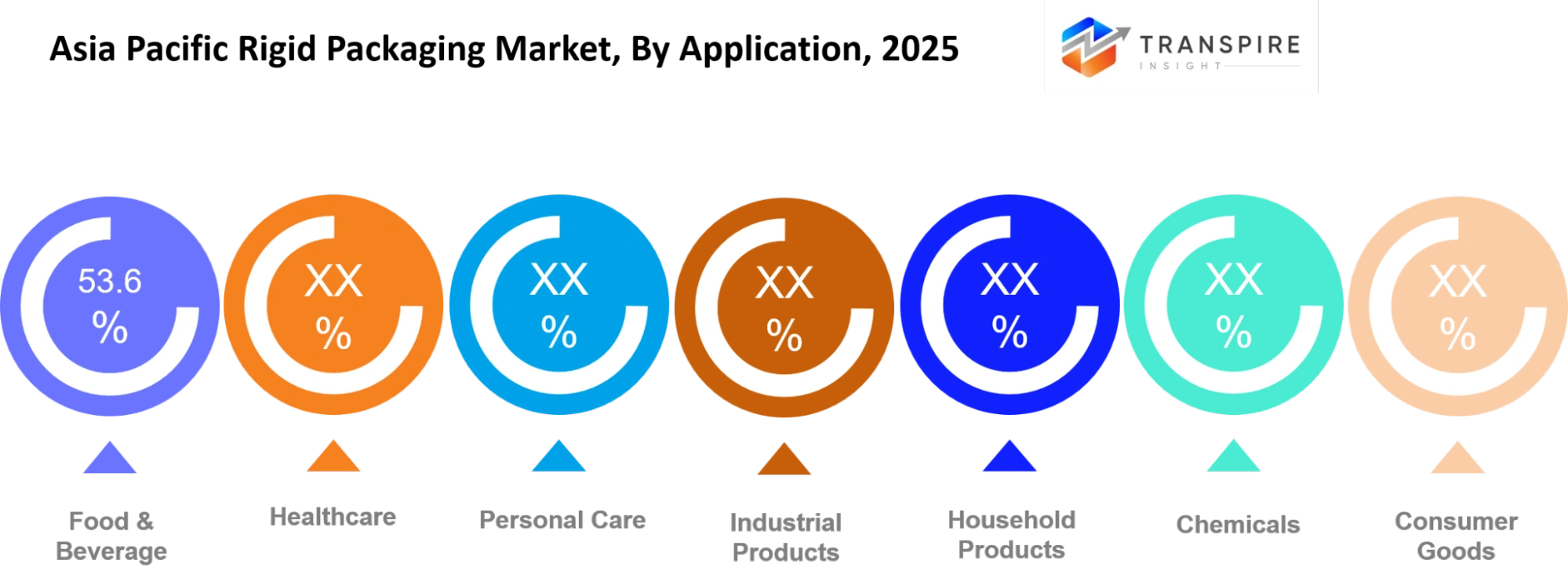
Food and beverage applications use a substantial amount of rigid packaging because packaging performance directly relates to product freshness, safety, and shelf life. Healthcare applications utilize high performing security packaging to ensure safe delivery and protection against environmental and external factors for medical goods and drugs.
Personal care application requires high performing aesthetically appealing packaging for brand value and consumer use. Industrial, domestic and chemical products utilize packaging that provides resilience against tough transportation and storage conditions. Consumer goods packaging is primarily centered on product protection and presentation. Other applications will drive demand for unique packaging formats suitable for niche products.
By End User :
The most significant end user group is food manufacturers as packaged food production necessitates safe and performing packaging for transportation, distribution, storage and retail display. The pharmaceutical industry demands rigid packaging to provide product integrity and safety. Consumer goods utilize high performing and resilient rigid packaging to achieve product protection and enhance brand image.
Retailers and beverage companies utilize rigid packaging to provide convenient product display and transportation benefits. The chemical industry utilizes rigid packaging as they possess high performing packaging formats, resistant to product damage. E-commerce vendors are adopting rigid packaging formats, as they offer an efficient way to avoid product damage during shipping. The other end-users will continue to constitute the market for niche packaging requirements.
What are the Key Use Cases Driving the Asia Pacific Rigid Packaging Market?
Food and beverage packaging is still the dominant application for rigid packaging in the Asia Pacific. Bottles, containers, cans, and trays are used to maintain freshness, increase shelf life, and prevent products from being damaged throughout a long supply chain. Demand from the growth of packaged food consumption and increasingly strict food safety regulations continues to fuel significant demand.
Healthcare and personal care applications, as well as beauty brands, also drive demand as pharmaceutical firms and cosmetics companies are searching for packaging solutions with high barrier properties and tamper evidence features. E-commerce companies are also increasingly looking to utilize rigid containers and boxes in order to avoid product damage and increase delivery speed across supply chains in the region.
Developing applications will likely be based on smart packaging with QR codes that link to tracking capabilities and packaging solutions that use new, higher quality, recyclable materials. However, these applications will likely continue to develop and grow as brands increasingly invest in digital consumer interaction, closed-loop systems, and compliance.
|
Report Metrics |
Details |
|
Market size value in 2025 |
USD 112.4 Billion |
|
Market size value in 2026 |
USD 116.8 Billion |
|
Revenue forecast in 2033 |
USD 152.5 Billion |
|
Growth rate |
CAGR of 3.88% from 2026 to 2033 |
|
Base year |
2025 |
|
Historical data |
2021 - 2024 |
|
Forecast period |
2026 - 2033 |
|
Report coverage |
Revenue forecast, competitive landscape, growth factors, and trends |
|
Regional scope |
Asia Pacific (India, China, Japan, Australia, South Korea, Rest of Asia Pacific) |
|
Key company profiled |
Amcor, Berry Global, Silgan Holdings, Ball Corporation, Crown Holdings, Sonoco, DS Smith, AptarGroup, ALPLA, Gerresheimer, Ardagh, Sealed Air, Tetra Pak, Mondi, Smurfit Westrock. |
|
Customization scope |
Free report customization (country, regional & segment scope). Avail customized purchase options to meet your exact research needs. |
|
Report Segmentation |
By Material (Plastic, Metal, Glass, Paperboard, Composite Materials, Aluminum, Steel, Others); By Product Type (Bottles, Containers, Trays, Caps & Closures, Cans, Boxes, Drums, Others); By Application (Food & Beverage, Healthcare, Personal Care, Industrial Products, Household Products, Chemicals, Consumer Goods, Others); By End User (Food Manufacturers, Pharmaceutical Companies, Consumer Goods Companies, Retailers, Beverage Producers, Chemical Companies, E-commerce Firms, Others). |
Which Regions are Driving the Asia Pacific Rigid Packaging Market Growth?
As the most prominent country market, China holds leading positions due to the country's considerable manufacturing capacity, extended supply networks of packaging production, and increased support for industrial modernization initiatives by the government. Vast segments such as food processing, beverage, and pharmaceuticals constantly drive the demand of rigid containers, bottles, cans, and caps. Moreover, established logistics infrastructure and integrated supply chains of raw materials enable the cost-effective large-scale manufacturing, and the further development of the facilities for waste recycling and circular economy will reinforce the dominance of this market in the future.
Japan, positioned as the second largest market, stands out for its distinctive business environment. Market expansion is significantly driven by product quality, premium packaging, and stable consumer base (health and personal care industry), rather than large production capacity. High quality standards stimulate the business investment for sophisticated materials, light packaging technology and precision machines, contributing to steady revenue for the region and making the market a reliable market for technology-driven manufacturers.
India emerges as a rapidly growing market for the acceleration of urbanization, widely developing e-commerce networks, and increased business investment in food and pharmaceuticals.Recent growth in the sector is further supported by governments-driven initiatives aimed at developing the country's manufacturing capability and logistics. Increased popularity of organised retail chains and modern distribution networks generate more market opportunities for new packaging types and materials. Driven by those trends, the 2026-2033 period offers strong development prospects for manufacturers to increase production capacity and achieve long term business growth.
Who are the Key Players in the Asia Pacific Rigid Packaging Market and How Do They Compete?
The Asia Pacific Rigid Packaging Market is moderately consolidated with regional and multi-national players. While cost effectiveness continues to play a role in the market, competition has increasingly focused on product innovation, manufacturing flexibility and sustainability. Companies are increasingly focused on developing new recyclable materials, light-weight packaging formats and digital manufacturing technologies that will enhance packaging capabilities and secure long term contracts with key companies within the food, healthcare and consumer goods industries.
Amcor targets technology innovation and sustainable packaging. Through significant investments in both recyclable and high-barrier materials, Amcor enables its customers to utilize less material while ensuring product integrity. Through establishing additional manufacturing plants across the Asian region and fostering research partnerships, Amcor is able to provide customized responses to evolving market demands. Berry Global leverages manufacturing scale and a wide portfolio of rigid plastic packaging products for applications ranging from food to healthcare to industrial. Investment in sustainable materials through the use of recycled resins and lightweight packaging formats continues to enhance market share and provides a competitive advantage against other suppliers within eco-sensitive markets.
Sonoco Products targets the provision of customized packaging solutions, utilizing strong paperboard and protective packaging capabilities. While broadening its operations across regions, Sonoco is developing more eco-friendly and transportation-effective packaging forms and formats. Ball Corporation focuses on aluminum packaging due to its high recyclability rate and lightweight characteristics that provide a competitive advantage. Investment in manufacturing facilities for can production across Asia allows Ball to efficiently fulfill demand from an increasingly large beverage industry and develop a substantial presence within expanding economies.
Company List
- Amcor
- Berry Global
- Silgan Holdings
- Ball Corporation
- Crown Holdings
- Sonoco
- DS Smith
- AptarGroup
- ALPLA
- Gerresheimer
- Ardagh
- Sealed Air
- Tetra Pak
- Mondi
- Smurfit Westrock
Recent Development News
In April 2025, Amcor announced the construction of an advanced healthcare packaging coating facility in Asia Pacific. The investment introduced the region's first air knife coating technology, strengthened supply chain resilience, and reduced lead times for healthcare packaging customers.
Source: https://www.amcor.com/
In February 2026, Amcor received two WorldStar Global Packaging Awards for its AmPrima Recycle-Ready packaging technology. The recognition highlighted commercial success for recyclable packaging formats and reinforced industry investment in circular rigid and flexible packaging solutions.
Source: https://www.amcor.com/media/
What Strategic Insights Define the Future of the Asia Pacific Rigid Packaging Market?
Overall, the Asia Pacific Rigid Packaging Market is gradually shifting away from simply increasing production volumes and moving toward more high-performance, recyclable, and digitally driven systems of packaging. The market has seen demand for stricter environmental regulations; shifting retail models have also forced it to adapt, requiring more complex packaging to facilitate greater efficiencies in long, regionally diverse supply chains. It is likely that, in the next 5-7 years, competitive advantage will come more from the innovation of materials, recycled properties and the drive for digitally powered production rather than economies of scale in manufacturing.
An obvious risk is raw material consolidation and deficient recycling infrastructure. Many pack producers continue to rely heavily on a finite supply of recycled resin and specialized materials, which could be a recipe for supply disruptions and tighter margins as end-market demand is kept in check.
A clear opportunity lies in the rise of smart, connected packaging – particularly India and the ASEAN, where the move towards QR code traceability and digital authentication is strong. Players should make early investments in sustainable, recyclable materials and smart packaging technology and look at building strong domestic supply chains for better resilience and long-term growth.
Asia Pacific Rigid Packaging Market Report Segmentation
By Material
- Plastic
- Metal
- Glass
- Paperboard
- Composite Materials
- Aluminum
- Steel
By Product Type
- Bottles
- Containers
- Trays
- Caps & Closures
- Cans
- Boxes
- Drums
By Application
- Food & Beverage
- Healthcare
- Personal Care
- Industrial Products
- Household Products
- Chemicals
- Consumer Goods
By End User
- Food Manufacturers
- Pharmaceutical Companies
- Consumer Goods Companies
- Retailers
- Beverage Producers
- Chemical Companies
- E-commerce Firms
Frequently Asked Questions
Find quick answers to common questions.
The Asia Pacific Rigid Packaging Market size is USD 152.5 Billion in 2033.
Key segments for the Asia Pacific Rigid Packaging Market are By Material (Plastic, Metal, Glass, Paperboard, Composite Materials, Aluminum, Steel, Others); By Product Type (Bottles, Containers, Trays, Caps & Closures, Cans, Boxes, Drums, Others); By Application (Food & Beverage, Healthcare, Personal Care, Industrial Products, Household Products, Chemicals, Consumer Goods, Others); By End User (Food Manufacturers, Pharmaceutical Companies, Consumer Goods Companies, Retailers, Beverage Producers, Chemical Companies, E-commerce Firms, Others).
Major Asia Pacific Rigid Packaging Market players are Amcor, Berry Global, Silgan Holdings, Ball Corporation, Crown Holdings, Sonoco, DS Smith, AptarGroup, ALPLA, Gerresheimer, Ardagh, Sealed Air, Tetra Pak, Mondi, Smurfit Westrock.
The Asia Pacific Rigid Packaging Market size is USD 112.4 Billion in 2025.
The Asia Pacific Rigid Packaging Market CAGR is 3.88% from 2026 to 2033.
- Amcor
- Berry Global
- Silgan Holdings
- Ball Corporation
- Crown Holdings
- Sonoco
- DS Smith
- AptarGroup
- ALPLA
- Gerresheimer
- Ardagh
- Sealed Air
- Tetra Pak
- Mondi
- Smurfit Westrock
About the Authors

Kartik bhong
I am Kartik Bhong, a Senior Research Analyst at Transpire Insight, specializing in the Packaging, Manufacturing, and Construction industry. My work focuses on analyzing market trends, emerging technologies, industry regulations, and competitive landscapes to deliver accurate, data-driven insights. I am passionate about transforming complex industry information into clear, practical content that helps businesses, professionals, and decision-makers stay informed and make confident strategic decisions. Through continuous research and a strong commitment to accuracy, I strive to create reliable, well-researched content that reflects the latest developments across these dynamic industries and supports the vision of Transpire Insight in delivering valuable market intelligence.

Chakradhar Khansole
Chakradhar serves as the Research Director at Transpire Insight, bringing over 8 years of experience in technology, innovation, and strategic market intelligence. He specializes in transforming complex market data into actionable business insights that enable organizations to make informed, growth-oriented decisions. Recognized for his strategic vision and analytical expertise, Chakradhar leads high-impact research initiatives, delivering comprehensive market assessments, competitive intelligence, and forward-looking industry analysis.
Recently Published Reports
-
Apr 2026
Pharmaceutical Cold Chain Packaging Market
Pharmaceutical Cold Chain Packaging Market By Material (Plastic,(Polyethylene (PE), Polypropylene (PP), Polyethylene Terephthalate (PET), Expanded Polystyrene (EPS), Polyurethane (PU),Others), Paper, Metal, Others), By Product (Small Boxes, Pallets, Large Sized Pallet Containers, Others), By End Use (Biopharmaceutical Companies, Clinical Research Organizations, Hospitals, Research Institutes, Logistics and Distribution Companies, Others)”, By Industry Analysis, Size, Share, Growth, Trends, and Forecasts 2026-2033
-
Apr 2026
Active & Intelligent Packaging Market
Active & Intelligent Packaging Market By Type (Active Packaging, Smart Packaging), By Material (Polymer-Based, Paper & Board-Based, Metal-Based, Glass-Based), By Technology (Time-Temperature Indicators, Freshness Indicators, RFID, Antimicrobial Packaging, Modified Atmosphere Packaging), By Application (Food & Beverages, Pharmaceutical, Cosmetics & Personal Care, Electronics & Consumer Goods, Others), By Industry Analysis, Size, Share, Growth, Trends, and Forecasts 2026-2033
-
Apr 2026
Biodegradable Cut Flower Packaging Market
Biodegradable Cut Flower Packaging Market By Material Type (Paper & Paperboard, Biodegradable Plastics, Natural Fibers, Molded Pulp, Others), By Product Type (Sleeves, Wraps, Boxes & Cartons, Bags & Pouches, Inserts & Holders), By Application (Roses, Carnations, Tulips, Chrysanthemums, Mixed Flowers, Others) and By Distribution Channel (Direct Sales, Distributors & Wholesalers, Online Channels), By Industry Analysis, Size, Share, Growth, Trends, and Forecasts 2026-2033
-
May 2026
Pharmaceutical Packaging Market
Pharmaceutical Packaging Market By Material Type (Plastic, Glass, Metal, Paper & Paperboard, Others), By Packaging Type (Bottles, Blister Packs, Vials, Ampoules, Pouches & Sachets, Others) and By End User (Hospitals & Clinics, Retail Pharmacies, Online Pharmacies, Pharmaceutical Manufacturers), By Industry Analysis, Size, Share, Growth, Trends, and Forecasts 2026-2033