
Asia Pacific Platform Supply Vessels PSV Market Size & Forecast:
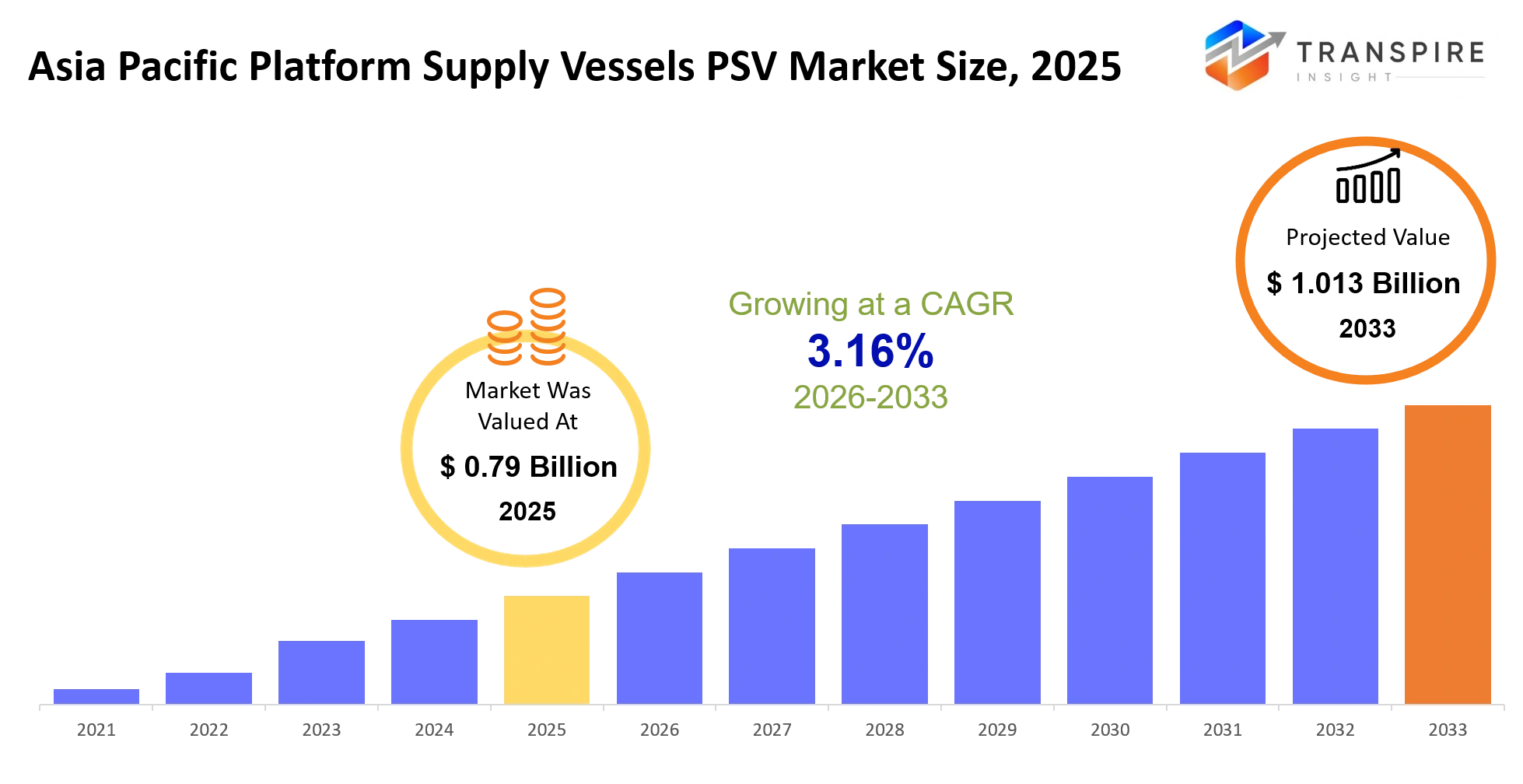
- Asia Pacific Platform Supply Vessels PSV Market Size 2025: USD 0.79 Billion
- Asia Pacific Platform Supply Vessels PSV Market Size 2033: USD 1.013 Billion
- Asia Pacific Platform Supply Vessels PSV Market CAGR: 3.16%
- Asia Pacific Platform Supply Vessels PSV Market Segments: By Vessel Type (Small PSV, Medium PSV, Large PSV, Hybrid PSV, Others); By Application (Offshore Oil & Gas Support, Deepwater Operations, Subsea Operations, Others); By End User (Oil & Gas Companies, Offshore Service Providers, Others).
To learn more about this report,  Download Free Sample Report
Asia Pacific Platform Supply Vessels PSV Market Summary
The Asia Pacific Platform Supply Vessels PSV Market was valued at USD 0.79 Billion in 2025. It is forecast to reach USD 1.013 Billion by 2033. That is a CAGR of 3.16% over the period.
Platform Supply Vessels (PSVs) do a really big job in offshore energy, basically they move drilling gear, fuel, water, chemicals, and other necessary supplies between shore terminals and the offshore oil and gas platforms. Without these vessels, those sites would sit longer than they should, so crews kinda rely on them to keep logistics steady—cut off production delays, and help operators stay on their production timetables. Especially in remote marine areas, where things can get messy quickly, real fast.
In the last 5 years, the market shifted in a more structural manner, moving toward newer fleet arrangements and lower-emission options. Operators are now putting more money into hybrid propulsion systems, more fuel efficient engines, and digital fleet management tools. All of that is tied to tougher environmental rules and honestly also to better day-to-day economics. One key driver behind how the market moves has been the fresh round of offshore exploration, plus deepwater project approvals, across Southeast Asia, Australia, and India. That push followed energy security worries and supply chain interruptions. With that, vessel usage rates have gone up, and charter demand is looking stronger. And as offshore operators lock in capital for long-duration production ventures, PSV owners typically see clearer contract horizons, easier fleet scheduling, and steadier revenue across the Asia Pacific maritime landscape.
Key Market Insights
- The Asia Pacific Platform Supply Vessels PSV Market is set to rise ,from USD 0.79 billion in 2025 up to USD 1.013 billion by 2033.
- Southeast Asia holds the lead in the Asia Pacific Platform Supply Vessels PSV Market with an estimated 38% share, backed by offshore projects in Malaysia and Indonesia .
- Australia shows the quickest momentum through 2033, mainly driven by LNG developments and a steady run of offshore gas field investments .
- PSVs with large capacity pull in nearly 45% of total industry revenue, because operators are choosing longer-distance offshore logistics missions more and more.
- Medium-capacity vessels still sit as the second-biggest segment ,and they are being deployed widely across mature offshore production fields.
- Hybrid along with low-emission PSV fleets are expected to see the fastest adoption, roughly between 2026 and 2033.
- Across the wider regional market, offshore oil and gas production activities are responsible for about 60% of vessel demand.
- Support work for offshore wind is starting to look like the speediest application segment ,especially in Australia and in East Asia.
- Energy exploration firms stay as the largest end-user group, generating more than 55% of PSV charter activity.
- Firms such as Tidewater, DOF Group, Solstad Offshore, Maersk Supply Service, and SEACOR Marine are leaning into digital fleet management, building strategic partnerships, and expanding their regional fleet footprint, so they can stay sharper against competition.
What are the Key Drivers, Restraints, and Opportunities in the Asia Pacific Platform Supply Vessels PSV Market?
The strongest growth driver is the resurgence of offshore oil and gas investment across Asia Pacific, more or less. Energy security worries after global supply disruptions pushed governments and operators to speed up offshore field development, especially for deepwater and gas focused projects. New drilling pushes also need nonstop transport of equipment, drilling fluids , fuel, and crew supplies. So basically there is sustained demand for PSV charter services. As project pipelines keep expanding, vessel utilization gets better and operators tend to lock in longer term contracts, which then supports market revenues in a straight way.
The biggest restraint still feels like the high capital cost tied to fleet modernization and vessel construction. To build advanced PSVs with hybrid propulsion systems, digital navigation technologies, and emission compliant engines, you need substantial outlays. And this is not just temporary, it is more structural because shipyard capacity stays constrained and vessel construction cycles often go beyond two years. Together these factors cap fleet expansion, slow down the replacement of older vessels, and make it harder for market participants to respond fast when demand openings show up.
A major opportunity is the expansion of offshore wind and renewable marine infrastructure. In Australia, Japan, South Korea, and Taiwan, governments are putting notable resources into offshore renewable initiatives. A lot of the support work for offshore wind farms calls for logistics, very similar to what offshore oil and gas already uses. PSV operators that adapt vessels for turbine installation, subsea inspections and maintenance services can add new revenue streams while also being less dependent on hydrocarbon markets. If that shift goes through properly, it could form a sizable new addressable market, across most of the forecast period.
What Has the Impact of Artificial Intelligence Been on the Asia Pacific Platform Supply Vessels PSV Market?
Artificial intelligence is messing around with offshore vessel operations in a real way, mostly by boosting fleet efficiency , smoothing maintenance planning, and making operational choices a bit more informed. More and more vessel operators are rolling out AI-based monitoring setups that keep watching engine behavior, fuel burn, emissions output, and the status of onboard equipment. In practice these tools spot irregularities, and they help with compliance reporting too, so the paperwork load drops, and it also helps reduce unexpected operational disruptions , you know.
Machine learning models are getting used for predictive upkeep as well. They sift through vibration signals, temperature readings, fuel consumption patterns, and machinery performance records. Then operators can flag trouble signs earlier, before failures actually show up. This method tends to reduce surprise downtime, stretch the service life of equipment, and also bring maintenance expenses down. Some fleet operators mention noticeable gains in vessel readiness and fuel efficiency, especially when AI is paired with route optimization and day-to-day operational planning.
On top of that, advanced analytics backs weather-based routing, cargo organization, and offshore mission scheduling. These features help make fuel use more efficient, and they also cut down voyage delays, particularly when conditions are rough in the offshore environment.
Still, even with all that, adoption is held back by integration costs and spotty connectivity in far-off offshore areas. Solid AI tools need steady data capture and transmission, which can be hard when you are working in distant fields. Also, uneven data quality and limited historical training datasets can make prediction accuracy slip, especially for specialized vessel operations where the patterns are not so common.
Key Market Trends
- Since 2021, operators have been boosting investment into hybrid powered PSV fleets, with the idea to lower fuel spend and also to keep up with stricter emissions rules, kinda like it all has to line up.
- Offshore drilling activity across Southeast Asia rebounded quite a lot between 2023 and 2025, which made vessel utilization look better across the main energy basins.
- A few charter contracts moved away from short term spot arrangements and more toward multi-year agreements, so vessel owners got a clearer, revenue future, more or less.
- Digital fleet management adoption went up by over 25% since 2022, because operators were hunting for operational efficiency, not just cost cutting, you know.
- PSV day rates went through pretty notable swings during 2025, mainly because offshore project approvals were delayed, and that messed with utilization.
- Offshore renewable energy work has been opening new vessel deployment chances, beyond the usual oil and gas applications.
- Operators are also increasingly treating fuel efficient vessel designs as a must-have, since operating expenses take up a bigger share in how project economics play out.
- Fleet renewal programs picked up speed after 2024, with firms putting money into newer vessels that have advanced navigation technology onboard.
- Methanol-ready and other alternative fuel PSV designs started getting more attention after new vessel development initiatives were announced during 2026.
- Strategic partnerships between vessel operators, shipyards, and offshore energy companies have been happening more often since 2023.
Asia Pacific Platform Supply Vessels PSV Market Segmentation
By Vessel Type
Small PSV handles offshore spots where there is frequent transport of supplies equipment , and other operational materials but mainly over relatively short distances. Its compact build helps it move around in areas with operational constraints and still gives workable, efficient access to smaller offshore installations. Also the lower running cost side makes this vessel type quite appealing for everyday logistics errands.
Medium PSV stays visible in the market since its cargo capacity feels fairly balanced and its operational flexibility supports a broad mix of offshore missions. Large PSV pulls in demand when the offshore developments are more complicated, and they need shipping of bigger volumes—like drilling fluids, fuel, and lots of equipment. Hybrid PSV is getting more notice because it promises improved fuel efficiency , plus reduced emissions. Others covers specialized vessel concepts designed for particular offshore support needs and project based operations.
By Application
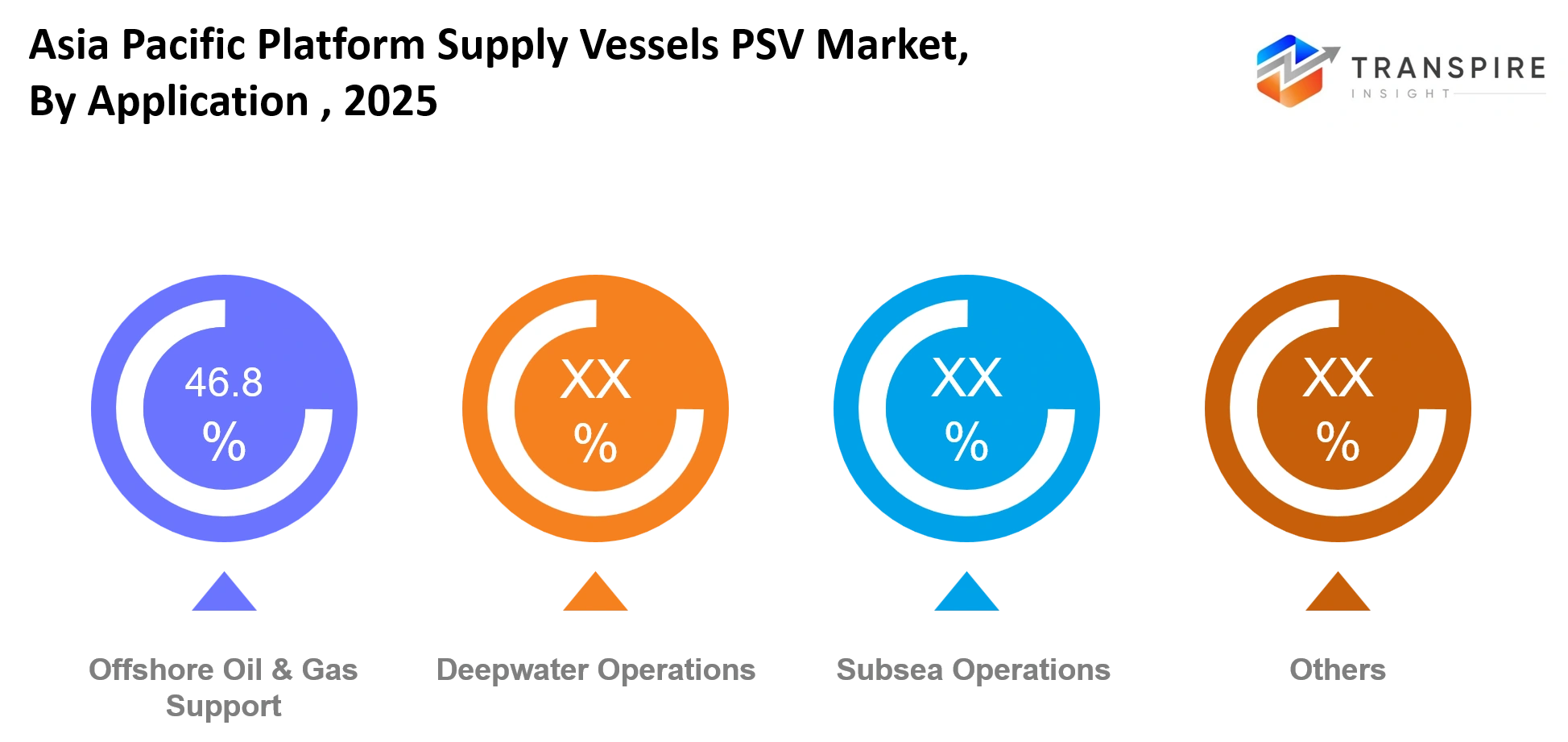
Offshore Oil & Gas Support is , in practice, the broadest application area since offshore production platforms rely on uninterrupted delivery of vital materials as well as routine operational supplies. It is the steady movement of fuel drilling chemicals , equipment, and the maintenance related resources that keeps the production effort stable. Even with time, long lasting offshore developments keep generating a fairly constant use pattern across the support fleets.
Deepwater Operations take up a lot of demand too, mainly because exploration and production keep pushing into deeper offshore fields. Those efforts need vessels that can move bigger cargo loads farther out , all while facing tough working conditions. Subsea Operations cover inspection, repair, and the whole underwater infrastructure set of tasks, while Others groups together offshore construction work, decommissioning initiatives, emergency response services, and several other supporting roles tied to marine energy operations.
To learn more about this report, Download Free Sample Report
By End User
Oil & Gas Companies make up a pretty substantial share, mainly because offshore exploration drilling and production really can’t function without dependable logistics support, you know the kind. The nonstop movement of supplies, equipment, and day to day operational materials stays essential, otherwise it messes with production timelines and increases downtime out at sea. And then the longer, field development programs kind of push vessel deployment needs even more.
Offshore Service Providers are another key end user segment, they often handle transportation coordination, maintenance back up, subsea services, plus specialized offshore operations too. As offshore infrastructure projects keep expanding, that also keeps opening up fresh business chances for service contractors in different regional markets. Other players, kind of alongside them, include engineering firms, offshore construction contractors, and renewable energy project developers. There are also organizations tied to marine infrastructure work, that want reliable offshore logistics and practical operational support solutions.
What are the Key Use Cases Driving the Asia Pacific Platform Supply Vessels PSV Market?
The main real use case for platform supply vessels still seems to be offshore oil and gas production help. In practice these vessels ferry drilling materials, fuel, water, equipment, and spare parts over to the offshore platforms, so exploration and production can keep going without too much interruption. Honestly this particular role is where most of the market demand comes from, because offshore assets really lean on routine logistical support, day after day.
Lately, a few other uses are showing up more often, like subsea construction work, offshore maintenance tasks , and decommissioning projects. Energy service companies are also leaning more on PSV fleets for moving specialized gear and for backing underwater inspection routines. This has turned out to be especially significant as the offshore infrastructure keeps getting older and it needs more upkeep, and even upgrades.
On top of that, newer chances are being talked about, especially for offshore wind farm support and broader renewable energy logistics. As offshore wind projects move forward across Australia, Japan, and several other regional markets, PSV operators are starting to tailor vessels for installation support as well as maintenance work, plus the transport of specialized equipment. It is expected that these kinds of uses will keep growing and become more important through 2033.
|
Report Metrics |
Details |
|
Market size value in 2025 |
USD 0.79 Billion |
|
Market size value in 2026 |
USD 0.815 Billion |
|
Revenue forecast in 2033 |
USD 1.013 Billion |
|
Growth rate |
CAGR of 3.16% from 2026 to 2033 |
|
Base year |
2025 |
|
Historical data |
2021 - 2024 |
|
Forecast period |
2026 - 2033 |
|
Report coverage |
Revenue forecast, competitive landscape, growth factors, and trends |
|
Regional scope |
Asia Pacific (India, China, Japan, Australia, South Korea, Rest of Asia Pacific) |
|
Key company profiled |
Maersk Supply Service, Bourbon Offshore, Tidewater, Solstad Offshore, DOF Group, SEACOR Marine, Edison Chouest Offshore, Havila Shipping, Hornbeck Offshore, Swire Pacific Offshore, PACC Offshore, Vroon Offshore, GulfMark Offshore, Siem Offshore, Island Offshore. |
|
Customization scope |
Free report customization (country, regional & segment scope). Avail customized purchase options to meet your exact research needs. |
|
Report Segmentation |
By Vessel Type (Small PSV, Medium PSV, Large PSV, Hybrid PSV, Others); By Application (Offshore Oil & Gas Support, Deepwater Operations, Subsea Operations, Others); By End User (Oil & Gas Companies, Offshore Service Providers, Others). |
Which Regions are Driving the Asia Pacific Platform Supply Vessels PSV Market Growth?
Southeast Asia still shows up as the leading regional market mostly because it has lots of offshore oil and gas assets sitting there. In practice, countries like Malaysia , Indonesia, and Brunei keep running extensive offshore production, so they really need continuous marine logistics support. The whole area also has well known port infrastructure, seasoned offshore service providers, and fairly mature supply chain networks. Put all that together and you end up with a kind of solid ecosystem that keeps vessel demand going for the long haul.
Australia comes in as the second biggest contributor. It feels different from Southeast Asia, mainly because it leans more toward big scale LNG projects and other offshore gas developments. There regulatory setup also gives a level of stability that helps long term energy investments. Even when commodities swing a bit, operators don’t fully stop, they keep putting money into offshore projects. That ongoing investment climate helps support reliable PSV utilization and keeps charter activity steady.
East Asia, meanwhile, is starting to grow the fastest. Over the last few years, offshore wind investments are picking up, plus there is more spending on marine infrastructure, and vessel modernization programs are moving along too. All of those moves open up fresh chances for offshore support services. Japan and South Korea governments are backing energy transition initiatives that need specialized marine logistics capabilities. So for investors, and for the operators as well, this could mean pretty attractive expansion opportunities between 2026 and 2033, since offshore renewable projects will gradually shift from planning into actual execution.
Who are the Key Players in the Asia Pacific Platform Supply Vessels PSV Market and How Do They Compete?
Competition in the market is, kind of moderately consolidated, not totally, anyway, with global offshore vessel operators on one side and regional specialists on the other competing for charter contracts. The way companies try to stand out usually comes down to fleet quality, operational steadiness, how fast vessels are actually available, geographic reach, and whether they can help with complicated offshore jobs. In practice companies that keep modern fleets and a solid regional presence tend to win the higher value charters.
Tidewater puts a lot of focus on fleet modernization and operating scale. It has a wide vessel portfolio so it can shuffle deployment across multiple offshore markets, which means it responds quicker when charter demand shifts, or seems to shift. DOF Group differentiates with integrated offshore services, it basically blends vessel operations with subsea engineering know-how. That integrated approach tends to create more value for customers who are managing complex offshore projects, not just simple transport.
Solstad Offshore leans into advanced vessel technology and more specialized offshore capabilities. Maersk Supply Service relies on project execution expertise and customer relationships that were built over time through big offshore energy work. SEACOR Marine competes by using operational flexibility and by strategically deploying modern support vessels when it counts.
Overall, across the sector, many firms are expanding through fleet upgrades, digitalization programs, and getting involved in emerging offshore renewable energy projects.
Company List
- Maersk Supply Service
- Bourbon Offshore
- Tidewater
- Solstad Offshore
- DOF Group
- SEACOR Marine
- Edison Chouest Offshore
- Havila Shipping
- Hornbeck Offshore
- Swire Pacific Offshore
- PACC Offshore
- Vroon Offshore
- GulfMark Offshore
- Siem Offshore
- Island Offshore
Recent Development News
In March 2026, Shipping Corporation of India (SCI) entered a partnership with Mazagon Dock Shipbuilders Ltd. to construct a 3,000 DWT methanol dual-fuel diesel-electric Platform Supply Vessel (PSV). The project will deliver the first green methanol-capable PSV in SCI’s fleet, supporting offshore logistics decarbonization and strengthening India's domestic shipbuilding ecosystem.
Source: http://indiashippingnews.com
In March 2026, Mazagon Dock Shipbuilders Ltd. secured an investment contract worth approximately USD 39 million from Shipping Corporation of India for the construction of a methanol dual-fuel Platform Supply Vessel. The investment accelerates deployment of low-emission offshore support vessels and reflects growing commitment to alternative marine fuels in the Asia Pacific PSV sector.
Source: https://www.investywise.com
In November 2025, ABS Marine Services secured a charter agreement with Larsen & Toubro for the DP-2 Platform Supply Vessel “M.V. Ocean Diamond.” The contract improved fleet utilization and expanded offshore support capacity for energy infrastructure projects in India, reinforcing investment momentum in regional PSV operations.
Source: https://test.uniindia.com.
What Strategic Insights Define the Future of the Asia Pacific Platform Supply Vessels PSV Market?
The market seems to be drifting toward a more diversified offshore support ecosystem, where vessel operators end up serving both hydrocarbon work and renewable energy projects. Like it’s not just one lane anymore. This shift is pushed by longer-term energy security needs, bigger offshore infrastructure bets, and also, more and more strict environmental standards. Over the next ten years, fleet modernization and digital vessel management will kind of become the key competitive factors, the real differentiators.
One risk that doesn’t get enough attention is how shipyard capacity gets concentrated. When operators try to renew fleets and adopt alternative-fuel technologies, but shipbuilding availability is tight, delivery timelines can stretch out and capital costs can rise. And honestly, this kind of constraint could also slow down fleet replacement, even if demand conditions are still pretty favorable.
There’s also a fairly promising opportunity in specialized low-emission, alternative-fuel PSVs. Methanol-ready, hybrid-electric, and later-ammonia-capable vessels might attract premium charter rates, especially as offshore operators push harder on decarbonization. Market players should focus investment on fuel-flexible vessel designs, plus digital fleet optimization abilities, right now. That way they’re better positioned to grab the newer offshore energy opportunities before those ideas become mainstream.
Asia Pacific Platform Supply Vessels PSV Market Report Segmentation
By Vessel Type
- Small PSV
- Medium PSV
- Large PSV
- Hybrid PSV
- Others
By Application
- Offshore Oil & Gas Support
- Deepwater Operations
- Subsea Operations
- Others
By End User
- Oil & Gas Companies
- Offshore Service Providers
- Others
Frequently Asked Questions
Find quick answers to common questions.
The expected Asia Pacific Platform Supply Vessels PSV Market size for the market will be USD 1.013 Billion in 2033.
Key segments for the Asia Pacific Platform Supply Vessels PSV Market are By Vessel Type (Small PSV, Medium PSV, Large PSV, Hybrid PSV, Others); By Application (Offshore Oil & Gas Support, Deepwater Operations, Subsea Operations, Others); By End User (Oil & Gas Companies, Offshore Service Providers, Others).
Major Asia Pacific Platform Supply Vessels PSV Market players are Maersk Supply Service, Bourbon Offshore, Tidewater, Solstad Offshore, DOF Group, SEACOR Marine, Edison Chouest Offshore, Havila Shipping, Hornbeck Offshore, Swire Pacific Offshore, PACC Offshore, Vroon Offshore, GulfMark Offshore, Siem Offshore, Island Offshore.
The Asia Pacific Platform Supply Vessels PSV Market size is USD 0.79 Billion in 2025.
The Asia Pacific Platform Supply Vessels PSV Market CAGR is 3.16% from 2026 to 2033.
- Maersk Supply Service
- Bourbon Offshore
- Tidewater
- Solstad Offshore
- DOF Group
- SEACOR Marine
- Edison Chouest Offshore
- Havila Shipping
- Hornbeck Offshore
- Swire Pacific Offshore
- PACC Offshore
- Vroon Offshore
- GulfMark Offshore
- Siem Offshore
- Island Offshore
About the Authors

Avinash Kumar
I’m Avinash Kumar, a Senior Research Analyst at Transpire Insight, with expertise in the Electronics and Semiconductor and Energy & Power industry. My work focuses on analyzing emerging technologies, market trends, industry developments, and innovation across these sectors. I specialize in transforming complex technical and market insights into clear, research-backed content that helps professionals, businesses, and decision-makers stay informed. Through continuous industry research and data-driven analysis, I strive to deliver accurate, reliable, and practical perspectives on the latest advancements shaping the semiconductor and energy landscape.

Chakradhar Khansole
Chakradhar serves as the Research Director at Transpire Insight, bringing over 8 years of experience in technology, innovation, and strategic market intelligence. He specializes in transforming complex market data into actionable business insights that enable organizations to make informed, growth-oriented decisions. Recognized for his strategic vision and analytical expertise, Chakradhar leads high-impact research initiatives, delivering comprehensive market assessments, competitive intelligence, and forward-looking industry analysis.
Recently Published Reports
-
Apr 2026
Active Power Filter Market
Active Power Filter Market Size, Share & Analysis Report By Type (Shunt Active Power Filters, Series Active Power Filter, Hybrid Active Power Filter), By Application (Harmonics Mitigation, Reactive Power Compensation, Voltage Regulation, Power Factor Correction), By Phase (Single Phase, Three Phase), By End-User Industry (Manufacturing, Healthcare, Commercial, Automotive, Oil and Gas, Others), and Geography (North America, Europe, Asia-Pacific, Middle East and Africa, South and Central America), 2021 - 2031
-
Apr 2026
Electrical Transformer Market
Electrical Transformer Market Size, Share & Analysis Report By Core (Closed, Shell, and Berry), By Insulation (Gas, Oil, Solid, Air, and Other), By Phase (Single, and Three), By Rating (100 MVA to 500 MVA, 501 MVA to 800 MVA, and 801 MVA to 1200 MVA), and Geography (North America, Europe, Asia-Pacific, Middle East and Africa, South and Central America), 2021 – 2031
-
Apr 2026
Hydraulic Piston Pumps Market
Hydraulic Piston Pumps Market Size, Share & Analysis Report By Type (Axial Piston Pumps, Radial Piston Pumps), By Operating Pressure (Low Pressure, Medium Pressure, High Pressure), By Application (Construction, Mining, Agriculture, Automotive, Oil & Gas, Industrial Machinery, Others), By End-User (OEMs, Aftermarket), and Geography (North America, Europe, Asia-Pacific, Middle East and Africa, South and Central America), 2021 – 2031
-
Apr 2026
Laboratory Gas Generators Market
Laboratory Gas Generators Market Size, Share & Analysis Report By Product (Nitrogen Gas Generator, Hydrogen Gas Generator, Zero Air Gas Generator, Purge Gas Generator, TOC Gas Generators, Others), By Application (Gas Chromatography, Liquid Chromatography-mass Spectrometry (LC-MS), Gas Analyzers, Others), By End-user (Life Science, Chemical & Petrochemical, Food & Beverage, Others), and Geography (North America, Europe, Asia-Pacific, Middle East and Africa, South and Central America), 2021 – 2031