

Asia Pacific Overhead Cranes Market Size & Forecast:
- Asia Pacific Overhead Cranes Market Size 2025: USD 1.97 Billion
- Asia Pacific Overhead Cranes Market Size 2033: USD 3.85 Billion
- Asia Pacific Overhead Cranes Market CAGR: 8.75%
- Asia Pacific Overhead Cranes Market Segments:By Crane Type (Bridge Cranes, Gantry Cranes, Jib Cranes, Monorail Cranes, Workstation Cranes, Process Cranes, Smart Cranes, Others); By Load Capacity (Below 10 Tons, 10–50 Tons, 51–100 Tons, 101–200 Tons, Above 200 Tons, Heavy Duty Cranes, Automated Cranes, Others); By Application (Manufacturing, Warehousing, Construction, Shipbuilding, Mining, Power Generation, Logistics, Others); By End User (Industrial Facilities, Ports, Construction Firms, Warehouses, Energy Companies, Mining Operators, Government Projects, Others)
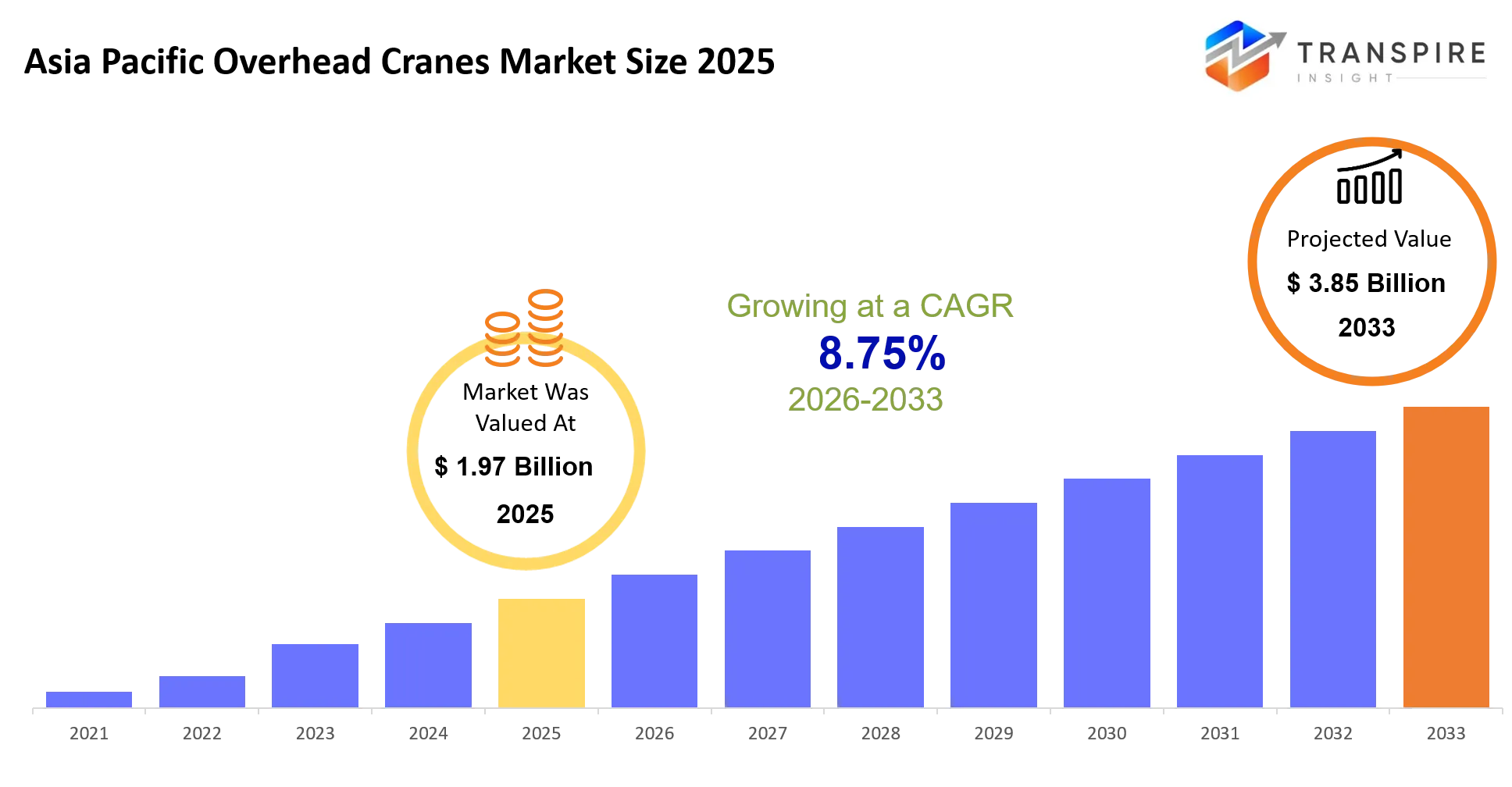
Asia Pacific Overhead Cranes Market Summary
The Asia Pacific Overhead Cranes Market was valued at USD 1.97 billion in 2025. It is forecast to reach USD 3.85 billion by 2033. That is a CAGR of 8.75% over the period.
The Asia Pacific Overhead Cranes Market helps move stuff inside factories, shipyards, ports and steel plants. This is where safe movement of loads is super important for production speed and keeping things running smoothly.These systems make it safer and more precise to lift loads. This is really important because if machines break down it can slow down production and affect how goods move around.In the five years the market has changed a lot. People are moving away from wired crane systems to automated and semi-automated lifting solutions. These new solutions use sensors and remote controls.A big change has been the use of crane systems. These systems can track loads in time and predict when maintenance is needed.
The global supply chain problems after 2020 made manufacturers upgrade their logistics. They wanted to be less dependent on handling delays.This change made people want cranes that can handle weight and have digital features. These cranes improve uptime and enable faster throughput in industrial facilities across the region.The Asia Pacific Overhead Cranes Market supports this need for safe material handling.These systems are crucial, in factories, shipyards, ports and steel plants where the Asia Pacific Overhead Cranes Market operates.
Key Market Insights
- The Asia Pacific Overhead Cranes Market is mostly controlled by China with 48% share in 2025. This is because China has manufacturing and steel production.
- India is growing fast in this market from 2025 to 2032. This growth is due to the development of corridors and better logistics infrastructure.
- Double girder overhead cranes are the most used making up around 55% of the Asia Pacific Overhead Cranes Market. They are needed for heavy-load work in industries.
- Gantry cranes are growing the fastest from 2025 to 2032. Their growth is driven by the automation of ports and modernization of shipyards.
- Manufacturing uses the overhead cranes with over 40% share. This is because of the demand from heavy engineering production.
- Shipbuilding and port logistics are growing fast. This is due to global trade and automation of container handling.
- Industrial manufacturing uses the overhead cranes. They keep installing high-capacity lifting systems.
- The construction sector is asking for overhead cranes. This is because of infrastructure and metro rail projects.
- Companies, like Konecranes and Demag are leading in crane technology. Their cranes have maintenance features.
- SANY Zoomlion and Weihua are expanding quickly. They offer cranes at prices and are making more cranes in different regions.
What are the Key Drivers, Restraints, and Opportunities in the Asia Pacific Overhead Cranes Market?
Drivers
The Asia Pacific Overhead Cranes Market is driven by the need for automation, in manufacturing, steel and logistics sectors. Companies want to produce things and they do not want to wait for people to move things around. So they are buying cranes that can lift heavy things and are connected to computers. These cranes can even tell when they need to be fixed. This means that companies that sell these cranes are making money because buyers want the smart cranes instead of the simple ones.
Restraints
One thing that is holding back the Asia Pacific Overhead Cranes Market is that it costs a lot of money to install these cranes. Old factories need to be changed to use these cranes. That takes time. Medium sized factories do not want to spend the money to upgrade their cranes because it means they have to stop working for a while. This means that companies that sell cranes are not selling many as they could.
Opportunity
There is a chance for the Asia Pacific Overhead Cranes Market to grow in Southeast Asia especially in Vietnam and Indonesia. Ports are being. They need overhead cranes to move cargo faster. This means that companies that sell cranes and technology are going to make money. The Asia Pacific Overhead Cranes Market is going to grow because ports want to use computers to manage their work and they need cranes to do that.
What Has the Impact of Artificial Intelligence Been on the Asia Pacific Overhead Cranes Market?
Artificial intelligence and advanced digital technologies are changing the way lifting systems work in industrial facilities in the Asia Pacific region. They are making these systems more automated, safer and better at using equipment. Smart crane control systems now use intelligence to balance loads and make movements more efficient. This reduces the chance of error and makes handling heavy materials more precise in places like steel plants, shipyards and manufacturing hubs.Digital models of lifting operations help figure out the way for cranes to move and reduce the time it takes to do things. This also reduces energy waste when doing the tasks over and over in industrial settings.
Artificial intelligence is also being used to predict when crane parts like hoists, motors and wire ropes need to be fixed. These systems look at things like vibration, temperature and how much the parts are used to find out if they are starting to wear out. This means that maintenance can be scheduled before something breaks. In some cases using intelligence like this has made equipment work 15 to 30 percent more and reduced unexpected shutdowns, in places where a lot of work is being done. Systems that monitor all the cranes in a facility also help make sure they are working well as they can by tracking how much they are used and finding cranes that are not being used enough.
However one big problem is that it costs a lot to add intelligence to old crane systems especially in older manufacturing plants. Many facilities still have sensor systems that do not work well together which makes it hard to get good data and reduces the accuracy of the models. This slows down the use of intelligence in overhead lifting systems even though it can make things work more efficiently in the Asia Pacific region.
Key Market Trends
- Since 2021 companies that make cranes started to use -automated systems with digital load monitoring in heavy industries like steel plants.
- From 2022 to 2025 a lot of steel plants started using cranes that are connected to the internet, which made things safer and reduced the time that the cranes were not working.
- After 2023 Konecranes put smart cranes in big factories in Asia and they also started using systems that can predict when the cranes need to be fixed.
- Demag started to upgrade cranes with automated control systems, which made companies prefer to fix their old cranes instead of buying new ones.
- SANY and Zoomlion started to sell cranes after 2022 because they were cheaper which made them a good choice for smaller industrial projects.
- After 2023 ports started to use systems, which led to more gantry cranes being installed and made it easier to handle cargo at ports.
- The new monitoring systems reduced the time that cranes were not working because they were broken by up to 25 percent in crane networks that use technology.
- After 2021 the people who buy cranes for industries started to think about the cost of the crane over its lifetime and they preferred cranes that use less energy and are easier to maintain.
- After 2024 shipyards in Vietnam, Indonesia and other places near the sea started to use overhead cranes, which increased the demand, for these types of cranes in these areas.
Asia Pacific Overhead Cranes Market Segmentation
By Crane Type:
Crane systems like Bridge cranes are really good at handling loads in manufacturing plants because they can move these loads around continuously within a fixed area. Gantry cranes are becoming more popular in ports and shipyards because they can handle containers and move them around easily outdoors. Jib cranes are useful in assembly lines and workshops because they can lift things in areas. Monorail and workstation cranes are also getting more popular in places that make things with precision because they help move things around in a controlled way and save space.Process cranes are used in places like steel factories and heavy fabrication units because they can handle high temperatures and heavy loads. Smart cranes are being used more and more in factories because they have sensors and can control loads automatically. Heavy-duty cranes are being used in infrastructure projects and mining because they can lift really heavy things. Overall there are types of cranes and this helps because they can be used in different situations.
By Load Capacity:
Cranes that can lift than 10 tons are still needed in small manufacturing units and warehouses because they can move light things around. Cranes that can lift 10 to 50 tons are popular in sized industrial operations because they can handle a good amount of weight and are not too expensive. Cranes that can lift 51 to 100 tons are used in manufacturing and steel processing plants because they can handle consistent heavy loads. Cranes that can lift 101 to 200 tons are used in infrastructure projects and shipbuilding because they can handle really heavy loads.Cranes that can lift than 200 tons are being used more in mining and big construction projects because they can lift extremely heavy things. Heavy-duty crane systems are replacing mechanical systems in places that need to lift heavy things. Automated cranes are being used more because industries want to be more precise and use sensors to lift things. The different load capacities show that industries are trying to be more efficient and safe.
By Application:
Manufacturing uses cranes the most because they need to move things around in places that make cars, steel and machines. Warehouses are using cranes more because they are getting more organized and need to support shopping. Construction projects need cranes to build infrastructure, metro rails and industrial facilities. Shipbuilding is using cranes more because of trade and the need to modernize coastal production yards.Mining operations need high-capacity cranes to extract things and handle equipment. Power generation facilities use cranes to install and maintain turbines because they need to lift things. Logistics sectors are using automated crane systems to handle cargo and reduce delays. The different applications make the demand for cranes stable across industries.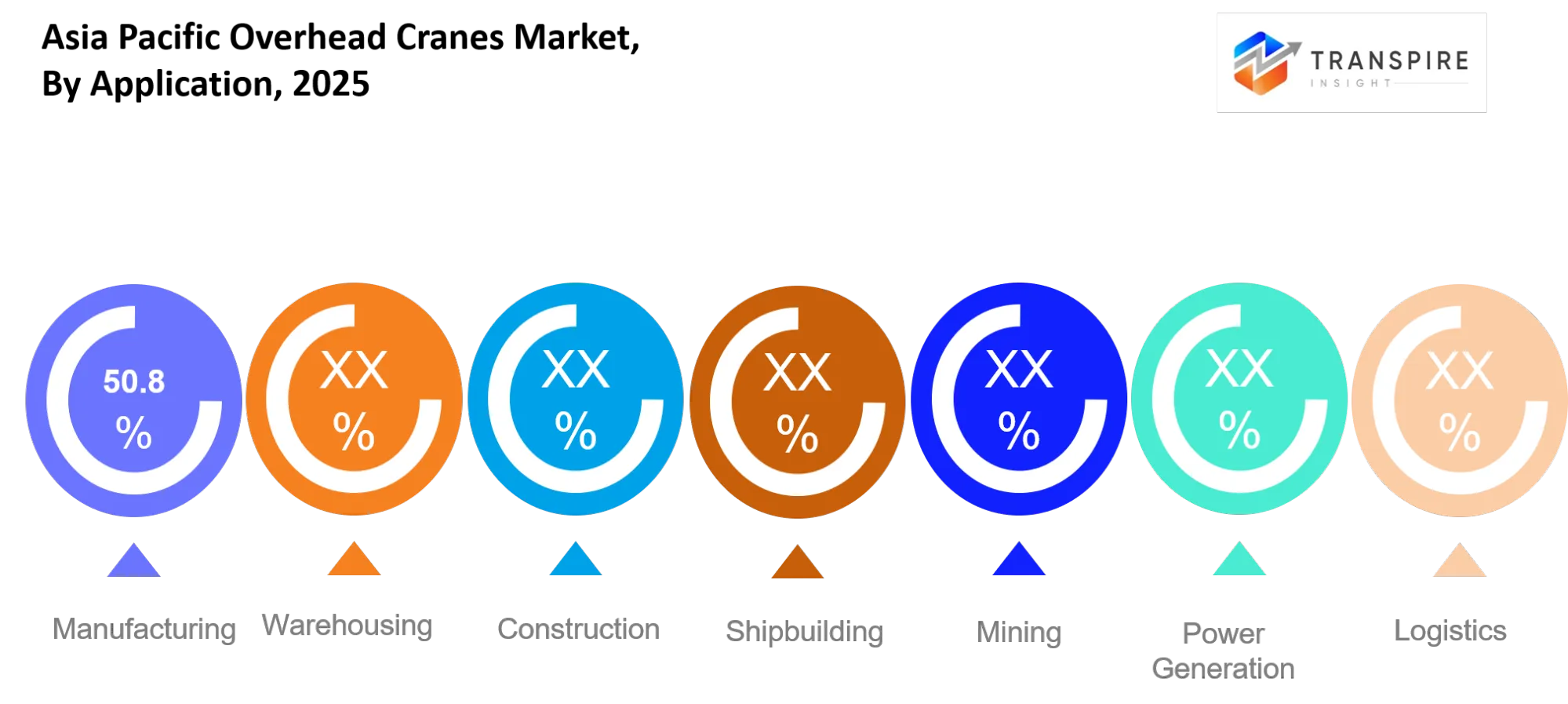
By End User:
Industrial facilities need cranes the most because they need to move things inside their facilities. Ports are installing cranes to move containers around more efficiently and reduce the time it takes to turn cargo around. Construction firms are using cranes in infrastructure projects because they need to lift things. Warehouses are using automated crane systems to store and retrieve things efficiently.Energy companies use cranes to install and maintain equipment in power plants and renewable energy sites. Mining operators need high-capacity cranes to extract and transport things. Government projects are supporting the demand, for cranes through infrastructure development and industrial corridor expansion. The end users make sure that cranes are being adopted steadily across both private and public sector investments.
What are the Key Use Cases Driving the Asia Pacific Overhead Cranes Market?
The main use of cranes in the Asia Pacific Overhead Cranes Market is to handle heavy materials in factories. This is where they move a lot of steel, machinery parts and car components around. This helps factories make things faster and safer for people. The Asia Pacific Overhead Cranes Market is important for factories because it helps them work efficiently.
Other places that use cranes are shipyards and ports. These are places where big ships are built and fixed. Overhead cranes help move containers around quickly. They also help build and fix ships. Storage places also use cranes to store things closer together and to move big things around automatically.Now people are starting to use cranes in new ways. For example some factories are using cranes with artificial intelligence to make sure they are not too heavy on one side. Some mines are also using overhead cranes to dig things up and to move equipment around in places that are not safe, for people. The Asia Pacific Overhead Cranes Market is using cranes in these new ways.
|
Report Metrics |
Details |
|
Market size value in 2025 |
USD 1.97 Billion |
|
Market size value in 2026 |
USD 2.14 Billion |
|
Revenue forecast in 2033 |
USD 3.85 Billion |
|
Growth rate |
CAGR of 8.75% from 2026 to 2033 |
|
Base year |
2025 |
|
Historical data |
2021 - 2024 |
|
Forecast period |
2026 - 2033 |
|
Report coverage |
Revenue forecast, competitive landscape, growth factors, and trends |
|
Regional scope |
Asia Pacific |
|
Key company profiled |
Konecranes, Demag, ABUS, GH Cranes, Street Crane, Columbus McKinnon, Mitsubishi Heavy Industries, Hitachi, Weihua, Henan Mine Crane, Terex, Tadano, Zoomlion, SANY, Gorbel |
|
Customization scope |
Free report customization (country, regional & segment scope). Avail customized purchase options to meet your exact research needs. |
|
Report Segmentation |
By Crane Type (Bridge Cranes, Gantry Cranes, Jib Cranes, Monorail Cranes, Workstation Cranes, Process Cranes, Smart Cranes, Others); By Load Capacity (Below 10 Tons, 10–50 Tons, 51–100 Tons, 101–200 Tons, Above 200 Tons, Heavy Duty Cranes, Automated Cranes, Others); By Application (Manufacturing, Warehousing, Construction, Shipbuilding, Mining, Power Generation, Logistics, Others); By End User (Industrial Facilities, Ports, Construction Firms, Warehouses, Energy Companies, Mining Operators, Government Projects, Others) |
Which Regions are Driving the Asia Pacific Overhead Cranes Market Growth?
Asia Pacific leads the Overhead Cranes Market due to strong industrial concentration in heavy manufacturing, steel production, and large-scale infrastructure development. Countries with advanced industrial bases support continuous installation of high-capacity lifting systems across factories, shipyards, and logistics hubs. Government-backed manufacturing expansion policies and industrial corridor development programs strengthen demand for advanced material handling equipment. A well-established ecosystem of crane manufacturers, maintenance providers, and engineering contractors ensures consistent deployment and service support.
North America remains a stable comparison region, but within Asia-focused analysis, Japan and South Korea represent the most comparable mature markets due to their precision manufacturing ecosystems. These economies prioritize long-term equipment reliability, strict workplace safety standards, and gradual modernization of aging industrial infrastructure. Demand growth remains steady rather than rapid, supported by consistent capital investment in automotive, electronics, and shipbuilding sectors. This stability creates predictable replacement cycles and sustained demand for advanced crane upgrades.
Southeast Asia shows the fastest growth momentum driven by rapid industrialization and expansion of port infrastructure and manufacturing clusters. Recent investments in Vietnam, Indonesia, and Thailand have accelerated factory construction and logistics network upgrades, increasing demand for modern crane systems. Industrial relocation trends from higher-cost economies have further strengthened new installation demand. This growth signals strong opportunity for equipment suppliers and investors targeting long-term infrastructure and manufacturing expansion across 2026 to 2033.
Who are the Key Players in the Asia Pacific Overhead Cranes Market and How Do They Compete?
The Asia Pacific Overhead Cranes Market is moderately fragmented, with global engineering firms and regional manufacturers competing across heavy industrial, manufacturing, and logistics sectors. Competition is shifting toward technology integration, especially smart crane systems with IoT monitoring, predictive maintenance, and automated load control. Incumbents focus on defending share through long-term service contracts and customization for large industrial facilities, while new entrants from China and India increase pressure through cost-competitive offerings and faster delivery cycles. Pricing, digital capability, and after-sales service quality remain the key competitive levers.
Konecranes focuses on technology innovation through smart crane ecosystems that integrate real-time monitoring and predictive maintenance, improving uptime in steel and automotive plants. Demag strengthens its position through engineering precision and retrofit solutions that upgrade legacy crane systems instead of full replacements, reducing customer capital costs. Columbus McKinnon emphasizes industrial safety systems and precision lifting solutions, targeting high-reliability manufacturing environments where operational safety standards are strict.
SANY and Zoomlion compete primarily through cost leadership and large-scale manufacturing capacity, enabling aggressive pricing for infrastructure and construction projects. Weihua Crane expands through domestic dominance in China and export-driven growth across developing industrial markets, supported by broad product portfolios covering heavy-duty and gantry cranes. GH Cranes focuses on modular crane systems and regional customization, enabling faster deployment across mid-sized industrial facilities.
Company List
- Street Crane
- Columbus McKinnon
- Mitsubishi Heavy Industries
- Hitachi
- Weihua
- Henan Mine Crane
- Terex
- Tadano
- Zoomlion
- SANY
- Gorbel
Recent Development News
In February 2026, Konecranes announced a strategic expansion of its industrial lifting and automation solutions portfolio, focusing on smart, energy-efficient crane systems integrated with digital monitoring technologies to support decarbonization and material efficiency in heavy industries. The initiative strengthens demand for advanced material handling solutions in manufacturing, steel, and recycling-related industrial ecosystems.https://www.konecranes.com
In October 2025, Tadano Ltd. introduced upgraded hybrid and electric crane technologies aimed at reducing emissions and improving operational efficiency in construction and industrial lifting applications. The development supports the company’s long-term sustainability roadmap and aligns with increasing demand for low-emission heavy equipment across global infrastructure sectors.https://www.tadano.com
In January 2026, Mitsubishi Heavy Industries (MHI) expanded its industrial automation and smart manufacturing initiatives, integrating advanced robotics and AI-based monitoring systems into heavy equipment and industrial solutions. This development enhances efficiency and supports circular manufacturing and resource optimization efforts across industrial supply chains.https://www.mhi.com
What Strategic Insights Define the Future of the Asia Pacific Overhead Cranes Market?
Over next 5–7 years, APAC overhead cranes market will shift toward automated, smart, and energy-efficient lifting systems, driven by industrial automation, infrastructure expansion, and manufacturing and logistics modernization, with rising demand for connected, predictive operations over standalone equipment sales. However, an underappreciated risk is substitution from automated warehouse robotics and AGVs in light-duty material handling, which could erode conventional crane demand, alongside exposure to steel price volatility and cyclical construction slowdowns. The most promising opportunity lies in IoT-enabled smart cranes and electrified systems deployed in renewable energy projects, semiconductor fabs, and smart ports, where precision, uptime, and automation readiness command premium investment. Market participants should shift from equipment-centric models to lifecycle service offerings, prioritizing sensor-based retrofits and strategic partnerships with EPC contractors to secure long-term maintenance and recurring revenue streams.
Asia Pacific Overhead Cranes Market Report Segmentation
-
By Type
- Single Girder Overhead Cranes
- Double Girder Overhead Cranes
- Gantry Cranes
- Jib Cranes
- Underslung Cranes
- Others
-
By Operation
- Manual Cranes
- Semi-Automated Cranes
- Fully Automated Cranes
- Remote-Controlled Cranes
-
By Capacity
- Light Duty (Up to 10 Tons)
- Medium Duty (10–50 Tons)
- Heavy Duty (Above 50 Tons)
-
By End-Use Industry
- Manufacturing
- Construction
- Automotive
- Shipbuilding
- Steel & Metals
- Aerospace
- Logistics & Warehousing
- Energy & Power
- Others
-
By Application
- Material Handling
- Assembly Line Operations
- Loading & Unloading
- Maintenance Operations
- Heavy Fabrication
-
By Technology
- Conventional Cranes
- Smart / IoT-Enabled Cranes
- Electric Cranes
- Hybrid Cranes
-
By Sales Channel
- Direct Sales (OEM)
- Distributor / Dealer Network
- Aftermarket & Retrofit Services
Frequently Asked Questions
Find quick answers to common questions.
The Expected Asia Pacific Overhead Cranes Market size for the Market will be USD 3.85 Billion in 2033.
Key Segments for the Asia Pacific Overhead Cranes Market are By Crane Type (Bridge Cranes, Gantry Cranes, Jib Cranes, Monorail Cranes, Workstation Cranes, Process Cranes, Smart Cranes, Others); By Load Capacity (Below 10 Tons, 10–50 Tons, 51–100 Tons, 101–200 Tons, Above 200 Tons, Heavy Duty Cranes, Automated Cranes, Others); By Application (Manufacturing, Warehousing, Construction, Shipbuilding, Mining, Power Generation, Logistics, Others); By End User (Industrial Facilities, Ports, Construction Firms, Warehouses, Energy Companies, Mining Operators, Government Projects, Others)
Major Asia Pacific Overhead Cranes Market players are Konecranes, Demag, ABUS, GH Cranes, Street Crane, Columbus McKinnon, Mitsubishi Heavy Industries, Hitachi, Weihua, Henan Mine Crane, Terex, Tadano, Zoomlion, SANY, Gorbel.
The Current Asia Pacific Overhead Cranes Market size is USD 1.97 Billion in 2025.
The Asia Pacific Overhead Cranes Market CAGR is 8.75% from 2026 to 2033.
- Konecranes
- Demag
- ABUS
- GH Cranes
- Street Crane
- Columbus McKinnon
- Mitsubishi Heavy Industries
- Hitachi
- Weihua
- Henan Mine Crane
- Terex
- Tadano
- Zoomlion
- SANY
- Gorbel
About the Authors

Kartik bhong
I am Kartik Bhong, a Senior Research Analyst at Transpire Insight, specializing in the Packaging, Manufacturing, and Construction industry. My work focuses on analyzing market trends, emerging technologies, industry regulations, and competitive landscapes to deliver accurate, data-driven insights. I am passionate about transforming complex industry information into clear, practical content that helps businesses, professionals, and decision-makers stay informed and make confident strategic decisions. Through continuous research and a strong commitment to accuracy, I strive to create reliable, well-researched content that reflects the latest developments across these dynamic industries and supports the vision of Transpire Insight in delivering valuable market intelligence.

Chakradhar Khansole
Chakradhar serves as the Research Director at Transpire Insight, bringing over 8 years of experience in technology, innovation, and strategic market intelligence. He specializes in transforming complex market data into actionable business insights that enable organizations to make informed, growth-oriented decisions. Recognized for his strategic vision and analytical expertise, Chakradhar leads high-impact research initiatives, delivering comprehensive market assessments, competitive intelligence, and forward-looking industry analysis.
Recently Published Reports
-
Apr 2026
Handling and Lifting Equipment Market
Handling and Lifting Equipment Market Size, Share & Analysis Report By Product (Cranes and Hoists, Forklifts, Conveyor Systems, Aerial Work Platforms, Others), By Application (E-Commerce, Automotive and Railway, Food and Beverages, Aviation, Others), and Geography (North America, Europe, Asia-Pacific, Middle East and Africa, South and Central America), 2021 - 2031
-
Apr 2026
HVAC Equipment Market
HVAC Equipment Market Size, Share & Analysis Report By Heating Equipment Type (Boilers and Furnaces, Heat Pumps, and Unitary Heaters), By Ventilation Equipment (Air Handling Units, Humidifiers and Dehumidifiers, Air Filters, and Fan Coiling Units), By Air Conditioning Equipment (Unitary Air Conditioners, Room Air Conditioners, Packaged Terminal Air Conditioners, and Chillers), By End User (Commercial, Residential, Industrial, and others), and Geography (North America, Europe, Asia-Pacific, Middle East and Africa, South and Central America), 2021 – 2031
-
Apr 2026
Refrigeration Valves Market
Refrigeration Valves Market Size, Share & Analysis Report By Type (Solenoid Valves, Expansion Valves, Check Valves, Service Valves, Others), By Application (Commercial Refrigeration, Industrial Refrigeration, Transport Refrigeration, Residential Refrigeration, Air Conditioning Systems), By End User (Food and Beverage Industry, Pharmaceutical Industry, HVAC Industry, Chemical Industry, Others), and Geography (North America, Europe, Asia-Pacific, Middle East and Africa, South and Central America), 2021 – 2031
-
Apr 2026
E-Commerce Packaging Materials Market
E-Commerce Packaging Materials Market By Material Type (Corrugated Boxes, Paper & Paperboard, Foam & Cushioning Materials, Plastic Packaging, Flexible Packaging, Protective Packaging, Others), By Product(Primary Packaging, Secondary Packaging, Tertiary Packaging), By Packaging Function (Protective Packaging, Branding & Presentation Packaging, Transit & Logistic Packaging, Sustainable Packaging, Tamper Evidence Packaging), By End-User (Retail & Consumer Goods, Electronic Appliances, Food & Beverages, Healthcare & Pharmaceutical, Fashion & Apparel, Home & Furnishing, Others); By Industry Analysis, Size, Share, Growth, Trends, and Forecasts 2021-2033