
France Material Handling Equipment Market Size & Forecast:
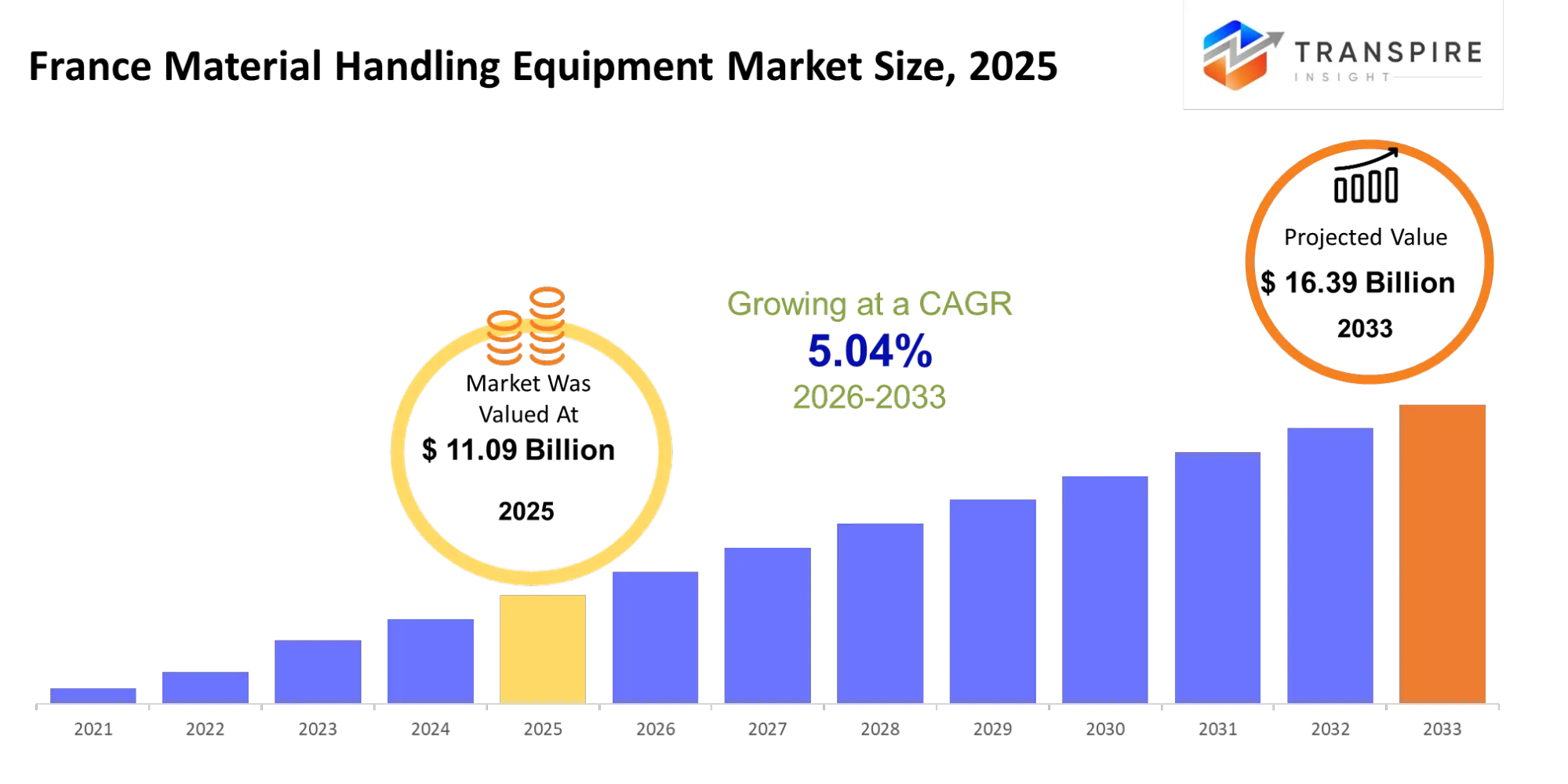
- France Material Handling Equipment Market Size 2025: USD 11.09 Billion
- France Material Handling Equipment Market Size 2033: USD 16.39 Billion
- France Material Handling Equipment Market CAGR: 5.04%
- France Material Handling Equipment Market Segments: By Type (Forklifts, Conveyors, Cranes, Automated Storage Systems, Others); By Application (Warehousing, Manufacturing, Construction, Logistics, Others); By End-User (Manufacturing Firms, Logistics Companies, Warehouses, Construction Sector, Retailers, Others); By Automation (Manual, Semi-automated, Automated, Others)
To learn more about this report,  Download Free Sample Report
France Material Handling Equipment Market Summary
The France Material Handling Equipment Market was valued at USD 11.09 Billion in 2025. It is forecast to reach USD 16.39 Billion by 2033. That is a CAGR of 5.04% over the period.
The France material handling equipment market enables the transportation and storage and loading of goods and their automated processing throughout various locations which include warehouses and manufacturing plants and ports and logistics hubs and retail distribution centers. The industry performs an essential function by decreasing the need for manual labor which enables better warehouse operations and faster order delivery throughout industrial supply networks. The market experienced a structural transformation during the past five years because logistics operators developed their facilities to implement warehouse automation and electric-powered handling systems which supported e-commerce expansion and new workplace efficiency requirements.
The main cause occurred during the post-pandemic supply chain disruption period which revealed operational problems that European distribution networks faced because of delivery delays and labor shortages. The market saw increased funding for automated guided vehicles and robotic picking systems and smart forklifts. The integrated automation platforms and predictive maintenance services and digitally connected warehouse systems enable equipment suppliers to increase their revenues because manufacturers and logistics operators need to move their inventory faster while keeping their operational costs down.
Key Market Insights
- The France Material Handling Equipment Market reached USD 11.09 billion in 2025 due to strong logistics infrastructure modernization and industrial automation investment.
- Île-de-France accounted for nearly 34% market share in 2025 because of concentrated warehousing, retail distribution, and e-commerce fulfillment activity.
- Between 2024 and 2033 autonomous mobile robots showed the fastest growth among all equipment categories used in large-scale logistics operations.
- Forklifts dominate industry revenue with over 38% share due to extensive usage in warehousing, manufacturing, and port cargo operations.
- The second-largest market segment for conveyor systems exists because automated parcel handling operations increased throughout distribution and courier networks.
- E-commerce fulfillment applications recorded the fastest operational growth as same-day delivery models increased warehouse automation spending.
- The manufacturing sector serves as the primary end-user market because automotive, aerospace, and industrial production facilities need to move large quantities of inventory.
- The logistics industry and third-party warehouse operators accelerated their investments in robotic picking systems and automated storage systems because they experienced labor shortages after the year 2022.
- The implementation of lithium-ion battery forklifts together with AI-powered fleet tracking systems has become common among manufacturers who need to decrease their energy use and operational interruptions.
- The operational implementation of automated guided vehicle systems across France received support through the partnership between robotics companies and warehouse operators.
What are the Key Drivers, Restraints, and Opportunities in the France Material Handling Equipment Market?
E-commerce expansion and industrial automation targets drive rapid changes to warehouse and logistics systems which create the most substantial growth for the France material handling equipment market. Retailers and logistics operators increased their investments in automated storage systems and robotic picking solutions and electric forklifts after supply chain disruptions in 2021 showed them that manual warehouse operations had major efficiency problems. Businesses adopted automated handling systems which enhance throughput and decrease operational downtime and cut permanent employment expenses because of their need to meet quicker delivery times and their battle with workforce shortages. The operational transition led to major budget increases for equipment acquisition which affected all sectors including logistics and manufacturing and distribution.
The most significant restraint remains the high capital cost associated with advanced automation infrastructure and warehouse modernization projects. Smaller operators struggle to manage the substantial initial costs required for automated storage systems and robotics integration and warehouse management software and lithium-ion fleet conversion. The structural challenge prevents mid-sized warehouses and regional distributors from adopting new technology which results in extended equipment replacement periods and restricted market access.
AI-enabled warehouse automation and smart intralogistics systems present a significant opportunity. French logistics hubs increasingly invest in autonomous mobile robots, predictive fleet analytics, and connected inventory management platforms which help businesses achieve precise order fulfillment and improved operational results. The regional fulfillment centers which serve cities like Lyon and Lille create valuable business prospects for suppliers who develop scalable automation solutions and energy-efficient equipment..
What Has the Impact of Artificial Intelligence Been on the France Material Handling Equipment Market?
The France material handling equipment market experiences major changes because artificial intelligence and advanced digital technologies transform warehouse operations and industrial logistics. AI-powered warehouse management systems now use automated systems to manage inventory distribution and delivery path planning and vehicle management throughout extensive logistics operations and production sites. Distribution operators use machine learning algorithms to improve forklift traffic flow while achieving automatic pallet positioning and decreased traffic jams within their busy fulfillment centers.
The predictive analytics systems enhance equipment reliability through their ability to track vibration patterns and battery performance and mechanical wear across all forklifts and conveyors and automated guided vehicles. The machine learning models enable operators to schedule maintenance activities before equipment failures disrupt warehouse operations. The logistics operators achieved better equipment uptime and faster order processing and improved energy efficiency after they implemented AI-powered fleet management systems together with their automated storage systems. Computer vision technology now enables robotic picking systems to identify package dimensions and track barcode locations and product positions in real time.
The AI-based warehouse orchestration systems help organizations allocate staff resources and schedule shipments more precisely during times of high demand.. However, businesses face two main challenges with AI implementation because they deal with high integration expenses and their existing warehouse systems use obsolete technology. Many mid-sized facilities still operate disconnected inventory systems that limit real-time data collection and reduce predictive model accuracy across automated warehouse environments.
Key Market Trends
- Warehouse operators began adopting lithium-ion forklifts as their primary equipment after the year 2022 because they wanted to decrease their usage of diesel-powered industrial fleets.
- E-commerce fulfillment centers began using autonomous mobile robots together with automated conveyor systems to replace manual pallet transportation.
- Logistics companies increased their funding for robotic picking systems during the period between 2023 and 2025 to solve workforce shortages and boost operational efficiency.
- Third-party logistics companies and retail distribution centers started using smart warehouse systems which combine artificial intelligence inventory forecasting to improve their operational efficiency.
- Manufacturers adopted modular automated storage systems because these systems enable quick warehouse expansion without needing to replace complete storage systems.
- Port and cargo terminals enhanced their use of connected handling systems which help them achieve better container movement tracking and faster cargo processing times.
- Jungheinrich and Toyota Material Handling expanded their electric equipment product lines to meet the European industrial decarbonization standards.
- Logistics hubs implemented real-time fleet monitoring systems as their new standard because operators needed these systems to support their predictive maintenance and energy management needs.
- French retailers established partnerships with robotics companies to enhance their ability to deliver products on the same day while they increased their warehouse automation capacity.
- Urban micro-fulfillment centers which support last-mile logistics operations have seen a growing demand for compact automated guided vehicles.
France Material Handling Equipment Market Segmentation
By Type
The market structure relies on forklift operations because warehouses and factories and logistics hubs and retail distribution centers require uninterrupted movement of pallets and transportation of cargo. The market remains dominated by electric and lithium-ion forklifts because logistics operators value their energy-saving capabilities and reduced maintenance expenses and enhanced safety for indoor work environments. Automated product movement through conveyors enables e-commerce fulfillment and parcel handling facilities to operate at higher throughput speeds while needing less manual labor. Cranes and automated storage systems retain their industrial significance because they enable heavy lifting operations and high-density warehouse automation processes which assist manufacturing activities and port logistics operations.
The segment grows through warehouse modernization programs, labor shortage pressures, and rising investment in automated logistics infrastructure across France. The future development of AI-enabled fleet management systems and autonomous forklifts and modular automated storage systems will reach its peak because these technologies will enhance scalability and operational efficiency for logistics companies and industrial users.
By Application
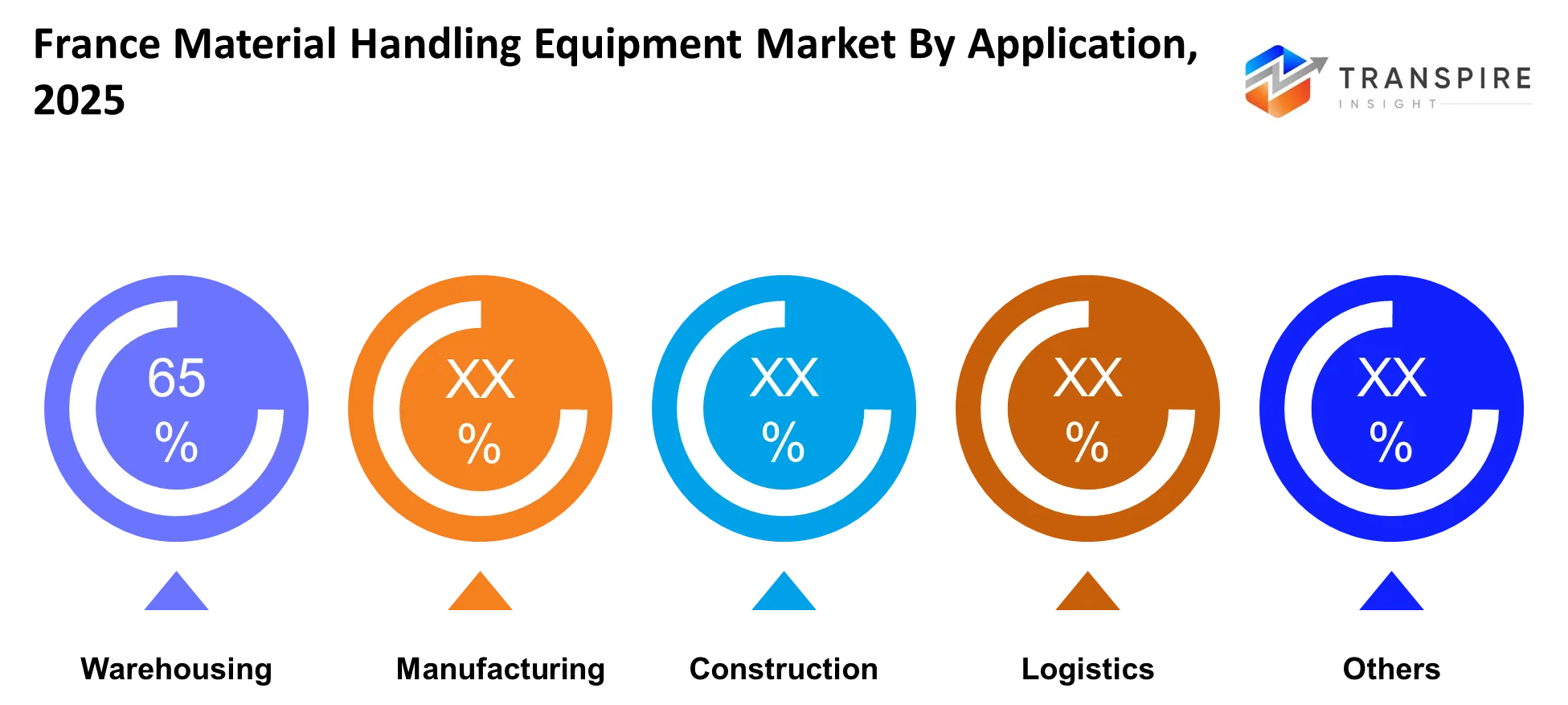
The operational usage of material handling equipment throughout all warehousing and manufacturing and construction and logistics and industrial cargo operations determines its commercial value. Warehousing remains the dominant application because e-commerce expansion and high-frequency order fulfillment require continuous inventory movement and automated storage systems and rapid parcel processing capabilities. Manufacturing facilities continue strengthening demand because automotive aerospace and industrial production plants rely on robotic handling systems and conveyor infrastructure to maintain production flow efficiency. Construction and logistics operations also create strong equipment demand through their activities of heavy material transportation and container handling and intermodal freight movement.
Market expansion in this segment comes from supply chain modernization and industrial automation programs and same-day delivery infrastructure development. The future growth of the market will likely support connected warehouse systems and AI-driven inventory coordination platforms and automated cargo handling technologies which use operational speed improvements and downtime reductions to enable large-scale logistics expansion across France.
To learn more about this report, Download Free Sample Report
By End-User
Manufacturing companies remain the primary users of industrial facilities because these plants need ongoing movement of materials together with automated production systems and equipment that can handle large quantities of items. Warehouses and logistics companies operate their facilities more efficiently by purchasing automated guided vehicles and electric forklifts and conveyor systems which help them reach their fulfillment goals faster. Retailers create higher market demand through their rapid development of omnichannel distribution centers which include urban fulfillment centers that enable online delivery services. The construction industry maintains consistent equipment demand because infrastructure projects and industrial development activities need cranes and lifting systems and heavy-duty material transportation equipment.
The segment experiences growth through industrial digitization, warehouse automation investment, and regional logistics expansion across France. The market will develop through upcoming equipment partnerships between suppliers and logistics operators who will concentrate on building predictive maintenance systems together with scalable warehouse automation platforms and energy-efficient industrial handling fleets.
By Automation
The ongoing use of manual equipment within the market exists because smaller warehouse operations together with regional distribution centers and construction companies require them to maintain their operational flexibility while spending less money to start their operations. The manufacturing industry and mid-sized logistics centers use semi-automated systems because they need to combine manual operations with automated technologies that handle their lifting and sorting and transportation needs. The most rapidly expanding category of automated systems exists because large fulfillment centers and industrial operators require their operations to achieve higher efficiency while reducing their need for labor and managing inventory across their intricate warehouse systems. The specialized industrial sector maintains its need for customized automation solutions that develop special cargo handling systems and robotic elements.
The AI segment experiences expansion because of AI technology integration and robotic systems implementation and the increasing need for warehouse automation systems which offer scalability. Logistics and industrial sectors will experience operational cost savings through the deployment of autonomous mobile robots and predictive fleet monitoring systems and cloud-based warehouse management technologies which will boost throughput capacity.
What are the Key Use Cases Driving the France Material Handling Equipment Market?
Material handling equipment in France functions primarily through its application in warehouse and distribution operations. The fulfillment centers of e-commerce, the distribution hubs of retail, and the logistics providers of third-party services all depend on forklifts and conveyor systems and automated storage technologies to speed up inventory movement while they decrease delivery times. The volume of parcels combined with same-day delivery requirements creates strong demand for automated systems which handle warehouse operations.
Advanced handling systems find application in manufacturing facilities and port logistics operations as their secondary use case. The automotive industry and aerospace sector and food processing plants now implement robotic palletizing systems together with autonomous guided vehicles to boost their production efficiency while decreasing their requirement for manual labor. Electric handling fleets together with automated container movement systems enhance operational efficiency at cargo terminals and intermodal logistics hubs.
The development of urban micro-fulfillment centers and AI-powered cold chain logistics systems represents a new area of practical application. Compact robotic handling systems which operate effectively in restricted urban warehouse areas and temperature-controlled spaces are being tested by pharmaceutical distributors and grocery delivery platforms.
|
Report Metrics |
Details |
|
Market size value in 2025 |
USD 11.09 Billion |
|
Market size value in 2026 |
USD 11.62 Billion |
|
Revenue forecast in 2033 |
USD 16.39 Billion |
|
Growth rate |
CAGR of 5.04% from 2026 to 2033 |
|
Base year |
2025 |
|
Historical data |
2021 - 2024 |
|
Forecast period |
2026 - 2033 |
|
Report coverage |
Revenue forecast, competitive landscape, growth factors, and trends |
|
Regional scope |
France |
|
Key company profiled |
Toyota Industries, KION Group, Jungheinrich, Mitsubishi Logisnext, Hyster-Yale, Crown Equipment, Daifuku, SSI Schaefer, Dematic, Bosch Rexroth, Honeywell, ABB, KUKA, Komatsu, Caterpillar |
|
Customization scope |
Free report customization (country, regional & segment scope). Avail customized purchase options to meet your exact research needs. |
|
Report Segmentation |
By Type (Forklifts, Conveyors, Cranes, Automated Storage Systems, Others); By Application (Warehousing, Manufacturing, Construction, Logistics, Others); By End-User (Manufacturing Firms, Logistics Companies, Warehouses, Construction Sector, Retailers, Others); By Automation (Manual, Semi-automated, Automated, Others) |
Which Regions are Driving the France Material Handling Equipment Market Growth?
Île-de-France remains the dominant regional market because the region hosts the country’s largest concentration of logistics hubs and e-commerce fulfillment centers and industrial distribution infrastructure. High retail and parcel delivery activity in Paris and its surrounding metropolitan areas creates substantial demand for automated warehouse systems and electric forklifts and conveyor technologies. The highway system and rail network and cargo terminals enable businesses to conduct operations which require fast inventory movement and extensive warehouse activities. The existence of major third-party logistics companies together with retail distribution businesses establishes a continuous pattern of funding for advanced smart intralogistics technologies.
Auvergne-Rhône-Alpes represents the second-largest contributor through its industrial manufacturing base which provides stable employment without demonstrating growth in retail-based logistics activities. Automotive production facilities together with machinery manufacturers and regional industrial exporters maintain a constant requirement for forklifts and robotic handling systems and automated storage infrastructure. The region benefits from consistent industrial investment and strong cross-border trade connectivity and established manufacturing supply chains which connect to broader European markets. Production facilities across different industries implement long-term modernization programs which generate consistent needs for new advanced material handling equipment.
Hauts-de-France has emerged as the fastest-growing regional market because the development of new logistics infrastructure and warehouse space has increased during its growth near major Northern European trade routes. The recent establishment of multimodal freight facilities together with extensive e-commerce distribution centers has resulted in a significant boost to automated guided vehicle implementation.
Who are the Key Players in the France Material Handling Equipment Market and How Do They Compete?
The France material handling equipment market sees its competition operate through technological developments because global industrial automation companies battle each other for control of warehouse automation and fleet electrification and connected logistics solutions. Established manufacturers use integrated service networks and predictive maintenance platforms and long-term leasing models to protect their market presence against robotics-focused newcomers who use AI-based automation systems to change traditional warehouse operations. The primary basis of competition increasingly centers on operational efficiency, automation scalability, and lifecycle cost reduction therefore equipment pricing no longer serves as the only competitive factor.
Toyota Industries Corporation uses its energy-efficient electric forklifts together with advanced fleet management software to enhance warehouse operational efficiency and decrease overall expenses. Jungheinrich AG differentiates itself through its development of lithium-ion battery technology and its creation of automated storage systems that function in high-density warehouse environments. The company continues expanding through smart intralogistics partnerships and digitally connected warehouse platforms across European logistics networks. KION Group uses Dematic to provide complete automation solutions which include robotic systems, warehouse management software and self-driving vehicles for major distribution centers.
SSI SCHAEFER specializes in designing personalized warehouse systems which include automated storage systems that businesses in e-commerce and pharmaceutical logistics operations can easily expand. Daifuku Co., Ltd. achieves its competitive edge through its development of high-speed conveyor systems and its expertise in airport baggage handling which enable it to operate in complex logistics environments. ABB Ltd. keeps advancing its industrial handling operations through the development of new robotic automation systems.
Company List
- Toyota Industries Corporation
- KION Group
- Jungheinrich AG
- Mitsubishi Logisnext
- Hyster-Yale Materials Handling
- Crown Equipment Corporation
- Daifuku Co., Ltd.
- SSI Schaefer
- Dematic
- Bosch Rexroth
- Honeywell
- ABB Ltd.
- KUKA AG
- Komatsu Ltd.
- Caterpillar Inc.
Recent Development News
In October 2025, KION Group expanded strategic investment in warehouse automation through Dematic smart logistics platforms. The investment accelerated deployment of AI-enabled fulfillment technologies across European e-commerce distribution centers.https://www.kiongroup.com
In June 2025, Daifuku Co., Ltd. entered a strategic partnership with logistics operators to expand automated material handling deployment across European distribution hubs. The agreement strengthened high-speed warehouse automation capabilities and improved large-scale inventory processing efficiency.https://www.daifuku.com
What Strategic Insights Define the Future of the France Material Handling Equipment Market?
The France material handling equipment market is turning into a system which connects all elements of logistics operations through automatic technology to achieve higher warehouse productivity while saving energy and using inventory data for competitive advantage. The permanent shift toward e-commerce which requires fast delivery and strong supply chain systems is the main factor which drives this operational change in the business. The upcoming five to seven years will see autonomous handling systems and AI-based fleet management systems and predictive warehouse systems become the primary solutions for warehouse operations which currently depend on human workers.
The rising concentration of advanced automation technology among a small number of global companies creates a hidden danger for businesses. Small warehouse operators face challenges because they depend on vendors and face high integration costs and software systems which do not work together and these challenges will delay their efforts to implement modernization.
The development of urban micro-fulfillment automated systems and temperature-controlled logistics networks for pharmaceutical and grocery delivery operations presents a valuable business opportunity. The market participants should choose modular automation systems which enable mid-sized warehouse businesses to implement their operations at different scales instead of selecting only large business distribution centers because this approach will help them achieve better long-term operational results throughout their regional distribution systems.
France Material Handling Equipment Market Report Segmentation
By Type
Forklifts
Conveyors
Cranes
Automated Storage Systems
Others
By Application
Warehousing
Manufacturing
Construction
Logistics
Others
By End-User
Manufacturing Firms
Logistics Companies
Warehouses
Construction Sector
Retailers
Others
By Automation
Manual
Semi-automated
Automated
Others
Frequently Asked Questions
Find quick answers to common questions.
The confirmed 2033 market size figure in USD 16.39 Billion .
Key segments for the France Material Handling Equipment Market are By Type (Forklifts, Conveyors, Cranes, Automated Storage Systems, Others); By Application (Warehousing, Manufacturing, Construction, Logistics, Others); By End-User (Manufacturing Firms, Logistics Companies, Warehouses, Construction Sector, Retailers, Others); By Automation (Manual, Semi-automated, Automated, Others).
Major France Material Handling Equipment Market players are Toyota Industries, KION Group, Jungheinrich, Mitsubishi Logisnext, Hyster-Yale, Crown Equipment, Daifuku, SSI Schaefer, Dematic, Bosch Rexroth, Honeywell, ABB, KUKA, Komatsu, Caterpillar.
The France Material Handling Equipment Market size is USD 11.09 Billion in 2025.
The France Material Handling Equipment Market CAGR is 5.04% from 2026 to 2033.
- Toyota Industries Corporation
- KION Group
- Jungheinrich AG
- Mitsubishi Logisnext
- Hyster-Yale Materials Handling
- Crown Equipment Corporation
- Daifuku Co., Ltd.
- SSI Schaefer
- Dematic
- Bosch Rexroth
- Honeywell
- ABB Ltd.
- KUKA AG
- Komatsu Ltd.
- Caterpillar Inc.
Recently Published Reports
-
Apr 2026
ATV & UTV Market
ATV & UTV Market Size, Share & Analysis Report By Type (ATV, and UTV), By Variants (Less Than 400 CC, 400 CC To 800 CC, and More Than 800 CC), and Geography (North America, Europe, Asia-Pacific, Middle East and Africa, South and Central America), 2021 - 2031
-
Apr 2026
Automotive Central Gateway Module Market
Automotive Central Gateway Module Market Size, Share & Analysis Report By Type (Ethernet Central Gateway Module, CAN Central Gateway Module, LIN Central Gateway Module, and FlexRay), By Application (Powertrain Control, Body Control, Infotainment System, Advanced Driver Assistance Systems (ADAS), and Others), By End User (Passenger Vehicles, and Commercial Vehicles), and Geography (North America, Europe, Asia-Pacific, Middle East and Africa, South and Central America), 2021 - 2031
-
Apr 2026
Automotive Engine Oil Filter Market
Automotive Engine Oil Filter Market Size, Share & Analysis Report By Filter Type (Fuel Filter, Engine Oil Filter, Hydraulic Oil Filter, and Others), By Filter Media (Cellulose, Synthetic, and Micro), By Sales Channel (OEMs, and Aftermarket), By Vehicle Type (Passenger Cars, Light Commercial Vehicles, Heavy Duty Trucks, Buses and Coaches, and Off-road Vehicles), and Geography (North America, Europe, Asia-Pacific, Middle East and Africa, South and Central America), 2021 - 2031
-
Apr 2026
Automotive Parts Aluminium Die Casting Market
Automotive Parts Aluminium Die Casting Market Size, Share & Analysis Report By Production Process (Pressure Die Casting, Vacuum Die Casting, Squeeze Die Casting, Gravity Die Casting), By Application (Body Parts, Engine Parts, Transmission Parts, Battery And Related Components, Other Application Types), and Geography (North America, Europe, Asia-Pacific, Middle East and Africa, South and Central America), 2021 - 2031
Our Clients