

Europe Ultra high Molecular Weight Polyethylene Market Size & Forecast:
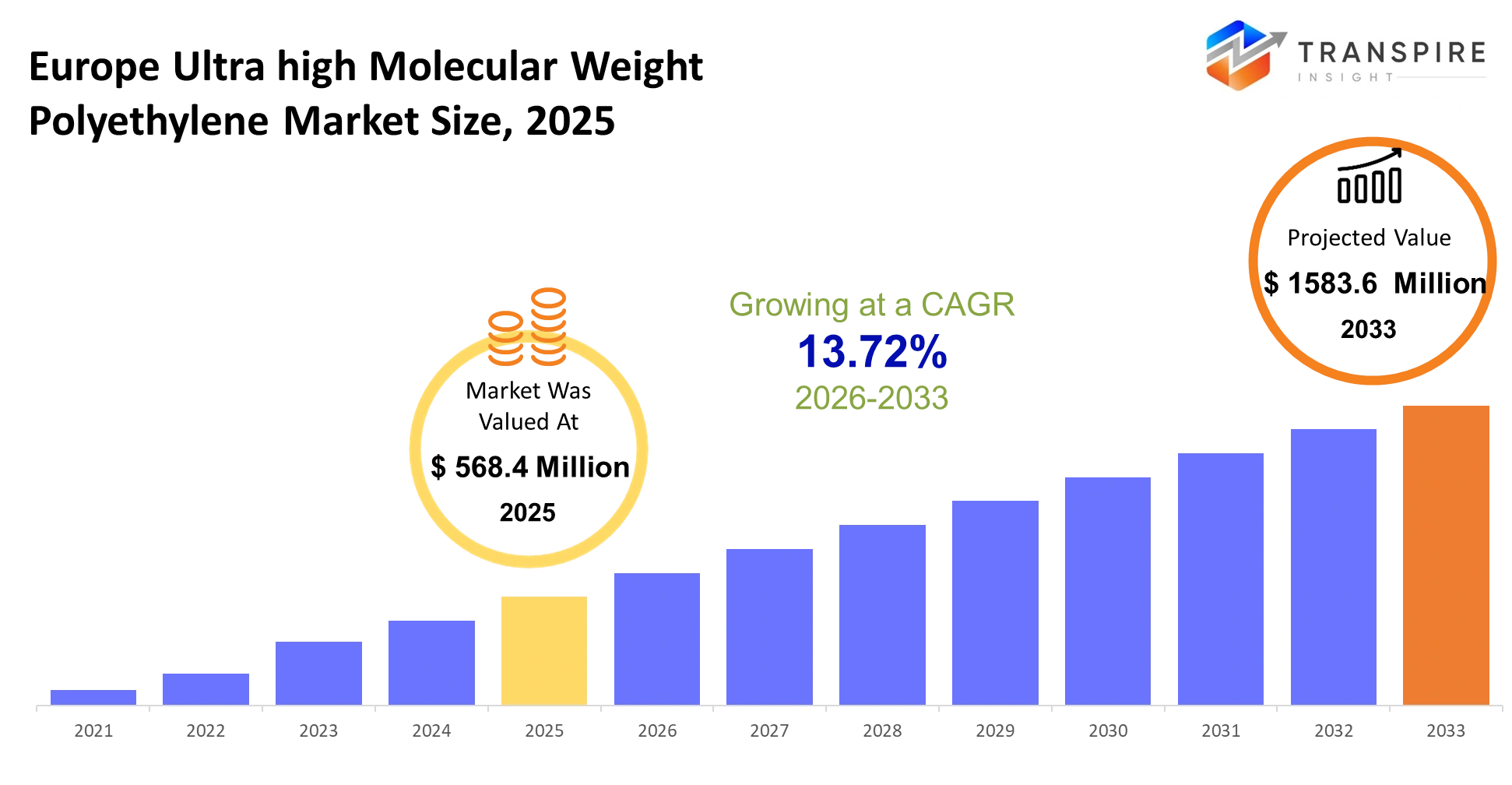
- Europe Ultra high Molecular Weight Polyethylene Market Size 2025: USD 568.4 Million
- Europe Ultra high Molecular Weight Polyethylene Market Size 2033: USD 1583.6 Million
- Europe Ultra high Molecular Weight Polyethylene Market CAGR: 13.72%
- Europe Ultra high Molecular Weight Polyethylene Market Segments: By Type (Sheets, Rods, Fibers, Films, Others); By Application (Medical Implants, Industrial Components, Defense, Automotive, Filtration, Others); By End-User (Healthcare Sector, Industrial Firms, Defense Sector, Automotive Industry, Chemical Industry, Others); By Form (Powder, Granules, Others)
To learn more about this report,  Download Free Sample Report
Europe Ultra high Molecular Weight Polyethylene Market Summary
The Europe Ultra high Molecular Weight Polyethylene Market was valued at USD 568.4 Million in 2025. It is forecast to reach USD 1583.6 Million by 2033. That is a CAGR of 13.72% over the period.
Europe employs ultra-high molecular weight polyethylene (UHMWPE) because it outperforms standard materials which cannot withstand friction and wear and corrosive conditions. The material serves as a lining for chutes and fenders and conveyor systems in ports and shipyards and bulk handling facilities to enable cargo operations while minimizing maintenance requirements and energy consumption.
The market has changed during the last three years because customers now prefer engineered grades that meet their specific needs and prebuilt components instead of choosing standard commodity sheets. This shift corresponds to the introduction of automated systems in ports together with new demands for higher operational standards in industrial facilities. The European Union introduced its environmental and safety rules which created new requirements that forced operators to substitute traditional lubricated metal systems with self-lubricating polymers that offer extended service life and decreased maintenance needs.
The expansion of UHMWPE applications into both retrofitting projects and new construction stems from operators who prioritize operational availability and total lifecycle expenses above initial equipment costs. The company experiences direct benefits from this shift because it results in more valuable contracts and better supplier relationships and consistent income sources that will last for extended periods.
Key Market Insights
- The Ultra High Molecular Weight Polyethylene Market in Europe is controlled by Western Europe which holds approximately 55% of the market share that will exist in 2025 because of its advanced industrial facilities.
- The Northern European region shows the highest growth rate which will continue until 2030 because of its maritime modernization efforts and its sustainability projects.
- The sheets and rods segment will dominate the market in 2025 because it accounts for more than 48% of the market share which is used to create liners and wear strips and conveyor components.
- The second-largest market segment consists of fibers which are becoming increasingly popular for use in high-strength products that include ropes and protective equipment.
- The engineered components segment will experience the fastest market growth during the period from 2024 to 2030 because industrial clients need customized pre-machined solutions.
- The bulk material handling industry controls approximately 35% of the market because UHMWPE material helps reduce friction and material buildup problems that occur in conveyors and chutes.
- The demand for marine fender systems and dock components currently shows the highest growth rate because of port automation and the need to comply with new environmental regulations.
- The European Ultra High Molecular Weight Polyethylene Market gets driven by industrial manufacturing which holds more than 42% market share because of the rising need for components that resist wear.
- The ports and maritime logistics sector experiences the fastest growth among end-user segments because of ongoing infrastructure projects and investments that aim to improve efficiency.
- The performance of products becomes better through technological advancements which develop new methods for polymer processing and machining.
What are the Key Drivers, Restraints, and Opportunities in the Europe Ultra high Molecular Weight Polyethylene Market?
The Europe Ultra High Molecular Weight Polyethylene Market experiences growth because European Union industrial safety regulations and environmental regulations have become more strict by enforcing regulations that control contamination and noise and maintenance emissions from ports and processing facilities. The regulatory requirements now mandate operators to use self-lubricating UHMWPE solutions instead of traditional lubricated steel and rubber components. The stricter compliance frameworks which came into effect between 2020 and 2023 enabled organizations to conduct their operations without proper standards, which led to increased penalties for operational inefficiencies and environmental leakage. Companies now use materials which help them decrease operational downtimes while maintaining their equipment without using outside lubricants. The shift boosts engineered UHMWPE component adoption while driving revenue growth through more valuable customized installations.
The primary structural barrier to overcome exists because UHMWPE machining and installation work require both expensive initial expenses and specialized technical skills. The need for specialized fabrication methods and precise engineering of UHMWPE materials prevents European companies from obtaining adequate suppliers of this material. The current situation will remain unchanged until organizations acquire more skilled employees and appropriate machinery and complete their certification processes for industrial and maritime applications. The smaller business operators see their equipment upgrades postponed, which creates a situation that decreases their immediate revenue stream while keeping them from entering markets that focus on low-cost products.
Northern and Eastern Europe present businesses with a major chance to develop their automated port infrastructure through port development initiatives. Smart ports that implement AI-driven cargo handling systems require investments in low-friction materials and wear-resistant materials which enable their operations to run continuously.The performance requirements for the project specifications have been met through the use of UHMWPE components which function as conveyor liners and fender systems. The suppliers who provide pre-engineered system-integrated UHMWPE solutions will achieve long-term contracts and market expansion because governments and private operators are investing in port digitization until 2030.
What Has the Impact of Artificial Intelligence Been on the Europe Ultra high Molecular Weight Polyethylene Market?
The implementation of artificial intelligence together with advanced digital technologies is starting to transform the design and operation as well as the upkeep of UHMWPE components in European industrial sites and maritime operations. AI-based control systems manage automated port operations by controlling conveyor speeds and cargo movement while monitoring liner wear conditions, which results in reduced friction losses and blockage prevention inside UHMWPE-lined chutes. The digital compliance platforms used by fleet operators and terminal managers enable them to track equipment performance while verifying their compliance with EU safety regulations and environmental protection standards.
Machine learning models enable the prediction of future events through the examination of vibration data and load pattern information and temperature measurements from UHMWPE components. The systems predict wear rates, which enable them to plan maintenance activities that will take place before equipment failure, thus helping to extend equipment lifespan and decrease operational downtime by substantial amounts. The bulk handling and port logistics operators experience two benefits because their unplanned downtime and maintenance expenses decrease while their process efficiency and energy consumption become more stable.
The process of adoption encounters a fundamental restriction. The majority of facilities need to develop their sensor networks and operational data collection systems before they can create trustworthy training models. The costs of integrating systems remain high because legacy systems require special handling, and their performance declines when data signals become unstable in maritime operations.
Key Market Trends
- The environmental compliance regulations established by the European Union since 2021 have compelled operators to substitute lubricated steel components with self-lubricating UHMWPE materials, which results in decreased contamination hazards and extended equipment operational periods.
- Northern European port operators have adopted automated cargo systems, which increasing their need for UHMWPE liners to achieve operational efficiency while decreasing equipment deterioration.
- The manufacturing process has shifted from producing standard sheets to creating pre-machined components of UHMWPE which manufacturers use for specific applications, which leads to higher contract values and stronger supplier partnerships since 2022.
- Buyers who experienced supply chain disruptions from 2020 to 2022 had to develop new sourcing methods which resulted in faster business relationships with UHMWPE fabricators located throughout Eastern Europe.
- Since 2023, Celanese and LyondellBasell have developed new high-performance polymer products to serve niche industrial markets which require better wear protection and impact resistance capabilities.
- Buyers increasingly evaluate UHMWPE based on lifecycle cost rather than upfront pricing, shifting procurement behavior toward long-term durability and reduced downtime.
- The integration of IoT sensors into bulk handling systems enables operators to track UHMWPE component wear in real time, which enhances predictive maintenance processes and increases operational efficiency since 2022.
- Marine infrastructure projects have transitioned toward UHMWPE-based fender systems, which provide greater service life and lower ownership costs compared to traditional rubber systems.
- The high costs of fabrication and installation for smaller industrial operators create a progress delay, which results in an increasing market gap between large-scale operators and mid-tier companies.
Europe Ultra high Molecular Weight Polyethylene Market Segmentation
By Type:
The sheet and rod materials bring about the highest market share because their use extends to liners and wear strips and machined parts. The bulk handling and processing industries show strong demand because their operations require low friction and abrasion resistance to maintain equipment uptime. The high-value segment of the market follows fibers because they can be used in ropes and ballistic protection and high-strength industrial applications. Thinner formats of films and other materials stay limited to niche markets because they lack the structural strength which thicker formats possess.
European ports and factories experience growth in sheets and rods because they increasingly adopt pre-engineered components and retrofitting solutions for existing systems. The defense industry and offshore applications drive fiber expansion because these sectors require materials that maintain strength while reducing weight. Throughout the forecast period product developers will create customized geometries while developing improved product formulations; investors will select suppliers who possess machining and fabrication skills.
By Application:
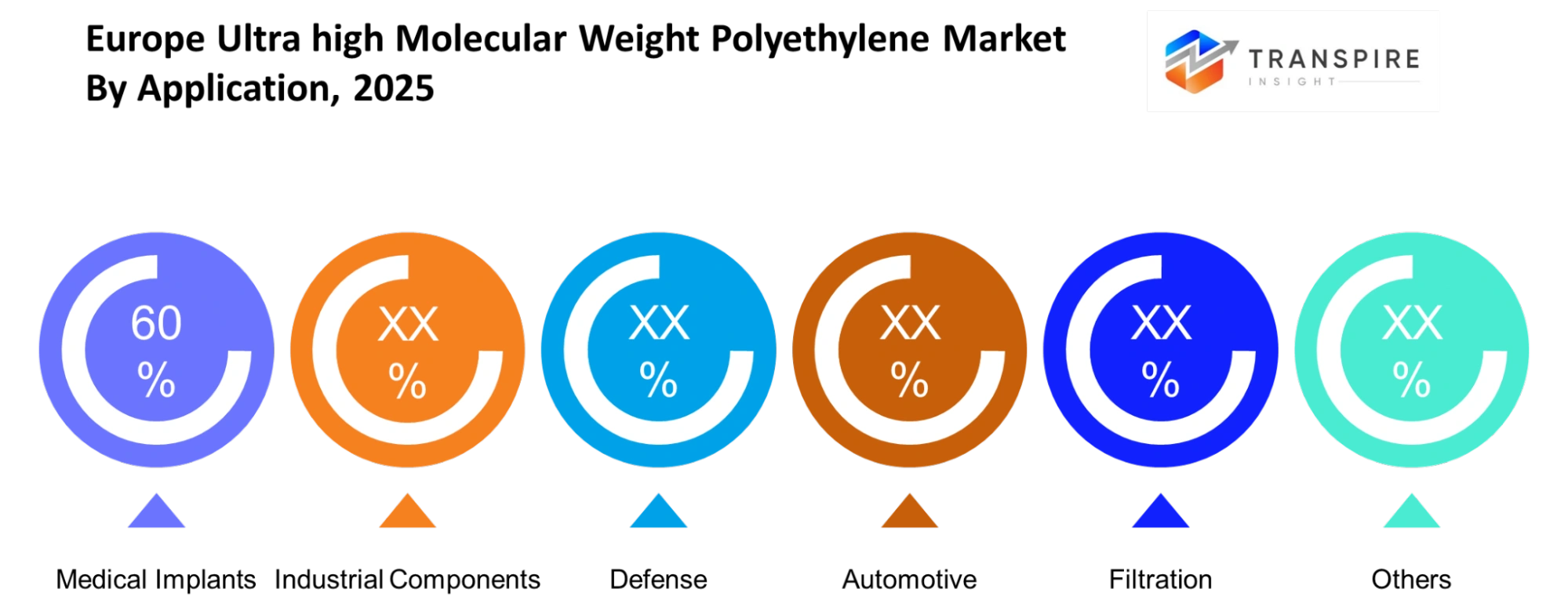
Industrial components dominate application share, supported by widespread use in conveyor systems, marine fenders, and mechanical parts exposed to wear. Medical implants represent a specialized but high-margin segment due to strict regulatory standards and demand for biocompatibility. Defense and automotive applications follow, with usage in protective gear and lightweight components. Filtration and other uses remain smaller but stable.
The industrial sector experiences growth because of automated systems which enable businesses to achieve ongoing production despite their operational demands. The medical field is expanding because of three factors which include rising elderly populations and the need for orthopedic surgeries and the development of long-lasting implant materials. Manufacturers will need to enhance their quality control and regulatory compliance systems because future requirements will demand precision-grade materials and certified supply chains.
To learn more about this report, Download Free Sample Report
By End-User:
Industrial firms lead consumption, contributing the largest share due to continuous demand from manufacturing, mining, and logistics operations. The defense and healthcare sectors share an aggregate market presence which generates substantial revenue because of their unique operational needs. The automotive and chemical industries mostly implement their technology to support particular requirements. Other sectors contribute marginally.
Industrial firms drive growth through modernization of facilities and focus on lifecycle cost reduction. The healthcare sector experiences increasing demand because of rising surgical procedures while defense funding enables the military to acquire new materials. The suppliers will develop their products to meet industry requirements as they develop specific solutions which create distinct benefits for different groups of end users.
By Form:
Granules control market share because they are easy to process and match standard molding and extrusion methods. The powder form controls a minor market share yet it plays essential functions in both compression molding and high-performance applications that need consistent material density. Other forms remain limited in use.
The industry needs more granules because industrial applications require both scalable production capacity and material quality control. The powder form maintains its importance in situations where accurate results and high-performance capabilities take priority over complex processing requirements. The upcoming market trends will result in higher funding for new processing technologies which will help manufacturers improve their material properties while developing new product applications.
What are the Key Use Cases Driving the Europe Ultra high Molecular Weight Polyethylene Market?
The Europe Ultra High Molecular Weight Polyethylene Market shows its primary application in bulk material handling which services operations at mining sites and cement production facilities and grain handling terminals. The operators use UHMWPE to cover their chutes and hoppers and conveyor systems which results in reduced material buildup and friction reduction and unplanned downtime elimination. This application generates the most demand because it directly improves throughput and lowers maintenance costs in high-volume industrial environments.
The adoption of this technology is now spreading into both marine infrastructure and industrial processing facilities. Port authorities use UHMWPE in fender facings and dock systems to handle repeated vessel impact with minimal wear. Food and beverage processors are also integrating UHMWPE components into conveyor lines to meet strict hygiene and low-contamination requirements.
New applications for the technology are emerging in offshore wind logistics and automated port operations. The testing of UHMWPE is currently taking place in three applications which include cable handling and crane pads and robotic cargo interfaces because its durability and low friction properties enable accurate and ongoing operations.
|
Report Metrics |
Details |
|
Market size value in 2025 |
USD 568.4 Million |
|
Market size value in 2026 |
USD 643.7 Million |
|
Revenue forecast in 2033 |
USD 1583.6 Million |
|
Growth rate |
CAGR of 13.72% from 2026 to 2033 |
|
Base year |
2025 |
|
Historical data |
2021 - 2024 |
|
Forecast period |
2026 - 2033 |
|
Report coverage |
Revenue forecast, competitive landscape, growth factors, and trends |
|
Regional scope |
Europe (Germany, United Kingdom, France, Italy, Spain, Rest of Europe) |
|
Key company profiled |
Celanese, DSM, Mitsui Chemicals, Asahi Kasei, Braskem, Teijin, LyondellBasell, Sabic, Honeywell, Dow, Evonik, Röchling, Garland Manufacturing, TSE Industries, Quadrant Engineering |
|
Customization scope |
Free report customization (country, regional & segment scope). Avail customized purchase options to meet your exact research needs. |
|
Report Segmentation |
By Type (Sheets, Rods, Fibers, Films, Others); By Application (Medical Implants, Industrial Components, Defense, Automotive, Filtration, Others); By End-User (Healthcare Sector, Industrial Firms, Defense Sector, Automotive Industry, Chemical Industry, Others); By Form (Powder, Granules, Others) |
Which Regions are Driving the Europe Ultra high Molecular Weight Polyethylene Market Growth?
The market exists for Western Europe because Germany and the Netherlands and France maintain both strict regulatory enforcement and their extensive industrial infrastructure. The European Union mandates for workplace safety together with environmental protection regulations have led to ports and processing facilities replacing conventional materials with UHMWPE. The major ports of Rotterdam and Antwerp create market demand through their use of automated systems and their ongoing movement of cargo. The established supplier network maintains its leadership position because it provides high-quality custom solutions through its advanced production capabilities.
Northern Europe follows with a different growth profile shaped by stability and long-term investment planning. Sweden and Denmark and Norway continue to invest in maritime infrastructure and industrial efficiency improvements. Public policy and private sector investment show strong alignment which enables steady advanced materials adoption without sudden demand changes. The region generates dependable revenue streams because organizations practice disciplined procurement and they adopt performance-based materials at an early stage.
The fastest growth in Eastern Europe results from rapid industrial development which connects to European supply chains. The recent investments in Poland and Baltic states, which aimed at developing logistics corridors and modernizing ports, have created a new market for materials that offer durability and require minimal maintenance. The government has established financial incentives that help businesses update their old infrastructure systems. The current momentum creates pathways for new businesses to establish local partnerships while they pursue the market demand which will emerge until 2033.
Who are the Key Players in the Europe Ultra high Molecular Weight Polyethylene Market and How Do They Compete?
The European UHMWPE market shows a partially unified market structure because major polymer manufacturers maintain control of raw material resources while local manufacturing companies compete through their technical capabilities and customer support. The existing companies maintain their market position through established agreements that last multiple years and their technical connections with industrial customers who operate in port and bulk handling environments. Companies now compete through performance metrics and their ability to customize products and deliver economical solutions throughout the entire product lifespan instead of competing on price. New companies need to overcome two obstacles because they must obtain certifications and develop specialized machining capabilities which prevents them from entering the market quickly.
Celanese establishes its market position through technology-based product differentiation which provides medical and industrial markets high-purity and wear-optimized UHMWPE grades. The strong research and development investment together with their polymer chemistry expertise enables Celanese to secure contracts when performance reliability and regulatory standards become essential for customers. LyondellBasell uses its operational size and feedstock combination capabilities to sustain competitive pricing while developing specialized polymer products for demanding applications. The company establishes European processor partnerships which boost product distribution and provide access to vital industrial centers.
Braskem focuses on bio-based polyethylene solutions which enable the company to operate in markets that use carbon footprint reductions as a criterion for making buying decisions. Mitsubishi Chemical Group develops its market identity through superior material science innovations and its development of UHMWPE products that meet military and industrial standards. The companies in this study pursue business growth through their development of regional collaboration agreements which include plans for establishing local manufacturing facilities that will help them meet European industrial requirements.
Company List
- Celanese
- DSM
- Mitsui Chemicals
- Asahi Kasei
- Braskem
- Teijin
- LyondellBasell
- Sabic
- Honeywell
- Dow
- Evonik
- Röchling
- Garland Manufacturing
- TSE Industries
- Quadrant Engineering
Recent Development News
In April 2026, Dow Inc. reported quarterly earnings reflecting ongoing restructuring and portfolio adjustments across its polyethylene and specialty materials segment, including Europe-facing operations, amid weak pricing and volume pressures.https://chemxplore.com
In April 2026, Mitsui Chemicals, alongside Idemitsu Kosan and Sumitomo Chemical, advanced their previously announced integration of polyolefin businesses (including polyethylene-related assets) under Prime Polymer following regulatory clearance, strengthening their global and European market positioning.https://chemxplore.com
What Strategic Insights Define the Future of the Europe Ultra high Molecular Weight Polyethylene Market?
The Europe Ultra High Molecular Weight Polyethylene Market is moving toward a performance-driven, engineered solutions model over the next five to seven years, led by automation in ports and industrial systems. The demand for pre-fabricated application-specific components which connect to smart infrastructure will replace the need for basic material supply. The logistics and processing sectors require this transformation because they must maximize equipment uptime while decreasing maintenance intervals and achieving new regulatory requirements.
The production of UHMWPE faces a hidden threat because the raw materials needed for production depend on a small number of major polymer manufacturers who supply feedstock materials. Any disruption in ethylene supply or pricing could compress margins and delay project timelines.
Offshore wind logistics has created an emerging business opportunity which specialized UHMWPE components can use to provide heavy-load handling and corrosion protection functions. Market participants should invest in advanced fabrication and system-integration capabilities to secure long-term, high-value contracts in these evolving industrial ecosystems.
Europe Ultra high Molecular Weight Polyethylene Market Report Segmentation
By Type
- Sheets
- Rods
- Fibers
- Films
- Others
By Application
- Medical Implants
- Industrial Components
- Defense
- Automotive
- Filtration
- Others
By End-User
- Healthcare Sector
- Industrial Firms
- Defense Sector
- Automotive Industry
- Chemical Industry
- Others
By Form
- Powder
- Granules
- Others
Frequently Asked Questions
Find quick answers to common questions.
The Europe Ultra high Molecular Weight Polyethylene Market size is USD 1583.6 Million in 2033.
Key segments for the Europe Ultra high Molecular Weight Polyethylene Market are By Type (Sheets, Rods, Fibers, Films, Others); By Application (Medical Implants, Industrial Components, Defense, Automotive, Filtration, Others); By End-User (Healthcare Sector, Industrial Firms, Defense Sector, Automotive Industry, Chemical Industry, Others); By Form (Powder, Granules, Others).
Major Europe Ultra high Molecular Weight Polyethylene Market players are Celanese, DSM, Mitsui Chemicals, Asahi Kasei, Braskem, Teijin, LyondellBasell, Sabic, Honeywell, Dow, Evonik, Röchling, Garland Manufacturing, TSE Industries, Quadrant Engineering.
The Europe Ultra high Molecular Weight Polyethylene Market size is USD 568.4 Million in 2025.
The Europe Ultra high Molecular Weight Polyethylene Market CAGR is 13.72% from 2026 to 2033.
- Celanese
- DSM
- Mitsui Chemicals
- Asahi Kasei
- Braskem
- Teijin
- LyondellBasell
- Sabic
- Honeywell
- Dow
- Evonik
- Röchling
- Garland Manufacturing
- TSE Industries
- Quadrant Engineering
Recently Published Reports
-
Apr 2026
Healthcare Polymer Packaging Market
Healthcare Polymer Packaging Market Size, Share & Analysis Report By Packaging Type (Syringes, IV Bottles and Pouches, Clamshells, Blisters, Bottles & Jars, Containers, Tubes, IV Parental Packaging, Others), By Type (Regulated, Non-regulated), By Polymer Type (LDPE (Low-Density Polyethylene), HDPE (High-Density Polyethylene), Homo-polymer (Homo), Random Copolymer (Random), Block Copolymer (Block), PET, Polystyrene, Polyvinyl Chloride, Polyamide/EVOH, Others), and Geography (North America, Europe, Asia-Pacific, Middle East and Africa, South and Central America), 2021 - 2031
-
Apr 2026
Hydrophilic Tape (Waterstop) Market
Hydrophilic Tape (Waterstop) Market Size, Share & Analysis Report By Type (Bentonite-Based Hydrophilic Tape, Rubber-Based Hydrophilic Tape), By Application (Residential Buildings, Commercial Buildings, Infrastructure Projects), and Geography (North America, Europe, Asia-Pacific, Middle East and Africa, South and Central America), 2021 - 2031
-
Apr 2026
Metalens Market
Metalens Market Size, Share & Analysis Report By Type (Visible Light Metalens, and Infrared Metalens), By Application (Consumer Electronics, Automotive Electronics, Industrial, Medical, and Others), and Geography (North America, Europe, Asia-Pacific, Middle East and Africa, South and Central America), 2021 - 2031
-
Apr 2026
PBT Resin Market
PBT Resin Market Size, Share & Analysis Report By Type (Reinforced PBT Resin, Unreinforced PBT Resin), By Processing Method (Injection Molding, Extrusion, Blow Molding, Others), By End-User (Automotive, Electrical & Electronics, Consumer Appliances, Industrial Machinery, Medical Devices, Packaging, Others), and Geography (North America, Europe, Asia-Pacific, Middle East and Africa, South and Central America), 2021 - 2031