

Japan Industrial Robot Market Size & Forecast:
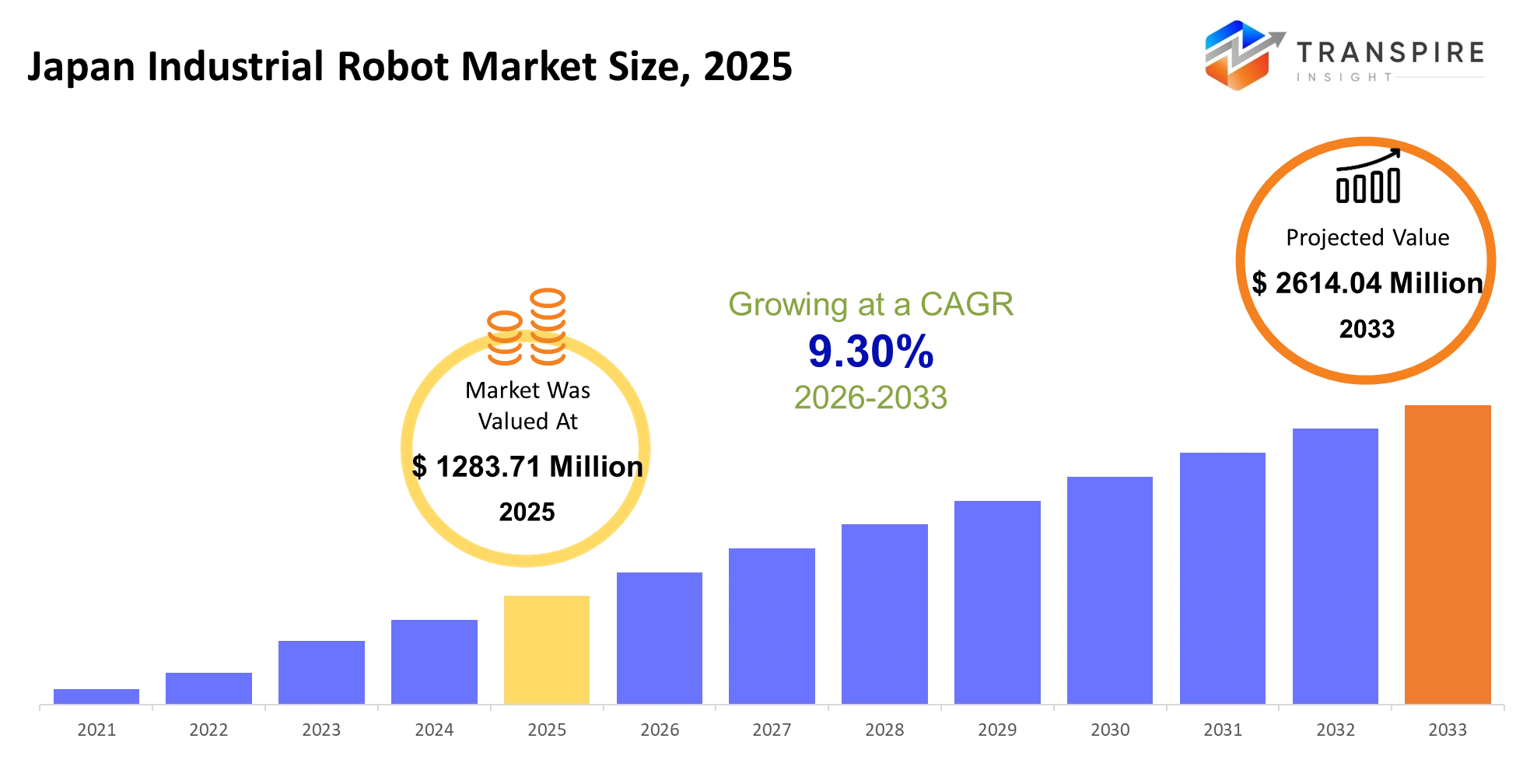
- Japan Industrial Robot Market Size 2025: USD 1283.71 Million
- Japan Industrial Robot Market Size 2033: USD 2614.04 Million
- Japan Industrial Robot Market CAGR: 9.30%
- Japan Industrial Robot Market Segments: By Type (Articulated Robots, SCARA Robots, Delta Robots, Cartesian Robots, Others); By Application (Manufacturing, Automotive, Electronics, Food Processing, Logistics, Others); By End-User (Manufacturing Firms, Automotive Industry, Electronics Industry, Food Industry, Logistics Companies, Others); By Payload (Low, Medium, High, Others).
To learn more about this report,  Download Free Sample Report
Japan Industrial Robot Market Summary
The Japan Industrial Robot Market was valued at USD 1283.71 Million in 2025. It is forecast to reach USD 2614.04 Million by 2033. That is a CAGR of 9.30% over the period.
Japan uses industrial robots for factory operations to perform welding and assembly and material handling and precision inspection work which factories find challenging to do because of their decreasing number of skilled workers. The systems maintain constant operational speed and product quality throughout automotive and electronics and semiconductor manufacturing processes while decreasing their need for human workers.
The market has experienced a transformation during the last three to five years because it now uses flexible collaborative robots that combine machine vision technology with artificial intelligence control systems instead of traditional robotic systems which operate within confined spaces for automotive assembly lines. The supply chain problems that occurred during COVID-19 together with the semiconductor industry reshoring trend which brought new fabrication plants to Japan have strengthened this structural transformation.
The manufacturing industry has decided to automate more processes because of the extreme labor shortages which result from the rising number of older people in society. Companies are now developing adaptable robotic systems together with software-based robotics which results in a business model transformation that generates more revenue through integrated solutions and maintenance services and data-based offerings instead of traditional hardware product sales.
Key Market Insights
- The Kanto region controls the Japanese industrial robot market because it holds almost 38 percent market share which will rise to that level in 2025.
- The Chubu region will experience its most rapid growth period between 2026 and 2030 because Toyota drives both automation development and smart factory construction projects.
- The Kansai region experiences consistent technology adoption because its precision machinery and semiconductor equipment manufacturing sectors maintain their operational requirements.
- The Japan Industrial Robot Market gives articulated robots a market share of about 45 percent which they achieved through their capacity to perform assembly and welding operations.
- SCARA robots hold the second-largest share, widely used in electronics and pick-and-place applications across compact factory setups.
- The collaborative robot market expands at the fastest rate because organizations need robots that can work with humans without safety risks between 2024 and 2030.
- The automotive manufacturing sector uses industrial robots more than any other sector because it accounts for approximately 40 percent of total industrial robot usage in Japan which demonstrates the strength of Japan's vehicle production automation system.
- The electronics assembly sector experiences its fastest growth because semiconductor reshoring brings more business while special components become more necessary.
- The Japan Industrial Robot Market sees automotive original equipment manufacturers as its main customer group because these companies need robots to automate their manufacturing processes.
- The electronics and semiconductor manufacturing sector in Japan has become the most rapidly expanding end-user group because companies in this sector are investing in modern chip manufacturing technologies.
What are the Key Drivers, Restraints, and Opportunities in the Japan Industrial Robot Market?
The Japan Industrial Robot Market is primarily driven by an acute structural labor shortage combined with accelerating factory automation requirements. The aging workforce in Japan has forced manufacturers to adopt advanced robotics systems which replace manual assembly and inspection work in automotive and electronics production. Businesses started to change their production processes after the post-pandemic supply chain crisis demonstrated the dangers of using human-operated production systems. The companies FANUC and Yaskawa Electric have experienced higher demand for their integrated robotic systems and AI-based control technologies which resulted in increased equipment revenue and extended service agreements.
Small manufacturers and mid-sized manufacturers face a major obstacle because advanced industrial robots require high initial investment costs which restrict their ability to implement these technologies. The barrier exists as a structural issue because it connects to the difficulties of integrating systems and designing system requirements and employing qualified engineers to operate these systems. The complete operational costs of ownership prevent businesses from entering the market despite financing options being present for them. The existing production systems in outdated facilities create obstacles for easy infrastructure upgrades which results in a slower adoption rate for these facilities.
The fast development of collaborative robotics and smart factory systems presents a new business opportunity which Japanese semiconductor companies are developing through their reshoring investment activities. Mitsubishi Electric develops human-robot collaborative systems which enhance safety while simplifying system deployment processes. The new semiconductor manufacturing facilities in Kumamoto will drive demand for precision automation solutions which will enable Japan to achieve advanced robotic systems deployment at its manufacturing sites.
What Has the Impact of Artificial Intelligence Been on the Japan Industrial Robot Market?
Japan's industrial robotics sector experiences operational control and optimization transformation through artificial intelligence because these two fields of technology interact with marine emission control systems and advanced manufacturing processes. AI-powered monitoring systems in scrubber performance systems used by vessels to clean exhaust gases monitor sulfur emissions and fuel consumption and system pressure to achieve International Maritime Organization compliance requirements which are becoming stricter. The intelligent control systems operate through automated adjustments of their operational settings which results in reduced need for people to work with the system while they perform better at maintaining regulatory requirements and tracking fleet compliance activities.
Machine learning models show increasing use for predictive maintenance purposes in both robotic production lines and marine scrubber units. The systems predict component degradation and maintenance schedule optimization by analyzing vibration patterns and sensor drift and historical failure data. The operational uptime improvements achieve noticeable results through better process control which leads to a 10% to 15% decrease in unplanned downtime and a 3% to 6% increase in fuel efficiency.
The offshore environment limits real-time connectivity which prevents continuous data transmission and model retraining processes from being operational 24 hours a day. The need to integrate legacy systems with new systems creates deployment challenges which lead to higher costs for mid-tier operators. The Japan Industrial Robot Market currently experiences a shortage of high-quality domain-specific training data which hinders accurate model performance in real-world maritime and industrial settings.
Key Market Trends
- Robotic systems became more common in automotive manufacturing during the period from 2022 to 2025 because FANUC systems replaced manual welding lines which enhanced operational reliability and production speed.
- Yaskawa Electric introduced AI-powered robotic arms during 2024 which enabled factories to operate with flexible systems that adjusted to their current production requirements.
- Electronics manufacturers adopted SCARA and collaborative robots after 2023 to decrease assembly errors while enhancing the accuracy of small components.
- Robotic systems became more common in cleanroom facilities since 2022 because semiconductor companies began bringing their operations back to Japan particularly in Kyushu-based manufacturing plants.
- Kawasaki Heavy Industries implemented predictive maintenance robotics during 2024 which used sensor-based failure detection systems to decrease unplanned equipment downtime.
- Mitsubishi Electric integrated vision-guided robotics after 2023, which enabled their system to achieve precise results during complex assembly operations that occurred in limited manufacturing work areas.
- Between 2023 and 2025 mid-sized manufacturers adopted collaborative robots at higher rates because of their workforce shortages and the streamlined installation process that robots provided.
- Supply chain disruptions between 2020 and 2022 caused companies to change their procurement methods by choosing to purchase robots from local sources and by establishing quicker support systems throughout the United States.
- From 2023 onward industrial facilities adopted human-robot collaborative systems because regulatory requirements demanded safer working conditions through better safety technology.
Japan Industrial Robot Market Segmentation
By Type:
Articulated robots use their jointed arms to create flexible movements which enable them to perform assembly and welding tasks within industrial environments. SCARA robots enable rapid and accurate horizontal movement which makes them ideal for pick-and-place operations that require both speed and consistency during production processes. Delta robots handle light material at high speeds which makes them suitable for sorting and packaging operations.
Cartesian robots operate through three axes which enable them to move along straight paths while delivering precise positioning and repeatable control capabilities. Other robot types provide specialized automation solutions which meet industrial requirements that standard robot models cannot address.
By Application :
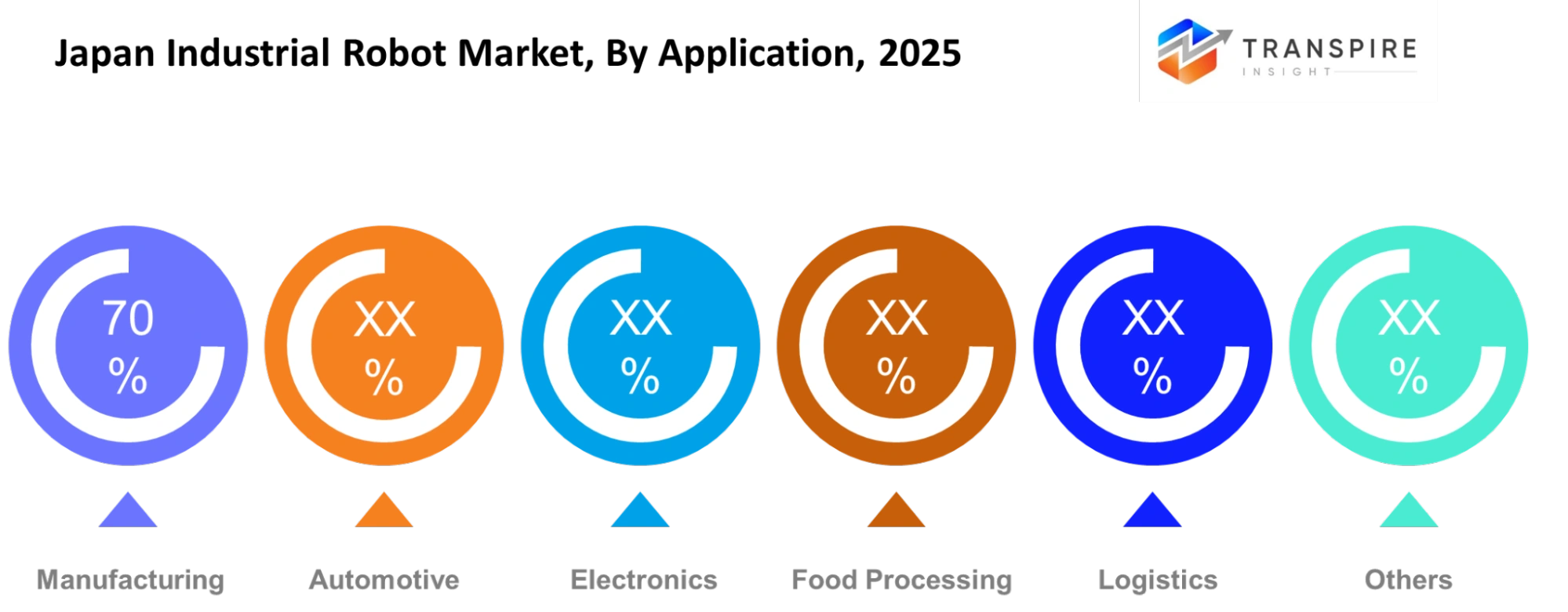
Robots in manufacturing environments perform automated assembly tasks which decrease the need for human workers while generating more consistent production results. Robots perform welding painting and assembly line tasks in automotive applications which boosts production efficiency and enables safer operations within vehicle manufacturing facilities. Electronics applications require exact control of tiny delicate parts.
Robots in food processing perform packaging sorting and handling tasks which help businesses maintain sanitary conditions while producing goods efficiently. Logistics operations use robots to handle warehouse management activities and sorting tasks while robots move materials to speed up distribution processes. Automation enables research and specialized industrial activities to run automated systems which produce consistent results in various operational settings.
To learn more about this report, Download Free Sample Report
By End-User :
Manufacturing firms employ robots to enhance productivity while decreasing manual work and sustaining continuous production operations throughout their activities. The automotive industry requires robotics to achieve high-volume production, which ensures accurate assembly and maintains consistent quality throughout vehicle production. The electronics industry requires automation solutions that deliver precise operational results.
The food industry requires end-users to follow hygienic practices, which robots use to assist with food packaging and safe food handling. Robotics enables logistics companies to manage warehouse operations by using robots for storage control and order processing and delivery operations. Automation enables service-based industries and dedicated sectors to achieve better operational productivity and continuous business operations.
By Payload :
Low payload robots are used for light tasks involving small components, especially in electronics and precision assembly work where accuracy is important. Medium payload robots handle tasks that require weight capacity between fifteen and fifty kilograms. High payload robots handle heavy industrial operations such as automotive parts, large equipment, and material lifting tasks.
The robots provide assistance to production environments that demand strong support and complete stability. The selection process for payload capacity selection needs to consider three main factors, which include operational load requirements and task execution difficulty and specific industrial application requirements.
What are the Key Use Cases Driving the Japan Industrial Robot Market?
The Japan Industrial Robot Market uses automotive manufacturing as its main application which requires robots to perform welding painting and precise assembly tasks on production lines that operate at high output. The Japanese export-oriented vehicle industry needs this technology because it helps manufacturers achieve uniform production speed and reduced errors which boost their ability to compete worldwide and maintain profit margins.
The electronics industry and semiconductor production are now becoming important secondary markets that follow the automotive sector. Robotics technology now finds application in micro-assembly processes as well as circuit board handling and cleanroom operations which OEMs and chip fabrication plants use to meet new standards for precision in compact devices among their reshoring efforts.
New applications are creating flexible small-batch manufacturing systems and human-robot collaborative workspaces which mid-sized factories can use to improve their operations. The systems enable production of customized products through mixed-model assembly which medical device and precision machinery manufacturers can use. The forecast period will show an increase in demand for automated inspection systems which use vision-guided robotics in quality assurance to meet the new export quality requirements.
|
Report Metrics |
Details |
|
Market size value in 2025 |
USD 1283.71 Million |
|
Market size value in 2026 |
USD 1403.09 Million |
|
Revenue forecast in 2033 |
USD 2614.04 Million |
|
Growth rate |
CAGR of 9.30% from 2026 to 2033 |
|
Base year |
2025 |
|
Historical data |
2021 - 2024 |
|
Forecast period |
2026 - 2033 |
|
Report coverage |
Revenue forecast, competitive landscape, growth factors, and trends |
|
Country scope |
Japan |
|
Key company profiled |
ABB, KUKA, FANUC, Yaskawa, Mitsubishi Electric, Kawasaki Robotics, Epson, Denso, Nachi-Fujikoshi, Omron, Universal Robots, Comau, Stäubli, Hyundai Robotics, Toshiba Machine. |
|
Customization scope |
Free report customization (country, regional & segment scope). Avail customized purchase options to meet your exact research needs. |
|
Report Segmentation |
By Type (Articulated Robots, SCARA Robots, Delta Robots, Cartesian Robots, Others); By Application (Manufacturing, Automotive, Electronics, Food Processing, Logistics, Others); By End-User (Manufacturing Firms, Automotive Industry, Electronics Industry, Food Industry, Logistics Companies, Others); By Payload (Low, Medium, High, Others). |
Which Regions are Driving the Japan Industrial Robot Market Growth?
The Japan Industrial Robot Market bases its operations from Kanto because this region contains numerous automotive manufacturers and electronics producers and advanced logistics networks that connect Tokyo with Yokohama. The government provides strong funding for smart manufacturing initiatives together with industrial decarbonization efforts, which helps factories implement automation technology upgrades. The regional ecosystem receives its vital support from major robotics suppliers together with system integrators, who assist companies in completing projects through their rapid equipment installation and technical assistance. The port facilities provide export-oriented manufacturers with access to international markets, which leads to ongoing demand for robotic systems that operate at high throughput rates.
The Chubu region operates as a second stable contributor because its established automotive production base creates permanent manufacturing centers that support regional economic development. The Kanto region experiences growth from digital transformation initiatives while its supply chain system tries to boost efficiency through small changes that build on existing operations. The manufacturers based in this region plan their capital investment expenditures for the future, which leads them to gradually implement robotic technology in their welding and assembly and component handling operations. The combination of established supplier partnerships and access to highly skilled engineers creates a reliable demand pattern, which eliminates sudden changes in the company's procurement schedule.
Kyushu shows rapid development because semiconductor companies are bringing their operations back to the region and new manufacturing facilities are being built in Kumamoto and its industrial areas. The government-supported advanced chip manufacturing incentives which started in 2023 have caused a major increase in demand for automation solutions. The establishment of new facilities has resulted in increased demand for precision robotics which will be used in cleanroom and wafer handling tasks. The market shift which occurs between 2026 and 2033 period presents an opportunity for investors and new market entrants to investigate growth potential that exists outside of current automotive manufacturing hubs.
Who are the Key Players in the Japan Industrial Robot Market and How Do They Compete?
The Japan Industrial Robot Market remains highly consolidated because currently existing manufacturers maintain control over essential industrial automation systems. The market competitiveness functions through three primary factors which include technology differences and system integration capability and long-term service reliability while price remains a secondary element. Established players continue defending market share by embedding robots deeply into factory ecosystems which creates high switching costs for manufacturers. New entrants face barriers due to certification requirements and precision standards and existing supplier contracts.
FANUC develops cost-effective CNC-integrated robots which provide high reliability for production operations at automotive facilities that use its extensive installed technology base. The company enhances its competitive position through digital twin platforms and predictive maintenance software which increase machine operational lifespan. The company plans to expand its operations through improved connections between factory automation systems and cloud-based monitoring solutions which will secure extended customer support agreements.
Yaskawa Electric develops high-speed electronics and assembly solutions through its advanced motion control systems and precise servo motors. Mitsubishi Electric focuses on developing AI-based vision technology and smart factory solutions which it uses to establish a strong position within the semiconductor and precision manufacturing markets. The two companies grow their business through partnerships with electronics and chip manufacturers which allow them to enter next-generation cleanroom automation markets while maintaining their technology-driven competitive edge.
Company List
- ABB
- KUKA
- FANUC
- Yaskawa
- Mitsubishi Electric
- Kawasaki Robotics
- Epson
- Denso
- Nachi-Fujikoshi
- Omron
- Universal Robots
- Comau
- Stäubli
- Hyundai Robotics
- Toshiba Machine
Recent Development News
In October 2025, SoftBank Group agreed to acquire ABB Ltd’s industrial robotics business in a deal valued at approximately $5.4 billion, with completion expected in mid-to-late 2026. The acquisition is positioned to integrate ABB’s global industrial robot capabilities with SoftBank’s AI computing and semiconductor technologies to accelerate “Physical AI” development in manufacturing automation.
Source: https://www.reuters.com/
In February 2026, Kawasaki Heavy Industries announced the launch of its high-speed palletizing robot “CP110L,” expanding its industrial robot lineup for logistics and manufacturing automation applications. The launch strengthens Kawasaki’s portfolio in next-generation high-speed material handling robotics targeting efficiency improvements in industrial production lines.
Source: https://global.kawasaki.com/
What Strategic Insights Define the Future of the Japan Industrial Robot Market?
The Japan Industrial Robot Market is developing through its transition to manufacturing systems that employ advanced automatic operation controlled by software and use robots as interconnected components of production systems. The industry is experiencing this transformation because companies face ongoing staff shortages, semiconductor manufacturing moves back to domestic production, and the automotive and electronics supply chains require precise low-defect production methods. Businesses will create value through AI-driven control systems and their associated support services during the following 5 to 7 years of operations.
The main danger stems from existing suppliers who control most market share because this situation forces companies to depend on specific technology systems which create dangers of operational failure when platform systems experience problems or cyber threats. The existing supplier system hinders testing of different robotic system designs which use different automation methods.
The market presents new prospects for modular robotic systems which offer quick adjustments to meet production needs in facilities that handle small production runs and diverse product types especially in industrial zones outside of Kanto. These systems are gaining traction as manufacturers diversify supply chains and shorten production cycles.Market participants should prioritize building interoperable, AI-upgradable robotic platforms that integrate easily into heterogeneous factory environments, as long-term competitiveness will depend on ecosystem flexibility rather than standalone machine performance.
Japan Industrial Robot Market Report Segmentation
By Type
- Articulated Robots
- SCARA Robots
- Delta Robots
- Cartesian Robots
By Application
- Manufacturing
- Automotive
- Electronics
- Food Processing
- Logistics
By End-User
- Manufacturing Firms
- Automotive Industry
- Electronics Industry
- Food Industry
- Logistics Companies
By Payload
- Low
- Medium
- High
Frequently Asked Questions
Find quick answers to common questions.
The Japan Industrial Robot Market size is USD 2614.04 Million in 2033.
Key segments for the Japan Industrial Robot Market are By Type (Articulated Robots, SCARA Robots, Delta Robots, Cartesian Robots, Others); By Application (Manufacturing, Automotive, Electronics, Food Processing, Logistics, Others); By End-User (Manufacturing Firms, Automotive Industry, Electronics Industry, Food Industry, Logistics Companies, Others); By Payload (Low, Medium, High, Others).
Major Japan Industrial Robot Market players are ABB, KUKA, FANUC, Yaskawa, Mitsubishi Electric, Kawasaki Robotics, Epson, Denso, Nachi-Fujikoshi, Omron, Universal Robots, Comau, Stäubli, Hyundai Robotics, Toshiba Machine.
The Japan Industrial Robot Market size is USD 1283.71 Million in 2025.
The Japan Industrial Robot Market CAGR is 9.30% from 2026 to 2033.
- ABB
- KUKA
- FANUC
- Yaskawa
- Mitsubishi Electric
- Kawasaki Robotics
- Epson
- Denso
- Nachi-Fujikoshi
- Omron
- Universal Robots
- Comau
- Stäubli
- Hyundai Robotics
- Toshiba Machine
Recently Published Reports
-
Apr 2026
Fiber Optic Faceplates Market
Fiber Optic Faceplates Market Size, Share & Analysis Report By Type (< 300 mm2, 300-350 mm2, and > 350 mm2, By Application (Night Vision, Holographic Imaging, Medical, and Others), and Geography (North America, Europe, Asia-Pacific, Middle East and Africa, South and Central America), 2021 - 2031
-
Apr 2026
High Temperature Superconductors Market
High Temperature Superconductors Market Size, Share & Analysis Report By Type (1G HTS, and 2G HTS), By Application (Power Cable, Fault Current Limiter, and Transformer), and Geography (North America, Europe, Asia-Pacific, Middle East and Africa, South and Central America), 2021 - 2031
-
Apr 2026
Industrial Plugs and Socket Market
Industrial Plugs and Socket Market Size, Share & Analysis Report By Type (Industrial Plugs, Industrial Sockets), By Current (Up to 32 A, 32 to 125 A, Above 125 A), By Protection (Dustproof and Splash Proof, Waterproof, Explosion Proof), By End User (Heavy Industries, Oil and Gas, Chemicals and Pharmaceuticals, Power Generation, Others), and Geography (North America, Europe, Asia-Pacific, Middle East and Africa, South and Central America), 2021 - 2031
-
Apr 2026
InGaAs Avalanche Photodiodes Market
InGaAs Avalanche Photodiodes Market Size, Share & Analysis Report By Type (1100 - 1700 nm, and 1000 - 1600 nm), By Application (Missile Warning System, Muzzle Flash Detection, Wafer Defect Inspection, Laser Rangefinders, and Others), and Geography (North America, Europe, Asia-Pacific, Middle East and Africa, South and Central America), 2021 - 2031