
Asia Pacific Mobile Cranes Market Size & Forecast:
- Asia Pacific Mobile Cranes Market Size 2025: USD 8.57 Billion
- Asia Pacific Mobile Cranes Market Size 2033: USD 13.97 Billion
- Asia Pacific Mobile Cranes Market CAGR: 6.30%
- Asia Pacific Mobile Cranes Market Segments: By Crane Type (Truck Mounted Cranes, All Terrain Cranes, Rough Terrain Cranes, Crawler Cranes, Pick & Carry Cranes, Floating Cranes, Others); By Capacity (Below 50 Tons, 50–100 Tons, 101–200 Tons, Above 200 Tons, Others); By Application (Construction, Oil & Gas, Mining, Utilities, Infrastructure Projects, Others); By End User (Contractors, Rental Companies, Industrial Operators, Others).
Asia Pacific Mobile Cranes Market Summary
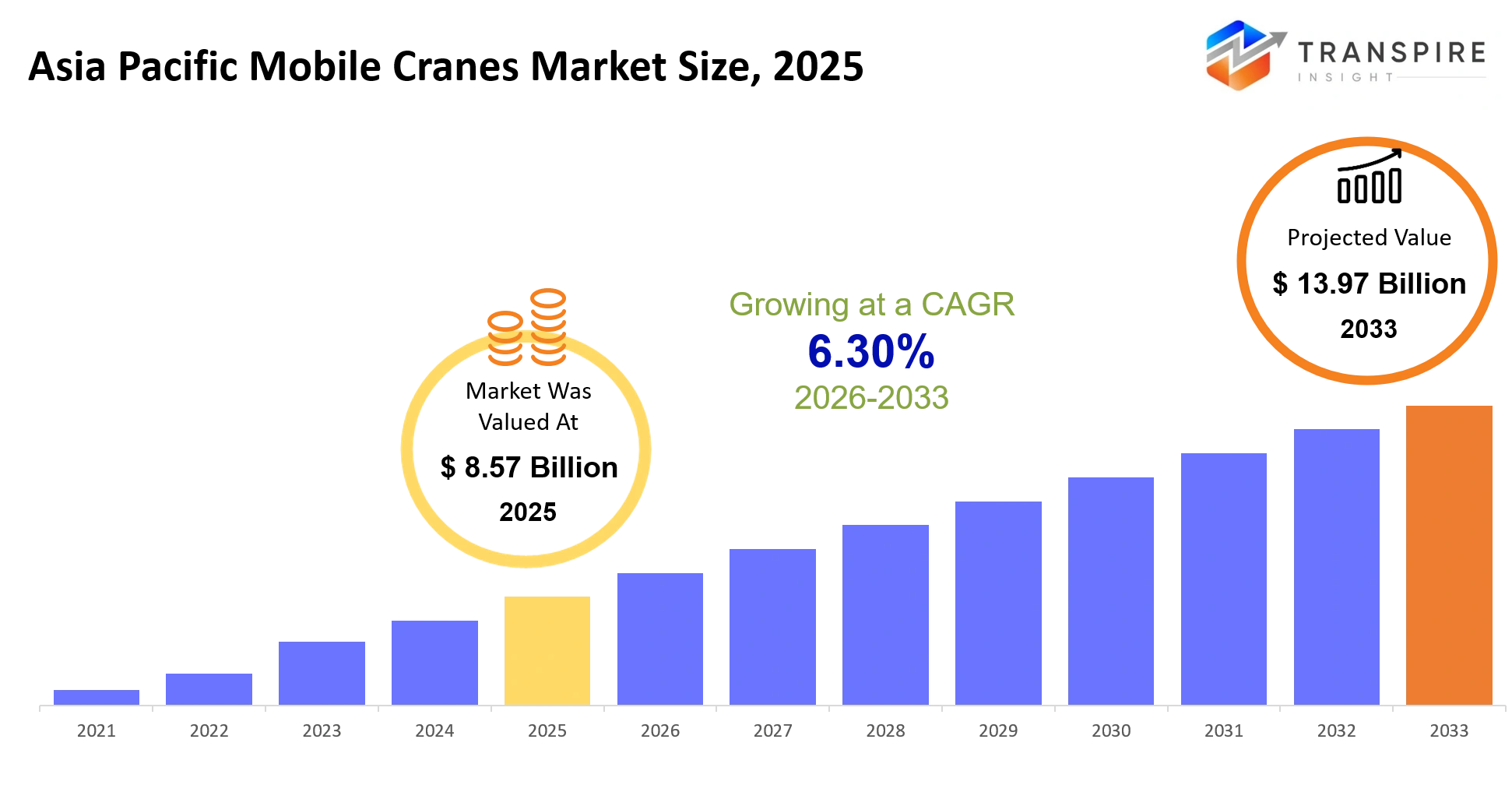
The Asia Pacific Mobile Cranes Market was valued at USD 8.57 Billion in 2025. It is forecast to reach USD 13.97 Billion by 2033. That is a CAGR of 6.30% over the period.
Mobile cranes from the Asia Pacific Mobile Cranes market, are used in vital lifting & material handling operations in construction, ports, energy projects and industrial settings where permanent lifting systems cannot be established. In such scenarios, these cranes can be mobilized easily for installation of large, heavy equipment; erecting structures and in emergency lifting activities where speed is critical & space is a constraint. Mobile cranes enhance the speed of project execution due to their quick deployment & reduced dependence on fixed lifting installations.
In the last 3-5 years, the market has also experienced a structural shift towards the utilization of large capacity telescopic & all terrain cranes coupled with a range of digital load monitoring and telematics capabilities. This transition has been spurred on by the pace of huge infrastructure schemes in both India and SE Asia following increased public expenditure in post pandemic recovery initiatives as well as investments in energy transition projects. This has led to higher demand for improved mobility & lifting accuracy. Manufacturers expect to witness an accelerated demand for smart cranes to assist in achieving enhanced safety, lower equipment downtime and optimized efficiency across multiple projects.
Key Market Insights
- China is the dominating country in Asia Pacific Mobile Cranes Market with a market share of almost 45% in 2025 backed by massive infrastructure and industrial construction projects being carried out.
- India is identified as the fastest growing region in the Asia Pacific Mobile Cranes Market driven by the highway, metro and renewable energy expansion initiatives from 2024-2030.
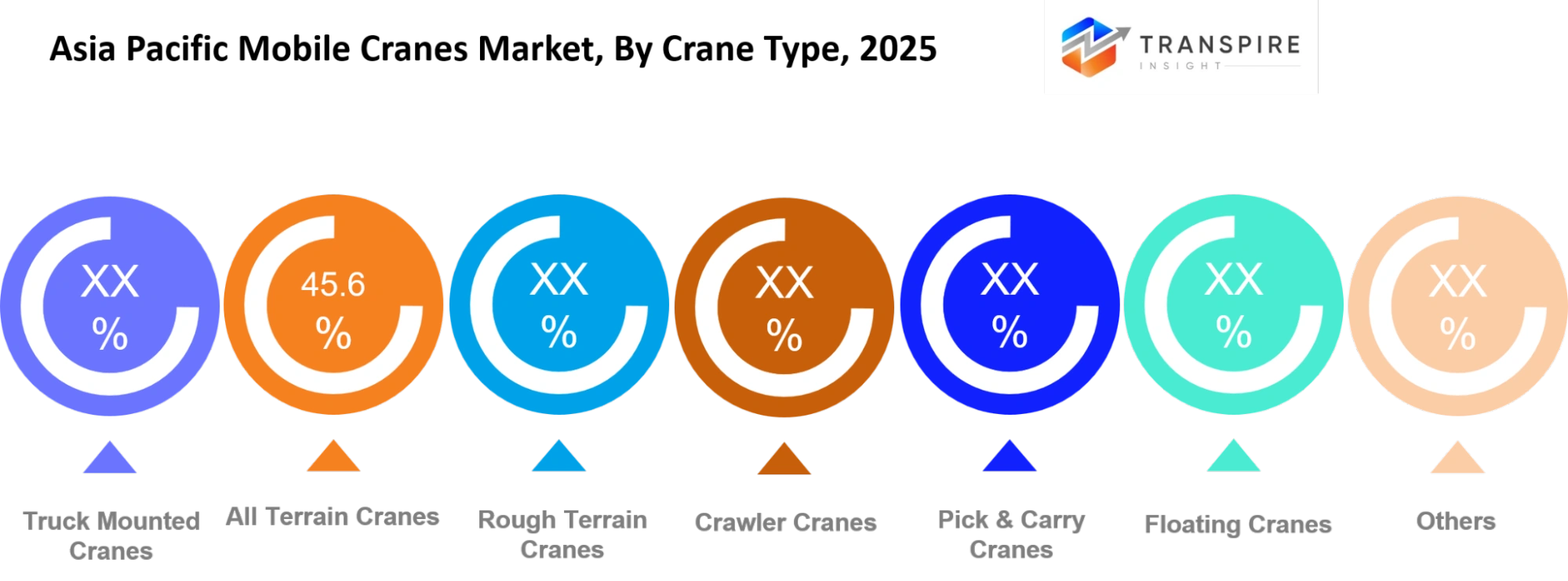
- All terrain cranes accounted for a market share of nearly 38% as it is utilized in diverse work environments with both mixed industrial and urban sectors for lifting tasks.
- Telescopic cranes constitute the second largest product segment for use in short span construction and maintenance projects in highly concentrated and urbanized areas.
- Rough terrain cranes were projected to witness the fastest market growth from 2024-2030 driven by mining activities and infrastructure projects in remote areas.
- Construction is the leading segment by application with an approximate 52% share as the Asia Pacific Mobile Cranes Market continues to remain dependent on cycles of growth in infrastructure and urban development.
- The fastest growing application is the port and logistics segment driven by increasing container handling capacity and upgrades to terminal automation systems.
- Construction companies stand out as the largest segment by end-user with more than 60% share due to continuous investments by both private and public sector on infrastructure development.
- Users in the energy segment display robust growth, especially in wind and renewable installations that necessitate use of heavy-lift mobile cranes.
What are the Key Drivers, Restraints, and Opportunities in the Asia Pacific Mobile Cranes Market?
Increasingly large-scale infrastructure development (highways, metros, ports and renewable energy facilities) is the main market driver in Asia Pacific Mobile Cranes Market. Construction spending driven by government-initiated projects in China, India, and South East Asia has driven up demand for high-capacity machines with quick mobilization and ease of transport between sites, leading to a rise in crane utilization and rental revenues for providers.
A market challenge comes from the high ownership and operating costs of sophisticated mobile cranes, especially in case of all-terrain and higher-capacity models. High technical expertise, regular maintenance and adherence to stringent safety standards add to overall life cycle costs. Smaller contractors usually postpone their purchases or opt for rental, restricting penetration in budget conscious construction sub-sectors.
Renewable energy infrastructure development, particularly in offshore wind (around Taiwan and India) and large-scale solar power installations (across Taiwan, India and Vietnam), represents a major opportunity in the Asia Pacific Mobile Cranes Market. High-capacity and precise lifting and installation services are indispensable in these kinds of projects (turbines, heavy components), ensuring high long-term growth visibility for manufacturers and equipment rentals companies, backed by escalating clean energy targets of several regional governments.
What Has the Impact of Artificial Intelligence Been on the Asia Pacific Mobile Cranes Market?
AI is now a more widespread feature within fleet management systems across the Asia Pacific Mobile Cranes Market-offering real-time load monitoring, autonomous stability control and remote diagnostic systems. These fleet management systems increase safety within operations as all lifting operations are monitored continuously for changing loads and conditions, thereby eliminating a significant portion of human error in difficult construction environments.
The application of machine learning has also been adapted for preventative maintenance among mobile crane fleets, enabling prediction of machine and component failure prior to an actual breakdown by using data based on vibration characteristics, hydraulic systems and engine performance characteristics. This has resulted in increased uptime and decreased reactive maintenance expenses, especially in the large rental fleet industry with cranes operating on numerous infrastructure development sites.
AI-driven telematics have increased fleet productivity and fuel efficiency by streamlining crane scheduling and reducing crane idle time, with an improvement of asset productivity and a more stable safety compliance reported by operators, mainly due to automatic reporting.
However, a critical drawback has been the cost of incorporating AI systems within old machine fleets. The lack of standard sensor technology within old crane fleets complicates fully digital reconstruction making the investment and re-fit of existing machinery more costly. Furthermore, lack of constant connectivity within remote mining or construction sites limits data streaming capabilities in some Asia Pacific sites.
Key Market Trends
- China’s output of automated cranes rose significantly between 2022-2025, with major suppliers like XCMG and Zoomlion exporting more smart cranes across Southeast Asia.
- Infrastructure development accelerated in India for highways and metro, driving demand for higher-capacity all terrain cranes for mult-site projects after 2023.
- Crane utilization via renting services grew by almost 35% since 2023 as owners sought to avoid ownership risks and gain access to fleet resources on demand.
- Demand for Liebherr and Tadano cranes fitted with telematics rose sharply after 2024 for precise load tracking and minimal downtime in Asia.
- Projects focused on port expansion in Singapore and Vietnam led to increased demand for heavy lifting systems since 2023 to facilitate upgrades for container movement.
- Deployment of mobile cranes for installation of wind turbines in Taiwan, India and Australia rose sharply after 2024 due to the growing reliance on wind power.
- Between 2023 and 2026, manufacturers began transitioning to hybrid hydraulic-electric cranes over mechanically operated machines for efficiency and lower maintenance intervals.
- After 2024, Sany and Manitowoc expanded their regional service networks for improved after-market support and minimized machine downtime.
- The mandate for advanced load monitoring systems due to safety regulations led to a higher share of sensor-based control in cranes from 2023-2025.
- Manufacturers and vendors increased their competitive focus on digital fleet integration by bundling software features, predictive maintenance and remote diagnostics.
Asia Pacific Mobile Cranes Market Segmentation
By Crane Type :
Truck mounted and all terrain crane usage will stay prevalent given their maneuverability within urban construction projects and infrastructure movement necessities in Asia Pacific region. Rough terrain crane adoption will become more pronounced for mining and remote project locations needing enhanced mobility on rugged terrain. Crawler and floating cranes will have an emphasis on facilitating the massive lifting required in ports and industrial constructions.
Future demand will evolve towards multi-functional cranes facilitating less downtime and swift positioning in varied project locations. Companies would invest more in enhanced load control and mobility features for dynamic environments. Infrastructure growth will contribute to a balanced requirement profile across varied types of crane in both urban and remote areas.
By Capacity :
Cranes with capacity less than 50 ton and 50-100 ton will continue to have a huge application base in small and medium projects owing to the affordability in cost and portability of these cranes. Medium cranes will be extensively used in building construction and maintenance. Cranes with lifting capacity of more than 100 tons will find its use in heavy construction in large infrastructure and power projects.
The trend for capacity utilization will gradually shift towards heavier load requirements in future with the escalating trend in renewable energy, metro rail and industrial development projects. A flexible and dynamic crane capacity portfolio shall be adopted by contractors to cater the varied lifting requirement across different projects. Hence rental companies will add more diversity to their crane fleet.
By Application :
Construction will continue to be the leading segment on account of ongoing urban and residential development and the rise of infrastructure projects including highways, bridges, and metro-rail in the region. Demand from infrastructure projects such as highways, bridges, and metro-rail lines will drive sustained crane deployment across different segments of Asia Pacific. Demand from mining and utilities will drive steady crane application requirements for handling large industrial equipment.
Demand will then move toward large scale infrastructural and energy projects driven by increased governmental expenditure on transportation and renewable power infrastructure. Oil and gas segments will exhibit steady but slow growth compared to infrastructure driven segments. The resultant demand for high-capacity and mobile crane systems on job sites will increase.
By End User :
Contractors will continue to be the leading end-user owing to their direct involvement in construction and infrastructure projects where crane deployment frequency is high. Rental companies will rise in importance as mobile crane accessibility over ownership will become desirable due to affordability in many emerging regions. Industrial applications for maintenance and installation of heavy machinery and components will also be driving.
End-user segmentation will shift toward a rental based application as companies aim to minimize capital expenses and enhance operational flexibility. Contractors will become increasingly dependent on rental fleets for short-term construction jobs while industrial operators will rely on long-term services contracts. Hence the shared equipment model will expand across Asia Pacific.
What are the Key Use Cases Driving the Asia Pacific Mobile Cranes Market?
Construction and infrastructure projects comprise the major use-case of the Asia Pacific Mobile Cranes Market, which involves cranes for constructing buildings, erecting bridges and big urban projects. Demand is high due to the fastlifting and placing of heavy materials and the decrease in completion time, especially in rapidly expanding cities.
Growing applications include renewable energy setup, and port modernization whereby cranes will handle wind turbines and containers, and heavy-lift machinery. The dependence on contractors and industrial operations to lift and move things on a site is fueling demand for mobile cranes to position around the worksites, logistic hubs and industrial yards.
Emerging use-cases include disaster management, where it is crucial for government and utilities to implement recovery plans, and offshore energy exploration support where assembly for offshore wind is important. The demand drivers are arising from disaster recovery efforts in many affected cities and Offshore energy development that has significant importance on forecasting growth.
|
Report Metrics |
Details |
|
Market size value in 2025 |
USD 8.57 Billion |
|
Market size value in 2026 |
USD 9.11 Billion |
|
Revenue forecast in 2033 |
USD 13.97 Billion |
|
Growth rate |
CAGR of 6.30% from 2026 to 2033 |
|
Base year |
2025 |
|
Historical data |
2021 - 2024 |
|
Forecast period |
2026 - 2033 |
|
Report coverage |
Revenue forecast, competitive landscape, growth factors, and trends |
|
Regional scope |
Asia Pacific (India, China, Japan, Australia, South Korea, Rest of Asia Pacific) |
|
Key company profiled |
Liebherr, Tadano, Manitowoc, XCMG, Zoomlion, SANY, Kobelco, Terex, Kato Works, Palfinger, Hiab, Action Construction Equipment, Escorts Kubota, Sennebogen, LiuGong. |
|
Customization scope |
Free report customization (country, regional & segment scope). Avail customized purchase options to meet your exact research needs. |
|
Report Segmentation |
By Crane Type (Truck Mounted Cranes, All Terrain Cranes, Rough Terrain Cranes, Crawler Cranes, Pick & Carry Cranes, Floating Cranes, Others); By Capacity (Below 50 Tons, 50–100 Tons, 101–200 Tons, Above 200 Tons, Others); By Application (Construction, Oil & Gas, Mining, Utilities, Infrastructure Projects, Others); By End User (Contractors, Rental Companies, Industrial Operators, Others). |
Which Regions are Driving the Asia Pacific Mobile Cranes Market Growth?
China accounts for the dominant share of the Asia Pacific Mobile Cranes Market owing to its colossal infrastructure pipeline and established manufacturing base for heavy lifting equipment. Sustained investment in the development of highways, railways and industrial regions ensures continued demand for large capacity crane deployment and deployment infrastructure. Proximity to an established network of rental firms and manufacturing plants ensures rapid availability of equipment and a significant volume demand pipeline over most critical transportation routes. State supported manufacturing policies provide an additional push to the manufacturing base and purchasing efficiency.
Japan constitutes a stable and mature market primarily driven by stringent precision construction requirements and safety regulations. The demand here stems from replacement purchase and advanced equipment technology unlike that from China’s extensive capacity deployment. Ongoing urban redevelopment and disaster management infrastructure ensures continued need for crane deployment and equipment rentals over these segments. Well-defined regulations and high operational standards ensure predictable procurement cycles.
India is projected to be the fastest growing segment over the analysis period attributed to its large infrastructure pipeline and increasing public expenditure in energy and transportation projects. Government initiatives regarding development of metro rail, highway infrastructure and renewal energy projects have led to increased crane deployment. Increasing volume demand from private construction segments will contribute to high growth. Strong potential for local, as well as, regional suppliers is expected between 2026 and 2033.
Who are the Key Players in the Asia Pacific Mobile Cranes Market and How Do They Compete?
The market structure in the Asia Pacific mobile cranes market is moderately consolidated with global players competing with powerful regional players across various lines of differentiation, such as price, technology, and services. Well-established players compete by safeguarding market share through sophisticated product portfolios and excellent after-sales services, and Chinese players have aggressively expanded their market share using models with better cost competitiveness. The rivalry is heating up with the rising buying volume of rental companies and pressure from owners on manufacturers to deliver more economical and digitally supported mobile cranes.
Liebherr positions itself as a provider of highly engineered cranes with a strong focus on advanced safety systems in the premium all-terrain and crawler crane segment throughout the region. The company gains a competitive advantage in large infrastructure projects requiring precise standards and compliances by laying significant focus on telematics and efficient hydraulic systems that help to reduce fuel consumption and save costs. Expansion strategy includes the formation of partnerships and establishment of local service centers across major construction hotspots in Asia.
XCMG and Zoomlion have emerged as rivals that heavily depend on lower cost structure and large-scale production capacity for their expansion strategy. The companies aggressively compete in emerging markets of Southeast Asia by developing new products and enhancing their exports. The differentiation strategies of Tadano lie in mobility and safety-certified lifting systems in the mobile cranes, which helps it to capture a considerable market share in the segments such as urban infrastructure and rental businesses, and it finds potential in the Japanese and Southeast Asian markets. Sany is gaining prominence in this region by forming integrated equipment and technologies along with a wider construction machinery fleet along with a tool for managing fleet and services through telematics.
Company List
- Liebherr
- Tadano
- Manitowoc
- XCMG
- Zoomlion
- SANY
- Kobelco
- Terex
- Kato Works
- Palfinger
- Hiab
- Action Construction Equipment
- Escorts Kubota
- Sennebogen
- LiuGong
Recent Development News
In March 2026, Tadano announced a strategic partnership with a Southeast Asian rental fleet operator network to expand heavy crane availability across Vietnam and Indonesia. The collaboration strengthens regional access to high-capacity cranes for port and construction projects.
Source: https://www.tadano.com/
In January 2026, Liebherr highlighted advanced mobile crane operations and fleet modernization initiatives through its latest 2026 operational showcase, focusing on digitalized lifting systems and real-world deployment efficiency improvements. The initiative reflected growing integration of telematics and smart control systems across mobile crane fleets in Asia Pacific.
Source: https://www.youtube.com/
What Strategic Insights Define the Future of the Asia Pacific Mobile Cranes Market?
The Asia Pacific Mobile Cranes Market is becoming increasingly embedded within the digital, high-capacity lifting ecosystem where equipment, software and fleet service offering function as a single system. Demand drivers will be long-term construction/infrastructure development, renewable energy project construction, and growing trend towards rental business model, lowering initial capital requirement from contractors. In the next 5–7 years, manufacturers that provide not just crane hardware but are also equipped with predictive maintenance and live fleet data intelligence will have a competitive advantage.
Hidden threat is overreliance on a few major OEMs which can shrink the room for price negotiation and purchasing options of small-mid-sized contractors and put procurement contracts into risk when critical components like hydraulic systems and control modules run short.
A rapidly unfolding opportunity for the Asia Pacific Mobile Cranes Market will be within the Offshore wind projects in Taiwan, India, Australia and more as government mandates clean energy development targets and hence increases demand for high capacity mobile cranes, investors should look to build up telematics-enable crane fleets and foster long term relationship with renewable energy EPC contractors to gain early access to premium infrastructure projects pipeline.
Asia Pacific Mobile Cranes Market Report Segmentation
By Crane Type
- Truck Mounted Cranes
- All Terrain Cranes
- Rough Terrain Cranes
- Crawler Cranes
- Pick & Carry Cranes
- Floating Cranes
By Capacity
- Below 50 Tons
- 50–100 Tons
- 101–200 Tons
- Above 200 Tons
By Application
- Construction
- Oil & Gas
- Mining
- Utilities
- Infrastructure Projects
By End User
- Contractors
- Rental Companies
- Industrial Operators
Frequently Asked Questions
Find quick answers to common questions.
The Asia Pacific Mobile Cranes Market size is USD 13.97 Billion in 2033.
Key segments for the Asia Pacific Mobile Cranes Market are By Crane Type (Truck Mounted Cranes, All Terrain Cranes, Rough Terrain Cranes, Crawler Cranes, Pick & Carry Cranes, Floating Cranes, Others); By Capacity (Below 50 Tons, 50–100 Tons, 101–200 Tons, Above 200 Tons, Others); By Application (Construction, Oil & Gas, Mining, Utilities, Infrastructure Projects, Others); By End User (Contractors, Rental Companies, Industrial Operators, Others).
Major Asia Pacific Mobile Cranes Market players are Liebherr, Tadano, Manitowoc, XCMG, Zoomlion, SANY, Kobelco, Terex, Kato Works, Palfinger, Hiab, Action Construction Equipment, Escorts Kubota, Sennebogen, LiuGong.
The Asia Pacific Mobile Cranes Market size is USD 8.57 Billion in 2025.
The Asia Pacific Mobile Cranes Market CAGR is 6.30% from 2026 to 2033.
- Liebherr
- Tadano
- Manitowoc
- XCMG
- Zoomlion
- SANY
- Kobelco
- Terex
- Kato Works
- Palfinger
- Hiab
- Action Construction Equipment
- Escorts Kubota
- Sennebogen
- LiuGong
About the Authors

Kartik bhong
I am Kartik Bhong, a Senior Research Analyst at Transpire Insight, specializing in the Packaging, Manufacturing, and Construction industry. My work focuses on analyzing market trends, emerging technologies, industry regulations, and competitive landscapes to deliver accurate, data-driven insights. I am passionate about transforming complex industry information into clear, practical content that helps businesses, professionals, and decision-makers stay informed and make confident strategic decisions. Through continuous research and a strong commitment to accuracy, I strive to create reliable, well-researched content that reflects the latest developments across these dynamic industries and supports the vision of Transpire Insight in delivering valuable market intelligence.

Chakradhar Khansole
Chakradhar serves as the Research Director at Transpire Insight, bringing over 8 years of experience in technology, innovation, and strategic market intelligence. He specializes in transforming complex market data into actionable business insights that enable organizations to make informed, growth-oriented decisions. Recognized for his strategic vision and analytical expertise, Chakradhar leads high-impact research initiatives, delivering comprehensive market assessments, competitive intelligence, and forward-looking industry analysis.
Recently Published Reports
-
Apr 2026
Handling and Lifting Equipment Market
Handling and Lifting Equipment Market Size, Share & Analysis Report By Product (Cranes and Hoists, Forklifts, Conveyor Systems, Aerial Work Platforms, Others), By Application (E-Commerce, Automotive and Railway, Food and Beverages, Aviation, Others), and Geography (North America, Europe, Asia-Pacific, Middle East and Africa, South and Central America), 2021 - 2031
-
Apr 2026
HVAC Equipment Market
HVAC Equipment Market Size, Share & Analysis Report By Heating Equipment Type (Boilers and Furnaces, Heat Pumps, and Unitary Heaters), By Ventilation Equipment (Air Handling Units, Humidifiers and Dehumidifiers, Air Filters, and Fan Coiling Units), By Air Conditioning Equipment (Unitary Air Conditioners, Room Air Conditioners, Packaged Terminal Air Conditioners, and Chillers), By End User (Commercial, Residential, Industrial, and others), and Geography (North America, Europe, Asia-Pacific, Middle East and Africa, South and Central America), 2021 – 2031
-
Apr 2026
Refrigeration Valves Market
Refrigeration Valves Market Size, Share & Analysis Report By Type (Solenoid Valves, Expansion Valves, Check Valves, Service Valves, Others), By Application (Commercial Refrigeration, Industrial Refrigeration, Transport Refrigeration, Residential Refrigeration, Air Conditioning Systems), By End User (Food and Beverage Industry, Pharmaceutical Industry, HVAC Industry, Chemical Industry, Others), and Geography (North America, Europe, Asia-Pacific, Middle East and Africa, South and Central America), 2021 – 2031
-
Apr 2026
E-Commerce Packaging Materials Market
E-Commerce Packaging Materials Market By Material Type (Corrugated Boxes, Paper & Paperboard, Foam & Cushioning Materials, Plastic Packaging, Flexible Packaging, Protective Packaging, Others), By Product(Primary Packaging, Secondary Packaging, Tertiary Packaging), By Packaging Function (Protective Packaging, Branding & Presentation Packaging, Transit & Logistic Packaging, Sustainable Packaging, Tamper Evidence Packaging), By End-User (Retail & Consumer Goods, Electronic Appliances, Food & Beverages, Healthcare & Pharmaceutical, Fashion & Apparel, Home & Furnishing, Others); By Industry Analysis, Size, Share, Growth, Trends, and Forecasts 2021-2033