

Asia Pacific Landfill Mining Market Size & Forecast:
- Asia Pacific Landfill Mining Market Size 2025: USD 37.3 Million
- Asia Pacific Landfill Mining Market Size 2033: USD 52.8 Million
- Asia Pacific Landfill Mining Market CAGR: 4.38%
- Asia Pacific Landfill Mining Market Segments: By Material Type (Metals, Plastics, Glass, Soil, Construction Waste, E-waste, Others); By Technology (Excavation, Screening, Sorting, Recycling, Waste-to-Energy, Others); By Application (Resource Recovery, Land Reclamation, Energy Recovery, Others); By End User (Municipalities, Waste Companies, Recyclers, Others)

To learn more about this report,  Download Free Sample Report
Asia Pacific Landfill Mining Market Summary
The Asia Pacific Landfill Mining Market was valued at USD 37.3 Million in 2025. It is forecast to reach USD 52.8 Million by 2033. That is a CAGR of 4.38% over the period.
Across Asia Pacific, landfill mining is being used to recover metals, plastics, soil- like materials, and usable land from decades-old waste sites that take up valuable urban and industrial space. In real practice, it kind of helps municipalities reduce long-term environmental liabilities, extend land availability, and pull out secondary resources that can slide back into manufacturing supply chains. Over the last five years, the market has shifted away from straightforward landfill remediation efforts and more toward resource-recovery approaches. These days they’re often paired with advanced sorting systems , sensor-based material identification, and waste-to-energy integration.
One big trigger is the tightening of landfill diversion and circular economy policies in places like Japan, South Korea, Australia, and parts of Southeast Asia, which added pressure to reclaim legacy waste sites. This kind of policy environment has improved project economics, by tying landfill excavation to material recovery revenue streams and land redevelopment opportunities. So now, more public agencies , and private operators are treating landfill mining as an asset recovery strategy rather than just an environmental cleanup thing.
Key Market Insights
- East Asia is basically ruling the Asia Pacific Landfill Mining Market, with something like a 40%+ market share in 2025, and it’s mostly pushed by Japan , and South Korea.
- Southeast Asia meanwhile looks like the fastest moving regional market through 2030, helped along by urban waste build-up and landfill redevelopment programs.
- Australia keeps expanding its landfill resource recovery work via state-led circular economy approaches and infrastructure investments too.
- When you look at it by service, metal recovery services take the lead, with around 35% market share in 2025, because recovered ferrous as well as non ferrous materials are simply worth a lot.
- And then, soil and construction material recovery is the second-largest slice, backed by land rehabilitation endeavors.
- Advanced sensor based sorting, and resources recovery technologies are expected to be the fastest growing bit through 2030, more or less.
- Land reclamation and site redevelopment seem to take the biggest application slice, at almost 40% particularly where cities are packed and dense.
- The quicker growing application is resource recovery for secondary raw materials, it is pushed along by manufacturing supply chain demands and the need to keep things moving.
- Municipal authorities hold the most, roughly 50%+ of the market , which lines up with public ownership of older landfill assets.
- Meanwhile private waste management and environmental services firms show up as the fastest growing end user class, kind of a clear trend there.
What are the Key Drivers, Restraints, and Opportunities in the Asia Pacific Landfill Mining Market?
The main growth driver in the Asia Pacific Landfill Mining Market is really the tightening of landfill diversion, resource recovery, and land-use regulations in a lot of the major economies. In Japan, South Korea, Australia, and Singapore, Governments have strengthened circular economy frameworks which push the recovery of metals, plastics, and reusable soil fractions from older waste sites. This policy shift changed the whole project economics, because it now allows several revenue streams from recovered feedstocks, plus waste-to-energy integration, and even land redevelopment. And as urban land values keep rising, many municipalities now see landfill mining as a kind of financially viable asset recovery play, not only as a remediation cost. As a result approvals move faster, more private-sector players show up, and investment grows for advanced recovery technologies too.
The biggest restraint is the high level of uncertainty around waste composition in those older landfill sites. A lot of facilities don’t have solid historical records, so it becomes tough to predict recoverable material volumes, and consequently the profitability. This structural problem drives up exploration costs, it also stretches feasibility assessments, and makes financing riskier. Also, excavation itself, environmental monitoring, and remediation requirements impose significant upfront capital obligations. Since these issues stem from decades of accumulated waste and incomplete landfill documentation, they don’t get fixed quickly. So the end outcome is slower project development, and delayed revenue generation across several emerging markets.
A major opportunity kinda sits in weaving advanced sort technologies, robotics, and material characterization systems right into landfill mining operations. High resolution sensors, automated sorting equipment, and digital resource mapping tools are helping boost recovery rates, and also trim down the overall processing costs. Southeast Asia feels especially promising, because governments there are dealing with aging landfill infrastructure while, at the same time, land scarcity is getting more intense near major urban centers. If investments can pair landfill mining with renewable energy generation , plus industrial resource recovery, it could basically open the next phase of market expansion. The idea is that better project returns make it easier to attract institutional capital too.
What Has the Impact of Artificial Intelligence Been on the Asia Pacific Landfill Mining Market?
Artificial intelligence plus advanced digital tech are, increasingly kind of changing landfill mining in the Asia Pacific area. The main thing they do is boost resource recovery efficiency and help with day to day operational decisions, maybe even faster. AI based sorting platforms use machine vision, spectral imaging, and machine learning approaches to spot metals, plastics, construction fractions and the organic part with more consistency than the older manual ways. In practice, these tools sort materials automatically and they can raise recovery yields from all those mixed waste streams that don’t really behave the same way.
On top of that, machine learning models are also being used for predictive maintenance on excavators, conveyors, shredders, and the sorting systems themselves. Basically, by looking at equipment performance signals, operators can catch failure patterns before a breakdown happens. That reduces unexpected downtime, and it also tends to stretch the overall service life of assets. Then there are the digital monitoring setups, which tune up excavation sequencing, guide the movement of material, and support resource allocation. This helps operators cut fuel use a bit, and improves processing performance. For larger programs, predictive analytics can even estimate the recoverable material volumes and back more realistic economic evaluations before any excavation starts
Overall, these tools can raise plant utilization rates, improve operational reliability, and reduce maintenance spending. Still, there is a major issue with adoption. A lot of landfill locations have waste compositions that vary a lot from place to place, plus there are often incomplete historical records. That combination limits the quality of the training data that machine learning models need. So prediction accuracy can end up being different across sites, and then deployment becomes harder and integration costs climb for the project developers.
Key Market Trends
- Since 2020, municipalities in Japan and South Korea, have been turning more attention to landfill excavation programs that merge resource recovery with urban redevelopment, and land use renewal .
- Advanced optical sorting systems , AI assisted material identification and sensor driven recovery setups that were first mostly in trials, have now moved into actual commercial rollouts across several major builds.
- Regulators too have started shifting their focus, from just keeping waste contained, toward more circular economy outcomes. That change pushes operators to retrieve metals, plastics, and reusable soil fractions, whenever possible.
- Because metal prices have been higher since 2021 it also made the whole deal more workable financially. So project teams are re looking at older landfill sites as secondary resource reserves, not just as end of life disposal areas.
- Public-private partnerships have shown up more often, with governments handing off day to day operational duties to specialized environmental services providers, and also to technology firms that run the sensing and sorting side.
- In Southeast Asia, countries have accelerated landfill rehabilitation planning since 2022, partly because cities are expanding, and industrial land is getting tighter .
- Firms like Veolia, and SUEZ have expanded integrated recovery approaches, where excavation , sorting, and energy generation get bundled rather than handled separately .
- Also, more project developers now rely on drone mapping and digital site modeling, which cuts down on uncertainty about waste composition , and tends to strengthen feasibility assessments.
- Investment priorities have gradually leaned toward recovering critical metals and other recyclable fractions, especially as manufacturers look for substitute inputs when supply chains get shaky or inconsistent.
- And the buyer's viewpoint has changed too. They often judge landfill mining projects by the total recovery value, rather than by environmental remediation alone which used to be the main driver for procurement decisions.
Asia Pacific Landfill Mining Market Segmentation
By Material Type :
Material type segmentation in the Asia Pacific Landfill Mining Market seems to revolve around the various resources that get pulled out from older landfill sites, kind of like a legacy cache. Metals cover both ferrous and non-ferrous types, meaning iron heavy fractions plus others that can be extracted, then put back into industrial production. Plastics from earlier waste deposits might be reworked for recycling or even for energy generation, but it really depends on the quality, and the physical condition.
Glass materials are usually split out so they can be reused in construction or in manufacturing routines. Soil fractions tend to be a mix of decomposed waste and cover soils, they can sometimes be directed toward land restoration projects after proper treatment. Construction waste is another bucket, it includes concrete, bricks, and aggregates, and those can be processed for secondary use. E-waste contains discarded electronic components, with potentially valuable metals along with other recoverable materials. The “others” category covers mixed inputs and recoverable resources that do not quite match the main groupings.
By Technology :
Technology segmentation, meanwhile, focuses on the ways operators recover useful materials from landfill environments. Excavation is typically the starting phase, where buried waste gets removed for additional processing. Screening technologies separate materials based on size, which helps later recovery steps run more efficiently, and with a clearer workflow.
Sorting systems then identify and classify different material streams using mechanical, optical, magnetic, or sensor-driven processes. Recycling technologies take the recovered outputs and turn them into usable products for industrial applications. Waste-to-energy solutions treat fractions that are not recyclable, to produce energy and also to shrink the disposal volume. The “others” portion includes newer technologies, monitoring systems, and niche treatment methods, all of which support overall landfill mining operations.
By Application :
Application based segmentation basically mirrors what landfill mining projects are trying to do first. Resource recovery is about pulling out recoverable fractions like metals plastics glass and a few other materials, then feeding them back into manufacturing and industrial supply lines. In other words it supports material utilization while also lowering how much the sector leans on virgin resources, somehow.
Land reclamation means clearing away degraded areas and restoring landfill sites so the land can be used again, for redevelopment, infrastructure works, or other practical uses. Energy recovery centers on turning combustible waste portions into usable energy using approved processing technologies, no shortcuts. The other category covers things like environmental remediation work, site rehabilitation efforts, plus specialized recovery initiatives that tie back to local operational needs.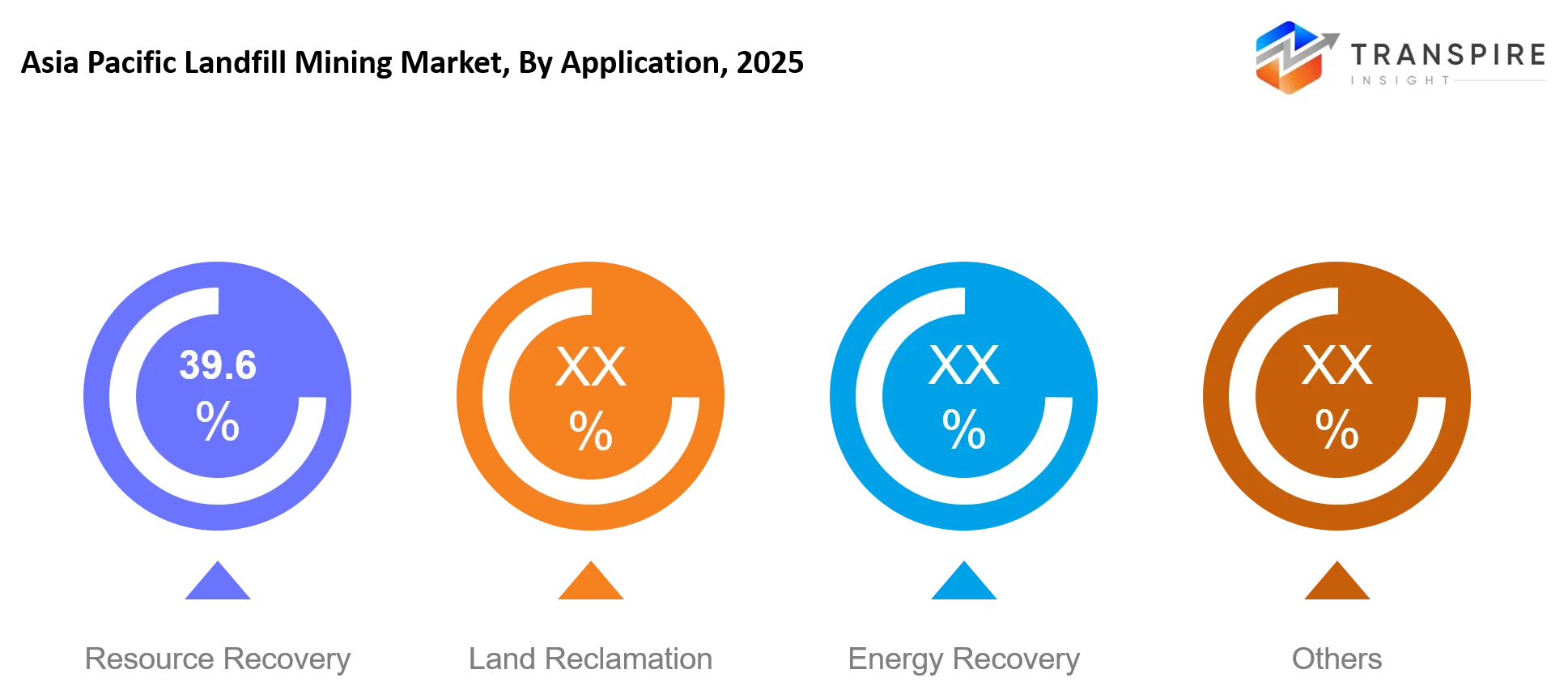
To learn more about this report, Download Free Sample Report
By End User :
End user segmentation looks at who is actually involved,meaning the organizations that plan, run, and benefit from landfill mining work. Municipalities are a major group because many sites are under public ownership or local government oversight. Project objectives often revolve around environmental management, land restoration and resource utilization.
Waste companies get involved through excavation, processing, transport, and day to day operational management services. Recyclers tend to concentrate on recovering, sorting, and processing valuable materials for commercial use across industrial segments. The other category includes engineering firms, environmental service providers, infrastructure developers, and private investors, all of them connected to landfill mining projects and related material recovery activities.
What are the Key Use Cases Driving the Asia Pacific Landfill Mining Market?
Resource recovery is still sort of the main reason driving adoption in the Asia Pacific Landfill Mining Market, you know, the primary use case. Municipal authorities, and also waste management operators, are increasingly digging up older landfill sites to reclaim metals and other valuable stuff, then bringing it back into manufacturing supply chains again. This particular application pulls the most demand because the reclaimed resources create clear revenue streams while also trimming the long term costs tied to landfill management.
Then there is land reclamation , which is becoming a noticeable secondary application, especially in crowded urban areas where land is hard to find. Municipalities and infrastructure developers are turning to landfill mining projects to prep locations for commercial expansion, transport infrastructure, and public amenities. On top of that, energy recovery from the combustible waste fractions is picking up momentum among waste companies that want extra value from what they excavate.
Some newer, emerging applications are also starting to appear, like extracting critical minerals from older waste deposits, and using advanced digital resource mapping to spot the higher value landfill zones before any excavation actually begins. These approaches are still early , but they could boost the overall project economics, and also help support bigger circular economy goals across the region.
|
Report Metrics |
Details |
|
Market size value in 2025 |
USD 37.3 Million |
|
Market size value in 2026 |
USD 39.1 Million |
|
Revenue forecast in 2033 |
USD 52.8 Million |
|
Growth rate |
CAGR of 4.38% from 2026 to 2033 |
|
Base year |
2025 |
|
Historical data |
2021 - 2024 |
|
Forecast period |
2026 - 2033 |
|
Report coverage |
Revenue forecast, competitive landscape, growth factors, and trends |
|
Regional scope |
Asia Pacific (India, China, Japan, Australia, South Korea, Rest of Asia Pacific) |
|
Key company profiled |
Veolia, SUEZ, Waste Management, FCC Environment, Remondis, Hitachi Zosen, Covanta, Biffa, Cleanaway, Sims, Tomra, CP Group, Renewi, GFL Environmental, Paprec |
|
Customization scope |
Free report customization (country, regional & segment scope). Avail customized purchase options to meet your exact research needs. |
|
Report Segmentation |
By Material Type (Metals, Plastics, Glass, Soil, Construction Waste, E-waste, Others); By Technology (Excavation, Screening, Sorting, Recycling, Waste-to-Energy, Others); By Application (Resource Recovery, Land Reclamation, Energy Recovery, Others); By End User (Municipalities, Waste Companies, Recyclers, Others) |
Which Regions are Driving the Asia Pacific Landfill Mining Market Growth?
East Asia kinda looks like the main regional market for landfill mining efforts across Asia Pacific. In Japan, and South Korea they’ve already put into place fairly mature resource recovery and circular economy policies, so it makes sense that people keep doing excavation and then redevelopment of older landfill sites. There’s also strong technical know-how, advanced waste processing infrastructure , plus recycling industries that are already established. Together they set up really favorable conditions for big scale projects. So basically this whole ecosystem lets operators recover valuable materials more efficiently, while still backing land reclamation goals in densely populated urban areas, which is kind of the point.
Then Oceania, mainly Australia, is the second most important driver of market activity, though the growth rhythm is not the same as East Asia. Market development there is helped by stable environmental regulations, long-term waste management planning, and public investment that stays consistent in landfill rehabilitation programs. Local authorities are also integrating landfill mining into wider sustainability and land-use plans , not only focusing on material recovery. That method, in practice, tends to produce a dependable stream of projects, and it gives service providers as well as technology suppliers some steadier revenue paths.
Southeast Asia meanwhile is emerging as the fastest-growing region in the market. Rapid urbanization, a rising strain on landfill capacity, and increasing government attention to waste management have boosted interest in resource recovery projects. Several countries have extended landfill remediation efforts and infrastructure spending to deal with legacy waste problems and the land scarcity near major cities. This momentum is expected to create appealing opportunities for technology providers, engineering firms, and private investors between 2026 and 2033 as project activity expands across the region.
Who are the Key Players in the Asia Pacific Landfill Mining Market and How Do They Compete?
The competitive landscape in the Asia Pacific Landfill Mining Market is still sort of moderately fragmented, not fully clean-cut, with rivals basically driven by technical know-how, how well they recover materials, and whether they can steer through tricky remediation efforts. Big environmental services firms go head to head with more niche recycling and engineering companies. What decides outcomes more and more is technology alignment, the real project economics, and the capability to deliver both resource recovery and land redevelopment results, kind of from one continuous project, not in pieces.
Veolia stands out because it runs integrated resource recovery models. These models pull together landfill excavation, materials processing, recycling, and environmental remediation under one service platform, which sounds simple but is actually a big advantage. For project owners, it can trim down operational confusion while also stretching the value they get from recovered materials. SUEZ leans hard into advanced waste treatment and circular economy solutions, and it uses digital monitoring along with recovery technologies to lift extraction rates and overall project performance. Also, strategic partnerships with municipal authorities help keep a longer term project flow steady, and they support growth into emerging markets.
The competitive landscape in the Asia Pacific Landfill Mining Market is still kind of moderately fragmented, not fully clean cut, with rivals mostly pushed by technical know-how, how well they recover usable materials, and whether they can navigate awkward remediation tasks. Big environmental services firms go head to head with more specialized recycling and engineering companies, sometimes in overlapping project scopes. More and more, outcomes get decided by technology fit, the actual project economics , and the ability to deliver both resource recovery plus land redevelopment results, kind of as one continuous engagement, not chopped up into separate parts.
Veolia stands out because it runs integrated resource recovery models. These models combine landfill excavation, materials processing, recycling, and environmental remediation within one service platform, which sounds straightforward but is really a major edge. For project owners, it can reduce operational muddle while also increasing the value they capture from recovered materials. SUEZ leans into advanced waste treatment and circular economy solutions, and it applies digital monitoring alongside recovery technologies to raise extraction rates and overall performance. On top of that, strategic partnerships with municipal authorities help keep a steadier long term project pipeline, and they back expansion into emerging markets.
Company List
- Veolia
- SUEZ
- Waste Management
- FCC Environment
- Remondis
- Hitachi Zosen
- Covanta
- Biffa
- Cleanaway
- Sims
- Tomra
- CP Group
- Renewi
- GFL Environmental
- Paprec
Recent Development News
In August 2025, the Brihanmumbai Municipal Corporation (BMC) approved a revised bioremediation and legacy-waste clearing contract with Navayuga Engineering Ltd for the Deonar landfill in Mumbai. The agreement, valued at approximately ₹2,540 crore after rate revisions, unlocked one of India's largest landfill-remediation projects and accelerated large-scale landfill mining activity in the Asia-Pacific region.
Source https://timesofindia.indiatimes.com/
What Strategic Insights Define the Future of the Asia Pacific Landfill Mining Market?
The Asia Pacific Landfill Mining Market is gradually sliding toward a more resource centric operating model, kind of where landfill sites are treated like long term reservoirs of secondary raw materials, not just some annoying environmental liability. In the next five to seven years, the biggest pull will probably be the meeting point between circular economy policies, land scarcity in the major urban areas, and that steady demand for alternative material sources. Because of this, you may see bigger, more tech driven projects that blend resource recovery, land redevelopment, and environmental remediation into one single investment plan.
A less obvious risk is the uncertainty around what materials can actually be recovered, both in quality and in volume, especially once the landfill sites are aging. When the easiest-to-reach and most economically attractive locations are exhausted, it can become harder to forecast project feasibility. That may, in turn, lift capital risk and start chipping away at investor confidence.
One emerging opportunity lies in AI enabled resource characterization and digital landfill mapping in Southeast Asia, since many of the older waste sites are still not properly assessed. Market participants should likely focus on investments in advanced site assessment technologies, and also build strategic partnerships with municipalities. Accurate resource valuation will become a real differentiator for how projects are chosen, how financing gets structured, and how long term profitability actually plays out.
Asia Pacific Landfill Mining Market Report Segmentation
By Material Type
- Metals
- Plastics
- Glass
- Soil
- Construction Waste
- E-waste
By Technology
- Excavation
- Screening
- Sorting
- Recycling
- Waste-to-Energy
By Application
- Resource Recovery
- Land Reclamation
- Energy Recovery
By End User
- Municipalities
- Waste Companies
- Recyclers
Frequently Asked Questions
Find quick answers to common questions.
The Expected Asia Pacific Landfill Mining Market size is USD 52.8 Million in 2033.
Key Segments for the Asia Pacific Landfill Mining Market are By Material Type (Metals, Plastics, Glass, Soil, Construction Waste, E-waste, Others); By Technology (Excavation, Screening, Sorting, Recycling, Waste-to-Energy, Others); By Application (Resource Recovery, Land Reclamation, Energy Recovery, Others); By End User (Municipalities, Waste Companies, Recyclers, Others).
Major Asia Pacific Landfill Mining Market Players are Veolia, SUEZ, Waste Management, FCC Environment, Remondis, Hitachi Zosen, Covanta, Biffa, Cleanaway, Sims, Tomra, CP Group, Renewi, GFL Environmental, Paprec.
The Current Asia Pacific Landfill Mining Market size is USD 37.3 Million in 2025.
The Asia Pacific Landfill Mining Market CAGR is 4.38% from 2026 to 2033.
- Veolia
- SUEZ
- Waste Management
- FCC Environment
- Remondis
- Hitachi Zosen
- Covanta
- Biffa
- Cleanaway
- Sims
- Tomra
- CP Group
- Renewi
- GFL Environmental
- Paprec
About the Authors

Pankaj Ghogare Patil
I am Pankaj Ghogare Patil, a Senior Research Analyst at Transpire Insight, specializing in the Pharmaceutical, Chemicals & Materials, Healthcare IT, and Biotechnology industry. My expertise lies in conducting comprehensive market research, analyzing industry trends, evaluating competitive landscapes, and translating complex data into actionable insights. At Transpire Insight, I closely follow emerging technologies, regulatory developments, and market innovations to create accurate, well-researched, and informative content that helps businesses and professionals make informed decisions. I am committed to producing credible, evidence-based articles that reflect industry best practices while making technical topics accessible and valuable for a broad audience.

Chakradhar Khansole
Chakradhar serves as the Research Director at Transpire Insight, bringing over 8 years of experience in technology, innovation, and strategic market intelligence. He specializes in transforming complex market data into actionable business insights that enable organizations to make informed, growth-oriented decisions. Recognized for his strategic vision and analytical expertise, Chakradhar leads high-impact research initiatives, delivering comprehensive market assessments, competitive intelligence, and forward-looking industry analysis.
Recently Published Reports
-
May 2026
Healthcare Polymer Packaging Market
Healthcare Polymer Packaging Market Size, Share & Analysis Report By Packaging Type (Syringes, IV Bottles and Pouches, Clamshells, Blisters, Bottles & Jars, Containers, Tubes, IV Parental Packaging, Others), By Type (Regulated, Non-regulated), By Polymer Type (LDPE (Low-Density Polyethylene), HDPE (High-Density Polyethylene), Homo-polymer (Homo), Random Copolymer (Random), Block Copolymer (Block), PET, Polystyrene, Polyvinyl Chloride, Polyamide/EVOH, Others), and Geography (North America, Europe, Asia-Pacific, Middle East and Africa, South and Central America), 2021 - 2031
-
Apr 2026
Hydrophilic Tape (Waterstop) Market
Hydrophilic Tape (Waterstop) Market Size, Share & Analysis Report By Type (Bentonite-Based Hydrophilic Tape, Rubber-Based Hydrophilic Tape), By Application (Residential Buildings, Commercial Buildings, Infrastructure Projects), and Geography (North America, Europe, Asia-Pacific, Middle East and Africa, South and Central America), 2021 - 2031
-
Apr 2026
Metalens Market
Metalens Market Size, Share & Analysis Report By Type (Visible Light Metalens, and Infrared Metalens), By Application (Consumer Electronics, Automotive Electronics, Industrial, Medical, and Others), and Geography (North America, Europe, Asia-Pacific, Middle East and Africa, South and Central America), 2021 - 2031
-
Apr 2026
PBT Resin Market
PBT Resin Market Size, Share & Analysis Report By Type (Reinforced PBT Resin, Unreinforced PBT Resin), By Processing Method (Injection Molding, Extrusion, Blow Molding, Others), By End-User (Automotive, Electrical & Electronics, Consumer Appliances, Industrial Machinery, Medical Devices, Packaging, Others), and Geography (North America, Europe, Asia-Pacific, Middle East and Africa, South and Central America), 2021 - 2031