
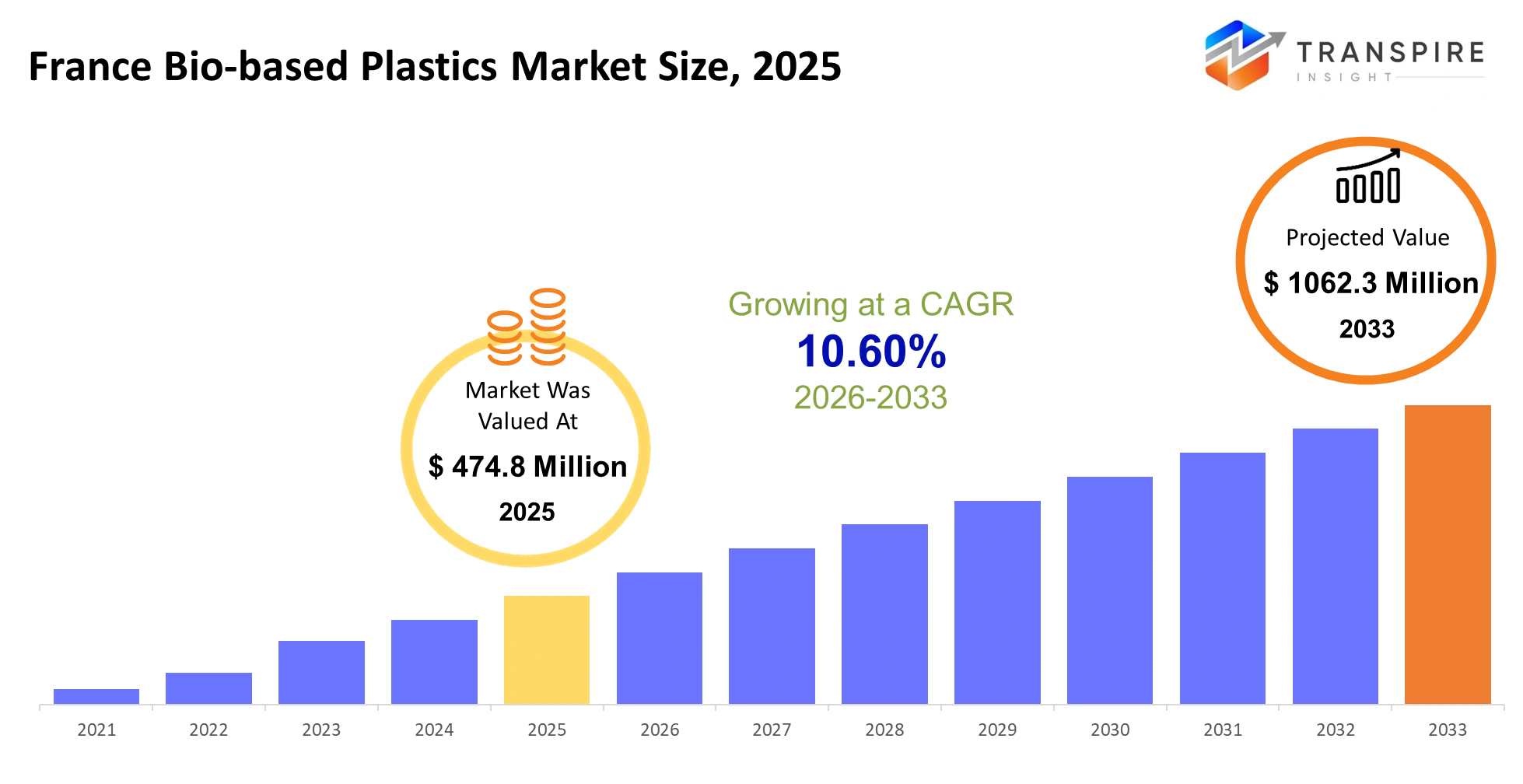
France Bio-based Plastics Market Size & Forecast:
- France Bio-based Plastics Market Size 2025: USD 474.8 Million
- France Bio-based Plastics Market Size 2033: USD 1062.3 Million
- France Bio-based Plastics Market CAGR: 10.60%
- France Bio-based Plastics Market Segments: By Type (PLA, PHA, Bio-PET, Bio-PE, Others); By Application (Packaging, Automotive, Consumer Goods, Agriculture, Others); By End-User (Packaging Industry, Automotive, Retail, Agriculture, Others); By Form (Films, Bottles, Fibers, Others).
To learn more about this report,  Download Free Sample Report
France Bio-based Plastics Market Summary
The France Bio-based Plastics Market was valued at USD 474.8 Million in 2025. It is forecast to reach USD 1062.3 Million by 2033. That is a CAGR of 10.60% over the period.
In France, bio-based plastics are getting used more and more to replace classic petroleum based polymers in packaging, inside automotive cars, agriculture films, and also in consumer goods production. In real life, these materials help French manufacturers cut fossil reliance a bit , while still meeting tight EU rules on packaging and circular economy, and those rules now really guide purchasing choices across industrial supply chains.
Over the past 3–5 years, the market has sort of moved in a structural way , from pilot scale adoption to full industrial scale integration. This shift is pushed by certification schemes for compostable materials, plus improvements in bio-polymer performance that now behave pretty close to conventional plastics in terms of durability. A major factor speeding it up has been the European Union Single-Use Plastics Directive, which basically made packaging makers and retailers rethink their material decisions under regulatory pressure.
So, procurement teams are currently reworking their material portfolios , which results in quicker time-to-market cycles and more revenue visibility for bio-based resin producers. Companies like TotalEnergies Corbion, Arkema, and BASF are scaling production too and also strengthening supply interconnections across Europe.
Key Market Insights
- Compostable packaging uses are expected to take up almost 40% of the market by 2025, mostly because retail sustainability rules are getting stricter, and EU waste reduction policies they’re pushing pretty hard.
- In general packaging is still the big slice, hovering around 46% share, and that’s linked to post 2022 European plastic waste reduction directives , plus the ongoing shift toward sustainable packaging adoption in many places.
- Agriculture films are at about 22% of the market. This is supported by more biodegradable mulch being used, and also by French agricultural modernization initiatives , which keep appearing in planning docs and investment announcements.
- For automotive lightweighting, growth is forecast to be above 15% CAGR through 2033, as electric vehicle production ramps up and polymer performance improvements keep accelerating in the background.
- Industrial applications, like electronics casings and durable goods manufacturing, moved forward by roughly 27% between 2023 and 2025 across France.
- Retail and FMCG companies, they’re basically the fastest-growing end user group, reaching nearly 14% yearly growth , due to extended producer responsibility compliance requirements that keep expanding.
- Novamont and NatureWorks also widened their French distribution partnerships by about 20% after 2023, aiming to stabilize the supply chain and extend market reach more smoothly.
- Bigger players like Novamont, NatureWorks, TotalEnergies, BASF, and Corbion are putting money into PLA technology, bio-PET innovation, integrated bio refinery facilities, and circular production models to strengthen their competitive edge.
What are the Key Drivers, Restraints, and Opportunities in the France Bio-based Plastics Market?
The main driver of the France Bio-based Plastics Market is regulatory push connected to the European Union’s circular economy framework, and well, it has sort of redefined how materials are chosen across packaging, retail, and even automotive. Because of this the companies are basically forced to swap fossil-derived polymers for certified bio-based options, and this is upping procurement quantities right away, while also speeding up those long-term supply understandings. And as compliance expenses keep climbing for conventional plastics, bio-based materials start looking more cost-smart in regulated uses, so producers can keep showing steady revenue expansion.
Still a big restraint stays there, mainly the elevated manufacturing cost and the narrow scalability of feedstock for bio-based polymers, especially when they come from agricultural sources like corn and sugarcane. This built-in constraint limits wider market uptake since supply cannot yet land at the same cost efficiency as petrochemical plastics. It also brings some price jitters for converters, so full scale substitution gets pushed back in cost-sensitive fields like mass packaging, and construction materials too.
The clearest opportunity shows up in advanced bio-refining and waste-to-polymer methods, those approaches turn agricultural leftovers and industrial waste into polymer feedstocks that can actually scale. France is putting more money into pilot bio-refinery initiatives supported by EU financing schemes, and that is setting up the groundwork for next generation cost reductions. Companies like Corbion are working on scalable PLA platforms, and if that momentum holds, it could open the door for high-volume adoption across packaging and automotive supply chains.
What Has the Impact of Artificial Intelligence Been on the France Bio-based Plastics Market?
Artificial intelligence is getting more and more stuck into bio-based polymer production systems in France, and it helps with process optimization across things like fermentation , polymerization, and also quality checks. In pretty advanced bioplastic manufacturing sites, AI control setups watch reactor conditions in real time , and they start tuning temperature, pH, and feedstock composition on the fly . The goal is better yield consistency and less material waste, which in practice makes operations run smoother and keeps output quality steadier for big industrial customers.
On top of that, machine learning models get used for predictive maintenance, so they can spot weird behavior in extrusion and polymer blending systems before anything actually breaks down. This kind of approach cuts down on unexpected downtime and keeps continuous production going, and that matters a lot for packaging and automotive contracts where supply commitments are strict. Plus, AI forecasting tools help plan raw material procurement by estimating agricultural feedstock availability and the kinds of pricing swings that might happen.
From an operational point of view, companies often mention improved energy efficiency and fewer defects in bio-polymer batches, and that boosts cost competitiveness pretty directly. Still, there’s a big catch: there isn’t yet standardized, high-quality training data for bio-based chemical processes. When feedstock composition changes a lot , and fermentation conditions vary, model performance drops, and then full automation becomes hard to reach in everyday production settings.
Key Market Trends
- In 2022 the EU Single-Use Plastics Directive shifted packaging design strategies, toward bio based alternatives across FMCG industries and it felt a bit broader than just “replace plastic”.
- In France, the Bio-based Plastics Market saw packaging dominance rise, mostly because retailers started pushing compliance more, under circular economy rules during 2024–2025, and the whole flow changed from the shelf back upstream.
- On the automotive side, manufacturers increased bio polymer usage in interiors as EV production expanded, which made lightweight material demand rise along with it.
- Meanwhile Bio-PET and PLA innovations helped with heat resistance, so industrial grade applications became more realistic beyond the usual traditional packaging scenarios.
- In agriculture, biodegradable mulch films adoption grew steadily, mainly as stricter soil pollution controls were implemented after 2023, you know in a very direct way.
- Strategic alliances between polymer producers and converters also sped up commercialization, across French manufacturing networks and it seemed faster than before for sure.
- BASF then expanded bio based material investments in Europe, aiming to strengthen supply resilience and not get trapped by shortages.
- Also retail procurement policies shifted toward certified compostable materials, and that influenced upstream manufacturing decisions in a pretty noticeable manner.
- After 2024, bio refinery pilot projects in France increased, supporting longer term feedstock diversification strategies that look more durable.
- Finally, cost reduction efforts in enzymatic polymer production are gradually improving competitiveness, against fossil based plastics, though the timeline still isn’t perfectly linear.
France Bio-based Plastics Market Segmentation
By Type
PLA keeps a strong, kind of leading position in the France bio-based plastics market , mostly because people really accept it for packaging, and it matches the compostable product rules quite well. Because it’s seen so often in food packaging and disposable use, its presence feels dominant, not least because manufacturers like cheaper bio-polymer alternatives. Bio-PET comes next as a solid secondary segment, supported by how similar it is to regular PET and how easy it is to fit into the existing recycling systems. Bio-PE is still smaller but it stays steady, and it tends to be used for flexible packaging as well as consumer product applications. PHA along with Others sits in a niche area , since production costs are higher and large-scale commercialization is still limited.
PLA growth happens mostly from its regulatory fit with EU compostability standards, and also from the growing push to replace fossil based plastics in retail packaging. Bio-PET rides on demand from beverage and FMCG industries that want “drop-in” solutions, meaning they can adopt it without switching up their production setup. Bio-PE gets more attention because flexible packaging demand keeps rising, while PHA growth is held back by price levels and feedstock limits. Looking ahead, expansion will likely favor PLA and Bio-PET, mainly as scalability improves, so material developers can put more effort into lowering costs and improving industrial grade performance, not just keeping things stable.
By Application
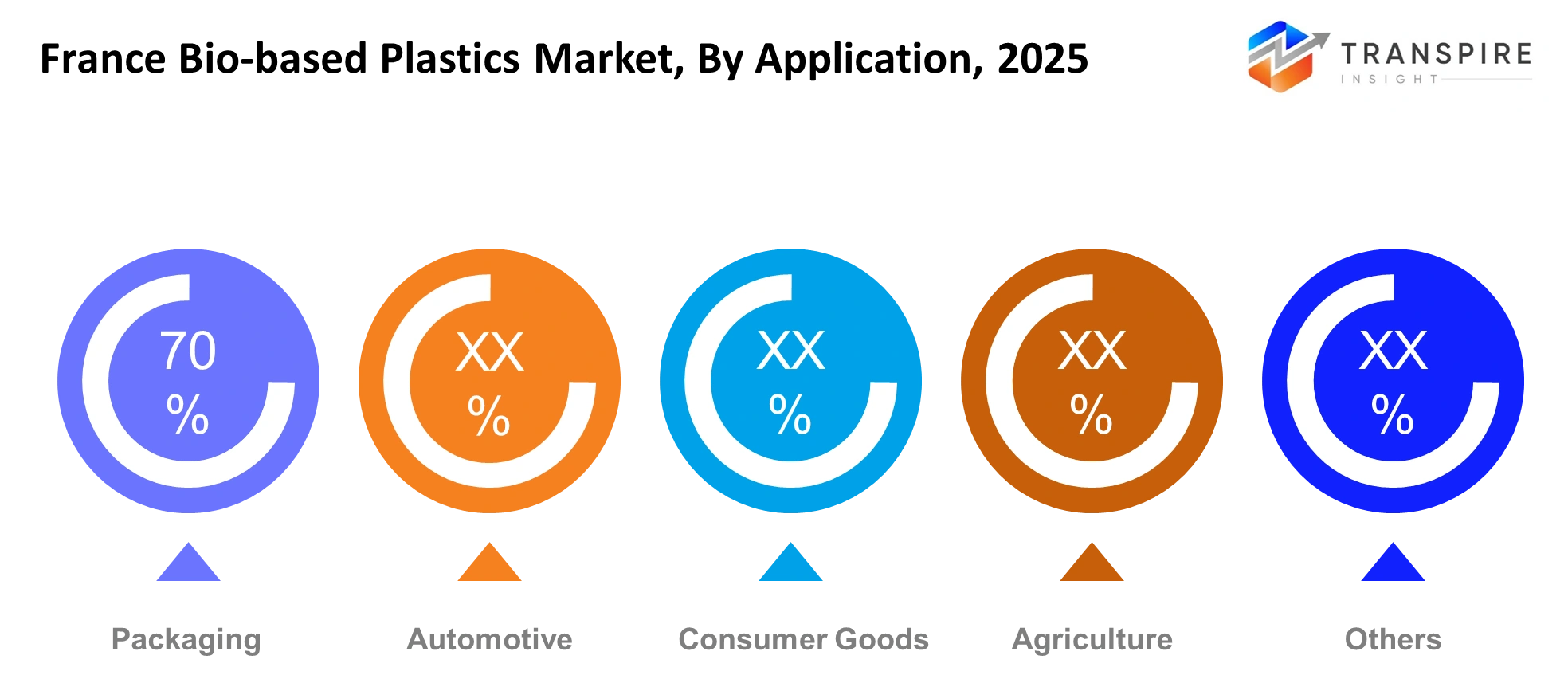
In the France Bio-based Plastics Market, packaging tends to dominate because the EU waste reduction rules are strict, and because FMCG plus retail supply chains really need reliable output, fairly quickly. At the same time, automotive applications are taking more room in the picture , since manufacturers are folding lightweight bio-polymers into interior elements and other non-structural parts. Consumer goods look pretty stable, backed by the steady take up of sustainable materials in household and lifestyle products. Agriculture is still a meaningful area, but it stays smaller, mostly centered on mulch films and soil-friendly biodegradable solutions. The rest is sort of a mixed group, like niche industrial uses and healthcare needs where adoption is slower, but it keeps moving forward.
Packaging growth mainly comes from bans on single-use plastics and the fast rollout of compostable materials across retail networks, so it is less “optional” and more “must do”. For automotive, demand keeps rising due to electrification momentum and the material efficiency targets that encourage lighter designs, not just for performance but for compliance. In agriculture, the drivers are soil protection expectations and sustainability initiatives that are happening across France. Looking ahead, expansion should stay concentrated in packaging and automotive, which means suppliers will need to craft high-performance, regulation compliant bio-based materials for large-scale industrial use.
To learn more about this report, Download Free Sample Report
By End-User
In the France Bio-based Plastics Market the packaging industry is basically holding the leading position, mainly because it is directly exposed to regulatory restrictions and those high-volume consumption requirements. The automotive end-users come in next, with pretty steady integration of bio-based materials into interior bits and also into lightweight structural components, which kinda matters a lot in real manufacturing. Retail then works like a strong downstream influencer, pushing sustainability oriented procurement decisions across different product categories, not just one. Agriculture still keeps a moderate share, supported by biodegradable film usage and environmental compliance needs that keep showing up in tenders. Others—like industrial manufacturing and specialty applications—have a limited but consistent demand, more like quiet persistence rather than big hype.
Growth in packaging is strongly tied to EU circular economy directives, since those enforce strict material substitution targets. Automotive adoption is being pushed by OEM sustainability goals and, you know, the material redesign that comes with electrification. Retail growth is shaped by brand-driven sustainability commitments and shifting consumer preference toward eco-friendly products. Over the forecast period, packaging and automotive end-users will continue to dominate demand, which in turn encourages suppliers to line up their production capacity with large-scale industrial procurement cycles, even if timelines get a bit tight.
By Form
In the France Bio-based Plastics Market, films tend to be the prevailing way to go , mostly because they’re used a lot for flexible packaging, farming uses, and everyday retail. After that, bottles show up as a pretty solid segment , pushed by drink packaging needs and the gradual shift away from PET -based containers. Fibers then sit in a smaller but steady slice, usually going into textiles and industrial tasks that want more sustainable feedstock. “Other” forms cover things like shaped parts and niche shapes for electronics and consumer product manufacturing, kind of a catch-all but still important.
The appetite for film is mostly powered by new regulatory pressure around single-use plastics, and also by the broad FMCG packaging rework happening across supply chains. Bottles get a lift from beverage sector sustainability programs, plus more uptake of bio-based PET substitutes. Fiber growth, meanwhile, is supported by textile sustainability efforts and the integration of recycled materials, even when the exact blend varies by producer. Looking ahead, development will likely favor films and bottles because they scale at high volume, so companies keep investing in high-efficiency extrusion and molding techniques, to produce bio-plastics on a large, consistent scale.
What are the Key Use Cases Driving the France Bio-based Plastics Market?
In the France Bio-based Plastics Market, the main use case is kind of for flexible and rigid packaging, for food plus retail products. This section really drives the demand, since EU rules push for less landfill waste and also stricter recyclability requirements , so producers end up using compostable and bio-derived materials at scale, even when the adoption takes time.
Besides that, people are expanding into automotive interior components and agricultural mulch films . In the automotive space, suppliers bring in bio-based plastics to cut vehicle weight , and at the same time raise their sustainability scores. For agriculture, farmers lean on biodegradable films so soil contamination stays lower, and so they can match environmental farming expectations that are common across France.
What’s also starting to show up are more emerging use cases like electronics housings and medical disposable products, where pressure to reduce waste keeps growing. Those applications are still in progress, a bit uneven, but they look promising as material performance improves. Certification frameworks are also widening across industrial supply chains, which helps these products move from trials into wider use.
|
Report Metrics |
Details |
|
Market size value in 2025 |
USD 474.8 Million |
|
Market size value in 2026 |
USD 524.7 Million |
|
Revenue forecast in 2033 |
USD 1062.3 Million |
|
Growth rate |
CAGR of 10.60% from 2026 to 2033 |
|
Base year |
2025 |
|
Historical data |
2021 - 2024 |
|
Forecast period |
2026 - 2033 |
|
Report coverage |
Revenue forecast, competitive landscape, growth factors, and trends |
|
Regional scope |
France |
|
Key company profiled |
NatureWorks, BASF, TotalEnergies, Braskem, Corbion, Novamont, Danimer Scientific, Mitsubishi Chemical, Toray, Arkema, DuPont, FKuR, Plantic, Bio-on, Green Dot. |
|
Customization scope |
Free report customization (country, regional & segment scope). Avail customized purchase options to meet your exact research needs. |
|
Report Segmentation |
By Type (PLA, PHA, Bio-PET, Bio-PE, Others); By Application (Packaging, Automotive, Consumer Goods, Agriculture, Others); By End-User (Packaging Industry, Automotive, Retail, Agriculture, Others); By Form (Films, Bottles, Fibers, Others). |
Which Regions are Driving the France Bio-based Plastics Market Growth?
The leading area in the France Bio-based Plastics Market feels like it is Île-de-France, mostly because that’s where a lot of the headquarters sit for big packaging converters, plus R&D hubs and those regulatory bodies that, sort of directly, set the material adoption expectations. With Paris-based institutions pushing policy enforcement pretty consistently, companies usually manage compliance with EU circular economy rules sooner, and that in turn speeds up procurement decisions toward bio-based alternatives. The region also has dense industrial clusters, so packaging makers, chemical distributors, and retail supply networks can work together in short logistics windows. All of this basically trims down the time-to-market for bio-based material adoption and keeps demand moving in a steady stream.
Auvergne-Rhône-Alpes is the second important region, and it stands out more for industrial muscle rather than for regulatory concentration. Unlike Île-de-France, its advantage is tied to large-scale chemical processing, automotive suppliers, and plastics conversion facilities that run on long-term capital cycles. Another part is that the region gets stable energy infrastructure and predictable industrial output, which lets manufacturers bring in bio-based polymers step by step, without wrecking production efficiency. In practice, many companies in this area lean toward dependability and cost optimization, more than aggressive compliance ramp-ups.
The fastest-growing region is Hauts-de-France, and it’s driven by port modernization that has recently been rolling out, plus an expanding logistics footprint along trade corridors like Calais and Dunkirk. Investments in circular economy industrial zones, together with cross-border supply chain integration with Belgium, have increased bio-based material throughput a lot since 2024. This change has made it easier to bring in bio-feedstocks faster, then move out finished biopolymers to broader European markets.
Who are the Key Players in the France Bio-based Plastics Market and How Do They Compete?
Competition in the France Bio-based Plastics Market is kinda moderately consolidated at the top, but after that it stays fragmented among specialty polymer producers and regional converters. The biggest chemical players pretty much lead the core bio-polymer supply, mainly because of scale advantages, plus integrated R&D. Meanwhile smaller firms are fighting back with more specific, almost targeted offerings like niche compostable formulations and application-focused innovations. Overall, the real basis of competition is this kind of tech differentiation in bio-polymer chemistry, and the ability to satisfy EU compostability together with performance standards at industrial scale, not just in lab conditions.
NatureWorks kind of centers its strategy on PLA innovation. It differentiates with high-purity fermentation-based production processes, these improve clarity and also food-contact safety. In France, it grows mostly via long-term supply contracts with packaging converters, instead of having a direct retail presence ( which is sort of normal anyway). BASF competes with a wide breadth of material portfolios and sustainability programs that are driven by certification. It also integrates bio-based plastics into big industrial client ecosystems. The edge here is multi-material substitution capability, across both automotive and packaging sectors, so they can swap materials with less drama for customers.
TotalEnergies leans on upstream petrochemical integration, then it transitions into bio-based polymers by using joint ventures like Corbion-linked platforms. Corbion keeps strengthening its position through lactic acid specialization, and that supports scalable PLA production partnerships across Europe. Novamont, meanwhile, competes with certified compostable material solutions that are often adopted across agricultural and retail uses. In practice, these companies tend to expand mostly through strategic alliances, capacity expansion, and co-development agreements with packaging converters, or so the pattern goes.
Company List
- NatureWorks
- BASF
- TotalEnergies
- Braskem
- Corbion
- Novamont
- Danimer Scientific
- Mitsubishi Chemical
- Toray
- Arkema
- DuPont
- FKuR
- Plantic
- Bio-on
- Green Dot
Recent Development News
“In January 2026, BASF announced expansion of its bio-based polymer production capacity in Europe. The expansion supports increased demand from packaging converters and automotive suppliers adopting low-carbon materials.”
Source: https://www.basf.com
What Strategic Insights Define the Future of the France Bio-based Plastics Market?
The France Bio-based Plastics Market is moving toward deeper industrial integration, where bio-based polymers kinda become default inputs in regulated packaging and mobility supply chains, not really only niche substitutes . This shift is mostly pushed by tightening EU material restrictions and the gradual cost convergence between bio-based and fossil-derived plastics. Still, there is a hidden risk around feedstock concentration, where leaning on a limited set of agricultural inputs makes producers vulnerable to climate variability and commodity price shocks, and that could mess up scaling plans. At the same time , there’s a pretty big emerging opportunity tied to waste-to-polymer commercialization , especially municipal and agricultural residue conversion systems, which cut dependency on food-based feedstocks. Over the next 5–7 years, the players that manage circular feedstock pipelines will get a more structural advantage. Market participants should prioritize vertical integration into bio-refining ecosystems and also lock in long-term feedstock agreements, so volatility drops and margin stability becomes more solid.
France Bio-based Plastics Market Report Segmentation
By Type
- PLA
- PHA
- Bio-PET
- Bio-PE
- Others
By Application
- Packaging
- Automotive
- Consumer Goods
- Agriculture
- Others
By End-User
- Packaging Industry
- Automotive
- Retail
- Agriculture
- Others
By Form
- Films
- Bottles
- Fibers
- Others
Frequently Asked Questions
Find quick answers to common questions.
The expected France Bio-based Plastics Market size for the market will be USD 66.8 Million in 2033.
Key segments for the France Bio-based Plastics Market are By Type (PLA, PHA, Bio-PET, Bio-PE, Others); By Application (Packaging, Automotive, Consumer Goods, Agriculture, Others); By End-User (Packaging Industry, Automotive, Retail, Agriculture, Others); By Form (Films, Bottles, Fibers, Others).
Major France Bio-based Plastics Market players are NatureWorks, BASF, TotalEnergies, Braskem, Corbion, Novamont, Danimer Scientific, Mitsubishi Chemical, Toray, Arkema, DuPont, FKuR, Plantic, Bio-on, Green Dot.
The France Bio-based Plastics Market size is USD 474.8 Million in 2025.
The France Bio-based Plastics Market CAGR is 10.60% from 2026 to 2033.
- NatureWorks
- BASF
- TotalEnergies
- Braskem
- Corbion
- Novamont
- Danimer Scientific
- Mitsubishi Chemical
- Toray
- Arkema
- DuPont
- FKuR
- Plantic
- Bio-on
- Green Dot
Recently Published Reports
-
Apr 2026
Healthcare Polymer Packaging Market
Healthcare Polymer Packaging Market Size, Share & Analysis Report By Packaging Type (Syringes, IV Bottles and Pouches, Clamshells, Blisters, Bottles & Jars, Containers, Tubes, IV Parental Packaging, Others), By Type (Regulated, Non-regulated), By Polymer Type (LDPE (Low-Density Polyethylene), HDPE (High-Density Polyethylene), Homo-polymer (Homo), Random Copolymer (Random), Block Copolymer (Block), PET, Polystyrene, Polyvinyl Chloride, Polyamide/EVOH, Others), and Geography (North America, Europe, Asia-Pacific, Middle East and Africa, South and Central America), 2021 - 2031
-
Apr 2026
Hydrophilic Tape (Waterstop) Market
Hydrophilic Tape (Waterstop) Market Size, Share & Analysis Report By Type (Bentonite-Based Hydrophilic Tape, Rubber-Based Hydrophilic Tape), By Application (Residential Buildings, Commercial Buildings, Infrastructure Projects), and Geography (North America, Europe, Asia-Pacific, Middle East and Africa, South and Central America), 2021 - 2031
-
Apr 2026
Metalens Market
Metalens Market Size, Share & Analysis Report By Type (Visible Light Metalens, and Infrared Metalens), By Application (Consumer Electronics, Automotive Electronics, Industrial, Medical, and Others), and Geography (North America, Europe, Asia-Pacific, Middle East and Africa, South and Central America), 2021 - 2031
-
Apr 2026
PBT Resin Market
PBT Resin Market Size, Share & Analysis Report By Type (Reinforced PBT Resin, Unreinforced PBT Resin), By Processing Method (Injection Molding, Extrusion, Blow Molding, Others), By End-User (Automotive, Electrical & Electronics, Consumer Appliances, Industrial Machinery, Medical Devices, Packaging, Others), and Geography (North America, Europe, Asia-Pacific, Middle East and Africa, South and Central America), 2021 - 2031