
Asia Pacific Nickel Market Summary
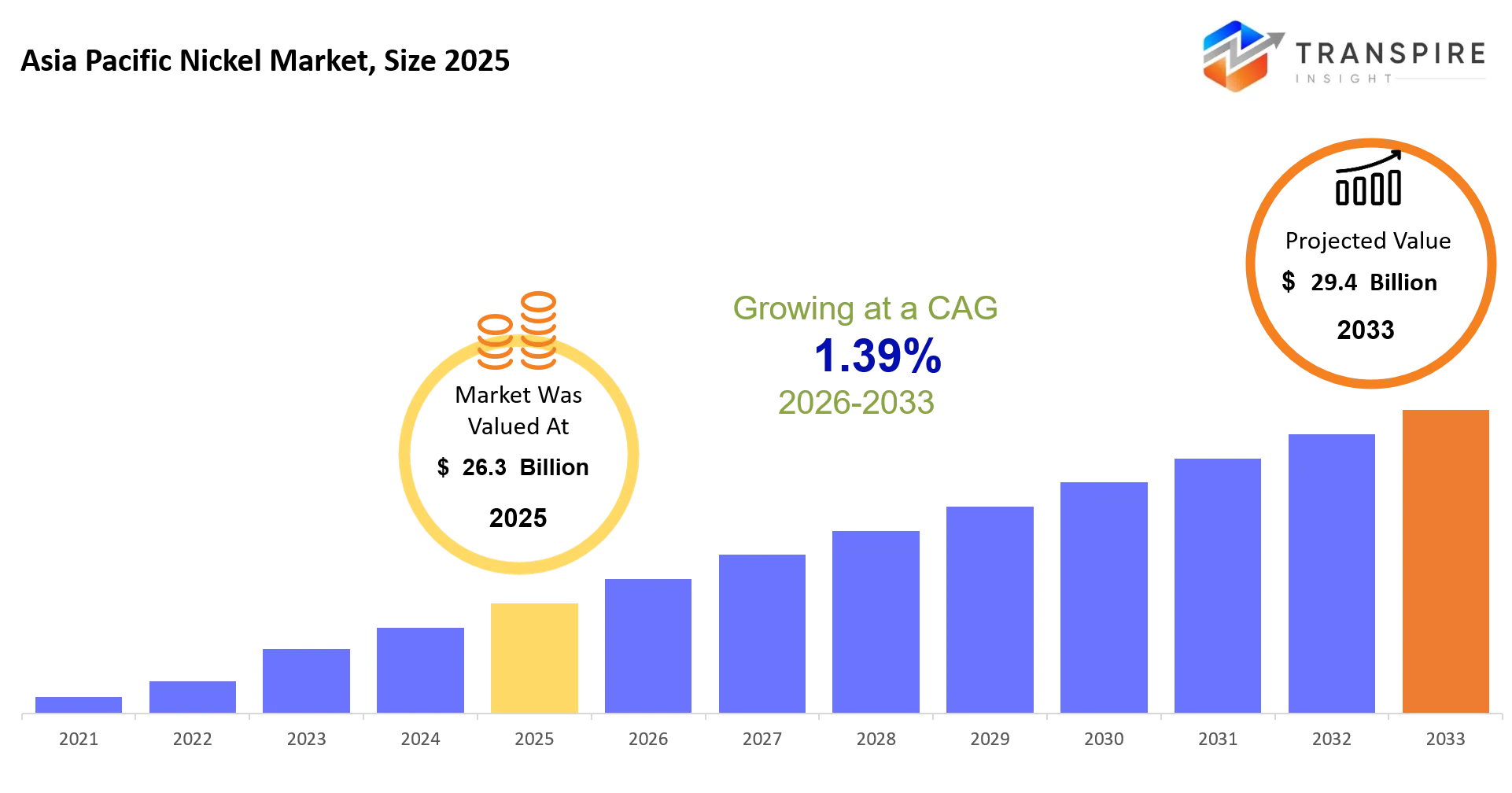
As per Transpire Insight Analysis, the Asia Pacific Nickel Market size is estimated at USD 26.3 Billion in 2025 and is anticipated to reach USD 29.4 Billion by 2033, growing at a CAGR of 1.39% from 2026 to 2033.
The Asia Pacific nickel market provides a kind of raw material that really keeps stainless steel manufacturing going, and also supports electric vehicle battery production, aerospace parts, industrial machinery, and energy infrastructure. When nickel is available in a dependable way , companies can push better corrosion resistance, stretch the service life of products, and satisfy stricter performance requirements across major heavy industries. In the last five years , things changed pretty a bit, the market moved away from being mostly steel centered, and it became more even across the supply chain with battery grade nickel also getting real priority for electric mobility and energy storage uses. This shift picked up speed after worldwide supply chain disruptions and geopolitical tensions showed where sourcing could fail, so governments and manufacturers started to diversify sourcing routes, and they began investing in regional processing capability.
As battery producers grow their local output and steel manufacturers try to reach higher value alloys, capital keeps flowing into mining, refining, and the later stages of processing . With this wider industrial connection, revenue opportunities look stronger while also encouraging tech upgrades, supply security efforts , and longer term capacity expansion throughout the region.
Asia Pacific Nickel Market Size & Forecast:
- Asia Pacific Nickel Market Size 2025: USD 26.3 Billion
- Expected Market Value 2033: USD 29.4 Billion
- Forecast CAGR: 1.39%
- Leading region in 2025: Southeast Asia
- Fastest Growing region: Southeast Asia
- Key Profile: Vale, Nornickel, BHP, Jinchuan Group, Tsingshan Holding Group, Eramet, Sumitomo Metal Mining, POSCO Future M, Glencore, South32, Anglo American, Sherritt International, PT Vale Indonesia, Huayou Cobalt, Nickel Asia Corporation
Key Market Insights
- Southeast Asia kind of dominated the market , with an approx 58% share in 2025, mainly driven by Indonesia integrated mining, refining, and that export minded processing capacity.
- Southeast Asia will still look like the fastest growing region across the 2025–2033 forecast window, because battery-grade nickel refining investments keep accelerating around Indonesia.
- On the product side, Class I nickel led overall, taking nearly 54% of the market in 2025, largely thanks to the climb in stainless steel and battery precursor needs.
- Class II nickel stayed in the second spot , supported by fairly stable ferronickel consumption for stainless steel making across China and Southeast Asia.
- Nickel sulfate is expected to be the quickest growing segment through 2033, fueled by expanding electric vehicle battery cathode output.
- For applications, stainless steel manufacturing pretty much led, holding around 65% market share in 2025, as industrial construction and infrastructure work continued to support consumption.
- Electric vehicle battery production is set to show the fastest application growth through 2033, backed by growth in regional battery manufacturing capacity.
- When it comes to end users, stainless steel producers were the top category, with nearly 67% share in 2025, mostly because industrial alloy demand stayed steady.
- Battery manufacturers will likely become the fastest-growing end-user group during 2025–2033, supported by strategic investments in regional cell production facilities .
What are the Key Drivers, Restraints, and Opportunities in the Asia Pacific Nickel Market?
The biggest driver that, kind of, keeps pushing the Asia Pacific Nickel Market forward is the fast growth in electric vehicle battery manufacturing along with integrated nickel refining. Indonesia’s downstream mineral processing policies, plus the limits on raw ore exports, basically helped push more investment into local smelters and refining sites. In response battery manufacturers ended up locking in long-term nickel supply agreements rather than leaning on imported refined material. That change then boosted regional processing capacity, improved value added output, and created extra revenue flow through the whole mining refining and battery supply chain.
The main drag, though still noticeable, is how nickel supply is concentrated in only a handful of producing countries and a few processing hubs. Creating new mines ,and building high pressure acid leach facilities takes years, requires heavy capital, and also depends on tight environmental approvals. On top of that, price swings can make investment timing messy and slow down procurement contract decisions. From a Transpire Insight review of regional procurement announcements and product launch schedules, supply chain concentration still looks like the main execution risk. Together these things tend to choke off broader expansion plans, postpone commercial output, and trim near term revenue possibilities for downstream manufacturers.
A big opportunity is opening up by stretching battery grade nickel sulfate output across Southeast Asia. There’s also this shift toward advanced hydrometallurgical processing, plus recycling approaches, that makes brand new commercial routes, kind of beyond the usual stainless steel demand. You can see it in countries like Indonesia and Malaysia they’re drawing international battery material players through industrial parks, and a bunch of infrastructure incentives. Over time, these moves should lock in stronger regional value chains, raise export competitiveness, and back the next stage of industry growth.
What Has the Impact of Artificial Intelligence Been on the Asia Pacific Nickel Market?
Artificial intelligence and digital technologies are kinda changing nickel mining, refining, and what comes after it, especially across Asia Pacific. A lot of operators are now using AI powered monitoring systems, to squeeze better ore extraction, keep an eye on equipment health, and make environmental compliance easier through nonstop analysis of day to day operational data. At the same time, digital twins plus automated control platforms let refineries keep processing parameters more steady, and also cut down on production swings.
Machine learning models are doing another thing too: they help with predictive maintenance by spotting equipment failures earlier, before a shutdown even starts. Forecasting tools then stitch together production records, weather conditions, logistics details and commodity demand signals, so companies can plan inventory with more sense and line up shipment schedules. In practice, these setups push plant utilization upward, shrink maintenance downtime, and boost recovery rates, all while lowering operating costs across connected mining and refining sites.
Digital optimization also makes energy management stronger, by tweaking processing conditions based on real time operational performance. Automated quality inspection helps product consistency too, particularly for battery grade nickel materials. Still, AI adoption isn’t the same everywhere in the regional nickel industry. The main issues are high integration costs, scattered operational data, older processing infrastructure, and weak digital connectivity in remote mining areas, these things basically slow big rollout. Smaller producers often don’t have enough investment capacity or technical know-how to put advanced AI platforms in place, so widespread digital transformation moves slower, even when the operational benefits are pretty obvious.
Key Market Trends
- Since 2022, Indonesia kinda accelerated downstream refining investments, so they were boosting battery-grade nickel output quite a lot and also, lowering the reliance on raw ore exports, pretty noticeably.
- Between 2023 and 2025, high pressure acid leach projects grew faster, and this helped raise mixed hydroxide precipitate output for electric vehicle battery manufacturers, like more stable results.
- During 2024–2025 , Chinese companies went deeper into cross border investments for Southeast Asian processing sites, which strengthened regional supply chain integration, maybe a bit too well.
- After 2023, battery manufacturers started signing multi year nickel supply agreements more often, and that reduced procurement uncertainty, while also backing refining capacity expansion.
- In 2024, digital mine management platforms got adopted wider, and that improved equipment utilization, production planning, and even predictive maintenance performance, overall.
- From 2023 to 2025, environmental compliance standards tightened across several producing countries, which basically pushed investors toward cleaner refining technologies and stronger emissions controls.
- After 2024, nickel recycling capacity expanded steadily, giving better access to secondary raw materials for battery precursor manufacturing, in practice.
- POSCO, Tsingshan Holding Group, and Sumitomo Metal Mining expanded their investments in battery materials and refining partnerships, to shore up regional value chains, end of story.
- And after 2023, stainless steel producers diversified procurement sources more frequently, so they cut exposure to price swings and localized supply disruptions.
Asia Pacific Nickel Market Segmentation
By Product Type :
Class I nickel supports high-purity applications, where strong performance and reliable quality matter most. The demand keeps climbing, mostly tied to battery manufacturing, advanced alloys and more specialized industrial needs. Class II nickel is still widely used in stainless steel production because of cost efficiency and easy availability, it’s kind of the default choice in many supply chains. Nickel pig iron has also become an important material for large-scale stainless steel manufacturing, mainly because its production costs stay competitive.
Nickel sulfate keeps moving up in importance too, especially with electric vehicle battery production growing and with more investment going into battery material supply chains. Ferronickel still stays as a preferred raw material for stainless steel producers, since it shows stable performance and the processing methods are already pretty well established. The “others” category covers specialty nickel products that are tuned for niche industrial requirements, research applications, and customized manufacturing processes. These uses typically require specific material properties, not just general-grade output or something similar.
By Application :
Stainless steel production is still taking the biggest chunk of nickel consumption, mostly because construction, transportation, and industrial manufacturing keep pulling hard. At the same time battery manufacturing keeps broadening, driven by more electric vehicle production and also energy storage investments, which is kind of the main push. Electroplating uses nickel too, mainly to boost corrosion resistance, better appearance , and to extend product durability across automotive, electronics, and consumer goods. Alloy manufacturing, meanwhile, depends on nickel to lift strength, increase heat resistance, and support long term reliability.
Foundry products also count on nickel, to make casting quality better and to raise mechanical performance in pretty demanding operating environments. Chemical applications use nickel for catalysts, processing equipment, and those specialized industrial reactions that need solid corrosion resistance. The “others” category is a bit of a mix, it covers medical devices, marine equipment, and several high value industrial uses where material performance has to stay dependable even when conditions get rough.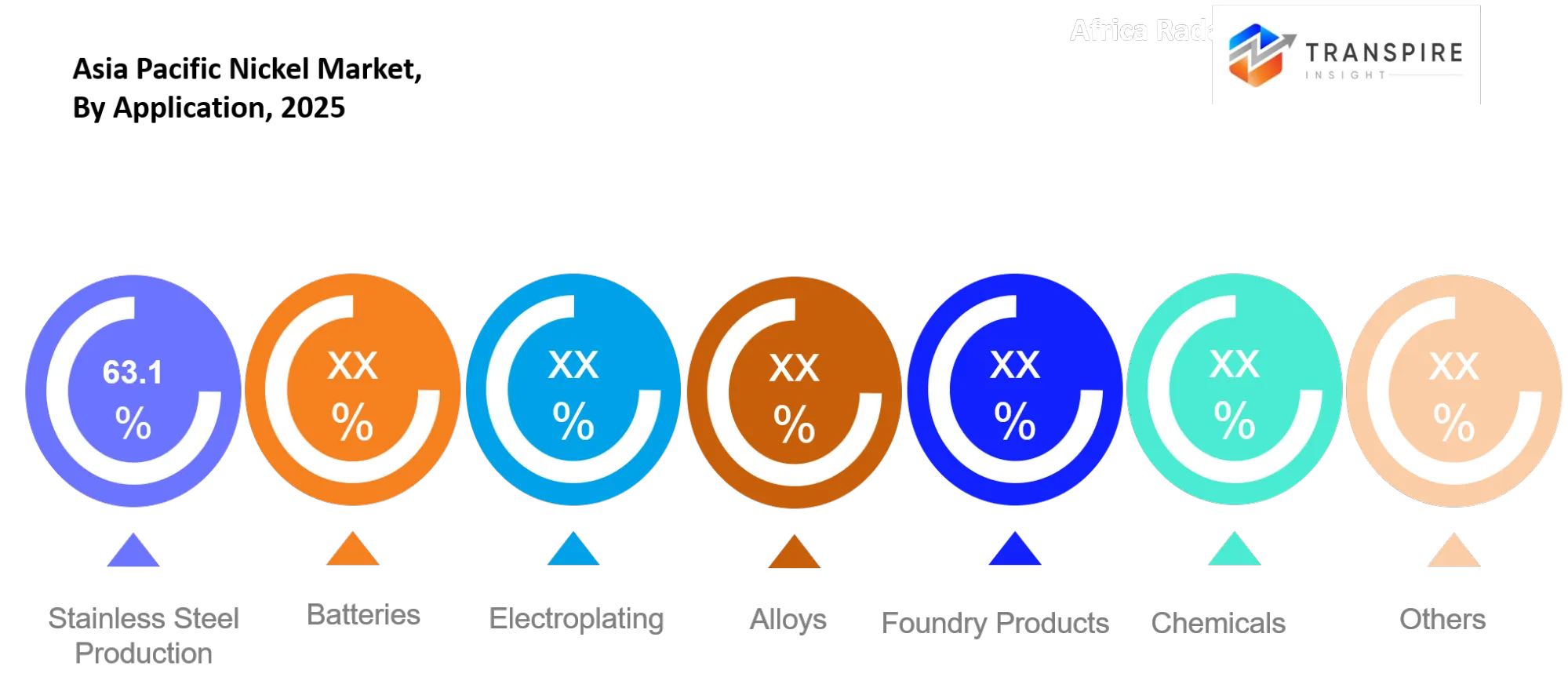
By End User :
Automotive manufacturing keeps going up , and with it nickel consumption rises too stainless steel parts are part of that story, plus electric vehicle battery production also pulls a lot of nickel in. Construction work still backs steady demand for corrosion resistant materials, especially for buildings , bridges, and all kinds of infrastructure projects that have to last. Electronics manufacturers lean on nickel for connectors, batteries, and electronic components where consistent electrical and thermal behavior matters.
Aerospace applications need nickel based materials that can handle high temperatures, and also survive extreme mechanical stress, sometimes for long periods. Energy storage stays a key growth area, since investments keep increasing in battery systems meant for renewable power integration and grid stability. Industrial manufacturing uses nickel in machinery, processing equipment, and heavy engineering work where durability is basically non negotiable. The “others” category includes healthcare , defense, transportation, and several specialized industries, all of them asking for high performance materials that can work in critical operating environments.
By Mining Type :
Laterite ore basically counts as a major mining source because there are so many reserves, plus investments keep going up in processing facilities in the key producing countries. The output coming from laterite deposits helps feed stainless steel manufacturing and also a few battery material uses, depending on the downstream demand. Sulfide ore is still valuable too, mainly because the higher grade deposits are around, and processing methods tend to be quite efficient, which leads to high purity nickel fit for more advanced industrial uses. Mining companies keep tuning their extraction methods, trying to boost operational efficiency ,and also cut down production costs a bit more.
Mixed ore resources add this extra bit of flexibility since they can support different processing routes based on ore composition and what the market is asking for. Ongoing exploration efforts also matter, they help widen the resource base and strengthen long term supply security. The “others” category covers smaller deposit types and newer mining projects ,which add extra production capacity while also backing regional resource development.
By Distribution Channel :
Direct sales is still kind of the go-to distribution channel for big industrial buyers, largely because of long term supply agreements, price steadiness and dependable delivery timetables. In practice, manufacturers can get better rapport with suppliers and smoother supply-chain coordination by going the direct procurement route. Metal traders meanwhile connect producers with a broad set of industrial customers, and they help with product availability across various locations, not just one area. Commodity exchanges also matter because they bring transparent pricing, and they back up risk management via standardized trading systems.
The “others” box, though, usually covers distributors, regional suppliers, and specialized sales networks that tend to serve smaller manufacturers, plus a few niche industrial customers. Digital procurement platforms keep getting better too, mainly by expanding market reach and making transaction handling feel more straightforward, almost like less friction. Even with all that, strong distribution networks will stay important for keeping material availability consistent across many industrial segments.
What are the Key Use Cases Driving the Asia Pacific Nickel Market?
Stainless steel production still stays the main use case that kinda backs demand across manufacturing and infrastructure sectors. Construction groups , industrial machinery makers, and transportation providers buy nickel-based materials because they get that long service life, solid resistance to corrosion, and dependable work even when the operating conditions are really tough. And yeah, more investment for city growth and industrial expansion keeps the purchasing activity steady.
On the battery side, manufacturing is still getting more important. This is tied to the rising output of electric vehicles plus the expansion of energy storage projects. Electronics manufacturers are also pushing higher demand for materials used in rechargeable batteries and for high performance electronic components that need stable operating efficiency. Industrial buyers keep signing stronger supply agreements so they can plan production far ahead.
Looking forward, advanced battery chemistries and hydrogen-related technologies feel like the most promising directions. Research keeps increasing and pilot-scale investment is starting to show up more often. Government policies that support clean energy , lower emissions, and domestic supply chains make it easier for materials to get adopted through new industrial programs. Meanwhile aerospace manufacturers are evaluating next generation material solutions aimed at better efficiency and higher operating temperatures during the forecast period.
|
Report Metrics |
Details |
|
Market size value in 2025 |
USD 26.3 Billion |
|
Market size value in 2026 |
USD 26.7 Billion |
|
Revenue forecast in 2033 |
USD 29.4 Billion |
|
Growth rate |
CAGR of 1.39% from 2026 to 2033 |
|
Base year |
2025 |
|
Historical data |
2021 - 2024 |
|
Forecast period |
2026 - 2033 |
|
Report coverage |
Revenue forecast, competitive landscape, growth factors, and trends |
|
Regional scope |
Asia Pacific (India, China, Japan, Australia, South Korea, Rest of Asia Pacific) |
|
Key company profiled |
Vale, Nornickel, BHP, Jinchuan Group, Tsingshan Holding Group, Eramet, Sumitomo Metal Mining, POSCO Future M, Glencore, South32, Anglo American, Sherritt International, PT Vale Indonesia, Huayou Cobalt, Nickel Asia Corporation . |
|
Customization scope |
Free report customization (country, regional & segment scope). Avail customized purchase options to meet your exact research needs. |
|
Report Segmentation |
By Product Type (Class I Nickel, Class II Nickel, Nickel Pig Iron, Nickel Sulfate, Ferronickel, Others); By Application (Stainless Steel Production, Batteries, Electroplating, Alloys, Foundry Products, Chemicals, Others); By End User (Automotive, Construction, Electronics, Aerospace, Energy Storage, Industrial Manufacturing, Others); By Mining Type (Laterite Ore, Sulfide Ore, Mixed Ore, Others); By Distribution Channel (Direct Sales, Metal Traders, Commodity Exchanges, Others) |
Which Regions are Driving the Asia Pacific Nickel Market Growth?
East Asia kinda holds the biggest share of the regional market, at about 58% or so, because of solid production capacity and this broad downstream manufacturing setup. There’s also government support for mineral processing, battery supply chains, and general industrial modernization, which really helps keep the region in the lead, thanks to long term policy direction. When you look at it as a whole, integrated mining operations, refining facilities, stainless steel producers, and battery material manufacturers feel like one connected industrial ecosystem. That linkage supports more efficient production, not just separate activity. And as long as they keep investing in processing technology, export ability, and domestic manufacturing, this position should stay pretty strong through the whole forecast period.
Southeast Asia, meanwhile, comes in as the second biggest regional contributor, with growth that’s backed by mineral resources that are basically abundant and by refining capacity that keeps expanding. A steady investment environment, mining regulations that are supportive, and rising foreign direct investment together give a dependable base for long term industrial growth. Bigger processing projects and export driven operations help lock in regional supply. They also feed into stainless steel and battery industries at the same time. Plus, continuous infrastructure expansion, along with industrial policies that are predictable, makes Southeast Asia a reliable source of revenue across multiple end user sectors.
South Asia is expected to show the quickest growth through 2033, as industrial expansion, manufacturing investments, and clean energy initiatives boost material demand. Lately, new infrastructure work, tougher electric vehicle policies, and growth in domestic battery manufacturing have kinda improved the outlook all over the region. Meanwhile, more capital going into industrial production and transportation projects keeps opening fresh consumption chances for downstream processors. This sort of momentum should also bring solid openings for brand new investors, processing companies and supply chain participants who are looking for long-term expansion between 2026 and 2033.
Who are the Key Players in the Asia Pacific Nickel Market and How Do They Compete?
Competition stays somewhat consolidated, sort of, because a small set of bigger mining and refining firms controls a meaningful slice of output, while local processors and material suppliers still spar across downstream uses. Cost efficiency and processing know-how, plus who owns the resources and even the geographic access to ore deposits, are basically the main levers that decide competitive results. Meanwhile, long running producers keep pushing harder on integrated operations. Newer entrants instead lean on extra processing capacity and battery material supply, hoping to snag the fast coming demand.
BHP boosts its competitiveness via high-grade sulfide resources, day to day operational efficiency, and funding for reduced-emission mining methods that battery supply chains tend to like. Vale sets itself apart with large, integrated mining and refining platforms, backed by ongoing improvements in production and longer term customer arrangements. Tsingshan Holding Group takes a cost driven approach, tying together mining, refining, and stainless steel production into one system, which helps them keep tighter control over production costs, and also steadier supply reliability.
Jinchuan Group puts emphasis on tech development, and also diversified nickel processing, so it can supply across industrial uses and battery-related needs, with pretty consistent product quality. Meanwhile Sumitomo Metal Mining highlights refining know-how and high purity materials that battery manufacturers ask for, and it leans on strategic partnerships plus processing expansion as well. If we keep looking forward, more money into downstream production, refining capacity, and cross border collaboration will end up shaping how competitive each one is in regional supply networks.
Company List
- Vale
- Nornickel
- BHP
- Jinchuan Group
- Tsingshan Holding Group
- Eramet
- Sumitomo Metal Mining
- POSCO Future M
- Glencore
- South32
- Anglo American
- Sherritt International
- PT Vale Indonesia
- Huayou Cobalt
- Nickel Asia Corporation
Recent Development News
In April 2026, Nickel Asia Corporation entered into a Membership Interest Sale and Purchase Agreement to acquire a 20% interest in East Copper Production LLP in Kazakhstan. The acquisition expands the company's critical minerals portfolio beyond nickel and strengthens long-term resource diversification across Asia. Source https://nickelasia.com/
In April 2026, Nickel Industries Limited completed the acquisition of ENC (Excelsior Nickel Cobalt). The transaction expanded the company's battery-grade nickel processing capacity in Indonesia and reinforced its position in the electric vehicle battery supply chain.
Source https://company-announcements.afr.com/
What Strategic Insights Define the Future of the Asia Pacific Nickel Market?
In the next five to seven years, the Asia Pacific nickel market is likely to drift toward a more integrated value chain, where mining, refining and advanced material production work with tighter coordination, kind of like a smoothly timed relay. On top of that, the big driver—mostly the same one you always see behind this kind of change—will be the steadily rising investment in battery materials, plus industrial modernization and more regional manufacturing capacity. That combo keeps pushing the structural shift forward, even if it doesn’t look dramatic from week to week.
At the same time there is a less visible problem too, which is the growing reliance on a smaller set of processing locations. That matters because it can turn into supply risk if trade policies shift , or if environmental regulations get tougher, or if permitting frameworks are revised in a way nobody planned for. It’s not always obvious early , but the constraints can show up fast.
Still, there’s a real opportunity that could balance things out. Next-generation battery materials and better recycling facilities may open new routes, especially as governments lean harder into resource efficiency and domestic critical mineral supply. For market participants, the practical advantage could be in expanding partnerships across mining, refining, recycling, and the downstream manufacturing side, rather than leaning on single-source procurement. That approach should boost supply security, and also give more flexibility, as industrial demand keeps diversifying across the region.
Asia Pacific Nickel Market Report Segmentation
By Product Type
- Class I Nickel
- Class II Nickel
- Nickel Pig Iron
- Nickel Sulfate
- Ferronickel
By Application
- Stainless Steel Production
- Batteries
- Electroplating
- Alloys
- Foundry Products
- Chemicals
By End User
- Automotive
- Construction
- Electronics
- Aerospace
- Energy Storage
- Industrial Manufacturing
By Mining Type
- Laterite Ore
- Sulfide Ore
- Mixed Ore
By Distribution Channel
- Direct Sales
- Metal Traders
- Commodity Exchanges
Frequently Asked Questions
Find quick answers to common questions.
The Expected Asia Pacific Nickel Market size for the Market will be USD 29.4 Billion in 2033.
Key Segments for the Asia Pacific Nickel Market are By Product Type (Class I Nickel, Class II Nickel, Nickel Pig Iron, Nickel Sulfate, Ferronickel, Others); By Application (Stainless Steel Production, Batteries, Electroplating, Alloys, Foundry Products, Chemicals, Others); By End User (Automotive, Construction, Electronics, Aerospace, Energy Storage, Industrial Manufacturing, Others); By Mining Type (Laterite Ore, Sulfide Ore, Mixed Ore, Others); By Distribution Channel (Direct Sales, Metal Traders, Commodity Exchanges, Others).
Major Asia Pacific Nickel Market players are Vale, Nornickel, BHP, Jinchuan Group, Tsingshan Holding Group, Eramet, Sumitomo Metal Mining, POSCO Future M, Glencore, South32, Anglo American, Sherritt International, PT Vale Indonesia, Huayou Cobalt, Nickel Asia Corporation.
The Current Asia Pacific Nickel Market size is USD 26.3 Billion in 2025.
The Asia Pacific Nickel Market CAGR is 1.39% from 2026 to 2033.
- Vale
- Nornickel
- BHP
- Jinchuan Group
- Tsingshan Holding Group
- Eramet
- Sumitomo Metal Mining
- POSCO Future M
- Glencore
- South32
- Anglo American
- Sherritt International
- PT Vale Indonesia
- Huayou Cobalt
- Nickel Asia Corporation
About the Authors

Pankaj Ghogare Patil
I am Pankaj Ghogare Patil, a Senior Research Analyst at Transpire Insight, specializing in the Pharmaceutical, Chemicals & Materials, Healthcare IT, and Biotechnology industry. My expertise lies in conducting comprehensive market research, analyzing industry trends, evaluating competitive landscapes, and translating complex data into actionable insights. At Transpire Insight, I closely follow emerging technologies, regulatory developments, and market innovations to create accurate, well-researched, and informative content that helps businesses and professionals make informed decisions. I am committed to producing credible, evidence-based articles that reflect industry best practices while making technical topics accessible and valuable for a broad audience.

Chakradhar Khansole
Chakradhar serves as the Research Director at Transpire Insight, bringing over 8 years of experience in technology, innovation, and strategic market intelligence. He specializes in transforming complex market data into actionable business insights that enable organizations to make informed, growth-oriented decisions. Recognized for his strategic vision and analytical expertise, Chakradhar leads high-impact research initiatives, delivering comprehensive market assessments, competitive intelligence, and forward-looking industry analysis.
Recently Published Reports
-
May 2026
Healthcare Polymer Packaging Market
Healthcare Polymer Packaging Market Size, Share & Analysis Report By Packaging Type (Syringes, IV Bottles and Pouches, Clamshells, Blisters, Bottles & Jars, Containers, Tubes, IV Parental Packaging, Others), By Type (Regulated, Non-regulated), By Polymer Type (LDPE (Low-Density Polyethylene), HDPE (High-Density Polyethylene), Homo-polymer (Homo), Random Copolymer (Random), Block Copolymer (Block), PET, Polystyrene, Polyvinyl Chloride, Polyamide/EVOH, Others), and Geography (North America, Europe, Asia-Pacific, Middle East and Africa, South and Central America), 2021 - 2031
-
Apr 2026
Hydrophilic Tape (Waterstop) Market
Hydrophilic Tape (Waterstop) Market Size, Share & Analysis Report By Type (Bentonite-Based Hydrophilic Tape, Rubber-Based Hydrophilic Tape), By Application (Residential Buildings, Commercial Buildings, Infrastructure Projects), and Geography (North America, Europe, Asia-Pacific, Middle East and Africa, South and Central America), 2021 - 2031
-
Apr 2026
Metalens Market
Metalens Market Size, Share & Analysis Report By Type (Visible Light Metalens, and Infrared Metalens), By Application (Consumer Electronics, Automotive Electronics, Industrial, Medical, and Others), and Geography (North America, Europe, Asia-Pacific, Middle East and Africa, South and Central America), 2021 - 2031
-
Apr 2026
PBT Resin Market
PBT Resin Market Size, Share & Analysis Report By Type (Reinforced PBT Resin, Unreinforced PBT Resin), By Processing Method (Injection Molding, Extrusion, Blow Molding, Others), By End-User (Automotive, Electrical & Electronics, Consumer Appliances, Industrial Machinery, Medical Devices, Packaging, Others), and Geography (North America, Europe, Asia-Pacific, Middle East and Africa, South and Central America), 2021 - 2031