
South Korea Nickel Cadmium Battery Market Size & Forecast:
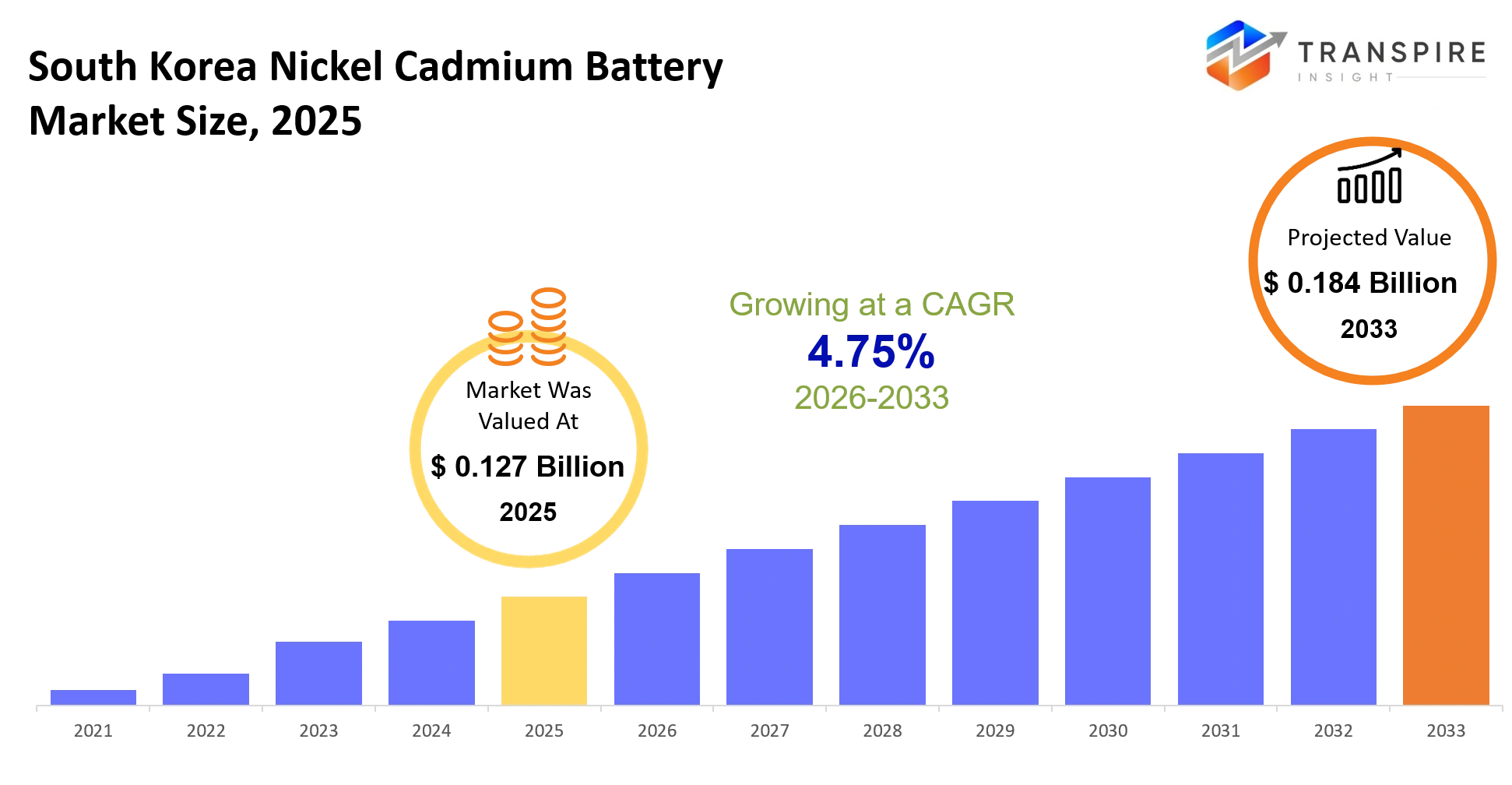
- South Korea Nickel Cadmium Battery Market Size 2025:USD 0.127 Billion
- South Korea Nickel Cadmium Battery Market Size 2033: USD 0.184 Billion
- South Korea Nickel Cadmium Battery Market CAGR: 4.75%
- South Korea Nickel Cadmium Battery Market Segments: By Type (Portable Ni-Cd Batteries, Industrial Ni-Cd Batteries, Sealed Ni-Cd Batteries, Others); By Application (Emergency Lighting, Aviation, Railways, Power Backup, Others); By End User (Industrial, Transportation, Utilities, Others)
To learn more about this report,  Download Free Sample Report
South Korea Nickel Cadmium Battery Market Summary
The South Korea Nickel Cadmium Battery Market was valued at USD 0.127 Billion in 2025. It is forecast to reach USD 0.184 billion by 2033. That is a CAGR of 4.75% over the period.
South Korea Nickel Cadmium Battery Market is kind of a big deal for keeping backup power steady, especially in industrial setups where any failure is not really an option. Think about emergency lighting in factories, railway signaling, aviation controls, and utility substations. The batteries tend to be appreciated because they can keep stable output even when the temperatures go extreme, plus they keep running reliably for a long service life, which matters a lot in safety-critical infrastructure. In real practice, this market is more about uninterrupted operations during grid fluctuations, outages, and those heavy load industrial cycles, rather than the usual everyday energy storage story that most people imagine.
In the last few years, things started to shift a bit, mostly because tighter environmental regulations now restrict cadmium handling, and there’s been a gradual move toward lithium-based alternatives especially in consumer uses. Still, the demand hasn’t really collapsed in regulated sectors where safety certification and proven discharge reliability are taken very seriously, so replacement pressure doesn’t fully bite. One clear trigger has been stricter industrial safety compliance across transportation and energy infrastructure, which has basically doubled down on the need for certified backup systems. That’s helped keep older legacy systems in place too, and it also slows down a full swap to other technologies, so overall revenues stay steady, even if the wider ecosystem is moving around.
Key Market Insights
- South Korea Nickel Cadmium Battery Market kinda keeps doing that “must work no matter what” routine for mission critical backup setups, across aviation railways, and utilities infrastructure, you know the whole deal.
- When you look at the trends, you can see slow replacement pressure from lithium-ion, but the industrial reliability part still sort of holds demand steady like it will not budge, even a little, no matter how the market shifts.
- Ni-Cd batteries on the industrial side feel more dominant because they deliver strong endurance, steady long lifecycle performance, and also they match very strict safety regulations, so procurement teams basically feel calmer, safer really.
- Emergency lighting stays as the main application, and it keeps a big share too, mainly because mandatory safety installation rules are already baked in, not optional, not negotiable.
- Railways are the fastest adopting area, mostly tied to modernization of signaling and the need for uninterrupted power even during odd conditions not just “regular” situations.
- For end users, utilities has the biggest market share, backed by grid stabilization programs and substation backup systems.
- Transportation shows steady growth, and this seems driven by aviation, plus railway electrification upgrades, throughout the 2025–2033 forecast window.
- Saft and EnerSys are reinforcing leadership with industrial grade Ni-Cd systems that are built around reliability, not just specs on paper.
- GS Yuasa and EaglePicher Technologies meanwhile lean into aviation grade reliability systems, with backup integration that supports operational continuity across real world interruptions.
- And the strategic expansion in the South Korea Nickel Cadmium Battery Market is largely pushed by the modernization of legacy infrastructure, plus compliance driven procurement cycles that bring requirements, timelines, and audits along with them, almost like clockwork.
What are the Key Drivers, Restraints, and Opportunities in the South Korea Nickel Cadmium Battery Market?
The main driver behind the South Korea Nickel Cadmium Battery Market is basically strict safety rules around operations, especially in areas where power loss can turn into high risk failures. In railway signaling systems, aviation backup controls and utility substations, they lean on certified battery formulations that keep a steady discharge rhythm, even when conditions get harsh. Regulatory compliance expectations that transportation and energy bodies apply have also pushed Ni-Cd solutions to stay in legacy setups. So procurement tends to stay fairly stable, mainly because replacement and upkeep chores keep coming back, not because there is some big wave of brand new infrastructure growth.
On the other hand the biggest restraint is environmental pressure, tied to cadmium toxicity rules. These requirements make it harder to expand in brand-new installations, even when the reliability case is solid. There are also disposal limits and higher compliance costs, which makes lifecycle management a bit more expensive for end users. A lot of industries are shifting toward lithium ion solutions for new deployments, and that kind of pivot kind of locks in a ceiling for longer term growth. As a result, incremental demand drops, and Ni-Cd batteries get squeezed into smaller, more specific niches, which slows the overall revenue expansion even though replacement demand stays pretty steady.
There’s a real key chance sitting in the infrastructure modernization push, across railways and utilities too, where these hybrid backup arrangements are showing up a bit more often now, not completely evenly though. In South Korea, the ongoing spend on smart railway signaling and grid hardening keeps dragging along the need for certified backup storage. And if Ni-Cd batteries get placed inside redundant safety layers—especially in very high reliability spaces like aviation maintenance hubs and the nuclear-adjacent utility networks—then you can back steady niche growth, even if the bigger adoption curve stays uneven, kind of up and down.
What Has the Impact of Artificial Intelligence Been on the South Korea Nickel Cadmium Battery Market?
Artificial intelligence is gradually reshaping operational monitoring and lifecycle management inside the South Korea Nickel Cadmium Battery Market, especially across industrial backup systems and infrastructure safety networks, kinda like an always-on pair of extra eyes. AI based diagnostic tools are getting stitched into power management systems so they can watch battery health, voltage stability, and discharge cycles in real time across railway signaling corridors and utility substations . With this kind of setup operators tend to cut unexpected downtime, because early degradation patterns show up sooner, and maintenance schedules get optimized instead of just reacting late.
Machine learning models are also lifting predictive maintenance accuracy by sorting through past discharge data along with environmental conditions, then forecasting performance decline in backup installations. As a result utilities and transportation operators can extend service life while still keeping compliance with safety standards, no shortcuts. In industrial control environments, AI driven energy management systems help operational efficiency too, by lowering manual inspection needs and speeding up fault detection, which is really where the difference feels practical.
However, adoption stays kinda limited because integration costs keep being high, and data quality comes in inconsistent, from the old legacy infrastructure. A bunch of older installations still do not have digital monitoring interfaces, so advanced analytics get less useful and it kind of ruins the whole idea. Also, there are connectivity limitations in remote substations and across railway networks, which further shrinks the ability to run real-time AI deployment, and so the full-scale transformation gets slower, not just a little, but quite a lot.
Key Market Trends
- South Korea Nickel Cadmium Battery Market looks like it’s getting more and more dependent on replacement- style demand, not so much on brand new setups across industrial zones, kinda shifting the whole story a bit.
- In fact the Utilities sector moved toward digital monitoring systems which helps lifecycle tracking for Ni-Cd batteries in substations since 2022, so the emphasis is different than it was before.
- Meanwhile railway modernization pushed backup power needs up by over 15% during signaling infrastructure upgrades in 2023–2025, so operators had to rethink their supply tempo a little.
- Aviation maintenance facilities also expanded certified battery replacement cycles, partly because international safety compliance standards got more strict after 2022.
- Industrial buyers then reduced fresh Ni-Cd adoption by nearly 20%, since lithium-ion alternatives became cheaper for non-critical configurations and honestly that trend is pretty stubborn.
- Emergency lighting systems still stay in front, mostly because safety regulations in commercial and industrial buildings in South Korea didn’t really change.
- On the supplier side strategic companies like Hoppecke leaned into longer service arrangements rather than just moving product only, which feels like a more stable kind of play.
- So the South Korea Nickel Cadmium Battery Market growth is increasingly shaped by lifecycle service agreements and compliance-driven procurement, not only by price sensitivity.
- And utilities plus transportation kept raising digital monitoring adoption, which improves predictive maintenance efficiency for older Ni-Cd installations.
South Korea Nickel Cadmium Battery Market Segmentation
By Type
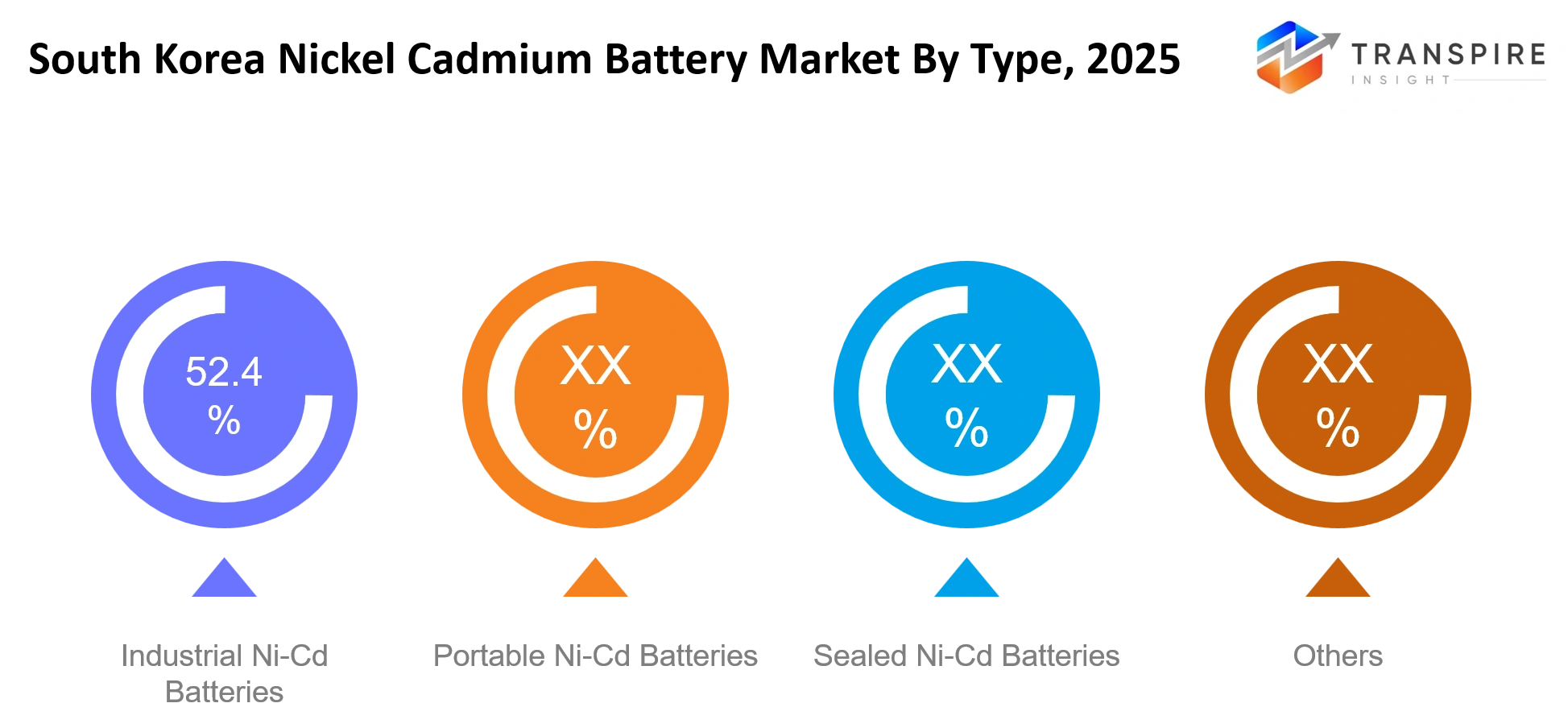
Portable Ni-Cd batteries are pretty useful for compact backup setups where mobility matters a lot and short-duration power stability is still needed. You’ll often see these types in emergency devices, and also in portable industrial gear that depends on steady discharge performance, even when things get a bit chaotic. Industrial Ni-Cd batteries kind of dominate the scene, because they have a proven track record in substations, aviation systems, and railways infrastructure. They deliver long cycle life too, and the output stays consistent under extreme conditions. Sealed Ni-Cd batteries, meanwhile, are commonly deployed in enclosed areas where maintenance-free operation is the whole point. Another category is basically the “other” group, and it covers specialized configurations used in niche industrial systems, with custom power needs that don’t fit the usual templates.
Industrial Ni-Cd batteries keep the biggest share due to high reliability standards in critical infrastructure. Portable versions show limited growth though, because consumer applications are increasingly swapping to lithium-based systems. Sealed variants still keep expanding in regulated industrial environments where safety compliance is mandatory, and where less maintenance intervention is desired. Overall, the market evolution feels strongly tied to safety-certified backup systems, rather than being driven by consumer demand alone.
To learn more about this report, Download Free Sample Report
By Application
Emergency Lighting remains the dominant application due to mandatory installation requirements for commercial and industrial buildings, kind of a “make it work no matter what” vibe. These systems keep operational safety intact, even when the grid goes sideways or when emergency shutdown scenarios show up . In aviation, Ni-Cd batteries are used as back up for instrumentation plus safety critical control systems, so no, it’s not really optional. For railways, they’re there in signaling and communication backup setups, and they need uninterrupted performance, otherwise everything starts to lag, and that becomes a problem fast. There are also defense installations and industrial automation environments, with specialized power continuity needs that are picky.
Emergency Lighting still leads, mostly because regulators keep pushing enforcement through building safety codes. Railway applications keep growing too, driven by modernization of signaling infrastructure, and electrified transport networks that never really pause . Aviation demand stays fairly steady, because certification requirements tied to battery chemistries are already proven, and they don’t like surprises. Overall, the application patterns point to a strong dependence on regulated environments, where reliability wins out over pure cost optimization.
By End User
Industrial end users end up as the biggest slice, mostly because they are installed all over manufacturing plants and different heavy infrastructure setups. Transportation is next, with aviation plus railway segments, and in both situations they really do need certified backup power equipment so ops stay alive even during disruptions or small outages. Utilities lean quite a bit on Ni-Cd batteries, especially at substations, where they help keep grid stability and they absolutely match those reliability requirements. Then there’s the “Other” category, which sort of mashes together defense facilities and specialized government infrastructure use, cases that don’t fit neatly anywhere else.
Industrial users keep leading, since they rely on backup systems almost nonstop for safety, compliance, and that “don’t fail” expectation. Transportation is still climbing, driven by modernization of rail lines and upgrades across aviation infrastructure. Utilities stay pretty steady as an end user group, supported by ongoing grid reliability needs and resilience programs. Overall end- user dynamics lean heavily on regulatory dependence and lifecycle oriented purchasing habits, kind of like clockwork, even when demand shifts.
What are the Key Use Cases Driving the South Korea Nickel Cadmium Battery Market?
Core demand kind of comes from railway signaling systems, where uninterrupted power keeps train operations safe and it prevents control failures when the grid does its occasional interruptions. Those systems use Ni-Cd batteries, mostly because the discharge stays stable for a long time, and the behavior is predictable even when conditions are pretty harsh.
If we look at broader use cases, aviation ground support systems also lean on them, plus industrial emergency lighting inside manufacturing complexes. In practice, these depend on certified backup power so safety requirements still hold up and day to day operations don’t just stall during outages, even if it’s brief.
Now, the emerging part, smart grid substations and automated industrial monitoring systems are getting more attention. They need reliable auxiliary power for sensing and switching, and they are increasingly integrated with digital control platforms, which helps with real time fault detection and keeps operational resilience better across critical infrastructure networks.
|
Report Metrics |
Details |
|
Market size value in 2025 |
USD 0.127 Billion |
|
Market size value in 2026 |
USD 0.133 Billion |
|
Revenue forecast in 2033 |
USD 0.184 Billion |
|
Growth rate |
CAGR of 4.75% from 2026 to 2033 |
|
Base year |
2025 |
|
Historical data |
2021 - 2024 |
|
Forecast period |
2026 - 2033 |
|
Report coverage |
Revenue forecast, competitive landscape, growth factors, and trends |
|
Regional scope |
South Korea |
|
Key company profiled |
Saft, EnerSys, GS Yuasa, Panasonic, Alcad, HBL Power, Sichuan Changhong, Hoppecke, Exide, Toshiba, BYD, East Penn, Marathon Norco, EaglePicher, VARTA |
|
Customization scope |
Free report customization (country, regional & segment scope). Avail customized purchase options to meet your exact research needs. |
|
Report Segmentation |
By Type (Portable Ni-Cd Batteries, Industrial Ni-Cd Batteries, Sealed Ni-Cd Batteries, Others); By Application (Emergency Lighting, Aviation, Railways, Power Backup, Others); By End User (Industrial, Transportation, Utilities, Others) |
Which Regions are Driving the South Korea Nickel Cadmium Battery Market Growth?
North America kinda keeps the upper hand in the South Korea Nickel Cadmium Battery Market, mostly because its aviation and defense setup is already fairly mature, and it still leans on certified reserve power systems, if that even makes sense. Strict Federal Aviation Administration safety rules, plus long running industrial safety routines, really do help keep Ni-Cd batteries in use for essential operations. You also get a pretty dense layout of certified service centers, and there’s strong stitching of backup systems across airports, and military bases too. Because of all that, replacements tend to roll out on a routine cadence rather than from brand new adoption. So it kinda ends up reinforcing leadership in overall global consumption patterns.
Europe, on the other hand, looks more stable in the South Korea Nickel Cadmium Battery Market, and it’s regulated as well, backed by dependable industrial compliance frameworks and ongoing utility modernization pushes. Compared with the leading region, Europe’s demand feels more linked to infrastructure renewal instead of heavy defense intensity. Places like Germany and France keep putting steady funding into railway signaling, along with industrial safety backup roles. The regulatory steadiness that comes from EU industrial safety directives also helps procurement cycles stay fairly predictable. That combination, just adds up to a durable demand base, delivering pretty steady revenue, with not much in the way of sudden spikes or dips.
Asia Pacific kinda looks like the fastest-growing area in the South Korea Nickel Cadmium Battery Market, mainly because of rapid railway expansion mixed with utility grid modernization programs. Lately, new investments in smart rail corridors and industrial automation infrastructure in South Korea, India,and Southeast Asia have pushed more certified backup systems into the field. I guess a big change happened after 2023, when governments started putting extra weight on infrastructure resilience and uninterrupted power systems for both transport and energy sectors. That whole wave is now pulling battery manufacturers to broaden regional partnerships and grow their service networks too. For people trying to enter the market, Asia Pacific is probably the best growth route between 2026 and 2033, since infrastructure digitalization keeps speeding up.
Who are the Key Players in the South Korea Nickel Cadmium Battery Market and How Do They Compete?
In the South Korea Nickel Cadmium Battery Market, competition feels kinda moderately consolidated, like the same big names keep showing up, over and over. Established battery manufacturers tend to dominate, mainly because they can lean on certification strength, steady long lifecycle reliability and procurement that’s pushed by compliance requirements. Most of the time the incumbents aren’t really battling it out on price. Instead they defend position through long term arrangements with utilities, rail operators and aviation maintenance providers, sort of a lock-in effect. New entrants don’t seem to move things much, and overall it’s more about service continuity, technical certification and replacement-cycle efficiency. Competitive intensity is especially high in industrial and transportation backup segments, where failure risk is… basically not allowed, full stop.
Saft comes in with high-reliability, industrial-grade Ni-Cd systems targeted at aviation and defense. Their pitch is certified safety compliance, plus long operational life cycles, you know the usual trust signals. They also build strength via collaborations with aerospace maintenance providers and longer supply agreements across regulated infrastructure networks. EnerSys differentiates with broad industrial coverage and solid aftermarket service networks, and they keep expanding by using maintenance contracts for utilities and transportation systems. GS Yuasa leans on engineering precision and railway oriented backup configurations, then reinforces presence through partnerships with rail infrastructure operators in Asia. EaglePicher Technologies focuses on aerospace-certified battery solutions and expands through defense contracts, plus more specialized aviation system integrations where compliance validation has to be strict, no shortcuts, not really.
Company List
- Saft
- EnerSys
- GS Yuasa
- Panasonic
- Alcad
- HBL Power Systems
- Sichuan Changhong
- Hoppecke
- Exide Industries
- Toshiba
- BYD
- East Penn Manufacturing
- Marathon Norco Aerospace
- EaglePicher Technologies
- VARTA
Recent Development News
In March 2025, EnerSys announced expansion of its industrial battery service network in Asia. The expansion strengthened aftermarket support capabilities for utility and transportation backup systems across the region.https://www.enersys.com
In January 2026, Saft launched an upgraded industrial Ni-Cd battery platform designed for extended lifecycle performance in aviation applications. The launch improved reliability metrics for critical backup systems used in regulated infrastructure.https://www.saft.com
What Strategic Insights Define the Future of the South Korea Nickel Cadmium Battery Market?
The South Korea Nickel Cadmium Battery Market is, kinda gradually, moving toward a more maintenance-driven ecosystem where replacement cycles, and compliance requirements… they basically take over how revenue gets made. Over the next 5–7 years, demand should stay pretty anchored in aviation, railways, and utility infrastructure, pushed along by tough safety certification standards, plus the plain need for uninterrupted backup power in really critical systems.
There’s also a less obvious risk that’s easy to overlook, from faster substitution in newly developed infrastructure. In several new builds, lithium-ion systems are getting specified right in the design stage, which means the long term Ni-Cd integration chances get narrowed. So even if replacement demand stays steady, this structural change might still squeeze future installation volumes.
On the other hand, there’s an opportunity that’s starting to show up more often in practice: hybrid backup architectures inside smart grid upgrades, and railway modernization work. In those setups, Ni-Cd batteries can be kept as the fail safe layer inside multi chemistry systems. Market participants should lean into service based contracts and lifecycle management solutions, not just standalone product sales, if they want steadier long-run revenue in this shifting environment.
South Korea Nickel Cadmium Battery Market Report Segmentation
By Type
- Portable Ni-Cd Batteries
- Industrial Ni-Cd Batteries
- Sealed Ni-Cd Batteries
- Others
By Application
- Emergency Lighting
- Aviation
- Railways
- Power Backup
- Others
By End User
- Industrial
- Transportation
- Utilities
- Others
Frequently Asked Questions
Find quick answers to common questions.
The expected South Korea Nickel Cadmium Battery Market size for the market will be USD 0.184 Billion in 2033.
By Type (Portable Ni-Cd Batteries, Industrial Ni-Cd Batteries, Sealed Ni-Cd Batteries, Others); By Application (Emergency Lighting, Aviation, Railways, Power Backup, Others); By End User (Industrial, Transportation, Utilities, Others).
Major South Korea Nickel Cadmium Battery Market players areSaft, EnerSys, GS Yuasa, Panasonic, Alcad, HBL Power, Sichuan Changhong, Hoppecke, Exide, Toshiba, BYD, East Penn, Marathon Norco, EaglePicher, VARTA.
The South Korea Nickel Cadmium Battery Market size is USD 0.127 Billion in 2025.
The South Korea Nickel Cadmium Battery Market CAGR is 4.75% from 2026 to 2033.
- Saft
- EnerSys
- GS Yuasa
- Panasonic
- Alcad
- HBL Power Systems
- Sichuan Changhong
- Hoppecke
- Exide Industries
- Toshiba
- BYD
- East Penn Manufacturing
- Marathon Norco Aerospace
- EaglePicher Technologies
- VARTA
About the Authors

Avinash Kumar
I’m Avinash Kumar, a Senior Research Analyst at Transpire Insight, with expertise in the Electronics and Semiconductor and Energy & Power industry. My work focuses on analyzing emerging technologies, market trends, industry developments, and innovation across these sectors. I specialize in transforming complex technical and market insights into clear, research-backed content that helps professionals, businesses, and decision-makers stay informed. Through continuous industry research and data-driven analysis, I strive to deliver accurate, reliable, and practical perspectives on the latest advancements shaping the semiconductor and energy landscape.

Chakradhar Khansole
Chakradhar serves as the Research Director at Transpire Insight, bringing over 8 years of experience in technology, innovation, and strategic market intelligence. He specializes in transforming complex market data into actionable business insights that enable organizations to make informed, growth-oriented decisions. Recognized for his strategic vision and analytical expertise, Chakradhar leads high-impact research initiatives, delivering comprehensive market assessments, competitive intelligence, and forward-looking industry analysis.
Recently Published Reports
-
Apr 2026
Fiber Optic Faceplates Market
Fiber Optic Faceplates Market Size, Share & Analysis Report By Type (< 300 mm2, 300-350 mm2, and > 350 mm2, By Application (Night Vision, Holographic Imaging, Medical, and Others), and Geography (North America, Europe, Asia-Pacific, Middle East and Africa, South and Central America), 2021 - 2031
-
Apr 2026
High Temperature Superconductors Market
High Temperature Superconductors Market Size, Share & Analysis Report By Type (1G HTS, and 2G HTS), By Application (Power Cable, Fault Current Limiter, and Transformer), and Geography (North America, Europe, Asia-Pacific, Middle East and Africa, South and Central America), 2021 - 2031
-
Apr 2026
Industrial Plugs and Socket Market
Industrial Plugs and Socket Market Size, Share & Analysis Report By Type (Industrial Plugs, Industrial Sockets), By Current (Up to 32 A, 32 to 125 A, Above 125 A), By Protection (Dustproof and Splash Proof, Waterproof, Explosion Proof), By End User (Heavy Industries, Oil and Gas, Chemicals and Pharmaceuticals, Power Generation, Others), and Geography (North America, Europe, Asia-Pacific, Middle East and Africa, South and Central America), 2021 - 2031
-
Apr 2026
InGaAs Avalanche Photodiodes Market
InGaAs Avalanche Photodiodes Market Size, Share & Analysis Report By Type (1100 - 1700 nm, and 1000 - 1600 nm), By Application (Missile Warning System, Muzzle Flash Detection, Wafer Defect Inspection, Laser Rangefinders, and Others), and Geography (North America, Europe, Asia-Pacific, Middle East and Africa, South and Central America), 2021 - 2031