
South Korea Nickel Sulfate Market Size & Forecast:
- South Korea Nickel Sulfate Market Size 2025: USD 261.9 Million
- South Korea Nickel Sulfate Market Size 2033: USD 815.5 Million
- South Korea Nickel Sulfate Market CAGR: 15.23%
- South Korea Nickel Sulfate Market Segments: By Grade (Battery Grade, Industrial Grade, High Purity Grade, Electroplating Grade, Specialty Grade, Technical Grade, Recycled Grade, Others); By Application (EV Batteries, Energy Storage Systems, Electroplating, Catalysts, Chemicals, Alloys, Research Applications, Others); By End User (Battery Manufacturers, Chemical Companies, Automotive OEMs, Electronics Firms, Industrial Users, Research Institutes, Energy Companies, Others)
South Korea Nickel Sulfate Market Summary
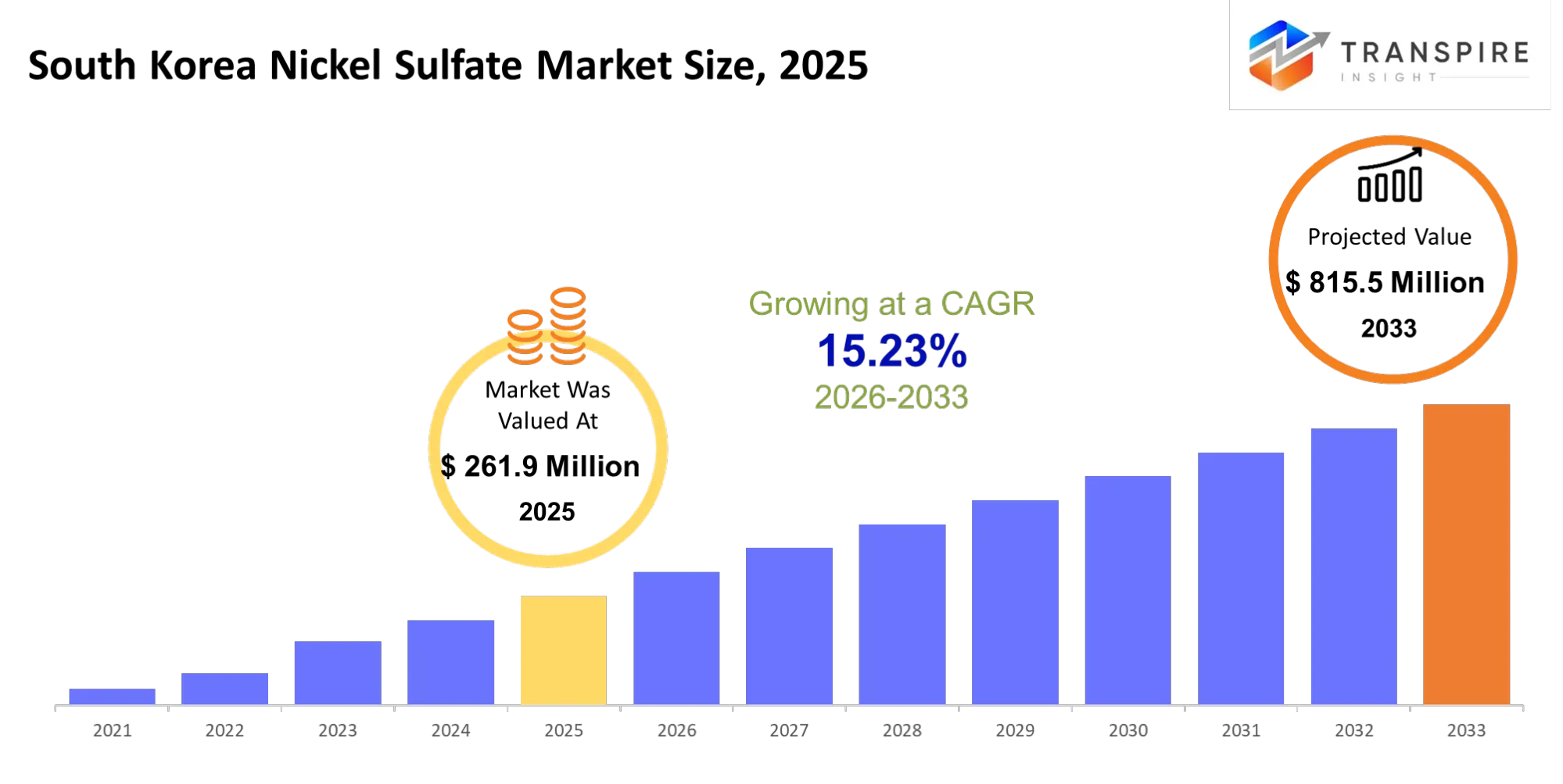
The South Korea Nickel Sulfate Market was valued at USD 261.9 Million in 2025. It is forecast to reach USD 815.5 Million by 2033. That is a CAGR of 15.23% over the period.
In South Korea, the nickel sulfate market kind of sits right in the middle of the whole battery manufacturing ecosystem. This material takes refined nickel, then turns it into a battery-grade chemical, which helps high energy density cathodes work properly. Because of that, electric vehicles can go farther and consumer electronics can keep more power in tighter, more compact formats. Over the last three to five years, the market has seen a real structural change, it moved away from depending on imported intermediates, toward more localized and vertically integrated battery supply chains. That shift picked up speed after global supply chain disruptions and geopolitical tensions, which basically showed how risky it is when raw materials are sourced from just a few places.
As battery makers rolled out more domestic production capacity, and also locked in long-term feedstock agreements, nickel sulfate consumption changed too. It went from being a more cyclical industrial kind of demand, to something closer to strategic procurement. And this is starting to reshape revenue streams as well, since producers are now putting money into higher purity grades, plus more stable supply networks, in order to capture more value as South Korea’s battery exports keep expanding.
Key Market Insights
- The South Korea nickel sulfate market is, like, increasingly pulling in on the southeastern industrial corridor , which still held close to 60% of production capacity in 2025.
- Ulsan is the main manufacturing region, mostly because the battery supply chains there are kinda all connected, while Gyeonggi Province is the fastest-moving hub up through 2032.
- Battery-grade nickel sulfate keeps taking the lead, with more than 80% market share, since cathode manufacturers really lock in on high-purity ingredients for high-nickel battery chemistries.
- Industrial-grade nickel sulfate is still the next biggest chunk, and it’s supported by electroplating and specialty chemical use cases , even though its growth pace is slower than the leaders.
- Then there’s high-purity nickel sulfate above 99.9% purity, which is growing the quickest segment as premium EV batteries move toward nickel-rich cathodes.
- On the demand side, lithium-ion battery cathodes represent nearly 85% of total needs, so energy storage becomes the dominant application across the South Korea nickel sulfate market.
- Energy storage systems are also the fastest-growing application, since utilities and manufacturers keep ramping up grid-scale battery installations after 2023.
- Battery manufacturers still show up as the leading end-user group, with over 75% share, and that’s backed by aggressive domestic cathode production investment.
- After 2021, strategic partnerships between producers and battery makers expanded pretty sharply, because supply security became a kind of critical competitive edge.
- More manufacturers are also turning toward recycled nickel feedstocks and digital process control tools, to lower production costs, and at the same time strengthen overall competitiveness in the market.
What are the Key Drivers, Restraints, and Opportunities in the South Korea Nickel Sulfate Market?
The main force pushing the South Korea Nickel Sulfate Market forward is a quick move toward high nickel lithium-ion cells used in electric vehicles. That momentum kinda really picked up after 2020, when car makers leaned into longer drive ranges, and battery firms ramped up output of nickel-dense cathodes like NCM 811. As cathode factories expanded their capacity, and signed multi-year agreements for supply, nickel sulfate stopped being only a niche chemical and became a more strategic battery ingredient. With that change, producers get steadier revenue visibility, plus more investment shows up across the whole domestic battery materials web.
Still, raw material dependence is the biggest structural block for the market. South Korea leans on imported nickel matte and mixed hydroxide precipitate a lot, which puts producers in the crosshairs of geopolitical uncertainty and swings in commodity prices. Building fresh upstream mining operations, or adding refining capability, needs heavy capital outlays and long development timelines. Because of that, production costs can climb, supply flexibility is reduced, and expansion schedules for battery material manufacturers sometimes get pushed back, or delayed for a while.
Nickel recycling looks like the most promising chance for the next growth phase. More and more manufacturers are pulling nickel from used batteries and production scrap, basically to lock in local feedstock. At the same time investments in closed-loop recycling systems are picking up steam because they cut import dependence, steady raw material prices, and in general help the country keep a stronger, long-term battery supply chain resilience.
What Has the Impact of Artificial Intelligence Been on the South Korea Nickel Sulfate Market?
Artificial intelligence and advanced digital technologies are kind of reshaping nickel sulfate production, by pushing process efficiency, quality control, and supply chain visibility all at once. Manufacturers now tend to deploy AI-enabled monitoring systems across refining and crystallization facilities, to optimize things like temperature, chemical concentration ,and impurity removal in real time. Automated control systems keep looking at production variables and then fine-tune operating conditions, which cuts material losses while also making the final product more consistent.
Machine learning models, on top of that, support predictive maintenance. They do this by interpreting equipment vibrations, pressure variations, and historical operating data. In practice operators can spot potential failures earlier, before an unplanned shutdown happens, that boosts plant uptime and also trims maintenance expenses. AI-driven forecasting tools also help inventory planning by estimating raw material needs and market demand swings with more steadiness, rather than guessing too late.
Operational improvements have become more noticeable since 2022. Producers say they get higher production yields, lower energy consumption, and quicker quality inspections, using computer vision technologies. Digital twins, meanwhile, are showing up as useful methods for trying out process improvements before they’re actually carried out in the physical plant.
Still, AI adoption has limitations. Bringing advanced analytics into legacy refining equipment usually takes a lot of money, and in battery-grade nickel sulfate production, there can be limited historical datasets. That shortage can reduce model accuracy when operating conditions get complicated and a bit unpredictable.
Key Market Trends
- Since 2021, battery makers have been shifting toward longer term nickel sulfate procurement contracts, in order to reduce their exposure to raw material price volatility and that kind of thing.
- Producers also started investing more in recycling facilities because recovered nickel is looking like a strategic substitute for imported feedstocks, more often than before.
- After 2020, high nickel cathode chemistries gained notable share, and that pulled demand upward for ultra high purity nickel sulfate production…pretty quickly.
- Then the supply chain playbook changed rapidly after global logistics disruptions, with manufacturers putting more emphasis on localized sourcing, and operations that are more integrated overall.
- Digital manufacturing technologies got more attention after 2022, as producers rolled out AI based monitoring to boost yield and also keep processing costs down.
- In terms of competition, the focus moved away from pure price competition toward supply security, so partnerships became more common across mining refining, and battery manufacturing segments.
- Over roughly the last five years, environmental regulations encouraged companies to use energy efficient refining technologies and adopt lower carbon production methods.
- Investment in precursor and cathode material facilities accelerated too, especially as South Korea strengthened its role inside the global battery ecosystem.
- And going forward through the forecast period, manufacturers increasingly diversify nickel sourcing strategies, to lower geopolitical risks and maintain steady production, more consistently.
South Korea Nickel Sulfate Market Segmentation
By Grade :
Battery grade nickel sulfate is used for making lithium ion batteries, mostly for electric vehicles and also energy storage systems, in general. You see it valued because the quality stays consistent and the nickel content stays high, so it matters a lot for cathode making . As battery production sites keep expanding, this segment gets pulled along across the whole value chain, more and more.
Industrial grade nickel sulfate is for several industry jobs where ultra high purity isn’t really needed. Meanwhile High Purity Grade is made for the newer applications that insist on strict quality rules. Electroplating Grade is for surface finishing steps , and Specialty Grade together with Technical Grade cover separate industrial requirements. Recycled Grade is getting noticed too, since producers are leaning more on resource recovery and material efficiency . The Others part includes custom grades, created for narrow use cases and specialized industrial needs.
By Application :
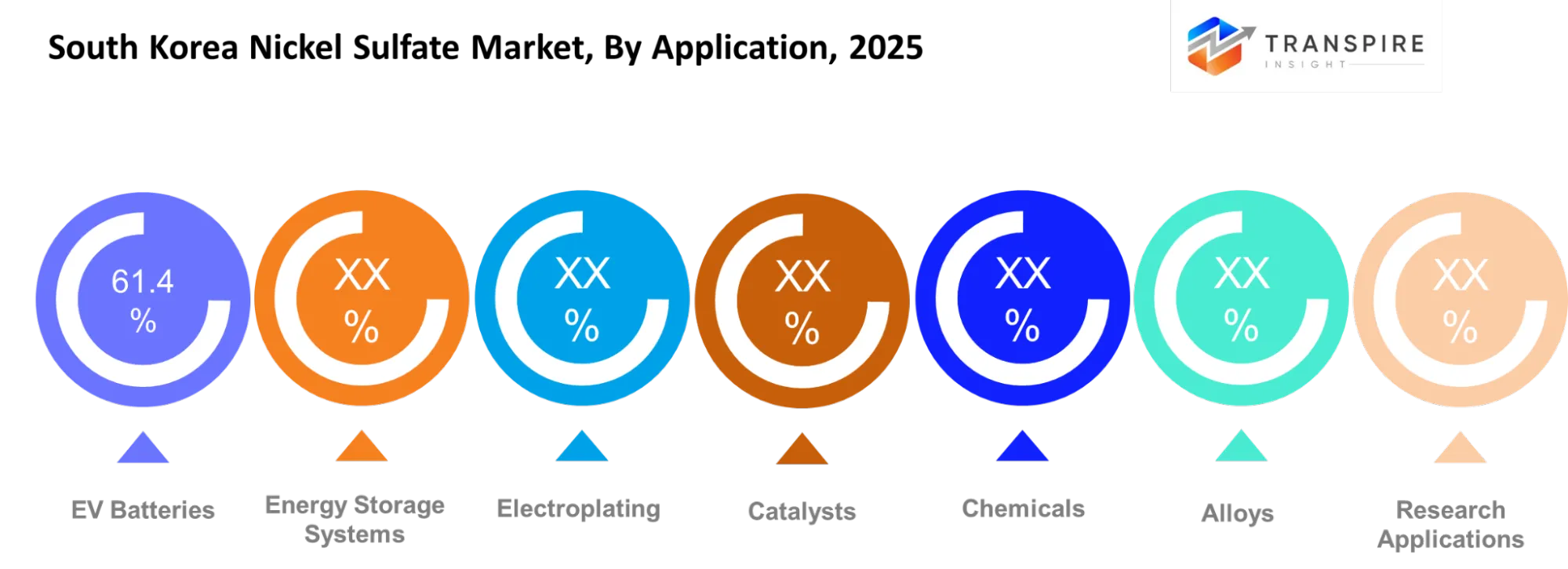
EV Batteries are still kind of the biggest application segment since the use of nickel-rich battery chemistries keeps ramping up. In that setup, nickel sulfate has a key part, it improves battery performance, energy density and also driving range. Meanwhile strong investments into electric mobility keep pushing demand from battery producers, and the related supply chain stuff that comes with them.
Energy Storage Systems add a lot too, particularly as power storage projects are expanding. For electroplating, nickel sulfate is used to boost corrosion resistance and surface quality, it’s pretty common. Then for catalysts, chemicals, and alloys, nickel compounds are used throughout manufacturing steps, and they also help product performance. Research Applications back material development and innovation work, basically where new improvements get tested. The Others segment is a mixed basket, it covers emerging uses that are still being explored, since technology requirements keep shifting across industries.
By End User :
Battery manufacturers hold a big chunk of total consumption, since nickel sulfate is a crucial raw material for lithium-ion battery cathodes, so basically a lot of it has to move through their supply chain. As electric vehicle output and battery capacity keep growing, this buying momentum has become more noticeable from their side , too. On top of that, long-term sourcing contracts make this end-user group even more important , because shipments are planned earlier and locked in for longer.
Chemical Companies treat nickel sulfate as a kind of go-between substance, used across several production routes and downstream steps. Automotive OEMs help carry demand through electric vehicle development and battery supply collaborations. Electronics Firms lean on more advanced battery chemistries for both consumer gadgets and industrial hardware. Industrial Users rely on nickel sulfate for plating work, plus manufacturing operations that need reliable consistency. Research Institutes concentrate on materials work, then they do development , testing, and related verification. Energy Companies apply battery storage methods for managing power across projects. The Others category includes extra users with specialized operational needs, requirements that do not fit neatly anywhere else.
What are the Key Use Cases Driving the South Korea Nickel Sulfate Market?
In South Korea, nickel sulfate still shows up mostly for electric vehicle batteries, i mean thats the primary use case, and it stays that way for now. Battery makers lean on high-purity nickel compounds so they can build nickel-rich cathodes, which in turn help energy density go up and can push the driving range further. The rapid build out of local battery plants, plus solid export momentum, keeps feeding the biggest part of total material usage.
Then there’s energy storage systems, they are turning into a kind of secondary use, especially as utilities and industrial sites put money into large battery deployments. Electroplating is also steady, mainly because electronics and industrial manufacturers still want durable coatings, and those coatings come with better corrosion resistance and a smoother surface feel.
Looking ahead, more unusual uses are starting to appear, like battery recycling, and also advanced research around solid-state batteries. Companies are getting more serious about recovering nickel from spent batteries so they can secure nearby feedstock, while research institutes and technology teams explore newer chemistries. If those efforts land, they could open up new demand across the forecast period.
|
Report Metrics |
Details |
|
Market size value in 2025 |
USD 261.9 Million |
|
Market size value in 2026 |
USD 302.4 Million |
|
Revenue forecast in 2033 |
USD 815.5 Million |
|
Growth rate |
CAGR of 15.23% from 2026 to 2033 |
|
Base year |
2025 |
|
Historical data |
2021 - 2024 |
|
Forecast period |
2026 - 2033 |
|
Report coverage |
Revenue forecast, competitive landscape, growth factors, and trends |
|
Country scope |
South Korea |
|
Key company profiled |
POSCO Future M, EcoPro, LG Chem, Sumitomo Metal Mining, Umicore, BASF, Huayou Cobalt, GEM, CNGR, Jinchuan, Vale, BHP, Glencore, Norilsk Nickel, Mitsubishi Materials |
|
Customization scope |
Free report customization (country, regional & segment scope). Avail customized purchase options to meet your exact research needs. |
|
Report Segmentation |
By Grade (Battery Grade, Industrial Grade, High Purity Grade, Electroplating Grade, Specialty Grade, Technical Grade, Recycled Grade, Others); By Application (EV Batteries, Energy Storage Systems, Electroplating, Catalysts, Chemicals, Alloys, Research Applications, Others); By End User (Battery Manufacturers, Chemical Companies, Automotive OEMs, Electronics Firms, Industrial Users, Research Institutes, Energy Companies, Others) |
Which Regions are Driving the South Korea Nickel Sulfate Market Growth?
The south-eastern part of South Korea is still basically the leading place for nickel sulfate production and also consumption. Cities like Ulsan, Pohang, and Gwangyang seem to ride on big industrial clusters, well prepared port infrastructure, and really tight connections to battery and cathode manufacturers. On top of that, government backing for electric vehicle supply chains and battery materials keeps pushing companies to put money into refining units, also precursor facilities. With this kind of connected arrangement, firms can lock in raw materials more easily, lower transport expenses, and keep production levels steady for both local needs and exports.
Then you have the Seoul metropolitan area together with Gyeonggi Province, which looks like the second most important region. Still, the growth reasons there are not exactly the same as in the southeast. In this case the advantage is more about solid research ability, close distance to battery technology companies, and dependable investment from the electronics and automotive industries. Demand stays firm, because manufacturers are not just selling today, they are also pushing product changes, newer battery chemistries, and multi year technology plans. Since industrial activity keeps going and supply channels are already in place, this area ends up being a reliable contributor to market revenue.
Chungcheong Province is, in a way, the one that is emerging the fastest. New battery material projects and precursor plants are moving beyond the old style industrial strongholds. Lately, investments in industrial parks, better transport links, and expanded battery manufacturing capacity have opened up fresh doors for nickel sulfate suppliers. Local governments are also getting more involved, using incentives and infrastructure upgrades aimed at advanced materials industries. As this momentum builds, the region should offer interesting prospects for new entrants and investors who want room to expand between 2026 and 2033.
Who are the Key Players in the South Korea Nickel Sulfate Market and How Do They Compete?
Competition in the South Korea nickel sulfate industry is like moderately concentrated, but not completely. A small group of integrated producers controls a large chunk of the output, and the rest of the market kind of follows around that. Firms usually compete by production capability, secure raw materials, product purity, and they build long-term, steady relationships with battery manufacturers, instead of only going head to head on price. The established producers keep pushing their positions via vertical integration, while newer entrants tend to bet on recycling technologies and on specialized battery materials, kind of to stand out a bit more.
LG Chem is more focused on high performance battery materials, and it also benefits from close linkage with cathode related and battery manufacturing operations. The company puts serious investment into advanced cathode technologies and it signs long term supply agreements. Those arrangements create consistent demand, and they also strengthen supply chain control, even when conditions get messy. EcoPro Materials differentiates through precursor production and high-nickel cathode materials, so it can react fairly fast when battery chemistry requirements start shifting.
POSCO Future M combines nickel sulfate output with wider battery material operations, and it leans on strong access to raw materials through global partnerships. Korea Zinc, on the other hand, is expanding into battery materials using its experience in non ferrous metal refining, plus recycling technologies. Ongoing investment in recycled nickel recovery and purification is a key part of that approach. Over time this helps reduce reliance on imported feedstocks, and it supports cost competitiveness too.
Company List
- POSCO Future M
- EcoPro
- LG Chem
- Sumitomo Metal Mining
- Umicore
- BASF
- Huayou Cobalt
- GEM
- CNGR
- Jinchuan
- Vale
- BHP
- Glencore
- Norilsk Nickel
- Mitsubishi Materials
Recent Development News
In June 2025, POSCO Future M completed the Gwangyang precursor plant with an annual production capacity of 45,000 tons and secured an in-house supply chain for high-purity nickel sulfate. The investment strengthens domestic battery material production and reduces dependence on imported precursor materials. Sourcehttps://newsroom.posco.com/
In September 2025, EcoPro Materials entered a strategic partnership with Green Li-ion through a Letter of Intent for recycled NCM hydroxide supply. The agreement secures recycled battery materials for five years starting in 2026 and supports expansion of sustainable nickel and precursor supply chains. Sourcehttps://www.greenli-ion.com/
What Strategic Insights Define the Future of the South Korea Nickel Sulfate Market?
South Korea Nickel Sulfate Market is moving, towards a more integrated and local-ish battery materials ecosystem, over the next five to seven years. The main push behind this change is basically the supply chain security factor, because battery manufacturers want steady access to high-purity nickel materials, but also they’re trying to cut back on exposure to geopolitical disruptions and too much import dependence. As this goes forward, you should expect more investment showing up in domestic refining, precursor making, and also recycling capability or infrastructure, depending how you phrase it.
There’s another risk that’s not as easy to see: battery chemistry diversification. Even if nickel-rich cathodes are still a big deal, lithium iron phosphate adoption keeps rising, and there are advances in alternative chemistries too, which could slow the nickel sulfate consumption growth in some particular applications. Meanwhile, recycling is turning into a pretty major opportunity. Closed-loop recovery systems that take nickel out of spent batteries are getting commercially realistic, and they may end up reshaping how raw materials are sourced in practice.
For market players, the smart move is to put emphasis on recycling technologies and on longer-horizon raw material partnerships. That should help build resilience, and also keep future growth chances more secure.
South Korea Nickel Sulfate Market Report Segmentation
By Grade
- Battery Grade
- Industrial Grade
- High Purity Grade
- Electroplating Grade
- Specialty Grade
- Technical Grade
- Recycled Grade
By Application
- EV Batteries
- Energy Storage Systems
- Electroplating
- Catalysts
- Chemicals
- Alloys
- Research Applications
By End User
- Battery Manufacturers
- Chemical Companies
- Automotive OEMs
- Electronics Firms
- Industrial Users
- Research Institutes
- Energy Companies
Frequently Asked Questions
Find quick answers to common questions.
The South Korea Nickel Sulfate Market size is USD 815.5 Million in 2033.
Key segments for the South Korea Nickel Sulfate Market are By Grade (Battery Grade, Industrial Grade, High Purity Grade, Electroplating Grade, Specialty Grade, Technical Grade, Recycled Grade, Others); By Application (EV Batteries, Energy Storage Systems, Electroplating, Catalysts, Chemicals, Alloys, Research Applications, Others); By End User (Battery Manufacturers, Chemical Companies, Automotive OEMs, Electronics Firms, Industrial Users, Research Institutes, Energy Companies, Others).
Major South Korea Nickel Sulfate Market players are POSCO Future M, EcoPro, LG Chem, Sumitomo Metal Mining, Umicore, BASF, Huayou Cobalt, GEM, CNGR, Jinchuan, Vale, BHP, Glencore, Norilsk Nickel, Mitsubishi Materials.
The South Korea Nickel Sulfate Market size is USD 261.9 Million in 2025.
The South Korea Nickel Sulfate Market CAGR is 15.23% from 2026 to 2033.
- POSCO Future M
- EcoPro
- LG Chem
- Sumitomo Metal Mining
- Umicore
- BASF
- Huayou Cobalt
- GEM
- CNGR
- Jinchuan
- Vale
- BHP
- Glencore
- Norilsk Nickel
- Mitsubishi Materials
About the Authors

Pankaj Ghogare Patil
I am Pankaj Ghogare Patil, a Senior Research Analyst at Transpire Insight, specializing in the Pharmaceutical, Chemicals & Materials, Healthcare IT, and Biotechnology industry. My expertise lies in conducting comprehensive market research, analyzing industry trends, evaluating competitive landscapes, and translating complex data into actionable insights. At Transpire Insight, I closely follow emerging technologies, regulatory developments, and market innovations to create accurate, well-researched, and informative content that helps businesses and professionals make informed decisions. I am committed to producing credible, evidence-based articles that reflect industry best practices while making technical topics accessible and valuable for a broad audience.

Chakradhar Khansole
Chakradhar serves as the Research Director at Transpire Insight, bringing over 8 years of experience in technology, innovation, and strategic market intelligence. He specializes in transforming complex market data into actionable business insights that enable organizations to make informed, growth-oriented decisions. Recognized for his strategic vision and analytical expertise, Chakradhar leads high-impact research initiatives, delivering comprehensive market assessments, competitive intelligence, and forward-looking industry analysis.
Recently Published Reports
-
May 2026
Healthcare Polymer Packaging Market
Healthcare Polymer Packaging Market Size, Share & Analysis Report By Packaging Type (Syringes, IV Bottles and Pouches, Clamshells, Blisters, Bottles & Jars, Containers, Tubes, IV Parental Packaging, Others), By Type (Regulated, Non-regulated), By Polymer Type (LDPE (Low-Density Polyethylene), HDPE (High-Density Polyethylene), Homo-polymer (Homo), Random Copolymer (Random), Block Copolymer (Block), PET, Polystyrene, Polyvinyl Chloride, Polyamide/EVOH, Others), and Geography (North America, Europe, Asia-Pacific, Middle East and Africa, South and Central America), 2021 - 2031
-
Apr 2026
Hydrophilic Tape (Waterstop) Market
Hydrophilic Tape (Waterstop) Market Size, Share & Analysis Report By Type (Bentonite-Based Hydrophilic Tape, Rubber-Based Hydrophilic Tape), By Application (Residential Buildings, Commercial Buildings, Infrastructure Projects), and Geography (North America, Europe, Asia-Pacific, Middle East and Africa, South and Central America), 2021 - 2031
-
Apr 2026
Metalens Market
Metalens Market Size, Share & Analysis Report By Type (Visible Light Metalens, and Infrared Metalens), By Application (Consumer Electronics, Automotive Electronics, Industrial, Medical, and Others), and Geography (North America, Europe, Asia-Pacific, Middle East and Africa, South and Central America), 2021 - 2031
-
Apr 2026
PBT Resin Market
PBT Resin Market Size, Share & Analysis Report By Type (Reinforced PBT Resin, Unreinforced PBT Resin), By Processing Method (Injection Molding, Extrusion, Blow Molding, Others), By End-User (Automotive, Electrical & Electronics, Consumer Appliances, Industrial Machinery, Medical Devices, Packaging, Others), and Geography (North America, Europe, Asia-Pacific, Middle East and Africa, South and Central America), 2021 - 2031