

Market Summary
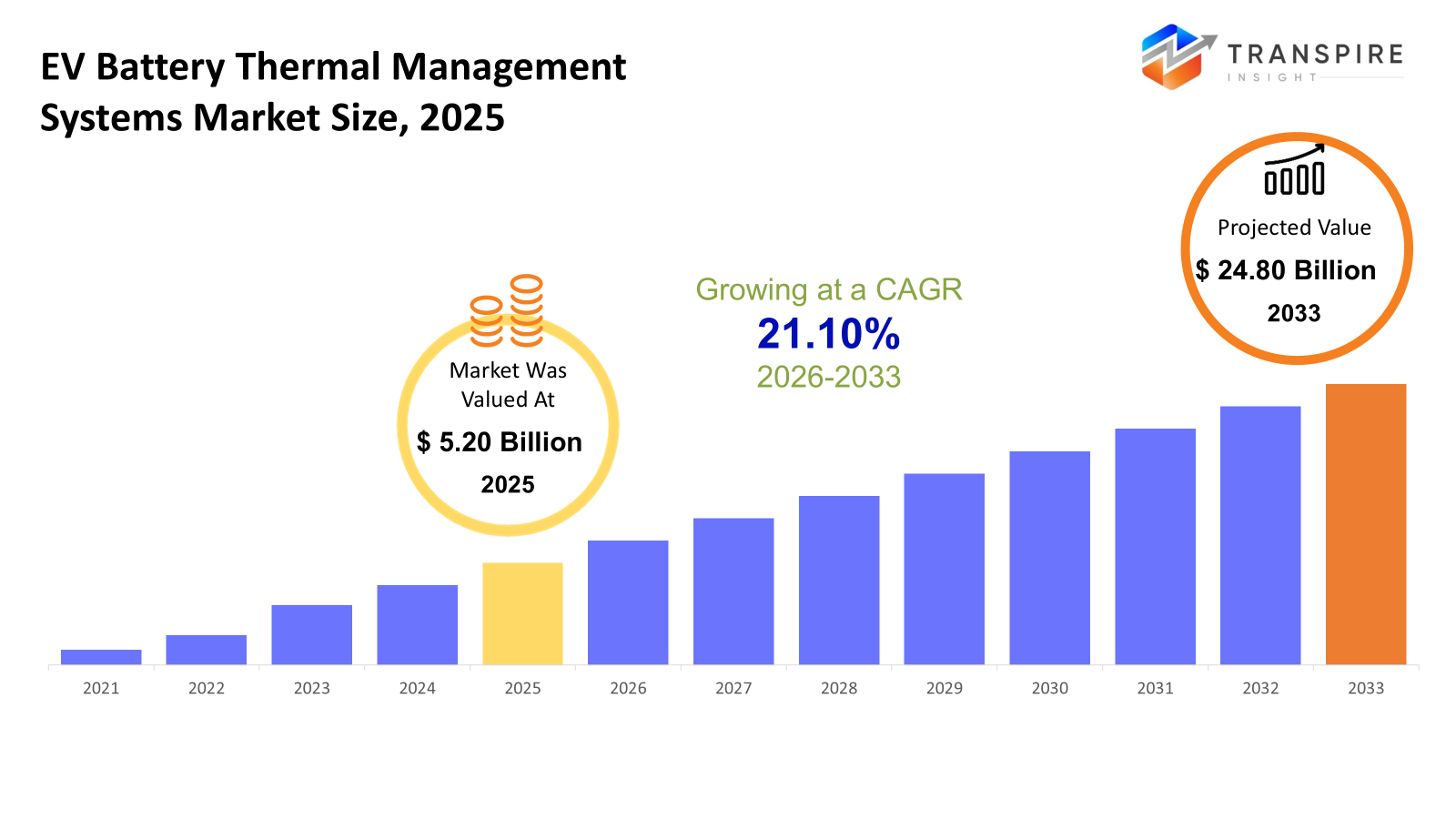
The global EV Battery Thermal Management Systems market size was valued at USD 5.20 billion in 2025 and is projected to reach USD 24.80 billion by 2033, growing at a CAGR of 21.10% from 2026 to 2033. The market is expected to expand steadily with the increasing adoption of EVs worldwide and the demand for effective management of batteries amidst different environmental conditions. Technological advancements in active and passive thermal management solutions improve the safety and life of batteries. Increasing governmental regulations and incentives for various types of vehicles make their adoption imminent. Moreover, charging infrastructure developments and a trend of preferring high-performance vehicles with greater efficiency are some significant factors that augment the growth of this market.
Market Size & Forecast
- 2025 Market Size: USD 5.20 Billion
- 2033 Projected Market Size: USD 24.80 Billion
- CAGR (2026-2033): 21.10%
- North America: Largest Market in 2026
- Asia Pacific: Fastest Growing Market
To learn more about this report,  Download Free Sample Report
Key Market Trends Analysis
- North America has a growing demand for advanced battery thermal management as the intense variations in the region's temperatures coupled with the increasing demand for fast charging trigger automakers to adopt active cooling systems for battery safety and regulatory requirements.
- The United States remains in the lead in regional demand, driven by its high penetration ratio of long-range electric passenger vehicles, as well as the increasing electrification of its commercial vehicle fleets, in which thermal management solutions must support high energy density, fast charging, and long driving cycles.
- Asia Pacific shows the quickest adoption dynamic, driven by massive EV production in China, technological prowess in Japan and South Korea, and the growing adoption of EVs in India, which has extreme climates that accentuate the necessity for efficient battery cooling solutions.
- Active systems continue to be the leading system segment due to car makers adopting various liquid-based and integrated thermal architectures designed to cater to the heat demands of quick charging systems in electric vehicles.
- Passenger cars currently lead within application demand, as consumer needs for extended range, enhanced safety, as well as consistent performance drive the need for sophisticated thermal management solutions, especially within luxurious as well as mainstream electric passenger vehicles and sport utility vehicles.
So, the EV Battery Thermal Management Systems market is primarily engaged in developing technologies which are required to control the temperatures of batteries in electric vehicles. The increasing adoption of electric vehicles in the global market has further increased the importance of appropriate thermal management systems. Active and passive systems are primarily used in this market. The increasing adoption of high-performance electric vehicles in the global market has become an important factor in this market. The increasing adoption of electric vehicles in the global market is further driven by stringent regulations related to electric vehicle safety. The increasing focus on energy efficiency in electric vehicles has become an important factor in this market. The adoption of electric vehicles in the global market has been primarily driven by governments in various regions. The increasing adoption of electric vehicles in the global market has become an important factor in this market. The adoption of electric vehicles in various regions has primarily been driven due to various regulations. The adoption of electric vehicles in various regions has become an important factor in this market. This market is primarily one of the fastest-growing markets in the electric vehicle industry.
EV Battery Thermal Management Systems Market Segmentation
By System
- Active Systems
Active thermal management systems incorporate the use of pumps, fans, and liquid coolants to control the temperature of the batteries. The active thermal management system is very flexible to adapt to any weather conditions to optimize the performance of the battery. Active thermal management systems are highly valued in the development of high-performance EVs because of the importance of controlling the temperatures in the batteries. Active thermal management systems offer much better temperature control to the batteries compared to passive systems.
- Passive Systems
Passive designs are based on the usage of materials that naturally dissipate heat using a phase change material or a heat sink. These designs do not consume any extra energy. Therefore, passive designs are simpler and lighter compared to active designs. Yet, passive designs may not work well in extreme temperatures. The passive systems are useful for cost-effective or range-optimized EV models, where concepts such as simplicity and energy-saving are in high regard. They are an ideal, maintenance-free, and whir-free solution for normal use, without lacking basic safety for the batteries.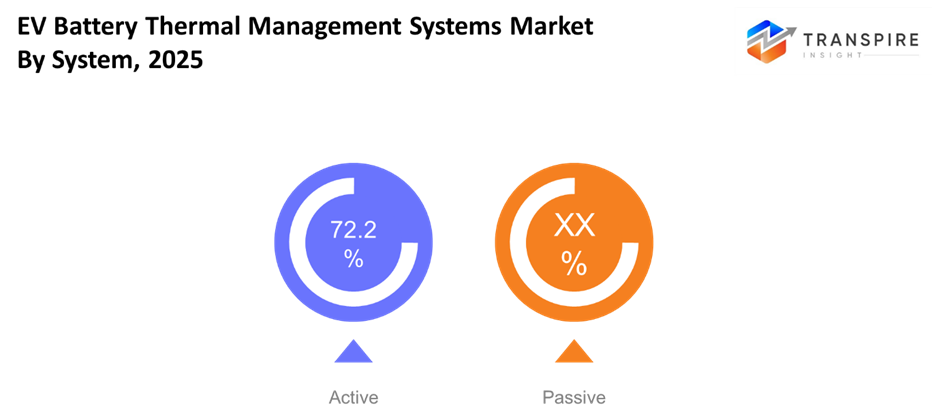
To learn more about this report, Download Free Sample Report
By Application
- Passenger Vehicles
The electric vehicles used as passengers are cars, hatchbacks, and sport utility vehicles. They use battery TMS to provide a comfortable, safe, and performance-oriented ride for the passengers. The battery TMS in passenger cars increases the overall lifespan of the battery and boosts its reliability to instill a feeling of confidence in the driver to travel anywhere in the world. Its incorporation is a subtle but very essential aspect of a vehicle because it allows the vehicle to respond well to the driver's commands while protecting the battery from any damage caused by either its excessive heating up or otherwise.
- Commercial Vehicles
Battery-powered EVs, such as buses, trucks, and delivery vans, usually work under heavy and long-hour drives, where thermal management plays an important role to prevent shutdown. TMS in these EVs provides optimal performance and safety.
Regional Insights
North America focuses on the adoption of active TMS in high-performance vehicles in the United States. Canada and Mexico are moving toward the integration of TMS in EVs used in commercial and public transportation in urban areas. Europe has strong adoption in Germany, the UK, France, and Italy due to the strict regulations imposed in the region related to emissions and the need for longer-range EVs with the active and passive use of TMS in both commercial and private vehicles. The other region in Europe is showing interest in the passive technology used in mid-range vehicles with the motive of cost-effectiveness. The Asia Pacific region consisting of Japan, China, South Korea, India, and Australia and New Zealand has the potential to become a rapidly growing market for active TMS due to the increased usage of EVs in the region and the high temperatures. South America, with Brazil and Argentina leading, will likely experience gradual TMS adoption in emerging fleets of EVs, mostly commercial. Middle East & Africa, specifically Saudi Arabia, the UAE, and South Africa, have demonstrated early-stage TMS adoption through passenger EVs driven by extreme climates and luxury vehicle demand, while other countries are more incrementally exploring scalable TMS solutions.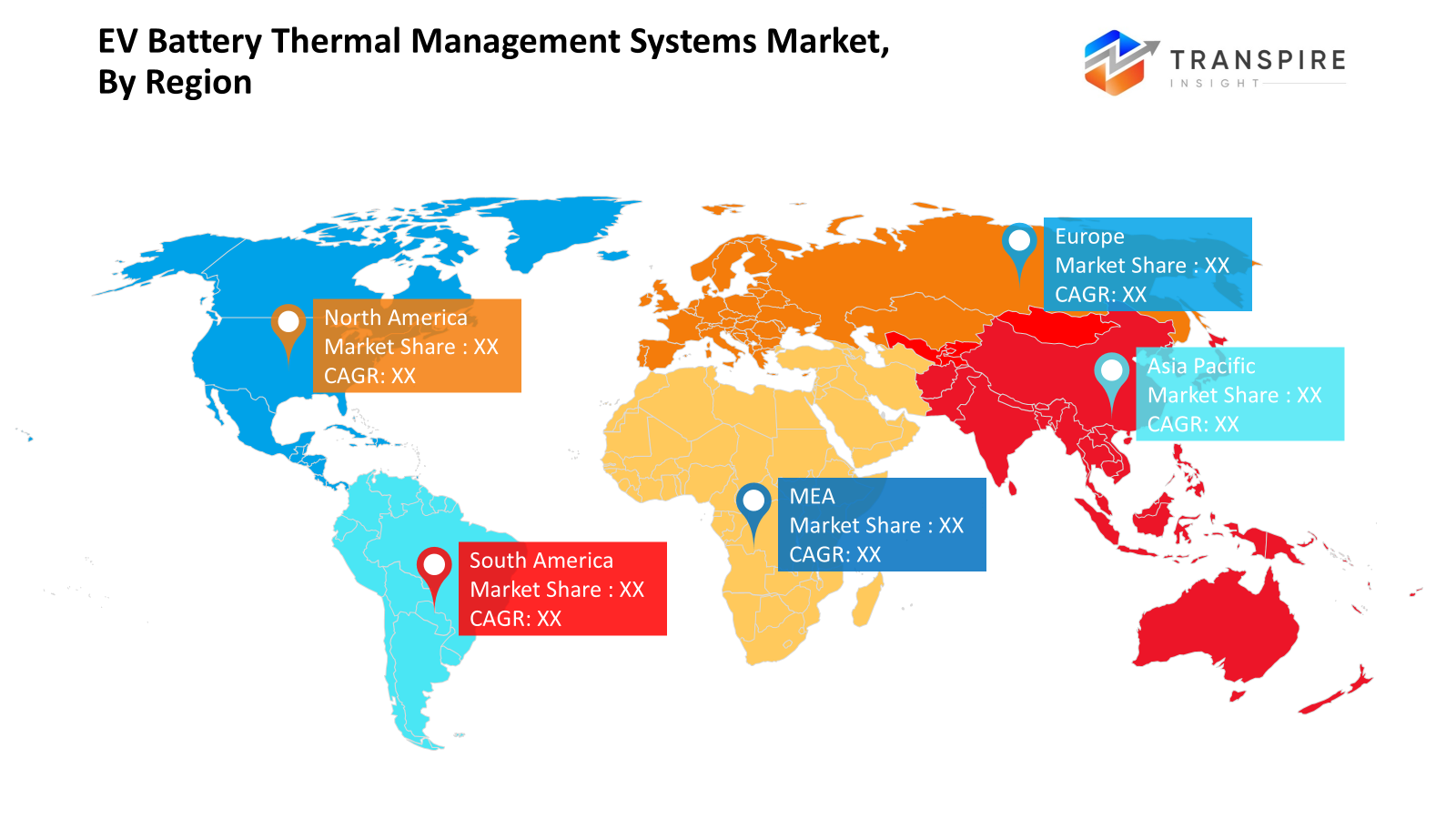
To learn more about this report, Download Free Sample Report
Recent Development News
- January 2026, ProLOGium Technology, a R&D expert in solid-state batteries as well as mass production technology in this area, proudly announces that it is going to co-exhibit at CES in Las Vegas, USA in January this year with FEV Group, an internationally leading innovation catalyst for mobility solutions and many other fields. The two partners are going to unveil at CES a concept of a future EV battery module developed using ProLOGium's own superfluidized all-inorganic solid-state lithium ceramic battery technology with a high priority put on high energy density, very high safety levels, fast charging capabilities, and cold temperature characteristics, targeting a maximum driving distance of electric cars of about 1,000 km and having already reached the development milestone of a sample car-ready product.
- In April 2024, MAHLE has won two significant contracts for thermal management modules and thereby resumed its successful acquisition journey in the area of e-mobility. The first contract has been received by MAHLE from a established and globally operating car-manufacturer. This contract is the single largest in the company history of the technology group. The other contract has been received by the company from a rising and innovative car-manufacturer from the Asian region. The value of both contracts combined is nearly €1.5 billion.
|
Report Metrics |
Details |
|
Market size value in 2025 |
USD 5.20 Billion |
|
Market size value in 2026 |
USD 6.50 Billion |
|
Revenue forecast in 2033 |
USD 24.80 Billion |
|
Growth rate |
CAGR of 21.10% from 2026 to 2033 |
|
Base year |
2025 |
|
Historical data |
2021 – 2024 |
|
Forecast period |
2026 – 2033 |
|
Report coverage |
Revenue forecast, competitive landscape, growth factors, and trends |
|
Regional scope |
North America; Europe; Asia Pacific; Latin America; Middle East & Africa |
|
Country scope |
United States; Canada; Mexico; United Kingdom; Germany; France; Italy; Spain; Denmark; Sweden; Norway; China; Japan; India; Australia; South Korea; Thailand; Brazil; Argentina; South Africa; Saudi Arabia; United Arab Emirates |
|
Key company profiled |
MAHLE GmbH, Valeo SA, Hanon Systems, Gentherm Incorporated, Dana Incorporated, Robert Bosch GmbH, Continental AG, VOSS Automotive GmbH, Denso Corporation, Schaeffler AG, LG Energy Solution, Samsung SDI Co., Ltd., Grayson Thermal Systems Corporation, Panasonic Corporation, BYD Company Limited |
|
Customization scope |
Free report customization (country, regional & segment scope). Avail customized purchase options to meet your exact research needs. |
|
Report Segmentation |
By System (Active, Passive), By Application (Passenger Vehicles, Commercial Vehicles) |
Key EV Battery Thermal Management Systems Company Insights
MAHLE GmbH is a prominent innovation leader in the EV battery thermal management systems industry. They apply their many years of knowledge in automotive thermal systems to offer innovative cooling systems to the electric vehicle industry. The innovative thermal management systems designed by MAHLE are very helpful in improving the efficiency of batteries in electric vehicles. They also work effectively in controlling the high heat generated in electric batteries when in high-usage modes. The global collaborated efforts of MAHLE with prominent automakers in developing liquid cooling systems establish strong competition in the global market.
Key EV Battery Thermal Management Systems Companies:
- MAHLE GmbH
- Valeo SA
- Hanon Systems
- Gentherm Incorporated
- Dana Incorporated
- Robert Bosch GmbH
- Continental AG
- VOSS Automotive GmbH
- Denso Corporation
- Schaeffler AG
- LG Energy Solution
- Samsung SDI Co., Ltd.
- Grayson Thermal Systems Corporation
- Panasonic Corporation
- BYD Company Limited
Global EV Battery Thermal Management Systems market Report Segmentation
By System
- Active
- Passive
By Application
- Passenger Vehicles
- Commercial Vehicles
Regional Outlook
- North America
- United States
- Canada
- Mexico
- Europe
- Germany
- United Kingdom
- France
- Spain
- Italy
- Rest of Europe
- Asia Pacific
- Japan
- China
- Australia & New Zealand
- South Korea
- India
- Rest of Asia Pacific
- South America
- Brazil
- Argentina
- Rest of South America
- Middle East & Africa
- Saudi Arabia
- United Arab Emirates
- South Africa
- Rest of the Middle East & Africa
Frequently Asked Questions
Find quick answers to common questions.
The approximate EV Battery Thermal Management Systems Market size for the market will be USD 24.80 billion in 2033.
Key segments for the EV Battery Thermal Management Systems Market are By System (Active, Passive), By Application (Passenger Vehicles, Commercial Vehicles).
Major EV Battery Thermal Management Systems Market players are MAHLE GmbH, Valeo SA, Hanon Systems, Gentherm Incorporated, Robert Bosch GmbH.
The North America region is leading the EV Battery Thermal Management Systems Market.
The CAGR of the EV Battery Thermal Management Systems Market is 21.10%.
- MAHLE GmbH
- Valeo SA
- Hanon Systems
- Gentherm Incorporated
- Dana Incorporated
- Robert Bosch GmbH
- Continental AG
- VOSS Automotive GmbH
- Denso Corporation
- Schaeffler AG
- LG Energy Solution
- Samsung SDI Co., Ltd.
- Grayson Thermal Systems Corporation
- Panasonic Corporation
- BYD Company Limited
Recently Published Reports
-
Dec 2024
Active Power Filter Market
Active Power Filter Market Size, Share & Analysis Report By Type (Shunt Active Power Filters, Series Active Power Filter, Hybrid Active Power Filter), By Application (Harmonics Mitigation, Reactive Power Compensation, Voltage Regulation, Power Factor Correction), By Phase (Single Phase, Three Phase), By End-User Industry (Manufacturing, Healthcare, Commercial, Automotive, Oil and Gas, Others), and Geography (North America, Europe, Asia-Pacific, Middle East and Africa, South and Central America), 2021 - 2031
-
Jan 2025
Electrical Transformer Market
Electrical Transformer Market Size, Share & Analysis Report By Core (Closed, Shell, and Berry), By Insulation (Gas, Oil, Solid, Air, and Other), By Phase (Single, and Three), By Rating (100 MVA to 500 MVA, 501 MVA to 800 MVA, and 801 MVA to 1200 MVA), and Geography (North America, Europe, Asia-Pacific, Middle East and Africa, South and Central America), 2021 – 2031
-
Jan 2025
Hydraulic Piston Pumps Market
Hydraulic Piston Pumps Market Size, Share & Analysis Report By Type (Axial Piston Pumps, Radial Piston Pumps), By Operating Pressure (Low Pressure, Medium Pressure, High Pressure), By Application (Construction, Mining, Agriculture, Automotive, Oil & Gas, Industrial Machinery, Others), By End-User (OEMs, Aftermarket), and Geography (North America, Europe, Asia-Pacific, Middle East and Africa, South and Central America), 2021 – 2031
-
Jan 2025
Laboratory Gas Generators Market
Laboratory Gas Generators Market Size, Share & Analysis Report By Product (Nitrogen Gas Generator, Hydrogen Gas Generator, Zero Air Gas Generator, Purge Gas Generator, TOC Gas Generators, Others), By Application (Gas Chromatography, Liquid Chromatography-mass Spectrometry (LC-MS), Gas Analyzers, Others), By End-user (Life Science, Chemical & Petrochemical, Food & Beverage, Others), and Geography (North America, Europe, Asia-Pacific, Middle East and Africa, South and Central America), 2021 – 2031