

Asia Pacific Lentiviral Vector Market Size & Forecast:
- Asia Pacific Lentiviral Vector Market Size 2025: USD 132.4 Billion
- Asia Pacific Lentiviral Vector Market Size 2033: USD 436.8 Billion
- Asia Pacific Lentiviral Vector Market CAGR: 16.09%
- Asia Pacific Lentiviral Vector Market Segments: By Product Type (Research-Grade Lentiviral Vectors, GMP Lentiviral Vectors, Custom Lentiviral Vectors, Packaging Plasmids, Expression Vectors, CRISPR Lentiviral Vectors, Stable Cell Line Vectors, Others); By Application (Gene Therapy, Cell Therapy, Cancer Research, Vaccine Development, Drug Discovery, Functional Genomics, Stem Cell Research, Others); By Workflow (Vector Design, Vector Production, Purification, Quality Control Testing, Fill & Finish Services, Storage & Logistics, Analytical Services, Others); By End User (Biotechnology Companies, Pharmaceutical Companies, Academic Institutes, CROs, CDMOs, Research Institutes, Hospitals, Others); By Vector Type (Self-Inactivating Vectors, Integrating Vectors, Non-Integrating Vectors, Inducible Vectors, Replication-Deficient Vectors, Third-Generation Vectors, Customized Vectors, Others)
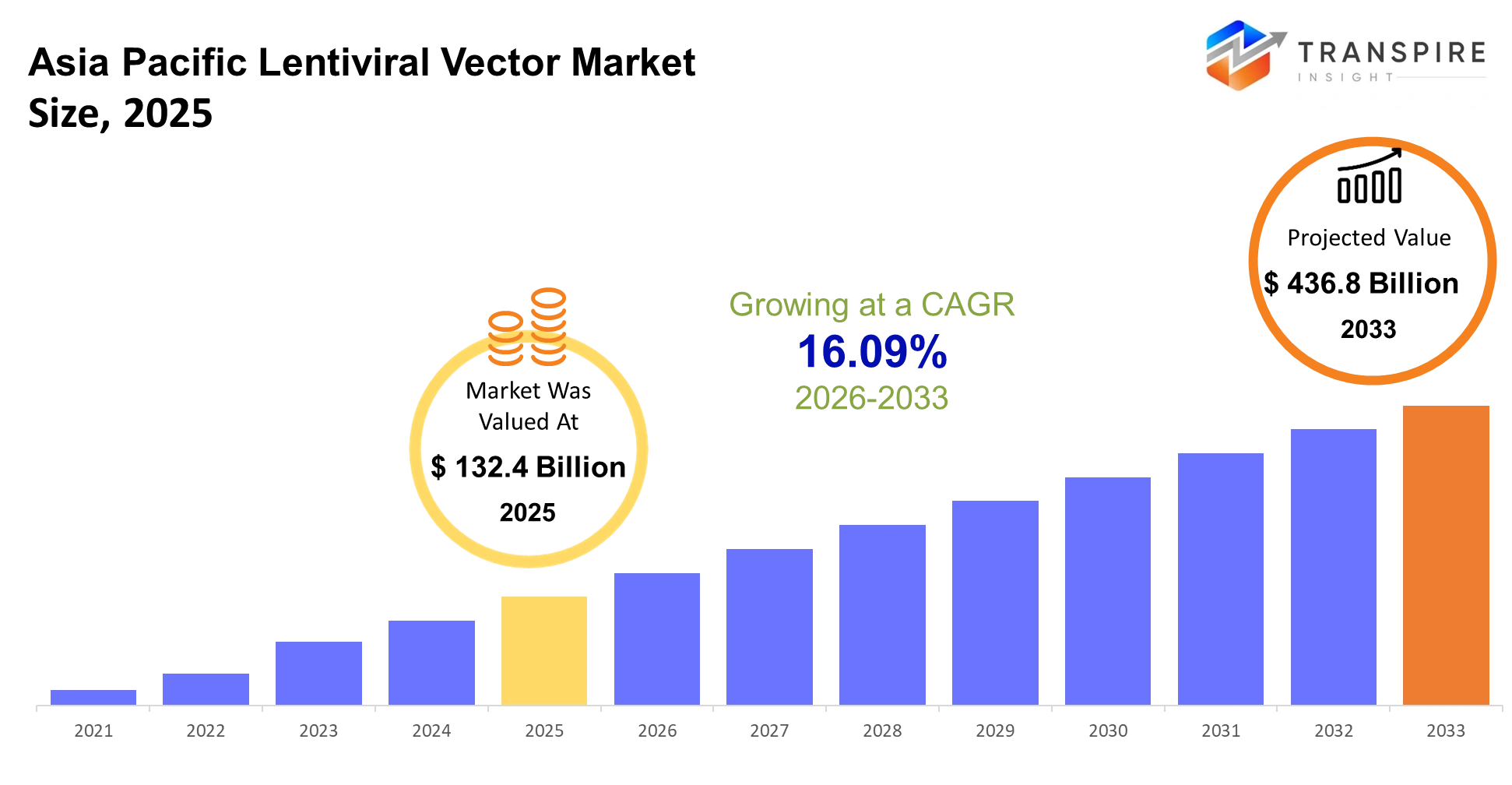
Asia Pacific Lentiviral Vector Market Summary
As per Transpire Insight Analysis, the Asia Pacific Lentiviral Vector Market was valued at USD 132.4 Billion in 2025. It is forecast to reach USD 436.8 Billion by 2033. That is a CAGR of 16.09% over the period.
The Asia Pacific lentiviral vector market supports the production of viral delivery systems which are used to transfer genetic material into cells, for gene therapy, cell therapy, vaccine development, and also advanced biomedical research. In practice, these vectors address a big manufacturing issue , because they enable stable and efficient gene delivery, and that makes them truly important for commercial cell and gene therapy programs as well as translational studies. Their role keeps growing, especially as healthcare systems , and biotechnology companies move beyond small lab scale experiments, toward clinical and commercial production.
Over the last five years, the market has been kind of drifting away from research oriented vector production and more toward GMP grade manufacturing, which now supports late stage clinical trials and commercial therapies. The shift really sped up after the COVID-19 pandemic ,because it made it very clear how important regional bio manufacturing capacity is. after that, governments across Asia Pacific started pumping money into domestic biotechnology infrastructure. then, once more gene and cell therapy candidates kept flowing through the clinical pathways , manufacturers are widening their production capacity and rolling out more scalable vector platforms. This change supports improved manufacturing efficiency, it also helps shrink development timelines ,and it produces ongoing revenue angles for contract development organizations , biotechnology firms, and vector technology providers.
Key Market Insights
- The Asia Pacific Lentiviral Vector Market is forecast to hit USD 436.8 billion by 2033, showing steady investment in advanced therapy manufacturing infrastructure, and not slowing down much.
- China led the whole scene with almost 42% market share in 2025, helped by a big wave of biotechnology funding, more CDMO capacity, plus government-backed innovation programs that keep moving.
- India is likely to be the fastest riser through 2033, powered by growing clinical research, contract manufacturing, and also encouraging biotechnology investments that keep landing.
- In 2025, GMP lentiviral vectors made up roughly 38% of the market share, which basically means more commercialization of cell and gene therapy manufacturing in practice.
- Research-grade lentiviral vectors stayed in second place with about 27% share, driven by academic institutes, and also by early stage biotechnology research work.
- CRISPR lentiviral vectors are projected to show the quickest growth across the forecast period, because genome editing use cases keep getting broader in real life.
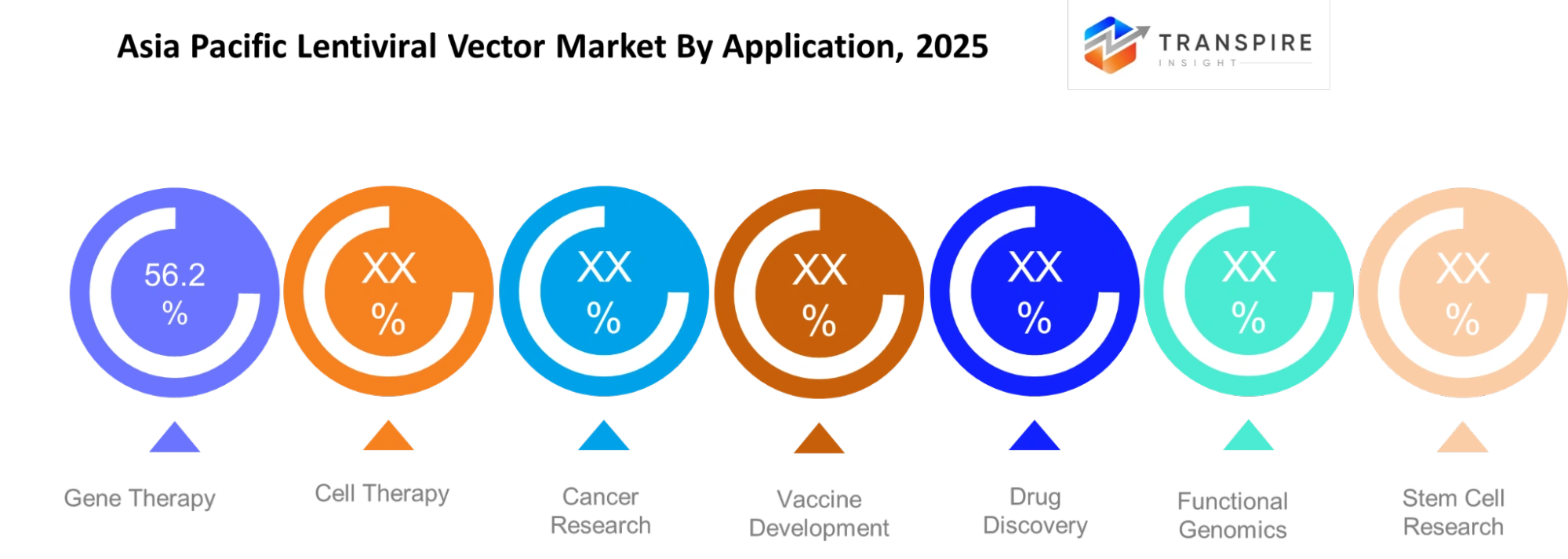
- Gene therapy contributed nearly 35% of application revenue in 2025, while cell therapy keeps emerging as one of the most quickly growing therapeutic areas, somewhat.
- Biotechnology and pharmaceutical companies held more than 48% of the end user share, while contract development and manufacturing organizations keep expanding regional production ability, steadily, and in multiple places.
- Key players such as Thermo Fisher Scientific, Merck KGaA, Sartorius AG, Lonza Group, FUJIFILM Diosynth Biotechnologies, and Oxford Biomedica are strengthening their positions via manufacturing expansion, technology innovation, and strategic partnerships that actually stick.
What are the Key Drivers, Restraints, and Opportunities in the Asia Pacific Lentiviral Vector Market?
The strongest force, kinda pushing market expansion is the fast advancement of gene and cell therapy clinical pipelines across Asia Pacific.Governments in China, Japan, South Korea, Singapore and India have bumped up investments in biotechnology research , GMP manufacturing facilities, and translational medicine programs as well. Meanwhile regulatory agencies began rolling out more clear approval routes for advanced therapies, so biotechnology firms feel more encouraged to move candidates from lab based research into clinical development. And since more treatments are reaching Phase II and Phase III trials, manufacturers then have to secure much larger volumes of high quality lentiviral vectors, which in turn makes repeatable revenue opportunities for vector producers, CDMOs, and technology providers too.
Still, the biggest structural hurdle lingers in the complexity and overall cost of GMP compliant lentiviral vector manufacturing. The production relies on specialized cleanroom areas, very trained teams, heavy quality testing, plus strict regulatory adherence , overall. Setting up that kind of infrastructure usually requires serious capital spend, and frankly a lot of years of operational know-how. Because manufacturing capacity is often limited, supply bottlenecks show up, clinical development timelines get longer, and production costs rise, which eventually slows down commercialization efforts for smaller biotechnology companies as well as research groups.
There is also a meaningful opening in growing regional manufacturing ecosystems, backed by advanced process technologies. Single-use bioprocessing systems, automated upstream and downstream production setups,and AI-supported quality control approaches are boosting scalability, while at the same time lowering contamination exposure risks.
What Has the Impact of Artificial Intelligence Been on the Asia Pacific Lentiviral Vector Market?
Artificial intelligence, plus advanced digital technologies, are helping make lentiviral vector development and manufacturing more efficient across Asia Pacific, in a sorta straightforward way. AI models take in bioprocess information from cell culture, transfection, purification, and quality testing, then they tune production parameters while things are running, almost like in real time. As a result manufacturers are more often leaning on machine learning algorithms to forecast how a batch will behave, catch early deviations before they mess with product quality, and suggest practical process tweaks that lift vector yield and keep it consistent. On top of that, automated digital monitoring systems back up GMP compliance by constantly watching critical manufacturing variables, then producing detailed records for regulatory review.
Predictive analytics is also becoming useful for equipment maintenance and for production scheduling, which is kinda important. AI can spot recurring signs of equipment wear or process instability, so teams can do maintenance before failures happen and interrupt the workflow. That supports better facility uptime, fewer manufacturing stop-and-start moments, lower operating expenses, and more dependable delivery timing for clinical programs. Digital twins and simulation platforms add another layer here, they speed up process optimization by testing manufacturing scenarios first, before anything is actually implemented, which reduces development time and helps cut down material waste.
Still, even with these benefits, AI adoption is held back by several things: the upfront implementation costs can be high, datasets across manufacturing teams are often fragmented, and standardized biological data isn’t always readily available between facilities. Because of this, model accuracy can suffer, and the push to deploy at large scale moves slowly, especially for smaller biotechnology companies that don’t have much digital infrastructure to start with.
Key Market Trends
- In 2025 China sort of strengthened its regional leadership, and it contributed about 42% of market revenue via biotechnology funding, while also expanding GMP manufacturing capacity.
- The move toward closed-system manufacturing adoption rose by over 30% since 2022, which helped producers get better batch consistency while also lowering contamination risks, a bit more stability in general.
- For 2025, GMP-grade lentiviral vectors took roughly 38% share, showing the shift from lab based research to more commercial cell and gene therapy production.
- At the same time AI assisted process monitoring rolled out across manufacturing facilities more widely, and it reduced batch deviations by around 15–20% while improving quality control documentation, especially for regulatory submissions.
- Contract development and manufacturing organizations have also expanded regional capacity, because biotechnology firms increasingly outsource vector production instead of keeping everything in-house.
- Thermo Fisher Scientific, Lonza, and Merck KGaA accelerated their investments in automated viral vector manufacturing platforms, aiming to improve scalability, plus better production flexibility.
- Pharmaceutical companies have been leaning more toward long term manufacturing partnerships rather than one off transactional supply agreements, and that seems to improve production visibility while reducing clinical development risks too.
- Regulatory agencies across Japan, South Korea, and Singapore introduced clearer advanced therapy pathways, which shortened approval timelines for qualified manufacturing facilities.
- Digital quality management systems have, in a way, replaced manual documentation across modern production sites, boosting traceability and supporting global GMP compliance requirements.
- Finally regional biotechnology clusters are increasingly bundling plasmid DNA production, viral vector manufacturing, and fill finish capabilities into one place, so supply chain complexity goes down a notch.
Asia Pacific Lentiviral Vector Market Segmentation
By Product Type
Research-Grade Lentiviral Vectors are used for lab studies, early stage checks, and proof of concept work because production stays flexible and you can get them quickly, which fits both academic teams and discovery programs. GMP Lentiviral Vectors handle the manufacturing side under tight requirements for clinical development, while Custom Lentiviral Vectors let you tune the design toward a particular research goal or therapeutic target. Packaging Plasmids stay kinda critical during vector production , since they provide key genetic pieces needed for the assembly step, and Expression Vectors help deliver the gene in a stable plus efficient way across different experimental setups.
CRISPR Lentiviral Vectors keep getting more attention for deliberate gene editing and functional readouts, and that keeps opening up additional chances in advanced biomedical research. Stable Cell Line Vectors support long term gene expression for drug screening, and also for biological studies, so people can avoid repeating the same prep tasks again and again. Other options include specialized vector formats created for unusual therapeutic needs, more advanced research use cases, and newer technologies , all of which keep expanding what’s possible.
By Application
Gene Therapy still counts as a major application, mostly because lentiviral vectors offer a dependable, long-lasting gene transfer for inherited AND acquired disorders, you know. Cell Therapy keeps growing through engineered immune cell development, with Cancer Research leaning on vector technology to probe disease mechanisms and judge new treatment strategies. Vaccine Development also takes advantage of efficient gene delivery systems, so antigen expression goes higher, and the whole research momentum gets stronger
Drug Discovery uses lentiviral vectors for finding therapeutic targets and checking how compounds perform, via steady genetic modification that doesn’t really drift. Functional Genomics supports a more detailed look at gene function and biological pathways, which makes it easier to interpret complicated cellular activity. Stem Cell Research gains from stable gene expression during cell differentiation experiments, while Others cover infectious disease studies, regenerative medicine, and other experimental applications across the life sciences umbrella
By Workflow
Vector Design kind of sets off the whole thing, choosing apt genetic elements that line up with research or therapeutic aims and also boost delivery efficiency. Vector Production then kicks in, centered on scalable manufacturing with stable, repeatable quality. After that, Purification removes the not‑so‑wanted materials so you end up with better product purity. Quality Control Testing checks identity, safety, potency, and how it performs before any next steps, or before it’s used commercially.
Fill & Finish Services handle making it “ready for real life” for storage and clinical use, using secure packaging and carefully controlled processing. Storage & Logistics keeps the product steady during shipping and for long term preservation under validated conditions. Analytical Services give the deeper look at vector characteristics. As for Others, this is more like extra workflow support tasks that help manufacturing efficiency and also regulatory alignment.
By End User
Biotechnology companies tend to put a lot of money into lentiviral vector technologies , mainly so product development moves faster, plus innovation and commercialization efforts can keep going. Pharmaceutical companies often lean on sophisticated vector platforms for their gene, and cell therapy pipelines , and Academic institutes do more of the foundational and translational work. That kind of research backs scientific discovery, bit by bit. CROs also show up in a big way by offering specialized research and testing services, which helps cut down development timelines for biotech and pharma clients.
Then there are CDMOs, they bring manufacturing know how and real production bandwidth , so clinical plus commercial requirements can be handled through the different stages. Research institutes contribute through joint studies and experimental validation, which supports technology advancement. Hospitals are also getting more involved in clinical research and advanced treatment programs , while “Others” covers government organizations , nonprofit laboratories, and other healthcare institutions involved in vector based research.
By Vector Type
Self-Inactivating Vectors kind of improve safety, by dialing down unwanted genetic activity after integration, so yeah, making broad clinical use more practical. Integrating Vectors, on the other hand, provide long-lasting and durable gene expression for long term treatments, while Non-Integrating Vectors aim to reduce permanent genomic alterations when you only need gene expression for a limited time. Inducible Vectors let you turn gene expression on in a controlled way, based on set experimental or therapeutic conditions.
Replication-Deficient Vectors improve safety because they block viral replication after delivery into the target cells. Third-Generation Vectors bring better biosafety features, and also higher production standards for both research and clinical development. Customized Vectors support needs that are specific to the application, by using tailored genetic design choices, whereas Others cover newly developed vector systems that are built for specialized therapeutic and research purposes.
What are the Key Use Cases Driving the Asia Pacific Lentiviral Vector Market?
Gene therapy is still the main use case for lentiviral vectors across Asia Pacific, mainly because it really needs stable , and long lasting gene expression to help with inherited disorders and rare genetic diseases. Because of this, biotechnology firms and pharmaceutical manufacturers tend to lean on vectors that are high quality, so they can move through clinical development and then scale commercial production. In the end, this kind of application stays the biggest revenue driver.
Cell therapy is also getting more attention now. Especially with CAR-T cell manufacturing for hematological cancers, where people want consistent results. Contract development and manufacturing organizations , along with research institutes, are starting to use lentiviral vectors for bespoke cell engineering more and more. At the same time functional genomics research keeps broadening, and that naturally feeds into drug discovery and target validation.
Besides that, there are emerging uses like in vivo gene editing, stem cell engineering, and next generation regenerative medicine. Scientists are actively investigating lentiviral platforms for personalized cancer vaccines, and engineered immune cell treatments too. This is opening up fresh opportunities as regulatory rules slowly get clearer, and as manufacturing capabilities become more scalable across Asia Pacific.
|
Report Metrics |
Details |
|
Market size value in 2025 |
USD 132.4 Billion |
|
Market size value in 2026 |
USD 153.7 Billion |
|
Revenue forecast in 2033 |
USD 436.8 Billion |
|
Growth rate |
CAGR of 16.09% from 2026 to 2033 |
|
Base year |
2025 |
|
Historical data |
2021 - 2024 |
|
Forecast period |
2026 - 2033 |
|
Report coverage |
Revenue forecast, competitive landscape, growth factors, and trends |
|
Regional scope |
United States; Canada; Mexico; United Kingdom; Germany; France; Italy; Spain; Denmark; Sweden; Norway; China; Japan; India; Australia; South Korea; Thailand; Brazil; Argentina; South Africa; Saudi Arabia; United Arab Emirates |
|
Key company profiled |
Thermo Fisher Scientific, Merck KGaA, Lonza, Charles River Laboratories, Oxford Biomedica, FUJIFILM Diosynth Biotechnologies, Catalent, Sartorius, GenScript, Takara Bio, Cell and Gene Therapy Catapult, VectorBuilder, Sino Biological, Cytiva, Revvity |
|
Customization scope |
Free report customization (country, regional & segment scope). Avail customized purchase options to meet your exact research needs. |
|
Report Segmentation |
By Product Type (Research-Grade Lentiviral Vectors, GMP Lentiviral Vectors, Custom Lentiviral Vectors, Packaging Plasmids, Expression Vectors, CRISPR Lentiviral Vectors, Stable Cell Line Vectors, Others); By Application (Gene Therapy, Cell Therapy, Cancer Research, Vaccine Development, Drug Discovery, Functional Genomics, Stem Cell Research, Others); By Workflow (Vector Design, Vector Production, Purification, Quality Control Testing, Fill & Finish Services, Storage & Logistics, Analytical Services, Others); By End User (Biotechnology Companies, Pharmaceutical Companies, Academic Institutes, CROs, CDMOs, Research Institutes, Hospitals, Others); By Vector Type (Self-Inactivating Vectors, Integrating Vectors, Non-Integrating Vectors, Inducible Vectors, Replication-Deficient Vectors, Third-Generation Vectors, Customized Vectors, Others) |
Which Regions are Driving the Asia Pacific Lentiviral Vector Market Growth?
China is still the biggest regional market, mainly because the government keeps pumping money into biotech innovation, better manufacturing infrastructure, and those translational medicine programs. Even though the policy side feels pretty strong, it has basically pushed biotechnology companies to grow their GMP manufacturing capacity, and also to pull in international partnerships. On top of that, the clinical trial pipeline stays large, and that alone really boosts the need for commercial scale lentiviral vector production. Plus, the country has this whole connected setup—research institutes, CDMOs, and pharma manufacturers—and it keeps reinforcing that leadership position, even when demand shifts a bit.
Japan lands in second place, but the reasons are a little different. Japan does not rely on quick, aggressive capacity expansion so much. Instead it tends to lean on a mature regulatory framework, steady healthcare spending, and established pharmaceutical firms that concentrate on higher value advanced therapies. Strong quality standards make manufacturers place emphasis on process reliability, and also on meeting regulatory compliance, properly. So the environment feels stable, which helps long term commercial manufacturing continue, and keeps sustained investment going for next generation gene therapy technologies.
India, though, is expected to grow the quickest through the whole forecast window. That is largely because biotech investments keep rising, contract manufacturing capabilities are getting stronger, and clinical research activities are increasing. Government initiatives tied to biotechnology parks and domestic biomanufacturing have encouraged companies to expand viral vector production capacity. There are also lower operating costs compared with several developed markets, which makes international outsourcing projects more likely to move there. Altogether, these changes put India in the role of an appealing destination for investors and for new entrants looking for scalable manufacturing opportunities between 2026, and 2033.
Who are the Key Players in the Asia Pacific Lentiviral Vector Market and How Do They Compete?
Competition is still pretty moderately consolidated, with well-known global manufacturers going after customers mostly by using manufacturing technology, regulatory knowledge, the whole production scalability angle, and integrated CDMO services, not just price. The players who can actually deliver GMP-compliant lentiviral vectors starting from early research and also carrying it through to commercial production, they tend to have the better edge. This is because biotechnology developers increasingly like, in a very straightforward way, end-to-end manufacturing partners rather than piecing things together.
Thermo Fisher Scientific sort of stands out with integrated cell therapy manufacturing solutions, automation in production technologies, and a wide global manufacturing footprint. Lonza basically leans into large-scale commercial manufacturing, but it’s supported by advanced process development and regulatory expertise which, in turn, helps it pull in late-stage therapy developers. Merck KGaA meanwhile highlights single-use bioprocessing tools, analytical testing strengths, and integrated manufacturing platforms that help improve production efficiency and also overall product consistency.
Oxford Biomedica is more about proprietary lentiviral vector platform technologies, plus a lot of hands-on experience supporting CAR-T manufacturing programs. This background helps it secure long-term commercial supply agreements. Takara Bio focuses on research-grade and clinical-grade vector solutions while also benefiting from a strong presence in Japan, and more broadly Asia Pacific research markets too. These companies keep expanding by doing strategic partnerships, making manufacturing investments, using digital process optimization, and expanding regional capacity , to reinforce their competitive positioning overall.
Company List
- Thermo Fisher Scientific
- Merck KGaA
- Lonza
- Charles River Laboratories
- Oxford Biomedica
- FUJIFILM Diosynth Biotechnologies
- Catalent
- Sartorius
- GenScript
- Takara Bio
- Cell and Gene Therapy Catapult
- VectorBuilder
- Sino Biological
- Cytiva
- Revvity
Recent Development News
In April 2026, Thermo Fisher Scientific introduced the Gibco™ CTS™ Compleo™ Fill and Finish System. The platform streamlines cell therapy manufacturing workflows and strengthens integrated production capabilities for advanced therapy developers.https://newsroom.thermofisher.com
In February 2026, Oxford Biomedica signed a new multi-year commercial supply agreement with Bristol Myers Squibb. The agreement expands commercial lentiviral vector manufacturing for CAR-T programs and is expected to generate significant long-term revenue.https://www.investegate.co.uk
What Strategic Insights Define the Future of the Asia Pacific Lentiviral Vector Market?
The Asia Pacific lentiviral vector market seems to be sliding into a phase where manufacturing capability becomes more of a competitive advantage, than scientific discovery by itself. In the next five to seven years, you can pretty much expect regional investment in GMP facilities, plus automated production platforms, and also integrated CDMO services, to basically decide who leads the space. As more gene and cell therapies inch toward commercialization, the race is likely to shift.
Still, there is a less visible risk that people do not always talk about, the whole industry depending on a small set of specialized manufacturing facilities. That kind of dependence can create capacity constraints, and yes it might also push clinical development timelines out longer, if demand grows faster than expansion.
On the flip side, there is a newer opportunity showing up too: AI enabled continuous bioprocessing, along with decentralized manufacturing hubs in India and Southeast Asia. In those areas infrastructure investment is picking up steam, and it’s making deployment feel more feasible. Firms should focus on flexible manufacturing platforms, regional production collaborations, and digital quality management systems. The goal is to improve scalability, keep supply more resilient, and lock in long term contracts with biotechnology and pharmaceutical developers.
Asia Pacific Lentiviral Vector Market Report Segmentation
By Product Type
• Research-Grade Lentiviral Vectors
• GMP Lentiviral Vectors
• Custom Lentiviral Vectors
• Packaging Plasmids
• Expression Vectors
• CRISPR Lentiviral Vectors
• Stable Cell Line Vectors
• Others
By Application
• Gene Therapy
• Cell Therapy
• Cancer Research
• Vaccine Development
• Drug Discovery
• Functional Genomics
• Stem Cell Research
• Others
By Workflow
• Vector Design
• Vector Production
• Purification
• Quality Control Testing
• Fill & Finish Services
• Storage & Logistics
• Analytical Services
• Others
By End User
• Biotechnology Companies
• Pharmaceutical Companies
• Academic Institutes
• CROs
• CDMOs
• Research Institutes
• Hospitals
• Others
By Vector Type
• Self-Inactivating Vectors
• Integrating Vectors
• Non-Integrating Vectors
• Inducible Vectors
• Replication-Deficient Vectors
• Third-Generation Vectors
• Customized Vectors
• Others
Frequently Asked Questions
Find quick answers to common questions.
The expected Asia Pacific Lentiviral Vector Market size for the market will be USD 436.8 Billion in 2033.
Key segments for the Asia Pacific Lentiviral Vector Market are By Product Type (Research-Grade Lentiviral Vectors, GMP Lentiviral Vectors, Custom Lentiviral Vectors, Packaging Plasmids, Expression Vectors, CRISPR Lentiviral Vectors, Stable Cell Line Vectors, Others); By Application (Gene Therapy, Cell Therapy, Cancer Research, Vaccine Development, Drug Discovery, Functional Genomics, Stem Cell Research, Others); By Workflow (Vector Design, Vector Production, Purification, Quality Control Testing, Fill & Finish Services, Storage & Logistics, Analytical Services, Others); By End User (Biotechnology Companies, Pharmaceutical Companies, Academic Institutes, CROs, CDMOs, Research Institutes, Hospitals, Others); By Vector Type (Self-Inactivating Vectors, Integrating Vectors, Non-Integrating Vectors, Inducible Vectors, Replication-Deficient Vectors, Third-Generation Vectors, Customized Vectors, Others)
Major Asia Pacific Lentiviral Vector Market players are Thermo Fisher Scientific, Merck KGaA, Lonza, Charles River Laboratories, Oxford Biomedica, FUJIFILM Diosynth Biotechnologies, Catalent, Sartorius, GenScript, Takara Bio, Cell and Gene Therapy Catapult, VectorBuilder, Sino Biological, Cytiva, Revvity
The Asia Pacific Lentiviral Vector Market size is USD 132.4 Billion in 2025.
The Asia Pacific Lentiviral Vector Market CAGR is 16.09% from 2026 to 2033.
- Thermo Fisher Scientific
- Merck KGaA
- Lonza
- Charles River Laboratories
- Oxford Biomedica
- FUJIFILM Diosynth Biotechnologies
- Catalent
- Sartorius
- GenScript
- Takara Bio
- Cell and Gene Therapy Catapult
- VectorBuilder
- Sino Biological
- Cytiva
- Revvity
About the Authors

Pankaj Ghogare Patil
I am Pankaj Ghogare Patil, a Senior Research Analyst at Transpire Insight, specializing in the Pharmaceutical, Chemicals & Materials, Healthcare IT, and Biotechnology industry. My expertise lies in conducting comprehensive market research, analyzing industry trends, evaluating competitive landscapes, and translating complex data into actionable insights. At Transpire Insight, I closely follow emerging technologies, regulatory developments, and market innovations to create accurate, well-researched, and informative content that helps businesses and professionals make informed decisions. I am committed to producing credible, evidence-based articles that reflect industry best practices while making technical topics accessible and valuable for a broad audience.

Chakradhar Khansole
Chakradhar serves as the Research Director at Transpire Insight, bringing over 8 years of experience in technology, innovation, and strategic market intelligence. He specializes in transforming complex market data into actionable business insights that enable organizations to make informed, growth-oriented decisions. Recognized for his strategic vision and analytical expertise, Chakradhar leads high-impact research initiatives, delivering comprehensive market assessments, competitive intelligence, and forward-looking industry analysis.
Recently Published Reports
-
Apr 2026
AI in Diabetic Retinopathy Market
AI in Diabetic Retinopathy Market Size, Share & Analysis Report By Type (Screening AI Systems, Diagnostic AI Systems, and Predictive AI Models), By Application Segment (Hospitals, Ophthalmology Clinics, Diagnostic Centers, and Research and Development), and Geography (North America, Europe, Asia-Pacific, Middle East and Africa, South and Central America), 2021 - 2031
-
Apr 2026
Psychometric Tests Market
Psychometric Tests Market Size, Share & Analysis Report By Type (Personality Tests, Ability/Aptitude Tests, Skill/Knowledge Tests, and Others), By Application (Talent Acquisition and Talent Management), and Geography (North America, Europe, Asia-Pacific, Middle East and Africa, South and Central America), 2021 – 2031
-
Apr 2026
Rare Biological Sample Collection Market
Rare Biological Sample Collection Market Size, Share & Analysis Report By Type (Isolation Kits & Reagent, Blood Collection Tubes, and Others), By Application (Oncology, Transcriptomics, Pharmacogenomics, and Others), and Geography (North America, Europe, Asia-Pacific, Middle East and Africa, South and Central America), 2021 – 2031
-
Jul 2026
Diabetic Retinopathy Market
Diabetic Retinopathy Market Size, Share & Analysis Report By Type (Proliferative Diabetic Retinopathy, and Diabetic Macular Edema (DME)), By Treatment Type (Anti VEGF Drug, Steroid Implants, Laser Surgeries, and Vitrectomy), and Geography (North America, Europe, Asia-Pacific, Middle East and Africa, South and Central America), 2021 – 2031
Our Clients







