
Asia Pacific Kapok Fiber Market Size & Forecast:
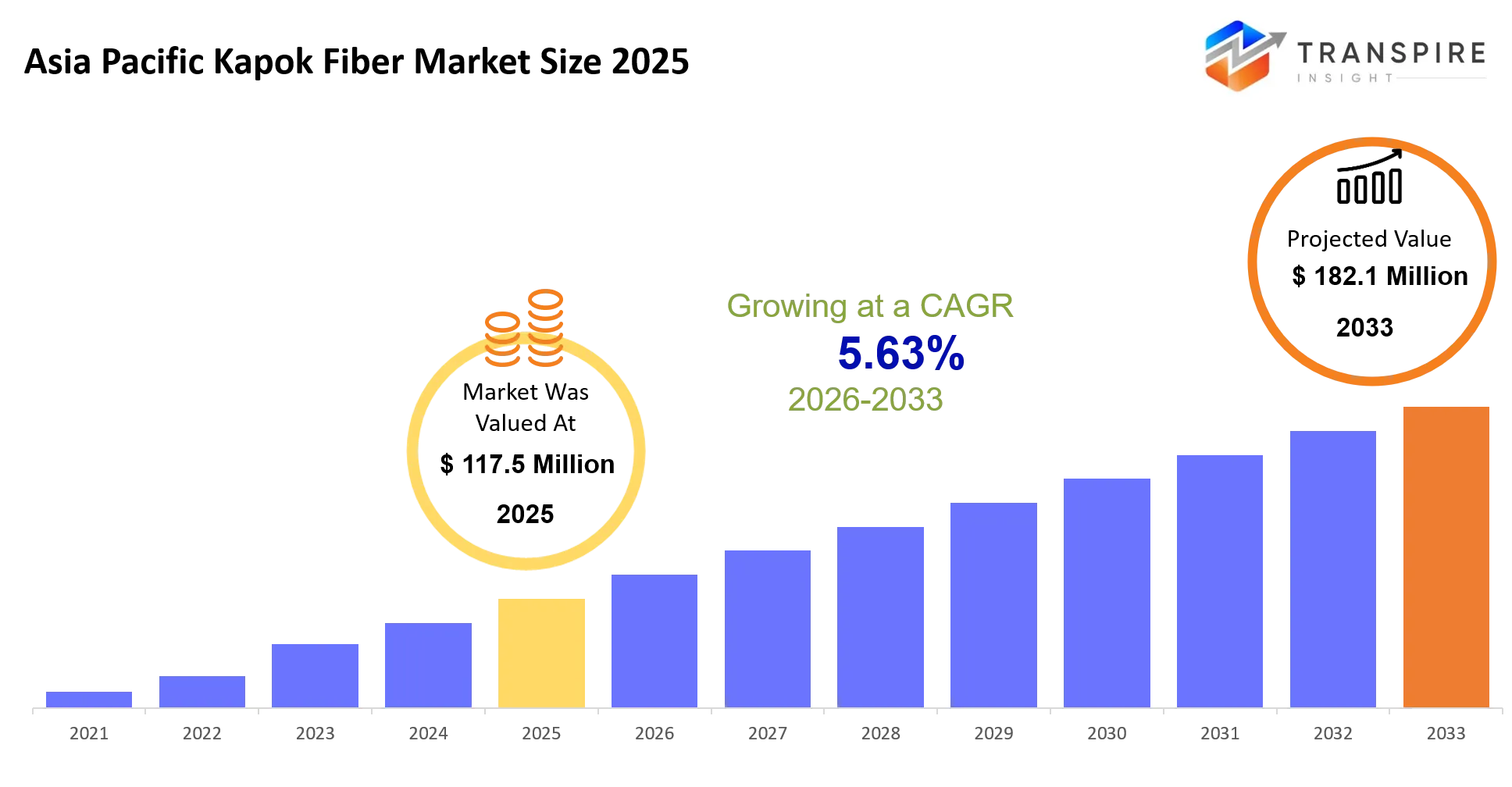
- Asia Pacific Kapok Fiber Market Size 2025: USD 117.5 Million
- Asia Pacific Kapok Fiber Market Size 2033: USD 182.1 Million
- Asia Pacific Kapok Fiber Market CAGR: 5.63%
- Asia Pacific Kapok Fiber Market Segments: By Product Type (Raw Kapok Fiber, Processed Kapok Fiber, Organic Kapok Fiber, Treated Kapok Fiber, Blended Fiber, Premium Fiber, Recycled Fiber, Others); By Application (Mattresses, Pillows, Upholstery, Insulation Materials, Life Jackets, Textiles, Automotive Interiors, Others); By Processing Type (Natural Processing, Chemical Processing, Mechanical Processing, Bleaching, Dyeing, Blending, Finishing, Others); By End User (Textile Manufacturers, Bedding Manufacturers, Furniture Companies, Automotive Companies, Construction Firms, Export Houses, Retail Brands, Others)
Asia Pacific Kapok Fiber Market Summary
The Asia Pacific Kapok Fiber Market was valued at USD 117.5 Million in 2025. It is forecast to reach USD 182.1 Million by 2033. That is a CAGR of 5.63% over the period.
The Asia Pacific Kapok Fiber Market provides a light natural fiber that people use in beds, chairs and things that keep us warm. Companies like kapok fiber because it is very good at keeping things afloat. It does not get damaged by water, it keeps us warm. It is a natural alternative to man-made materials. These things about kapok fiber help companies use materials that come from oil and still make products that work well for people and for industries.Over the few years the Asia Pacific Kapok Fiber Market has changed in a big way. It is now more about using materials that're good for the earth and can be broken down naturally. Companies that make beds, furniture and clothes have started to use plant-based fibers in their products because being sustainable is now very important. The COVID-19 pandemic showed that using man-made materials can be a problem so companies are now trying to use different kinds of materials.
The Asia Pacific Kapok Fiber Market is growing now because companies want to be sustainable, they want to make products that're different and people want to use natural things. As companies start to use kapok fiber, in high-end beds, clothes that're good for the earth and special industrial products, more and more people are using it. This change is helping companies make products and create new ways to make money in the Asia Pacific Kapok Fiber Market.
Key Market Insights
- The Asia Pacific Kapok Fiber Market is seeing a lot of growth because companies are moving away from using petroleum-based fillings and towards kapok fiber, which's renewable and biodegradable.
- This change started to happen quickly after 2020 when companies set goals to be more sustainable.
- Now people are choosing kapok fiber for bedding, furniture and specialty textiles because it is a fiber and this is more important to them than just the price.
- In the last few years the process of making kapok fiber has gotten better so the quality is more consistent and companies can use it to make more products.
- Companies that export kapok fiber are investing in ways to make it more valuable so they can make money and compete better.
- The Asia Pacific Kapok Fiber Market is mostly in Southeast Asia, which will have more than 55% of the market by 2025 because they have a lot of raw materials and are already set up to produce kapok fiber.
- South Asia is expected to grow the fastest until 2033 because they are making textiles and home furnishings.
- Most of the kapok fiber used is raw because it is used a lot in bedding, cushions and industrial applications.
- Making bedding and mattresses uses more than 40% of all the kapok fiber so it is the biggest use of kapok fiber.
- Companies like PT Kapok, Java Kapok Indonesia, Thai Kapok, Vietnam Kapok and Indo Fiber are growing by making their processes better, exporting more and getting their kapok fiber in ways.
- The Asia Pacific Kapok Fiber Market is about kapok fiber and kapok fiber is becoming more popular because it is natural and renewable.
- Kapok fiber is used in things and the Asia Pacific Kapok Fiber Market is the biggest market for kapok fiber.
- The growth of the Asia Pacific Kapok Fiber Market is good for companies that make kapok fiber. It is also good for the environment because kapok fiber is biodegradable.
What are the Key Drivers, Restraints, and Opportunities in the Asia Pacific Kapok Fiber Market?
Drivers
The main thing that is helping the market grow is that companies that make bedding, furniture and textiles are starting to use fibers of synthetic ones.People are getting more and more concerned about the environment.Companies need to meet these standards.companies are telling their suppliers to use materials like kapok fiber.Kapok fiber is great because it is light and it can withstand moisture and it is biodegradable.This makes kapok fiber perfect for high end products like bedding and furniture.Companies are selling their products made with kapok fiber for money.More people are buying these products made with kapok fiber because they are good for the environment.The use of kapok fiber is a change, for companies that make bedding, furniture and textiles.This change is helping companies that make bedding, furniture and textiles to grow and make money by selling products made with kapok fiber.
Restraints
The biggest problem is that there is no kapok fiber available and it is mostly grown in a few areas. The production of kapok fiber depends on things like the weather, the time of year and how mature kapok trees there are. It takes a long time to grow new trees so the supply of kapok fiber cannot be increased quickly. This means that the price of kapok fiber can change a lot, it can be hard to get and big companies cannot always get the amount they need. This is slowing down the growth of the market.
Opportunities
There is a chance for companies to grow if they invest in new technologies that can process kapok fiber better and combine it with other materials. Companies are mixing kapok with things like cotton, bamboo and recycled materials to make it stronger and more useful. Places like South Asia are becoming good at making textiles and exporting them which is helping companies that are innovating. Companies that can process kapok fiber in better ways will be able to sell their products for more money and make more profit in the long run. Kapok fiber is a part of this and companies are looking for ways to use kapok fiber to make their products better.
What Has the Impact of Artificial Intelligence Been on the Asia Pacific Kapok Fiber Market?
Kapok fiber harvesting is getting better with the help of intelligence and advanced digital technologies. These new technologies are making things more efficient in areas like harvesting, processing, quality grading and supply chain management of kapok fiber.Fiber producers are using intelligence to sort and check the quality of kapok fiber, which means they do not have to do it by hand anymore. This makes the quality of kapok fiber consistent from one batch to another.There are also systems that keep an eye on things like moisture levels, storage conditions and processing parameters for kapok fiber all the time. This helps manufacturers of kapok fiber reduce waste and keep the quality of kapok fiber high.Artificial intelligence and machine learning models are very helpful because they can look at data and make predictions. They look at things like how much kapok fiber was produced in the past, the weather, when kapok fiber is harvested and how well the equipment is working.
This helps manufacturers of kapok fiber know when they will have raw materials, when they should produce kapok fiber and when they need to fix their equipment. Artificial intelligence also helps them keep the right amount of kapok fiber in stock so they do not have too much or too little.The kapok fiber harvesting process is getting better in ways. It is faster to check the quality of kapok fiber. It takes labor to produce kapok fiber and the manufacturers of kapok fiber are getting more kapok fiber from their crops. They are also using their resources better.There are platforms that help keep track of where the kapok fiber comes from and how it is made, which is important for businesses that sell kapok fiber to countries.However it is still very expensive for medium-sized kapok fiber producers to use these new digital systems.Also it is hard to get data to make the artificial intelligence models work well which slows down the use of these new technologies, in some places that produce kapok fiber.
Key Market Trends
- Since 2021 the companies that make bedding have started to use kapok fiber. This is because stores are selling products that are natural and biodegradable.
- The companies that make these products to sell to countries have changed the way they do business. Between 2020 and 2025 they started to process the fibers themselves by just selling the raw fibers. This helps them make money and be more competitive in the market.
- New technologies have made it possible to clean and grade the fibers better. This means that the quality of the fibers is more consistent. The companies that buy these fibers for their products are very picky. They want the best quality.
- The way that companies buy their supplies has changed because of the pandemic. They do not want to rely on one type of filling material anymore. They are looking for natural materials.
- After 2022 it became very important for companies to be able to prove that their products are sustainable. This means that they have to keep track of where their supplies come from and be able to show this to their customers.
- Some companies like PT Kapok, Java Kapok Indonesia and Vietnam Kapok have invested money in their processing facilities. This will help them be more competitive when they sell their products to countries.
- The companies that make furniture are now using kapok fiber mixed with cotton and other natural fibers. This makes their products stronger and more durable.
- The companies are also using tools to manage their supplies and production. This helps them plan better and work with their suppliers efficiently.
- More and more people are looking for products that're natural and plant-based. This is good for the companies that make premium mattresses, cushions and home furnishing products.
- The competition between companies is not about who can sell the most product at the lowest price. It is now about who can provide the quality fibers, process them well and have a reliable supply chain.
Asia Pacific Kapok Fiber Market Segmentation
By Product Type
Raw Kapok Fiber is really useful for making bedding, cushions and filling because it is very light and has an ability to bounce back. This is why Raw Kapok Fiber is an input for these applications. Processed Kapok Fiber is cleaner and more consistent which makes it perfect for high-end products that need to meet standards. Organic Kapok Fiber is great for companies that want to make products that are good for the environment and people who buy these products care about where the materials come from. The treated Kapok Fiber is stronger. Lasts longer which makes it useful for special industrial and consumer products.Treated Kapok Fiber provides these benefits because of the way it is made. Blended Fiber is a mix of Kapok Fiber and other materials which makes it stronger and more versatile. Premium Fiber is used in high-end products where comfort and quality're important. Recycled Fiber helps companies use resources efficiently and reduce waste. Others include types of fibers that are made for specific uses and are still being developed.
By Application
People like to buy mattresses made with Kapok Fiber because they want their mattresses to be light and breathable and made from things. Kapok Fiber is used in pillows because it is very soft and it can get wet and still feel comfortable. People who make upholstery use Kapok Fiber to make furniture that's comfortable and will last for a long time. Kapok Fiber is also good for Insulation Materials because it can keep things cool.Kapok Fiber has been used in Life Jackets for a time because it helps people stay afloat in the water. More and more people are getting interested in using Kapok Fiber and other special fibers in Textile applications. Automotive Interiors also use Kapok Fiber to make car seats and other parts feel more comfortable. There are other uses for Kapok Fiber that people are still finding out about and Kapok Fiber is very valuable, in many different industries.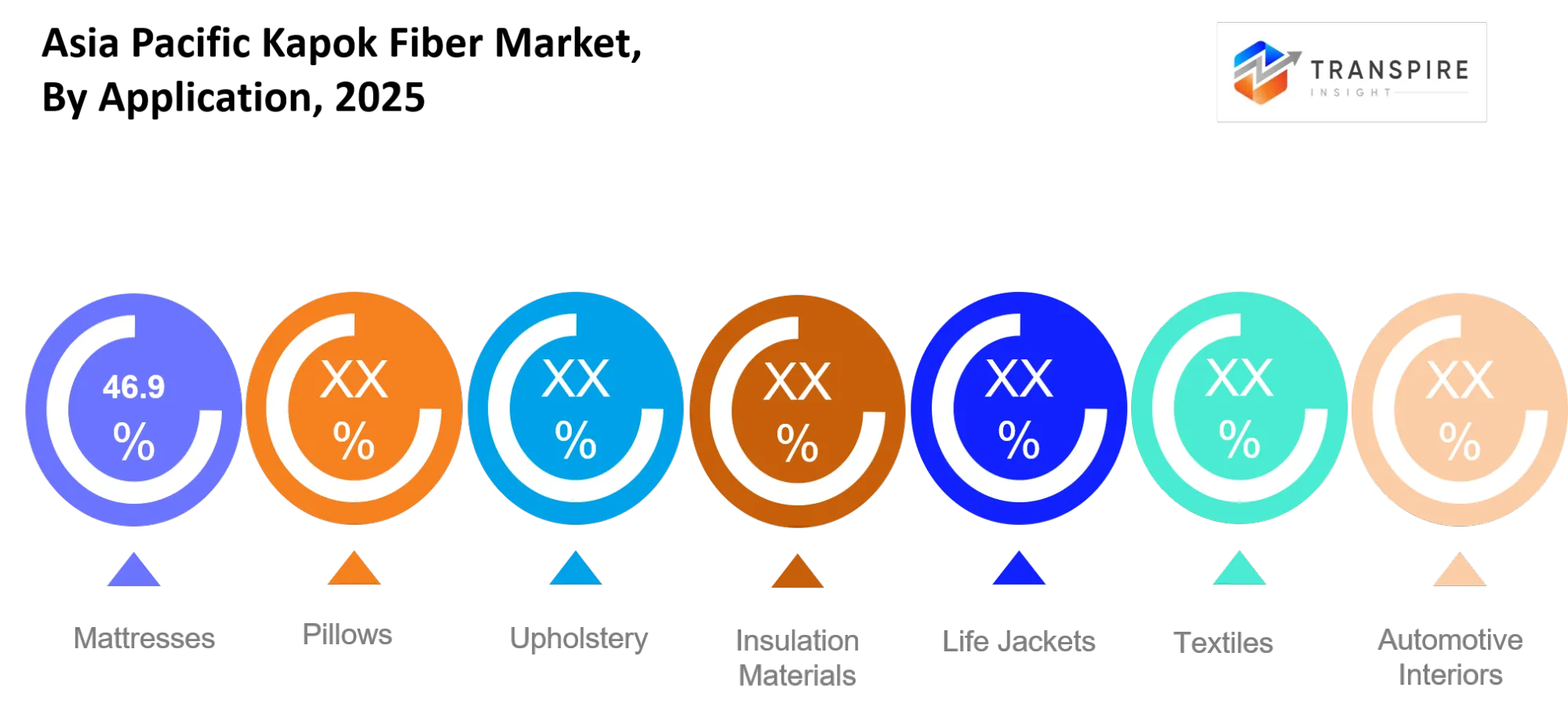
By Processing Type
Natural Processing keeps the characteristics of the Kapok Fiber and is good for the environment. Chemical Processing makes the fiber better for uses and helps it meet certain standards. Mechanical Processing makes it easier to separate, clean and prepare the fiber for use. Bleaching helps the fiber look uniform and nice.Dyeing allows for design options and customization. Blending combines Kapok Fiber, with materials to make it more versatile. Finishing processes make the fiber more durable and user-friendly. Others include processing methods that are being developed to meet new standards and customer expectations.
By End User
Textile Manufacturers use Kapok Fiber to make fabrics and specialty products. Bedding manufacturers are users of Kapok Fiber because it is often used in mattresses, pillows and cushions. Furniture Companies use Kapok Fiber to make upholstery and cushions that're comfortable and of high quality. Automotive Companies are starting to use Kapok Fiber in some of their parts.Construction Firms use insulation products that have Kapok Fiber because it is light and helps regulate temperature. Export Houses help sell Kapok Fiber products to countries. Retail Brands are starting to offer natural and sustainable products that appeal to changing consumer preferences. Others include companies that use Kapok Fiber in special ways and are still finding new uses for it.
What are the Key Use Cases Driving the Asia Pacific Kapok Fiber Market?
The biggest use of kapok fiber comes from making bedding and home furnishings, where companies use kapok fiber as a material to fill comfort products. Kapok fiber is great for this because it is light, can resist moisture and keeps the temperature right. This makes it perfect for products that need to be durable and comfortable. Lots of companies are making bedding with materials now so they can sell them in their own country and abroad.
There are uses for kapok fiber too like making furniture and insulation materials. Furniture companies are starting to use fibers to fill cushions and upholstered products.. When it comes to building houses, kapok fiber is great for keeping things warm or cool. These new uses are helping kapok fiber become more popular not for bedding.Kapok fiber is also being used to make car parts and special textiles that're good for the environment. Car companies want to use fibers to make their cars lighter and more sustainable. Textile companies are making products that combine the good things about kapok fiber with being good for the environment. This means that kapok fiber will be used more and more in the future in special products.
|
Report Metrics |
Details |
|
Market size value in 2025 |
USD 117.5 Million |
|
Market size value in 2026 |
USD 124.1 Million |
|
Revenue forecast in 2033 |
USD 182.1 Million |
|
Growth rate |
CAGR of 5.63% from 2026 to 2033 |
|
Base year |
2025 |
|
Historical data |
2021 - 2024 |
|
Forecast period |
2026 - 2033 |
|
Report coverage |
Revenue forecast, competitive landscape, growth factors, and trends |
|
Regional scope |
Asia Pacific |
|
Key company profiled |
PT Kapok, Java Kapok Indonesia, Thai Kapok, Vietnam Kapok, Indo Fiber, Kapok House, Green Textiles, Natural Fiber Export, FiberFill, Eco Fiber, Cangnan Kapok, Kapok World, Asia Fiber, Natural Bedding, Koperasi Kapok |
|
Customization scope |
Free report customization (country, regional & segment scope). Avail customized purchase options to meet your exact research needs. |
|
Report Segmentation |
By Product Type (Raw Kapok Fiber, Processed Kapok Fiber, Organic Kapok Fiber, Treated Kapok Fiber, Blended Fiber, Premium Fiber, Recycled Fiber, Others); By Application (Mattresses, Pillows, Upholstery, Insulation Materials, Life Jackets, Textiles, Automotive Interiors, Others); By Processing Type (Natural Processing, Chemical Processing, Mechanical Processing, Bleaching, Dyeing, Blending, Finishing, Others); By End User (Textile Manufacturers, Bedding Manufacturers, Furniture Companies, Automotive Companies, Construction Firms, Export Houses, Retail Brands, Others) |
Which Regions are Driving the Asia Pacific Kapok Fiber Market Growth?
Southeast Asia holds the dominant position in the market because the region serves as the primary source of kapok cultivation and fiber processing activities. Favorable climatic conditions, established agricultural networks, and long-standing expertise in fiber production support large-scale commercial output. A strong ecosystem of growers, processors, exporters, and manufacturing companies sustains regional leadership. Efficient export infrastructure and close connections with textile and bedding industries further strengthen market influence.
East Asia ranks as the second-largest regional contributor, although market dynamics differ from those in Southeast Asia. Rather than relying on raw material production, growth is supported by advanced manufacturing capabilities and stable consumption from bedding, furniture, and textile sectors. Consistent investment in premium consumer products and quality-focused manufacturing creates reliable demand for processed natural fibers. This stability makes the region an important revenue contributor despite more limited raw material availability.
South Asia demonstrates the strongest growth momentum through the forecast period. Expansion in textile manufacturing, home furnishing production, and export-oriented industries has increased the use of alternative natural fibers in recent years. Investments in processing facilities and sustainable material sourcing programs have created new commercial opportunities across the value chain. This growth trajectory will provide attractive prospects for producers, processors, and investors seeking exposure to expanding natural fiber applications between 2026 and 2033.
Who are the Key Players in the Asia Pacific Kapok Fiber Market and How Do They Compete?
Competition remains fragmented, with numerous regional producers, processors, exporters, and specialty fiber suppliers operating across the value chain. Market participants compete primarily through fiber quality, processing capabilities, sourcing reliability, and export reach rather than scale alone. Established suppliers continue to defend market share by strengthening relationships with bedding, furniture, and textile manufacturers. New entrants are creating pressure by offering specialized natural fiber products, sustainable sourcing practices, and value-added processing services that address changing customer requirements.PT Kapok focuses on supply chain integration and direct sourcing networks that improve raw material availability and cost efficiency. This approach helps maintain consistent product quality while reducing procurement risks for customers. Java Kapok Indonesia differentiates itself through export-oriented operations and processing capabilities designed for premium bedding and furnishing applications. Expansion efforts concentrate on strengthening international distribution channels and increasing access to higher-value markets.Thai Kapok emphasizes fiber quality improvement and specialized processing techniques that support demanding industrial and consumer applications. Vietnam Kapok benefits from proximity to major manufacturing hubs, allowing faster delivery and stronger relationships with textile and furniture producers. Indo Fiber focuses on product diversification and customized fiber solutions for different end-use requirements, creating flexibility that many commodity suppliers cannot easily match. Competitive advantage increasingly depends on quality assurance, processing innovation, and long-term supply agreements that secure stable business relationships.
Company List
- PT Kapok
- Java Kapok Indonesia
- Thai Kapok
- Vietnam Kapok
- Indo Fiber
- Kapok House
- Green Textiles
- Natural Fiber Export
- FiberFill
- Eco Fiber
- Cangnan Kapok
- Kapok World
- Asia Fiber
- Natural Bedding
- Koperasi Kapok
Recent Development News
In April 2026, KAPOK JAPAN entered a partnership with JOURNAL STANDARD FURNITURE. The collaboration launched the limited-edition “MUSUBI + JSF” weighted blanket, expanding commercial applications for kapok-based materials in premium home furnishing products and strengthening market visibility for kapok fiber.https://prtimes.jp
In October 2025, Flocus launched expanded kapok fiber product offerings under its Clarus and Fina ranges. The company combined patented spinning technology with exclusive sorting processes to improve consistency and scalability, supporting wider adoption of kapok across textile, furniture, and industrial applications.https://www.fibre2fashion.com
What Strategic Insights Define the Future of the Asia Pacific Kapok Fiber Market?
The Asia Pacific Kapok Fiber Market is moving toward a more specialized and value-added growth trajectory over the next five to seven years, driven by rising demand for biodegradable and low-carbon materials across textiles, insulation, packaging, and sustainable consumer goods. As environmental regulations tighten and manufacturers seek alternatives to synthetic fibers, kapok is likely to transition from a niche natural fiber to a strategic component within circular material ecosystems.
A less visible risk lies in raw material concentration and supply instability. Kapok production remains dependent on limited cultivation zones and largely fragmented harvesting networks, creating vulnerability to climate variability, land-use shifts, and inconsistent quality standards. These factors could constrain supply even as demand accelerates.
An emerging opportunity is the integration of kapok fiber into advanced bio-composite materials for lightweight industrial applications. Market participants should secure long-term sourcing partnerships and invest in fiber processing technologies that improve consistency, scalability, and application performance, enabling differentiation as downstream industries increasingly prioritize sustainable material inputs.
Asia Pacific Kapok Fiber Market Report Segmentation
By Type
- Natural Kapok Fiber
- Blended Kapok Fiber
- Processed Kapok Fiber
- Others
By Application
- Textiles & Apparel
- Bedding & Upholstery
- Insulation Materials
- Packaging Materials
- Automotive Interiors
- Others
By End Use
- Residential
- Commercial
- Industrial
- Automotive
- Aerospace
- Marine
By Distribution Channel
- Direct Sales
- Distributors & Wholesalers
- Online Retail
- Specialty Stores
Frequently Asked Questions
Find quick answers to common questions.
The Expected Asia Pacific Kapok Fiber Market size for the Market will be USD 182.1 Million in 2033.
Key Segments for the Asia Pacific Kapok Fiber Market are By Product Type (Raw Kapok Fiber, Processed Kapok Fiber, Organic Kapok Fiber, Treated Kapok Fiber, Blended Fiber, Premium Fiber, Recycled Fiber, Others); By Application (Mattresses, Pillows, Upholstery, Insulation Materials, Life Jackets, Textiles, Automotive Interiors, Others); By Processing Type (Natural Processing, Chemical Processing, Mechanical Processing, Bleaching, Dyeing, Blending, Finishing, Others); By End User (Textile Manufacturers, Bedding Manufacturers, Furniture Companies, Automotive Companies, Construction Firms, Export Houses, Retail Brands, Others).
Major Asia Pacific Kapok Fiber Market Players are PT Kapok, Java Kapok Indonesia, Thai Kapok, Vietnam Kapok, Indo Fiber, Kapok House, Green Textiles, Natural Fiber Export, FiberFill, Eco Fiber, Cangnan Kapok, Kapok World, Asia Fiber, Natural Bedding, Koperasi Kapok.
The Current Asia Pacific Kapok Fiber Market size is USD 117.5 Million in 2025.
The Asia Pacific Kapok Fiber Market CAGR is 5.63% from 2026 to 2033.
- PT Kapok
- Java Kapok Indonesia
- Thai Kapok
- Vietnam Kapok
- Indo Fiber
- Kapok House
- Green Textiles
- Natural Fiber Export
- FiberFill
- Eco Fiber
- Cangnan Kapok
- Kapok World
- Asia Fiber
- Natural Bedding
- Koperasi Kapok
About the Authors

Pankaj Ghogare Patil
I am Pankaj Ghogare Patil, a Senior Research Analyst at Transpire Insight, specializing in the Pharmaceutical, Chemicals & Materials, Healthcare IT, and Biotechnology industry. My expertise lies in conducting comprehensive market research, analyzing industry trends, evaluating competitive landscapes, and translating complex data into actionable insights. At Transpire Insight, I closely follow emerging technologies, regulatory developments, and market innovations to create accurate, well-researched, and informative content that helps businesses and professionals make informed decisions. I am committed to producing credible, evidence-based articles that reflect industry best practices while making technical topics accessible and valuable for a broad audience.

Chakradhar Khansole
Chakradhar serves as the Research Director at Transpire Insight, bringing over 8 years of experience in technology, innovation, and strategic market intelligence. He specializes in transforming complex market data into actionable business insights that enable organizations to make informed, growth-oriented decisions. Recognized for his strategic vision and analytical expertise, Chakradhar leads high-impact research initiatives, delivering comprehensive market assessments, competitive intelligence, and forward-looking industry analysis.
Recently Published Reports
-
May 2026
Healthcare Polymer Packaging Market
Healthcare Polymer Packaging Market Size, Share & Analysis Report By Packaging Type (Syringes, IV Bottles and Pouches, Clamshells, Blisters, Bottles & Jars, Containers, Tubes, IV Parental Packaging, Others), By Type (Regulated, Non-regulated), By Polymer Type (LDPE (Low-Density Polyethylene), HDPE (High-Density Polyethylene), Homo-polymer (Homo), Random Copolymer (Random), Block Copolymer (Block), PET, Polystyrene, Polyvinyl Chloride, Polyamide/EVOH, Others), and Geography (North America, Europe, Asia-Pacific, Middle East and Africa, South and Central America), 2021 - 2031
-
Apr 2026
Hydrophilic Tape (Waterstop) Market
Hydrophilic Tape (Waterstop) Market Size, Share & Analysis Report By Type (Bentonite-Based Hydrophilic Tape, Rubber-Based Hydrophilic Tape), By Application (Residential Buildings, Commercial Buildings, Infrastructure Projects), and Geography (North America, Europe, Asia-Pacific, Middle East and Africa, South and Central America), 2021 - 2031
-
Apr 2026
Metalens Market
Metalens Market Size, Share & Analysis Report By Type (Visible Light Metalens, and Infrared Metalens), By Application (Consumer Electronics, Automotive Electronics, Industrial, Medical, and Others), and Geography (North America, Europe, Asia-Pacific, Middle East and Africa, South and Central America), 2021 - 2031
-
Apr 2026
PBT Resin Market
PBT Resin Market Size, Share & Analysis Report By Type (Reinforced PBT Resin, Unreinforced PBT Resin), By Processing Method (Injection Molding, Extrusion, Blow Molding, Others), By End-User (Automotive, Electrical & Electronics, Consumer Appliances, Industrial Machinery, Medical Devices, Packaging, Others), and Geography (North America, Europe, Asia-Pacific, Middle East and Africa, South and Central America), 2021 - 2031