
Global Carbon Fiber Idler Rollers Market Size & Forecast:
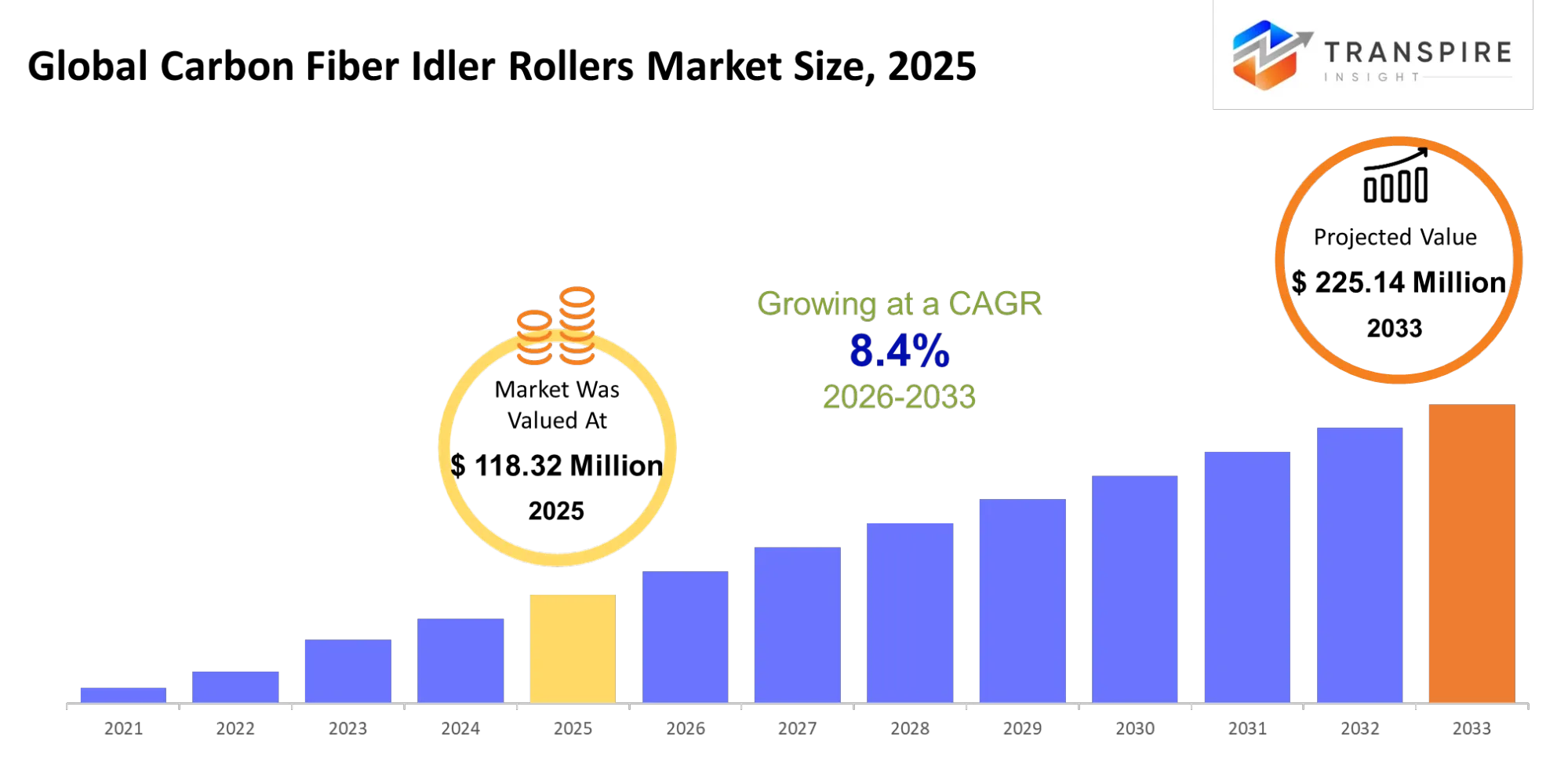
- Global Carbon Fiber Idler Rollers Market Size 2025: USD 118.32 Million
- Global Carbon Fiber Idler Rollers Market Size 2033: USD 225.14 Million
- Global Carbon Fiber Idler Rollers Market CAGR: 8.4%
- Global Carbon Fiber Idler Rollers Market Segments: By Type (Lightweight Carbon Fiber Rollers, High-strength Idler Rollers, Anti-corrosion Rollers, Composite Idler Rollers, Precision Conveyor Rollers, High-speed Rollers, Others); By Application (Mining Conveyors, Material Handling Systems, Packaging Machinery, Printing Equipment, Industrial Automation, Others); By End-User (Mining Companies, Manufacturing Plants, Logistics Providers, Packaging Companies, Others); By Diameter (Small Diameter Rollers, Medium Diameter Rollers, Large Diameter Rollers, Heavy-duty Rollers, Others)
Global Carbon Fiber Idler Rollers Market Summary
The Global Carbon Fiber Idler Rollers Market size is estimated at USD 118.32 Million in 2025 and is anticipated to reach USD 225.14 Million by 2033, growing from 2026 to 2033.
This industry is all about replacing heavy steel rollers on massive conveyor systems with ultra-lightweight carbon fiber alternatives to keep materials moving smoothly. Over the last few years, the big structural shift has been a massive demand for ultra-high-speed material handling where heavy steel components simply warp or fail under intense friction. The real-world tipping point came when soaring industrial electricity rates made running heavy conveyor belts incredibly expensive. Because carbon fiber rollers cut total equipment weight dramatically, motors don't have to work nearly as hard. This massive drop in energy consumption directly lowers daily operating costs, which is why logistics hubs and mining facilities are swapping out their old hardware as fast as possible.
Key Market Insights
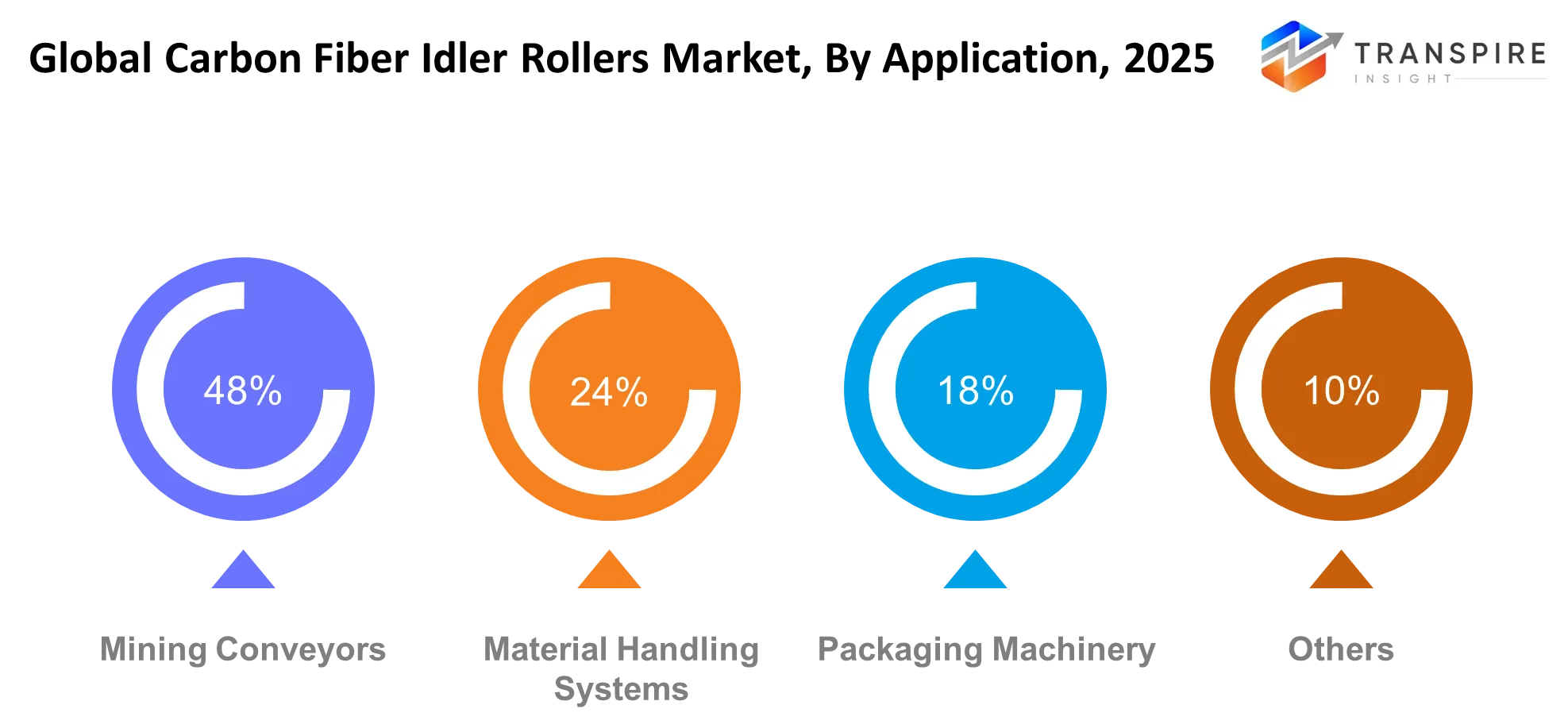
- Mining Conveyors claims a 48% share as bulk handling facilities swap out heavy steel idlers to lower belt tension, prompting giants like Sandvik and NEPEAN Conveyors to deploy ruggedized composite setups on long-haul overland systems.
- High-speed Rollers lead growth at a 10.4% CAGR to eliminate severe rotational vibrations during rapid sorting routines, driving builders like Interroll and PROK to roll out precision carbon sleeves that protect system bearings from burning out.
- Asia Pacific commands a 40% market share due to massive bulk terminal modernizations, pushing local suppliers like CPS Conveyors and Kinder Australia to aggressively ramp up production lines for low-inertia hardware.
- North America is accelerating at a 9.6% CAGR as skyrocketing factory electricity bills force processing plants to cut down torque, encouraging innovators like Superior Industries and Precision Pulley & Idler to deliver high-efficiency rollers.
- Material Handling Systems holds 24% of demand as distribution hubs prioritize long-term utility savings over cheap setups, driving manufacturers like Continental Conveyor and Flexco to launch integrated composite cores for 24/7 warehouse loops.
- Packaging Machinery makes up 18% of the volume, where specialists like Rulmeca Group and Conveyor Units supply ultra-stiff, thin-walled idlers so high-tension wrapping machines run flawlessly without stretching delicate film layers.
- Europe holds a 29% market share as strict eco-design rules and tightening workplace noise limits take effect, prompting industrial pioneers like Fenner Dunlop to leverage the natural sound-dampening properties of carbon fiber.
- The "Others" segment captures a 10% share as specialized automation lines require tailor-made component tracking, allowing firms like Martin Engineering to drop fully customized, low-wear rollers directly into tight assembly zones.
What are the Key Drivers, Restraints, and Opportunities in the Global Carbon Fiber Idler Rollers Market?
Driver
The big push to cut down on electricity bills across massive material handling operations is what's really driving this market forward. It all started when power rates skyrocketed right as mining companies began building much longer overland conveyor setups. Because carbon fiber rollers are incredibly light, they slash the initial torque and continuous electrical load needed to spin the belt. This means logistics hubs and mines can bank serious long-term energy savings, making the swap a no-brainer.
In 2025, Sandvik pushed its HR185 all-composite rollers, which reduce the total cost of ownership by up to 20% while easily handling massive mining tonnages. This rollout gives operators a proven, durable alternative to heavy steel, driving a steady stream of high-volume hardware upgrades.
Restraint
Sticker shock is the main thing holding facilities back from swapping out all their conveyor rollers at once. Carbon fiber comes with a hefty upfront price tag, and that hurdle isn't going away anytime soon because baking and molding advanced composites is just fundamentally more expensive than stamping out basic steel tubes. Since the initial buy-in is so high, budget-tight operations usually end up patching in a few new composite rollers at a time during routine maintenance instead of shelling out for a complete system overhaul.
Opportunity
The massive upgrade wave hitting high-speed e-commerce fulfillment centers is where the next big growth spike is going to come from. Modern logistics hubs across North America are pushing their automated sorting lines to absolute breaking points, and traditional metal rollers just can't take the heat—they vibrate way too much and fail constantly. Stepping into this space with precision-balanced, low-inertia carbon sleeves to stop bearing burnout gives manufacturers a wide-open revenue stream completely separate from heavy mining.
What Has the Impact of Artificial Intelligence Been on the Global Carbon Fiber Idler Rollers Market?
Historically, conveyor maintenance meant following a rigid calendar—or scrambling when an idler seized up and tore the belt. The introduction of artificial intelligence creates a much more proactive model. Today, monitoring software actively scans the idler network for tiny deviations. Whether the issue is an odd vibration frequency, a hidden bearing failure, or an unexpected heat spike, the system catches it. Facility teams now rely on these precise metrics to forecast component wear, arranging repairs long before an actual failure halts the line.
Day-to-day operations look totally different now. You no longer need to walk miles of overland conveyor belts for manual inspections because AI algorithms automatically analyze acoustic and rotational data in real time. By keeping constant tabs on the low-inertia carbon fiber rollers, the system ensures everything runs at peak efficiency, instantly cutting down on wasted power and motor stress.
The main hurdle right now is an environmental accuracy gap. In brutal mining and material handling zones, extreme dust, uneven dirt buildup on the roller casings, and heavy impacts easily scramble sensor data, triggering false alarms that confuse the predictive models and force crews to second-guess the system.
Key Market Trends
- Plant managers moved away from heavy, high-inertia steel rollers over time through a behavioral movement to slash soaring factory electricity bills, driving an industry shift toward ultra-lightweight carbon fiber alternatives.
- Maintenance teams replaced rigid manual visual inspections over time via a technological movement integrating acoustic tracking and IoT sensors, forcing an industry shift toward live, smartphone-based predictive wear alerts.
- Conveyor engineers evolved past uniform, single-material roller tubes over time via a technological movement blending carbon fibers with high-strength fiberglass wraps, solidifying an industry shift toward cost-effective hybrid core architectures.
- Facility architects moved away from standard spray-on polyurethane protections over time through a behavioral movement demanding long-term chemical resilience, sparking an industry shift toward permanently bonded, resin-infused nano-coatings.
- System designers replaced external battery-powered monitors over time via a technological movement engineering internal kinetic energy harvesters, causing an industry shift toward self-powered embedded sensor networks on remote overland belts.
- Production technicians evolved past manual component balancing over time via a technological movement adopting dynamic, laser-guided structural tuning, driving an industry shift toward extreme high-speed, vibration-free roller configurations.
- Safety inspectors moved away from standard combustible polymer coatings over time through a behavioral movement prioritizing strict underground fire guidelines, forcing an industry shift toward self-extinguishing, flame-retardant composite resins.
- Operations managers replaced completely scrapping worn-out idler units over time through a behavioral movement to cut down on routine replacement waste, sparking an industry shift toward modular, slide-on carbon fiber sleeve jackets.
Global Carbon Fiber Idler Rollers Market Segmentation:
By Type
Manufacturers build a diverse lineup of specialized hardware, from lightweight carbon fiber rollers and composite idler rollers to anti-corrosion rollers and precision conveyor rollers. Right now, high-speed rollers are completely stealing the spotlight and dominating the market's growth. High-volume fulfillment centers are rapidly pushing past traditional line limits, prompting facility managers to abandon old metal alternatives in favor of these dynamically balanced, low-inertia variants. This urgent need to eliminate severe high-speed rotational vibrations means traditional, heavy idler options are falling out of favor quickly on fast-moving lines. This shift is forcing equipment builders to aggressively funnel their engineering budgets into structural sleeves that protect system bearings from premature failure.
By Application
These advanced rollers are deployed heavily across packaging machinery, printing equipment, industrial automation, and material handling systems. Despite this wide industrial footprint, mining conveyors stand as the ultimate heavyweight, claiming a massive 48% share of total market volume. As mining companies extend their overland conveying routes across long distances, hauling heavy tonnages places extreme stress on structural belt infrastructure. Upgrading to advanced composite idlers allows operations to drastically lower overall belt tension and operational drag. Moving forward, as remote extraction sites face increasingly brutal environments, the industry will pivot sharply toward self-monitoring, low-friction rollers to run long-haul systems with minimal manual upkeep.
By End-User
The core buyer network is split among manufacturing plants, logistics providers, packaging companies, and others, but mining companies remain the most high-value, consistent purchasing segment. The harsh operational realities of modern bulk material handling demand equipment that can survive punishing loads without seizing up. Because a single jammed roller can trigger catastrophic belt tears and cost millions in unscheduled downtime, corporate buyers are shifting their behavioral habits entirely. In the coming years, mining operations will phase out stand-alone hardware completely, meaning future idler purchases must feature embedded IoT tracking to feed real-time health data straight into a facility’s predictive maintenance network.
By Diameter
The market provides a wide spread of dimensional options, including small diameter rollers, medium diameter rollers, large diameter rollers, and heavy-duty rollers. Large and heavy-duty configurations currently command the strongest market position because they support the thick, heavy belts used in primary industrial sorting and heavy bulk transport. The unique growth engine here stems from a structural shift toward wider and faster material paths, where small rollers would simply spin too fast, overheat, and fail. Looking ahead, the demand for large-diameter composite shells will explode as material handlers scale up their volumetric capacity, forcing a permanent industry shift toward thick-walled, low-inertia rollers that maximize structural load capacity without adding unnecessary weight.
What are the Key Use Cases Driving the Global Carbon Fiber Idler Rollers Market?
Long-distance bulk material hauling across overland mining conveyors drives this market forward. Mining companies use these low-inertia rollers to handle massive tonnages while lowering belt tension. Swapping out heavy steel dramatically cuts the startup torque required to run miles of continuous, loaded conveyor belts.
Beyond bulk hauling, applications are expanding into automated material handling systems and high-speed packaging machinery. In these environments, distribution hubs deploy precision rollers to eliminate rotational vibrations that cause premature bearing blowouts during rapid sorting routines.
Emerging use cases are surfacing in specialized industrial automation lines and high-tension printing equipment. Here, facilities leverage non-corrosive, ultra-stiff carbon fiber jackets to keep delicate film webs flawlessly aligned without risking chemical degradation or material stretching.
|
Report Metrics |
Details |
|
Market size value in 2025 |
USD 118.32 Million |
|
Market size value in 2026 |
USD 128.02 Million |
|
Revenue forecast in 2033 |
USD 225.14 Million |
|
Growth rate |
CAGR of 8.4% from 2026 to 2033 |
|
Base year |
2025 |
|
Historical data |
2021 - 2024 |
|
Forecast period |
2026 - 2033 |
|
Report coverage |
Revenue forecast, competitive landscape, growth factors, and trends |
|
Regional scope |
United States; Canada; Mexico; United Kingdom; Germany; France; Italy; Spain; Denmark; Sweden; Norway; China; Japan; India; Australia; South Korea; Thailand; Brazil; Argentina; South Africa; Saudi Arabia; United Arab Emirates |
|
Key companies profiled |
NEPEAN Conveyors, Sandvik, Rulmeca Group, Interroll, Flexco, Fenner Dunlop, Continental Conveyor, Conveyor Units, Lorbrand, CPS Conveyors, Kinder Australia, Precision Pulley & Idler, PROK, Martin Engineering, Superior Industries |
|
Customization scope |
Free report customization (country, regional & segment scope). Avail customized purchase options to meet your exact research needs. |
|
Report Segmentation |
By Type (Lightweight Carbon Fiber Rollers, High-strength Idler Rollers, Anti-corrosion Rollers, Composite Idler Rollers, Precision Conveyor Rollers, High-speed Rollers, Others); By Application (Mining Conveyors, Material Handling Systems, Packaging Machinery, Printing Equipment, Industrial Automation, Others); By End-User (Mining Companies, Manufacturing Plants, Logistics Providers, Packaging Companies, Others); By Diameter (Small Diameter Rollers, Medium Diameter Rollers, Large Diameter Rollers, Heavy-duty Rollers, Others) |
Which Regions are Driving the Global Carbon Fiber Idler Rollers Market Growth?
The Asia Pacific region dominates the global market as massive bulk material handling terminals and heavy-duty shipping infrastructure undergo rapid modernization. Industrial operators across this territory are aggressively swapping out heavy steel idlers for low-inertia alternatives to lower the massive operational costs of high-capacity conveyor routes. The region is further supported by a robust manufacturing ecosystem and extensive state-funded mining expansions that demand continuous bulk-handling hardware upgrades. Additionally, the sheer scale of raw material extraction in major industrial corridors ensures a steady, high-volume domestic market for advanced conveyor components.
North America locks down the second-largest market spot, but its growth is fueled by a completely different motive: a massive corporate push to cut down on energy waste. Instead of installing massive new conveyor networks from the ground up, plant managers across the region are focusing on swapping out parts on their older, existing setups to lower electricity bills and stop burning out heavy conveyor motors. This keeps the market incredibly steady because manufacturing and processing hubs are under constant pressure to hit strict environmental targets. Since everyone is trying to squeeze more life out of their gear while lowering total costs, component suppliers can count on a highly predictable, ongoing stream of replacement orders. In January 2024, Superior Industries launched the Moxie Roll in the United States. Moxie Roll is a high-density polyethylene (HDPE) idler roll that is up to 50% lighter than steel and designed to decrease horsepower requirements for heavy-duty bulk material conveyors. https://superior-ind.com/products/troughing-idlers
Europe is currently outgrowing everyone else on the map thanks to a recent wave of strict new safety laws and eco-friendly design rules. To stay compliant with cracking-down noise limits and tight carbon regulations, local manufacturing plants and underground mining sites are phasing out old, noisy steel hardware as fast as they can. This sudden regulatory shift is a massive window for companies making specialized, fire-resistant composite rollers designed for dangerous underground tunnels. Looking forward, the continent’s aggressive transition toward fully automated, whisper-quiet e-commerce fulfillment hubs is going to keep pouring money into high-end, precision-balanced composite setups. In November 2023, PROK launched the PROK HDPE roller in Europe. PROK HDPE is a lightweight composite roller that is manufactured with a visual wear indicator to help distribution hubs and mines safely plan maintenance without unexpected downtime. 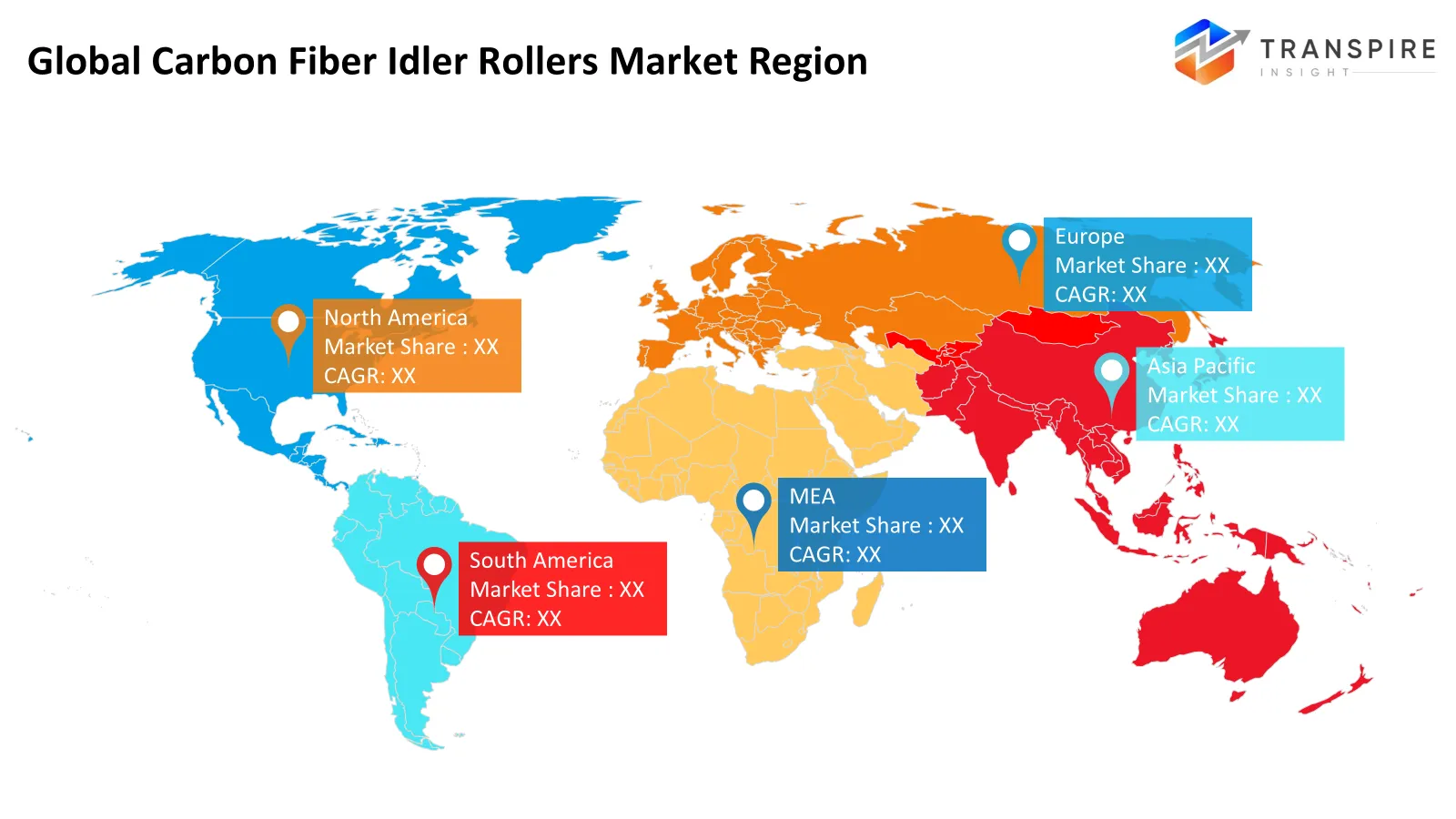
Who are the Key Players in the Global Carbon Fiber Idler Rollers Market and how do they Compete?
The Global Carbon Fiber Idler Rollers Market features intense rivalry driven by engineering firms moving past standard metal fabrication toward advanced polymer and composite chemistry. Competition centers heavily on balancing high structural stiffness with lower rotational inertia to capture high-speed logistics contracts and long-distance heavy mining operations.
Sandvik deploys a clear innovation strategy, differentiating its product line through its HR185 all-composite design that handles massive mining tonnages while cutting total cost of ownership by up to 20%. Rather than competing on low prices, the company focuses its expansion approach on cross-selling these high-end, durable composite upgrades directly into its massive, existing global network of heavy mining infrastructure.
PROK executes a technology-led niche strategy, differentiating its composite and high-density rollers with built-in visual wear indicators and smart maintenance sensors. Its expansion approach hinges on securing aggressive international distribution partnerships, moving rapidly into strict European and North American fulfillment hubs where reducing unexpected conveyor downtime is treated as a top operational priority.
Company List
- NEPEAN Conveyors
- Sandvik
- Rulmeca Group
- Interroll
- Flexco
- Fenner Dunlop
- Continental Conveyor
- Conveyor Units
- Lorbrand
- CPS Conveyors
- Kinder Australia
- Precision Pulley & Idler
- PROK
- Martin Engineering
- Superior Industries
Recent Development News
- In May 2026, Interroll Holding AG purchased the Royal Apollo Group. This buyout instantly expands Interroll’s material handling lineup, giving the company a direct way to offer fully unified conveyor and sorting setups built for the punishing pace of high-volume automated distribution centers worldwide. https://www.interroll.com/
- In May 2026, Martin Engineering snapped up ConveyorTech Pty Ltd. This strategic move lets Martin Engineering supply its interchangeable, non-urethane belt cleaners and spare parts into completely new global territories, vastly growing its footprint across the material handling market. https://www.quarrymagazine.com
- In December 2025, PROK opened a brand-new composite idler manufacturing and recycling plant in Vespasiano, Brazil. The fresh facility gives regional production a massive boost for lightweight HDPE rollers while rolling out a smart take-back program to recycle old, worn-out hardware, heavily driving down carbon output and material waste in the area. https://prok.com
What Strategic Insights Define the Future of the Global Carbon Fiber Idler Rollers Market?
The future of this market hinges on transforming structural hardware into active data assets. Forward-thinking bulk handlers are rapidly phasing out passive hardware in favor of self-sensing, circular composite shells that continuously benchmark their own structural health.
However, a hidden risk lies in microscopic delamination within the composite. Intermittent thermal shocks and high-velocity impact shear can steadily degrade internal resin bonds, masking internal flaws from basic acoustic sensors until a sudden, catastrophic structural failure occurs.
Conversely, a massive opportunity is emerging within highly corrosive marine environments. Coastal bulk terminals and salt-flat loading docks suffer from relentless galvanic corrosion that routinely destroys metal rollers, opening up a lucrative, high-margin niche for completely inert carbon fibers.
To stay ahead, manufacturers must stop treating rollers as mere commodities. The smart play is pivoting to "predictive-uptime-as-a-service" subscription models, tying corporate revenue directly to guaranteed conveyor availability.
Key segments for the Global Carbon Fiber Idler Rollers Market
By Type
- Lightweight Carbon Fiber Rollers
- High-strength Idler Rollers
- Anti-corrosion Rollers
- Composite Idler Rollers
- Precision Conveyor Rollers
- High-speed Rollers
- Others
By Application
- Mining Conveyors
- Material Handling Systems
- Packaging Machinery
- Printing Equipment
- Industrial Automation
- Others
By End-User
- Mining Companies
- Manufacturing Plants
- Logistics Providers
- Packaging Companies
- Others
By Diameter
- Small Diameter Rollers
- Medium Diameter Rollers
- Large Diameter Rollers
- Heavy-duty Rollers
- Others
Frequently Asked Questions
Find quick answers to common questions.
The Global Carbon Fiber Idler Rollers Market size was valued at USD 118.32 Million in 2025 and is poised to reach USD 225.14 Million by 2033, expanding at a 8.4% CAGR.
Key segments for the Global Carbon Fiber Idler Rollers Market are Type (Lightweight Carbon Fiber Rollers, High-strength Idler Rollers, Anti-corrosion Rollers, Composite Idler Rollers, Precision Conveyor Rollers, High-speed Rollers, Others), Application (Mining Conveyors, Material Handling Systems, Packaging Machinery, Printing Equipment, Industrial Automation, Others), End-User (Mining Companies, Manufacturing Plants, Logistics Providers, Packaging Companies, Others), and Diameter (Small Diameter Rollers, Medium Diameter Rollers, Large Diameter Rollers, Heavy-duty Rollers, Others).
Growth is primarily driven by a massive technological movement toward embedding real-time structural health monitoring sensors and a global behavioral push to lower routine power loads and startup torque across heavy-duty bulk material conveyor systems.
The global market is led by major manufacturers including Sandvik AB, NEPEAN Conveyors, Interroll Group, PROK, CPS Conveyors, Kinder Australia, Superior Industries, Precision Pulley & Idler (PPI), Continental Conveyor, Flexco, Rulmeca Group, Conveyor Units Ltd., Fenner Dunlop, and Martin Engineering.
Asia Pacific holds a dominant 40% share of global market volume, heavily steering industry dynamics through rapid port modernization, extensive state-funded mining expansions, and an aggressive push to deploy low-inertia composite hardware over old steel variants to cut high-capacity operational costs.
Highly lucrative commercial opportunities exist within extreme, corrosive marine environments like coastal bulk terminals and salt-flat loading docks where completely inert carbon fiber builds eliminate structural failure from relentless galvanic corrosion, alongside emerging high-margin niches for integrated self-sensing, circular composite shells.
- NEPEAN Conveyors
- Sandvik
- Rulmeca Group
- Interroll
- Flexco
- Fenner Dunlop
- Continental Conveyor
- Conveyor Units
- Lorbrand
- CPS Conveyors
- Kinder Australia
- Precision Pulley & Idler
- PROK
- Martin Engineering
- Superior Industries
About the Authors

Pankaj Ghogare Patil
I am Pankaj Ghogare Patil, a Senior Research Analyst at Transpire Insight, specializing in the Pharmaceutical, Chemicals & Materials, Healthcare IT, and Biotechnology industry. My expertise lies in conducting comprehensive market research, analyzing industry trends, evaluating competitive landscapes, and translating complex data into actionable insights. At Transpire Insight, I closely follow emerging technologies, regulatory developments, and market innovations to create accurate, well-researched, and informative content that helps businesses and professionals make informed decisions. I am committed to producing credible, evidence-based articles that reflect industry best practices while making technical topics accessible and valuable for a broad audience.

Chakradhar Khansole
Chakradhar serves as the Research Director at Transpire Insight, bringing over 8 years of experience in technology, innovation, and strategic market intelligence. He specializes in transforming complex market data into actionable business insights that enable organizations to make informed, growth-oriented decisions. Recognized for his strategic vision and analytical expertise, Chakradhar leads high-impact research initiatives, delivering comprehensive market assessments, competitive intelligence, and forward-looking industry analysis.
Recently Published Reports
-
May 2026
Healthcare Polymer Packaging Market
Healthcare Polymer Packaging Market Size, Share & Analysis Report By Packaging Type (Syringes, IV Bottles and Pouches, Clamshells, Blisters, Bottles & Jars, Containers, Tubes, IV Parental Packaging, Others), By Type (Regulated, Non-regulated), By Polymer Type (LDPE (Low-Density Polyethylene), HDPE (High-Density Polyethylene), Homo-polymer (Homo), Random Copolymer (Random), Block Copolymer (Block), PET, Polystyrene, Polyvinyl Chloride, Polyamide/EVOH, Others), and Geography (North America, Europe, Asia-Pacific, Middle East and Africa, South and Central America), 2021 - 2031
-
Apr 2026
Hydrophilic Tape (Waterstop) Market
Hydrophilic Tape (Waterstop) Market Size, Share & Analysis Report By Type (Bentonite-Based Hydrophilic Tape, Rubber-Based Hydrophilic Tape), By Application (Residential Buildings, Commercial Buildings, Infrastructure Projects), and Geography (North America, Europe, Asia-Pacific, Middle East and Africa, South and Central America), 2021 - 2031
-
Apr 2026
Metalens Market
Metalens Market Size, Share & Analysis Report By Type (Visible Light Metalens, and Infrared Metalens), By Application (Consumer Electronics, Automotive Electronics, Industrial, Medical, and Others), and Geography (North America, Europe, Asia-Pacific, Middle East and Africa, South and Central America), 2021 - 2031
-
Apr 2026
PBT Resin Market
PBT Resin Market Size, Share & Analysis Report By Type (Reinforced PBT Resin, Unreinforced PBT Resin), By Processing Method (Injection Molding, Extrusion, Blow Molding, Others), By End-User (Automotive, Electrical & Electronics, Consumer Appliances, Industrial Machinery, Medical Devices, Packaging, Others), and Geography (North America, Europe, Asia-Pacific, Middle East and Africa, South and Central America), 2021 - 2031