
Asia Pacific Industrial Plastic Market Size & Forecast:
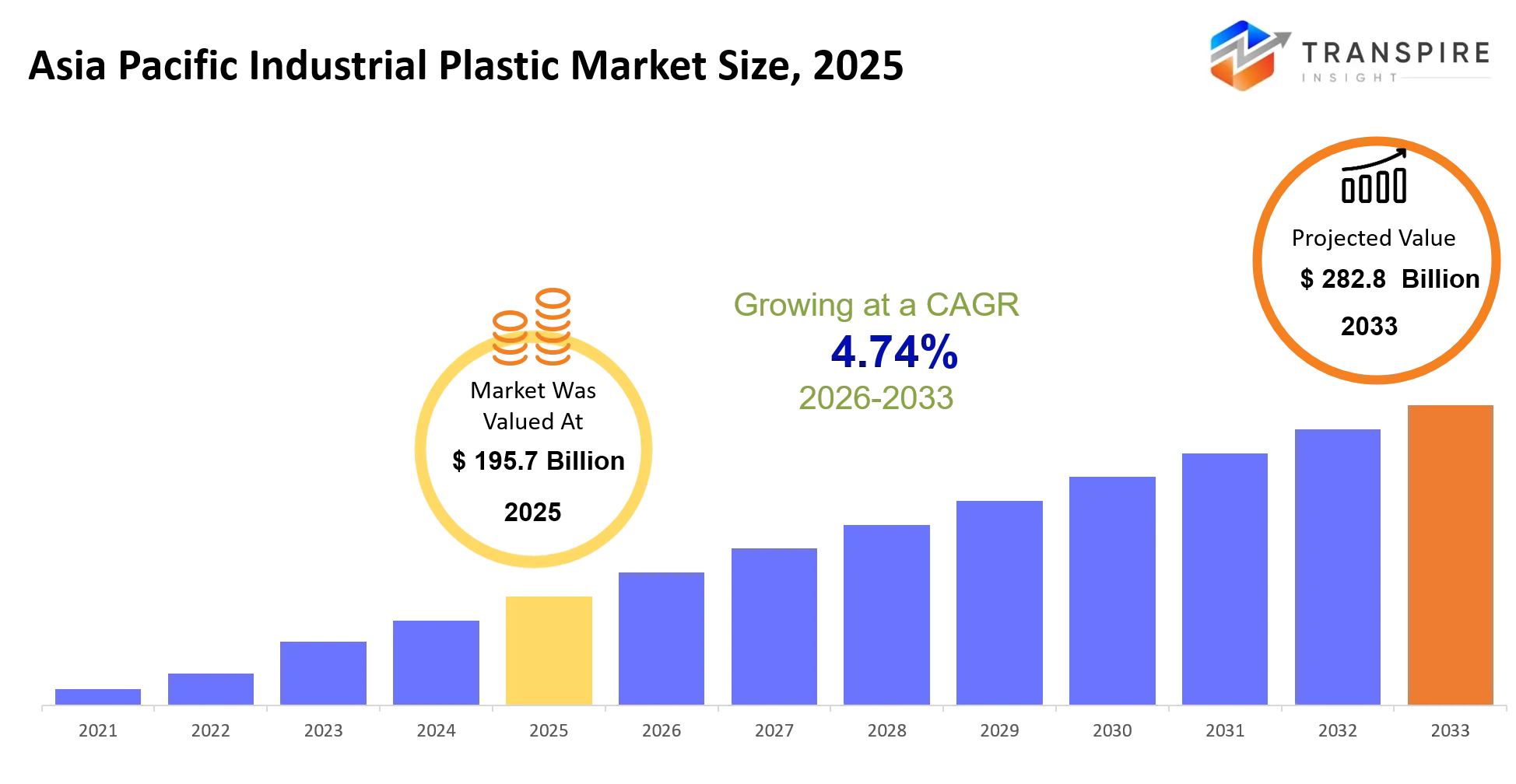
- Asia Pacific Industrial Plastic Market Size 2025: USD 195.7 Billion
- Asia Pacific Industrial Plastic Market Size 2033: USD 282.8 Billion
- Asia Pacific Industrial Plastic Market CAGR: 4.74%
- Asia Pacific Industrial Plastic Market Segments: By Product Type (PE, PP, PVC, ABS, PET, Polycarbonate, Nylon, Others); By Application (Packaging, Automotive, Construction, Electronics, Healthcare, Others); By Processing (Injection Molding, Extrusion, Blow Molding, Others); By End User (Manufacturing, Automotive, Electronics, Construction, Others)
To learn more about this report,  Download Free Sample Report
Asia Pacific Industrial Plastic Market Summary
The Asia Pacific Industrial Plastic Market was valued at USD 195.7 Billion in 2025. It is forecast to reach USD 282.8 Billion by 2033. That is a CAGR of 4.74% over the period.
In the Asia Pacific industrial plastic market, the supplies matter in a very practical way: materials that keep factories, shipyards, and infrastructure moving along. Think corrosion resistant piping and marine parts, but also lighter housings, insulation types, and industrial packaging that keeps products safe while they are in transit.In the last few years things have shifted a bit, not just in demand but also in how companies source their inputs, kind of. Instead of sticking mostly to virgin petrochemical resins, more manufacturers lean on engineered and reused polymer blends. It is sort of a quiet change but it shows up everywhere.They are doing this because supply chains feel expensive and durability has become more of a hard requirement.
One noticeable structural change is the quick adoption of recycled high performance plastics in automotive, construction, and even maritime uses. And yes, this became possible thanks to better sorting systems plus compounding technologies. The whole acceleration really picked up after COVID-19 because it showed how brittle some global supply routes can be. On top of that, stricter extended producer responsibility rules in places like India and Japan raised compliance costs, especially for single use, and for materials that do not recycle well.
Key Market Insights
- The Asia Pacific Industrial Plastic Market is basically dominated by China, with something like a 38–42% share in 2025, because large-scale manufacturing and export activity is just huge.
- India feels like the fastest-growing region, and it’s projected to expand real quickly during 2026–2030, mainly driven by infrastructure push and maritime investments, so there is a lot going on.
- Meanwhile Southeast Asia is quietly becoming a cost-efficient production hub, pulling in relocation of polymer processing facilities, kind of like plants moving closer to advantage points.
- On materials, Polyethylene is holding the lead, roughly ~30% share across the Asia Pacific Industrial Plastic Market, driven by packaging plus industrial pipe use.
- Polypropylene comes in second, and it’s widely used in automotive components, and also in chemical-resistant industrial systems, which keeps demand pretty steady.
- The engineering plastics segment is the fastest-growing, sort of backed by the demand for high-strength, heat-resistant maritime materials, which seems to keep pushing it forward.
- Packaging and industrial logistics still dominate with nearly 35% share, mostly because cross-border trade keeps climbing and warehousing keeps expanding too.
- Marine and offshore applications are the fastest-growing, supported by shipbuilding modernization and this ongoing need for corrosion-resistant materials.
- The manufacturing sector is leading too, around ~40% share, due to large-scale plastic usage in machinery, components, and protective systems, basically everywhere.
- Construction and infrastructure is also rapidly growing, driven by smart city projects and industrial corridor development, and you can see it gaining momentum across regions.
What are the Key Drivers, Restraints, and Opportunities in the Asia Pacific Industrial Plastic Market?
The strongest growth driver in the Asia Pacific Industrial Plastic Market is the rapid expansion of industrial manufacturing and maritime infrastructure modernization across China, India and Vietnam. At the same time this shift feels like it’s being pulled forward by big industrial corridors, supported by government backing, plus shipbuilding upgrades that call for corrosion resistant and lightweight polymer materials which are also cost efficient. So as factories replace systems that were metal heavy, with engineered plastics , the idea is to reduce upkeep and stretch lifecycle efficiency. In turn revenue generation seems to rise across high performance polymer segments, especially in transportation and offshore applications, and it keeps building momentum.
One major structural restraint though is the volatility in petrochemical feedstock pricing, it directly messes with the production economics for industrial plastics. Since upstream crude oil and naphtha costs stay extremely sensitive to geopolitical tensions , and also refinery capacity limitations, manufacturers end up under persistent margin pressure. This situation is not something that can be fixed fast, because the whole industry still leans deeply on fossil based inputs. Because of that procurement decisions get delayed and long term contracting across industrial buyers can get suppressed.
The biggest opportunity, in my view, sits in scaling advanced recycled and bio based engineering plastics for maritime and heavy industrial uses. Japan and India for instance are pushing circular polymer ecosystems, which helps enable closed loop recycling for higher value industrial components. For example, recycled polypropylene and polyethylene blends are being tested more often in ship interiors and modular construction systems, and that basically opens up a new revenue stream for sustainable industrial materials.
What Has the Impact of Artificial Intelligence Been on the Asia Pacific Industrial Plastic Market?
Artificial intelligence is kind of reshaping the Asia Pacific Industrial Plastic Market, by boosting production efficiency , tuning material design, and enabling predictive maintenance across industrial polymer manufacturing setups. In big polymer plants , AI powered automation doesn’t just “speed things up”, it helps tune temperature control, regulate extrusion rates, and refine blending accuracy. Because of this, less material gets wasted , and the output quality stays more stable across runs. You can see this trend showing up more and more in smart factories across China and South Korea, where adjustments happen in real time , which tends to improve throughput and keep operational expenses lower.
At the same time , machine learning models are being used for predictive maintenance of polymer processing equipment. They spot early warning clues of wear in extruders, compressors, and molding systems. The result is fewer unexpected shutdowns , and better equipment use, especially where high volume output is tied to automotive and marine supply chains. Also, AI enabled simulation tools are helping forecast how materials behave when stressed, which strengthens product reliability for offshore and other industrial uses.
Still, uptake is not everywhere because the integration costs can be high, and the data quality is often inconsistent across older, legacy manufacturing lines. Quite a few mid-sized producers do not have the digital backbone needed for real time data capture, so the models don’t stay as accurate once they’re running in the real environment. On top of that, connectivity issues in spread out industrial sites can slow down full scale AI rollouts. This is especially noticeable in emerging production areas across Southeast Asia.
Key Market Trends
- Manufacturers kind of shifted from virgin polyethylene toward recycled composites after 2022, regulatory tightening started sweeping across China, Japan, and India—mostly across industrial waste frameworks.
- Industrial buyers more often adopted lightweight engineering plastics after 2021 supply chain disruptions, and that showed up as real steel dependency risks in maritime use, not just theory.
- Shipbuilding firms also expanded corrosion-resistant polymer usage post 2023, swapping out metal fittings in about nearly 25% of new offshore vessel designs.
- Chemical producers started integrating digital compounding systems in 2022, and in practice this helped material consistency, while lowering batch rejection rates at Asia Pacific facilities.
- Then the regulatory push in 2024, extended producer responsibility rules, it basically sped up closed loop recycling investments across packaging and industrial logistics segments.
- After 2021, as EV production growth took off , a lot of automotive manufacturers moved toward high-heat thermoplastics. It sort of boosted the need for lighter parts that can handle heat, thermal resistant components, basically.
- In the Southeast Asian production hubs, share also went up after 2020 as companies shifted resin processing away from the costly China coastal clusters . Instead, they leaned more into Vietnam and Thailand for the same kind of work , resin handling and so on.
- BASF and Dow increased regional R&D spending from 2023 to develop bio-based industrial plastic alternatives for export markets; it was pretty noticeable in 2023 planning cycles.
- Industrial procurement strategies moved toward multi supplier sourcing after 2021 resin shortages revealed dependency risk tied to single country polymer supply chains, even for stable contracts.
- Smart manufacturing adoption in 2025 improved extrusion efficiency by as much as 18% , cutting waste in large scale polymer production facilities across Asia.
Asia Pacific Industrial Plastic Market Segmentation
By Product Type :
Polyethylene and polypropylene will still see solid demand, because they get used a lot in packaging, piping, and also in industrial containers across basically most manufacturing units. PVC usage should stay pretty steady in construction and infrastructure work, mainly for the cost advantage, and because it holds up with durability even when conditions are harsh.
ABS, PET, polycarbonate, and nylon should get more traction too, especially in automotive, electronics, and precision industrial systems. Engineering grade plastics are likely to grow quicker as industries move toward lighter materials, but with higher strength, better heat resistance, and longer service life, even in complex production surroundings where everything has to last.
By Application :
Packaging keeps being the biggest application area, largely due to the constant movement of goods, the warehousing expansion, and export driven supply chains across Asia Pacific . Industrial packaging will also rise, for protective, lightweight, and reusable material solutions that are easier to handle and less wasteful.
Automotive and construction should expand at a faster pace too, tied to the growth in electric vehicle production and the ongoing infrastructure development projects. Electronics and healthcare will follow along, as demand climbs for precision components, sterile packaging, and durable protective materials used in sensitive, controlled environments.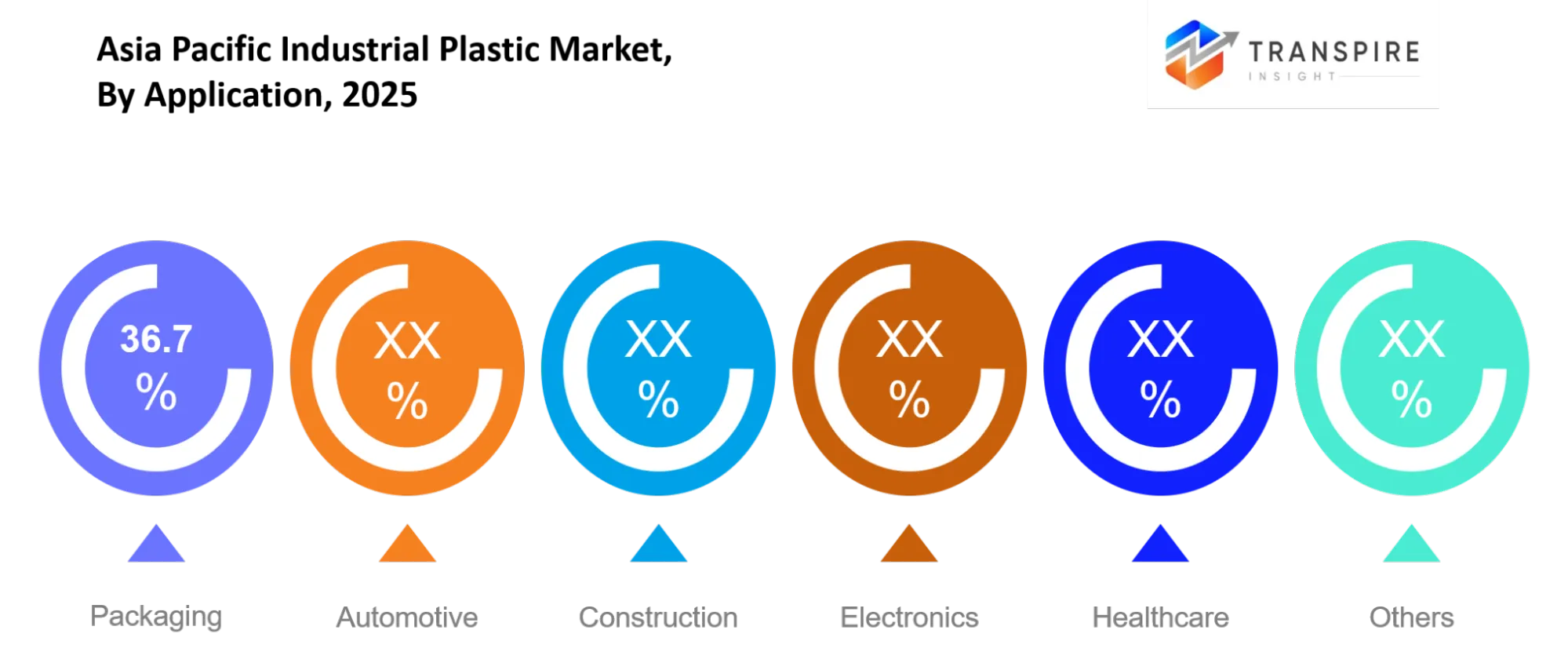
To learn more about this report, Download Free Sample Report
By Processing :
Injection molding will stay dominant, mostly because it can crank out intricate, high accuracy industrial parts at scale. In the next few years adoption should rise across automotive components, electronic housings, and those industrial equipment manufacturing lines, where throughput and detail matter.
Extrusion will keep a strong usage profile in piping, insulation, and film production setups. Blow molding will continue supporting packaging and container manufacturing too, and meanwhile advanced processing methods will get more attention, to improve production efficiency, trim waste , and keep material performance consistency steady across most industrial applications.
By End User :
The manufacturing sector is still likely the biggest end user since industrial plastics are already woven into machinery, equipment parts, and protective systems throughout production facilities in Asia Pacific economies. Automotive and construction areas should expand quicker as lightweight materials replace older metal components.
Electronics and other industrial users will also push demand upward for high performance polymers, ones that give heat resistance, strong insulation, and a longer service life even when the operating conditions get complex.
What are the Key Use Cases Driving the Asia Pacific Industrial Plastic Market?
Packaging and industrial logistics still remain the core use case in the Asia Pacific Industrial Plastic Market, moved by high trade volumes, warehousing expansion, and the constant movement of industrial goods. Demand stays strong because lightweight plastics cut transport cost, make product protection better, and allow a faster supply chain turnover across manufacturing hubs.
Automotive components and construction materials are also showing up more often as secondary use cases, especially in electric vehicles and big infrastructure projects. Electronics manufacturing is boosting the use of heat-resistant plastics for housings , insulation, and precision parts as well, and there’s more backing from growing industrial output in China, India and South Korea.
Marine-grade materials, along with newer industrial composites, are becoming more visible too, mainly tied to shipbuilding upgrades and offshore energy programs. Healthcare-grade packaging plastics are getting attention as well, mostly because of stricter hygiene rules and higher demand for sterile, durable, and contamination-resistant material solutions across industrial supply lines.
|
Report Metrics |
Details |
|
Market size value in 2025 |
USD 195.7 Billion |
|
Market size value in 2026 |
USD 204.5 Billion |
|
Revenue forecast in 2033 |
USD 282.8 Billion |
|
Growth rate |
CAGR of 4.74% from 2026 to 2033 |
|
Base year |
2025 |
|
Historical data |
2021 - 2024 |
|
Forecast period |
2026 - 2033 |
|
Report coverage |
Revenue forecast, competitive landscape, growth factors, and trends |
|
Regional scope |
Asia Pacific (India, China, Japan, Australia, South Korea, Rest of Asia Pacific) |
|
Key company profiled |
John Deere, Trimble, Bayer, AGCO, Topcon, CropX, DeLaval, IBM, Microsoft, Cisco, Huawei, Bosch, SAP, Oracle, Syngenta |
|
Customization scope |
Free report customization (country, regional & segment scope). Avail customized purchase options to meet your exact research needs. |
|
Report Segmentation |
By Product Type (PE, PP, PVC, ABS, PET, Polycarbonate, Nylon, Others); By Application (Packaging, Automotive, Construction, Electronics, Healthcare, Others); By Processing (Injection Molding, Extrusion, Blow Molding, Others); By End User (Manufacturing, Automotive, Electronics, Construction, Others) |
Which Regions are Driving the Asia Pacific Industrial Plastic Market Growth?
China is still the most dominant region in the Asia Pacific Industrial Plastic Market, mainly because it has this huge manufacturing setup and a pretty well wound petrochemical supply chain. Also, the government keeps pushing industrial expansion so the domestic polymer production capacity keeps growing across those coastal industrial clusters. Big ports like Shanghai and Shenzhen, they help move plastic components at high volume out to global markets. And there’s this mature supplier ecosystem, resin producers plus downstream processors, which basically keeps demand steadier than one might expect, while also keeping costs more efficient.
Japan and South Korea sit next as the second main region. Here the edge comes from advanced industrial systems and really solid demand, especially from electronics and automotive manufacturing. In contrast with China, the momentum is less about chasing raw volume and more about precision engineering needs. Regulatory rules stay fairly stable, and long-term investment by shipbuilders and semiconductor manufacturers keeps usage of high-performance plastics from swinging too much. Plus, when industrial conglomerates maintain steady capital spending, the demand cycles in this region stay pretty predictable.
Meanwhile Southeast Asia and India are likely the fastest-growing areas, tied to industrial relocation, broader infrastructure buildouts, and policy reforms that boost manufacturing competitiveness. New port projects in Vietnam and India improve export capacity and reduce logistics friction, which is kind of a big deal. Government-led programs, like industrial corridors and EV manufacturing incentives, also raise polymer consumption across construction and automotive sectors. From 2026 to 2033, this ramp up should pull in more new entrants, mostly because they’re hunting for cost advantages while also extending their access to expanding end-user demand bases.
Who are the Key Players in the Asia Pacific Industrial Plastic Market and How Do They Compete?
The Asia Pacific Industrial Plastic Market kind of shows a moderately consolidated setup, where big multinational chemical producers run into strong regional petrochemical firms. In practice the contest is mostly steered by cost efficiency , material innovation and also easier access to downstream industrial networks, not just pricing alone. Older firms keep their slice of the market by building integrated supply chains, while newer players tend to zoom in on more specialized materials and the regional “manufacturing closeness” factor.
Companies like BASF and Dow go after rivals using advanced polymer innovation and circular material technologies, which help industrial sustainability goals across Asia. Reliance Industries then holds a stronger stance thanks to vertical integration across refining and petrochemicals, giving cost benefits in high volume polymer supply. LG Chem leans into high performance materials for electric vehicles and electronics, backed by solid domestic industrial demand. Meanwhile Mitsubishi Chemical Group differentiates through specialty engineering plastics for precision manufacturing , and it keeps expanding regional partnerships to lock in a bigger Asia presence.
Company List
- BASF
- Dow
- SABIC
- LG Chem
- Lotte Chemical
- ExxonMobil
- INEOS
- Formosa Plastics
- Reliance Industries
- Mitsubishi Chemical
- Covestro
- Hanwha
- Sumitomo Chemical
- Toray
- Borealis
Recent Development News
In March 2026, Siegwerk announced acquisition of Hi-Tech Inks. The acquisition strengthens Siegwerk’s position in India’s fast-growing flexible packaging inks segment, consolidating market share above 20% and enhancing its Asia Pacific industrial packaging coatings footprint.
Source https://www.siegwerk.com/
In April 2026, Sumitomo Chemical, Mitsui Chemicals, and Idemitsu Kosan announced regulatory approval progress for their Prime Polymer business integration. The transaction further consolidates polypropylene and polyethylene operations under a single joint venture platform, expected to enhance scale efficiency and pricing resilience across the Asia Pacific industrial plastics market. Source https://chemxplore.com/
What Strategic Insights Define the Future of the Asia Pacific Industrial Plastic Market?
The Asia Pacific Industrial Plastic Market is kinda moving, toward higher dependence on engineered recyclable and application specific polymers, as industrial buyers focus on efficiency compliance, and lifecycle value more than just the cheap material price. You can see this change happening because environmental rules are getting tighter across big economies, and also because advanced manufacturing clusters are growing. Those clusters tend to need consistent performance materials, not the usual commodity plastics. In the next 5 to 7 years, production networks may become more regional, since firms want to cut down their exposure to long supply chains and the unstable feedstock markets
One less visible risk is the increasing concentration in upstream petrochemical supply, where a relatively small group of integrated producers can steer pricing power and also limit flexibility for downstream buyers. That situation might slow adoption in cost sensitive industries during times of crude price wobble. At the same time there is a newer kind of opportunity too, the expansion of closed loop recycling systems for industrial grade plastics in Southeast Asia, backed by policy incentives and infrastructure investments that are starting to stack up
Overall, market participants should benefit if they invest early in circular material technologies and also build localized production partnerships, to reduce supply risk and capture the emerging demand before it gets crowded
Asia Pacific Industrial Plastic Market Report Segmentation
By Product Type
- PE
- PP
- PVC
- ABS
- PET
- Polycarbonate
- Nylon
By Application
- Packaging
- Automotive
- Construction
- Electronics
- Healthcare
By Processing
- Injection Molding
- Extrusion
- Blow Molding
By End User
- Manufacturing
- Automotive
- Electronics
- Construction
Frequently Asked Questions
Find quick answers to common questions.
The Asia Pacific Industrial Plastic Market size is USD 282.8 Billion in 2033.
Key Segments for the Asia Pacific Industrial Plastic Market are By Product Type (PE, PP, PVC, ABS, PET, Polycarbonate, Nylon, Others); By Application (Packaging, Automotive, Construction, Electronics, Healthcare, Others); By Processing (Injection Molding, Extrusion, Blow Molding, Others); By End User (Manufacturing, Automotive, Electronics, Construction, Others).
Major Asia Pacific Industrial Plastic Market Players are John Deere, Trimble, Bayer, AGCO, Topcon, CropX, DeLaval, IBM, Microsoft, Cisco, Huawei, Bosch, SAP, Oracle, Syngenta.
The current Asia Pacific Industrial Plastic Market size is USD 195.7 Billion in 2025.
The Asia Pacific Industrial Plastic Market CAGR is 4.74% from 2026 to 2033.
- BASF
- Dow
- SABIC
- LG Chem
- Lotte Chemical
- ExxonMobil
- INEOS
- Formosa Plastics
- Reliance Industries
- Mitsubishi Chemical
- Covestro
- Hanwha
- Sumitomo Chemical
- Toray
- Borealis
About the Authors

Pankaj Ghogare Patil
I am Pankaj Ghogare Patil, a Senior Research Analyst at Transpire Insight, specializing in the Pharmaceutical, Chemicals & Materials, Healthcare IT, and Biotechnology industry. My expertise lies in conducting comprehensive market research, analyzing industry trends, evaluating competitive landscapes, and translating complex data into actionable insights. At Transpire Insight, I closely follow emerging technologies, regulatory developments, and market innovations to create accurate, well-researched, and informative content that helps businesses and professionals make informed decisions. I am committed to producing credible, evidence-based articles that reflect industry best practices while making technical topics accessible and valuable for a broad audience.

Chakradhar Khansole
Chakradhar serves as the Research Director at Transpire Insight, bringing over 8 years of experience in technology, innovation, and strategic market intelligence. He specializes in transforming complex market data into actionable business insights that enable organizations to make informed, growth-oriented decisions. Recognized for his strategic vision and analytical expertise, Chakradhar leads high-impact research initiatives, delivering comprehensive market assessments, competitive intelligence, and forward-looking industry analysis.
Recently Published Reports
-
May 2026
Healthcare Polymer Packaging Market
Healthcare Polymer Packaging Market Size, Share & Analysis Report By Packaging Type (Syringes, IV Bottles and Pouches, Clamshells, Blisters, Bottles & Jars, Containers, Tubes, IV Parental Packaging, Others), By Type (Regulated, Non-regulated), By Polymer Type (LDPE (Low-Density Polyethylene), HDPE (High-Density Polyethylene), Homo-polymer (Homo), Random Copolymer (Random), Block Copolymer (Block), PET, Polystyrene, Polyvinyl Chloride, Polyamide/EVOH, Others), and Geography (North America, Europe, Asia-Pacific, Middle East and Africa, South and Central America), 2021 - 2031
-
Apr 2026
Hydrophilic Tape (Waterstop) Market
Hydrophilic Tape (Waterstop) Market Size, Share & Analysis Report By Type (Bentonite-Based Hydrophilic Tape, Rubber-Based Hydrophilic Tape), By Application (Residential Buildings, Commercial Buildings, Infrastructure Projects), and Geography (North America, Europe, Asia-Pacific, Middle East and Africa, South and Central America), 2021 - 2031
-
Apr 2026
Metalens Market
Metalens Market Size, Share & Analysis Report By Type (Visible Light Metalens, and Infrared Metalens), By Application (Consumer Electronics, Automotive Electronics, Industrial, Medical, and Others), and Geography (North America, Europe, Asia-Pacific, Middle East and Africa, South and Central America), 2021 - 2031
-
Apr 2026
PBT Resin Market
PBT Resin Market Size, Share & Analysis Report By Type (Reinforced PBT Resin, Unreinforced PBT Resin), By Processing Method (Injection Molding, Extrusion, Blow Molding, Others), By End-User (Automotive, Electrical & Electronics, Consumer Appliances, Industrial Machinery, Medical Devices, Packaging, Others), and Geography (North America, Europe, Asia-Pacific, Middle East and Africa, South and Central America), 2021 - 2031