
United Kingdom Off-highway Plastics Market Size & Forecast:
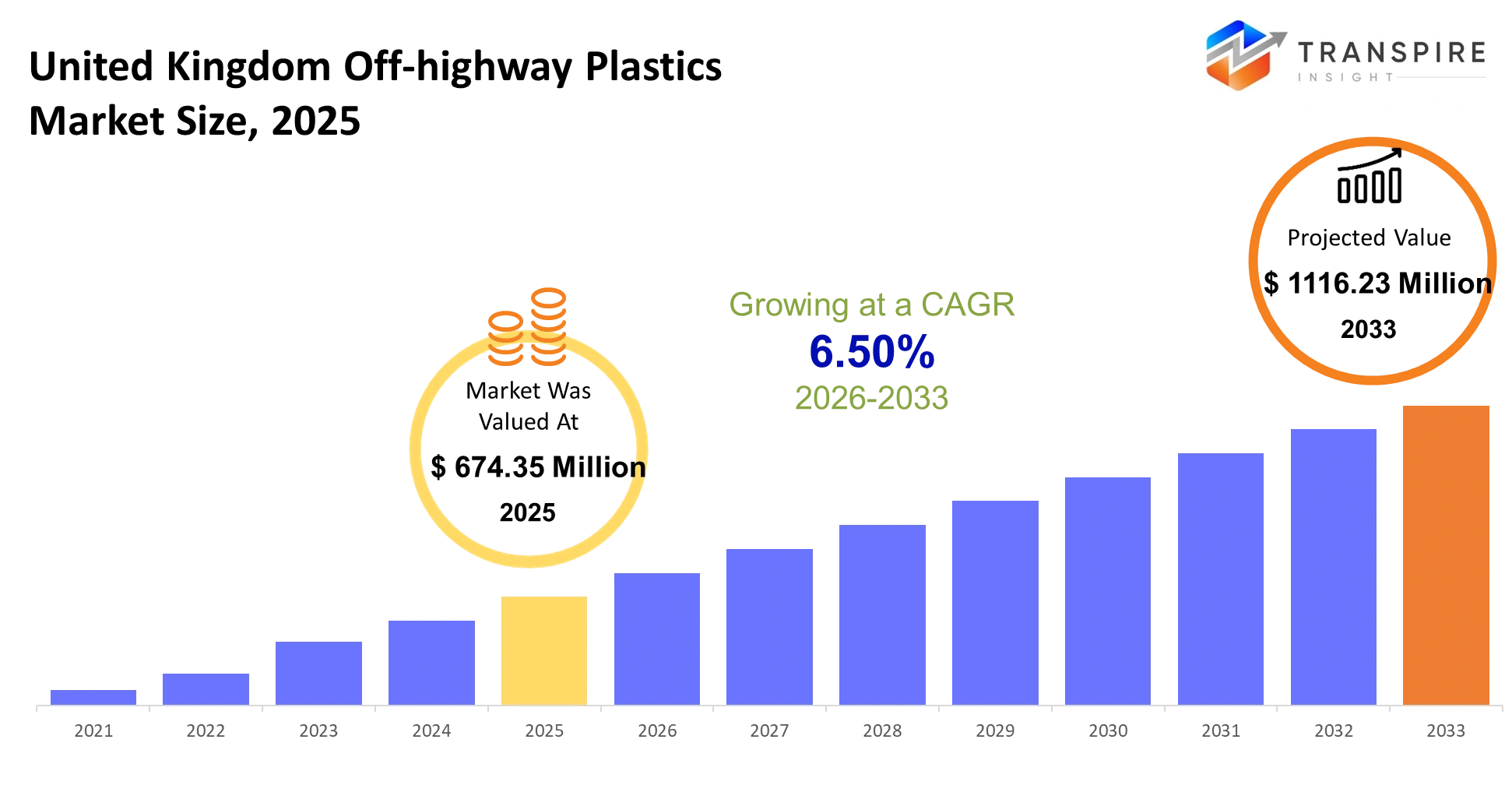
- United Kingdom Off-highway Plastics Market Size 2025: USD 674.35 Million
- United Kingdom Off-highway Plastics Market Size 2033: USD 1116.23 Million
- United Kingdom Off-highway Plastics Market CAGR: 6.50%
- United Kingdom Off-highway Plastics Market Segments: By Material Type (Polypropylene, Polyethylene, ABS, Polycarbonate, Nylon, Others); By Equipment Type (Construction Equipment, Agricultural Machinery, Mining Equipment, Forestry Equipment, Others); By Application (Interior Components, Exterior Components, Fuel Systems, Engine Components, Others); By End User (OEMs, Aftermarket Suppliers, Equipment Manufacturers, Others)
To learn more about this report,  Download Free Sample Report
United Kingdom Off-highway Plastics Market Summary
The United Kingdom Off-highway Plastics Market was valued at USD 674.35 Million in 2025. It is forecast to reach USD 1116.23 Million by 2033. That is a CAGR of 6.50% over the period.
The United Kingdom off-highway plastics market kind of helps push the redesign of heavy machinery in construction, agriculture, mining, and forestry, by swapping metal parts for engineered polymers that cut down on weight, resist corrosion, and boost day to day operational efficiency. You commonly see these materials in cabins, exterior panels fuel systems, and engine-adjacent components, where durability and thermal stability really matter because they directly affect equipment uptime, plus lifecycle costs too.
Over the last 3 to 5 years, there’s been a noticeable structural shift toward electrified and low-emission machinery, so OEMs are reworking equipment blueprints around lighter plastic-intensive components. This transition picked up steam after stricter UK and European emissions compliance frameworks tightened procurement rules for industrial fleets. Then supply chain disruption during 2020 to 2022 kind of forced localization of polymer sourcing, and that meant manufacturers had to broaden their supplier base, plus adopt more design-flexible materials. Because of that, uptake of advanced engineering plastics went up, since they reduced assembly complexity while also staying within shifting regulatory and performance boundaries.
Together, this pressure from regulations and the supply chain recalibration has produced a sort of cost-performance edge for plastics. It’s speeding up the move into next generation off-highway equipment platforms, and it’s widening long-term revenue chances for material suppliers.
Key Market Insights
- Northern Europe kinda dominates the United Kingdom Off-highway Plastics Market, with almost 38% share in 2025, and it looks like that is helped by stricter emissions rules along with advanced OEM manufacturing clusters even if it sounds a bit redundant.
- Eastern Europe is the fastest-growing area through 2030, propelled by infrastructure modernization and more mechanization across construction and farming fleets, which is, honestly, a pretty steady trend.
- On the materials side, polypropylene leads material demand at more than 32%, mostly because it is cost efficient and also shows up everywhere in cabin interiors and exterior load-bearing structural pieces.
- Nylon meanwhile shows up as the fastest-growing material segment from 2025–2030, supported by higher demands for engine compartment temperature resistance, and yeah this is the main reason it is accelerating.
- For applications, interior components dominate usage at roughly 41% share, driven by operator comfort systems and lightweight cabin redesign habits, where less weight really matters.
- For the growthiest application though, battery enclosures and sensor-integrated modules are moving the quickest, largely due to electrification across off-highway machinery.
- When you look at end users, OEMs hold the leading share at nearly 55% , because material integration starts early in the design cycles across equipment platforms.
- Aftermarket suppliers also expand quickly, mainly because older fleets in agriculture and construction keep needing replacement polymer components, so the demand stays kinda consistent.
- Covestro is getting a stronger footing in the United Kingdom Off-highway Plastics Market, thanks to high-performance polycarbonate innovation for safety critical apparatus components.
- BASF expands its engineering plastics portfolio via additive enhanced thermoplastics, supporting anti-vibration performance and heat endurance within heavy machine applications.
What are the Key Drivers, Restraints, and Opportunities in the United Kingdom Off-highway Plastics Market?
Driver: The main thing pushing the United Kingdom off-highway plastics market forward is that construction and agricultural machines are getting electrified pretty fast , plus they’re being made lighter. That happens because emissions rules are getting tighter and fuel efficiency thresholds keep getting raised too. OEMs then sort of answer by swapping out metal assemblies for high-performance thermoplastics, you see it in cabins, exterior panels and even in battery-adjacent structures. This whole move feels like it keeps building steam because operators are stuck with higher operating costs and they also have to meet more strict lifecycle carbon reporting. So the demand for engineered polymers goes up, mainly the ones that cut weight but still keep durability and thermal stability.
Restraint: The biggest structural snag is volatility in specialty resin supply chains, and it’s made worse by how much advanced engineering plastics depend on imported feedstock. This keeps going because capacity for high-performance polymers is still clustered in only a handful of global chemical hubs. So you end up with price instability and procurement uncertainty, and that slows down OEM qualification schedules. Then design transitions from metal to plastic parts get delayed, even when signals from downstream demand look strong. It hits especially hard for mid-tier equipment manufacturers that have stricter procurement budgets to manage.
Opportunity: A strong forward-looking opening is integrated circular manufacturing ecosystems for off-highway gear, especially closed-loop recycling setups that are built into construction fleets. Pilot programs are starting to show real traction , they use reclaimed polypropylene and polyamide taken from dismantled machinery across the United Kingdom and Northern Europe.As regulatory frameworks increasingly, reward recycled content in industrial applications, suppliers that invest in traceable, certified polymer recovery networks, will unlock long-term contract stability, and premium positioning inside OEM supply chains. In the long run it’s not just about meeting the baseline requirement, it’s more like building a sort of reliable material circuit, step by step.
What Has the Impact of Artificial Intelligence Been on the United Kingdom Off-highway Plastics Market?
Artificial intelligence is getting more and more embedded in scrubber performance systems , and in exhaust gas cleaning technology that gets used across UK-linked offshore and industrial fleets. it helps with automated monitoring of polymer lined components and corrosion resistant housings. Nowadays operators deploy AI driven control systems to tweak washwater flow rates and sort out chemical dosing in real time, which boosts efficiency in emission compliance equipment. Alongside that, digital dashboards tied into onboard sensors also follow wear patterns inside plastic linings and seals, so manual inspection is needed less often, and day to day operational consistency tends to hold up better.
Machine learning models are now being used for maintenance needs prediction in polymer based parts like filtration housings and fuel system elements. They look at vibration, temperature , and flow variability to estimate where failure points may show up. This improves how maintenance is scheduled, and it extends equipment uptime by cutting down on those annoying unexpected shutdowns. At the same time, emissions forecasting tools allow operators to tune engine load profiles, thereby indirectly improving fuel efficiency. it also reduces particulate output in equipment fleets that rely on high-performance plastics for thermal and structural stability.
Even with those improvements, AI rollout runs into a major snag: uneven data quality in real world conditions. In rough operating environments sensor degradation and connectivity gaps can mess with model accuracy. A lot of off-highway systems work in remote or high vibration settings, so continuous data transmission is not always there, and that limits how deep the algorithm training can go. Because of this, predictive accuracy still leans heavily on hybrid human machine oversight, rather than fully autonomous decision-making.
Key Market Trends
- Since 2021, UK agri and construction OEMs have been replacing metal parts with lighter thermoplastics, mainly to boost fuel efficiency and also to cut down on emissions compliance costs, a bit.
- JCB and CNH Industrial, expanded the use of injection molded cabin parts since 2020, moving away from steel, toward engineered polymers that are a little more targeted.
- After Brexit, the logistics disruptions between 2020 and 2022 kind of pushed UK off-highway manufacturers to localize polymer sourcing and, reduce the EU dependency which everyone talks about.
- UK plastics converters started rolling out Industry 4.0 automation after 2021. This helped them get better moulding accuracy and also shorten the cycle times across those component lines.
- Then, after the UK Plastic Packaging Tax in 2022, suppliers changed material formulations toward higher recycled content for off highway interior applications, in practice.
- And electrification across construction and mining equipment since 2023 has bumped demand for heat resistant engineering plastics like PEEK plus polyamides.
- Meanwhile, UK mid-tier plastics converters saw consolidation during 2022–2024, as energy expenses and resin price swings squeezed margins pretty significantly, really.
- Collaborations with recyclers like Veolia increased after 2021 too, supporting closed loop polymer recovery systems for construction machinery parts in Britain, overall.
United Kingdom Off-highway Plastics Market Segmentation
By Material Type
It’s kind of like a usual lineup in the United Kingdom off-highway plastics space, and Polypropylene kinda holds the dominant position largely because it’s cost efficient, has strong chemical resistance, and it’s already well rooted in molded interior and exterior components. Polyethene comes just behind, backed by its durability in fuel tanks and fluid-handling systems used across agricultural and construction equipment. ABS and polycarbonate sit in the mid-tier of shares, mostly because people want impact-resistant cabin parts and transparent protective housings. Nylon stays pretty consistent, too, especially in higher-stress engine bay applications. The “others” bucket—like specialty polymers—remains niche but it is getting more notice, mostly in electrified machinery tasks where performance matters.
Now the growth dynamics don’t really behave the same way across all of them, OEMs keep prioritizing lightweighting plus thermal resistance, so the whole story shifts. Polypropylene demand got a boost after 2020 because of cost pressure pushing metal substitution, and there’s a sort of ripple effect there. Nylon also gained more pull since engine compartments run hotter in hybridized equipment. Polycarbonate usage increased as operator safety standards tightened, especially for visibility panels. Polyethylene adoption improved in fuel storage systems too, due to regulatory attention around leak prevention and chemical stability, this part is very noticeable.
Looking ahead, future movement seems to point toward more substitution with high-performance engineering plastics, particularly in electrified off-highway machinery. Material developers will likely zero in on flame resistance and recyclability to align with sustainability targets. Investors might also notice stronger value capture in speciality polymers rather than commodity grades, which could shift budgets. Procurement teams, on their side, will probably lean more toward multi-functional resins since they reduce assembly complexity and cut weight a bit.
By Equipment Type
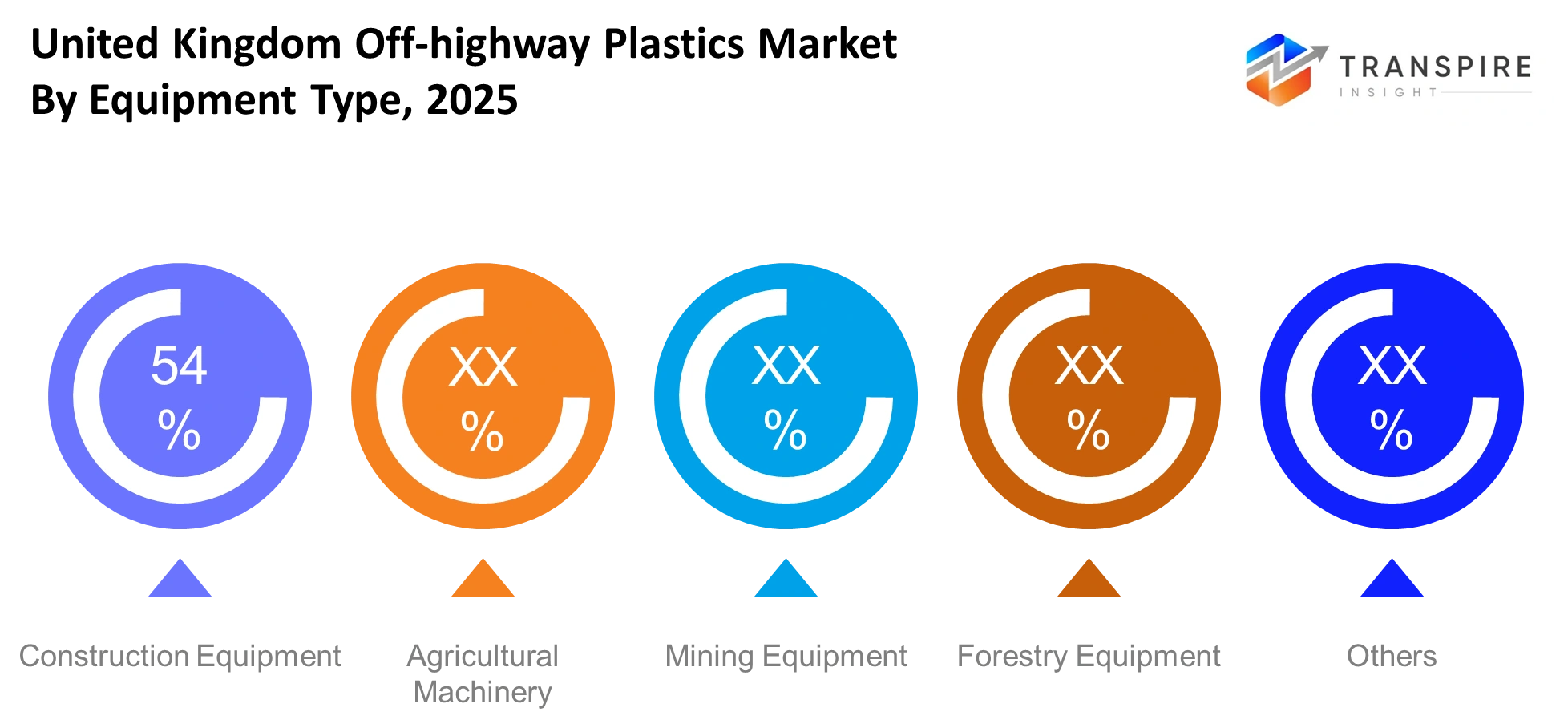
Construction equipment is taking the largest share of United Kingdom off-highway plastics demand, mostly because heavy use of cabins, panels and protective housings shows up again and again on excavators and loaders. Agricultural machinery comes next with solid consumption, since tractors and harvesters rely on weather-resistant, light weight components that keep working when conditions get rough. Mining equipment only takes a smaller slice, yet it’s still valuable because durability matters a lot, and forestry equipment keeps a niche presence, really tied to rugged exposure in the outdoor environment, you know
Growth in the construction segment gets a boost from electrification trends and emission-reduction targets tied to urban infrastructure projects. In agricultural machinery, the push comes from precision farming systems, which seek lighter structures to keep soil compaction lower. Mining equipment uses high strength plastics for corrosion resistance in abrasive spaces, while forestry uses plastics more for vibration resistance, plus long service life during harsh operations
For future expansion, most momentum will concentrate in construction and agricultural segments, as automation and electric drivetrains move faster and force design changes. Suppliers will keep tailoring polymer grades to very specific needs around vibration, heat, and load-related requirements. Equipment manufacturers will invest in modular plastic systems, to make maintenance easier and reduce downtime. Mining and forestry will bring in advanced composites selectively, mainly because cost sensitivity is still a real constraint for them
To learn more about this report, Download Free Sample Report
By Application
The United Kingdom off-highway plastics market is kind of led by interior parts. Dashboards, seating structures and operator cabin fittings really push the largest slice, even if the exact share moves year to year. After that, exterior components come in close behind, mostly from protective panels and housings that are built for durability but also for weight reduction. Fuel systems keep steady demand, and engine components stay smaller, though they’re technically more involved because they need heat-resistant polymers or similar materials.
After 2020, interior applications grew fast, sort of matching the push for better operator comfort standards across construction as well as agricultural machinery fleets. Exterior growth also picked up quickly, driven by corrosion resistant and easily swapped modular panels. In the meantime, fuel system plastics did well as leak prevention rules tightened, and engine component usage edged upward too, influenced by thermal loads tied to compact high efficiency engines.
Looking ahead the trend lines seem to suggest more smart interior systems, like sensors plus connectivity modules being folded into plastic assemblies. For exterior components, there should be a stronger turn toward recycled polymers and impact-modified grades to hit sustainability goals. Engine applications are expected to move toward high performance thermoplastics as electrification ramps up and raises the thermal management burden. Fuel systems, in turn, will likely lean harder on multi layer polymer structures to support stronger safety compliance expectations, and yeah this is where the emphasis will stay.
By End-User
In the United Kingdom, OEMs lead off-highway plastics consumption mostly because they just slot in molded components during the original equipment build, kinda seamless, and you can see it across the assembly stages. Equipment manufacturers still take a meaningful chunk, not by owning everything but by pushing design requirements, and then steering the material choices across production lines. Aftermarket suppliers sit in a smaller though steady position, mainly covering replacement parts and demand that comes from maintenance schedules.
This OEM lead got even stronger between 2020 and 2024 as design integration rose, plastics started appearing earlier in the whole product development loop. Equipment manufacturers were influential too, pushing material shifts toward lighter, more 1g recyclable polymers, partly so the industry can comply with emission regulations. Aftermarket needs kept climbing at a steady pace because older machinery fleets eventually age out, and buyers seek more economical replacement components. On top of that, supply chain disruptions nudged OEMs into localized sourcing playbooks, like sourcing closer rather than waiting.
Looking ahead, future patterns point to OEMs leaning more heavily on co-development with material suppliers, aiming for performance-tuned plastics. Equipment manufacturers are expected to deepen cooperation with recyclers to hit circular economy goals. Aftermarket suppliers will probably broaden what they sell for retrofit and repair uses , since machinery lifecycles keep stretching out. Digital manufacturing tools will also help speed up customization of polymer components across the various end-user groups, and it will feel less slow and more modular over time.
What are the Key Use Cases Driving the United Kingdom Off-highway Plastics Market?
Cabin interiors in construction and agricultural machinery continue to drive most off-highway plastics use in the United Kingdom, mainly for dashboards, seating frames, and control housings. The OEMs stick with these materials since they reduce overall equipment mass, improve operator comfort a bit, and align with tighter emissions and fuel-efficiency rules across entire fleets. Demand is still highest in excavators, loaders, and tractors, where the operator is on-site for long periods, so parts need to be tough, vibration resistant, and also thermally stable.
You also see growth in exterior body panels and fuel system components, especially when construction equipment makers and agricultural OEMs refresh product lines. Plastics step in for corrosion prone metals in protective shells, engine covers, and fluid tanks, which tends to improve lifecycle cost efficiency, and it lowers maintenance downtime. On top of that, aftermarket suppliers add to the trend, because replacement parts are continuously needed when older machinery fleets begin to need panel and system refurbishments, pretty regularly.
More emerging uses show up too, like battery enclosures and thermal management parts for electrified off-highway machinery, especially where urban construction fleets are moving toward low emission operations. There are also sensor-integrated plastic modules for precision farming tools, and those are gaining traction as ag OEMs roll in smarter monitoring systems. All these new directions get extra momentum from regulatory pressure around emissions, plus the increasing digitalization happening across equipment fleets.
|
Report Metrics |
Details |
|
Market size value in 2025 |
USD 674.35 Million |
|
Market size value in 2026 |
USD 718.21 Million |
|
Revenue forecast in 2033 |
USD 1116.23 Million |
|
Growth rate |
CAGR of 6.50% from 2026 to 2033 |
|
Base year |
2025 |
|
Historical data |
2021 - 2024 |
|
Forecast period |
2026 - 2033 |
|
Report coverage |
Revenue forecast, competitive landscape, growth factors, and trends |
|
Regional scope |
Middle East and Africa (Saudi Arabia, United Arab Emirates, South Africa, Rest of Middle East and Africa) |
|
Key company profiled |
BASF, SABIC, Dow, Covestro, Borealis, LyondellBasell, DuPont, Solvay, Celanese, INEOS, Röchling Group, DSM Engineering Materials, Trinseo, Evonik Industries, Lanxess |
|
Customization scope |
Free report customization (country, regional & segment scope). Avail customized purchase options to meet your exact research needs. |
|
Report Segmentation |
By Material Type (Polypropylene, Polyethylene, ABS, Polycarbonate, Nylon, Others); By Equipment Type (Construction Equipment, Agricultural Machinery, Mining Equipment, Forestry Equipment, Others); By Application (Interior Components, Exterior Components, Fuel Systems, Engine Components, Others); By End User (OEMs, Aftermarket Suppliers, Equipment Manufacturers, Others) |
Which Regions are Driving the United Kingdom Off-highway Plastics Market Growth?
Northern Europe sort of leads demand in the United Kingdom off-highway plastics landscape, mainly because enforcement is strong, there are advanced manufacturing clusters , and low-emission construction and agricultural machinery is being taken up fast. A lot of it comes from established OEM ecosystems, plus integrated supply chains that make it easier to test new materials and localize polymer conversion. Also strict environmental rules and carbon reduction mandates push equipment fleets away from metals toward lighter engineering plastics . On top of that mature recycling infrastructure helps with circularity, so industrial users can keep getting a more stable supply of recycled polymer feedstock.
Western Europe follows as a steady and very predictable contributor, driven by resilient industrial economies and long procurement horizons in agriculture and construction. Here, instead of Northern Europe’s more intense regulatory pressure, the pattern leans toward steady capital spending and incremental modernization of machinery fleets. Manufacturers in this region also focus on reliability and lifetime cost control, so adoption of advanced plastics is often gradual rather than a rapid swap-out. Aftermarket networks keep demand calmer, too, because they support refurbishment and replacement cycles for older equipment already in service.
Eastern and Central Europe are the fastest-growing regions, mostly tied to newer infrastructure expansion programs and higher mechanization across agriculture and construction. Since around 2022, government-backed investment in transport corridors and industrial zones has boosted demand for modern machinery, which in turn accelerates the adoption of lightweight polymer components. Fleet modernisation programs and the inflows of foreign OEM manufacturing facilities have helped, really, to bolster local production know-how. During the 2026–2033 span, that kind of upward growth path is forming strong entry opportunities for suppliers that are aiming at cost-effective engineering plastics, and also for those that want to build localized production partnerships.
Who are the Key Players in the United Kingdom Off-highway Plastics Market and How Do They Compete?
Competition in the United Kingdom within off-highway plastics is still pretty moderately fragmented, kinda, with specialty polymer makers, compounders, and component converters going head to head alongside vertically integrated chemical groups. No single supplier really dominates everywhere, because demand is split between high-performance engineering plastics and more cost-driven commodity resins. What matters most is material innovation, emissions compliance support, and the ability to deliver consistent quality at scale. Lately, suppliers also try to stand out through recyclability performance, thermal endurance, and even design assistance that helps OEM integration go more smoothly.
Victrex is leaning hard into high-performance PEEK solutions for engine components and electrified machinery, and it leans on technology leadership in extreme-temperature polymers to lock in longer-cycle contracts with equipment manufacturers. Covestro, on the other hand highlights polycarbonate and polyurethane systems for cabin interiors and safety panels; they differentiate through optical clarity requirements and impact resistance standards. Veolia is building momentum through recycled polymer supply partnerships, expanding closed-loop recovery setups with UK construction and agricultural equipment recyclers to satisfy the circularity expectations.
BASF competes via a wide portfolio of materials that blend engineering plastics with additive systems tuned for vibration damping and wear resistance in heavy equipment use. SABIC moves forward with cost-optimized thermoplastic solutions, supported by global production scale, plus localized distribution partnerships around European OEM hubs.Röchling specializes in precision-molded plastic components for off-highway cabins and structural parts, expanding capacity through acquisitions of regional converters and closer integration with equipment manufacturers seeking turnkey design-to-part solutions.
Company List
- BASF
- SABIC
- Dow
- Covestro
- Borealis
- LyondellBasell
- DuPont
- Solvay
- Celanese
- INEOS
- Röchling Group
- DSM Engineering Materials
- Trinseo
- Evonik Industries
- Lanxess
Recent Development News
“In February 2026, Covestro launched a CQ-configurator for polyurethane foam systems across European industrial applications. The tool enables manufacturers to optimize recycled content and emissions performance in engineered plastics used for transport and construction components.https://www.alchempro.com
“In February 2026, BASF Coatings expanded its UK collaboration with Volvo’s Approved Bodyshop Network through a three-year supply agreement extension. The partnership strengthens plastic refinish systems and supports advanced repair processes for polymer-based automotive and industrial components.https://www.basf-coatings.com
What Strategic Insights Define the Future of the United Kingdom Off-highway Plastics Market?
The United Kingdom off-highway plastics market is moving, toward deeper material specialization and system-level integration instead of the whole “just swap metal” thing . Demand will increasingly converge on high-performance, recyclable engineering polymers as electrification, automation, and emissions compliance reshape both construction and agricultural machinery design. This kind of structural shift is pushed by stricter lifecycle carbon accounting and the OEM type pressure to cut total equipment mass while still boosting thermal and mechanical output through longer duty cycles.
A less visible risk is starting to show up from volatility across advanced resin supply chains, especially for specialty polymers that rely on only a few global production hubs. If there s any disruption in feedstock availability, or energy prices move in Europe, it could squeeze margins and also postpone OEM qualification timelines. That would slow adoption even when the demand signals look strong. Another constraint is the potential for substitution with hybrid composites, which could reduce reliance on traditional thermoplastics in higher-stress applications.
At the same time there’s an emerging opportunity: circular polymer ecosystems that get integrated right into equipment manufacturing networks, particularly with closed-loop recovery in construction fleets. That approach is still somewhat underdeveloped, but it aligns well with the upcoming UK sustainability disclosure requirements. Market players should put money into co-development partnerships with OEMs so recyclable-by-design materials get embedded early into equipment architecture , and that can help secure long-term contract positions rather than getting stuck competing on commoditized resin supply.
United Kingdom Off-highway Plastics Market Report Segmentation
By Material Type
- Polypropylene
- Polyethylene
- ABS
- Polycarbonate
- Nylon
- Others
By Equipment Type
- Construction Equipment
- Agricultural Machinery
- Mining Equipment
- Forestry Equipment
- Others
By Application
- Interior Components
- Exterior Components
- Fuel Systems
- Engine Components
- Others
By End User
- OEMs
- Aftermarket Suppliers
- Equipment Manufacturers
- Others
Frequently Asked Questions
Find quick answers to common questions.
The expected United Kingdom Off-highway Plastics Market size is USD 1116.23 Million in 2033.
Key segments for the United Kingdom Off-highway Plastics Market are By Material Type (Polypropylene, Polyethylene, ABS, Polycarbonate, Nylon, Others); By Equipment Type (Construction Equipment, Agricultural Machinery, Mining Equipment, Forestry Equipment, Others); By Application (Interior Components, Exterior Components, Fuel Systems, Engine Components, Others); By End User (OEMs, Aftermarket Suppliers, Equipment Manufacturers, Others).
Major United Kingdom Off-highway Plastics Market players are BASF, SABIC, Dow, Covestro, Borealis, LyondellBasell, DuPont, Solvay, Celanese, INEOS, Röchling Group, DSM Engineering Materials, Trinseo, Evonik Industries, Lanxess.
The United Kingdom Off-highway Plastics Market size is USD 674.35 Million in 2025.
The United Kingdom Off-highway Plastics Market CAGR is 6.50% from 2026 to 2033.
- BASF
- SABIC
- Dow
- Covestro
- Borealis
- LyondellBasell
- DuPont
- Solvay
- Celanese
- INEOS
- Röchling Group
- DSM Engineering Materials
- Trinseo
- Evonik Industries
- Lanxess
Recently Published Reports
-
May 2026
Healthcare Polymer Packaging Market
Healthcare Polymer Packaging Market Size, Share & Analysis Report By Packaging Type (Syringes, IV Bottles and Pouches, Clamshells, Blisters, Bottles & Jars, Containers, Tubes, IV Parental Packaging, Others), By Type (Regulated, Non-regulated), By Polymer Type (LDPE (Low-Density Polyethylene), HDPE (High-Density Polyethylene), Homo-polymer (Homo), Random Copolymer (Random), Block Copolymer (Block), PET, Polystyrene, Polyvinyl Chloride, Polyamide/EVOH, Others), and Geography (North America, Europe, Asia-Pacific, Middle East and Africa, South and Central America), 2021 - 2031
-
Apr 2026
Hydrophilic Tape (Waterstop) Market
Hydrophilic Tape (Waterstop) Market Size, Share & Analysis Report By Type (Bentonite-Based Hydrophilic Tape, Rubber-Based Hydrophilic Tape), By Application (Residential Buildings, Commercial Buildings, Infrastructure Projects), and Geography (North America, Europe, Asia-Pacific, Middle East and Africa, South and Central America), 2021 - 2031
-
Apr 2026
Metalens Market
Metalens Market Size, Share & Analysis Report By Type (Visible Light Metalens, and Infrared Metalens), By Application (Consumer Electronics, Automotive Electronics, Industrial, Medical, and Others), and Geography (North America, Europe, Asia-Pacific, Middle East and Africa, South and Central America), 2021 - 2031
-
Apr 2026
PBT Resin Market
PBT Resin Market Size, Share & Analysis Report By Type (Reinforced PBT Resin, Unreinforced PBT Resin), By Processing Method (Injection Molding, Extrusion, Blow Molding, Others), By End-User (Automotive, Electrical & Electronics, Consumer Appliances, Industrial Machinery, Medical Devices, Packaging, Others), and Geography (North America, Europe, Asia-Pacific, Middle East and Africa, South and Central America), 2021 - 2031