
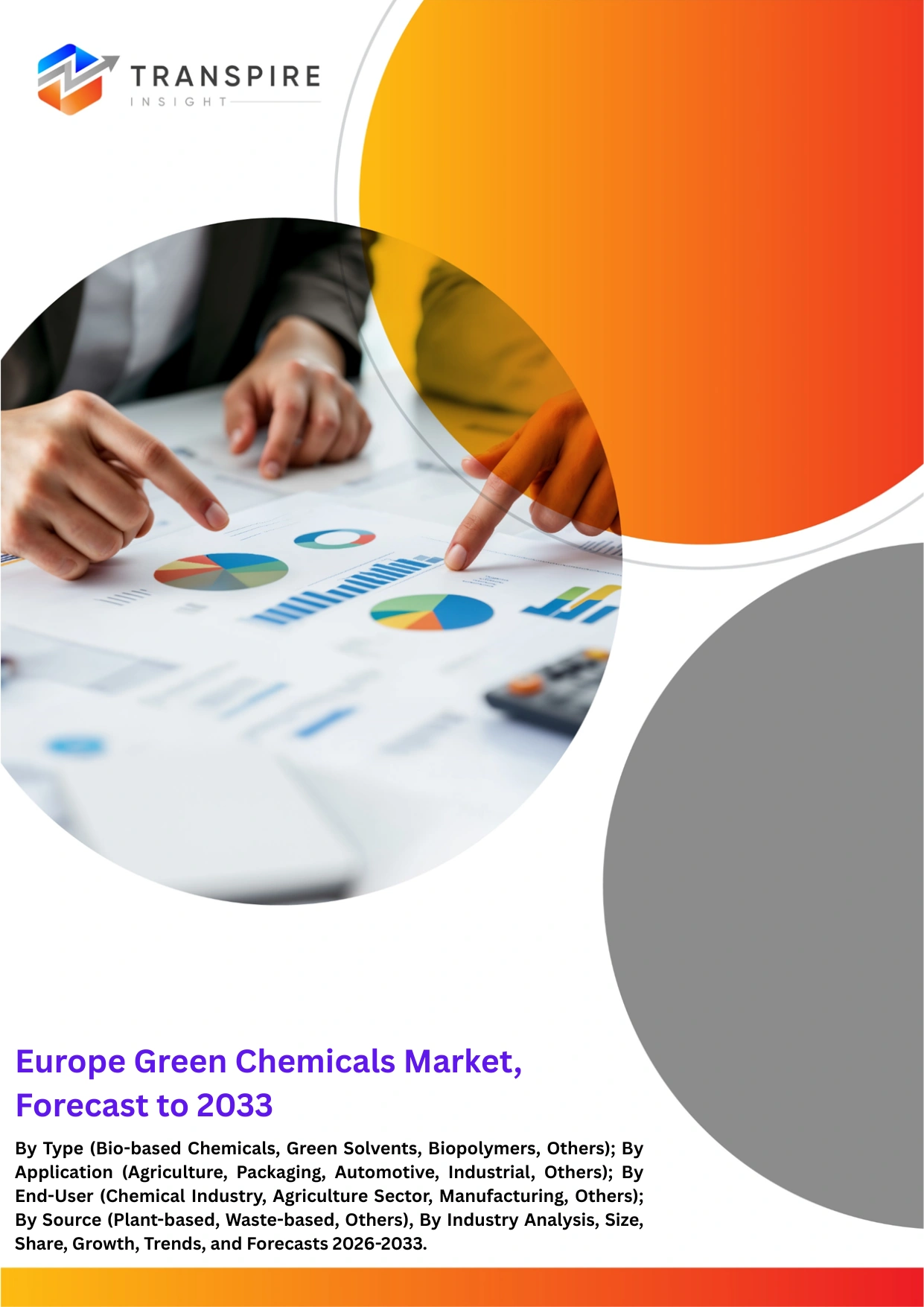
Europe Green Chemicals Market Size & Forecast:
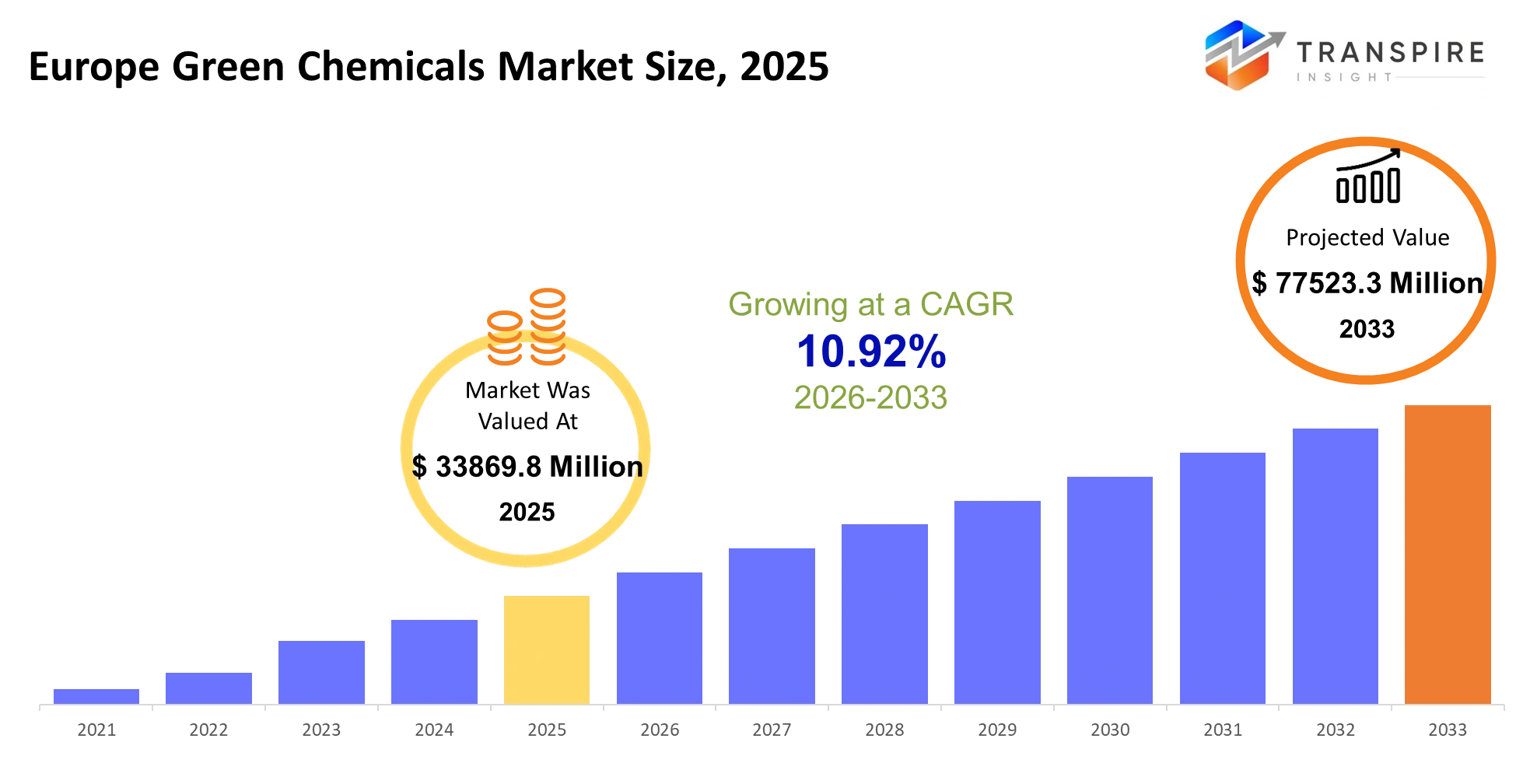
- Europe Green Chemicals Market Size 2025: USD 33869.8 Million
- Europe Green Chemicals Market Size 2033: USD 77523.3 Million
- Europe Green Chemicals Market CAGR: 10.92%
- Europe Green Chemicals Market Segments: By Type (Bio-based Chemicals, Green Solvents, Biopolymers, Others); By Application (Agriculture, Packaging, Automotive, Industrial, Others); By End-User (Chemical Industry, Agriculture Sector, Manufacturing, Others); By Source (Plant-based, Waste-based, Others).
To learn more about this report,  Download Free Sample Report
Europe Green Chemicals Market Summary
The Europe Green Chemicals Market was valued at USD 33869.8 Million in 2025. It is forecast to reach USD 77523.3 Million by 2033. That is a CAGR of 10.92% over the period.
The European Green Chemicals Market enables industrial and manufacturing systems to use renewable chemical materials which produce low emissions instead of fossil-based feedstocks for their packaging and agricultural and coating and process industry operations. It helps European supply chains meet stringent sustainability and emissions standards by decreasing their carbon emissions throughout their entire supply chain operations. The chemical industry and packaging conversion companies and industrial manufacturers use these materials to achieve their product environmental regulations and corporate emissions reduction goals.
Production methods which use circular and bio-based materials have experienced rapid growth during the past three to five years because biomass conversion and waste-to-chemical processes have replaced traditional petrochemical production methods. Manufacturers needed to develop new material portfolios and make investments in alternative feedstocks because the European Union's Single-Use Plastics Directive and growing carbon pricing regulations functioned as main regulatory drivers. Global energy supply disruptions caused supply chain instability which increased demand for local renewable material sourcing.
The combination of regulatory requirements and cost-risk management needs has driven organizations to shift their procurement methods because these elements have proven their effectiveness in the packaging and industrial sectors. Organizations now experience revenue growth because they need to comply with environmental regulations while their sustainable chemical solutions achieve technology readiness for the market.
Key Market Insights
- The Europe Green Chemicals Market in 2025 will be mostly controlled by Western Europe which holds a 45% market share because Germany France and the Netherlands maintain strong chemical manufacturing sectors.
- Northern Europe is the fastest-growing region through 2030 because it implements renewable feedstock solutions and develops advanced waste-to-chemicals systems.
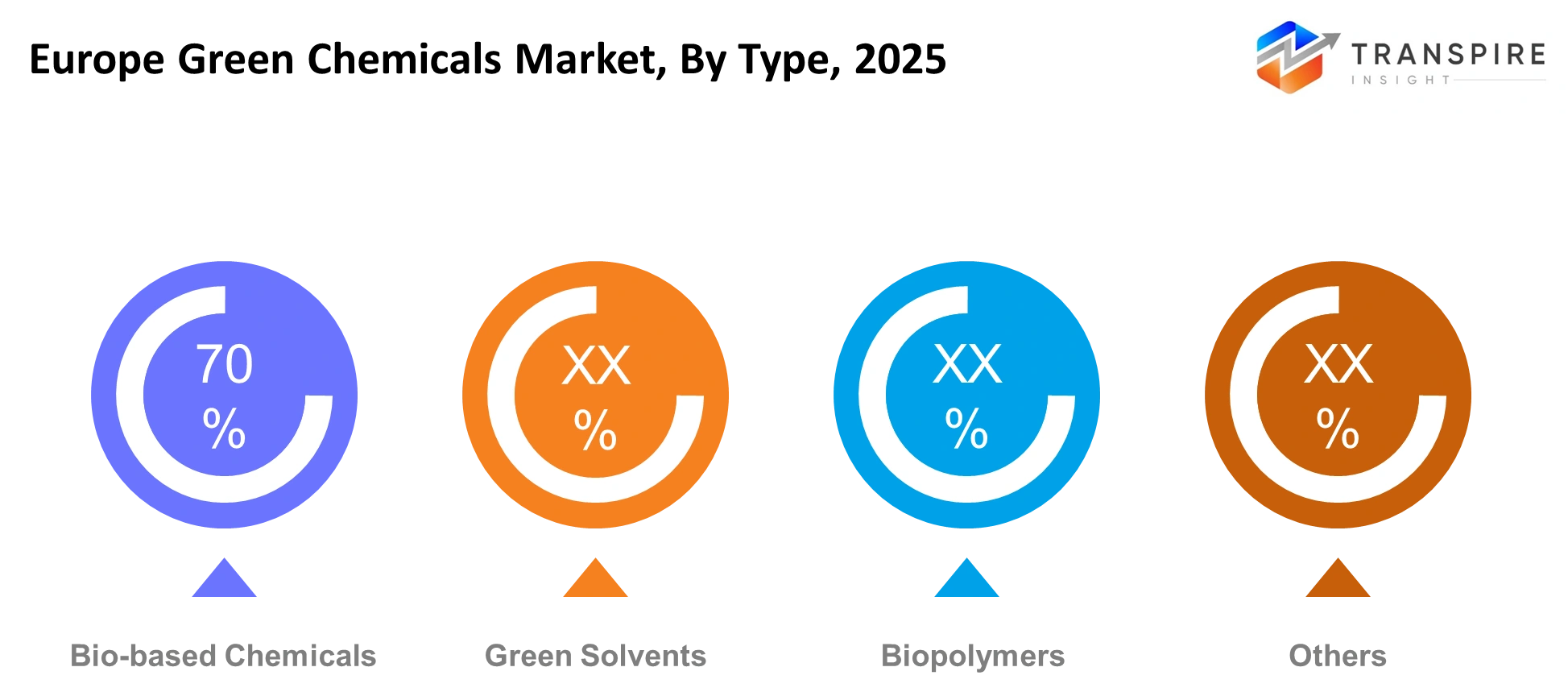
- Bio-based chemicals lead the Europe Green Chemicals Market with the highest share because they are used to replace industrial intermediates and base chemical production at industrial scale.
- Biopolymers represent the fastest-growing segment as packaging regulations accelerate demand for compostable and recyclable polymer alternatives across consumer goods industries.
- The EU single-use plastic bans together with corporate ESG compliance requirements create packaging applications which control nearly 40% of market share.
- Agricultural sector shows rapid growth because farmers increasingly use biofertilizers and biopesticides under sustainable farming policy frameworks.
- The chemical industry stands as the main customer group because manufacturers now produce their products with green feedstocks through their entire manufacturing process.
- The manufacturing end-user sector shows the highest growth rate because businesses now use bio-lubricants together with low-emission surface treatment chemicals.
- The Europe Green Chemicals Market is shaped by major companies which include BASF Dow Covestro Evonik Industries and Neste.
- The Europe Green Chemicals Market intends to enhance its market position and lower operational costs through strategic expansion into bio-refinery development and circular economy partnerships and chemical recycling technological advancements.
What are the Key Drivers, Restraints, and Opportunities in the Europe Green Chemicals Market?
The European Green Chemicals Market gets its main development force from both European Green Deal regulations and increasing carbon tax laws which multiple countries including Germany France and the Netherlands have introduced. The chemical manufacturing and packaging industries must now meet mandatory emissions reduction targets which require them to replace petrochemical feedstocks with bio-based and waste-derived feedstock alternatives. The regulations create a direct path which chemical producers use to shift their procurement practices while industrial users of chemicals face compliance challenges that lead to revenue increases for green chemical producers.
The most significant market barrier exists because bio-based chemical production costs more than petrochemical production. The structural gap exists because feedstock availability and energy-intensive bioprocessing methods and limited economies of scale create operational limits which base production costs of bioprocessing facilities. The manufacturing process leads mid-tier companies to either postpone their production activities until after they finish testing their products or limit their production capacity to specific market sectors which creates barriers for new products to enter the market while reducing growth potential outside premium markets that include packaging materials and specialized chemical compounds.
Industrial-scale waste valorization technologies create a main business opportunity through their advanced chemical recycling and lignocellulosic biomass conversion capabilities. Neste's renewable refinery expansion projects in Finland and new chemical recycling centers across Germany show that facility investments create better business opportunities. The industry expects cost reductions to occur as these technologies achieve greater operational capacity which will result in expanded material substitution across automotive materials and construction chemicals and industrial applications which use high volumes.
What Has the Impact of Artificial Intelligence Been on the Europe Green Chemicals Market?
The operational efficiency of Europe Green Chemicals Market supply chains which depend on emission control technologies and chemical processing optimization receives its main transformation through artificial intelligence and advanced digital systems. AI-powered sensors in scrubber performance systems and exhaust gas cleaning technology enable automatic monitoring of sulfur dioxide removal efficiency while they dynamically modify dosing systems to decrease chemical usage and better meet IMO and EU emission standards. Fleet operators use AI-based compliance systems to monitor vessel emissions throughout their routes, which helps them produce more accurate reports while decreasing the need for manual assessments.
Machine learning models support predictive maintenance by analyzing vibration data, corrosion rates, and exhaust temperature patterns to forecast equipment failure in scrubbers and chemical processing units. The maintenance shift process enables organizations to schedule necessary maintenance tasks before their performance drops, which results in decreased unexpected operational interruptions and better equipment operational time. AI-based emissions forecasting tools also provide operators with the capability to enhance their fuel blending methods, which results in both fuel consumption reductions and cost stability improvements.
The maritime industry faces two main obstacles that prevent AI technology from achieving full implementation because actual maritime data shows variable quality and offshore operations disconnect from digital networks which leads to lower model performance in changing ocean environments. The process of deploying complete systems faces significant delays because existing chemical plants and legacy vessels require expensive integration work, which particularly affects mid-sized companies that do not possess advanced digital capabilities.
Key Market Trends
- The European market experienced a fast transition to compostable and bio-based packaging materials after the 2021 regulations restricted single-use plastics.
- Between 2020 and 2025 chemical manufacturers started to use plant-based materials instead of petrochemical feedstocks to follow EU carbon neutrality roadmaps.
- The waste-to-chemicals technologies achieved substantial growth after 2022 because companies adopted circular economy practices to decrease their need for raw materials and lower their production emissions.
- The pharmaceutical and coatings sectors experienced a rapid increase in green solvent use after major European Union nations implemented new VOC emission restrictions.
- Packaging companies changed their buying methods after 2023 when they started to choose biodegradable certified plastics instead of regular plastics to fulfill ESG disclosure standards.
- Agricultural input suppliers expanded their biofertilizer product lines after regulatory authorities approved soil regeneration policies which introduced synthetic fertilizer restrictions.
- Since 2021 automotive suppliers implemented more bio-based composite materials to decrease vehicle emissions throughout their lifecycle while complying with EU emission regulations.
- Industrial biotechnology investments experienced rapid growth after 2022 because chemical producers needed to shift from fossil fuel production methods under carbon taxation regulations.
- The waste-based chemical production process obtained increased traction after 2024 because subsidies for circular feedstock use and landfill reduction requirements were implemented.
Europe Green Chemicals Market Segmentation
By Type:
Bio-based chemicals maintain their dominant market position because industrial manufacturing in Europe requires better alternatives to petrochemical materials. The emission control requirements and carbon intensity regulations drive widespread adoption of base chemicals and their intermediate products. The usage of green solvents exists at a moderate level because cleaning agents and coatings and pharmaceutical products need these substances. Biopolymers begin as a small market segment but they currently show increasing business growth. The other categories sustain their specialized market presence through their particular use in specialty formulations.
Renewable feedstock availability together with policy incentives and corporate decarbonization targets drive growth momentum development. Biopolymers gain advantage from packaging substitution trends, while green solvents benefit from stricter VOC regulations. Future expansion favors scalable bio-based chemical platforms and cost-competitive production technologies which support wider industrial integration and margin pressure on fossil-based alternatives.
To learn more about this report, Download Free Sample Report
By Applications:
The agricultural sector shows strong progress because farmers increasingly use biofertilizers and biopesticides and soil enhancement chemicals which decrease their reliance on synthetic materials. The packaging industry needs plastic replacement because it wants to achieve corporate sustainability targets. Industrial applications maintain stable mid-level demand through process chemicals. Automotive applications expand gradually with lightweight materials and bio-lubricants. Other uses remain fragmented across specialty sectors.
Different types of growth logic emerge through varying levels of regulatory enforcement which restrict various ways of using different materials. The packaging sector leads the industry because circular economy regulations combined with recycling requirements create more sustainable practices. The automotive industry expands because of material research developments which enable better emissions control solutions. The future of packaging industry growth will continue while agricultural operations expand and specific industrial sectors enter markets after they achieve equal performance with their competitors.
By End-User:
The chemical industry drives demand from end users because companies use green chemicals in their production processes and for their intermediate and specialty chemical products. The agricultural sector controls a substantial market share because sustainable farming products drive its demand. Manufacturing sectors use materials for processing and surface treatment at average levels of consumption. The remaining end users only use niche products which they test through pilot projects in developing markets.
Decarbonization requirements for chemical production together with sustainability demands for supply chains create the foundation for growth logic. The need for higher agricultural productivity drives farming adoption while manufacturing needs better process efficiency to increase its usage. The chemical industry will see greater consolidation of demand because agricultural and manufacturing sectors will begin to use products more as their expenses decrease and regulatory frameworks become better.
By Source:
The dominant position of plant-based sources exists because established agricultural feedstock supply chains enable their continuous expansion. The waste-based sources experience their fastest growth because circular economy frameworks enable the reuse of feedstocks at reduced costs. The other sources maintain their presence as they exist only in experimental settings and specialized chemical production processes.
Sustainability requirements together with economic factors related feedstock availability create the driving force behind growth patterns. The waste-based routes receive structural benefits from the combination of regulatory backing and decreased operational expenses while plant-based systems maintain their operations through existing facilities. The future waste-derived chemical share will increase while hybrid sourcing models will gradually expand their industrial presence throughout Europe’s green chemicals market until the end of the forecast period.
What are the Key Use Cases Driving the Europe Green Chemicals Market?
The European Green Chemicals Market experiences its primary demand through packaging applications which enable companies to replace traditional petroleum-based plastics with bio-based polymers and compostable materials. The European Union enforces strict regulations on single-use plastics together with its circular economy requirements which drive companies to adopt sustainable practices in food packaging and consumer goods packaging and industrial wrapping. Brand owners use packaging materials that produce low carbon emissions because they want to meet their sustainability reporting needs which results in packaging becoming their most important material demand.
Biofertilizers biopesticides green solvents and bio-based process chemicals have become more popular in agriculture and industrial processing. Chemical industry end-users integrate greener intermediates into formulation processes, while manufacturing sectors adopt bio-lubricants and surface treatment chemicals to reduce emissions intensity. Automotive applications extend their reach through the introduction of lightweight bio-composites together with vehicle interior materials that support emission reduction targets.
The development of advanced biopolymers for medical devices together with bio-based adhesives for electronics assembly represents emerging use cases. The applications exist in limited capacity yet they attract attention because of potential legal restrictions on toxic materials and increasing interest in recyclable electronic parts. The development of waste valorization pathways will create new methods for chemical production which will enable ongoing innovation to occur in specialized industrial fields.
|
Report Metrics |
Details |
|
Market size value in 2025 |
USD 33869.8 Million |
|
Market size value in 2026 |
USD 37528.7 Million |
|
Revenue forecast in 2033 |
USD 77523.3 Million |
|
Growth rate |
CAGR of 10.92% from 2026 to 2033 |
|
Base year |
2025 |
|
Historical data |
2021 - 2024 |
|
Forecast period |
2026 - 2033 |
|
Report coverage |
Revenue forecast, competitive landscape, growth factors, and trends |
|
Regional scope |
Europe (Germany, United Kingdom, France, Italy, Spain, Rest of Europe) |
|
Key company profiled |
BASF, Dow, DuPont, Braskem, Arkema, DSM, Evonik, Cargill, Corbion, Mitsubishi Chemical, LG Chem, Novamont, NatureWorks, TotalEnergies, Eastman. |
|
Customization scope |
Free report customization (country, regional & segment scope). Avail customized purchase options to meet your exact research needs. |
|
Report Segmentation |
By Type (Bio-based Chemicals, Green Solvents, Biopolymers, Others); By Application (Agriculture, Packaging, Automotive, Industrial, Others); By End-User (Chemical Industry, Agriculture Sector, Manufacturing, Others); By Source (Plant-based, Waste-based, Others). |
Which Regions are Driving the Europe Green Chemicals Market Growth?
The green chemicals market in Europe functions as the leading market since the European Union establishes strict decarbonization requirements which industrial chemistry systems in Europe already possess. The region benefits from deeply integrated chemical clusters in Germany, the Netherlands, and France, where producers, feedstock suppliers, and logistics networks operate in close proximity. Organizations implement low-emission chemical processes through their compliance with regulatory systems which include carbon pricing and circular economy regulations. The ecosystem acquires strength through its advanced research and development facilities which have existed for many years as industrial manufacturers and research institutes work together. Europe achieves better success than any other region in transforming sustainability regulations into business advantages through its existing system.
North America functions as a stability-driven contributor because its growth depends more on industrial capacity and capital resources than on regulatory requirements. The United States gains advantages from its extensive chemical manufacturing facilities which major petrochemical companies operate as they shift toward sustainable bio-based products and reduced carbon emissions. North American businesses pursue sustainability through internal goals which they achieve through gradual upgrades of their facilities instead of relying on environmental regulations to drive their progress. The company establishes a gradual business growth strategy which combines secure domestic market requirements from packaging, agriculture, and industrial manufacturing. The region establishes itself as a reliable revenue source which global chemical companies use to manage their financial operations during market fluctuations in other areas.
The Asia Pacific region experiences its highest growth rate because China South Korea and India have implemented new policies that focus on decarbonizing industrial operations and developing domestic sustainable material sources. The period since 2024 has witnessed rapid growth in bio-refining capacity creation and green hydrogen-based chemical manufacturing because state-sponsored industrial improvement initiatives back these developments. The automotive industry and packaging sector and textile industry all require increasing amounts of bio-based chemical materials to meet their production needs. International producers are now establishing infrastructure in early development stages through their partnerships and licensing deals. Asia Pacific provides the most expansion opportunities from 2026 to 2033 for investors and new market entrants but success will depend on their ability to build local partnerships and comply with regulations instead of relying on market entry alone.
Who are the Key Players in the Europe Green Chemicals Market and How Do They Compete?
The Europe Green Chemicals Market remains moderately consolidated because large chemical manufacturers handle most production while smaller biotechnology companies and material developers work on particular uses. Companies now compete through three main factors which include their ability to develop new processes and reduce carbon emissions and their capability to utilize renewable feedstock materials which have obtained certification. The established companies control market share through two methods which include creating closed-loop production systems and developing environmentally friendly manufacturing processes which they combine with their existing chemical products. The market for biodegradable polymers and bio-based intermediates faces disruption because new companies establish their presence through quick market entry and development of specialized products. The ability to meet regulations and maintain supply chain visibility has become an essential factor which determines competitive advantage especially in the packaging and automotive and industrial sectors.
The BASF company attempts to compete with other businesses through its ability to optimize production processes and its development of low-carbon chemical manufacturing operations. The company uses renewable energy power at its European production facilities to decrease product environmental impact while allowing customers to maintain their current industrial operation methods. Evonik Industries specializes in green hydrogen and advanced specialty chemicals through its technology-based focus which relies on partnerships with renewable energy companies to enhance its sustainable industrial chemical capabilities.
Corbion establishes market distinction through its development of bio-based lactic acid and algae-sourced ingredient technologies which serve food packaging and bioplastics production needs. The company achieves its competitive advantage through its extensive fermentation knowledge and its strong compliance with European sustainable packaging laws.Arkema is expanding through high-performance bio-based materials, particularly in specialty resins and advanced polymers used in automotive lightweighting and electronics. Meanwhile, NatureWorks continues to strengthen its European footprint through partnerships focused on PLA biopolymer adoption, targeting brands seeking compostable packaging alternatives that comply with tightening EU circular economy requirements.
Company List
- BASF
- Dow
- DuPont
- Braskem
- Arkema
- DSM
- Evonik
- Cargill
- Corbion
- Mitsubishi Chemical
- LG Chem
- Novamont
- NatureWorks
- TotalEnergies
- Eastman
Recent Development News
“In April 2026, BASF launched Uvinul® T 150 X EcoBalanced, its first biomass balance-based UV filter for the personal care sector. The product launch expands BASF’s portfolio of sustainable specialty chemicals and supports growing European demand for lower-carbon cosmetic ingredients.
Source: https://www.basf.com
“In January 2025, Evonik Industries entered a long-term partnership with VoltH2 to develop green hydrogen production at the Delfzijl chemical park in the Netherlands. The agreement includes construction of a 50 MW electrolyzer to supply green hydrogen for Evonik’s hydrogen peroxide operations, strengthening Europe’s low-carbon chemical manufacturing infrastructure.
Source: https://www.evonik.com
What Strategic Insights Define the Future of the Europe Green Chemicals Market?
The Europe Green Chemicals Market is moving toward a structurally integrated, regulation-led growth phase in which bio-based feedstocks, circular chemistry, and low-carbon manufacturing become embedded through industrial value chains. The main driving force of this transformation stems from the EU climate policy together with carbon accountability frameworks that industrial sectors including automotive and packaging and construction use to establish their procurement requirements. The agricultural disruptions and land-use regulations and import dependencies all create feedstock supply concentration problems which particularly affect biomass-derived inputs. An emerging opportunity has developed through green hydrogen-enabled chemical synthesis which Northern Europe is developing because its renewable energy infrastructure and industrial decarbonization incentives support pilot-scale commercialization. Market participants must establish long-term partnerships with feedstock suppliers and energy providers and end-use manufacturers to achieve supply resilience while expanding their low-emission product lines.
Europe Green Chemicals Market Report Segmentation
By Type
- Bio-based Chemicals
- Green Solvents
- Biopolymers
- Others
By Application
- Agriculture
- Packaging
- Automotive
- Industrial
- Others
By End-User
- Chemical Industry
- Agriculture Sector
- Manufacturing
- Others
By Source
- Plant-based
- Waste-based
- Others
Frequently Asked Questions
Find quick answers to common questions.
The Europe Green Chemicals Market size is USD 77523.3 Million in 2033.
Key segments for the Europe Green Chemicals Market are By Type (Bio-based Chemicals, Green Solvents, Biopolymers, Others); By Application (Agriculture, Packaging, Automotive, Industrial, Others); By End-User (Chemical Industry, Agriculture Sector, Manufacturing, Others); By Source (Plant-based, Waste-based, Others).
Major Europe Green Chemicals Market players are BASF, Dow, DuPont, Braskem, Arkema, DSM, Evonik, Cargill, Corbion, Mitsubishi Chemical, LG Chem, Novamont, NatureWorks, TotalEnergies, Eastman.
The Europe Green Chemicals Market size is USD 33869.8 Million in 2025.
The Europe Green Chemicals Market CAGR is 10.92% from 2026 to 2033.
- BASF
- Dow
- DuPont
- Braskem
- Arkema
- DSM
- Evonik
- Cargill
- Corbion
- Mitsubishi Chemical
- LG Chem
- Novamont
- NatureWorks
- TotalEnergies
- Eastman
Recently Published Reports
-
Apr 2026
Healthcare Polymer Packaging Market
Healthcare Polymer Packaging Market Size, Share & Analysis Report By Packaging Type (Syringes, IV Bottles and Pouches, Clamshells, Blisters, Bottles & Jars, Containers, Tubes, IV Parental Packaging, Others), By Type (Regulated, Non-regulated), By Polymer Type (LDPE (Low-Density Polyethylene), HDPE (High-Density Polyethylene), Homo-polymer (Homo), Random Copolymer (Random), Block Copolymer (Block), PET, Polystyrene, Polyvinyl Chloride, Polyamide/EVOH, Others), and Geography (North America, Europe, Asia-Pacific, Middle East and Africa, South and Central America), 2021 - 2031
-
Apr 2026
Hydrophilic Tape (Waterstop) Market
Hydrophilic Tape (Waterstop) Market Size, Share & Analysis Report By Type (Bentonite-Based Hydrophilic Tape, Rubber-Based Hydrophilic Tape), By Application (Residential Buildings, Commercial Buildings, Infrastructure Projects), and Geography (North America, Europe, Asia-Pacific, Middle East and Africa, South and Central America), 2021 - 2031
-
Apr 2026
Metalens Market
Metalens Market Size, Share & Analysis Report By Type (Visible Light Metalens, and Infrared Metalens), By Application (Consumer Electronics, Automotive Electronics, Industrial, Medical, and Others), and Geography (North America, Europe, Asia-Pacific, Middle East and Africa, South and Central America), 2021 - 2031
-
Apr 2026
PBT Resin Market
PBT Resin Market Size, Share & Analysis Report By Type (Reinforced PBT Resin, Unreinforced PBT Resin), By Processing Method (Injection Molding, Extrusion, Blow Molding, Others), By End-User (Automotive, Electrical & Electronics, Consumer Appliances, Industrial Machinery, Medical Devices, Packaging, Others), and Geography (North America, Europe, Asia-Pacific, Middle East and Africa, South and Central America), 2021 - 2031