
Europe Engineering Plastics Market Size & Forecast:
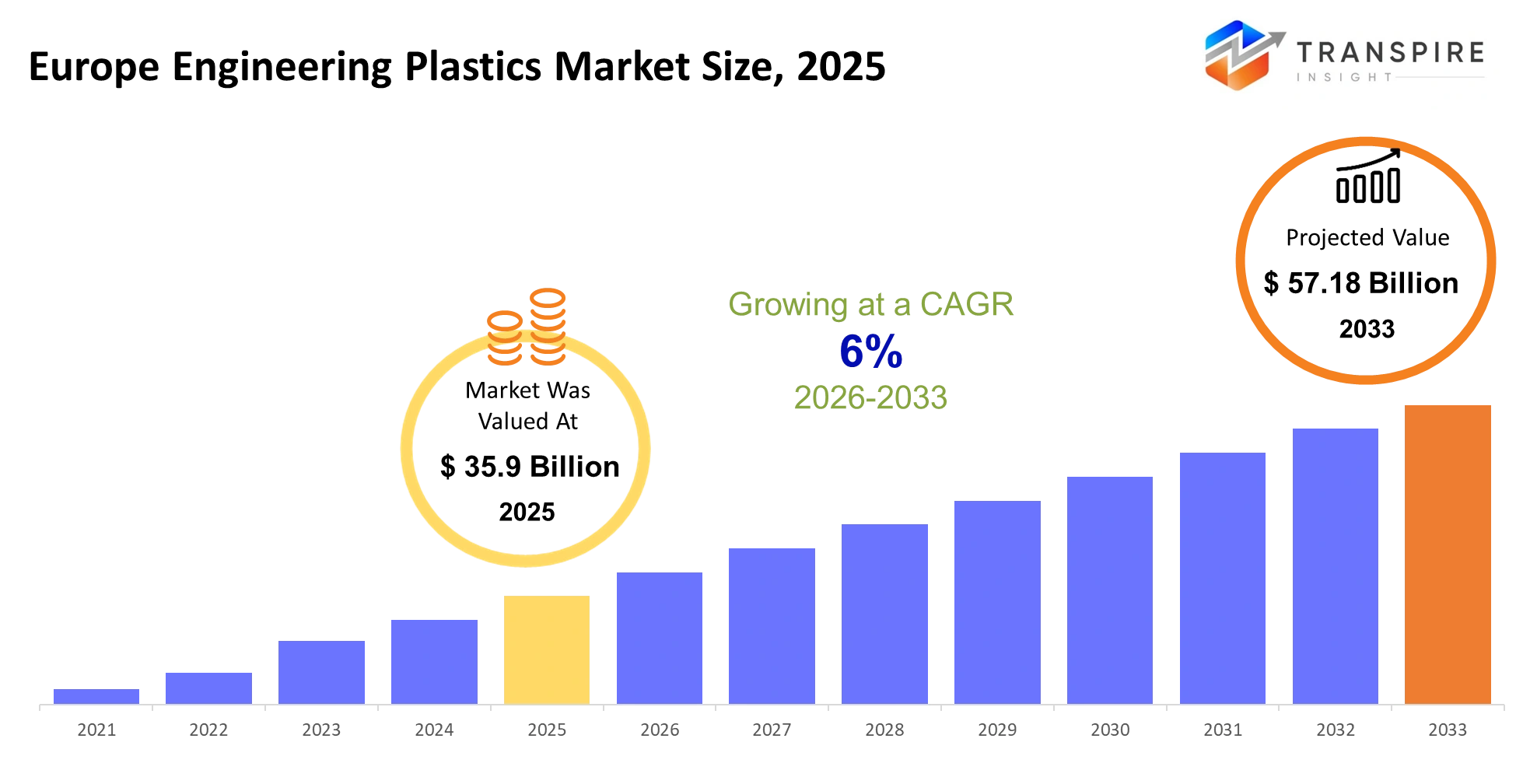
- Europe Engineering Plastics Market Size 2025: USD 35.9 Billion
- Europe Engineering Plastics Market Size 2033: USD 57.18 Billion
- Europe Engineering Plastics Market CAGR: 6%
- Europe Engineering Plastics Market Segments: By Type (Polycarbonate, Polyamide, PBT, POM, Others), By Application (Automotive, Electrical & Electronics, Industrial, Consumer Goods, Others), By End-User (Automotive Industry, Electronics Industry, Industrial Sector, Others), By Form (Granules, Fibers, Sheets, Others).
To learn more about this report,  Download Free Sample Report
Europe Engineering Plastics Market Summary:
The Europe Engineering Plastics Market size is estimated at USD 35.9 Billion in 2025 and is anticipated to reach USD 57.18 Billion by 2033, growing at a CAGR of 6% from 2026 to 2033. Engineering plastics serve as essential materials for European industries because they enable users to replace heavier metal components and standard polymers from their systems. The automotive industry uses these materials to create lighter vehicles which enhance electric vehicle performance, while the electronics and medical devices and industrial machinery sectors depend on these materials to produce precise components which endure extreme operational conditions.
The market has shifted during the past five years from organizations choosing materials based on their cost to their performance capabilities and sustainability features which drive engineering design processes. The demand for high-temperature and flame-retardant plastics has increased because electric mobility through battery systems and connectors and lightweight structural components.
The energy crisis in Europe together with supply chain interruptions from the Russia-Ukraine conflict, have revealed the regions heavy reliance on imported petrochemical feedstocks, which has driven manufacturers to develop local supply chains through investments in recycled and bio-based engineering plastics. The automotive industry has expanded to adopt this technology while developing high-value applications for renewable energy systems and aerospace and advanced industrial automation applications.
Key Market Insights
- Germany held the largest market share in the European Engineering Plastics Market through 2025 when it achieved almost 28% market share which automotive and industrial machinery production activities provided backing for his accomplishment.
- The fastest-growing regional market in Eastern Europe will continue to expand until 2030 because of its developing electronics assembly operations and investments in low-cost manufacturing facilities.
- France and Italy continue their strategic development of engineering polymer applications which they use for aerospace and renewable energy and medical device manufacturing.
- Nordic countries are currently increasing their use of bio-based engineering plastics after the implementation of new circular economy and sustainability rules which became effective in 2022.
- Polyamide controlled more than 32% of the European engineering plastics market in 2025 because it provides solutions for applications requiring high thermal resistance.
- The second largest segment in the market remained polycarbonate because it finds common usage in EV battery housings and lighting systems and electronic connectors.
- The need for aerospace and semiconductor manufacturing drives PEEK and high-performance fluoropolymers as the fastest-growing segments until 2030.
- Recycled engineering plastics achieved significant market growth after European manufacturers made sustainable polymer supply chains their main focus for local operations.
- The automotive industry used engineering polymers to replace metal components which resulted in OEMs achieving 38% market share in 2025.
- The electric vehicle battery systems became the fastest-growing application segment from 2025 to 2030 across the Europe Engineering Plastics Market.
- Industrial automation equipment experienced strong expansion because industries needed plastic components which offered wear resistance and chemical stability and precision engineering.
What are the Key Drivers, Restraints, and Opportunities in the Europe Engineering Plastics Market?
The rapid growth of electric vehicle technology in the automotive industry serves as the primary driving force behind the European Engineering Plastics Market. The European Union emission standards together with the 2035 internal combustion engine phase-out plan compelled automotive manufacturers to develop vehicles which use lightweight materials and high-efficiency components. Automotive manufacturers used engineering plastics to substitute metal components in battery enclosures and connectors and cooling systems and interior assemblies because these materials enabled them to produce lighter vehicles which preserved thermal and mechanical performance. The shift resulted in higher material usage for each vehicle because manufacturers needed to use more polyamide and polycarbonate and PEEK grades for production. German electric vehicle production together with French electric vehicle production and Eastern European electric vehicle production enabled polymer suppliers to obtain more profitable contracts that involved specialized thermal management and flame-retardant applications.
The market’s biggest structural barrier remains Europe’s dependence on volatile petrochemical feedstocks and imported raw materials. The energy price shocks which occurred after the Russia-Ukraine conflict revealed that polymer manufacturers in the region face significant cost challenges. The production of engineering plastics needs operational facilities which produce complex materials together with extended time requirements for their qualification process this creates challenges for companies that want to change their suppliers. The structural constraint causes production expenses to rise while it reduces profit margins for converters and it prevents mid-sized manufacturers from implementing new technologies because they struggle with unpredictable resin costs.
Advanced industrial automation and semiconductor manufacturing sectors are now experiencing a significant growth opportunity. European countries are investing in local chip production and intelligent factory systems which drives the need for ultra-high-performance plastics that possess chemical resistance, dimensional stability, and electrical insulation characteristics. The semiconductor industry in Germany and the Netherlands is expanding its infrastructure which creates additional business opportunities for suppliers of specialty engineering polymers.
What Has the Impact of Artificial Intelligence Been on the Europe Engineering Plastics Market?
The Europe Engineering Plastics Market experiences transformation through artificial intelligence and advanced digital technologies which enhance material processing efficiency and decrease production waste and speed up the development of high-performance polymers. Manufacturers are increasingly implementing AI-based process control systems for extrusion and injection molding and compounding operations to enable automatic adjustments of temperature and pressure and cycle times during production. The automated system reduces material defects while maintaining consistent batch quality and decreasing energy usage throughout extensive polymer production plants.
Engineering plastics production facilities utilize machine learning models to enhance their predictive maintenance systems. The molding equipment and polymer processing lines contain sensors which monitor vibration and heat and wear patterns to forecast equipment failures before they happen.All European processors who implemented predictive analytics into their manufacturing processes achieved measurable declines in unplanned downtime and maintenance expenses. Digital twin technology enhances operational performance by modeling how polymers react to various thermal and mechanical influences, which enables automotive and electronics manufacturers to reduce product development time and create efficient lightweight component designs.
Advanced analytics platforms enable producers to predict resin needs while assessing supply chain uncertainties and developing effective inventory strategies after the recent petrochemical disruptions in Europe. The adoption of AI technology encounters a significant challenge because organizations must invest considerable money to incorporate smart monitoring solutions into their existing traditional polymer manufacturing systems which demand specific engineering skills.
Key Market Trends
- European automakers increased their usage of engineering plastics for electric vehicle battery systems after 2021 to achieve lighter vehicles which provided greater driving range efficiency.
- The three countries of Germany France and the Netherlands increased their investments to establish local polymer production facilities after energy disruptions demonstrated their dependence on imported feedstock during the year 2022.
- Between the years 2023 and 2025 BASF Covestro and LANXESS developed new recycled engineering plastic products to meet the European Union's stricter requirements for circular economy initiatives.
- The semiconductor manufacturing projects which occurred in Germany and Eastern Europe after 2024 developed an increased demand for high-purity PEEK and fluoropolymer components.
- The implementation of AI-based injection molding systems by European processing plants achieved a reduction in material waste while decreasing cycle-time variability at multiple facilities during the past three years.
- Automotive OEMs shifted from commodity plastics toward flame-retardant engineering polymers as EU battery safety regulations tightened after 2023.
- Eastern European countries developed into important manufacturing centers because their labor expenses remained between 25 to 40 percent lower than those of Western European manufacturing locations.
- The medical device industry experienced a rise in sterilization-resistant engineering plastic usage after hospitals began to prefer reusable equipment with high durability which they needed during the pandemic.
- European industrial equipment manufacturers switched from using metal components to reinforced polyamide composite materials because it decreased their need for maintenance and enhanced their ability to withstand corrosion.
- The period after 2022 showed an increase in strategic partnerships between polymer suppliers and EV manufacturers which helped both parties secure sustained material supply and unique component development.
Europe Engineering Plastics Market Segmentation
By Type
The automotive and industrial sectors choose polyamide as their most suitable material because it delivers essential properties of high thermal resistance and durability and lightweight performance which they need for demanding applications. The demand for polycarbonate as a material primarily stems from its use in electric vehicle battery systems and lighting assemblies and electrical insulation components. PBT and POM maintain stable demand across precision engineering and electronic connector manufacturing because both materials offer dimensional stability and chemical resistance.
The others category specialty polymers which include fluoropolymers and PEEK materials are experiencing rapid expansion because Europe increases its investments in semiconductor and aerospace industries. The combination of rising energy efficiency standards and stricter fire safety regulations has resulted in buyers choosing engineered materials that provide better thermal management performance. Manufacturers are increasingly developing recycled and bio-based engineering plastics to establish supply chain sustainability while maintaining compliance with industry regulations. The upcoming market competition will focus on developing special polymer materials and establishing local manufacturing facilities and creating tailored electric vehicle and industrial automation products.
By Application
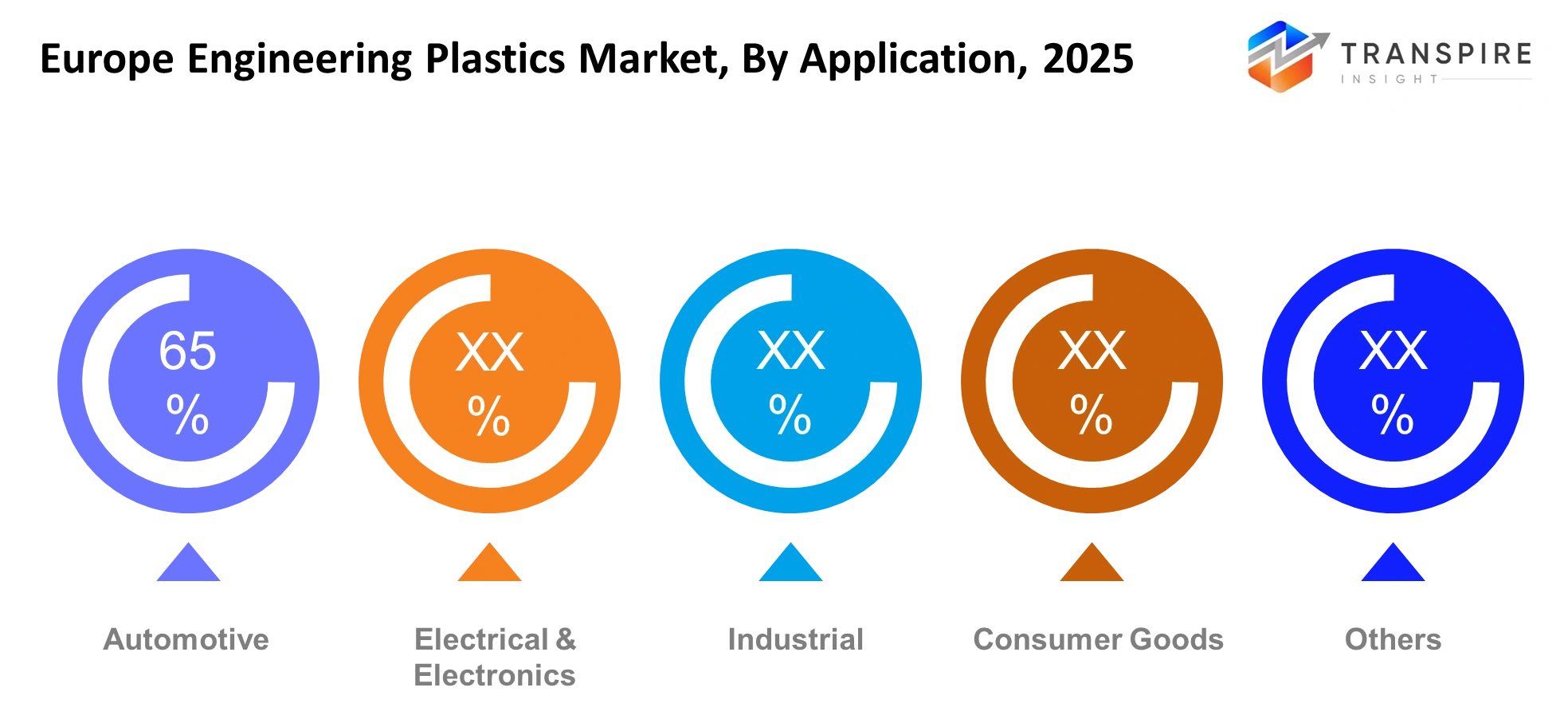
The automotive sector maintains its position as the primary consumer of engineering plastics because manufacturers use plastic parts to achieve lower vehicle weight and better battery performance. The electrical and electronics sector exists as the second largest market because semiconductor production increases and EV charging networks grow and there is a need for small yet powerful connectors. Robotics and automation systems together with heavy machinery components that need wear resistance and operational durability drive strong industrial application growth.
The market for consumer goods applications stays smaller than other areas but benefits from manufacturing lightweight appliances and producing high-end electronic devices. The need for regulatory compliance results in faster adoption of polymers for use in thermal management systems and battery enclosures and structural assemblies. The industrial buyers now focus on materials that help decrease maintenance expenses while boosting operational performance. Future application growth will likely concentrate around smart manufacturing systems and renewable energy infrastructure and high-voltage electrical platforms which require advanced flame-retardant and heat-resistant polymer solutions.
To learn more about this report, Download Free Sample Report
By End-User
European vehicle manufacturers maintain their status as the largest end-user group because they keep using advanced polymers for electric drivetrains and interior systems and lightweight structural components in their vehicles. The second-largest position belongs to electronics manufacturers because semiconductor fabrication and data infrastructure and high-speed connectivity projects are expanding through Germany and France and Eastern Europe. The industrial sector demonstrates increasing demand because businesses require automation equipment and robotics and precision manufacturing systems which need chemically stable and mechanically durable materials.
The adoption of engineering plastics is increasing in various industries including healthcare and aerospace and renewable energy for special applications which need sterilization resistance and lightweight construction and insulation performance. The rising investment in local semiconductor manufacturing and smart factory development is leading industrial buyers to change their procurement methods. Material suppliers are responding by expanding specialty polymer portfolios and improving technical collaboration with OEMs. The future growth of the market will benefit suppliers who can deliver engineering solutions and maintain supply chain security and create customized market solutions.
By Form
The form segment is dominated by granules because all automotive and electronics and industrial production lines use injection molding and extrusion as their main manufacturing methods. Granules serve as the preferred mass manufacturing format because they provide manufacturing flexibility and simple transportation and effective processing methods for large production volumes. Fiber forms keep expanding their presence in high-strength composite applications which now extend to aerospace and automotive structural reinforcement and industrial mechanical parts. Sheet formats maintain constant market demand because electrical insulation panels and construction materials and thermoformed industrial products need stable dimensions and protected surfaces.
The niche applications of engineering precision and semiconductor manufacturing use specialized forms which include films and rods to support their requirements. The market has increasingly shifted toward engineered forms which optimize automated production systems and high-speed processing equipment. Manufacturers are investing in advanced compounding technologies and customized material formats to improve consistency, reduce waste, and meet tighter technical specifications. The market will expand because composite fibers and precision-engineered products have become essential for electric vehicle development and advanced manufacturing system development.
What are the Key Use Cases Driving the Europe Engineering Plastics Market?
European engineers use engineering plastics in their primary work with electric vehicle production. Automakers use lightweight polyamide and polycarbonate components in battery housings and thermal management systems and interior assemblies to improve energy efficiency and extend driving range under strict EU emission regulations.
The market for electronics and industrial automation systems shows continuous growth, with semiconductor fabrication equipment and electric vehicle charging stations and robotic systems driving this expansion. Electronics manufacturers increasingly use heat-resistant and flame-retardant polymers to produce connectors and insulation systems and precision components that operate under high thermal stress.
The renewable energy and aerospace industries currently experience the development of new applications. Wind turbine manufacturers test reinforced composite polymers for corrosion-resistant structural components while aerospace suppliers evaluate ultra-high-performance plastics for lightweight cabin systems and advanced insulation technologies which design next-generation aircraft platforms.
|
Report Metrics |
Details |
|
Market size value in 2025 |
USD 35.9 Billion |
|
Market size value in 2026 |
USD 38.04 Billion |
|
Revenue forecast in 2033 |
USD 57.18 Billion |
|
Growth rate |
CAGR of 6% from 2026 to 2033 |
|
Base year |
2025 |
|
Historical data |
2021 - 2024 |
|
Forecast period |
2026 - 2033 |
|
Report coverage |
Revenue forecast, competitive landscape, growth factors, and trends |
|
Regional scope |
Europe (Germany, United Kingdom, France, Italy, Spain and Rest of Europe) |
|
Key company profiled |
BASF, SABIC, DuPont, Covestro, Celanese, Mitsubishi Chemical, Lanxess, Toray, Solvay, DSM, Evonik, LG Chem, Arkema, Asahi Kasei, Kuraray. |
|
Customization scope |
Free report customization (country, regional & segment scope). Avail customized purchase options to meet your exact research needs. |
|
Report Segmentation |
By Type (Polycarbonate, Polyamide, PBT, POM, Others), By Application (Automotive, Electrical & Electronics, Industrial, Consumer Goods, Others), By End-User (Automotive Industry, Electronics Industry, Industrial Sector, Others), By Form (Granules, Fibers, Sheets, Others). |
Which Regions are Driving the Europe Engineering Plastics Market Growth?
The engineering plastics market in Western Europe shows its highest development because Germany, France, and the Netherlands sustain their automotive, aerospace, and industrial manufacturing sectors. The European Union established strict emission standards together with vehicle electrification regulations which led to electric mobility systems adopting lightweight heat-resistant polymers. The area possesses research facilities which support advanced research activities and existing polymer processing systems and chemical manufacturers work together with original equipment manufacturers. Companies invest in local production facilities which produce specialized polymers because this approach ensures dependable supply chains while meeting ongoing needs of high-value manufacturing industries.
The industrial production capacities of Italy and Spain enable Southern Europe to maintain its status as a dependable and stable economic partner for industrial production in consumer goods and machinery and packaging and renewable energy equipment. The region experiences growth from manufacturing operations and export-based industrial activities which operate independently of the automotive electrification systems that drive development in Western Europe. The adoption of engineering polymers in industrial equipment and electrical systems receives ongoing support from government-sponsored industrial modernization initiatives and consistent infrastructure development funding. Mediterranean logistics routes provide local manufacturers with strong trade links which enable them to keep material supply demands steady during times when European supply chains face disruptions.
Eastern Europe experiences its greatest growth rate because of the rapid development in electronics assembly and electric vehicle component production and semiconductor-related investments.
Who are the Key Players in the Europe Engineering Plastics Market and How Do They Compete?
The Europe Engineering Plastics Market currently operates with moderate consolidation because global chemical producers control high-value polymer supply while regional compounders meet specialized needs of their industrial customers. The industry now evaluates competition through material performance and customization ability and environmental compliance with strict EU sustainability and recycling regulations instead of basic resin pricing. The existing companies use their production networks and automotive OEM and electronics manufacturer contracts to protect their market share. The new businesses face difficulties because they need to build expensive polymerization facilities which the automotive and aerospace industries require to meet all safety standards.
BASF strengthens its position through vertical chemical production integration combined with its extensive research and development funding for high-performance polyamides and recyclable engineering plastics. The company uses circular economy solutions for its supply chain management which specifically applies to automotive electric vehicle battery housings and lightweight structural components. Covestro develops polycarbonate products to create safety-compliant materials for the electronics and mobility industries which also need flame-retardant and impact-resistant properties. LANXESS develops its competitive edge through specialized polyamides designed for high-temperature automotive parts which it expands through partnerships with European original equipment manufacturers for electric drivetrain technology.
Solvay targets aerospace and semiconductor markets with high-performance fluoropolymers and PEEK materials, leveraging t through its advanced research capabilities.
Company List
- BASF
- SABIC
- DuPont
- Covestro
- Celanese
- Mitsubishi Chemical
- Lanxess
- Toray
- Solvay
- DSM
- Evonik
- LG Chem
- Arkema
- Asahi Kasei
- Kuraray
Recent Development News
In April 2026, Covestro Expands Advanced Engineering Plastics Portfolio at CHINAPLAS 2026: Covestro unveiled new high-performance material solutions for robotics, medical wearables, flying cars, and smart mobility applications during April 2026. The launch reinforced the company’s push toward sustainable engineering plastics and circular-material solutions, with strong relevance for European OEMs and electronics manufacturers.
Source: https://www.covestro.com
In April 2026, BASF Maintains 2026 Guidance Despite Market Volatility in Europe: German chemicals major BASF confirmed its 2026 earnings guidance at the end of April despite ongoing geopolitical and supply-chain disruptions affecting Europe’s engineering plastics and specialty chemicals sector. The company highlighted resilient industrial demand and operational flexibility across its European manufacturing network, signaling stability for downstream engineering plastics applications in automotive and electronics.
Source: https://www.reuters.com
What Strategic Insights Define the Future of the Europe Engineering Plastics Market?
The Europe Engineering Plastics Market has started to transform its fundamental structure because the market now requires high-performance material systems that meet existing regulations and current demand for electric power systems and semiconductor growth and industrial automation. The demand for advanced polymer grades will grow during the next five to seven years because original equipment manufacturers will build their systems using these polymers which provide thermal stability and electrical insulation and lightweight structural performance. The existing shift creates a market value system which depends on technical partnerships that exist between suppliers and their customers.
The industry faces an unrecognized danger when it relies too heavily on a few specialty resin manufacturers because this practice puts downstream production companies at risk of experiencing price fluctuations and limitations on their materials during energy or feedstock disruptions. The market for bio-based engineering plastics has not yet reached commercial stability which creates doubt about their potential to replace traditional materials. Central and Eastern Europe present a new business opportunity because their semiconductor and EV battery gigafactory ecosystems need integrated polymer supply chains to support their development.
Market participants should implement their production operations at regional sites while developing specific materials for particular applications which will help them establish connections with original equipment manufacturer design processes and achieve enduring qualification benefits.
Europe Engineering Plastics Market Report Segmentation
By Type
- Polycarbonate
- Polyamide
- PBT
- POM
- Others
By Application
- Automotive
- Electrical & Electronics
- Industrial
- Consumer Goods
- Others
By End-User
- Automotive Industry
- Electronics Industry
- Industrial Sector
- Others
By Form
- Granules
- Fibers
- Sheets
- Others
Frequently Asked Questions
Find quick answers to common questions.
The approximate Europe Engineering Plastics Market size for the market will be USD 57.18 Billion in 2033.
The key segments of the Europe Engineering Plastics Market are By Type (Polycarbonate, Polyamide, PBT, POM, Others), By Application (Automotive, Electrical & Electronics, Industrial, Consumer Goods, Others), By End-User (Automotive Industry, Electronics Industry, Industrial Sector, Others), By Form (Granules, Fibers, Sheets, Others).
Major players in the Europe Engineering Plastics Market are BASF, SABIC, DuPont, Covestro, Celanese, Mitsubishi Chemical, Lanxess, Toray, Solvay, DSM, Evonik, LG Chem, Arkema, Asahi Kasei, Kuraray.
The current market size of the Europe Engineering Plastics Market is USD 35.9 Billion in 2025.
The Europe Engineering Plastics Market CAGR is 6%.
- BASF
- SABIC
- DuPont
- Covestro
- Celanese
- Mitsubishi Chemical
- Lanxess
- Toray
- Solvay
- DSM
- Evonik
- LG Chem
- Arkema
- Asahi Kasei
- Kuraray
Recently Published Reports
-
Apr 2026
Healthcare Polymer Packaging Market
Healthcare Polymer Packaging Market Size, Share & Analysis Report By Packaging Type (Syringes, IV Bottles and Pouches, Clamshells, Blisters, Bottles & Jars, Containers, Tubes, IV Parental Packaging, Others), By Type (Regulated, Non-regulated), By Polymer Type (LDPE (Low-Density Polyethylene), HDPE (High-Density Polyethylene), Homo-polymer (Homo), Random Copolymer (Random), Block Copolymer (Block), PET, Polystyrene, Polyvinyl Chloride, Polyamide/EVOH, Others), and Geography (North America, Europe, Asia-Pacific, Middle East and Africa, South and Central America), 2021 - 2031
-
Apr 2026
Hydrophilic Tape (Waterstop) Market
Hydrophilic Tape (Waterstop) Market Size, Share & Analysis Report By Type (Bentonite-Based Hydrophilic Tape, Rubber-Based Hydrophilic Tape), By Application (Residential Buildings, Commercial Buildings, Infrastructure Projects), and Geography (North America, Europe, Asia-Pacific, Middle East and Africa, South and Central America), 2021 - 2031
-
Apr 2026
Metalens Market
Metalens Market Size, Share & Analysis Report By Type (Visible Light Metalens, and Infrared Metalens), By Application (Consumer Electronics, Automotive Electronics, Industrial, Medical, and Others), and Geography (North America, Europe, Asia-Pacific, Middle East and Africa, South and Central America), 2021 - 2031
-
Apr 2026
PBT Resin Market
PBT Resin Market Size, Share & Analysis Report By Type (Reinforced PBT Resin, Unreinforced PBT Resin), By Processing Method (Injection Molding, Extrusion, Blow Molding, Others), By End-User (Automotive, Electrical & Electronics, Consumer Appliances, Industrial Machinery, Medical Devices, Packaging, Others), and Geography (North America, Europe, Asia-Pacific, Middle East and Africa, South and Central America), 2021 - 2031