

Asia Pacific Industrial Mixers Market Size & Forecast:
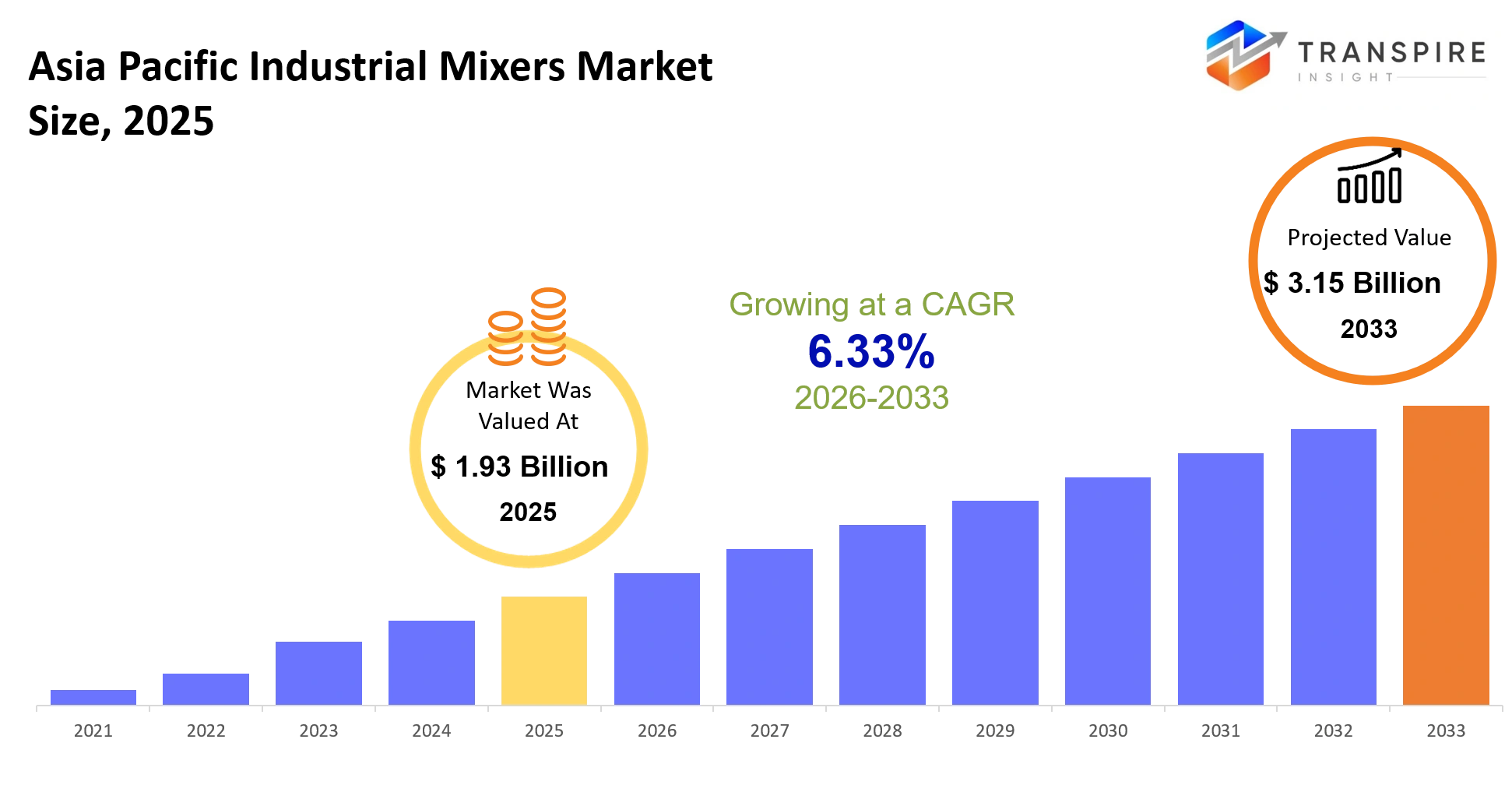
- Asia Pacific Industrial Mixers Market Size 2025: USD 1.93 Billion
- Asia Pacific Industrial Mixers Market Size 2033: USD 3.15 Billion
- Asia Pacific Industrial Mixers Market CAGR: 6.33%
- Asia Pacific Industrial Mixers Market Segments: By Product Type (Static Mixers, Ribbon Mixers, Paddle Mixers, High Shear Mixers, Planetary Mixers, Drum Mixers, Agitators, Others); By Application (Chemicals, Food & Beverages, Pharmaceuticals, Cosmetics, Construction Materials, Others); By Capacity (Small, Medium, Large, Industrial Scale, Others); By End User (Manufacturing, Processing Industries, Laboratories, Others)
Asia Pacific Industrial Mixers Market Summary
The Asia Pacific Industrial Mixers Market was valued at USD 1.93 Billion in 2025. It is forecast to reach USD 3.15 Billion by 2033. That is a CAGR of 6.33% over the period.
Industrial mixers are a pretty critical part of manufacturing work across Asia Pacific, they help liquids, powders, and semi solid materials stay blended in a consistent way so quality, safety, and performance goals actually get met. In practice, they sit right in the middle of industries like chemicals, food processing, pharmaceuticals, water treatment and construction materials, where production efficiency really leans on precise, repeatable mixing results , without surprises.
In the past 5 years, the market has moved away from conventional batch based equipment toward automated, energy efficient and process integrated mixing systems. A lot of manufacturers now connect mixers with digital controls and broader plant wide monitoring platforms, so they can cut down material waste and keep output steadier over time. One of the biggest reasons behind this shift was the supply chain disruption during and after the COVID 19 period, it kind of showed how labor intensive production methods can be inefficient. When companies expanded local production capacity and started focusing more on operational resilience, investment in advanced mixing gear picked up fast. In the end, this has meant higher equipment replacement rates, more appetite for customized setups and better revenue chances for suppliers that can deliver automation, reliability, and process optimization, kind of as a package.
Key Market Insights
- China kind of dominates the Asia Pacific Industrial Mixers Market, with something like 38–42% market share in 2025, mostly because its huge manufacturing base is just there and doing most of the work.
- Meanwhile, several Southeast Asian countries are grabbing noteworthy share too, as multinational manufacturers are spreading out their production footprints and doing it beyond China in a more deliberate way.
- Japan and South Korea still keep a solid stance, powered by their advanced manufacturing know-how and the steady use of high-performance mixing technologies, even when the market gets competitive, or yeah, when demand shifts.
- When it comes to mixer types, batch mixers are leading the Asia Pacific Industrial Mixers Market, close to 45% share, mainly since they’re pretty versatile for a lot of different industries.
- After that, high-shear mixers show up as the second-largest segment, and it’s largely linked to pharmaceutical needs and specialty chemical production requirements.
- Static mixers are also the fastest-growing category through 2030, because manufacturers are prioritizing energy-efficient continuous processing solutions and not slowing down in that direction, at all.
- Automated mixing systems are getting more traction as facilities try to push Industry 4.0 integration, and improve process control, a bit more than before.
- In the chemical processing space , it sits at roughly 35% market share , which points to broad reliance across both specialty and commodity chemical production, honestly.
- Pharmaceutical manufacturing meanwhile is the fastest-growing application segment, driven by tighter quality requirements and that formulation complexity thing.
- For food and beverage processing, the demand for mixers stays high because manufacturers need steady batch outcomes, hygiene compliance , and smoother production scaling over time.
What are the Key Drivers, Restraints, and Opportunities in the Asia Pacific Industrial Mixers Market?
The strongest force pushing market growth is that modernization of manufacturing operations across chemicals, pharmaceuticals, food processing, and water treatment industries is happening right now. The move toward more automated production lines and stricter quality control rules has really driven manufacturers to swap out older mixing equipment, for systems that are digitally controlled. This change also got a boost from post-pandemic attempts to strengthen production resilience and cut down on manual steps, sometimes even when staffing is already strained. As firms pour money into bigger capacity plants, and into continuous processing technologies, mixer suppliers tend to see bigger equipment orders, more system upgrades, and longer-term service commitments, which then support revenue growth in a pretty direct way.
Even so, the most important snag is still the high capital expenditure tied to advanced industrial mixing systems, and the whole plant integration effort. This obstacle feels structural because mixer performance is tightly linked to the wider process backbone, like automation platforms, piping networks, and control systems. A lot of small and mid-sized manufacturers keep postponing upgrades, mainly due to budget limits and long return-on-investment timelines, that can be hard to swallow. So replacement cycles don’t keep up, and equipment replacement rates stay slower than the pace of technological advancement, which then limits market revenue potential.
There is a real big opportunity sitting in the expansion of specialty chemicals, and also biopharmaceutical manufacturing across India and Southeast Asia. In these areas, companies need not just “mixing” but very tailored or specialized mixing solutions, that can deal with complicated formulations, along with strict quality requirements. When investors put money into new production plants, it basically opens the door for suppliers that bring smart mixers, the kind that include process analytics, automated controls, and real-time monitoring too. And since a lot of regional manufacturers are gradually shifting toward higher value output, the need for precision mixing technologies should pick up pace, pretty quickly.
What Has the Impact of Artificial Intelligence Been on the Asia Pacific Industrial Mixers Market?
In mixing, the use of AI and modern digital technology has enabled manufacturers to gain tighter control of the process and data-driven process decision-making. Modern mixing units increasingly utilize AI-based control logic where variables like viscosity, temperature, mixing speed, and composition of material in the mixing unit are continuously monitored. AI adjusts operational parameters to ensure consistent product quality while minimizing waste. Modern mixing systems have been shown to minimize raw materials, energy consumption. AI also has helped to gain more effective process control of the operations, enabling consistency in quality of production.
Machine learning has been useful in enhancing the predictive maintenance for manufacturing. By monitoring torque variations, motor operating speed, vibrational behavior of the mixers, and machine tool wear conditions, the predictive algorithms have the capability to anticipate equipment failures prior to unscheduled down times. This will significantly enhance availability of equipment in the manufacturing site and thus decrease the maintenance costs while extending service life of the individual components. Advanced analytics has been helpful in increasing process uptime in large chemical and pharmaceutical plants, providing greater batch consistency.
Digital twins and process simulation platforms have also helped to enhance operations by enabling operators to test mixing parameters virtually on the simulations, thus helping in process optimization and reduced commissioning time of the plants, also decreasing cycle times to optimize mixing process.
The drawback that remains in the application of AI is that most of the facilities are already operating under older systems, having a lot of non-connected equipment with negligible or no data and adequate sensors. Due to the cost involved in retrofitting connected sensors, upgrading the controls, and training for usage, most of the small and medium manufacturers are lagging behind and only the big establishments are benefiting from modern analytics for the increased production uptime and better consistency in batch processes.
Key Market Trends
- Automated systems have gained an accelerated adoption by chemical and pharmaceutical manufacturers over the last few years-since 2020-at the expense of manual mixing, enabling them to ensure batch consistency while decreasing reliance on operators.
- China has witnessed a steady trend in adopting Industry 4.0 mixers; by introducing sensors and leveraging real-time analysis of production processes, the latter helped manufacturers reduce the operational costs, minimize waste, and optimize production efficiency.
- Between 2021 and 2025, widespread disruptions in supply chains caused several producers to invest in domestic sources for mixing equipment and local service providers.
- More and more food and beverage manufacturers, faced with increasingly stringent quality and traceability standards, turned their operations towards hygienic mixer designs capable of automating the cleaning processes.
- Manufacturers turned to continuous mixing technologies over batch processing after 2022 for higher throughput and decreased operating costs.
- Leading equipment manufacturers, such as SPX FLOW, Sulzer, and EKATO Group, enlarged their service and engineering operations in India and Southeast Asia.
- Energy efficiency is already a major factor when purchasing new machinery, with increasingly double-digit reductions in energy consumption now achievable through advanced impeller designs.
- The Indian and Singaporean pharmaceutical markets have been increasingly investing in precise mixing equipment, which needs to be compliant with advanced formulations and validation needs.
- Use of predictive maintenance greatly increased after 2021 as operators are now able to monitor remotely, diagnose equipment issues, and prevent unnecessary production stoppages.
- Manufacturers differentiate based on lifecycle value instead of equipment price. Suppliers now offer services including process optimization, digital monitoring, and support packages, such as long-term maintenance contracts.
Asia Pacific Industrial Mixers Market Segmentation
By Product Type :
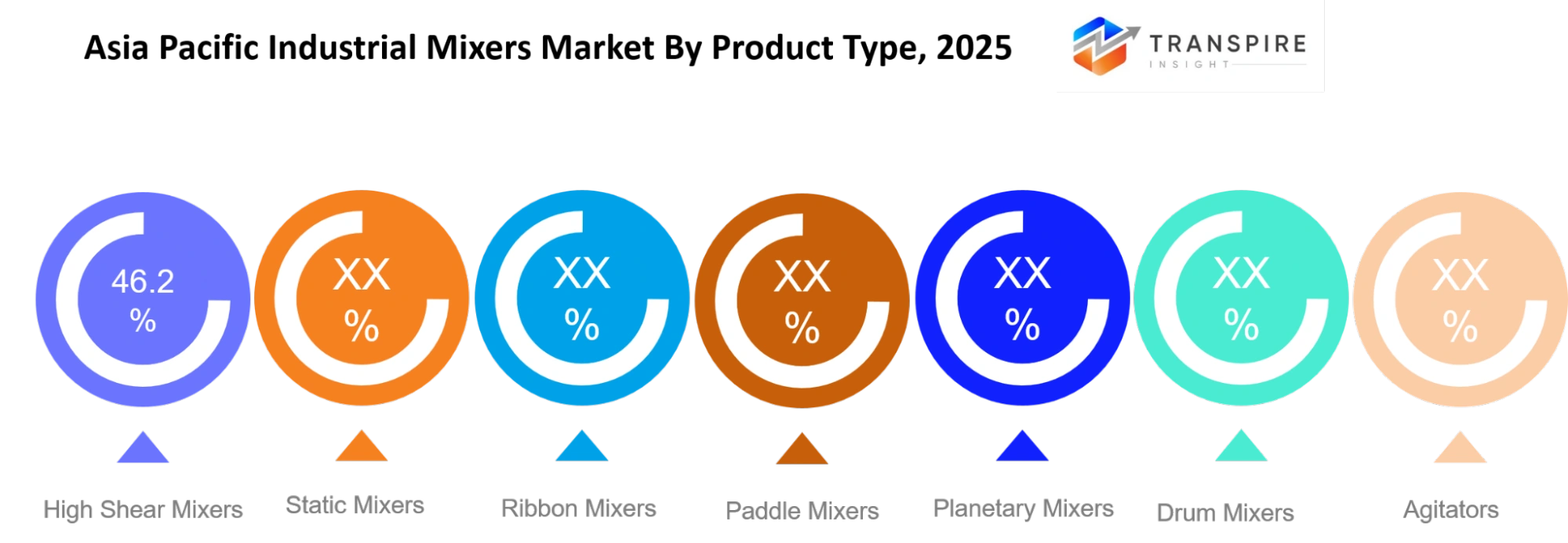
Continuous blending is facilitated by static mixers, which guides the flow of material through static internal elements. Ribbon mixers are suitable for powder and granular blending operations, and paddle mixers are appropriate for gently mixing shear sensitive products with consistent blended results. High shear mixers are effective for dispersing and emulsifying products, allowing for many challenging industrial applications.
Rotational and orbital action allows planetary mixers to blend highly viscous products thoroughly, and drum mixers allow blending to be conducted inside drums and containers. Agitators serve to ensure product uniformity in tanks during production and storage. Additional types of mixers exist to address various applications, enabling manufacturers to select equipment based on product characteristics, output, and desired results.
By Application :
Chemical industries apply industrial mixers to ensure accurate blending of raw materials, additives, and composites that need to be carefully formulated. Food and beverage industries utilize mixer equipment during ingredient formulation and in large production processes that demand consistent product quality. Medical industries require stringent process controls to ensure product consistency.
Cosmetics industries apply mixers for creams, lotions, gels and personal care formulas, and construction industries utilize mixer systems to formulate such products as cement blends, coatings, and adhesives. Other such industries that use industrial mixers include water treatment, agriculture, and specialty industries.
By Capacity :
Smaller capacity mixers are primarily utilized in laboratories, pilot plants, and specific production processes where minimal batches are needed. Mid capacity machines offer flexibility to manufacturers and are suitable where process optimization is necessary alongside efficient production. Mid capacity systems cater to diverse uses and are typically found in businesses with increasing operations.
Larger capacity mixers provide efficient production capacities and suit processes operating on continuous cycles. Industrial scale systems cater to major processing plants which often require continuous output rates, integration with automation systems, and longer service cycles. Remaining capacity options offer specific operational needs, enabling organizations to match operational and development needs to relevant mixer apparatus.
By End User :
Manufacturing facilities constitute the most significant end user class; they operate mixers to optimize production processes, guarantee quality output, and meet large volume output demands. Mixer technology is a critical element in the production of standard goods within diverse sectors like the chemical industry, food processing, pharmaceuticals, and construction materials. Proper mixer operations support both productivity and quality output.
Processing industries need advanced mixer technology to facilitate the production of complex compounds and maintain process stability throughout the production run cycle. Small sized, highly controlled, and sensitive machines are employed by laboratories to assist in the testing and development of their products. Other end user classes include those using educational, pilot plant, and custom industrial mixers for targeted application processes.
What are the Key Use Cases Driving the Asia Pacific Industrial Mixers Market?
Chemical manufacturing will be the main use for industrial mixers across Asia Pacific. Manufacturers are using automated mixing systems to obtain a homogeneous blend of raw materials, additives, pigments and specialties. Maintaining product quality, shorter batch processing times and accurate formulation control have made this use case a high demand application and replacement investment.
Food processing and pharmaceuticals are a growing use case. Food processing facilities are using mixers to produce high volume operations while ensuring texture, ingredient distribution and product consistency. Pharmaceutical production facilities are increasingly looking to invest in high-tolerance mixers that maintain precise formulations, required for validation needs, and product standards in India, China and Southeast Asia.
New applications will emerge in battery materials production and advance wastewater treatment. Production processes for lithium ion battery components need precise mixing for component consistency. High-efficiency water treatment projects have begun to adopt high-performance mixers to effectively blend chemicals. These new use cases are predicted to develop equipment investment over the forecast period.
|
Report Metrics |
Details |
|
Market size value in 2025 |
USD 1.93 Billion |
|
Market size value in 2026 |
USD 2.05 Billion |
|
Revenue forecast in 2033 |
USD 3.15 Billion |
|
Growth rate |
CAGR of 6.33% from 2026 to 2033 |
|
Base year |
2025 |
|
Historical data |
2021 - 2024 |
|
Forecast period |
2026 - 2033 |
|
Report coverage |
Revenue forecast, competitive landscape, growth factors, and trends |
|
Regional scope |
Asia Pacific (India, China, Japan, Australia, South Korea, Rest of Asia Pacific) |
|
Key company profiled |
SPX Flow, GEA Group, EKATO, Sulzer, Xylem, Charles Ross & Son, Silverson, INOXPA, Alfa Laval, Brawn Mixer, Hayward Gordon, Philadelphia Mixing, Mixquip, Munson Machinery, Shree Bhagwati |
|
Customization scope |
Free report customization (country, regional & segment scope). Avail customized purchase options to meet your exact research needs. |
|
Report Segmentation |
By Product Type (Static Mixers, Ribbon Mixers, Paddle Mixers, High Shear Mixers, Planetary Mixers, Drum Mixers, Agitators, Others); By Application (Chemicals, Food & Beverages, Pharmaceuticals, Cosmetics, Construction Materials, Others); By Capacity (Small, Medium, Large, Industrial Scale, Others); By End User (Manufacturing, Processing Industries, Laboratories, Others) |
Which Regions are Driving the Asia Pacific Industrial Mixers Market Growth?
China leads the Asia Pacific Industrial Mixers Market because of its extensive manufacturing base, strong industrial investment pipeline, and large concentration of chemical, pharmaceutical, and food processing facilities. National initiatives supporting industrial automation and smart manufacturing have encouraged companies to modernize production equipment, including advanced mixing systems. The country also benefits from a mature supplier network, local component manufacturing, and engineering expertise that reduce procurement and maintenance costs. This ecosystem allows manufacturers to scale production efficiently while continuously upgrading process technologies.
Japan represents the second most influential regional market, but growth is driven by different factors than in China. Rather than focusing on production scale, Japanese manufacturers emphasize process precision, product quality, and operational reliability. Consistent investment in advanced manufacturing technologies supports steady demand for high-performance mixing equipment across specialty chemicals, pharmaceuticals, and advanced materials industries. Long-term capital investment strategies and stable industrial output make Japan a dependable contributor to regional market revenue.
India is emerging as the fastest-growing market across the region. Rapid expansion of pharmaceutical manufacturing, specialty chemical production, and food processing capacity has created new demand for industrial mixing technologies. Government-backed manufacturing initiatives and increasing private-sector investment in production facilities have accelerated equipment purchases over the past few years. This momentum is expected to create significant opportunities for suppliers, technology providers, and investors seeking exposure to industrial modernization projects between 2026 and 2033.
Who are the Key Players in the Asia Pacific Industrial Mixers Market and How Do They Compete?
The competition is moderately fragmented across the Asia Pacific Industrial Mixers market where global engineering firms, mixing equipment specialists and regional players compete against one another. Technological performance, customizable process design, energy efficient application and after-sales service have begun to surpass simple pricing in terms of competitive factors, with firms developing custom-based solutions required by different production processes; this offers advantages to engineering firms that combine advanced engineering capability with specialized industrial application know-how.
SPX FLOW's focus on technology based products development caters to industries with need for meticulous control over processes. The firm's strong position can be attributed to its advanced mixing systems supplemented by sophisticated automation and control features that enhance production repeatability. EKATO Group, with its emphasis on highly engineered solutions, provides mixing solutions that meet the needs of complex chemical and pharmaceutical processes and holds a competitive edge through process-specific designs and dedicated engineering services to help users achieve optimized manufacturing environments.
Sulzer leverages on fluid engineering and process optimization to provide more efficient mixing and better energy performances. This is supplemented by constant investment in application specific technology and regional services. Alfa Laval stands out on its combination of various processing capabilities and the design of integrated systems offering a complete mix of mixing, heat transfer, and fluid handling. GEA Group improves its competitive strength through offering comprehensive systems enabling users to procure various manufacturing technologies under one roof thereby creating sustainable competitive advantages over different end user industrial segments, in the market.
Company List
- SPX Flow
- GEA Group
- EKATO
- Sulzer
- Xylem
- Charles Ross & Son
- Silverson
- INOXPA
- Alfa Laval
- Brawn Mixer
- Hayward Gordon
- Philadelphia Mixing
- Mixquip
- Munson Machinery
- Shree Bhagwati
Recent Development News
In March 2026, ITT Inc. secured completion of its acquisition of SPX FLOW for approximately US$4.775 billion. The transaction expanded ITT’s flow technologies portfolio by adding mixing, blending, fluid handling, and process equipment capabilities, strengthening its position in industrial processing markets that include industrial mixers.
Source https://www.chemicalprocessing.com/
In March 2026, Mack Trucks entered a partnership with Beck Industrial to integrate the Beck Intelligent Mixer with Mack GuardDog Connect technology. The collaboration introduced connected mixer monitoring capabilities that improve equipment visibility, fleet management, and operational efficiency, highlighting the growing role of digital technologies in mixer applications. Source https://www.macktrucks.com/
What Strategic Insights Define the Future of the Asia Pacific Industrial Mixers Market?
The Asia Pacific Industrial Mixers Market is expected to shift toward a future with intelligent process control rather than a simple increase in capacity. Over the next five to seven years, gaining a competitive advantage will depend on a supplier’s ability to offer digitally linked mixers with consistent quality and energy-efficient operation as part of a fully automated manufacturing system. A general trend in industries like chemicals, food & beverages, pharmaceuticals, and advanced materials toward higher-value and data driven manufacturing are the drivers for such a shift.
An understated threat for market growth is market concentration. With growing sophistication of the machines becoming software driven, major equipment and automation suppliers could limit their flexibility and increase their switching cost and thus slow down innovation for smaller industrial manufacturers.
An area for growth is the emergence of battery materials manufacturing in India and South East Asia. Highly controlled mixers are critical for the manufacturing of cathode, anode, and special materials and this will likely create another segment for specific equipment suppliers. Investment in digitally monitored systems, prediction maintenance, and a specific know-how for the application will be an investment for each market player in the segment before it becomes the standard in all manufacturing operations.
Asia Pacific Industrial Mixers Market Report Segmentation
By Product Type
- Static Mixers
- Ribbon Mixers
- Paddle Mixers
- High Shear Mixers
- Planetary Mixers
- Drum Mixers
- Agitators
By Application
- Chemicals
- Food & Beverages
- Pharmaceuticals
- Cosmetics
- Construction Materials
By Capacity
- Small
- Medium
- Large
- Industrial Scale
By End User
- Manufacturing
- Processing Industries
- Laboratories
Frequently Asked Questions
Find quick answers to common questions.
The Asia Pacific Industrial Mixers Market size is USD 3.15 Billion in 2033.
Key segments for the Asia Pacific Industrial Mixers Market are By Product Type (Static Mixers, Ribbon Mixers, Paddle Mixers, High Shear Mixers, Planetary Mixers, Drum Mixers, Agitators, Others); By Application (Chemicals, Food & Beverages, Pharmaceuticals, Cosmetics, Construction Materials, Others); By Capacity (Small, Medium, Large, Industrial Scale, Others); By End User (Manufacturing, Processing Industries, Laboratories, Others).
Major Asia Pacific Industrial Mixers Market players are SPX Flow, GEA Group, EKATO, Sulzer, Xylem, Charles Ross & Son, Silverson, INOXPA, Alfa Laval, Brawn Mixer, Hayward Gordon, Philadelphia Mixing, Mixquip, Munson Machinery, Shree Bhagwati.
The Asia Pacific Industrial Mixers Market size is USD 1.93 Billion in 2025.
The Asia Pacific Industrial Mixers Market CAGR is 6.33% from 2026 to 2033.
- SPX Flow
- GEA Group
- EKATO
- Sulzer
- Xylem
- Charles Ross & Son
- Silverson
- INOXPA
- Alfa Laval
- Brawn Mixer
- Hayward Gordon
- Philadelphia Mixing
- Mixquip
- Munson Machinery
- Shree Bhagwati
About the Authors

Kartik bhong
I am Kartik Bhong, a Senior Research Analyst at Transpire Insight, specializing in the Packaging, Manufacturing, and Construction industry. My work focuses on analyzing market trends, emerging technologies, industry regulations, and competitive landscapes to deliver accurate, data-driven insights. I am passionate about transforming complex industry information into clear, practical content that helps businesses, professionals, and decision-makers stay informed and make confident strategic decisions. Through continuous research and a strong commitment to accuracy, I strive to create reliable, well-researched content that reflects the latest developments across these dynamic industries and supports the vision of Transpire Insight in delivering valuable market intelligence.

Chakradhar Khansole
Chakradhar serves as the Research Director at Transpire Insight, bringing over 8 years of experience in technology, innovation, and strategic market intelligence. He specializes in transforming complex market data into actionable business insights that enable organizations to make informed, growth-oriented decisions. Recognized for his strategic vision and analytical expertise, Chakradhar leads high-impact research initiatives, delivering comprehensive market assessments, competitive intelligence, and forward-looking industry analysis.
Recently Published Reports
-
Apr 2026
Handling and Lifting Equipment Market
Handling and Lifting Equipment Market Size, Share & Analysis Report By Product (Cranes and Hoists, Forklifts, Conveyor Systems, Aerial Work Platforms, Others), By Application (E-Commerce, Automotive and Railway, Food and Beverages, Aviation, Others), and Geography (North America, Europe, Asia-Pacific, Middle East and Africa, South and Central America), 2021 - 2031
-
Apr 2026
HVAC Equipment Market
HVAC Equipment Market Size, Share & Analysis Report By Heating Equipment Type (Boilers and Furnaces, Heat Pumps, and Unitary Heaters), By Ventilation Equipment (Air Handling Units, Humidifiers and Dehumidifiers, Air Filters, and Fan Coiling Units), By Air Conditioning Equipment (Unitary Air Conditioners, Room Air Conditioners, Packaged Terminal Air Conditioners, and Chillers), By End User (Commercial, Residential, Industrial, and others), and Geography (North America, Europe, Asia-Pacific, Middle East and Africa, South and Central America), 2021 – 2031
-
Apr 2026
Refrigeration Valves Market
Refrigeration Valves Market Size, Share & Analysis Report By Type (Solenoid Valves, Expansion Valves, Check Valves, Service Valves, Others), By Application (Commercial Refrigeration, Industrial Refrigeration, Transport Refrigeration, Residential Refrigeration, Air Conditioning Systems), By End User (Food and Beverage Industry, Pharmaceutical Industry, HVAC Industry, Chemical Industry, Others), and Geography (North America, Europe, Asia-Pacific, Middle East and Africa, South and Central America), 2021 – 2031
-
Apr 2026
E-Commerce Packaging Materials Market
E-Commerce Packaging Materials Market By Material Type (Corrugated Boxes, Paper & Paperboard, Foam & Cushioning Materials, Plastic Packaging, Flexible Packaging, Protective Packaging, Others), By Product(Primary Packaging, Secondary Packaging, Tertiary Packaging), By Packaging Function (Protective Packaging, Branding & Presentation Packaging, Transit & Logistic Packaging, Sustainable Packaging, Tamper Evidence Packaging), By End-User (Retail & Consumer Goods, Electronic Appliances, Food & Beverages, Healthcare & Pharmaceutical, Fashion & Apparel, Home & Furnishing, Others); By Industry Analysis, Size, Share, Growth, Trends, and Forecasts 2021-2033