
Asia Pacific Industrial and Commercial LED Lighting Market Size & Forecast:
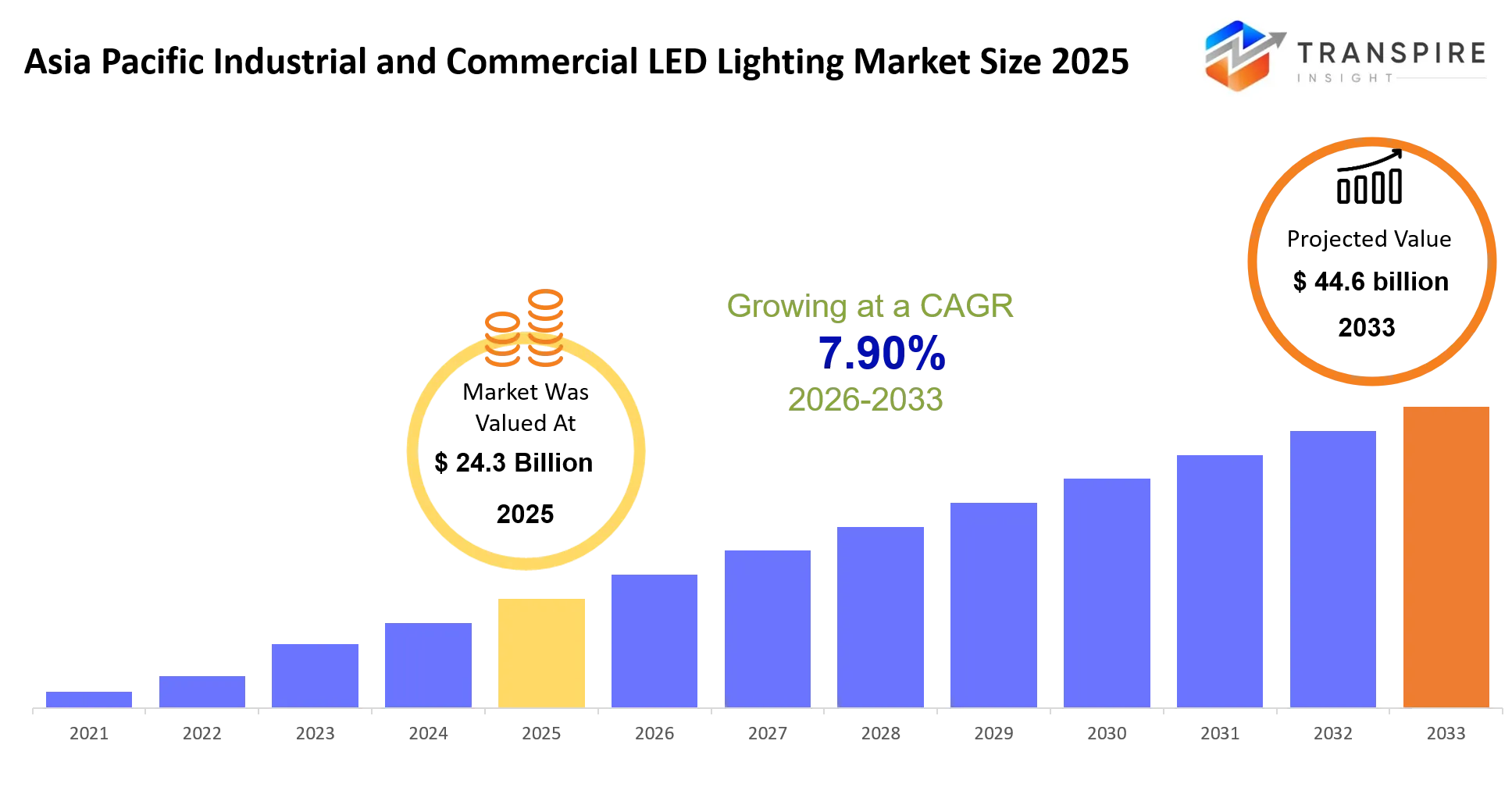
- Asia Pacific Industrial and Commercial LED Lighting Market Size 2025: USD 24.3 Billion
- Asia Pacific Industrial and Commercial LED Lighting Market Size 2033: USD 44.6 billion
- Asia Pacific Industrial and Commercial LED Lighting Market CAGR: 7.90%
- Asia Pacific Industrial and Commercial LED Lighting Market Segments:By Product Type (LED Lamps, LED Fixtures, Street Lights, High Bay Lights, Downlights, Panel Lights, Flood Lights, Others); By Application (Industrial Facilities, Commercial Buildings, Warehouses, Retail Stores, Outdoor Areas, Healthcare Facilities, Educational Institutions, Others); By Installation Type (New Installation, Retrofit Installation, Smart Lighting Systems, Connected Lighting, Energy-Efficient Upgrades, Automated Lighting, Hybrid Systems, Others); By End User (Manufacturing, Retail, Logistics, Healthcare, Education, Government, Hospitality, Others)
Asia Pacific Industrial and Commercial LED Lighting Market Summary
The Asia Pacific Industrial and Commercial LED Lighting Market was valued at USD 24.3 billion in 2025. It is forecast to reach USD 44.6 billion by 2033. That is a CAGR of 7.90% over the period.
The Asia Pacific Industrial and Commercial LED Lighting Market is about replacing old lighting systems in factories, warehouses, offices, ports and public infrastructure with new energy-efficient LED solutions. These LED solutions help reduce electricity consumption and the time spent on maintenance. In factories and other industrial places LEDs make it easier to see and help companies follow safety rules and make work more efficient. In offices and other commercial spaces LEDs help costs over time and work well with smart building systems.
Over the five years there has been a big change from old lighting systems to new connected and smart LED systems. These new systems use sensors and special control platforms that work with the internet. One of the reasons for this change was the rising cost of energy and new rules that require companies to use energy more efficiently. Many countries in the Asia Pacific region introduced these rules after problems with supply chains and high demand for power. This made companies hurry up and replace their lighting systems with new ones.Now companies are not just looking to save money by using LEDs. They also want to be able to control their lighting using data to predict when maintenance is needed and make their systems work automatically. This change has created opportunities for companies that make LED lighting systems to sell not just the lights, but also software and services to help companies manage their lighting over time. This means these companies can make money not from selling lights one time but from ongoing contracts and services. The Asia Pacific Industrial and Commercial LED Lighting Market is really growing because of this..
Key Market Insights
- The Asia Pacific Industrial and Commercial LED Lighting Market is growing because more industries are using energy-saving and smart lighting systems.
- China has the share, over 35% because it has a strong industrial setup and is upgrading to automation.
- India is growing fast because more commercial buildings are being constructed and the government is pushing for energy efficiency.
- Smart LED lighting systems are leading the market with a 42% share because more people are using sensors and connecting to the internet.
- Many companies are still replacing fluorescent lights with retrofit LED fixtures.
- More and more industries are using connected lighting platforms with cloud control and automation.
- Industrial manufacturing uses LED lighting because it needs to be safe, efficient and follow rules.
- Office spaces are growing fast because they are becoming buildings that save energy.
- Companies like Signify, OSRAM Samsung LED and Nichia are working on smart and efficient lighting.
- The competition is now about making lighting solutions that connect to the internet using AI to save energy and take a long time.
What are the Key Drivers, Restraints, and Opportunities in the Asia Pacific Industrial and Commercial LED Lighting Market?
Drivers
The main driver of the Asia Pacific Industrial and Commercial LED Lighting Market is that people want to use energy- infrastructure. This is because electricity is getting more expensive and buildings have to be more efficient. Governments and companies started to replace lighting systems with LED lights after they saw how much money they were wasting on electricity. This led to a lot of replacement programs in factories, warehouses and public buildings. As a result the LED market is making money from big contracts, smart lighting upgrades and maintenance agreements.
Restraint
One thing that is holding back the market is that smart LED lighting systems are very expensive to set up. Even though they save money on the run, many small companies are not adopting them because they cost too much and are hard to install. This is slowing down the process of replacing lighting systems especially in places where people are very sensitive about prices. This means that not all areas are using LED lights equally and it is limiting how fast manufacturers can make money.
Opportunity
There is an opportunity for growth in projects that use the internet to make cities and industries smarter especially in places like India and Southeast Asia that are growing very fast. LED lighting is being used with sensors, cloud platforms and energy management systems to make infrastructure better. These projects are creating ways for companies to make money, such as selling software analyzing data and helping people use energy more efficiently. The LED lighting market is getting bigger because of these projects. The Asia Pacific Industrial and Commercial LED Lighting Market is really benefiting from these opportunities. The driver of this market is still the need for energy- infrastructure.
What Has the Impact of Artificial Intelligence Been on the Asia Pacific Industrial and Commercial LED Lighting Market?
The Asia Pacific Industrial and Commercial LED Lighting Market is changing because of intelligence and advanced digital technologies. These things are making it possible to have automated lighting control and energy optimization across big infrastructure. Smart lighting systems use intelligence based sensors and building management platforms to automatically change how bright the lights are and to turn them on and off when people are not around in industrial facilities, warehouses and commercial buildings. This means that people do not have to get involved much in control systems and it makes the systems work better across many sites.
These systems look at how the lights are used and at things like temperature and voltage to figure out when parts might start to break down. This helps to prevent failures. In commercial installations using predictive analytics has meant that there are fewer times when the lights have to be fixed and the lights are on more often. Many people who run these systems say that they are saving energy and money on maintenance because the lights are working better.
The Asia Pacific Industrial and Commercial LED Lighting Market is getting better in ways. For example artificial intelligence is helping to make the lights use energy. The artificial intelligence driven lighting controls are making the lights use electricity by changing how much power they use based on what is needed at the time. However one big problem is that it is very expensive to put in the internet of things enabled lighting infrastructure in old buildings that need a lot of work to get them ready. This is slowing down the use of these systems even though they can save a lot of money and energy in the run and make the Asia Pacific Industrial and Commercial LED Lighting Market work better.
Key Market Trends
- Since 2022 industrial facilities have been getting rid of fluorescent systems. Putting in LED retrofits because the cost of electricity is going up and down a lot.
- People started using lighting a lot more after 2023 when building operators began using IoT sensors to control energy use automatically.
- China is putting in a lot of LED systems very quickly and they now have over 35% of the market in their region thanks to efforts to modernize manufacturing.
- India started using LED systems a lot more after 2024 because of national programs to save energy and make cities smarter.
- Companies like OSRAM and Signify are changing their strategy to focus on lighting platforms, which means they are moving away from just making hardware and towards making software that helps save energy.
- Companies that run warehouses and logistics are using bay LED systems more and more to use less energy and make it easier to see.
- After 2023 we started seeing lighting control systems that use intelligence, which can adjust the brightness in real time and turn lights on and off automatically when people are not around.
- As more new smart buildings are being built the demand for retrofitting buildings with new lighting systems is going down.
- Manufacturers are working with companies that make IoT and building automation systems to offer integrated lighting solutions.
- Now companies are not just competing to make the energy-efficient products but also to make products that can connect to the internet and to other systems and to reduce costs, over the whole lifecycle of the product and to make smarter infrastructure.
Asia Pacific Industrial and Commercial LED Lighting Market Segmentation
By Product Type:
People use LED Lamps for lighting. They are the common choice for industrial and commercial places. LED Fixtures are good for facilities because they make lighting more efficient and reduce maintenance work. Street Lights help cities upgrade their infrastructure and make public places safer with energy- light. High Bay Lights are used in warehouses and factories because they light up ceilings. Downlights and Panel Lights are used in offices and stores to make the lighting uniform. Flood Lights are used outside and for security in areas. There are special lights for specific needs.
By Application:
Industrial Facilities need lighting all the time for production and safety. Commercial Buildings use LED lights to save energy and make workspaces better. Warehouses need high-bay lights and automated systems to see better and work efficiently. Retail Stores use LED lights to make products look better and to make customers happy. Outdoor Areas need LED lights for infrastructure and safety. Healthcare Facilities need controlled lighting for care. Educational Institutions use energy- lighting to save money. There are places with special lighting needs.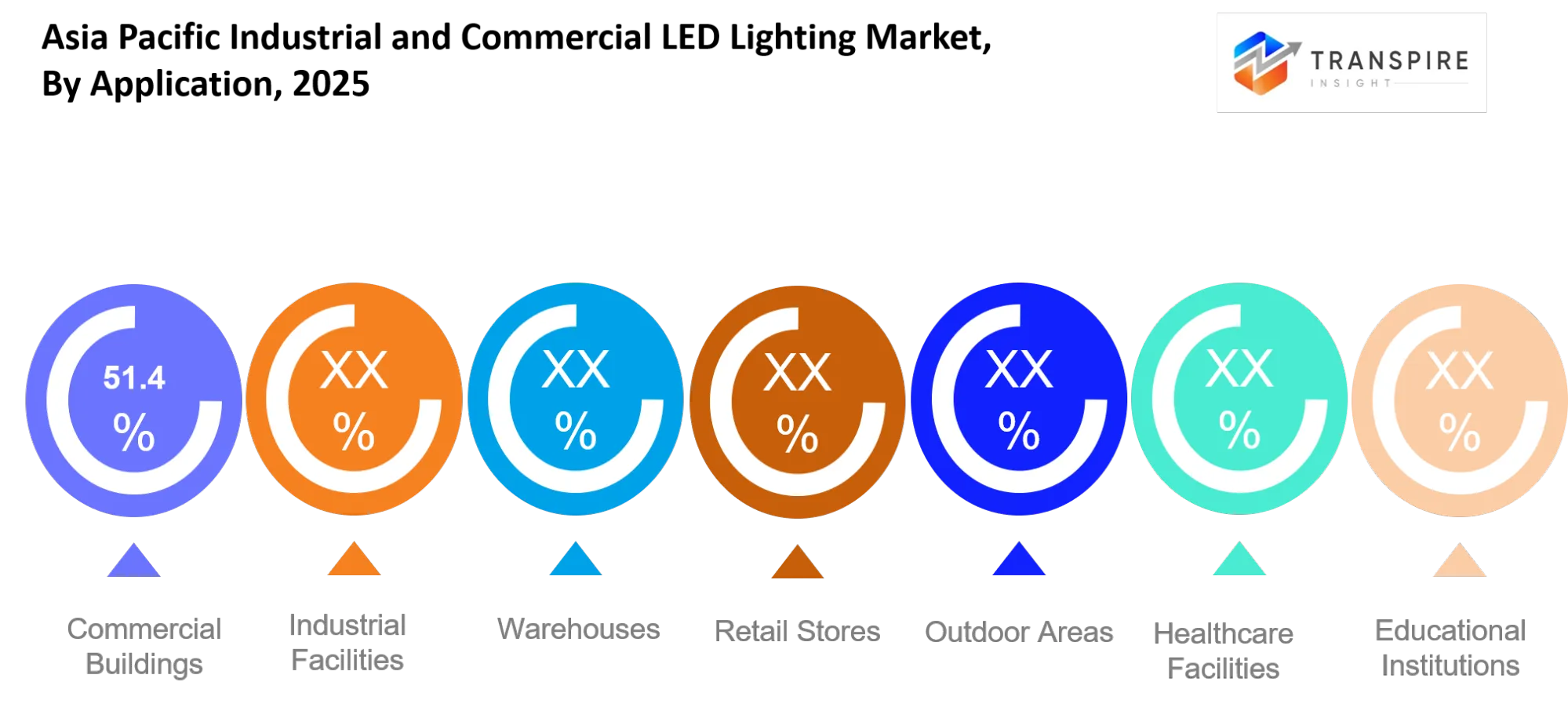
By Installation Type:
New Installation projects are happening often in smart cities and new industrial facilities. Retrofit Installation is still important because old systems need to be changed from fluorescent and halogen lights. Smart Lighting Systems help automate and control commercial spaces. Connected Lighting helps monitor and optimize energy use in time. Energy-Efficient Upgrades focus on reducing electricity use in infrastructure. Automated Lighting makes operations more efficient with sensor-based controls. Hybrid Systems combine new solutions when facilities are being modernized. There are installation methods based on what each facility needs.
By End User:
Manufacturing sectors need LED lights because they are always working and need to meet safety standards. Retail environments use LED systems to improve lighting and save energy. Logistics companies need good warehouse lighting to work accurately and safely. Healthcare facilities need controlled lighting for operations. Educational institutions want to save money by upgrading their lighting. Government projects are modernizing infrastructure on a scale. Hospitality sectors use LED systems to make guests happy and save energy. There are users, with special lighting needs.
What are the Key Use Cases Driving the Asia Pacific Industrial and Commercial LED Lighting Market?
The Asia Pacific Industrial and Commercial LED Lighting Market is mostly used in manufacturing and warehouse operations. These places need lights that're always on and very bright so that people can work safely and accurately. LED lights use energy and help people see better in big factories and warehouses which makes them the best choice for getting work done.Office buildings and stores are also starting to use LED lights to save money and make the space look nicer. Places that handle goods and packages are using LED lights too so they can work all the time without any problems. This helps them do their jobs better and safer.
Cities are also starting to use LED lights in streets and other public places. They are using systems that can control the lights from one place, which makes them more energy efficient. The Asia Pacific Industrial and Commercial LED Lighting Market is also used in areas, like industrial campuses, where LED lights are connected to sensors and other devices. This helps cities build infrastructure that will last for a long time.
|
Report Metrics |
Details |
|
Market size value in 2025 |
USD 24.3 Billion |
|
Market size value in 2026 |
USD 26.2 Billion |
|
Revenue forecast in 2033 |
USD 44.6 Billion |
|
Growth rate |
CAGR of 7.90% from 2026 to 2033 |
|
Base year |
2025 |
|
Historical data |
2021 - 2024 |
|
Forecast period |
2026 - 2033 |
|
Report coverage |
Revenue forecast, competitive landscape, growth factors, and trends |
|
Regional scope |
Asia Pacific (India, China, Japan, Australia, South Korea, Rest of Asia Pacific) |
|
Key company profiled |
Signify, Acuity Brands, Osram, Samsung LED, Nichia, Cree LED, Panasonic, Toshiba Lighting, Havells, Wipro Lighting, GE Lighting, Zumtobel, Eaton, Current Lighting, Fagerhult |
|
Customization scope |
Free report customization (country, regional & segment scope). Avail customized purchase options to meet your exact research needs. |
|
Report Segmentation |
By Product Type (LED Lamps, LED Fixtures, Street Lights, High Bay Lights, Downlights, Panel Lights, Flood Lights, Others); By Application (Industrial Facilities, Commercial Buildings, Warehouses, Retail Stores, Outdoor Areas, Healthcare Facilities, Educational Institutions, Others); By Installation Type (New Installation, Retrofit Installation, Smart Lighting Systems, Connected Lighting, Energy-Efficient Upgrades, Automated Lighting, Hybrid Systems, Others); By End User (Manufacturing, Retail, Logistics, Healthcare, Education, Government, Hospitality, Others) |
Which Regions are Driving the Asia Pacific Industrial and Commercial LED Lighting Market Growth?
The Asia Pacific Industrial and Commercial LED Lighting Market is led by East Asia. This is because East Asia has an ability to make things. It has advanced suppliers of semiconductor products and it was one of the first to adopt smart infrastructure policies.There are factories in China, Japan and South Korea. These factories are still using more energy-efficient lighting systems in buildings, ports and commercial areas.The government is making sure that people follow the rules about using energy. There are also local companies that make LED lights. All these things help East Asia stay ahead of regions.
This system helps people come up with ideas quickly and make things at a low cost.South Asia is in the position. This is because many people are moving to cities, new roads and buildings are being made and the need for electricity is increasing in industrial areas.In South Asia the growth is mainly because people want to save money and use energy efficiently. It is not because they want to use smart lighting systems like in East Asia.India is playing a role in this. The country has programs to use lighting in public buildings and industrial areas.
The economy is growing steadily. Private companies are investing more money. This is helping LED lights to be used more and more in commercial buildings.Southeast Asia is growing quickly. This is because many new industrial areas are being made and smart city projects are being started.A lot of money has been invested in logistics hubs, airports and commercial real estate. This has made people install LED lights and replace old ones.The government is making policies to use energy efficiently. Many foreign companies are also investing in manufacturing infrastructure. This is increasing the demand for LED lights.This growth will create opportunities for companies that make lighting products and technology from 2026, to 2033.
Who are the Key Players in the Asia Pacific Industrial and Commercial LED Lighting Market and How Do They Compete?
The Asia Pacific Industrial and Commercial LED Lighting Market has a lot of companies competing with each other. There are global brands and strong local companies. They compete on how their lights save energy, how smart they are and how much they cost over their whole life, not just how cheap they are. Big companies are trying to keep their customers by making their lights work with things like computers and phones. New companies from China and India are trying to sell their lights for low prices and make a lot of them quickly.
Signify is working on making technology to help their lights work with other systems so customers can save money over time. Acuity Brands is making buildings with special control systems, which helps them save energy. OSRAM makes good lights for factories especially for cars and precise manufacturing and they are very good at engineering and making sure their products are reliable.
Samsung LED is using the fact that they make their own parts to make bright lights for big buildings. Cree LED is making chips that make their lights last longer and save more energy and they are working with local sellers to sell more lights in the Asia Pacific Industrial and Commercial LED Lighting Market.
Company List
- Signify
- Acuity Brands
- OSRAM
- Samsung LED
- Nichia
- Cree LED
- Panasonic
- Toshiba Lighting
- Havells
- Wipro Lighting
- GE Lighting
- Zumtobel
- Eaton
- Current Lighting
- Fagerhult
Recent Development News
In 2025, Signify strengthened its industrial and commercial lighting portfolio by launching new modular and connected outdoor lighting systems, including solar-enabled and smart street lighting solutions. The expansion focused on improving energy efficiency and circular design, reinforcing its position in smart infrastructure lighting across global markets. The initiative supports the company’s broader strategy of integrating IoT-based lighting control and energy optimization platforms into commercial applications.https://www.signify.com
In November 2025, Panasonic Electric Works India launched its Honeycomb LED Down Light series with tri-CCT functionality, targeting commercial interior applications and decorative lighting upgrades. The product enhances flexibility in color temperature control and supports energy-efficient lighting transitions in retail and office environments. This launch reflects the company’s focus on design-driven LED innovation for expanding commercial demand.
https://lsin.panasonic.com
What Strategic Insights Define the Future of the Asia Pacific Industrial and Commercial LED Lighting Market?
The Asia Pacific Industrial and Commercial LED Lighting Market is moving toward fully integrated, software-driven lighting ecosystems where hardware becomes secondary to energy intelligence and building automation. Growth direction will be shaped by tightening energy efficiency mandates and rapid expansion of smart infrastructure projects across industrial corridors and commercial real estate developments. Lighting systems will increasingly operate as part of connected building platforms, linking occupancy data, energy analytics, and predictive control systems to reduce operating costs and carbon intensity.
A key hidden risk lies in supply chain dependency on semiconductor components, where geopolitical disruptions or raw material constraints can create cost volatility and delay large-scale deployments. Another emerging opportunity is the integration of AI-driven lighting optimization within industrial automation systems, particularly in logistics hubs and smart factories across Southeast Asia. This shift will create new value layers beyond illumination, positioning lighting as an operational efficiency tool rather than a utility.
Market participants should prioritize platform-based ecosystems rather than standalone products, investing in interoperable smart lighting systems that integrate with building management software to secure long-term enterprise contracts and recurring revenue streams.
Asia Pacific Industrial and Commercial LED Lighting Market Report Segmentation
By Product Type:
- LED Lamps
- LED Fixtures
- Street Lights
- High Bay Lights
- Downlights
- Panel Lights
- Flood Lights
- Others
By Application:
- Industrial Facilities
- Commercial Buildings
- Warehouses
- Retail Stores
- Outdoor Areas
- Healthcare Facilities
- Educational Institutions
- Others
By Installation Type:
- New Installation
- Retrofit Installation
- Smart Lighting Systems
- Connected Lighting
- Energy-Efficient Upgrades
- Automated Lighting
- Hybrid Systems
- Others
By End User:
- Manufacturing
- Retail
- Logistics
- Healthcare
- Education
- Government
- Hospitality
- Others
Frequently Asked Questions
Find quick answers to common questions.
The Expected Asia Pacific Industrial and Commercial LED Lighting Market size for the Market will be USD 44.6 Billion in 2033.
Key Segments for the Asia Pacific Industrial and Commercial LED Lighting Market are By Product Type (LED Lamps, LED Fixtures, Street Lights, High Bay Lights, Downlights, Panel Lights, Flood Lights, Others); By Application (Industrial Facilities, Commercial Buildings, Warehouses, Retail Stores, Outdoor Areas, Healthcare Facilities, Educational Institutions, Others); By Installation Type (New Installation, Retrofit Installation, Smart Lighting Systems, Connected Lighting, Energy-Efficient Upgrades, Automated Lighting, Hybrid Systems, Others); By End User (Manufacturing, Retail, Logistics, Healthcare, Education, Government, Hospitality, Others).
Major Asia Pacific Industrial and Commercial LED Lighting Market Players are Signify, Acuity Brands, Osram, Samsung LED, Nichia, Cree LED, Panasonic, Toshiba Lighting, Havells, Wipro Lighting, GE Lighting, Zumtobel, Eaton, Current Lighting, Fagerhult.
The Current Asia Pacific Industrial and Commercial LED Lighting Market size is USD 24.3 Billion in 2025.
The Asia Pacific Industrial and Commercial LED Lighting Market CAGR is 7.90% from 2026 to 2033.
- Signify
- Acuity Brands
- OSRAM
- Samsung LED
- Nichia
- Cree LED
- Panasonic
- Toshiba Lighting
- Havells
- Wipro Lighting
- GE Lighting
- Zumtobel
- Eaton
- Current Lighting
- Fagerhult
About the Authors

Pankaj Ghogare Patil
I am Pankaj Ghogare Patil, a Senior Research Analyst at Transpire Insight, specializing in the Pharmaceutical, Chemicals & Materials, Healthcare IT, and Biotechnology industry. My expertise lies in conducting comprehensive market research, analyzing industry trends, evaluating competitive landscapes, and translating complex data into actionable insights. At Transpire Insight, I closely follow emerging technologies, regulatory developments, and market innovations to create accurate, well-researched, and informative content that helps businesses and professionals make informed decisions. I am committed to producing credible, evidence-based articles that reflect industry best practices while making technical topics accessible and valuable for a broad audience.

Chakradhar Khansole
Chakradhar serves as the Research Director at Transpire Insight, bringing over 8 years of experience in technology, innovation, and strategic market intelligence. He specializes in transforming complex market data into actionable business insights that enable organizations to make informed, growth-oriented decisions. Recognized for his strategic vision and analytical expertise, Chakradhar leads high-impact research initiatives, delivering comprehensive market assessments, competitive intelligence, and forward-looking industry analysis.
Recently Published Reports
-
May 2026
Healthcare Polymer Packaging Market
Healthcare Polymer Packaging Market Size, Share & Analysis Report By Packaging Type (Syringes, IV Bottles and Pouches, Clamshells, Blisters, Bottles & Jars, Containers, Tubes, IV Parental Packaging, Others), By Type (Regulated, Non-regulated), By Polymer Type (LDPE (Low-Density Polyethylene), HDPE (High-Density Polyethylene), Homo-polymer (Homo), Random Copolymer (Random), Block Copolymer (Block), PET, Polystyrene, Polyvinyl Chloride, Polyamide/EVOH, Others), and Geography (North America, Europe, Asia-Pacific, Middle East and Africa, South and Central America), 2021 - 2031
-
Apr 2026
Hydrophilic Tape (Waterstop) Market
Hydrophilic Tape (Waterstop) Market Size, Share & Analysis Report By Type (Bentonite-Based Hydrophilic Tape, Rubber-Based Hydrophilic Tape), By Application (Residential Buildings, Commercial Buildings, Infrastructure Projects), and Geography (North America, Europe, Asia-Pacific, Middle East and Africa, South and Central America), 2021 - 2031
-
Apr 2026
Metalens Market
Metalens Market Size, Share & Analysis Report By Type (Visible Light Metalens, and Infrared Metalens), By Application (Consumer Electronics, Automotive Electronics, Industrial, Medical, and Others), and Geography (North America, Europe, Asia-Pacific, Middle East and Africa, South and Central America), 2021 - 2031
-
Apr 2026
PBT Resin Market
PBT Resin Market Size, Share & Analysis Report By Type (Reinforced PBT Resin, Unreinforced PBT Resin), By Processing Method (Injection Molding, Extrusion, Blow Molding, Others), By End-User (Automotive, Electrical & Electronics, Consumer Appliances, Industrial Machinery, Medical Devices, Packaging, Others), and Geography (North America, Europe, Asia-Pacific, Middle East and Africa, South and Central America), 2021 - 2031